CPNN discussion questions

Discussions about Education for Peace

Gender equality in education, Is it advancing?

Understanding the culture of peace, What are the key videos?

How can poetry promote a culture of peace?

What are some good films and videos that promote a culture of peace?

Film festivals that promote a culture of peace, Do you know of others?

What are the most important books about the culture of peace?

What is the best way to teach peace to children?

How do we promote a human rights, peace based education?

The theatre, How can it contribute to the culture of peace?

What is the relation between peace and education?

Where are police being trained in culture of peace?

Do the arts create a basis for a culture of peace?

Can peace be guaranteed through nonviolent means?

What place does music have in the peace movement?

Restorative justice: What does it look like in practice?

Where is peace education taking place?

Mediation as a tool for nonviolence and culture of peace

What’s the message to us today from Martin Luther King, Jr.?

University campus peace centers, What is happening on your campus?

Do war toys promote the culture of war?

Can popular art help us in the quest for truth and justice?

Culture of peace curricula: what are some good examples?

Discussions about Sustainable Development

How can we ensure that science contributes to peace and sustainable development?

When you cultivate plants, do you cultivate peace?

What is the relation between the environment and peace?

Indigenous peoples, Are they the true guardians of nature?

Divestment: is it an effective tool to promote sustainable development?

Opposing tax havens and global exploitation: part of the culture of peace?

Can UN agencies help eradicate poverty in the world

How can tourism promote a culture of peace?

Despite the vested interests of companies and governments, Can we make progress toward sustainable development?

Are we making progress in renewable energy?

What is the relation between movements for food sovereignty and the global movement for a culture of peace?

Can the African Union help bring a culture of peace to Africa?

If we can connect up the planet through Internet, can’t we agree to preserve the planet?

Is there a future for nuclear energy?

Sustainable Development Summits of States, What are the results?

How can we work together to overcome this medical and economic crisis?

Are we seeing the dawn of a global youth movement?

Can a culture of peace be achieved in Africa through local indigenous training and participation?

Local resistance actions-can they save sustainable development?

What is the contribution of BRICS to sustainable developolent?

Discussions about Human Rights

Truth Commissions, Do they improve human rights?

How effective are mass protest marches?

The right to form and maintain trade unions, is it being respected?

What is the state of human rights in the world today?

The struggle for human rights, is it gathering force in the USA?

Is there progress towards democracy and respect for human rights in Myanmar?

Rights of the child, How can they be promoted and protected?

Are we making progress against racism?

Is Internet freedom a basic human right?

Is language a human right?

Abortion – is it a human right?

Are economic sanctions a violation of human rights?

Discussions about Equality of Women with Men

Gender equality in education, Is it advancing?

What role should men play to stop violence against women?

Can the women of Africa lead the continent to peace?

UN Resolution 1325, does it make a difference?

Does the UN advance equality for women?

Prospects for progress in women’s equality, what are the short and long term prospects?

Do women have a special role to play in the peace movement?

Protecting women and girls against violence, Is progress being made?

International Women’s Day

Discussions about Democratic Participation

How can sports promote peace?

Is a U.S. Department of Peace a realistic political goal?

Participatory budgeting, How does it work?

How should elections be organized in a true democracy?

Can festivals help create peace at the community level?

The culture of peace at a regional level, Does it have advantages compared to a city level?

How important is community development for a culture of peace?

How can we develop the institutional framework for a culture of peace?

How can culture of peace be developed at the municipal level?

Restorative justice: What does it look like in practice?

How can parliamentarians promote a culture of peace?

Peace Museums, Are they giving peace a place in the community?

What is the legacy of Nelson Mandela for us today?

What is the contribution of trade unions to the culture of peace?

Discussions about Tolerance and Solidarity

Religion: a barrier or a way to peace?, What makes it one or the other?

Are we making progress against racism?

The understanding of indigenous peoples, Can it help us cultivate a culture of peace?

Youth initiatives for a culture of peace, How can we ensure they get the attention and funding they deserve?

Is there a renewed movement of solidarity by the new generation?

Presenting the Palestinian side of the Middle East; Is it important for a culture of peace?

How can different faiths work together for understanding and harmony?

The refugee crisis, Who is responsible?

Islamic extremism, how should it be opposed?

Solidarity across national borders, What are some good examples?

Two movements: scouting and culture of peace, Are they related?

Discussions about Free Flow of Information

Julian Assange, Is he a hero for the culture of peace?

Can peace be achieved in Mindanao?

How can we be sure to get news about peace demonstrations?

Peace Boat: Building a Culture of Peace around the World

Journalism in Latin America: Is it turning towards a culture of peace?

World Social Forums, Advancing the Global Movement for a Culture of Peace?

The courage of Mordecai Vanunu and other whistle-blowers, How can we emulate it in our lives?

African journalism and the culture of peace, A model for the rest of the world?

Where in the world can we find good leadership today?

How can we carry forward the work of the great peace and justice activists who went before us?

Will UNESCO once again play a role in the culture of peace?

What is the United Nations doing for a culture of peace?

Free flow of information, How is it important for a culture of peace?

What is happening in Colombia, Is peace possible?

Is there progress towards a culture of peace in Mexico?

Can you add to this analysis of the Democratic Republic of the Congo?

Global meetings, conferences, assemblies, What is the best way for delegates to interact afterwards?

What is really happening in Venezuela

The Luanda Biennale: What is its contribution to a culture of peace in Africa?

How can media from the Global south break the media hegemony of the Global North?

Is the media an arm of the culture of war?

Discussions about Disarmament and Security

CPNN discussion concerning the question “Can we abolish all nuclear weapons?”

Can the culture of peace be established at the level of the state?

Can peace be achieved in South Sudan?

Can peace be achieved between Ethiopia and Eritrea?

Israel/Palestine, is the situation like South Africa?

Can Korea be reunified in peace?

Do you think handguns should be banned?, Why or why not?

Is peace possible in Afghanistan?

The peace movement in the United States, What are its strengths and weaknesses?

How can a culture of peace be established in the Middle East?

Discussion concerning the question: A UN High-Level Conference on Nuclear Disarmament: Distraction or progress?

Does military spending lead to economic decline and collapse?

Can cluster bombs be abolished?

Can NATO be abolished?

Discussion: How can there be a political solution to the war in Syria?

Can Cyprus be reunited in peace?

“Put down the gun and take up the pen”, What are some other examples?

How can the peace movement become stronger and more effective?

A culture of peace in Iraq, Is it possible?

Drones (unmanned bombers), Should they be outlawed?

Can the peace movement help stop the war in the Ukraine?

Latin America, has it taken the lead in the struggle for a culture of peace?

Are the people of Haiti making progress towards a culture of peace?

Are there countries that promote a culture of peace?

Does Costa Rica have a culture of peace?

How can war crimes be documented, stopped, punished and prevented?

Where in the world are zones of peace?

The World March for Peace and Nonviolence: What is its history and its effects?

The Nobel Peace Prize: Does it go to the right people?

How can we be sure to get news about peace demonstrations?

It has been argued that over the past century the control of information, especially through the mass media, has become the most important characteristic of the culture of war. Why?

It is because there has been such an advance over the past century in democratic participation that the modern state is forced to justify its culture of war. Since people in general do not want war, the state and its military-industrial complex must convince them that military preparations are necessary in the face of external enemies. This is a major change from earlier history when the state was not subject to election by the people and it could pursue its policies regardless of their attitudes.

In fact, we see that the mass media in countries with the most powerful military forces, such as the United States, are pro-military and continually publish propaganda against external enemies and give priority to news about unavoidable violence and disaster. They do not give place to peace initiatives.

If the commercial mass media will not give us news about peace demonstrations, how can we be sure to get it?

The answer is in the alternative media like CPNN that do not rely on advertising and support from the military-industrial-financial complex.

Here are comments in this regard from a recent meeting during Independent Media Week, now in its 13th year in Oregon.

Citing the “unprecedented antagonism of the Trump administration to media,” Jeff Golden, producer of “Immense Possibilities” on Southern Oregon Public TV, said our challenges didn’t start Jan. 20, because, years ago, much of the media abandoned its role in public service and became driven by profit.

This trend greatly increases the need for independent media, he notes, and much of it can flower on the internet.

“We’d be in much deeper trouble than we are now if not for independent media.”

Here are the CPNN articles on this subject:

‘No Kings!’ 8 Million Rally Against Trump in Largest Single-Day Protest in US History

France: A Look Back at the Solidarity March

School Day of Non-violence and Peace

Hundreds of Thousands March Against US-Backed Israeli Aggression in Tehran

Global Day of Action to Close Bases

Peace Wave 2024

Austrian Censorship of Peace Conference Is An Outrage

More examples available of Russian opposition to the war against Ukraine

March 17: The struggle for free flow of information about the Russian war against Ukraine

Russian anti-war movement takes shape on the streets – and on screens

Russian regulator censors Ukraine war coverage, reporters told to toe Kremlin line

Over a Million Mobilize for International Women’s Day in Latin America

United States: Who Is Clare Grady and Why Should We Care that She is in Federal Prison?

USA: Patriots for Peace fighting the good fight

Launch of the Second World March for Peace and Nonviolence

2nd Walk for the Culture of Peace in Cotia, Brazil, receives support from the World March for Peace and Nonviolence

The Americas are preparing for the second World March for Peace and Nonviolence

Peacecamp Steinwenden, Germany, 28 June

UK: Nationwide Public Meeting Tour: Stop Bombing Yemen, Stop Arming Saudi

Peace and disarmament on the streets of Germany

UK: Protests: Trump & May – No More Bombs on Syria, 13-16 April, Nationwide

Global Anti-war Protests Against US-led Aggression in Syria[

London: International Peace Congress April 7

United Kingdom: Thousands call for Britain’s nuclear deterrent Trident to be scrapped

– – – – Links for the following articles published prior to 2015 do not work because they were made by a version of PERL programming that is no longer supported. With three easy steps, you can find the article by its number. First, click on it before returning to this page. Your browser will say that the article is not available but in the address listed you can see that it was located at ViewArticle=xxxx where xxxx is the number of the article. Returning to this page, then click here for the listing of all years. Then click on the year that contains the number for the article you seek. It will send you to the page where you can easily search for the article by its title. – – – –

Protest to Stop Western Intervention in Syria

International Conference: Confronting War Ten Years On

Thousands march in London for Gaza and freedom for Palestine

October 27 Anti-War Marches in US

Peace Rally in Helena, Montana “>

Demonstrations around the World

How can poetry promote a culture of peace?

Dr. Ada Aharoni, the founder of IFLAC considers that through poetry, people from both sides of conflicts, might come to understand each other better, and that this understanding can lead to the promotion of peace, as she explains below:

THE POWER OF THE POEM AND PEACE THROUGH POETRY

“The real profound difference between human beings is their Culture: mainly, their Cultural Heritage, Literature, Poetry, Language, Values, Norms, Traditions and their History. In the case of people in long conflicts – like the Israelis and Palestinians – feelings of fear, mistrust and lack of understanding have been piling up in their hearts and minds over the years, on both sides.

Only a suitable vehicle that can reach and profoundly penetrate through those layers of mistrust, suspicion and fear, can overcome those separating boundaries and build bridges of trust and respect for each other’s humanity. The best vehicle for this delicate operation is the magic and healing of the Poem, with its words of comprehension, feelings, care and tenderness. The poem has the marvellous ability to create bridges of trust and love.

Peace Poetry can also impart the important and crucial message that we all belong to one family, the family of humanity, and that violence and terror only lead to chaos, destruction, sorrow and deep pain and misery on all sides.

In every conflict there are two stories. The Poem of Peace, because of its wonderful ability to present both sides in all its reality, pain, hope and yearning for peace – can lead to mutual recognition and reconciliation, and to the building of confidence, trust, respect and love.”

Here are the CPNN articles on this subject:

World Movement of Poetry: for the Culture of Peace

From Madagascar: Identity specificity and civilization of the universal

IFLAC World Peace Festival : First edition in Argentina

Hall’s poetry about more than ‘black history

Gwangju, Korea: The 1st Asian Literature Festival

– – – – Links for the following articles do not work because they were made by a version of PERL programming that is no longer supported. With three easy steps, you can find the article by its number. First, click on it before returning to this page. Your browser will say that the article is not available but in the address listed you can see that it was located at ViewArticle=xxxx where xxxx is the number of the article. Returning to this page, then click here for the listing of all years. Then click on the year that contains the number for the article you seek. It will send you to the page where you can easily search for the article by its title. – – – – –

Une jeune malienne de 15 ans gagne le concours des « Chemins de la culture de la paix »

Young Malian aged 15 wins “Pathways to a Culture of Peace”> contest

Poets for Peace

Hall’s poetry about more than ‘black history’

EDUCATION FOR PEACE .

An article by Jeff Schwaner in The News Leader

“We all have poetry in us.” This is the first thing Neal Hall wants to be clear about. The renowned African American poet and medical doctor reads from his work at 7:30 p.m. Thursday, Feb. 18, in the Carter Center for Worship and Music at Bridgewater College.

While Hall is identified as an African-American poet, the demand for him to accept reading engagements is not limited to Black History Month. Hall has performed poetry readings throughout the United States and internationally in Canada, France, Indonesia, Italy, Jamaica, Kenya, Morocco, Nepal and India. He participated in Bridgewater College’s 2015 International Poetry Festival last January.


Photo: SUBMITTED / Steve Ladner

The Bridgewater reading is sandwiched between trips to India and Italy, both chock full of readings and public addresses.

In an email interview, Hall responded to questions of how being an African-American contributed to his evolution as a poet.

“What comes with the label of African-American or Black is this institutionalized, generational legacy of a trail of tears we are forced to walk. This trail and our tears make us uniquely sensitive to the suffering and exploitation of all men and women. It qualifies us and challenges us to stand up to be the true standard bearers and guardians of freedom for all,” Hall writes. “My poetry is influenced by and speaks not just to the surface pain of injustice and inhumanity, but digs deep into that pain, into the genteel socio-political-economic- religious constructs used to blur the common lines of cause that is our shared story. This shared story, the poetry reminds us, should unite us in our common struggle to be free.”

When asked if being identified as an African-American poet could be an obstacle to his expression, Hall responded, “If it is an identifier and/or identity, I did not create it to identify me nor to limit me. As such, one has to ask the larger question: Who created it for me and for what reasons?”

Across the work of four books, Hall’s poetic voice is insistent on his readers realizing their own will to be free, but also identifies the oppressor in its various institutional and cultural forms. “When you see that you are not free / you must say and do, to be free,” he writes in one of the poems from his first book. In the poems “White Man Asks Me” (“A white man asked me to / be less than a man so that he could / find a face-saving way out”) and “Dr. Nigga” (“…save my life / without  changing my life / when my white life codes blue”) Hall directly confronts and reveals the structure of racism.

For some of his readers this is difficult but necessary: “knowing that you are the cause and then the painful act of changing your behavior which has afforded and enriched you (relatively speaking) generating socio-economic advantages over your brothers and sisters.”

(continued in right column)

Question for this article:

How can poetry promote a culture of peace?

Are we making progress against racism?

(continued from left column)

Poetry is one way to face such formidable challenges. “We are the only obstacle getting in the way of our deeper expressions. I find my deepest expression in breathing air in and out deeply in the full realization of my connection, brotherhood and common humanity with all that exists. This connection, this brotherhood, our common humanity is seamless. It is the greed of man exploiting our fabricated man-made differences that has created seams in us, to divide us from our oneness. There is nothing complex nor complicated about man’s gluttony.”

Hall earned his undergraduate degree from Cornell University and an M.D. from Michigan State University. He received his surgical subspecialty training in ophthalmology at Harvard University’s Medical School and was in private practice for more than 20 years in Flourtown, Pa.

Hall is the author of four books of poetry, Nigger For Life, Winter’s A’ Coming Still, Appalling Silence and Where Do I Sit, that deal with oppression and exploitation in American society.

The poet’s charismatic reading style has captured international audiences that go far beyond what any label as an African-American poet might mean. I asked him about the connection. “I have learned from my travels that the oppressors, oppression and their methods are the same all over the world and thus those who suffer from them are connected,” Hall wrote. “The oppressed all understand that their oppression is based in large part on gluttony/greed. The need for a source of continuous cheap labor and to rob people of their substance, their lands and resources often under the guise of religion, democracy, freedom, education, tradition, culture and self-serving charity.”

Few poets read in public as often as Hall. And Hall recognized this activity as a watershed moment in his development as a poet. “There in real time with the poetry of your heart and mind flowing from your mouth, you see yourself touching, moving audiences’ hearts and minds to feel and live the poetry you’ve lived and are re-living in the readings before them. There in real time, I learned to live in my poetry as much as my poetry lives in me.”

I asked him how that speaks to the mysterious relationship between writer and poem and reader.

“It is no mystery. What people get from your poetry is not only what you give them, but also the life experiences they bring to your poetry. And the life experience they bring to your poem can illuminate the words and impact far more — or less — in them than in you or your intent.

So when readers respond in a very surprising manner to a poem, does it make him feel differently about the poem?

“No. The poem is my poem and my experience. I can only feel what I bring to it and it to me. On the other hand, I do feel honored and grateful that others bring their different life experiences into play when reading about and connecting with my life experiences through my poetry. We are, as I have said, seamless! Poetry can bear witness to erase the seams man creates in us.”

Hall writes in one of his poems, “We are socialized and emotionalized to see / our plight in black and white.”

No such adhering to stereotype in Hall’s work.

The program is free and open to the public.


Researchers Develop Artificial Photosynthesis System that Generates Both Hydrogen Fuel and Electricity

. . SUSTAINABLE DEVELOPMENT . .

An article by Dan McCue from the Renewable Energy Magazine

Researchers at the U.S. Department of Energy’s Lawrence Berkeley National Laboratory (Berkeley Lab) and the Joint Center for Artificial Photosynthesis (JCAP), a DOE Energy Innovation Hub, have come up with a new recipe for renewable fuels that could bypass the limitations in current materials: an artificial photosynthesis device called a “hybrid photoelectrochemical and voltaic (HPEV) cell” that turns sunlight and water into not just one, but two types of energy – hydrogen fuel and electricity. The paper describing this work was published on October 29 in Nature Materials.


Illustration: The HPEV cell’s extra back outlet would allow the current to be split into two, so that one part of the current contributes to solar fuels generation, and the rest can be extracted as electrical power. (Credit: Berkeley Lab, JCAP)

Most water-splitting devices are made of a stack of light-absorbing materials. Each layer absorbs different parts or “wavelengths” of the solar spectrum, ranging from less-energetic wavelengths of infrared light to more-energetic wavelengths of visible or ultraviolet light.

When each layer absorbs light it builds an electrical voltage. These individual voltages combine into one voltage large enough to split water into oxygen and hydrogen fuel. But according to Gideon Segev, a postdoctoral researcher at JCAP in Berkeley Lab’s Chemical Sciences Division and the study’s lead author, the problem with this configuration is that even though silicon solar cells can generate electricity very close to their limit, their high-performance potential is compromised when they are part of a water-splitting device.

“It’s like always running a car in first gear,” said Segev. “This is energy that you could harvest, but because silicon isn’t acting at its maximum power point, most of the excited electrons in the silicon have nowhere to go, so they lose their energy before they are utilized to do useful work.”

(Article continued in the right side of the page)

Question for this article:

How can we ensure that science contributes to peace and sustainable development?

Are we making progress in renewable energy?

(Article continued from the left side of the page)

So Segev and his co-authors – Jeffrey W. Beeman, a JCAP researcher in Berkeley Lab’s Chemical Sciences Division, and former Berkeley Lab and JCAP researchers Jeffery Greenblatt, who now heads the Bay Area-based technology consultancy Emerging Futures LLC, and Ian Sharp, now a professor of experimental semiconductor physics at the Technical University of Munich in Germany – proposed a surprisingly simple solution to a complex problem.

“We thought, ‘What if we just let the electrons out?’” said Segev.

In water-splitting devices, the front surface is usually dedicated to solar fuels production, and the back surface serves as an electrical outlet. To work around the conventional system’s limitations, they added an additional electrical contact to the silicon component’s back surface, resulting in an HPEV device with two contacts in the back instead of just one. The extra back outlet would allow the current to be split into two, so that one part of the current contributes to solar fuels generation, and the rest can be extracted as electrical power.

After running a simulation to predict whether the HPEC would function as designed, they made a prototype to test their theory. “And to our surprise, it worked!” Segev said.

According to their calculations, a conventional solar hydrogen generator based on a combination of bismuth vanadate and silicon will utilize only 6.8 percent of the solar energy striking the cell and store it the form of hydrogen fuel. All the rest is lost.

In contrast, the HPEV cells harvest leftover electrons that do not contribute to fuel generation. These residual electrons are used to generate electrical power, resulting in a dramatic increase in the overall solar energy conversion efficiency. For example, according to the same calculations, the same 6.8 percent of the solar energy can be stored as hydrogen fuel in an HPEV cell made of bismuth vanadate and silicon, and another 13.4 percent of the solar energy can be converted to electricity. This enables a combined efficiency of 20.2 percent, three times better than conventional solar hydrogen cells.

The researchers plan to continue their collaboration so they can look into using the HPEV concept for other applications such as reducing carbon dioxide emissions. “This was truly a group effort where people with a lot of experience were able to contribute,” added Segev. “After a year and a half of working together on a pretty tedious process, it was great to see our experiments finally come together.”

The Joint Center for Artificial Photosynthesis is a DOE Energy Innovation Hub.

The work was supported by the DOE Office of Science.

UNESCO proposes concrete projects to implement inter-Korean reconciliation

. .DISARMAMENT & SECURITY. .

An article from UNESCO

The Director-General of UNESCO, Audrey Azoulay, today met Moon Jae-in, President of the Republic of Korea, for the first time, and expressed the Organization’s determination to bolster cooperation with the Korean Peninsula.

“UNESCO wishes to commit its support to inter-Korean reconciliation through concrete projects,” declared the Director-General. “We can help restore the links between peoples through shared heritage, educational programmes and cooperation in natural resources management. Facilitating, even accelerating, the construction of durable peace in the Korean Peninsula through culture, education and the sciences is both the ambition and core mandate of UNESCO.”

(continued in right column)

Question for this article:

Can Korea be reunified in peace?

(continued from left column)

To that end, UNESCO intends to focus on projects that are at once concrete and symbolic. In her talk with the President of the Republic of Korea, the Director-General spoke of her will to reinforce cooperation in the three area of cultural heritage, education and science. These proposals will be discussed with the authorities of the Democratic People’s Republic of Korea.

With regard to cultural heritage, discussions are expected to concern cooperation with a view to identifying shared nominations for inscription on the World Heritage List and on UNESCO’s lists of Intangible Cultural Heritage. Work will also be undertaken to publish a first dictionary of Korean etymology.

In education, UNESCO will lend its support to teachers by reinforcing global citizenship education. Educational programmes to be implemented across the Peninsula could also be developed.

Finally, Ms Azoulay and President Moon Jae-in also envisaged scientific cooperation with regard to water and environmental preservation. Discussions notably focused on initiatives that could be implemented to facilitate joint access, sharing and management of transboundary water resources, and the preservation of biodiversity and its sustainable use for the benefit of local communities.

UK Nationwide Public Meeting Tour: Stop Bombing Yemen, Stop Arming Saudi

. .DISARMAMENT & SECURITY. .

From the website of Stop the War Coalition

The Saudi regime is one of the most brutal and authoritarian anywhere in the world. Its ruler Mohammed Bin Salman is implicated in the murder of journalist Jamal Khashoggi in Turkey and has rounded up and tortured opponents at home. His government is also the main protagonist of the terrible war on Yemen.

The Saudi led war has already devastated Yemen and killed tens of thousands of people. Aid agencies warn that if it continues it will cause the worst humanitarian catastrophe since World War Two.

Yet the British government continues to back the regime. Earlier this year Theresa May welcomed Bin Salman to Britain, claiming he was a reformer. Really the British government stays close to Saudi Arabia because Saudi buys more arms from Britain than any other country, because it is a major oil supplier to the West and because it has long been a key ally in a region the West is desperate to control.

(continued in right column)

Question for this article:

How can we be sure to get news about peace demonstrations?

(continued from left column)

Ending arms sales to Saudi Arabia is essential and urgent. It could help to avert catastrophe. Come to one of our public meetings near you and join us in our campaign to make it happen:

>> 08 Nov | York | Stop Arming Saudi Arabia

>> 12 Nov | Brent | Break Links with Saudi Arabia: End the War in Yemen

>> 15 Nov | Cardiff | Vigil 4 Yemen

>> 27 Nov | London | Stop Arming Saudi – Stop Bombing Yemen

>> 27 Nov | Portsmouth | Stop Bombing Yemen, Stop Arming Saudi

>> 30 Nov | Norwich | Stop Bombing Yemen, Stop Arming Saudi

>> 01 Dec | Merseyside | Justice For Palestine: Freedom, Human Rights and a Lasting Peace

>> 04 Dec | Manchester University | Stop Arming Saudi – Stop Bombing Yemen

>> 04 Dec | Sheffield | Stop Bombing Yemen, Stop Arming Saudi

>> 06 Dec | Basingstoke | Stop Bombing Yemen, Stop Arming Saudi

>> 07 Dec | Liverpool Hope University | Stop Arming Saudi – Stop Bombing Yemen

>> 08 Dec | Edinburgh | Stop Arming Saudi, Hands Off Yemen Protest

>> 13 Dec | Lewisham | Stop Arming Saudi – Stop Bombing Yemen

Paris: World summit brings surge of new commitments to protect human rights defenders

…. HUMAN RIGHTS ….

A press release from the International Federation for Human Rights

Human rights defenders from across all corners of the world gathered this week [31 October] in Paris for the Human Rights Defenders World Summit, to develop a plan of action for how to protect and promote the work of activists fighting for rights, 20 years on from the first UN Declaration on Human Rights Defenders.

After three days of discussions and strategy development spanning regional and global issues, environmental rights and women human rights defenders and the increasing attacks on human rights defenders everywhere, the momentum culminated in the presentation of a landmark action plan which will be presented to the UN in December.


(Click on photo to enlarge)

UN High Commissioner for Human Rights Michelle Bachelet, who spoke at the opening ceremony said: “What human rights defenders teach us is that all of us can stand up for our rights and for the rights of others, in our neighborhoods, in our countries and all over the world. We can change the world .”

The Summit discussed calls on Governments, corporations, international financial institutions, donors and others, including the adoption of national governmental action plans, implementation of legislation to legally uphold the UN declaration, protecting defenders as a priority in foreign policy and prioritizing the protection and work of women human rights defenders, LGBT+, indigenous rights defenders and other marginalized defenders.

(Article continued in the right column)

Question related to this article:

What is the state of human rights in the world today?

(Article continued from the left column)

Kumi Naidoo, Amnesty International’s Secretary General, said: “The level of danger facing activists worldwide has reached crisis point. Every day ordinary people are threatened, tortured, imprisoned and killed for what they fight for or simply for who they are. Now is the time to act and tackle the global surge in repression of human rights defenders.”

The closing ceremony took place at the Palais de Chaillot, where the Universal Declaration of Human Rights was signed 70 years ago. The 150 defenders gathered together to set out the Action Plan and pay tribute to the men and women who work tirelessly to defend human rights around the world.

Among those in attendance over the last three days were Alice Mogwe, Secretary General of FIDH and the Director of Botswana Ditshwanelo; Pulitzer Prize-winning journalist Matthew Caruana Galizia, who is calling for justice after his mother, Daphne Caruana Galizia, was assassinated one year ago in Malta; Anielle Franco, who is bravely campaigning on behalf of her sister, Marielle Franco, a Brazilian activist and elected councillor who was shot dead in her car seven months ago.

Hina Jilani, President of OMCT, founder of the Human Rights Commission of Pakistan, and the first UN Special Rapporteur on the situation of human rights defenders said: “States have never given us space. It is because of human rights defenders that there is space for civil society. Seeing you all here engaged in defending human rights, I am not too pessimistic. As a movement, we have never been as global as we are now. But we have to be clear to states: you need to live up to the challenge and speak out for defenders. Human rights don’t come for free .”

The 1998 UN Declaration on Human Rights Defenders

In 1998, governments adopted the Declaration on Human Rights Defenders to acknowledge the key role of human rights defenders. Despite progress in some areas, many governments are continuing to fall short of their commitments 20 years on from the first Summit and the global context in which human rights defenders operate in has become increasingly challenging. Democratic values are under threat and systemic corruption, extreme inequality and discrimination, religious fundamentalism and extremist policies are all on the rise. Alongside this, we have seen a concerted effort to undermine, discredit and kill human rights defenders. In 2017, at least 312 human rights defenders were assassinated, twice as many as in 2015, almost all with impunity for the perpetrators. The Action Plan hopes to tackle these injustices and support Human Rights Defenders to continue their critical work in a safe environment.

Città della Pieve, Italy: The Declaration of the Scientists for Peace

. . SUSTAINABLE DEVELOPMENT . .

A press release from Comunità di Etica Vivente

Can Peace be conquered on the Planet permanently? For the researchers of various branches of learning who took part in the International Conference “Scientists for Peace” – which was recently held in the “Aula della Cultura” – the answer is yes.


(Click on photo to enlarge)

The first step will be the commitment to increase the awareness of that part of the public opinion conditioned by information that is often distorted and incomplete.

Only effective communication can enable individuals to know, and therefore operate, with increasing awareness, in their daily actions, respecting themselves and their peers. Starting from their own consumptions and rethinking their needs, whose ideological, as well as economic, burden harms the entire planet and its resources.

All this requires dialogue between the various disciplines to arrive at a joint effort where Psychology and Physics intertwine in Mathematics and Law, Economics and Education, Philosophy and Medicine.

The goal is a Healthy world where Prejudice, Fear and War are no longer present. Where Science, as well, gives human beings awareness of the Cosmos, revealing more and more surprising analogical correlations and interconnections, taking a position for certain distortions to be corrected.

For these purposes, the scholars who took part in the Convention have signed the “Declaration of the Scientists for Peace” which will be sent to UNESCO [see text below]. Formative interventions are encouraged to increase a responsible human and social conscience in the school and university paths of those who become practitioners of applied sciences. Starting from the acceptance that scientists and technicians who are part (or that such could become) of a chain of production of war instruments can oppose, appealing to the ethical principles on which the applied sciences must be based. And that, at the same time, intervene in the media so that the war does not continue to be considered possible but definitely reveals the face of an absolute aberration and violation of fundamental human rights.

The Declaration will be brought into the world and will be enriched in the coming months with the signing of other scientists who will be joined under the aegis of “Flag of Peace”, the international association that promoted the conference and has in its mission the promotion of Culture as instrument of Peace, through Science, Art and Philosophy.

(Article continued in the right side of the page)

Question for this article:

How can we ensure that science contributes to peace and sustainable development?

(Article continued from the left side of the page)

Visit the Conference page to see photos, videos and to download the file of the abstracts of the speeches.

Declaration

Recommendations from the “Scientists for Peace” Conference

Science has an important role to play in promoting and achieving peace on Earth. The main question which we ask in this respect is, why are scientists and engineers, highly educated individuals, willing to violate basic humanistic principles by developing and producing weapons? This is mostly due to a limited ethical consciousness, whereby each human being is seen as an isolated individual, and the wider implications of one’s work for society and for humankind are usually belittled.

To change this state of affairs we must become conscious of the fact that humankind can only thrive in peace if it is able to live up to universal ethical principles. Peace on Earth can be fostered and maintained; a world without wars can be developed, where peaceful relationships of responsibility and respect among peoples and individual human beings are properly cultivated.

How can this vision be achieved? What is the proper role for scientists and engineers to fulfil this vision?

We are committed to a view of science as an invaluable resource to promote peace in all areas of life. Accordingly, as a meaningful step towards realizing Peace on Earth, we submit to the United Nations the following recommendations, directed to the world of science and engineering:

• Schools and universities should be strongly invited to offer courses addressing the social responsibilities of scientists and engineers, especially concerning the potential and actual warfare applications of their work. Along with their professional expertise, science and engineering students should develop the ability to raise societal awareness about the threats that existing and prospective weapons systems pose to the survival and flourishing of humankind, especially in connection with weapons of mass destruction.

• It should be made clear that scientists and engineers consciously participating in the development, production, distribution and use of weapons of mass destruction go against the fundamental ethical principles that should be at the core of science and engineering.

• Everybody shall have the right to refuse to obey when it comes to the use of weapons of mass destruction and should be protected accordingly.

• It should be continually reaffirmed that mass media and other sources of information which advocate the view that waging war is an acceptable way to solve conflicts betray universal ethical principles enshrined in the Charter of the United Nations and the prohibition of propaganda for war asserted in the United Nations International Covenant on Civil and Political Rights.

(Thank you to the Good News Agency for calling our attention to this article)

Abolish Militarism and War: Mairead Maguire to the International Conference against US/NATO Military Bases

FREE FLOW OF INFORMATION

Transcript at Transcend

Presentation by Mairead Maguire, Nobel Peace Laureate at the International Conference against US/NATO Military Bases, 16-18 Nov 2018, Dublin, Ireland

Dear Friends, It is good to be here with you all. I would like to thank the organizers for inviting me to address the conference.  Firstly I thank you all for your work for peace.  It is good that we will have an opportunity in the next few days to get to know each other and together discuss what kind of a world we want to live in?  There will be many different perspectives on this and the way forward, but let us agree to respect each other and to engage in deep listening and conversation no matter how hard and where the dialogue might take us!


Let us be encouraged by the fact that we have made an important first step when we agree to enter into dialogue, and when we agree that peace is both the means and the great achievable gift. It would be wonderful too no matter what area of social/political change we work in, if we can unite on a shared vision of a demilitarized world and find strength in agreeing we will not limit ourselves to civilizing and slowing down militarism, but demanding its total abolition.

Some people might argue that peace is not possible in such a highly militarized world.  However, I believe that peace is both possible and urgent.  It is achievable when we each become impassioned about peace and filled with an ethic that makes peace our objective and we each put into practice our moral sense of political/social responsibility to build peace and justice.

To build peace we are challenged to reject the bomb, the bullet, and all the techniques of violence.  Unfortunately, we are constantly bombarded with the glorification of militarism and war; therefore building a culture of peace and nonviolence will not be an easy task.  We are hearing about the building of a European army and we are asked to accept austerity and budget cuts to our health, education, etc. whilst increasing money to our own armies and also European military expansion.

The North Atlantic Treaty Organization-NATO, which should have been disbanded when the Warsaw Pact was dissolved, continue to carry out wars and proxy wars in many countries pushing towards the borders of Russia and resurrecting a cold war between the East and West. I believe that NATO should be disbanded and should be made accountable and make restitutions to the millions of people in countries such as Afghanistan, Iraq, Libya, and many others it has illegally attacked, invaded, destroyed.   We will never be allowed by our governments, or our mainstream media, to hear many of the stories of the lives of so many civilians killed by US/NATO forces.  NATO forces have targeted and assassinated individuals and entire families.

It is to all our shame in the International community, that their illegal criminal acts   of horror and bloodletting which embodies the comeback of barbarism, is allowed to continue.  NATO should be brought before the International Criminal Court  for war crimes.

(Article continued in the column on the right)

Questions related to this article:

Where in the world can we find good leadership today?

(Article continued from the column on the left)

It would be all too easy to point fingers and play the blame game but unless we all take responsibility for the highly dangerous militarised situation with which we are faced in the world today, things will not get better.

Ireland with the militarization of its Foreign and Defence Policy has been unfaithful to the Irish peoples’ wish for a Neutral State and worse by being complicit in accommodating illegal wars.  Ireland’s peace activists have been peacefully protesting US military use of Irish airports whereby over two and a half million armed US troops have passed through Shannon Airport on their way to and from the US-led Afghan and Iraq wars.  I believe ireland should refuse permission to any further stopover and refueling facilities being granted to aeroplanes ferrying troops or munitions to the wars and also withdraw Irish participation from all NATO and EU military operations overseas.

Ireland is deeply admired in many countries and has a proud record in helping developing countries.   Their role as mediators and peace negotiators is well known.   I would like to propose that Ireland disband their army and focus their finance and people on developing their great expertise in the science of peacemaking through a Government Dept. of Peace.   Recommitting to its tradition of neutrality and multilateralism, placing ethics, morality and justice as core values at the heart of its foreign policy would send out a clear message of Irish Government rejecting the road of militarism and war and choosing the road of peace and reconciliation, both locally and internationally.

For our survival through the UN we need to move to General and Complete Disarmament – including nuclear weapons.  This is not an impossible dream.  I commend the Irish Government in their work at UN to work for Nuclear Disarmament.  I believe we can take hope from Pope Francis statement after pointing out the dangers of nuclear weapons when he says‚

‘The threat of their use, as well as their very possession, is to be firmly condemned.’

And the Pope quotes as an example the

‘historic vote at the UN the majority of the members of the international community determined that nuclear weapons are not only immoral, but also must be considered an illegal means of warfare.’

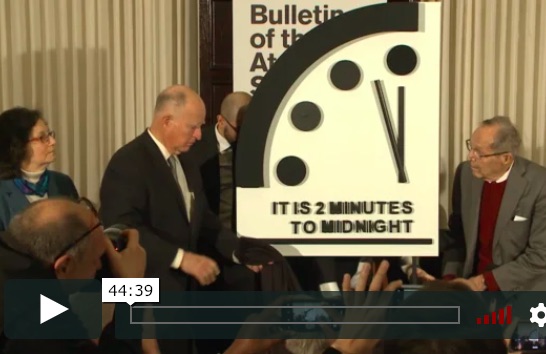
It is to be hoped that UK, Israel, USA and other nuclear armed states will begin to dismantle their nuclear weapons and help turn back the hands of the doomsday clock.   Up to the end of 1961 at the United Nations general and complete disarmament was the aim of all governments.  In a joint Soviet-United states statement of 20 Sep l961 they stated,

‘The goal of negotiations is to achieve agreement on a program which will ensure that disarmament is general and complete and war is no longer an instrument for settling international problems’.

Let us unite our voices to call for an end to enmity and war, and for President Trump and President Putin to join together with all world leaders in a World Peace Conference to work for an agreed Programme of General and Complete Disarmament.  Such courageous leadership towards dialogue and disarmament would give hope to humanity.