Tag Archives: United Nations

United Nations: Annual High-Level Forum on the Culture of Peace

FREE FLOW OF INFORMATION

The annual High Level Forum on the Culture of Peace was held on September 2 at United Nations Headquarters in New York.

The UN has published a transcript and video of the Forum, but we have not found a general article from the UN about the event since it occurred.

We have published here four important speeches to the Forum by:

General Assembly President Annalena Baerbock

Nobel Peace Laureate Leymah Gbowee

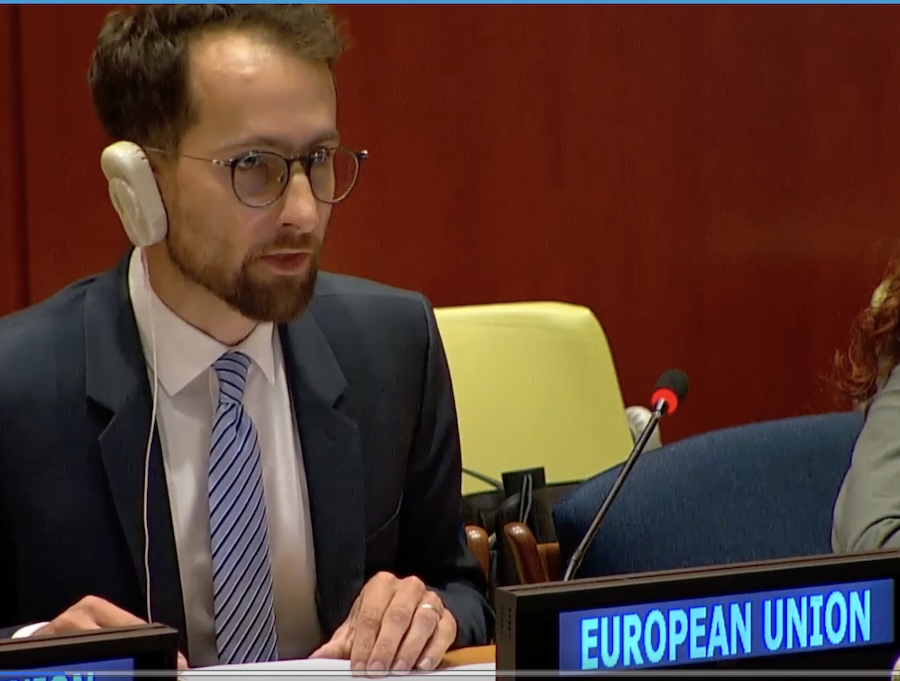
Representative of the European Union (name not provided)

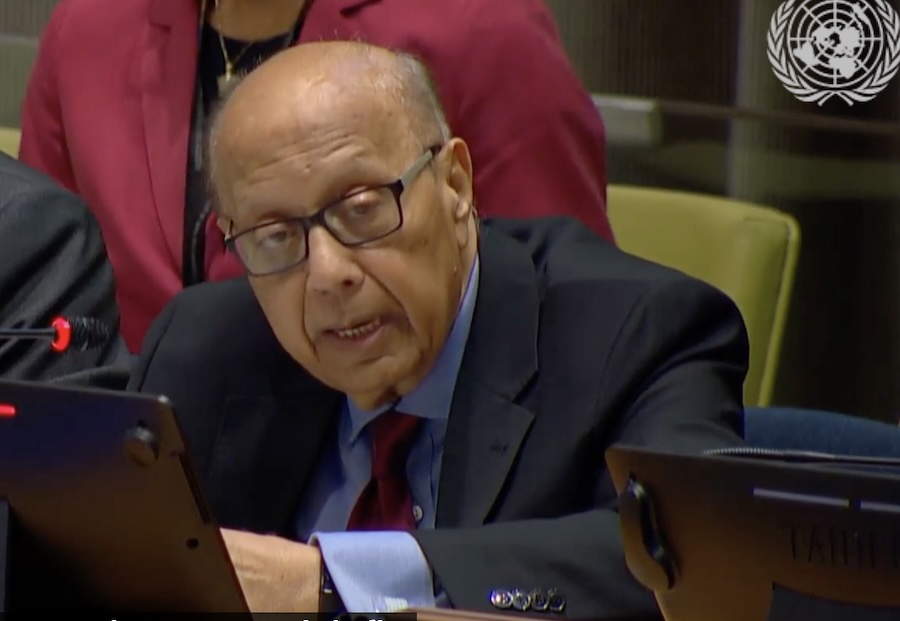
Ambassador Anwarul Chowdhury


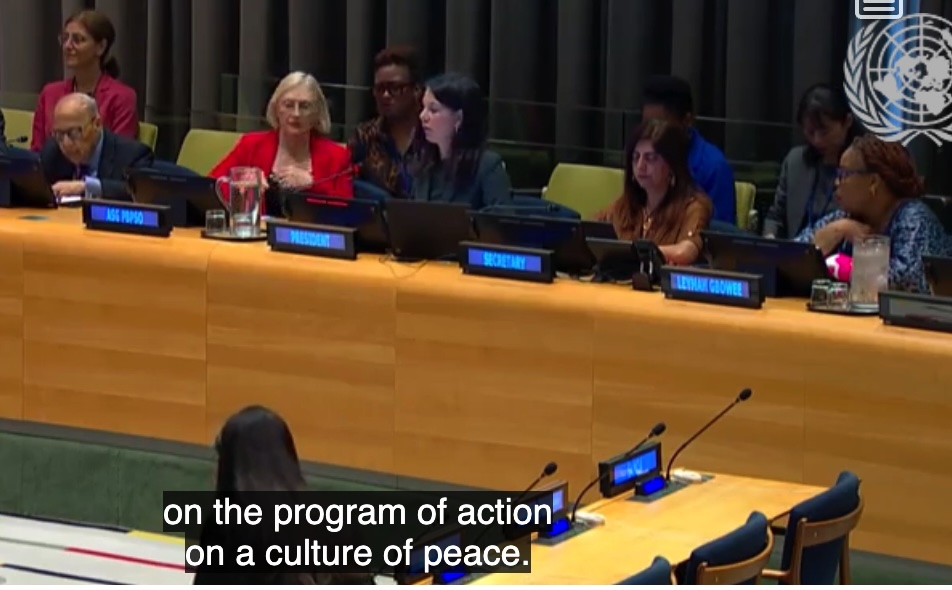
Shown in this frame from the video, from left to right, Ambassador Anwarul Chowdhury, Elizabeth Spehar (Assistant Secretary-General for the Peacebuilding and Peace Support Office), General Assembly President Annalena Baerbock, the Secretary for the event and Nobel Peace Laureate Leymah Gbowee

Question(s) related to this article:

What is the United Nations doing for a culture of peace?

It was Ambassador Chowdhury who inspired the High Level Forum, beginning in 2012, to continue the mission of the 1999 Declaration and Programme of Action on a Culture of peace. The document was submitted to the UN at that time by UNESCO, and it was Ambassador Chowdhury who was responsible for the process of its adoption by the UN General Assembly. When he was the Bangladesh representative to the UN Security Council in 2001, he introduced Security Council Resolution 1325 on Women, Peace and Security

The theme this year was “Women’s Leadership to promote a Culture of Peace”

Many delegations said that their countries are implementing national action plans on UN Security Council Resolution 13 25 on women peace and security. This included the delegations from Kazakhstan, Morocco, Germany, Algeria, Nigeria, Bahrain, Sierra Leone, Portugal, Senegal, Kyrgyzstan, Armenia, Tunisia and Mexico.

The representative from Angola said that his country will organize later this year on 22 and 23rd of October, the Luanda Biennale, the Pan African Forum for the Culture of Peace and Nonviolence. Previous editions of the Biennale may be found here.

The representative from the EU confirmed their support for the culture of peace, which is of special importance because prior to 2024 they did not support it.

Until 2023 the Forum brought together representatives of the civil society along with UN delegations to debate the culture of peace, as described CPNN articles listed here. Since 2023 then it has been restricted to UN delegations.

Ironically, as one may read in the transcript and hear on the video, the delegations of Israel and Russia claimed that their countries are promoting a culture of peace. No mention was made during the Forum to the ongoing genocide and wars involving the United States, Israel, Russia, Ukraine and Iran. The United States, Ukraine and Iran did not take part in the Forum.

– – – – – –

If you wish to make a comment on this article, you may write to coordinator@cpnn-world.org with the title “Comment on (name of article)” and we will put your comment on line. Because of the flood of spam, we have discontinued the direct application of comments.

United Nations: Remarks by the President of the General Assembly at the High-level Forum on the Programme of Action on a Culture of Peace

FREE FLOW OF INFORMATION

A publication of the United Nations

Remarks by H.E. Annalena Baerbock, President of the 80th Session of the United Nations General Assembly at the High-level Forum on the Programme of Action on a Culture of Peace on Wednesday, 2 September 2026,

[As Delivered]

Excellencies,

Ladies and gentlemen,
 
80 years ago, our United Nations was created with the express purpose of saving succeeding generations from the scourge of war.
 
Yet our founding mothers and fathers had the wisdom, foresight, and especially experience to know that peace is more than the absence of war.
 
Therefore, they sought to build an institution not focused narrowly on peace and security, but upon the mutually reinforcing pillars of human rights, sustainable development, and peace and security.
 
So while today some call for the United Nations to go “back to basics,” we should remember that the pursuit of a just, sustainable, and lasting peace is, indeed, one of our basics.

It is embedded in the very foundations of this Organization.


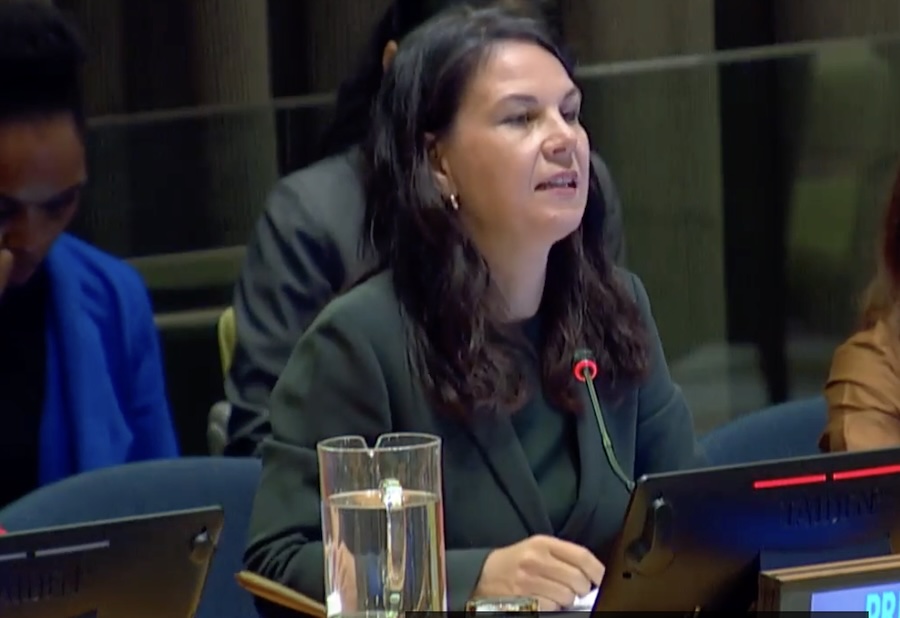
Frame from UN video

 
And it lies at the heart of the Culture of Peace: the conviction that lasting peace requires replacing violence with dialogue, division with mutual understanding and cooperation, and exclusion with participation.
 
Since the adoption of the Declaration and Programme of Action on a Culture of Peace in 1999, at the initiative of Bangladesh, this Assembly has continued to advance that vision of a more peaceful, just, and inclusive world.
 
Central to this effort is the full, equal, meaningful, and safe participation of women in peace processes.
 
That is why the theme of this year’s High-Level Forum—”Women’s Leadership to promote a Culture of Peace”—could not be more important and timley.
 
Including women at every stage of the peace process is not just a “nice to have”.
 
It is not doing a favour to women.
 
It is not even simply a matter of fairness.
 
It is fundamentally a question of whether peace succeeds.
 
Research has shown that when women participate meaningfully in peace processes, the probability of an agreement lasting at least two years increases by 20 per cent and the probability of conflict returning is reduced by 37 per cent.
 
That is because women bring the experiences, knowledge, and priorities of half the world’s population to the negotiation table. The society approach.
 
They broaden negotiations beyond the conduct of war and armed actors to the communities and people that are affected by it.

And they raise issues that create the conditions for peace to firmly take root—from conflict-related sexual violence and access to justice to economic opportunity and political participation at all levels.
 
Or as the women I who I met at the front lines told me: if women are safe, everyone is safe.
 
Because when more voices and perspectives are included when shaping peace, the outcome will better reflect the realities of the people who will benefit from it, and peace will be more likely to endure.

(article continued in right column)

Question(s) related to this article:

What is the United Nations doing for a culture of peace?

(article continued from left column)
 
History has given us powerful examples of women’s role in peace.
 
In Colombia, women-led advocacy helped ensure that the landmark 2016 agreement between the Government and the Revolutionary Armed Forces addressed critical issues, such as victims’ rights, land access, and conflict-related sexual violence.
 
And in Liberia, Christian and Muslim women came together across religious and social divides to pray, organize, and demonstrate for peace.
 
Through the Women of Liberia Mass Action for Peace, they pushed political leaders and armed actors towards peace by bringing their demands directly to the negotiating process in Accra.
 
I am therefore especially honoured that today we are joined by Ms. Leymah Gbowee, Nobel Peace Prize Laureate and one of the pioneering leaders of that movement, to learn from your experience.
 
Ms. Gbowee’s unwavering bravery and tenacity to mobilize communities and demand accountability is not simply an inspiration to admire from afar…it is a rallying call to give women the power to shape peace in every conflict.
 
This Assembly has affirmed that principle time and again.
 
The 2025 Review of the United Nations Peacebuilding Architecture recognized that the full, equal, meaningful, and safe participation of women at all decision-making levels in conflict resolution is key to achieving durable solutions and long-term stability.
 
The Architecture recognizes the role of women in the prevention and resolution of conflicts, in peacebuilding, and in building critical foundations for promoting a culture of peace.
 
Ladies and gentlemen,
 
Our commitments are clear.

The history speaks for itself.

And the data is unequivocal.
 
Yet there remains a profound gap between what we know and what we are doing.
 
At a time when the number of armed conflicts is at a record high, too many negotiating tables still exclude the women that hold the keys to unlocking peace.
 
Frankly speaking, you only have to look at the most recent photos or media coverage of the latest peace negotiations, where there are hardly any women in the room.
 
And also frankly speaking, if we also look at regular governmental consultations these days, so often there is not a single woman present.
 
And even in teams programming the next AI algorithm – even when we know that AI will play a crucial role in the conflicts of the future – still they are not designed with the voices of women.
 
So it doesn’t only start at the end, at the peace negotiation table.
 
It starts here today, in our own meetings, in our own CEO set ups, in our own culture.
 
As said, this is not only a question of injustice, it is a missed opportunity for sustained peace, to leave women out of the group.
 
If we are serious about fulfilling the promise made 80 years ago to save succeeding generations from the scourge of war, then our commitments must be matched by our actions.
 
A Culture of Peace is not an abstract aspiration, it is a choice every one of us makes every day throughout societies.

And it is our collective responsibility to build societies…

Where we uphold the principles of the UN Charter and the Universal Declaration of Human Rights.

Where we safeguard justice and dignity for all.

And where we ensure that women are not observers of peace, but are actively building it. Because if women are safe, everyone is safe.
 
– – – – – –

If you wish to make a comment on this article, you may write to coordinator@cpnn-world.org with the title “Comment on (name of article)” and we will put your comment on line. Because of the flood of spam, we have discontinued the direct application of comments.

Statement of Nobel Laureate Leymah Gbowee at the UN High-Level Forum on the Culture of Peace

FREE FLOW OF INFORMATION

Copied and corrected by CPNN from United Nations transcript and video

Thank you, Madam President.

Your Excellencies, I’m honored to join you at this high level forum on the program of action on the culture of Peace.

I’m glad to be sharing this space again with you, Ambassador Chowdhury and to other colleagues in the room.

12 years ago, I sat in this very room to speak on the culture of peace.
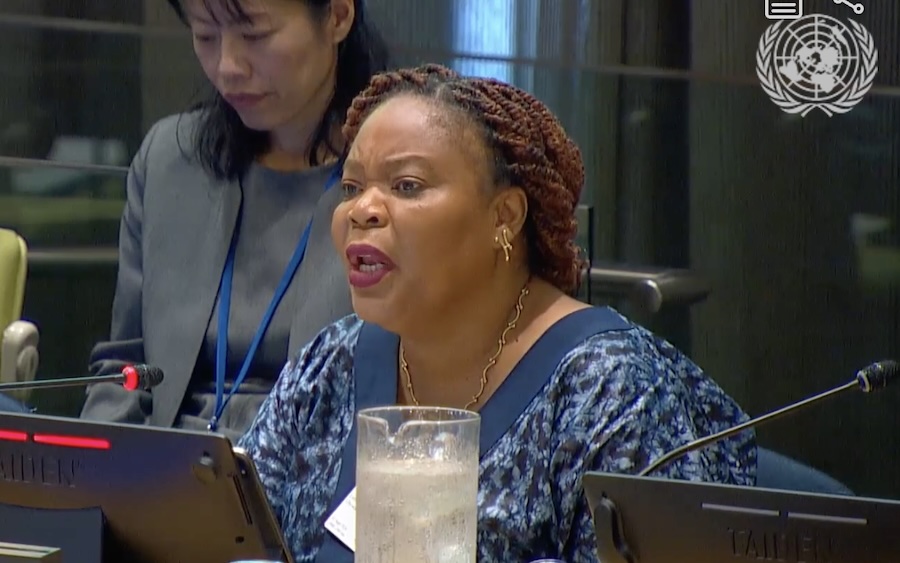

Frame from UN video

In those moments, we were faced with Ebola in the Mao River basin. ISIS was on the lips of everyone because of the war, the Syrian war was raging and the climate conversation had just ended in Peru, laying the groundworks for the Paris Agreement a year later.

That same year, we were preparing to celebrate the 15th anniversary of the UN Security Council Resolution 1325 as women peace builders.

In those moments as we prepared, we hoped our world would finally not only recognize our unique skills and potentials in conflict resolution and building peace in our communities, but strategically engage us as partners and thought leaders in the quest for peace in our world.

Fortunately or unfortunately, that would not be the case, and the struggle continues.

I am one of the thousands of women in Liberia who worked for years to end the Liberian Civil War.
In those years, we worked at the local level in different ways to end the war.

However, I wish I could say our processes were connected.

At the beginning, we were disconnected and it perpetuated a lot of divisions that separated our country and us as women.

Many of us recognize the futility of working separately. So the question we ask ourselves, how can we extinguish the fire of war with drops of water? And how can we extinguish the fire of war with a divisive mentality?

We came together, formed the Women of Liberia Mass Action for Peace, and Madam President spoke about it earlier on, bringing together Christian and Muslim women.

This marriage was far from easy. There was no honeymoon. We got married and we had to start working.

Our group included women from different income levels, rural and urban areas, ethnicity and faith.

In those early days, we spent many days negotiating amongst ourselves in order to resolve the conflicts that came up. Contrary to popular belief that grassroots women peace efforts lack planning, coordination, and strategy, we as Liberian women, like many other women across the world, were intentional. We planned every day for hours.

We deliberately sought out actors who will further our cause and build strategic alliances in the course of our work.

In that struggle, we inadvertently carried out the first mandate of Article 1 in the Declaration of the Culture of Peace. This article says, education, through education, dialogue and cooperation.

We fostered an environment conducive to peace. It is not easy as peace building is never easy. But in doing so, we expanded our initial goal of ending the Liberian Civil War.

We committed to building a culture of peace in a nation that had been devastated by war. 1 million of our compatriots were internally displaced, 500,000 were refugees. At that time, our population was about 3 million and we have an estimated 250,000 people who lost their lives.

Just to give you a picture that we were able to kill at least almost 10% of our population in 14 years of Civil War.

When negotiations negotiations failed in 1996 and 1999, the women of Liberia were able to contribute to lasting peace.

I can emphatically say 23 years without the resurgence of violence! Last August made it 23 years. in Liberia it is largely due to the communities, specifically the women’s active involvement. Not just in 2003, but from 2003, we have consistently continued to engage, ensuring that peace and the peace process remains on course.

If peace was never handed to the Liberian women, we labored, we persevered and recreated a culture of respect and constructive engagement.

(article continued in right column)

Question(s) related to this article:

What is the United Nations doing for a culture of peace?

(article continued from left column)

This year, our world is in a maze of conflict and global issues: geopolitical instability marred by competition and fragmentation; trade tensions and supply chains disruption; climate and environmental crisis, AI is source of opportunities and concern. False information and information manipulation are deepening political and social divisions and undermining public trust in governments and democratic processes.

In all of these, women continue to suffer.

As we gather to consider the programs of action on the culture of peace, we must consider these three factors.

One, a culture of peace therefore requires more than absence of conflict. It requires inclusion, justice, dignity, dialogue, and in the world that we live in today, dialogue is far from everything that we do. It’s either you agree with me, or if you disagree, we can have a conversation and the willingness to build relationship across political divide, religious, ethnic, and social divides.

In a world of increasing political intolerance, my question to you all Your Excellency, is this possible to achieve?

The second part, a culture of peace becomes possible when women are not simply invited to participate, but are recognized as leaders, decision makers, and builders of a more just and inclusive society. For too long, women’s involvement in these processes has been decorative.

Sometimes I refuse invitations to come to the UN, just saying what Ambassador Chaudhury said, 80 years of male dominance. Now is the time for women’s leadership at the UN.

We continue to see resistance or welfare amnesia in women’s full and effective participation in building a culture of peace and peace building work.

Women across the world have been tested, have been proven worthy of building peace at all levels.

We don’t need to build a strong case on the behalf of women anymore. Unlike many global peace processes, women have the track record.

It is our role now as leaders in this room to help elevate women’s peace building work and review the difference in how national and global peace is negotiated.

Women peace building is not centered solely on deconstructing war. It is about building a culture of peace.

Today’s affirmation is more importantly, a challenge.

The United Nations, as we all sit here, is as strong as its member states. And all of the member state in this room is weak without its people. And by saying people, I mean all genders.

When we have elections in our countries, it’s not just the men that vote. The women vote also.

So it is important that men as well as women play a critical role in creating the culture of peace.

The third part is resources.

Many speakers talked about it. The Assistant Secretary-General talked about resources.
We use billions to make war we cannot use peanuts to build peace. Now is the time if we’re serious about building a culture of peace and involving women, we must give them the necessary resources.

But let me just emphatically state here that I’m really very proud of women across the world, despite the shrinking spaces, The shrinking resources, despite the political pushback that we’ve received, women are no longer waiting because we recognize that with or without donors funding, we become the ones who bear the greatest brunt in every crisis.

So we continue to work to keep our communities and our society stable.

So I think we must continue to applaud the efforts of women. While the world continues to watch and wait, women continue to do amazing work in their different countries.

I sincerely believe that the ultimate goal of all of our activities globally is to create a culture of peace that promotes respect of rights of others in the world where we all live in harmony.

This goal is achievable.

However, it will take hard work, thinking outside of the box, political will and sincerity.

I will end with this, giving each and every one of us in this room a homework And the homework is, as you go home today, look at your children, look at your community, look at your nation.
Think about the culture of peace and ask yourself, can we continue to do peace building without the hands of everyone?

Can we continue to operate our world, leaving women behind?

If we’re serious about building a culture of peace for our children and the next generation, we must sit and answer these questions sincerely.

Thank you, Madam President.

– – – – – –

If you wish to make a comment on this article, you may write to coordinator@cpnn-world.org with the title “Comment on (name of article)” and we will put your comment on line. Because of the flood of spam, we have discontinued the direct application of comments.
EU Statement at UN High-Level Forum on the Culture of Peace: Women’s Leadership to Promote a Culture of Peace

FREE FLOW OF INFORMATION

A publication of the Delegation of the European Union to the United Nations in New York

Mr President,

I have the honour to speak on behalf of the European Union and its Member States. 
The Candidate Countries North Macedonia, Montenegro*, Albania*, the Republic of Moldova, and Georgia, as well as Armenia, Monaco, San Marino and the United Kingdom align themselves with this statement.

We reaffirm our full support for the Culture of Peace agenda and welcome the focus of the discussion this year on women’s leadership in promoting the culture of peace. 


Frame from the UN video

The EU was born from the ashes of war, with the determination to turn competition into partnership, conflict into cooperation. We have learned to nurture the culture of peace and adopted it as part of our DNA. The principles and values guiding us today are informed by this very experience. 

Today, as a global peace actor, the EU is committed to the peaceful settlement of conflicts, dialogue and diplomacy, as well as respect for international norms and obligations. We stand firm in our conviction that today’s complex challenges can only be resolved through collective commitment and action, through effective multilateralism, with the United Nations at its core. 

Chair, 

Peace can only be achieved and sustained with a holistic approach that tackles the root causes of conflicts. It requires strengthening societies through the promotion of human rights and fundamental freedoms, democratic participation and civic space, inclusive and sustainable development, as well as the rule of law and good governance, served by well-functioning justice systems. A comprehensive approach to peacebuilding also requires strengthened coherence between humanitarian action, development and peacebuilding efforts, particularly in fragile and conflict-affected contexts. 

(article continued in right column)

Question(s) related to this article:

What is the United Nations doing for a culture of peace?

(article continued from left column)

Peace is where the rights and dignity of every person are respected and where all have equal opportunities to thrive, without any discrimination, intimidation or violence, and where diversity and pluralism are celebrated. This requires investments into education from an early age, the empowerment of young persons, the inclusion of those marginalised, as well as gender equality and the empowerment of all women and girls – the focus of today’s discussion. 

Chair,

Women play a fundamental role in building and maintaining resilience in societies through their contributions in all aspects of life. Societies can only be strong if they are underpinned by the full and equal contributions of women and girls. 

In times of conflict, women have proven to be at the forefront of prevention, mediation and conflict resolution. Their full, equal and meaningful participation in peace processes, peacebuilding, post-conflict recovery and decisions-making is a prerequisite for sustainable and inclusive peace. The Women, Peace and Security Agenda is central to advancing this goal, and therefore, its implementation is a strategic imperative. 

However, this requires the elimination of structural barriers that women and girls face in society. This includes eradicating discriminatory gender norms, threats, harassment, reprisals and violence against them, including women peacebuilders and women human rights defenders, providing a safe and enabling environment, and taking proactive steps to promote women’s leadership at all levels. 

The EU remains strongly committed to this end. We support women mediators’ networks, systematically include women experts in our mediation support teams, and integrate a gender perspective throughout their work. We also promote women’s participation in peace processes, making sure that at least one third of participants in all EU-supported peace process activities are women. We further support women leaders and experts in directly engaging in negotiation and political processes through dedicated women’s advisory bodies. And finally, we fund women peacebuilders, women-led and civil society organisations and women human rights defenders to advance mediation, conflict prevention and inclusive governance in conflict-affected communities in various regions of the world. 

Chair,

The Culture of Peace agenda remains at the heart of our work as we strive to achieve peace, prosperity and human rights for all. The EU stands firm in this commitment and is taking action to cultivate it today and every day. 

I thank you. 

– – – – – –

If you wish to make a comment on this article, you may write to coordinator@cpnn-world.org with the title “Comment on (name of article)” and we will put your comment on line. Because of the flood of spam, we have discontinued the direct application of comments.
Statement of Anwarul Chowdhury at the UN High-Level Forum on the Culture of Peace

FREE FLOW OF INFORMATION

Copied and corrected by CPNN from United Nations transcript and video

Thank you, Madam President. I would like to begin by thanking you for a very powerful and meaningful opening statement. We appreciate that.

I have a special pleasure in welcoming Leymah Gbowee, because she was on previous occasion as the keynote speaker in the high level forum on the culture of peace. I’m very happy she joined us this time again.

I have also great pleasure in welcoming the permanent representative, the new permanent representative of Bangladesh. She is here and I’m very happy that Bangladesh mission is now headed by a woman leader. That’s a wonderful opportunity for me to meet her for the first time in this meeting.

Madam President, in 11 days from today, on 13 September, the United Nations will observe the 27th anniversary of the General Assembly’s unanimous adoption of the Declaration and program of action on a culture of peace. This high level forum convened by you, Madam President, provides the most appropriate setting for the celebration of this remarkable pathway to the global culture of peace as articulated by its apex body.

The theme of this forum rightfully is women’s leadership to promote the culture of peace.


Frame from UN video

If I may add here that you yourself, Madam President, is a true embodiment of the core focus of this theme in your leadership of the United Nations General Assembly as one of its five women presidents, among the 80 individuals gracing this position since the birth of this organization.

Mandated by the UN resolutions, the successive presidents of the General Assembly have been convening the annual high level forums attracting the attention of member states and civil society since 2012, when your predecessor, PGA 66, Ambassador Al-Assad, took the initiative to convene the first forum.

I had the honor of introducing on behalf of the member states after successfully chairing the nine month long negotiations on the relevant resolution A 53243, which was adopted on 13 September in 1999, as you said.

The global movement for the culture of Peace, GMCOP, a coalition of civil society organizations have been spearheading advocacy initiatives effectively since 2011, as well as in organizing the annual high level forums on the culture of Peace convened by the president of the UN General Assembly from its beginning in 2012, all the way to 2022.

The forum has the distinction of being the only gathering which was addressed by the largest number of Nobel peace laureates, all women, and again, recognize Leymah’s presence here. Six times out of 11 forums.

Also, the forum’s panelists were always gender balanced on most occasions with more women participating.

At the United as the United Nations Under Secretary-General and High Representative for the most vulnerable countries and as the permanent representative of Bangladesh, my work has taken me to the furthest corners of the world.

I have seen time and again the centrality of women’s equality and the culture of peace in our lives.

This realization has now become more pertinent in the midst of the ever increasing militarism, militarization, and weaponization that is destroying both our planet and our people.

(article continued in right column)

Question(s) related to this article:

What is the United Nations doing for a culture of peace?

(article continued from left column)

As we all know, the charter of the United Nations when signed in 1945, was the first international agreement to affirm the principle of equality between women and men.

The program of action on culture of peace accords a place of prominence to equality between women and men fourth among its eight action areas.

Women represent more than half of the global population, yet they continue to be underrepresented in leadership positions in every region of the world.

Unfortunately, in recent years, women’s rights are under threat from a backlash of conservatism and fundamentalism around the world.

Let me assert again that patriarchy and misogyny are the dual scourges pulling humanity back from our aspiration for a better world to live in freedom, equality and justice.

On 8th of March 2000, as the president of the UN Security Council, I could initiate and mobilize the council to recognize unanimously in a statement that and I quote, peace is inextricably linked with equality between women and men, end and affirmed the value of full and equal participation of women at all decision making levels. That is when the seed for the UN Security Council Resolution 13 25 was sown.

It was finally adopted on the 31st of October of the same year.

We should never forget that when women, more than half of the world’s 8 billion plus people, are marginalized, there is no chance for our world to get sustainable peace in the real sense.

It is my strong belief that unless women are engaged in advancing the culture of peace at equal levels at all times with men, sustainable peace would continue to elude us.

In various parts of the world, women have shown great capacity as peace builders. At the grassroots and community levels, women have organized to resist militarization, to create space for dialogue and moderation, and to weave together the shattered fabric of society.

As I reiterate time and again, women bring a new breadth, quality, and balance of vision to a common effort of moving away from the cult of war towards the culture of peace.

Women’s equality makes our planet safe and secure.

The slogan of global campaign on women peace and security, which we launched in London in June 2014 reiterates, and I quote, “If we are serious about peace, we must take women seriously.”

Let me end by emphasizing that feminism is not intended to pit women against men or men against women. Feminism is about smart policy, which is inclusive, uses all potential, and leaves no one behind.

I am proud to be a feminist. All of us need to be. That is how we make our planet a better place to live for all.

We should always remember that without peace, development is impossible and without development, peace is not achievable. But without women, neither peace nor development is conceivable.

I continue to emphasize that the culture of peace is not a quick fix. It is a movement, not a revolution, and women always bolster that movement immensely.

Let me conclude by underscoring here an unacceptable reality.

In its 81 years of existence, the United Nations has not yet elected a woman Secretary-General, eight decades plus nine men, not one woman. What an embarrassment, what a shame.

How can an institution that speaks of equality at every podium continues to model inequality at its pinnacle?

The credibility of the event’s advocacy depends on its own reflection in the mirror.

I thank you for your kind attention.

– – – – – –

If you wish to make a comment on this article, you may write to coordinator@cpnn-world.org with the title “Comment on (name of article)” and we will put your comment on line. Because of the flood of spam, we have discontinued the direct application of comments.
United Nations: Strengthening Culture of Peace

FREE FLOW OF INFORMATION

Excerpt from UN Meetings Coverage and Press Releases

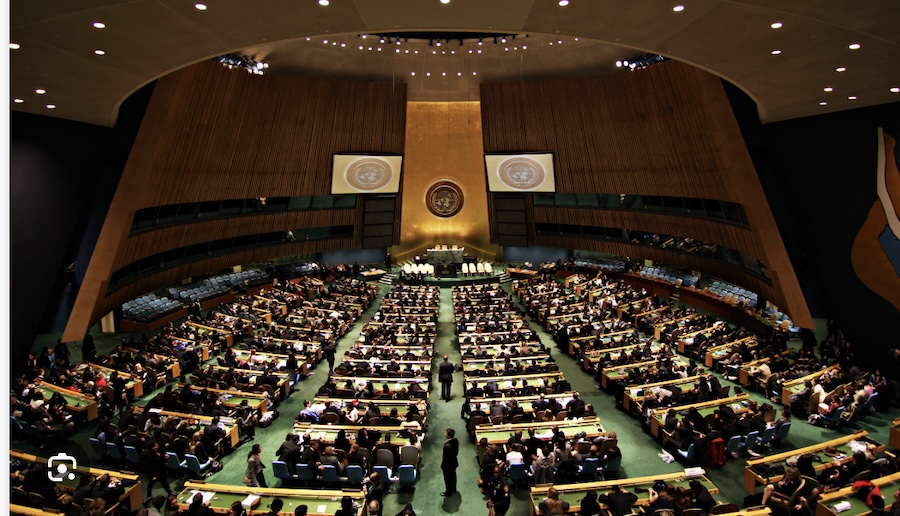
The Assembly adopted the draft resolution titled “Follow-up to the A/80/L.77/Rev.1) by a recorded vote of 169 in favour to 2 against (Israel, United States), with no abstentions.

Through that text, the Assembly reiterated that the Programme’s objective is to strengthen the global movement for a culture of peace and called on all concerned to renew their attention towards this end.  In that regard, the Assembly’s President was requested to consider convening a high-level forum during the eightieth session devoted to the Programme’s implementation.

Bangladesh’s representative, who introduced the draft, highlighted his country’s 25-year role in facilitating this initiative and said that the resolution has long served as a platform for reaffirming a shared commitment to peaceful coexistence.  “Investing in a culture of peace is an investment in our survival,” he urged.  

However, while the representative of the United States said that his delegation supports such a culture, he opposed the draft because of its “politicized, controversial and distracting references”.

Action paragraphs of the resolution:

1. Reiterates that the objective of the effective implementation of the Programme of Action on a Culture of Peace is to strengthen further the global movement for a culture of peace, and calls upon all concerned to renew their attention to this objective;

2. Invites Member States to continue to place greater emphasis on and expand their activities promoting a culture of peace at the national, regional and international levels and to ensure that peace and non-violence are fostered at all levels;

3. Invites the entities of the United Nations system, within their existing mandates, to integrate, as appropriate, the eight action areas of the Programme of Action into their programmes of activities, focusing on promoting a culture of peace and non-violence at the national, regional and international levels;

4. Commends the United Nations Educational, Scientific and Cultural Organization for strengthening efforts to mobilize all relevant stakeholders within and outside the United Nations system in support of a culture of peace, and invites the Organization to continue to enhance communication and outreach, including through the culture of peace website;

5. Also commends the practical initiatives and actions by relevant United Nations bodies, including the United Nations Children’s Fund, the United Nations Entity for Gender Equality and the Empowerment of Women (UN-Women) and the University for Peace, as well as their activities in further promoting a culture of peace and non-violence, in particular the promotion of peace education and activities related to specific areas identified in the Programme of Action, and encourages them to continue and further strengthen and expand their efforts;

6. Stresses the importance of addressing the underlying drivers of violence and conflict to promote a culture of peace;

7. Encourages Member States, United Nations entities and other relevant actors to adopt a holistic approach to the cross-cutting dimensions of peace, development, humanitarian action and human rights in order to prevent the recurrence of conflict and violence and build lasting peace;

8. Underlines that early childhood development contributes to the development of more peaceful societies through advancing equality, tolerance, human development and promoting human rights, and calls for investment in early childhood education, including through effective policies and practices, towards promoting a culture of peace;

(article continued in right column)

Question(s) related to this article:

What is the United Nations doing for a culture of peace?

(article continued from left column)

9. Encourages Member States, United Nations entities, regional and subregional organizations and relevant actors to
consider instituting mechanisms to involve youth in the promotion of a culture of peace, tolerance and intercultural and interreligious dialogue and develop, as appropriate, an understanding of respect for human dignity, pluralism and diversity, including, as appropriate, through education programmes, that could discourage their participation in acts of terrorism, violent extremism as and when conducive to terrorism, violence, xenophobia and all forms of discrimination;

10. Encourages the United Nations Alliance of Civilizations to increase its activities that focus on peace education and global citizenship education in order to enhance an understanding among young people of values such as peace, tolerance, openness, inclusion and mutual respect, which are essential in developing a culture of peace;

11. Encourages the United Nations peacebuilding architecture to continue to promote peacebuilding and sustaining peace activities, as outlined in its resolutions 72/276, 75/201 and 80/11, and to advance a culture of peace and non-violence in post-conflict peacebuilding efforts at the country level, and recognizes the important role of the Peacebuilding Commission in this regard;

12. Emphasizes the critical importance of an inclusive, resilient and sustainable recovery from the COVID-19 pandemic, and in this regard calls upon States to promote the values of a culture of peace, inter alia, in countering rising inequalities, discrimination, exclusion, hate crimes and violence;

13. Urges the appropriate authorities to provide age-appropriate education in children’s schools that builds a culture of peace and non-violence, including lessons in mutual understanding, respect, tolerance, active and global citizenship and human rights;

14. Encourages the involvement of media, especially the mass media, in promoting a culture of peace and non-violence, with particular regard to children and young people;

15. Commends civil society, non-governmental organizations and young people for their activities in further promoting a culture of peace and non-violence, A/80/L.77/Rev.1 26-08769 7/7 including through their campaign to raise awareness of a culture of peace and the peaceful settlement of disputes;

16. Encourages civil society and non-governmental organizations to further strengthen their efforts to promote a culture of peace, inter alia, by adopting their own programme of activities to complement the initiatives of Member States, the United Nations system and other international and regional organizations, in line with the Declaration and Programme of Action;

17. Invites Member States, all entities of the United Nations system and civil society organizations to accord increasing attention to their observance of the International Day of Peace on 21 September each year as a day of global ceasefire and non-violence, in accordance with its resolution 55/282 of 7 September 2001, and of the International Day of Non-Violence on 2 October, in accordance with its resolution 61/271 of 15 June 2007;

18. Requests the President of the General Assembly to consider convening a high-level forum, as appropriate, and within existing resources, devoted to the implementation of the Programme of Action on the occasion of the anniversary of its adoption, during the eightieth session, and requests the Secretariat to provide the required logistical support for its effective organization within their respective mandates and existing resources;

19. Invites the Secretary-General, within existing resources, in consultation with the Member States and taking into account the observations of civil society organizations, to explore mechanisms and strategies, in particular strategies in the sphere of information and communications technology, for the implementation of the Declaration and Programme of Action and to initiate outreach efforts to increase global awareness of the Programme of Action and its eight areas of action aimed at their implementation, including through public information activities by the Department of Global Communications of the Secretariat;

20. Requests the Secretary-General to submit to the General Assembly at its eighty-third session a report, within existing resources, on actions taken by Member States, on the basis of information provided by them, and those taken system-wide by all concerned entities of the United Nations to implement the present resolution;

21. Decides to include in the provisional agenda of its eighty-first session the item entitled “Culture of peace”.

– – – – – –

If you wish to make a comment on this article, you may write to coordinator@cpnn-world.org with the title “Comment on (name of article)” and we will put your comment on line. Because of the flood of spam, we have discontinued the direct application of comments.
US: UN High Commissioner for Human Rights alarmed at deaths in ICE custody, calls for urgent preventive action

…. HUMAN RIGHTS ….

An press release from the United Nations Office of the Commissioner for Human Rights

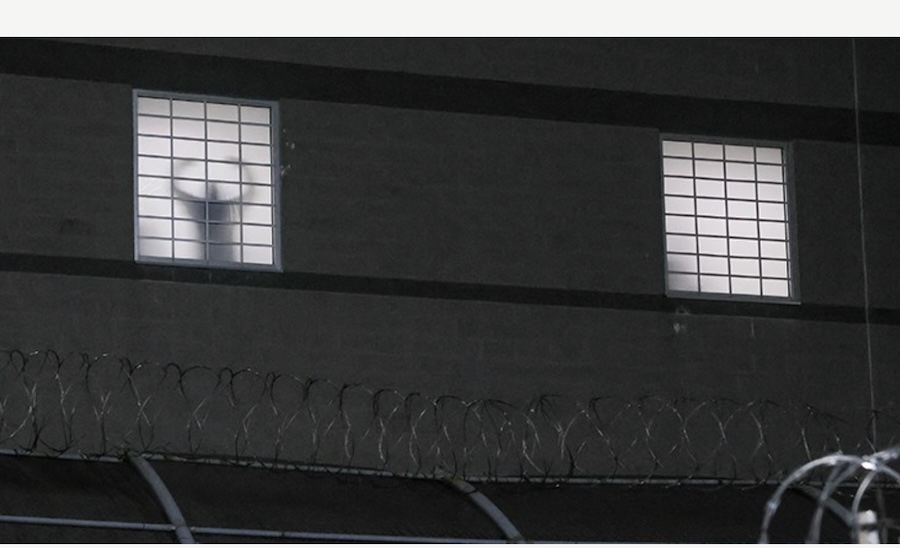
UN High Commissioner for Human Rights Volker Türk on Friday [June 26] urged prompt action to prevent further loss of life in U.S. Immigration and Customs Enforcement (ICE) custody and called for independent investigations into all deaths under ICE custody.

Türk said that it is alarming that, according to US Government official data, in the first five months of this year, 18 people had died in ICE detention. A further case of death in ICE custody has been reported this month. In 2025, a total of 33 deaths were registered, compared with 11 in 2024.

The lack of transparency and clarity surrounding the circumstances of these deaths in custody undermines accountability for them, the High Commissioner added.


ICE detention centre in Newark, New Jersey on June 6, 2026 © RYAN MURPHY / AFP

“I call for prompt, independent, impartial and effective investigations into all deaths in ICE custody. Those responsible for violations of the law must be held to account, and the rights of the victims’ families to truth, justice and reparation and guarantees of non-recurrence must be upheld,” said Türk.

These deaths occurred in a context of broad expansion of the US immigration detention system, with ICE currently holding over 60,000 individuals compared to approximately 40,000 in early 2025, according to the latest official data. There are plans to further increase the detention capacity up to 90,000 people by the end of 2026.

Detainees, who include entire families with children, and medically vulnerable people, are frequently reported to face inhuman conditions of detention and treatment, including inadequate healthcare and food, and exposure to disease outbreaks in overcrowded facilities. There have been concerning allegations regarding the use of force. Additionally, five of the officially reported deaths in 2026 were classified as suicides.

A lack of information regarding the whereabouts of detainees during transfers has been reported, causing significant distress among families, while prolonged uncertainty surrounding legal status and processes contributes to psychological distress among detainees.

(Article continued in the right column)

Question related to this article:

What is the state of human rights in the world today?

(Article continued from the left column)

Türk also expressed alarm over the reported use of solitary confinement, which should be an exceptional measure, and, particularly when prolonged or indefinite, could amount to cruel, inhuman or degrading treatment.

“All these factors exacerbate vulnerability and raise serious concerns as to whether some of these deaths in ICE custody could have been prevented,” said the High Commissioner.

He stressed that alternatives to detention should be prioritized. Immigration detention should be an exceptional measure of last resort and should generally be avoided for people with significant medical or mental health conditions, as well as pregnant women. Regardless of their immigration status or that of their parents, children should not be subjected to immigration detention.

US immigration authorities must ensure that their detention facilities comply with international human rights norms and standards. This includes upholding dignity, avoiding overcrowding, providing timely access to healthcare, including mental health services, family notification, consular assistance, legal representation, and necessary interpretation services for all individuals in immigration detention.

The High Commissioner urged the full restoration and strengthening of independent oversight mechanisms for immigration detention, highlighting their importance as a key safeguard against abuse. He also stressed the crucial role of Congressional bodies in overseeing immigration enforcement practices and associated public funding, to ensure better compliance with international human rights law.

Türk strongly denounced the continued dehumanisation and criminalisation of migrants and refugees. He expressed support for all those who continue to advocate for dignity, fairness, and the protection of their human rights, including lawyers, journalists, faith-based organisations, and civil society groups.

He emphasised that no one should be sent back to a place where they could face serious human rights violations or other irreversible harm.

For more information and media requests, please contact:
In Geneva
: Ravina Shamdasani – ravina.shamdasani@un.org
    
Marta Hurtado – marta.hurtadogomez@un.org

In New York
: Laura Gelbert – gelbert@un.org
WhatsApp
X: @UNHumanRights

Facebook: unitednationshumanrights
Instagram: @unitednationshumanrights

– – – – – –

If you wish to make a comment on this article, you may write to coordinator@cpnn-world.org with the title “Comment on (name of article)” and we will put your comment on line. Because of the flood of spam, we have discontinued the direct application of comments.
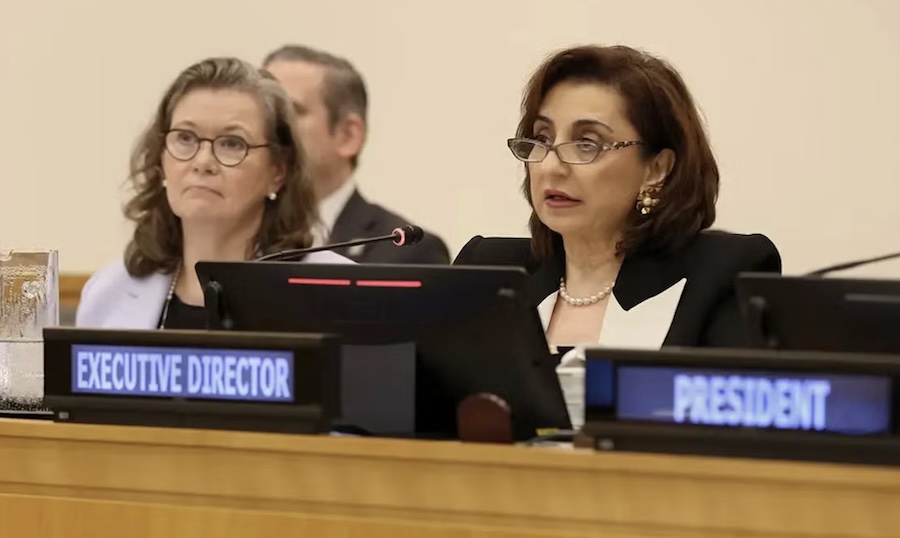
Report on Strategic Plan by UN Women Executive Director Sima Bahous

. . WOMEN’S EQUALITY . .

Excerpts from Report by UN Women Executive Director Sima Bahous

The following are excerpts from remarks by UN Women Executive Director Sima Bahous at the Executive Board Annual Session, at the UN Headquarters, on 23 June 2026:

I am honoured to present at this session my fourth and final report on the implementation of our 2022–2025 Strategic Plan. It lays out results of which we should be proud, reflecting our powerful triple mandate. They are the baseline we strive to exceed under our current Strategic Plan.


UN Women Executive Director Sima Bahous addresses the Annual Session of the UN Women Executive Board held in CR3 at UN Headquarters on 23 June 2026. Photo: UN Women/Radhika Chalasani.

Allow me to summarize:

° Over the 2022–2025 Strategic Plan period, UN Women invested nearly USD 2.35 billion across 135 countries in protecting and advancing norms, translating global commitments into programmes on the ground, and leading and supporting the UN system to deliver better for women and girls.

° In 110 countries, home to 3.1 billion women and girls, UN Women helped strengthen legal and policy environments for gender equality, contributing to stronger protections, expanded rights and greater opportunities for women and girls through 394 laws adopted, revised or repealed in line with international standards.

° Across 78 countries, 732 gender-responsive national and local policies, strategies and plans helped advance equal pay, the care economy, efforts to end violence against women, and strengthen resilience to conflict and climate change.

° In 50 countries, reforms supported by UN Women expanded women’s access to decent work, income generation, climate-resilient agriculture and care systems, while 1.6 million women directly accessed services, goods, resources, or information essential to their economic autonomy.

° We also helped make the promise of freedom from violence more real for women and girls. Through support to 180 laws and 213 strategies, policies, and action plans, nearly 1.7 billion women and girls benefited from stronger frameworks to prevent and respond to violence.

° In conflict and crisis, UN Women advanced women’s leadership, participation, and protection across 83 countries.

° Support for the Women, Peace and Security agenda contributed to 59 new National Action Plans, bringing total coverage to 117 countries and territories, while more than 2.5 million women and girls accessed protection services, cash assistance, and livelihood support in humanitarian and refugee response settings.

° Despite significant funding pressures, we lived up to our promise to women’s organizations, with more than USD 285 million channeled to civil society organizations, local women-led organizations and networks, helping sustain women’s leadership and frontline responses in communities and crises.

° Across 128 countries, more than 10,300 organizations strengthened their capacities and leadership, while more than 11,400 mechanisms enabled women’s meaningful and safe participation in decision-making.

Through the United Nations Trust Fund to End Violence against Women and the Women’s Peace and Humanitarian Fund, which UN Women hosts on behalf of the UN system, we continued to expand direct support to women’s rights organizations and advance locally led solutions where they are most needed.

Through these funds, despite scarcer resources, you are helping sustain women’s leadership across the humanitarian-development-peace nexus and ensuring that local women’s organizations remain at the forefront of response and recovery efforts.

These results are not just numbers. They show impact, they show lives changed. They do not just create an immediate effect for the women and girls we serve, but also an enabling environment for gender equality, for women’s rights, for normalizing women’s leadership, for changing laws, policies, and norms.

Allow me to share a few examples:

° In Ecuador, women gained stronger protections against violence in politics and greater opportunities to participate equally in public life through electoral reforms.

° In Afghanistan, over 350,000 women and girls accessed life-saving services in one of the world’s most restrictive environments for women’s rights, while 191 women-led organizations strengthened their capacity to support communities and sustain women’s leadership.

(Article continued in right column)

Question related to this article:

Protecting women and girls against violence, Is progress being made?

Does the UN advance equality for women?

(Article continued from left column)

° In Palestine, more than 323,000 people, the majority of whom are women and girls, received protection, cash, and livelihood support amid a devastating humanitarian crisis.

° In the Great Lakes region, women’s leadership in peace processes expanded, with women representing up to 40 per cent of the African Union mediation team for Eastern DRC.

° In Egypt, 330,000 women gained financial and digital literacy support, enhancing their economic opportunities and resilience.

° Across the Pacific Islands, more than 50,000 market vendors benefited from safer, more resilient livelihoods.

° In Ukraine, more inclusive humanitarian strategies advanced women’s rights and expanded the role of civil society in humanitarian response and recovery.

° In Viet Nam, a landmark population law strengthened the recognition of reproductive rights and unpaid care work, helping lay the foundation for stronger, gender-responsive care systems.

Our coordination efforts have shown impressive results. UNCT-SWAP [UN Country Team System Wide Action Plan] reporting increased by 105 per cent, from 61 UN country teams in 2021 to 125 in 2025. This growth is helping embed gender equality more consistently in UN country team planning, coordination, financing, and results.

We also continued to engage system-wide through the Gender Equality Acceleration Plan  (GEAP), which raises the ambition of collective work on gender equality, seeking to deliver transformative change across the three pillars of peace and security, development and human rights, and supporting UNCTs and RCs [UN Resident Coordinators] in their work to prioritize gender equality as the linchpin for all the UN’s work in country.

My report also describes how we have built a stronger entity, better equipped to deliver for women and girls with the resources you entrust to us. Over the Strategic Plan period, we strengthened our internal governance mechanisms, advanced business transformation, and modernized corporate systems.

We also enhanced oversight, accountability, and transparency, including by further strengthening our Transparency Portal, recognized as a good practice in public accountability for results and resources.

We consistently exceeded corporate targets on follow-up to internal and external audit recommendations, and maintained five consecutive years with no long-outstanding audit recommendations from the UN Board of Auditors.

We embedded enterprise risk management into planning, performance, and oversight cycles while institutionalizing the Quarterly Business Review as a forward-looking, evidence-based performance management tool that connects strategic priorities, risks, and resources.

These reforms have made UN Women even more agile, transparent and results focused. They deliver stronger alignment from country to global level and a clearer line of sight between our strategic objectives, the resources we invest, and the results we deliver.

Our strengthened communications and partnership functions have further enhanced our visibility, stakeholder engagement, and resource mobilization effectiveness, helping sustain the trust and support of partners during a period of increasing financial pressure and change across the multilateral system.

Allow me to remind you that we do all this with the most modest of resources. We have weathered the current, uniquely difficult funding environment for the multilateral system better than most, but we are not unaffected.

Like many, we are asked to do more with less. So once more, I ask you to take back to capitals a call to resource this crucial mandate fully, to advocate for our agenda, and for investment in gender equality and women’s empowerment as the greatest multiplier for the SDGs [Sustainable Development Goals]. An investment in UN Women is your vehicle for their achievement.

We will speak more extensively on UN80 this afternoon, but I will reiterate now our full support for the Secretary-General’s UN80 reform efforts, as the United Nations’ youngest entity, born and raised through the reform process.

We continue to ensure that our three priorities permeate all aspects of the process:

1. A stronger gender architecture that delivers for all women and girls.

2. Gender mainstreaming in all work packages.

3. The inclusion of voices of civil society and women-led organizations and movements.

– – – – – –

If you wish to make a comment on this article, you may write to coordinator@cpnn-world.org with the title “Comment on (name of article)” and we will put your comment on line. Because of the flood of spam, we have discontinued the direct application of comments.
Around the World, Global Solidarity and Cooperation Are Remarkably Popular

. . DEMOCRATIC PARTICIPATION . .

An essay by Lawrence Wittner in Foreign Policy in Focus

One of the curious ironies of our time is that, although many politicians spout heated nationalist rhetoric, rail against foreign nations, and belittle international cooperation, this approach to international affairs is not at all what most people want.

The climate of aggressive nationalism is clear enough. In nations around the globe, demagogues (usually of a rightwing variety) whip up xenophobia, preach superpatriotism, demand vast military buildups, and―if holding public office―often launch invasions of other nations under the banner of restoring an allegedly glorious national past.

But what is often overlooked is that, across the planet, most people favor a very different way of engaging with the world.

In late 2025, Focaldata, a major research company commissioned by the Rockefeller Foundation, conducted a landmark survey of 36,405 people across 34 countries. The resulting report, Demanding Results: Global Views on International Cooperation, revealed that 55 percent of people worldwide “believe their country should cooperate on global challenges even if it means compromising on national interests.” If international cooperation was proven to solve global problems, public support jumped to 75 percent. Respondents viewed such cooperation as essential for food and water security, jobs, health, trade, and climate.

Other opinion surveys confirm the widespread nature of internationalist sentiment. An Ipsos poll conducted between February and April 2026 found a substantial increase over the previous year in support for global solidarity and cooperation, with net disagreement shifting to net agreement. Among the more than 22,000 adults in the 31 countries surveyed, nearly two-thirds now supported the claim that, “for certain problems, like environmental pollution, international bodies should have the right to enforce solutions.” Some 42 percent (a plurality) agreed with the idea that “my taxes should go towards solving global problems.” And nearly four out of 10 respondents (a plurality) endorsed the statement: “I consider myself more a world citizen than a citizen of the country I live in.”

Another measure of the worldwide support for international cooperation is provided by polling on public attitudes toward international organizations. The Rockefeller Foundation-Focaldata study reported that public trust was strong for the United Nations (58 percent) and the World Health Organization (60 percent), although weaker for international financial institutions. The global popularity of the United Nations was also attested to by a Pew Research Center survey that appeared in September 2025. Covering 31,938 adults in 25 countries, it found that a median of 61 percent of adults had a favorable view of the world organization, while only 32 percent had an unfavorable one.

Even proposals for new, avant-garde global institutions have attracted more public support than opposition. Commissioned by Democracy Without Borders, Nira Data conducted a global survey in September 2025 of public attitudes toward the election of a citizen-elected world parliament to handle global issues. The survey, released in January 2026, drew upon 117,000 people in 101 countries that held 90 percent of the world’s population. The finding was that 40 percent of respondents approved of the world parliament idea, while only 27 percent opposed it.

(Article continued in right column)

Question related to this article:


How can we develop the institutional framework for a culture of peace?

(Article continued from left column)

But what about the United States? Surely in this flag-waving nation, engulfed in the rabid “America First” rhetoric of the Trump administration and its MAGA acolytes, no more than a small minority would support the ideals of global solidarity and cooperation.

But that’s not the case at all.

One of the most striking findings of the Rockefeller Foundation-Focaldata survey is that 61 percent of U.S. respondents believed that the United States should cooperate on global challenges even it meant compromising on some national interests.

When it came to the United Nations, the Pew Research Center report revealed that 57 percent of Americans held a positive view of the world organization, as compared to 41 percent with a negative one. Moreover, it found that positive views of the United Nations had increased by 5 percent over the preceding year.

A study by the Chicago Council on Global Affairs, issued in September 2025, reported an even more favorable public attitude toward the United Nations. Two-thirds of the Americans surveyed, it noted, said that the United States should be more willing to make decisions within the framework of the United Nations, even if this meant that the country would sometimes have to go along with a policy that was not its first choice.

Admittedly, opinion surveys found that the level of support for international cooperation varied significantly from country to country. Thus, for example, the backing for international cooperation when that meant compromising on some national interests was greater in India (81 percent) and South Korea (73 percent), the countries highest on the scale, than in Argentina (41 percent) and Japan (34 percent), the countries at the bottom of the scale.

Furthermore, there was often a political dimension to worldwide public attitudes toward foreign affairs. According to the Pew Research Center, “people who place themselves on the left of the ideological spectrum are more likely than those on the right to have a positive view of the UN.”

This political division was particularly wide in the United States, where, as the Pew report maintained, “81 percent of liberals―versus 34 percent of conservatives―have a favorable opinion” of the United Nations. When it came to the issue of support for cooperation with other nations, the surveys by Rockefeller-Focaldata and the Chicago Council on Global Affairs both found substantial differences between the attitudes of Democrats (quite positive) and Republicans (far more negative).

Even so, in most countries, including the United States, support for international solidarity and cooperation is very substantial, and growing. Consequently, political activists and politicians shouldn’t be reluctant to speak out for them. Indeed, given the popularity of this internationalist approach to global affairs, it might even prove a winning political issue.

– – – – – –

If you wish to make a comment on this article, you may write to coordinator@cpnn-world.org with the title “Comment on (name of article)” and we will put your comment on line. Because of the flood of spam, we have discontinued the direct application of comments.
Indigenous Leaders Call for Global Recognition of Peacebuilding Role as UN Forum Echoes Summit Outcomes

. . SUSTAINABLE DEVELOPMENT . .

An article from the Women Survivors Network

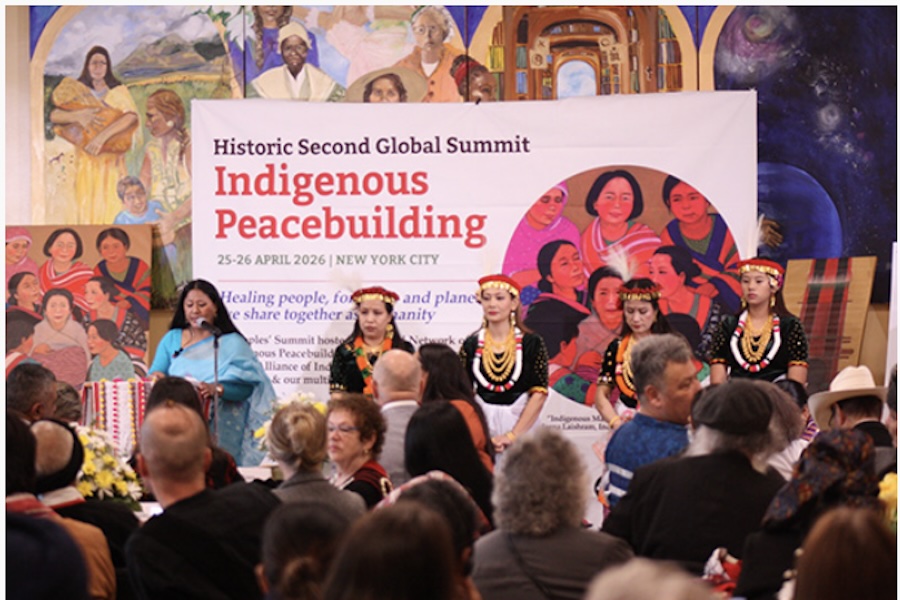
 Indigenous leaders, diplomats and United Nations officials convened in New York for the Second Global Summit on Indigenous Peacebuilding, issuing a call to reframe global peace and security efforts by placing Indigenous Peoples at the center of conflict prevention and resolution.

Held in New York City on April 25–26, 2026, the two-day summit gathered 300 representatives from 80 countries and seven socio-cultural regions of the world amid growing concern that a majority of the world’s conflicts occur in biodiversity-rich areas inhabited by Indigenous Peoples.

Organizers said the summit has already influenced international policy discussions. The United Nations Permanent Forum on Indigenous Issues referenced the event and its recommendations in its 2026 outcome document, including a proposal to declare 2027–2037 an International Decade of Indigenous Peacebuilding.

Opening the Summit, Binalakshmi Nepram, Founder-Director of Manipur Women Gun Survivors Network and President of the Global Alliance of Indigenous Peoples, Gender Justice and Peace, called for a fundamental shift: “It is time to move from seeing Indigenous Peoples as victims of conflict to recognizing them as experts, mediators, and negotiators of peace.”

The Summit built on the outcomes of the first global gathering, which led to the first-ever declaration on Indigenous Peacebuilding and the creation of a Global Network of Indigenous Peacebuilders, Mediators and Negotiators to help resolve some of the world’s most entrenched conflicts.

A series of global initiatives were launched at the gathering, including the Global Indigenous Mothers March for Peace, Healing and Unity, the recognition of an innovative and much-needed Indigenous Humanitarian Peacebuilding (IHP) Model to respond directly to survivors in war and conflict zones,  a forthcoming book on Indigenous Peacebuilding, and the rollout of online and in-person curriculum programs to train Indigenous peacebuilders worldwide.

A central feature of the summit was the Weaving for Peace exhibition, which brought together traditional textiles from Indigenous communities across Manipur, Guatemala, Papua New Guinea, Bolivia, the Haudenosaunee, the Sámi region, Maasai Regions, Amazon and the Sahel, highlighting cultural resilience as a foundation for peace.

(article continued in right column)

Question related to this article:

Indigenous peoples, Are they the true guardians of nature?

(article continued from left column)

Speakers pointed to rising global displacement—estimated at around 200 million people—with many conflicts linked to resource extraction, environmental degradation and transnational organized crime affecting Indigenous territories with huge humanitarian consequence.  Aluki Kotierk, Chair of the United Nations Permanent Forum on Indigenous Issues, underscored the role of Indigenous knowledge systems rooted in balance and reciprocity. “Indigenous Peoples must be recognized not as security threats, but as part of the security infrastructure,” said Dr Albert Barume, United Nations Special Rapporteur on Indigenous Issues, framing Indigenous peacebuilding as a matter of international peace and security.

Justin Mohammad, Ambassador for First Nations People, Australia, said Indigenous diplomacy has long shaped relations across regions and should be integrated into modern peace processes.

“When multilateral institutions are being questioned, we need governance—but we must humanize it,” said Laura Gil, Assistant Secretary General of the Organization of American States. Omar Hilale, Permanent Representative of Morocco to the United Nations and Chair of the United Nations Peacebuilding Commission, emphasized the need for inclusive peacebuilding approaches that incorporate Indigenous knowledge and local leadership.

Laura Flores Director of Americas Division of the United Nations Department of Political and Peacebuilding Affairs also joined and stated, “member states are increasingly recognizing Indigenous Peoples’ role in peacebuilding, including through a landmark resolution on Indigenous Peoples’ rights and their role in peacebuilding, negotiations, and transitional justice.”

Ana Pérez Conguache, representing the Guatemala Presidential Commission, highlighted the importance of addressing land rights, inequality and historical injustices as part of sustainable peace.Ambassador David Lametti, Permanent Representative of Canada to the United Nations also spoke at the Summit pledging support for Indigenous Peacebuilding.

Many scholars and leaders from conflict affected regions such as Dr Noni Arambam, Maisnam Arnapal, Adam Kuleit Ole Mwarabu, Daniel Mastaki from DRC, Nuba Mountain and many others also spoke. Participants concluded with a shared message: that the world’s Indigenous Peoples are the world’s peacemakers; that wars and conflicts currently engineered in Indigenous territories must end immediately; and that Indigenous Peoples who are displaced must be protected.

That justice, inclusion, and the leadership of Indigenous Peoples—their peacemaking and their wisdom—hold the key for healing people, for peace and the planet, and it’s time UN member states and the world realize and ensure this in policy, planning, action, and resourcing.

– – – – – –

If you wish to make a comment on this article, you may write to coordinator@cpnn-world.org with the title “Comment on (name of article)” and we will put your comment on line. Because of the flood of spam, we have discontinued the direct application of comments.