‘Fascist Rhetoric’ Becoming Commonplace in US and Europe: UN

…. HUMAN RIGHTS ….

An article by Nadia Prupis for Common Dreams (reprinted according to provisions of Creative Commons)

The “rhetoric of fascism” is on the rise in the U.S. and Europe, a United Nations official warned on Thursday, a disturbing trend that puts “unprecedented pressure” on human rights standards around the world.

“Anti-foreigner rhetoric full of unbridled vitriol and hatred is proliferating to a frightening degree, and is increasingly unchallenged,” said Zeid Ra’ad Al Hussein, the U.N. human rights chief. “The rhetoric of fascism is no longer confined to a secret underworld of fascists, meeting in ill-lit clubs or on the ‘Deep Net.’ It is becoming part of normal daily discourse.”


People protest in the wake of Donald Trump’s election. (Photo: Ben Alexander/flickr/cc)
(click on photo to enlarge>

Speaking ahead of International Human Rights Day on December 10, Zeid warned that “if the growing erosion of the carefully constructed system of human rights and rule of law continues to gather momentum, ultimately everyone will suffer.”

The failure of global leaders to deal with complex social issues like the massive wealth gap, discrimination, and climate change have led to growing numbers of people to turn to “the siren voices exploiting fears, sowing disinformation and division, and making alluring promises they cannot fulfill,” he said, in a nod to U.S. President-elect Donald Trump.

“Discrimination, yawning economic disparities, and the ruthless desire to gain or maintain power at any cost are the principal drivers of current political and human rights crises,” he said.

(Article continued in the right column)

Question related to this article:

What is the state of human rights in the world today?

(Article continued from the left column)

Zeid’s warning came just before far-right Dutch politician Geert Wilders—who is widely expected to win the upcoming March election for Prime Minister—was convicted of inciting discrimination for saying the Netherlands would be better off with fewer Moroccans.

During a municipal election campaign in the Hague in March 2014, Wilders, leader of the Party for Freedom, asked a crowd of people attending a rally if they wanted “more or fewer Moroccans in this city and in the Netherlands.” The crowd chanted back, “Fewer! Fewer!” Wilders, smiling at the reaction, responded, “We’re going to take care of that.”

Friday’s verdict indicated that Wilders had planned the comments as a stunt, with the judges finding evidence that his team had coached the crowd how to respond, and saying that it was intended to be insulting to Moroccans.

Although Wilders was convicted of inciting discrimination, he was acquitted of hate speech charges, and the panel rejected prosecutors’ requests to fine or jail him. As the BBC reports, the verdict will have little impact on Wilders’ political aspirations.

Zeid has previously named Wilders, among other high-profile politicians such as Trump and the U.K.’s Nigel Farage, as demagogues whose rhetoric is poised to bring about “colossal violence” against minorities. He has also said Trump was “dangerous” for the international community. Under Zeid’s leadership, the U.N. human rights office is readying to condemn Trump if he puts any of his xenophobic or discriminatory policies into effect.

On Thursday, Zeid urged all people to “push back the violence and hatred which threaten our world.”

“Human rights are for everyone, and everyone will be affected if we do not fight to preserve them,” he said. “They took decades of tireless effort by countless committed individuals to establish, but—as we have seen all too clearly in recent months—they are fragile. If we do not defend them, we will lose them.”

Nicaragua: Culture of Peace Proposed to Eradicate Violence

. . WOMEN’S EQUALITY . .

An article in El Nuevo Diario (translated by CPNN)

Karla Miranda, a third year psychology student, speaking about violence against women, said that aggressors should be evaluated by psychologists to understand the cause of their attitude. “Violent behavior often originates from childhood, so it is important that we know the history of these people in order to assess the origins of violence,” she said.

This was said yesterday at the fair called Growing a Culture of Peace, held at the University Cátolica (Unica), in the framework of the International Day for the Elimination of Violence Against Women, with the aim of promoting values ​​in society and raising awareness on this topic.


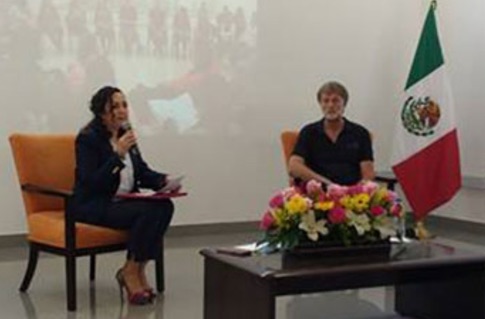
Rosa Salgado, with microphone, speaks before students of the Catholic University. (Photo: Melvin Vargas)
(Click on photo to enlarge)

Johnny Hodgson, career coordinator for the campus, explained that the fair was developed with different talks, information stands and cultural events so that students and experts could address the issues of violence.

“We did not just want to be part of the International Day for the Elimination of Violence Against Women, but rather to do something more integral, where everyone is involved. In addition, we promote spaces to come and share how to face, understand and avoid violence, “said Hodgson.

Karla Miranda added that “another important aspect is that in raising children, it is necessary to educate in values, so that the children grow up with the value to not violate either girls or children. That is why this topic must be addressed at the level of the family. ”

Miranda recalled that in 2013 the World Health Organization (WHO) declared violence against women as a public health problem and in that sense added that psychological violence is the one that most affects and causes the most damage.

(article continued in right column)

(Click here for the original Spanish version of this article.)

Question related to this article:

Protecting women and girls against violence, Is progress being made?

(article continued from left column)

Ana Hidalgo Mendoza, Miranda’s colleague, commented that violence is a cycle that comes from the home. “The child who sees that his father violates his mother will grow up with that profile, believing that it is normal behavior, and in the case of the girls, they will believe that they must be submissive and when they are raped, they will believe that it is ok” “He added.

VALUE FORMATION

Rosa Salgado, representative of the disabled with the Office of the Attorney General for Human Rights (PDDH), addressed violence against women with disabilities.

Salgado said that a solution is the formation in values ​​that must be started from the home and the different spaces of society and education, “so that in this way we appropriate the understanding of human rights for ourselves. and that we make use of the legal instruments “.

“To the extent that we recognize how we can help and improve the quality of life of a person with a disability, conditions will be improved by preventing violence,” she said.

SCHOOL HARASSMENT

Eliuth Martínez, a teacher at the Unica and a pedagogical advisor at the Directorate of Special Education at the Ministry of Education (Mined), commented that throughout the school year they continued to develop a non-bullying campaign, as this problem began to emerge in classrooms.

According to Martinez, since last year the campaign has trained 6,000 to 8,000 teachers.

“It was enough to have 1 to 3 cases for the Government to act immediately. Today we can say that we have good results from the center and the delegates and even a free telephone line was set up to report these types of violence,” added the teacher.

About 35% of all women will experience violence, either in or out of the couple, at some point in their lives, according to WHO data published in 2013.

Martinez recently attended a case of a visually impaired girl who was believed to experience bullying on the part of her colleagues, to which the Mined immediately acted in conjunction with the educational councils, investigated the case and began work not only with the teachers but also with the students and the school in general.

Mexico: Need to promote a culture of peace, to end violence against women: CEAMEG

. . WOMEN’S EQUALITY . .

An article from Sistema Michoacan for Radio and Television (translation by CPNN)

Mexico City.- The director general of the Center for Studies on the Advancement of Women and Gender Equality (CEAMEG) of the Chamber of Deputies, Adriana Ceballos Hernández, said that violence against women harms society every day, and, although there are important advances, there is still much to be done.

In inaugurating the forum “For a culture of peace”, she emphasized that violence should be eliminated in the relations of women and men, inculcating in people the knowledge of rights from childhood, respecting political rights of gender and understanding that abuse affects everyone around, especially children.

She considers it necessary to promote a culture of harmony in all fields of action.

The director of Social Studies of the Position and Condition of Women and Gender Equality of CEAMEG, Judith Díaz Delgado, explained that their organization works mainly for the prevention of violence.

She said that “we live in a violent Mexico with an absence of peace, in which seven out of ten suffer some type of abuse, so we can not say that there is a culture of peace.”

Guadalupe Salas y Villagómez, director of Promotion and Training of Women and Equality, of the National Human Rights Commission (CNDH), said that the CNDH is dedicated to raising awareness of human rights, equality between women and men, as well as awareness about gender-based abuse.

Finally, Ana Paula Hernández Romano, founder of Proyecto Paz A.C, pointed out that Mexico is far down the list in the 140th place of nations for providing a state of well-being. Meanwhile, the National Survey of Victimization and Perception on Public Safety (ENVIPE) for 2016, indicates that most Mexicans perceive that the problem of violence and insecurity is even greater than the problem of poverty and unemployment.

(Click here for the original Spanish version of this article.)

Question related to this article:

Laureates and scientists call on Nobel Prize Foundation to divest fossil fuels

. . SUSTAINABLE DEVELOPMENT . .

An article from gofossilfree.org

Citing the urgency of climate change, Nobel Prize winners and scientists have issued a letter calling on the Nobel Foundation to divest its $420 million endowment from fossil fuels. The letter coincides with the celebration of Nobel Days and the annual prize ceremonies.


Divest Nobel serve up oil and coal to Nobel nominees in Stockholm, November 2016
(click on image to enlarge)

The call from laureates and climate scientists cites the original intent of the Foundation – an organisational mission to recognize all that is good and innovative about humankind – to make the argument that the foundation cut ties with destructive fossil fuel companies.

Among the 14 laureates that signed the letter are atmospheric chemist Paul Josef Crutzen, physicist David Wineland and biologist Sir John Sulston, and several winners of the prestigious Nobel Peace Prize including Iranian human rights activist Shirin Ebadi, Yemeni women’s rights campaigner Tawakkol Karman and Argentinian human rights and peace activist Adolfo Pérez Esquivel. The letter has also been signed by eminent scientific contributors to the Nobel-winning Intergovernmental Panel on Climate Change (IPCC).

It’s hard to argue with Nobel Laureates who have made such incredible scientific discoveries, advanced human rights and helped foster peace and ends to major regional conflicts.

The laureates and scientists called on the Foundation to lead and set an example for the world, writing: “The Nobel Foundation has played a historic role in the struggle against climate change by recognising people who have highlighted and studied humankind’s impact on the climate. Today, in this time of urgent need, as we face a warming planet and strive to implement the Paris Agreement, we ask you to do more. Our educational and cultural institutions must do more than educate, they must be an example of a new pathway forward, free from the industries that have caused the most damage to our climate.”

Activists in Sweden, part of the Divest Nobel campaign, have already taken action by highlighting the links between the foundation’s investments and fossil fuel companies. Now with laureates and scientists joining the call, they hope the Foundation will be forced to listen – and act.

More than 600 institutions, foundations, universities and pension funds are already leading by committing to divest from destructive fossil fuel companies. Tell Nobel to join them and act on the message from laureates and scientists by adding your own name.

Sign the petition calling on Nobel Foundation to divest

(Thank you to Janet Hudgins, the CPNN reporter for this article)

Question for this article:

Winners of Youth Innovation Challenge to Engage in Peacebuilding in South Sudan

FREE FLOW OF INFORMATION

An article from PC Tech Magazine

The Youth Innovation Challenge for Peace was organized by United Nations Development Programme (UNDP) Community Security and Arms Control Project to specifically recognize the strength of youth-led initiatives and the impact of home-grown ideas on societies emerging from conflict. 132 youth attended the original introduction workshop when the competition launched in August 2016.


UNDP call for proposals

From there, 150 ideas were submitted and 26 semi-finalists were selected by an evaluation committee to participate in this week’s “ideation workshop”.

In a press statement, Eugene Owusu; Deputy Special Representative of the Secretary General, UN Resident Coordinator and UNDP Resident Representative, said; “The purpose of the challenge is not to reward ideas with dollars but to inspire and nurture creativity that would transform South Sudan.”

“ The challenge is about building a culture of peace and thrusting the youth at the forefront of creativity and social change, amplifying their ambition and smart use of new technology to engage and transform their society,” Owusu adds.

The participants received guidance and support for refining their ideas, structuring their proposals, and delivering effective presentations from UNDP’s Regional Innovation Advisor for Africa Mr. Mark Lepage and local open technology experts from Juba Hub (jHub).

Lightning-round sessions were held on Tuesday, where each project had seven minutes to present their idea in whatever format they chose.

Semi-finalists were judged based on a common set of criteria: clarity and presentation of their idea; creativity and originality of their idea; addresses the issue of engaging youth in peace; viability in the long term and financial sustainability; number of youth and general population who could benefit; implementable and realistic; scalable and replicable; and gender and social inclusion.

Winners

The overall winning proposal, taking home the top prize of US$10,000 was an individual submission from Mr. Kwaje called 64 Hands SACCO (savings and credit co-operative society), which combines social entrepreneurship with peace-building by providing South Sudanese small and medium enterprises access to a community-based source of financing.
64 Hands SACCO is designed to be propelled by youth drawn from all 64 tribes in South Sudan.

Kilkilu ana Comedy Extra placed second, with seed funding of US$6,000 to execute their vision of developing multi-lingual comedy performances to promote healing, understanding, and reconciliation. Their proposal focused on a pilot program to take place in IDP camps in and around Juba.

GOGIRLS-ICT Initiative won third place and will receive US$4,000 awarded to implement their proposed #TTOS-ICT project. The aim of the project is to engage, educate and empower women and girls in Science, Technology, Engineering and Mathematics (STEM) based fields through a philosophy of chain-based trainings. GOGIRLS-ICT Initiative focuses on mentoring and making meaningful social impact to address development challenges women and girls face in South Sudan which contribute to insecurity, like early and forced marriage, illiteracy, and unemployment.

The winning submissions will work closely with UNDP moving forward, with the ultimate aim of implementing their ideas on the ground in pilot programs.

Question related to this article:

Nobel Lecture by Juan Manuel Santos:”Peace in Colombia: From the Impossible to the Possible”

FREE FLOW OF INFORMATION

Excerpts from the lecture published by the official website of the Nobel Prize, presented in Oslo, 10 December 2016.

Six years ago, it was hard for we Colombians to imagine an end to a war that had lasted half a century. To the great majority of us, peace seemed an impossible dream – and for good reason. Very few of us – hardly anybody – could recall a memory of a country at peace.

Today, after six years of serious and often intense, difficult negotiations, I stand before you and the world and announce with deep humility and gratitude that the Colombian people, with assistance from our friends around the world, are turning the impossible into the possible. . . .

With this agreement, we can say that the American continent – from Alaska to Patagonia – is a land in peace.

And we can now ask the bold question: if war can come to an end in one hemisphere, why not one day in both hemispheres? Perhaps more than ever before, we can now dare to imagine a world without war.

The impossible is becoming possible. . . .

I have served as a leader in times of war – to defend the freedom and the rights of the Colombian people – and I have served as a leader in times of making peace.

Allow me to tell you, from my own experience, that it is much harder to make peace than to wage war.

When it is absolutely necessary, we must be prepared to fight, and it was my duty – as Defence Minister and as President – to fight illegal armed groups in my country.

When the roads to peace were closed, I fought these groups with effectiveness and determination

But it is foolish to believe that the end of any conflict must be the elimination of the enemy.

A final victory through force, when nonviolent alternatives exist, is none other than the defeat of the human spirit.

Seeking victory through force alone, pursuing the utter destruction of the enemy, waging war to the last breath, means failing to recognize your opponent as a human being like yourself, someone with whom you can hold a dialogue with.

Dialogue…based on respect for the dignity of all. That was our recourse in Colombia. And that is why I have the honour to be here today, sharing what we have learned through our hard-won experience.

Our first and most vital step was to cease thinking of the guerrillas as our bitter enemies, and to see them instead simply as adversaries. . .

A few lessons can be learned from Colombia’s peace process and I would like to share them with the world:

You must properly prepare yourself and seek advice, studying the failures of peace attempts in your own country and learning from other peace processes, their successes and their problems.

The agenda for the negotiation should be focussed and specific, aimed at solving the issues directly related to the armed conflict, rather than attempting to address all the problems faced by the nation.

Negotiations should be carried out with discretion and confidentiality in order to prevent them from turning into a media circus.

Sometimes it is necessary to both fight and talk at the same time if you want to arrive at peace – a lesson I took from another Nobel laureate, Yitzhak Rabin.

You must also be willing to make difficult, bold and oftentimes unpopular decisions in order to reach your final goal.

In my case, this meant reaching out to the governments of neighbouring countries with whom I had and continue to have deep ideological differences.

(Click here for a Spanish version of the speech)

(Continued in right column)

Question(s) related to this article:

What is happening in Colombia, Is peace possible?

(Continued from left column)

Regional support is indispensable in the political resolution of any asymmetric war. Fortunately, today all the countries in the region are allies in the search for peace, the noblest purpose any society can have.

We also achieved a very important objective: agreement on a model of transitional justice that enables us to secure a maximum of justice without sacrificing peace.

I have no doubt this model will be one of the greatest legacies of the Colombian peace process. . . .

And I feel that I must take this opportunity to reiterate the call I have been making to the world since the Summit of the Americas in Cartagena in 2012, which led to a special session of the General Assembly of the United Nations in April this year.

I am referring to the urgent need to rethink the world War on Drugs, a war where Colombia has been the country that has paid the highest cost in deaths and sacrifices.

We have moral authority to state that, after decades of fighting against drug trafficking, the world has still been unable to control this scourge that fuels violence and corruption throughout our global community.

The peace agreement with the FARC includes their commitment to cut all ties with the drug business, and to actively contribute to fighting it.

But drug trafficking is a global problem that demands a global solution resulting from an undeniable reality: The War on Drugs has not been won, and is not being won.

It makes no sense to imprison a peasant who grows marijuana, when nowadays, for example, its cultivation and use are legal in eight states of the United States.

The manner in which this war against drugs is being waged is equally or perhaps even more harmful than all the wars the world is fighting today, combined. It is time to change our strategy. . .
In Colombia, we have also been inspired by the initiatives of Malala, the youngest Nobel Laureate, because we know that only by developing minds, through education, can we transform reality.

We are the result of our thoughts; the thoughts that create our words; the words that shape our actions.

That is why we must change from within. We must replace the culture of violence with a culture of peace and coexistence; we must change the culture of exclusion into a culture of inclusion and tolerance. . . .

In a world where citizens are making the most crucial decisions – for themselves and for their nations – out of fear and despair, we must make the certainty of hope possible.

In a world where wars and conflicts are fuelled by hatred and prejudice, we must find the path of forgiveness and reconciliation.

In a world where borders are increasingly closed to immigrants, where minorities are attacked and people deemed different are excluded, we must be able to coexist with diversity and appreciate the way it can enrich our societies.

We are human beings after all. For those of us who are believers, we are all God’s children. We are part of this magnificent adventure of being alive and populating this planet.

At our core, there are no inherent differences: not the colour of our skin; nor our religious beliefs; nor our political ideologies, nor our sexual preferences. All these are simply facets of humanity’s diversity.

Let’s awaken the creative capacity for goodness, for building peace, that live within each soul.

In the end, we are one people and one race; of every colour, of every belief, of every preference.

The name of this one people is the world. The name of this one race is humanity.

If we truly understand this, if we make it part of our individual and collective awareness, then we will cut the very root of conflicts and wars.

In 1982 – 34 years ago – the efforts to find peace through dialogue began in Colombia.

That same year, in Stockholm, Gabriel García Márquez, who was my ally in the pursuit of peace, received the Nobel Prize in Literature, and spoke about “a new and sweeping utopia of life, (…) where the races condemned to one hundred years of solitude will have, at last and forever, a second opportunity on earth.”

Today, Colombia – my beloved country – is living that second opportunity; and I thank you, members of the Norwegian Nobel Committee, because, on this occasion, you have not only awarded a prize to peace: you helped make it possible!

The sun of peace finally shines in the heavens of Colombia.

May its light shine upon the whole world!

USA: 13 Minnesota churches eye ‘underground railroad’ for those facing deportation

TOLERANCE AND SOLIDARITY .

An article by Frederick Melo from the Twin Cities Pioneer Press

The rhetoric on immigration during the presidential campaign season has struck fear into the hearts of many foreign-born families, and a new network of Minnesota churches is mobilizing to respond.

The Lutheran Church of the Redeemer on St. Paul’s Dale Street already maintains 22 shelter beds for the homeless in its basement, where families with no other place to go often spend the night on a temporary basis. The Rev. James Erlandson said those beds may soon serve a different purpose: offering sanctuary to those facing deportation.

“That’s a moral stand that we’ve taken,” Erlandson said. “We want to say: ‘Don’t increase deportations.’ Let’s fix our immigration system, and offer a path to citizenship so our neighbors don’t live in fear.”

On Tuesday, clergy and religious leaders from 30 congregations gathered at the Church of the Redeemer to announce that 13 churches across Minnesota have agreed to open their doors to immigrants, whatever their circumstances, even those sought by law enforcement.

For the 13 “sanctuary churches” like the Church of the Redeemer, that means being prepared to house those who might face deportation, and shuttling them from church to church as the need arises.

In practical terms, how long any given church would be able to house a family remains unclear, but church officials on Tuesday referenced the Underground Railroad that helped hide and guide southern slaves to freedom.

“That’s unknown,” said the Rev. Mark Vinge of the House of Hope Lutheran Church in New Hope, “but we know that the Lord will guide us.”

Rather than house those living in the U.S. illegally outright, some “sanctuary support” congregations have agreed to assist the faith-based network with donations of food, money, clothing and toiletries, or prayer vigils, news conferences and legal assistance. Meanwhile, 20 churches are still discussing details with their congregations or church councils and contemplating whether to join the new Sanctuary or Sanctuary Support networks, and in what capacity.

(Article continued in the right column)

Questions related to this article:

The post-election fightback for human rights, is it gathering force in the USA?

(Article continued from the left column)

The churches are all affiliated with ISAIAH, a faith-based coalition of racial and social justice advocates based on University Avenue in St. Paul.

“We’re also seeking legal counsel to understand (our rights),” said the Rev. Grant Stevenson, an ISAIAH staff member. “What we know for sure is that standing on our faith we cannot allow families to be torn apart because someone ran for president on a platform of hate.”

The pastors acknowledged that the details of President-elect Donald Trump’s immigration plans remain unknown, but they said his tough rhetoric has created an atmosphere of unease, though one that has been building for years.

Returns (including voluntary departures and sending border-crossers back across the U.S.-Mexican border on buses) exceeded 8 million under President George W. Bush, and removals (formal, documented deportations) hit a historic high of more than 2 million under President Barack Obama.

“If there is an event of mass deportation, we’ll be ready,” said ISAIAH spokeswoman Janae Bates.

An ISAIAH guide sheet notes that “guidelines are at the discretion of individual churches and their congregants,” but the goal is have individuals or families “reside in your place of worship for an undetermined amount of time while the community of Sanctuary works on the ‘Stay of Removal’ orders for each person.”

Vinge said his 13-member church council met a week ago to discuss whether to name House of Hope a sanctuary church. His house of worship is active in helping the homeless and worked with Southeast Asian refugees in the 1970s, following the Vietnam War. Still, he said the prospect of housing a family “24 hours a day, 7 days a week” gave some members pause.

“Others wondered if maybe we should just be a ‘supporting congregation,’ helping others do this,” Vinge said. “But in the end we want to be part of this.”

During a joint presentation to reporters Tuesday, Vinge took the microphone to quote from the Bible, Leviticus 19:33-34: “When a foreigner resides among you in your land, do not mistreat them. The foreigner residing among you must be treated as your native-born. Love them as yourself, for you were foreigners in Egypt. I am the Lord your God.”

USA: Inside the Churches That Are Leading New York’s Sanctuary Movement

TOLERANCE AND SOLIDARITY .

An Article from The Nation Magazine

On the Tuesday after the election, two dozen pastors gathered in the back room of a Lower Manhattan church to begin plotting the resistance. Most of the faith leaders were immigrants, and all of them members of the New Sanctuary Coalition of New York City, an interfaith network of congregations, organizations, and activists. Since its founding in 2007, the coalition has worked on the front lines in the fight to protect undocumented New Yorkers from detention and deportation.


Members of the New Sanctuary Coalition of New York City protest in front of the Federal Plaza’s immigration services building. (New Sanctuary Coalition of New York City / Facebook)

The meeting began with a prayer—“We pray you will give us all the right to remain in justice, in solidarity and in truth”—delivered by a soft-spoken Mexican priest, first in Spanish, then in English. Updates from the past week followed—reports of congregations in crisis, sleepless nights spent consoling worried parents, tearful children afraid to go to school. The mood was tense but focused, and before long they’d arrived at the main item on the agenda.

“We are here today to discuss the future of physical sanctuary,” said coalition director Ravi Ragbir, a towering Trinidadian immigrant who once spent two years in immigration detention over a wire fraud conviction. Since his release, he’s managed to avoid deportation through prosecutorial discretion, though he fully expects to be among the first targets of the upcoming raids. “It’s time for us to start thinking more radically.”

Since it emerged nine years ago, the coalition has acted in two distinct capacities. Publicly, they advocate for the city’s undocumented residents, lobbying for reforms while hosting legal clinics and solidarity events. Many of the group’s best known actions, like their monthly prayer walk around Federal Plaza to protest deportations, fall into this category. The second capacity, called physical sanctuary, is more discreet. Premised on the quasi-legal expectation that federal agents will not raid houses of worship, physical sanctuary is the act of secretly housing immigrants facing deportation. Sometimes the tactic is used to provide a temporary safe haven during an overnight raid, while other times it involves housing an immigrant for months as they await a court ruling. At least eleven Christian congregations in the city currently offer physical sanctuary.

The purpose of the meeting, Ragbir explained, was to begin thinking about how to expand the number of congregations dramatically before Donald Trump takes office. “We need to reach out to every group in this city, to every representative,” he said. “We need faith leaders to step up and show their support for physical sanctuary, because the present situation is only going to get worse.”

The present situation, Ragbir noted, is that the United States is currently expelling immigrants at a rate unprecedented in history. Under Obama, at least 2.4 million immigrants have been deported—a 21 percent jump from the previous record, held by George W. Bush. And these raids aren’t just happening in border states, like Arizona and Texas. Just a few weeks before the election, Immigrations and Customs Enforcement (ICE) agents rounded up 25 undocumented workers during a raid on four restaurants in Buffalo. Such workplace sweeps were especially common during the Bush years, and as the legal director of the New York Immigration Coalition recently told The New York Times, the model may serve as a blueprint for the coming administration.

Should President Donald Trump decide to ramp up deportations—as he has repeatedly promised—there’s very little the rest of the government could do to stop him. While he’ll need funding from Congress to increase the size of ICE, there are currently 14,000 ICE officers, agents, and special agents already in place. In the past, only a fraction of those officers have worked on tracking down undocumented immigrants, but a single memo from President Trump could reshape the focus of the agency overnight.

The gathered faith leaders were painfully aware of the human cost of such an amped-up deportation regime. They know firsthand what it’s like to lose members of their community to ICE sweeps—to watch a parishioner banished to Mexico, forced to leave behind her two children, Michel and Heidy, ages nine and 13; to see a Haitian father of four sent to an immigrant detention center for a twenty-year-old drug conviction. In some cases, the coalition has blocked these measures by working through the available legal channels. In others, a more creative approach has been necessary.

(Article continued in the right column)

Questions related to this article:

The post-election fightback for human rights, is it gathering force in the USA?

(Article continued from the left column)

“Our number one job right now is protect people,” Donna Schaper, minister at Judson Memorial Church and a founder of the New Sanctuary Coalition, told the group. “We’re about to enter a new, more radical phase of this movement. We need to get organized, fast.”

And so that’s what they did. For the next ninety minutes, the faith leaders deliberated on their fast-approaching future. “How do we make sure a person can find us at 5 a.m. when ICE descends on their neighborhood?” asked one pastor. “What are the minimum necessities my church needs in order to offer physical sanctuary?” asked another. And finally, the question on so many people’s lips: “What is the single most important thing we need to do next?”

* * *

Two days after the meeting, Ravi Ragbir stood in the basement of a different lower Manhattan church, addressing another circle of weary faces. About forty undocumented immigrants sat in silence before him, a mix of first-timers and long-serving members of the New Sanctuary Coalition. The goal of the meeting was to provide a different sort of sanctuary—a venue for the community to, in the words of one activist, “be part of a movement that creates spaces where people can live in dignity.”

“We are here today to talk about our rights,” Ragbir began, a translator helping him reach the mostly Spanish-speaking crowd. “And to answer your questions of what comes next.” Over chicken noodle soup, Ragbir and his fellow organizers did their best to address the concerns of the group. These questions were different than the ones they’d fielded Tuesday—less focused on the future of resistance than the pressing issues of the moment.

One woman wondered if ICE could access the data she’d turned over to IDNYC, the municipal identification card used by many undocumented New Yorkers. Another spoke of her husband, currently awaiting a court hearing at a New Jersey immigrant detention facility, and the impact that Trump’s presidency could have on him. The most common fear was about the Deferred Action for Childhood Arrivals (DACA) initiative, an executive action issued by President Obama in 2012 to provide temporary work authorization and deportation protections to the children of undocumented immigrants. Donald Trump has promised to “immediately terminate” the action, though it remains unclear what that would mean for the roughly 800,000 young immigrants currently receiving DACA protections.

“If he does repeal it, I don’t know what will happen to my son,” said Judith, an undocumented resident of the United States for twenty years and longtime member of the coalition. Her two teenage sons have lived here their entire lives, but her oldest, 23, was born in Puebla, Mexico. After qualifying for DACA, he was able to get a work permit, a social security card, and a driver’s license. “It was such a relief for him,” she said. “But it feels like we are going back to the past.”

After the meeting ended, as the group filed slowly out of the church basement, Judith remained behind to help clean up. “I wish they could see that we’re not here to break the laws,” she told me. “We are not here because we want to steal their jobs.” Asked what she expected to change under a Trump presidency, she seemed reluctant to speculate. “Trump has said so many things,” she said, “but I don’t know what he’s going to do.”

For Judith and so many others, this is the frustrating new reality: While Trump’s most incendiary rhetoric may be aimed at immigrants, he remains defiantly ignorant of the complex web of laws and executive actions that govern our immigration system.

Eventually, Judith conceded that deportation remains a real threat. She tries to stay optimistic, she said, but the thought of her family being torn apart was never fully out of her mind. “Sometimes we, as parents, do feel guilty because we brought them,” she said softly. “But we always thought that we would do better here.” Still, it’s not Trump’s potential policies that top her list of concerns right now. “What is more scary is that millions of people think the same way he does,” she said. “How can we make millions of people change the way they think?”

That may seem like a rhetorical question, but it’s not. In Judith’s view, the ultimate goal of the sanctuary movement is to create a universal solidarity with immigrants, even among those who’d like to see her expulsion. It’s a radical idea, but one grounded in a lifetime of faith and activism.

In the meantime, Judith could can find solace in leaning on her community. “I know the people will support us in any situations,” she said, gesturing around the now empty room. “Our work is to grow this group as big as possible, so that everyone understands what we go through.”

200 legal scholars back right to boycott Israel

.DISARMAMENT & SECURITY. .

An article by Ali Abunimah from the Electronic Intifada

More than 200 European legal scholars have signed a statement affirming that the boycott, divestment and sanctions (BDS) movement for Palestinian freedom, justice and equality represents “a lawful exercise of freedom of expression.”

The Palestinian BDS National Committee (BNC) is welcoming the statement as “a major blow to Israel’s repressive legal war” against the movement.

“This momentous statement by European jurists not only vindicates BDS human rights defenders who have insisted that BDS is protected free speech,” said the BNC’s Europe campaigns coordinator Riya Hassan. “It will undoubtedly add a crucial layer of legal protection for European BDS networks and citizens in their efforts to end European complicity in Israel’s regime of oppression, especially in military trade and research, banking and corporate involvement in Israel’s violations of international law.”

The BNC notes that the signatories include world-renowned legal figures, including South African jurist John Dugard, who serves as a judge at the International Court of Justice in The Hague; José Antonio Martín Pallín, an emeritus justice of Spain’s supreme court; British human rights lawyer Michael Mansfield; Lauri Hannikainen, member of the European Commission against Racism and Intolerance and Géraud de la Pradelle, who led the civic inquiry into the involvement of France in the 1994 Rwanda genocide.

While the jurists do not take a position for or against BDS, they say that “states that outlaw BDS are undermining this basic human right and threatening the credibility of human rights by exempting a particular state from the advocacy of peaceful measures designed to achieve its compliance with international law.”

(Article continued in right column)

Question related to this article:

Presenting the Palestinian side of the Middle East, Is it important for a culture of peace?

(Article continued from left column)

They point to France, the United Kingdom, Canada and various US states, where legislatures and executives “have adopted laws and taken executive action to suppress, outlaw and in some instances, criminalize the advocacy of BDS.”

By contrast, Sweden, Ireland, the Netherlands, the European Union and even the US State Department have all recently affirmed that advocating for BDS is a protected right.

“States and organizations that view BDS as a lawful exercise of freedom of expression are correct,” the legal scholars say. “Whether one approves of the aims or methods of BDS is not the issue. The issue is whether in order to protect Israel an exception is to be made to the freedom of expression that occupies a central and pivotal place among fundamental human rights.”

“The right of citizens to advocate for BDS is part and parcel of the fundamental freedoms protected by the International Convention on Civil and Political Rights,” signatory Robert Kolb, a professor of international law at the University of Geneva and a former legal adviser to the International Committee of the Red Cross and the Swiss foreign ministry, said in a statement from the BNC.

“No government ever attempted to outlaw or criminalize the anti-apartheid movement for advocating boycott, disinvestment or sanctions to compel South Africa to abandon its racist policies,” Dugard said. “BDS should be seen as a similar movement and treated accordingly.”

The legal scholars join hundreds of European human rights organizations and civil society groups that have called on governments to end repression of Palestine solidarity activism.

Speaking on behalf of the BNC, Ingrid Jaradat welcomed the statement as “a defining moment in the struggle against Israel’s patently repressive legal war on the BDS movement for Palestinian rights.”

USA: Update from Standing Rock

. . SUSTAINABLE DEVELOPMENT . .

An article by ACLU published by Fourwinds10

On Sunday [December 4], just hours before the evacuation notice for the main protest camp at Standing Rock was to take effect, the Army Corps of Engineers denied a permit for the Dakota access pipeline to drill under the Missouri river – halting the pipeline construction.

This is a testament to the organizing power and resilience of the Standing Rock Sioux tribe, whose members have been fighting to protect their water and defend their sovereignty for more than nine months.

Over a quarter million ACLU supporters joined this fight. More than 250,000 of you called on the Department of Justice to demilitarize the police force confronting the nonviolent protesters and investigate possible constitutional violations. Over 46,000 of you sent a message to the Corps telling them not to silence free speech and shut down the biggest encampment at Standing Rock.

This fight is not over yet. The Corps must now consider alternate pipeline routes and will need to complete an Environmental Impact Statement, which could take months or years. The Standing Rock Sioux and other tribal leadership will continue to be key participants in this process.

We will continue to pressure the Department of Justice to hold police fully accountable for civil rights abuses committed against water protectors – including the many hundreds who have been detained and face criminal charges.

And we’ll continue to be vigilant should the Trump administration move to authorize construction on the pipeline.

For the moment, we celebrate this victory. and we will continue to fight to protect the rights of protesters, at standing rock and beyond.

Thank you for all that you have done,

Anthony for the ACLU action team

P.S. The father of an ACLU of South Dakota staff member, Jen Peterson, wrote a moving blog post: Why i joined my fellow vets at Standing Rock this weekend. ” it’s a great story.

Question for this article