Category Archives: FREE FLOW OF INFORMATION

Webinar: How Young People Can Lead Climate Change Action – November 2019

FREE FLOW OF INFORMATION

An announcement and video from YOUTHLEAD (updated)

Around the world, young people possess the passion and potential to create solutions for the world’s toughest challenges—including climate change. Focused on the connection between localized learning and collective action, this webinar [builds] awareness around the issue of climate change, provide applicable skills and recommendations, and better equip young leaders and changemakers to take action in their own communities. The International Youth Foundation invites you to join Mohsen Gul—the co-founder of Green Box—and a panel of guest speakers from across sectors. We hope you can join us for this informative, instructive, and inspiring discussion. Together, we can create the future we want!


Video of webinar

Moderator: Ehsan Gul

Ehsan co-founded Green Box, a youth-led national think tank aiming to help create routine attitudes, values, and actions for sustainable development. He now serves as a volunteer with the organization providing strategic support. A 2018 Atlas Corps Fellow, Ehsan has a master’s degree in Sustainability (Entrepreneurship and Innovation Management) from the University of Nottingham, UK. He has a wide range of professional experience in the development sector with organizations including UNESCO, Punjab Public Health Agency, and the International Youth Foundation, where he worked on the Social Innovation team to develop and launch new programs to engage young people around the 2030 Agenda for Sustainable Development. Currently, Ehsan is the Head of Experimentation for the United Nations Development Programme (UNDP) Pakistan.

Speakers:

Mohsen Gul

Mohsen is the co-founder of Green Box, a youth-led national think tank on actions and strategies for sustainable development. A Visiting Fellow at the University of Oxford, his latest research focuses on how youth engagement is constructed and interpreted within wider environmental governance frameworks and geographical contexts. With over 7 years of diverse experience in the international development sector, Mohsen has undertaken a range of research and advocacy assignments with UNESCO, UNDP and UN Volunteers in the UK, Thailand, Kenya, Brazil and Nepal. As the lead author for the UN’s Global Environment Outlook for Youth report, he directs a team to develop simple, engaging, and scientifically informed content and tools for young people. Mohsen is an honorary member of UNESCO advisory panel on youth and has recently been selected as regional finalist for the 2019 UN Young Champion of the Earth (Asia and the Pacific) award.

(Article continued in right column.)

Question related to this article:

How can webinars and online courses contribute to the culture of peace?

(Article continued from left column.)

Hai Ha Vu Thi

Driven by her passion to collaborate with young leaders across the globe to address social, economic and political injustice, Hai Ha has worked with grassroots initiatives on gender-based violence (GBV), Youth Development and Migration in France, Nepal and Sierra Leone. Today, as the Youth Program Officer at UNESCO Ha Noi, she fuels youth enthusiasm in changing the status quo in their communities by using innovative and creative ways to involve youth from all walks of life to have a say at the decision-making table. Hai Ha’s master’s degree in human rights and humanitarian action at Sciences Po combined with her experience in co-founding the Start Up “Kiron Open Higher Education France” set the foundation for her commitment in spurring social change for and with youth.

Mandy van den Ende

Mandy is a Coordinating Lead Author for UN Environment’s Global Environment Outlook-6 for Youth (GEO-6) report. She is also a Junior Researcher at the Copernicus Institute of Sustainable Development, Utrecht University, where she works on futures methods and citizen participation in policy. She explores and tests practical methods to involve citizens in the process of designing, planning and building climate-resilient urban deltas. During her master’s thesis on transformative bottom-up futures, Mandy got involved in the GEO-6 report as a Contributing Author. In GEO-6 for Youth she is now part of an amazing team that informs the youth with several scenarios and concrete transformative movements towards a radical, different, sustainable future. When she is not behind her laptop, Mandy can be found at her newest initiative: a local, organic farmers market in Amsterdam, which she sees as a concrete step in building a fair, more sustainable food chain chain.

Maryam Inam

Maryam is a passionate environmentalist and a communications specialist. She holds a master’s degree in Environment and Development from the London School of Economics and Political Science and has diverse work experience with the government, civil society and international organizations. She has extensively worked on issues related to climate change, biodiversity conservation, humanitarian crisis and poverty alleviation with different development organizations such as WWF-Pakistan, Concern Worldwide and National Rural Support Programme. At a policy level, she has carried out research work with Food Security and Climate Change section of Government of Pakistan’s Ministry of Planning, Development and Reform. Maryam is also a freelance journalist who likes reporting and penning down her thoughts and opinions about development issues and challenges in Pakistan, particularly related to climate change. Currently, she is working as the Reporting and Communications Officer with Youth Empowerment Programme at United Nations Development Programme (UNDP) Pakistan.

Online World Conference: No Nukes, Climate Justice, Peace , April 25

FREE FLOW OF INFORMATION

An announcement from Massachusetts Peace Action (updated)

In the context of the suffering and changes being wrought by the pandemic, the six- hour world conference [focused] on the continuing urgent need to abolish nuclear weapons and its relationship to stanching the climate emergency and challenging injustices which have left so many people marginalized and vulnerable. Additional sessions of the World Conference and four workshops will be for a healthier time in the future.


Video of conference

To accommodate people across the world the conference [was] held at 9 a.m. New York/Boston time (3 p.m. in Europe, 10 p.m. in East Asia) with simultaneous interpretation. The conference [was] held in concentric circles with up to 500 people in the conference itself with simultaneous live streaming so everyone can join by listening in. The conference [was] recorded and posted and made available on the worldconference2020.org and co-sponsors’ sites for continuing availability.

(Article continued in right column.)

Question related to this article:

How can webinars and online courses contribute to the culture of peace?

(Article continued from left column.)

No Nukes – Climate – Justice – PeaceSpeakers include :
• Sharon Burrows (ITUC, Australia)
• Reiner Braun (IPB, Germany)
• Joseph Gerson (AFSC/CPDCS/IPB, USA)
• Emad Kiyaei (IDG Group, Iran)
• Hiroshi Takakusaki (Gensuikyo, Japan)
• Rev. Liz Theoharis (Poor People’s Campaign, USA)
• Dr. Carlos Umana (IPPNW, Costa Rica)
• Wada Masako (Japan Confederation of A- & H- Bomb Sufferers Organizations, Japan)

Invitations pending to United Nations Office for Disarmament, the Sunrise Movement, and Marshall Islands

ONLINE WEBINAR – April 25th, 2020 @ 9:00 a.m. EDT

[The Youtube film of the conference is available at https://www.youtube.com/watch?v=v63jCpBJEXc

Campaign Nonviolence: Weekly Nonviolence Online Community Course

EDUCATION FOR PEACE . .

An announcement from Pace et Bene

INTRODUCTION TO NONVIOLENCE ONLINE COMMUNITY COURSE

EVERY THURSDAY AT 1PM PACIFIC / 2PM MTN / 3PM CENTRAL / 4PM EASTERN, BEGINNING MAY 28TH THROUGH JULY 2, 2020
Six weekly sessions of 1.5 hr each – approx.

Goals of the Course:
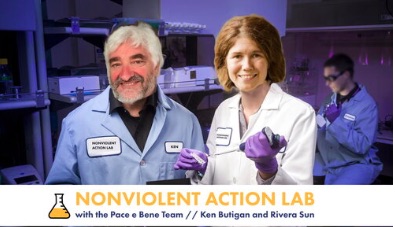
This online course is a basic introduction to principled and strategic nonviolence using Pace e Bene’s Engaging Nonviolence Manual. It is intended to provide an opportunity to build community while studying nonviolence. Participants will connect with up to 50 people who share their interests in discovering the many dimensions of active nonviolence. Using small and large groups, facilitators Veronica Pelicaric and Rivera Sun will guide the participants through explorations into the personal, interpersonal, and social justice aspects of nonviolence. This Community Course is designed to be accessible, fun, friendly, and fearless. Using an online platform, participants can engage with this exciting field from the comforts of their home. The course will familiarize participants with the overall contents of the Engaging Nonviolence study program which will serve to foster personal growth, healthy relationships and work for world peace.

(Article continued in right column.)

Question related to this article:

How can webinars and online courses contribute to the culture of peace?

(Article continued from left column.)

Weekly Themes:

Week 1: Understanding Nonviolence; Unpacking Violence

Week 2: Exploring Nonviolence: Going Deeper

Week 3: Conflict & Community: Using Nonviolence In Our Lives

Week 4: Nonviolence, Emotions, & Inner Awareness

Week 5: Principles of Nonviolence: Gandhi, King, and Beyond!

Week 6: Building a Culture of Nonviolence: Why We Need Nonviolence In Our World

Requirements: All participants need to purchase the Engaging Nonviolence Manual. It can be bought on Amazon or directly from Pace e Bene. The course will be held on Zoom. Participants must have internet access, and microphone and video on their computer. Each week, participants will be expected to complete weekly readings/viewings and come prepared for group discussions online.

Participants are strongly encouraged to invite friends and community members. Shared knowledge increases the power of active nonviolence in our communities!

Maximum number of participants per course: 50

Cost: $80 USD for the 6 sessions. Register below. If you are in need of a scholarship, a few are available, just let us know. Email us at info@paceebene.org

REGISTRATION

Register here on bottom of page.

Webinar: Youth Actions for Climate, Nuclear Disarmament and Sustainable Development – May 14 and 19

FREE FLOW OF INFORMATION

An announcement and video from Basel Peace Office (amended to update)

Youth movements for climate action, peace and nuclear disarmament have sprung up in Europe and around the world in the past few years. Young people have become concerned about existential threats to current and future generations, and increasingly frustrated at the insufficient action by governments to address these threats.


video of May 14

Further, the coronavirus pandemic has reinforced the need for governments and the international community to focus more on universal human security issues – like public health, climate and peace – and to move away from nationalism and militarism. Youth are well aware of the changes needed.

This webinar [includes] voices of civil society and youth from climate, peace, disarmament and sustainable development campaigns to inspire further action and to encourage intergenerational dialogue. It [also presents] Abolition 2000 Youth Network’s new project focused on the participation of youth in global, intergenerational dialogue. 

While the focus of the webinar is on the youth, any civil society members interested in sustainable development, nuclear disarmament and climate action are welcome to join. 

The webinar will be held in two sessions: Session 1 on May 14 timed to suit participants in the Americas, Europe and Africa. Session 2 on May 19 timed to suit participants in Asia and the Pacific.

Session 1: Thursday May 14. 11am EDT (New York), 5pm CET (Berlin)

Timed to suit participation by people in the Americas, Europe and Africa.

Speakers:

Chair: Marzhan Nurzhan (Kazakhstan, Switzerland). Coodrinator, Abolition 2000 Youth Network. Deputy-Director, Basel Peace Office

Yasmeen Silva (USA). Partnerships Manager, Beyond the Bomb

(Article continued in right column.)

Question related to this article:

How can webinars contribute to the culture of peace?

(Article continued from left column.)

Kehkashan Basu (UAE/Canada). Youth Ambassador, World Future Council. 2016 Children’s Peace Prize recipient. 

Akinyi Obama-Manners (Kenya). Sauti Kuu Foundation.

Anca Gliga (USA) Representative of the UN Secretary-General’s Envoy on Youth

Chaimae Sebbani (Morocco, Czech Republic). Project leader, Youth Voices for Climate, Peace and Nuclear Disarmament

Vanda Proskova (Czech Republic). Program Officer, PragueVision Institute for Sustainable Security

Session 2: May 19. 9am CET (Berlin).

Timed to suit participation of people in Europe, Asia and the Pacific
Speakers

Chair: Vanda Proskova (Czech Republic). Program Officer, PragueVision Institute for Sustainable Security.


Nicole Ponce (Philippines);  Member of the I am Climate Justice team. Research Fellow for the Normandy Chair for Peace.

Christopher Cruz (USA); Co-Founder / Outreach Director, Nuclear Free Schools.

Mostafiz Ahmed (Bangladesh). PNND South Asia Youth Program Coordinator

Junhong Min, (South Korea). Member of Friends of NPT

Takuya Moriyama (Japan); PNND Japan Coordinator. Researcher at Peace Depot. Coordinator of the Citizens’ Watch Project (monitoring peace and denuclearisation of North East Asia). 

Nuriya Azamatova (Kazakhstan); Organizer & Ambassador, Youth Peace Week Kazakhstan.  


Sooyoung Hwang (South Korea). Disarmament Program Manager, Peoples Solidarity for Participatory Democracy (PSPD)


Chaimae Sebbani (Morocco/Czech Republic). Project leader, Youth Voices for Climate, Peace and Nuclear Disarmament


Registration

Click here to register

Organized by:

Abolition 2000 Youth Network, World Future Council, Parliamentarians for Nuclear Non-Proliferation and Disarmament, Basel Peace Office. Contact vanda@pnnd.org

PAYNCoP Gabon Works with UNESCO to Combat Covid19 Fake News and Violence Against Women

FREE FLOW OF INFORMATION

sent to CPNN by Jerry Bibang

As part of the celebration of World Press Freedom Day (03 May), PAYNCoP Gabon took part, on 04 and 05 May 2020, in two video conferences, organized by the UNESCO Office in Libreville.


The first conference, which brought together about twenty youth organizations, focused on Media and Information Education (MIE) in order to combat the spread of fake news, particularly in connection with Covid 19.

(continued in right column)

Click here for the original version in French)

Question(s) related to this article:

African journalism and the Culture of Peace, A model for the rest of the world?

How can we work together to overcome this medical and economic crisis?

Protecting women and girls against violence, Is progress being made?

(continued from left column)

The meeting enabled the young association leaders from Gabon, including those from PAYNCoP Gabon, to strengthen their capacities in the techniques of detecting and verifying false information (fact-checking). Their rich discussions helped identify actions to be implemented jointly as part of the fight against Covid19, including an online awareness campaign.

The second conference, with journalists from public and private media, focused on dealing with violence against women and the safety of journalists. It was a question of seeing, among other things, how to deal with issues of violence against women, while respecting the rules of professional ethics and deontology as well as social and cultural realities in the Gabonese context. A pedagogical guide, published by UNESCO, entitled “Informing on violence against women and girls” as well as numerous oher contributions formed the framework of the exchanges.

On the sidelines of this meeting, the participating journalists discussed the need to set up a self-regulatory platform for information and communication professionals in order to to improve the practice of journalism in Gabon.

Coronavirus reveals need to bridge the digital divide

FREE FLOW OF INFORMATION

An article from the United Nations Conference on Trade and Development (UNCTAD)

The global crisis brought on by the coronavirus pandemic has pushed us further into a digital world, and changes in behaviour are likely to have lasting effects when the economy starts to pick up. But not everyone is ready to embrace a more digitized existence.

new analysis from UNCTAD  maps the changing digital landscape since the last major global calamity, the 2008/09 financial crisis. It looks at how a digitally enabled world is working for some, but not all equally.

According to the analysis, the coronavirus crisis has accelerated the uptake of digital solutions, tools, and services, speeding up the global transition towards a digital economy.

However, it has also exposed the wide chasm between the connected and the unconnected, revealing just how far behind many are on digital uptake.  
 
“Inequalities in digital readiness hamper the ability of large parts of the world to take advantage of technologies that help us cope with the coronavirus pandemic by staying at home,” said UNCTAD’s technology and logistics director, Shamika Sirimanne.

“This situation has significant development implications that cannot be ignored. We need to ensure that we do not leave those who are less digitally equipped even further behind in a post-coronavirus world.”

The power of digital revealed

The analysis provides snapshots of how technology is being used as a critical tool in maintaining business and life continuity.

Measures to contain the coronavirus pandemic have seen more businesses and governments move their operations and services online to limit physical interaction to contain the spread of COVID-19.

Digital platforms are also thriving as consumers seek entertainment, shopping opportunities and new ways of connecting during the crisis.

“There are incredible positives emerging that show the potential of a digitally transformed world,” notes Ms. Sirimanne.

Digitalization is allowing telemedicine, telework and online education to proliferate. It is also generating more data on the expansion of the virus and helping information exchanges for research.

There has been a leap in teleworking and online conferencing, amplifying the demand for online conferencing software such as Microsoft Teams, Skype, Cisco’s Webex and Zoom, the analysis says.

According to Microsoft, the number of people using its software for online collaboration climbed nearly 40% in a week.

(Article continued in right column.)

Question related to this article:

Is Internet freedom a basic human right?

(Article continued from left column.)

In China, the use of digital work applications from WeChat, Tencent and Ding took off at the end of January when lockdown measures started to take effect.

Other benefits include using artificial intelligence to help find a cure and a significant shift to e-commerce, benefitting small and big businesses alike.

However not all technology companies are profiting and there are some serious consequences of the rush to online platforms. These include mounting security and privacy concerns, according to UNCTAD.

The downside and the digital divide

The fast-paced shift towards digitalization is likely to strengthen the market positions of a few mega-digital platforms, the analysis finds.

This finding echoes the conclusions drawn in UNCTAD’s 2019 Digital Economy Report, which pointed out that the world’s top seven digital platforms already accounted for two-thirds of the value of digital platforms globally in 2017.

They have benefitted from network effects and from their ability to extract, control and analyse data, then transform it into digital intelligence that can be monetized.

“This situation will now be amplified as more people come or are forced online due to the coronavirus crisis,” said Torbjörn Fredriksson, UNCTAD’s digital economy head. “Those that do not have access are at risk of being left further behind as digital transformation accelerates, especially those in least developed countries.”

The least developed countries (LDCs) are the most vulnerable to the human and economic consequences of the pandemic, and they also lag farthest behind in digital readiness.

Only one in five people in LDCs use the Internet, and in most developing countries, well below 5% of the population currently buy goods or services online.

Lack of Internet access at home also limits connectivity, cramping, for example, the possibilities for students to be connected if schools are closed. “The education gap may also expand in developing countries, compounding inequalities,” said Sirimanne.

Low broadband quality hampers the ability to use teleconferencing tools. Mobile data costs also remain expensive across the developing world.

A development opportunity?

The coronavirus pandemic’s ability to show fractures can, hopefully, be turned into an opportunity, said Ms. Sirimanne. “More developing countries are exploring e-commerce and other digital solutions that can help build local resilience to future shocks,” she said.

The main policy takeaway from the analysis is that much more attention should be given to bridging existing and emerging digital divides to allow more countries to take advantage of digitalization.

New policies and regulations are needed to ensure a fair distribution of the gains from digital disruptions.

“If left unaddressed, the yawning gap between under-connected and hyper-digitalized countries will widen, thereby exacerbating existing inequalities,” she added.

“As with the coronavirus crisis and other development challenges, the world will need a coordinated multilateral response to deal with the challenge of digitalization.”

Trailblazing Nobel Peace Laureate Betty Williams Dies in Belfast

FREE FLOW OF INFORMATION

An article from the Nobel Women’s Initiative

Nobel peace laureate, Betty Williams, was a force of nature. She was awarded the Nobel peace prize in 1976 alongside Mairead Maguire for their work for peace in Northern Ireland. Betty once said, “Fear’s contagious, but so is courage.” Looking back on all that she has accomplished, it couldn’t have been more true.


Photo courtesy of the PeaceJam Foundation.

Betty and Mairead met under tragic circumstances. Earlier that year Betty witnessed a horrible car crash. A runaway car driven by Irish Republican Army member Danny Lennon, who had been fatally shot while fleeing from British soldiers, crashed into a family of four who were out for a walk. All three children; Joanne, John, and Andrew, were killed. Betty immediately sprung into action, circulating petitions. In the process she met the children’s aunt, Mairead Maguire.

Determined to use this tragedy to push for an end to the violence, Betty and Mairead organized a peace march. More than 10,000 Protestant and Catholic women came to show their support. The following week, 35,000 people marched with Betty and Mairead, demanding an end to the violence in their country.

Alongside journalist Ciaran McKeown, the two women co-founded /Peace People, an organization dedicated to nonviolence in Northern Ireland and throughout the world. In the thirty years since the award, Williams devoted her life to working for peace around the world, and a movement to begin a reversal of thinking on how we deal with the injustices, cruelty and horror perpetuated on the world’s children.

(Article continued in the column on the right)

Questions related to this article:

Where in the world can we find good leadership today?

(Article continued from the column on the left)  
  
Betty was the head of the World Centers of Compassion for Children International, which was founded in 1997 in honour of His Holiness the Dalai Lama. She was also the Chair of Institute for Asian Democracy in Washington D.C. and a founding member of the Nobel Women’s Initiative. She was the recipient of dozens of honours, including the Schweitzer Medallion for Courage and the Eleanor Roosevelt Award.

Betty passed away on March 18 in Belfast. Her legacy and incredible work for peace  in Northern Ireland, and the rights of children in war everywhere, will never be forgotten. She will be greatly missed. We send our deepest condolences, solidarity and love to her family and friends at this difficult time.

Condolences from Fellow Laureates

“It is with the greatest sadness that I heard of the death of my friend and co-worker for peace Betty Williams. Betty was a woman of great courage with a passion for peace and a love and compassion for all children. Betty will be sadly missed but remembered lovingly by all of us who knew Betty. I felt privileged to know her as a great peace activist and friend.” – Nobel peace laureate, Mairead Maguire.

“Betty was a dynamo – a force of nature that left a big mark in the world. She will be missed.” – Nobel peace laureate, Jody Williams.

Read more tributes

Read this beautiful tribute from Nobel peace laureate Mairead Maguire at Peace People.

Read these touching words about Betty from His Holiness the Dalai Lama.

Read moving obituaries from the New York Times  and the BBC.

UN Secretary-General calls for global ceasefire

FREE FLOW OF INFORMATION

Transcript of virtual press conference March 23 by the Secretary-General of the United Nations

Our world faces a common enemy: COVID-19.
 
The virus does not care about nationality or ethnicity, faction or faith.  It attacks all, relentlessly.
 
Meanwhile, armed conflict rages on around the world. 


UN Secretary-General Antonio Guterres

The most vulnerable — women and children, people with disabilities, the marginalized and the displaced — pay the highest price.
 
They are also at the highest risk of suffering devastating losses from COVID-19.
 
Let’s not forget that in war-ravaged countries, health systems have collapsed.
 
Health professionals, already few in number, have often been targeted.
 
Refugees and others displaced by violent conflict are doubly vulnerable.
 
The fury of the virus illustrates the folly of war.

(continued in right column)

Question(s) related to this article:

What is the United Nations doing for a culture of peace?

How can we work together to overcome this medical and economic crisis?

(continued from left column)

That is why today, I am calling for an immediate global ceasefire in all corners of the world.
 
It is time to put armed conflict on lockdown and focus together on the true fight of our lives.
 
To warring parties, I say:
 
Pull back from hostilities. 
 
Put aside mistrust and animosity.
 
Silence the guns; stop the artillery; end the airstrikes.
 
This is crucial…
 
To help create corridors for life-saving aid.
 
To open precious windows for diplomacy.
 
To bring hope to places among the most vulnerable to COVID-19.
 
Let us take inspiration from coalitions and dialogue slowly taking shape among rival parties in some parts to enable joint approaches to COVID-19.  But we need much more.
 
End the sickness of war and fight the disease that is ravaging our world.
 
It starts by stopping the fighting everywhere. Now.
 
That is what our human family needs, now more than ever.

(Note: The call by Guterres for a ceasefire has been applauded by the belligerents in the Yemen war which gives hope for a ceasefire there.)
 

China to Expel New York Times, Washington Post, Wall Street Journal Reporters From Country

FREE FLOW OF INFORMATION

An article by Ken Meyer in Mediaite reprinted according to Creative Commons Attribution Non-Commercial License for non-commercial reproduction with credit to the source site.

The Chinese Ministry of Foreign Affairs announced that they will expel American journalists from three news outlets — the New York Times, Washington Post and the Wall Street Journal — who are stationed to work in the country.

The press release, entitled “China Takes Countermeasures Against US Suppression of Chinese Media Organizations in the United States,” claims that “the US government has placed unwarranted restrictions on Chinese media agencies and personnel in the US, purposely made things difficult for their normal reporting assignments, and subjected them to growing discrimination and politically-motivated oppression.” The announcement goes on to say that the Chinese government will direct a number of retaliatory measures against The New York Times, Washington Post, the Wall Street Journal, Voice of America and Time Magazine.

(Article continued in the column on the right)

Question related to this article:
 
Free flow of information, How is it important for a culture of peace?

(Article continued from the column on the left)

The first demand was for all five outlets to provide the government “written form information about their staff, finance, operation and real estate in China.” Most notably, the statement goes on by saying American journalists for The New York Times, Washington Post and The Wall Street Journal are all ordered to leave China, along with Hong Kong and Macao, in the next 10 days.

“In response to the US slashing the staff size of Chinese media outlets in the US, which is expulsion in all but name, China demands that journalists of US citizenship working with the New York Times, the Wall Street Journal and the Washington Post whose press credentials are due to expire before the end of 2020 notify the Department of Information of the Ministry of Foreign Affairs within four calendar days starting from today and hand back their press cards within ten calendar days. They will not be allowed to continue working as journalists in the People’s Republic of China, including its Hong Kong and Macao Special Administrative Regions.”

The statement continues by hinting at further “reciprocal measures against American journalists” in response to “discriminatory restrictions” on Chinese journalists.

Last month, China expelled three WSJ journalists over an opinion that called the country “the real sick man of Asia.” The piece focused on China’s failed attempts to stop the coronavirus before it became a global pandemic, and it was decried as “malicious slander” by a Chinese Foreign Ministry spokesman.

Federico Mayor pays tribute to Javier Pérez de Cuéllar

FREE FLOW OF INFORMATION

A blog by Federico Mayor (translation by CPNN)

Javier Pérez de Cuéllar, former Secretary General of the United Nations (1982-1991), architect, among many other important achievements, of the peace processes in Mozambique, with the Community of Sant’Egidio, that of El Salvador and restart Guatemala. In the last two, I participated actively, following his guidelines as Director-General of UNESCO (1987-1999). His serenity and measure were always accompanied by great firmness and decisive action, with great logistical capacity. He was very demanding in the exercise of democratic multilateralism. He believed in the value and strength of the word, of the encounter, of the outstretched hand.


Javier Pérez de Cuéllar

Working with him was a very sobering experience. His clear vision, his conviction that the solution lies in the encounter, in the dialogue, in the mediation and conciliation constitute a luminous legacy that could clarify many challenges, some potentially irreversible, that confront humanity today.

We are in “… times of doubts and resignations in which noise drowns out words”, as Miquel Martí i Pol so beautifully wrote in 1981 (in “L’ámbit de tots el ámbits)”). As Secretary-General, Javier Pérez de Cuéllar was committed equally to freedom of expression and non-violence, but now the voices of the United Nations and its Institutions have been silenced. Now, more than ever – as between Calvino and Castellio – the principle of the word must be defended against the sword. Silencing “the voice of the world” goes against humanity’s interests, encouraging frustration, exclusion, radicalization.

Tireless on the path of reconciliation and concord, his life followed the common thread of his principles. From his time as Secretary-General, it is important to highlight how he made the orgaization effective, which is not easy given its complexity and the historical moment in which he carried out his responsibility with special dedication and a vision for the future. Despite the achievements made, “the majority of humanity still lives in conditions of poverty … and human excesses threaten the environment on which we all depend … There will be conflicts in the world until human aspirations can be more fully satisfied …”, he writes in the introduction to his book “Pilgrimage for Peace”, published in New York in 1997.

His reflections on the Economic and Social Council (ECOSOC) and the Security Council, relations with the United States and the role of NGOs and civil society could help today to redirect global governance, which is now irresponsibly placed in the hands of plutocratic groups. In the face of deadly invasions based on lies occur, the United Nations System is marginalized and outbreaks of xenophobia, supremacy and racism proliferate, refugee reception is neglected and development cooperation is reduced to shameful minimums.

At the ECOSOC meeting of 7 July 1988 in Geneva on international economic and social policy, I had an opportunity to directly appreciate his unusual ability as the Secretary-General. I participated in the debate with the participation of the United States, the Administrator of UNDP, Greece representing the European Economic Community, the United Kingdom, Germany, Tunisia (on behalf of the Group of 77), Canada, the Executive Director of UNICEF , China, Soviet Union …

(continued in the column on the right)

(Click here for the original Spanish.)

Questions related to this article:

Where in the world can we find good leadership today?

(continued from the column on the left)

Before assuming the United Nations General Secretariat, he had already achieved great successes, such as the one he achieved in 1974 when, as the UN Commissioner, he was able to broker an agreement in Cyprus between the Greek and Turkish leaders.

Javier Pérez de Cuéllar, has left us but he remains, as in the verse by Miguel Hernández, who also became invisible on a fateful day, but is always with us: “I’m leaving, I’m leaving, I’m leaving, but I’m staying… ”

In October 1987, he received the Prince of Asturias Award “for promoting Ibero-American cooperation.” In February 1989, the Nehru Prize “for international understanding”.

On January 19, 2000, I participated in Lima, with the “Discourse on Order”, in the tribute paid to the universities of Lima and Salamanca on their eightieth birthday. In these last twenty years, we have been in constant contact and have supported multiple initiatives in favor of multilateralism.

I end with a verse I dedicated to him in 1989:

“We must all build
in a place that is
in the middle of nowhere,
on the brink of the abyss.
Outside the borders
of the prosperous lands,
in the unknown swamps.
(No, you are not unknown,
the ignored swamps
where our past
sinks
progressively,
each day
before eyes that are
indifferent
and distant,
of the helpless
who cannot,
who don’t know,
of the well-to-do
who don’t hear,
who do not want to …).

To preserve memory,
the footprints of men,
their paths past,
to clarify
their steps tomorrow
we must, my children,
my friends,
you whom I do not know,
we must build everything
next to the abyss,
in the place,
rough and unique,
of our future,
and create only wealth
that can be shared”.

People with such a long journey and unusual attitude leave an imperishable mark. One day, they are absent and they become invisible, but what matters most remains: citizens of the world, continue to illuminate the paths of tomorrow and set new directions for future generations.