All posts by CPNN Coordinator

About CPNN Coordinator

Dr David Adams is the coordinator of the Culture of Peace News Network. He retired in 2001 from UNESCO where he was the Director of the Unit for the International Year for the Culture of Peace, proclaimed for the Year 2000 by the United Nations General Assembly.

PyeongChang Winter Olympics to Serve as Platform for Sustainable World

.. DEMOCRATIC PARTICIPATION ..

An article by Oh Soo-young, KBS World Radio News.

Anchor: With three days left until the PyeongChang Winter Olympics, an event in Seoul on Tuesday aimed to shine a spotlight on how the global sporting event can bring the world together in efforts to achieve social and environmental sustainability. Our Oh Sooyoung was at the event.

Report: The Olympics are not just a stage of athletic skill and sportsmanship but a global platform to build a better and more sustainable world. 

That was the over-arching theme of a “talk concert” held on Tuesday in central Seoul, co-hosted by the PyeongChang Olympics Organizing Committee, the South Korean government and seven UN agencies in South Korea. 

Former Olympians and various opinion leaders emphasized how the Olympic Games can contribute to the United Nations’ 17 Sustainable Development Goals(SDGs) which include improving livelihoods and empowering women and youth. 

(Article continued in right column)

Questions for this article:

Can Korea be reunified in peace?

(Article continued from left column)

United Nation Development Programme(UNDP) Seoul Policy Centre Director Balázs Horváth said a core principle of sustainable development is “leaving no one behind” – a value that resonates with the spirit of the Olympics. 

UNDP Seoul Policy Centre’s Director Balázs Horváth: “Sports is a valuable tool for promoting a just, peaceful and inclusive society. They help promote social inclusion, build trust and foster a culture of peace between groups, even groups that are in conflict. Help empower individuals and communities, especially for women and young children.” 

Beyond the sporting events, achieving sustainable peace and development are critical objectives for the games in PyeongChang. 

The PyeongChang Olympic Committee strives to preserve nature, revitalize local communities by supporting tourism and job creation as well as regional development using clean and affordable energy, according to the UN director. 

UNDP Seoul Policy Centre’s Director Balázs Horváth: “It contributes towards building industry and infrastructure. The KTX train that takes people to the Olympics. It contributes to clean water and sanitation – another SDG. Affordable and clean energy. Also, the way they are placing great emphasis on renewable energy and saving energy contributes to climate action, another SDG.” 

Organizers hope the PyeongChang Olympics will serve as an opportunity for the world to come together to create a better future.

The People of Mexico Give the World an Example of Solidarity

TOLERANCE AND SOLIDARITY .

An editorial by Leonardo Boff in Cultura de Paz. Managua, Nicaragua • Volume 23 • N° 73 • September – December, 2017 (translated by CPNN)

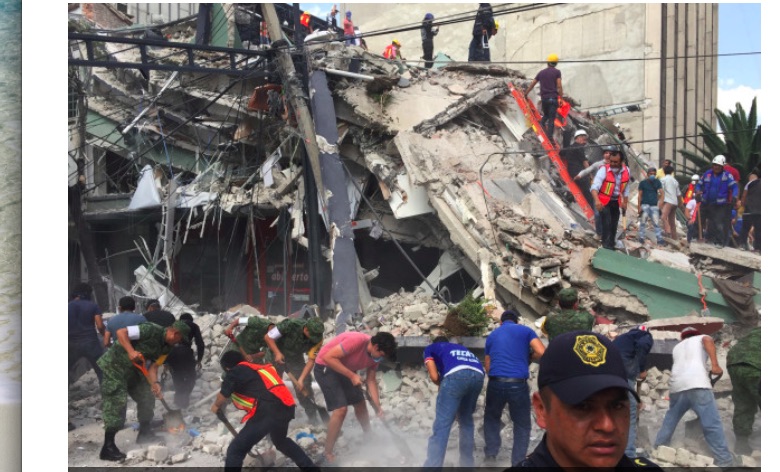
On September 19 and 23, Mexico was shaken by two earthquakes, one of magnitude 7.1 and another of 6.1 on the Richter scale, which struck 5 States and dozens of municipalities, including the capital, Mexico City, collapsing hundreds of houses and producing cracks in hundreds of other buildings. Beautiful churches, like that of St. Francis of Assisi in Puebla, saw their towers demolished. Everyone still remembers the terrible earthquake of 1985 that produced more than ten thousand victims. This, although it has been very strong, killed 360 people.


Image from Yucatan Times

Since then, I have been in Mexico and Puebla, invited to give lectures, and I have been able to verify in situ the ravages and the trauma caused to the people.

But what is most remarkable has been the spirit of solidarity and cooperation of the Mexican people. Without anyone to call them, thousands of people, especially youth, began to remove debris to save the buried victims. Groups were spontaneously organized and this spirit of solidarity saved many lives.

Immediately, aid collection centers were created for the victims, with water, food, clothes, blankets and all kinds of important utensils for a house. At the time I write this article (10/13/17) many collection sites are still visible. The cooperation knows no limits.

Here I only narrate two facts that are especially touching. The first: a school building that collapsed slowly with many children inside. A young man, seeing that a kind of channel had formed in the middle of the ruins, penetrated quickly through the hole and took out several children of 5-7 years. He had barely gotten the last one out when another part of the school fell behind him, saving his life by seconds.

(Article continued in right column)

(Click here for Spanish original of this article)

Question for this article

Is there a renewed movement of solidarity by the new generation?

(Article continued from left column)

Second fact: a young lady, about 30 years old, was 34 hours under the rubble. She granted a moving interview on television, narrating the different phases of her tragedy. Imprisoned in the rubble, a concrete slab was fixed within a few inches of her face. For 30 hours she did not hear any voice, or steps, or any noise that meant the approach of someone who could rescue her.

She narrated the different psychological stages, similar to those we know when a patient receives the news of the incurable character of his illness and the proximity of death.

At first, this lady asked: why precisely I must go through this misfortune? Then, almost desperate, she began to cry until she had no tears.  Then she began to pray and to plead with God and all the saints, especially the Virgin of Guadalupe, the one with the greatest devotion of the Mexicans. Finally, she resigned herself to die and confidently surrendered to the mysterious will of God. But she did not lose hope.

Finally, she heard footsteps and then voices. Her hope was strengthened. After 34 hours, literally buried under a mountain of rubble, she could be rescued. And here she was in the interview, happy and whole, accompanied by a psychoanalyst specialized in dealing with psychological traumas
like those caused by a sudden earthquake, and giving testimony of her terrible experience.

Mexico is a region geologically marked by earthquakes, given the configuration of the tectonic plates of its subsoil. The human being has no power over these enormous forces. What you can do is take precautions, learn to build your buildings to resist earthquakes in the way of the Japanese and, above all, get used to coexisting with this indomitable reality. In a similar way, the population of our semi-arid region of the Northeast, who must adapt and learn to coexist with the drought that can last for many years, as is currently the case.

 In the debate after a conference at the Universidad Iberoamericana, in Mexico City, one woman declared: “If our country and if all of humanity lived that spirit of solidarity and cooperation, there would be no poor in the world and we would have rescued a part of the lost paradise “.

I reinforced her statement and told her that it was the cooperation and solidarity of our anthropoid ancestors, who began to eat together, which allowed them to leap from animality to humanity. What was true yesterday must still be true today. Yes, solidarity and, in general, the cooperation of everyone with everyone will be able to rescue the essence of making us fully human. In recent days, the Mexican people have given us a splendid example of this fundamental truth.

(Thank you to Marcos Estrada, the CPNN reporter for this article.)

Philippines: MPI 2018 Annual Peacebuilding Training: Creating a Culture of Peace

EDUCATION FOR PEACE .

An article from the Global Campaign for Peace Education

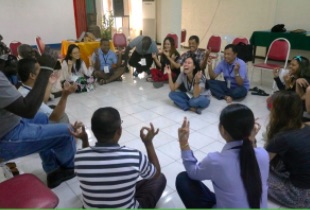
For over 18 years now, Mindanao Peacebuilding Institute (MPI) has successfully conducted its Annual Peacebuilding Training. This three-week intensive peacebuilding training has continued to bring together a wide range of people with experience, knowledge and skills in peace-related work to share and learn in a safe environment where all viewpoints are encouraged and respected.

Starting with the first training in 2000, MPI has trained over 2,000 peacebuilders coming from more than 40 countries around the globe, in areas such as conflict transformation, conflict analysis, peace education, religious peacebuilding, and trauma healing. These courses are taught by a distinguished roster of facilitators from Asia-Pacific and other parts of the world.

(continued in right column)

Question for this article:

Where is peace education taking place?

(continued from left column)

MPI will again endeavor to create a space where peacebuilders meet in mind, heart, and spirit to keep abreast of the challenges that the issues of peace and justice present, during the MPI 2018 Annual Peacebuilding Training from May 7 to May 25, 2018, at Mergrande Ocean Resort, Davao City, Philippines.

With this, we are pleased to inform you that we are now officially accepting applications for the 19th Annual Peacebuilding Training! For MPI 2018, we are offering one new course – Digital Peacebuilding and New Media in Week 2.

We will have an Early-Bird Discount of 7% that will be applied to those who submit their applications on or before March 1, 2018. The deadline for the receipt of regular applications is on April 1, 2018.

For more information on the courses, trainers, application and fees; please click this link.

State Of The City: We’re The Resistance (New Haven, CT, USA)

TOLERANCE AND SOLIDARITY .

A article by by Markeshia Ricks in the New Haven Independent

A week after President Trump delivered his State of the Union Address, Mayor Toni Harp delivered a “state of the city” address that put New Haven squarely in the camp of the anti-Trump “resistance.”

In front of a full aldermanic chamber at City Hall, Harp painted a picture of a city resistant to Trump’s vision for America, resistant to Connecticut’s cities-vs.-suburbs mentality, and resistant to any notion that New Haven isn’t a city on the rise. She borrowed a word — “resistance” — that has become a phrase for local movements across the country formed to oppose the current administration in Washington.
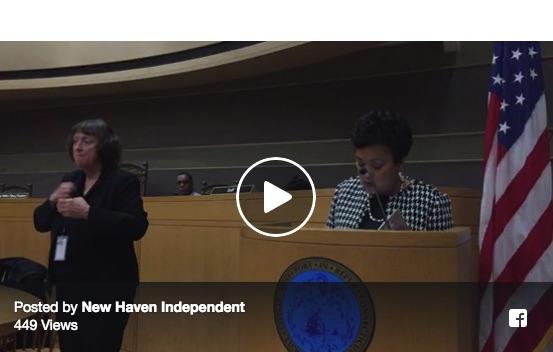

Video of Mayor’s speech

A year ago, Harp said, no one could have predicted that “we would be dealing with such a dramatically altered political, social, and economic landscape.”

“In that context, tonight, I would describe the state of New Haven as resistant to these frightening trends in this nation toward what would be a new normal -–  a Republic, a state, and a civic life so different as to be unrecognizable to most of us,” she said. “New Haven is resistant to these would-be, new standards not for the sake of being contrary, and not because it’s stylish or politically correct to be, but because these new standards are contrary to the best interests of this city, its residents, and its future.”

Harp said that New Haven continues to offer a hand to its residents even though there is “a trend in some government circles to neglect or abandon the aged, the vulnerable, and those who simply can’t keep up.

“Social services for veterans, the elderly, the formerly incarcerated, the homeless, the disabled, the addicted, and the mentally ill seem to fall increasingly on the shoulders of local providers, as federal and state support dwindles,” she said. “Going forward, New Haven must resist the temptation to follow suit: in my opinion, a community is measured by the care it provides for those who cannot provide – or speak up – for themselves. Tonight, I’m pleased to say that in this regard, New Haven continues to measure up.”

Harp said all of the progress that New Haven has made “reflects an undeniable collaboration.”

“In New Haven, elected officials, city workers, residents, volunteers, students, immigrants, and a host of other city partners make this a vibrant, attractive city, committed to its better days ahead. New Haven is resistant – and will continue to resist – a laundry list of frightful trends in America,” she said. “Perhaps most frightening among them is a deliberate attempt by some in this nation to deny benefits of the American dream—safety, security, education, healthcare, opportunity — to any number of Americans for completely arbitrary and unjustifiable reasons.

Harp said New Haven has “resisted” by rallying to the side of displaced Puerto Ricans with ongoing aid and relocation assistance; by partnering with Bridgeport in a long shot but, alas, failed bid for Amazon’s second North American headquarters; and by creating a favorable climate for development that is starting to pay dividends downtown and beyond. She also noted that since she took office New Haven’s unemployment rate has dropped from 10.3 percent to 5.1 percent.

“This city continues to resist any notion that big ideas are too much to handle in challenging times,” she said. “The new Boathouse at Canal Dock, a major redesign for the rest of Long Wharf, and continuing progress on Downtown Crossing reaffirm this. Phase 2 of Downtown Crossing will get started this year, continuing the process of stitching back together parts of town that were unduly separated generations ago.”

“As I complete my assessment of New Haven this year, and as I assess the state of other cities nearby and frankly, across the nation, there isn’t a city I envy, there isn’t a city I’d rather serve as mayor, and there isn’t a community of people I’d rather be with as we tackle a daunting agenda under these current, challenging circumstances,” she concluded.

(Article continued in the right column)

Questions related to this article:

The post-election fightback for human rights, is it gathering force in the USA?

(Article continued from the left column)

Alders Praise Vision, Seek Details

Several alders were getting their first taste of the mayor’s “state of the city” address as a member of the Board of Alders, and they found a lot to like.

Yale Alder Hacibey Catabasoglu said he was happy to hear about the city’s infrastructure and the improvements that have been made, such as the wifi on the Green and efforts to help small businesses. He applauded the city’s efforts to bring in companies like Goldman Sachs to teach small immigrant business owners like his father.

He added that he would have liked for Harp to talk a little bit about youth activism in the city and how their political activism helps New Haven resist.

“The youth are the ones that are going to be the decision makers and I think it would have been nice for her to touch upon that,” he said. “But overall, I thought it was a wonderful speech.”

First-term Newhallville/Prospect Hill Alder Kim Edwards said she found the mayor’s message about the state of the city to be positive and upbeat.
“We sound like a city that’s thriving,” she said. “There are many things we need to work on and we have to make sure all of our population is included in the decisions that we make daily.”

Edwards said while she knows there is much work ahead on the budget, she said she was impressed that the city has managed to cut its unemployment rate nearly in half.

“We need to keep on that trend and we need to make sure that they are living wage jobs,” she said. “We live in a high tax state. So we need to not just use the words living wage. They actually need to be living wage jobs.”

Downtown Alder Abigail Roth said listening to Mayor Harp Monday night reminded her of how proud she is of the Elm City. “I liked her theme of a city that’s resistant, especially with the state of our country today,” said Roth, who attended one of the original “resistance” events, a D.C women’s march coinciding with Trump’s first inauguration weekend. “It feels good to be in a city where people’s values align with mine and the mayor’s values on so many fronts.”

But like Edwards, Roth noted that the upcoming tango with the budget is on the horizon. And Harp didn’t have a lot to say about that in her address aside from mentioning the reduction of overtime in the fire department.

“If you look at the [monthly] budget reports it’s something we have to be concerned about,” Roth said. She noted, for instance,  a recent story in the Independent about a police psych-exam contract problem that is delaying the seating of an academy class and leading to increased overtime costs. She called the issue “a huge concern.” “That’s not to take away from what she said in the speech,” Roth added. “There were a lot of positive things but the city’s budget is a very serious thing that we’re going to have to focus a lot on.”

There will be time for focusing on that soon enough for Morris Cove Alder Sal DeCola, but Monday night the mayor’s speech had him focused on the positive.

“There are a lot of good things that are happening for New Haven,” he said. We’re always hearing the negative and she was talking about all of the positive things. I wish more people would focus on the positive. The bad’s always going to be there. I have this saying, ‘Every flower garden has weeds in it; look at the flowers.’ We know the weeds are there; enjoy the flowers. That’s how I look at it.”

Fair Haven Ernie Santiago saw some flowers when he heard Harp say that a sweep that helped the city assess the needs of Newhallville last year will make its way to his community.

“That was very good news,” he said. “Finally, Fair Haven is going to get its due. Now, we gotta see if it comes to fruition and how much is done because we do need a lot in Fair Haven. We’ve got the worst streets, the worst sidewalks. I feel good about hearing what I heard. She gave a good speech. It’s always good to hear they’re going to work on your ward.”
Freshman Newhallville/Prospect Hill Alder Steve Winter said he appreciated the message of resistance and believed it was needed. He also noted that he’s interested in hearing more about how the digitization of city services and other technology could help the city maintain a high level of service in a tough fiscal environment.

“With values and institutions under assault, it’s important to have our leaders and our colleagues remind us of why we have to do what we do and why you have to keep going,” he said.

Peace is not just a two-period a week subject – Prajnya Teachers for Peace Training (India)

EDUCATION FOR PEACE .

An article from the Global Campaign for Peace Education

CHENNAI: In the wake of alarming incidents that have threatened the holistic peace in the country and across the world, Prajnya, a Chennai-based NGO has flagged a two-day workshop — ‘Prajnya Teachers for Peace Training’. “In 2005, National Council of Educational Research and Training (NCERT) came up with a National Curriculum Framework (NCF) which says that peace education is a ‘concern cutting across the curriculum and is the concern of all teachers’,” says Swarna Rajagopalan, MD, Prajnya Trust.


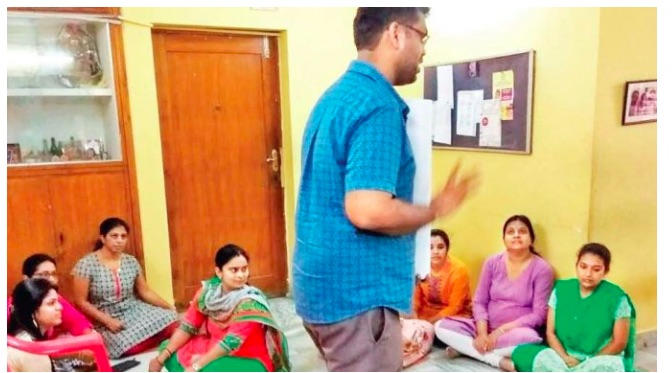
Training during a January 2016 peace training session (Photo: The New Indian Express)

Accordingly, schools and teachers are required to integrate peace education across the curriculum and extracurricular activities. “No matter what the teacher has taught, the value of peace education — be it acceptance, inclusivity and sensitivity should be integrated into curricula everywhere. For instance, if you have a math problem, instead of Raja and Jhony, it can be Raja and Lilly. So, inclusivity in everything — modeling and language, gender inclusivity and communal inclusivity are to be a part of the curriculum,” she shares.

(continued in right column)

Question for this article:

Where is peace education taking place?

(continued from left column)

The idea is not just to teach peace as a ‘two-period a week’ subject. It’s to include the values in everything a teacher shares. But sadly, this practice hasn’t taken off. “It has been hard to implement it in schools. With a minimum classroom strength of 35 and a maximum of 70, multiple divisions and exam pressure, the focus has not fallen on peace education,” elucidates Swarna.

With these short training workshops, Prajnya is trying to give teachers a broad idea of how peace education can be integrated. The two-day training will introduce participants to peace education and the NCF recommendations, facilitate an introspective exploration of what teachers bring into classroom, their communication practices, and values for an inclusive classroom and society; provide the opportunity to identify and design class plans with peace education principles and include a practice and peer mentoring component. “We will have Priyadarshini Rajagopalan, a peace educator-come-teacher and Chintan Girish Modi, another renowned peace activist to facilitate the workshop,” she says.

While the workshop is being conducted in Chennai, it’s not confined to the city. “If anyone from Sriperumbudur, Pondicherry or Kanchipuram want to enroll for the workshop, they are welcome as well. We are looking for teachers from different spectra to join us. Even if one person from a school joins us, it goes back to the school in some way,” she shares.

The workshop will take place once in three months and will be scheduled after assessing  the optimal time for the participants. “As adults, we are losing perspective on how we perceive the world and about asking the right questions.

So, what are we teaching our children? This has to be addressed,” she adds.
(Reposted from: The New Indian Express.  December 30, 2017, by Roshne Balasubramanian)

Spain: Junta of Andalucía highlights commitment of the community to dialogue and solidarity in the ‘School Day of Peace’

.. DEMOCRATIC PARTICIPATION ..

An article from 20 Minutos (reproduced according to terms of Creative Commons)(translated by CPNN)

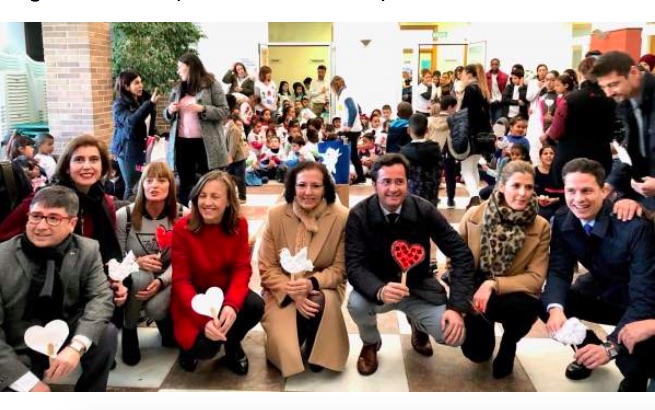
The 271 educational centers of the province of Almería integrated into the Network ‘School: Space of Peace’ have celebrated this Tuesday [January 30] the ‘School Day of Peace and Non-Violence’ with a program of recreational and cultural activities to promote the democratic values of equality, respect for diversity and tolerance.


Click on photo to enlarge

More than 100,000 students and 6,000 teachers participate in Almería in these initiatives to promote coexistence among the educational community. The delegate of the Junta, Grace Fernandez, who has highlighted the commitment of the educational community to solidarity and dialogue, has taken part along with the students of Las Norias de Daza and IES Aguadulce in the events they have organized to commemorate this international event.

Some thirty NGOs participated in the ‘VII Volunteering, Participation and Solidarity Day’ at the IES Aguadulce. The meeting, which puts students in direct contact with the work carried out by the associations in different areas, has been inaugurated by the Government delegate of the Junta, Gracia Fernández, who has visited the information tables of the different groups installed in the center accompanied by the delegate of Education, Francisca Fernández, and by the director of the institute, Amparo García.

During her visit, Gracia Fernández pointed out that this day highlights “the joint work of the educational community of the IES Aguadulce in promoting the values ​​of solidarity, social justice and equal opportunities and its promotion among students”.

The day, which celebrates its seventh edition, includes an exhibition area located in one of the covered courtyards of the center where, from 9 in the morning and until 13.30, the associations have shown the work they do through brochures, panels and other information material.

The program is completed with a series of lectures and workshops given by the different participating NGOs, aimed at students of ESO, Baccalaureate and Computer Training Cycles.

The delegate of the Government has explained that this type of meeting “contributes to make visible to society the work of the volunteer and their altruistic and solidary commitment. It reinforces the contents of these topics that are included in the Andalusian educational curriculum”.

Fernandez referred to the role of volunteering “as an instrument of participation of society and as a space from which citizenship is built and democracy is strengthened”. “Solidarity, social responsibility, justice and equal opportunities are values ​​that voluntary action and the public education system of Andalusia share”, explained the delegate.

(Article continued in right column)

(Click here for the article in Spanish)

Questions for this article:

How important is community development for a culture of peace?

(Article continued from left column)

She encouraged young people to participate in the associative movement “to combat exclusion, fight for equality, for education, for the integration of people with disabilities, for culture and for the environment, in short, for a more just society “.

Amnesty International, Proyecto Hombre, Greenpeace, Posidonia, Manos Unidas, Asalsido, Colega, Cáritas, Posidonia and A Toda Vela are some of the thirty associations that participated, together with the Andalusian Institute of Youth (IAJ) in this VII Volunteer Day of the IES Aguadulce, a center with 1,630 students and 75 teachers, which develops, among other programs, the Youth Formation and the Espacio de Paz School.

CAREER FOR SOLIDARITY IN LAS NORIAS

The delegates of the Government and Education, Gracia Fernández and Francisca Fernández, also visited this morning Las Norias de Daza to share with the students of the educational centers of this ejidal neighborhood the activities organized by the Local Board of Education and Community on the occasion of the ‘School Day of Peace’, including a charity race in favor of the NGO ‘Save the Children’.

Gracia Fernández thanked the educational community and the members of the Local Committee “their generous collaboration in the process of permanent improvement of the public education system.”

The Local Board of Education and Community of Las Norias was created in 2012 under the Intercultural Intervention Project promoted by the Social Work of La Caixa and on the initiative of the Association of Cooperation and Development with North Africa (Codenaf) with the support of the Junta and the City Council of El Ejido.

It has the participation of the five educational centers of Las Norias and a mixed group of technicians and professionals from social services, health, sports and education.

Its objective is to be a forum for reflection to collectively manage the cultural diversity of Las Norias and promote social cohesion and coexistence.

The delegate of Education has stressed that “the work of the Local Board of Education has paid off in improving the academic results of all students and in the development of an educational project that is enriched with multiculturalism and diversity.”

SCHOOL DAY OF PEACE

The School Day of Peace and Nonviolence has been celebrated on January 30 since 1964, when it emerged as an initiative of the Spanish teacher Llorenç Vidal for the dissemination of education for tolerance, solidarity, concord and respect for human rights. In 1993 it received the support of UNESCO. The anniversary coincides with the date of the death of Mahatma Gandhi, murdered in 1948.

The delegate of Education, Francisca Fernández, stressed that “the culture of peace is not only a transversal content but is one of the ultimate goals of the public educational system in Andalusia that is specified in the Andalusian Plan for Education for the Culture of Peace and which involved the creation in the 2002-2003 academic year of the School Network: Space of Peace “.

Going the Distance for Peace: South Sudanese Educators and Policy Makers Focus on Youth by Training Secondary-School Teachers

… EDUCATION FOR PEACE …

An article from Relief Web

The majority of the population in South Sudan is under thirty years of age. However, ongoing conflict, high unemployment and lack of consistent access to education risks leaving the generation of youth without the skills to politically, economically, and socially grow the world’s newest nation. Peace and the stability it provides are paramount in South Sudan.

As one way of developing peace-builders and peaceful societies in South Sudan, the Ministry of General Education and Instruction (MoGEI) with the UNESCO Juba Office and UNESCO-International Institute for Capacity Building in Africa (IICBA), hosted a Training of Trainers (ToTs) on Transformative Pedagogy for Peace-Building. From 23-26 January 2018, 24 MoGEI staff and trainers of secondary-school teachers from selected Institutions such as Rombur Teacher Training Institution, Juba Teachers Training Center, Yei TTC, Loka National Secondary School, Malakal Elshabia Secondary School, just to mention a few, participated in the workshop. This ToT is a key element of UNESCO-IICBA’s Teacher Training for Peace-Building in the Horn of Africa and Surrounding Countries project, supported by the Government of Japan.

The overall goal of the project is to train 6,000 secondary-school teachers in South Sudan, Ethiopia, Kenya, Somalia, and Uganda and Eritrea through a Training of Trainers (ToTs) model. By training teachers, the project invests in youth, offering them skills that will help them to become peace-loving and economically and socially productive citizens.

Those trained in Juba, South Sudan will go on to train pre and in-service secondary school teachers to meet the country’s goal of training 1,000 secondary-school teachers.
At the opening ceremony, His Excellency Seiji OKADA, Ambassador Extraordinary and Plenipotentiary of Japan to South Sudan; Abdullahi Ali, Acting Undersecretary of Ministry of General Education and Instruction; Umar Alam, Head of Office of UNESCO Juba office and Yumiko Yokozeki, Director of UNESCO-International Institute for Capacity Building in Africa (IICBA) provided welcoming remarks. Mr. Umar Alam stated that UNESCO is advocating for giving utmost priority to the peace education initiative in South Sudan, and thanked the Government of Japan and MoGEI for their support. Dr. Yokozeki shared that IICBA is keen to know the needs of the teachers in the continent and believes that teachers carry the key to quality education.

Since 2016, with the support of Japan, IICBA has been working on peace and resilience building, one of the most important issues in South Sudan and the world. IICBA has also spearheaded Prevention of Violent Extremism (PVE) through education in Africa with two multi-country PVE training workshops in Addis Ababa and Dakar in 2017. Ambassador Okada spoke about the important role of teachers in peaceful societies. His Excellency noted that Japan development was a result of investing in people and education. The Honourable Dr. Nadia Arop Dudi, Minister of Youth, Culture and Sports, officially opened the workshop by strongly emphasizing the role of gender in peace education access.

During the weeklong workshop, participants were engaged in dynamic activities designed for teaching peace-building through Transformative Pedagogy. This unique method relies on active participation and deep reflection. It encourages youth to become social entrepreneurs and design community projects to reduce root causes of conflict. Sarah Charles Hakim, a tutor at Rombur National Teacher Training Institute shared that she ‘benefited greatly from the workshop and is eager to implement it in her institution.’

(Article continued in right column)

Question for this article:

What is the relation between peace and education?

(Article continued from left column)

Another participant, Angelo Gume felt that ‘peace-building education is needed in South Sudan to teach youth the skills of critical thinking, active listening, mediation and negotiation so that they can be peace-builders. There is a long way to go, but together teachers, youth, families and communities can create a peaceful society.’ In fact, South Sudanese educators have already gone the distance to learn for other countries experiences in implementing peace education.

As a key activity of the project, from 2-9 August 2017, Ms. Doru Joyce Ladu, a secondary school teacher in Juba joined Mr. Babu Emmanuel Ezibon, Senior Inspector in the Planning Department and Mr. Victor Dut Chol, Director for Research and Policy Documentation both from MoGEI, were part of the 18 policy makers, teacher trainers, and secondary school teachers from the six participating countries who travelled to Japan for training in Tokyo and Hiroshima.

The study tour participants also had the honour to be invited to the Peace Ceremony on 6 August 2017 in Hiroshima. The Japan study tour bridged cultures, histories, and educational experiences between the six African countries and Japan and provided opportunities to share experiences on teaching and peace-building among educators and policy makers.

At the closing ceremony for the workshop, Mr. Takanobu, who represented the Ambassador of Japan in South Sudan, was pleased to hear about the project’s study tour to Japan. He stated that the trainers were like ‘seeds who will generate peace-builders who will also go on to develop additional peace-builders.’ The Honorable Deng Deng Hoc Hai, the Minister of General Education and Instruction, officially closed the workshop by sharing that the new South Sudan National Curriculum had the four objectives of developing good citizens, life-long learners, and creative problem solvers, who were also environmentally responsible persons.

The ministry has a new mandate to have peace-clubs at every school beginning in February 2018. The Honourable minister shared that ‘the right to education is as important as the right to life; education impacts the quality of one’s life and it is the foundation for reaching all the other 2030 Sustainable Development Goals (SDGs).’ He indicated that the teacher trainers had a great deal of work ahead of them but that they were now well-prepared for the task. The honourable minister thanked the Government of Japan for supporting this training and project.

South Sudan has also been instrumental in other project activities, including the development of teacher guides and participating in the training of trainers from 4-8 September 2017. In March 2018, educators, MoGEI, NGOs, youth and UNESCO will also hold a policy dialogue to discuss how to make the project sustainable.

This UNESCO-IICBA initiative comes at a crucial time as conflicts, disorder, and natural disasters are severely impeding global and regional efforts to improve access to quality education while exacerbating violence and radicalizing youth.

With 42% of its population of 12.2 million under the age of 15, lessons learned from this trip have the potential for great impact of future South Sudanese generations.

Project goals and activities are aligned with Goal 4 and Goal 16 of the 2030 Sustainable Development Goals (SDGs) and the AU’s Agenda 2063. To quote Dr. Yumiko Yokozeki, Director of UNESCO-IICBA, “More young people are enrolled in school in Africa. Therefore, a teacher’s role must be emphasized in promoting peaceful cultures amongst the youth.”

(Thank you to the Global Campaign for Peace Education for calliing this article to our attention.)

Report of the 2nd International Conference on “Peace Education for Peacebuilding” (Armenia)

… EDUCATION FOR PEACE …

An article from the Global Campaign for Peace Education

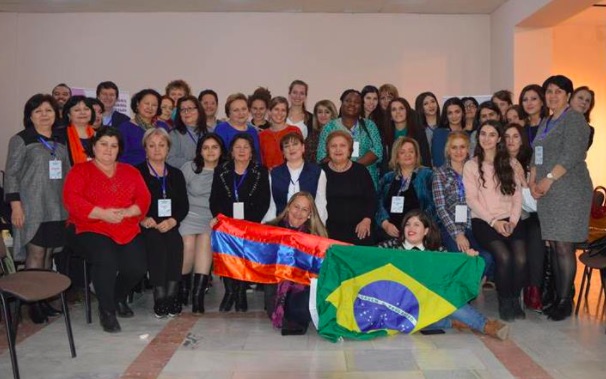
The international conference has passed, but the impressions gained during the event [Gyumri, Armenia, December 1-2, 2017] and the fruitful collaboration among the 130 participants from 25 countries remain. It was the second conference on peacebuilding, hosted by “Women for Development” NGO, follow-up of the one in 2007. While the first event intended to present mainly the work of WFD itself, this year’s conference also facilitated the intellectual exchange of others, offering platform, voice and translation and bringing together different field specialists. Among the keynote speakers were Werner Wintersteiner (Austria), Jennifer Batton (USA), Sanam Naraghi-Anderlini (UK), Isabella Sargsyan (Armenia), Gulnara Shahinian (Armenia).


Conference participants

Speakers from Austria to Australia, Ghana to Colombia and Netherlands to Japan, reflected on past experiences and proposed future goals on diverse topics such as domestic violence, violent extremism, global citizenship, Caucasian conflict resolution and many more. The participants and the speakers affirmed that all the challenges and problems faced worldwide in establishing peace and in the area of peacebuilding demand active participation of various representatives of the society.

Through the conference, they expressed the appeal to contribute to the expansion of peace education through formal and non-formal teaching and the creation of a culture of peace among schoolchildren and youth as an essential means to establishing peace and preventing violence and terrorism.

The conference and the following workshop-day enabled practitioners form different continents to introduce their best practices, success stories, to expand their professional network and to exchange opinions on the ongoing challenges, which accompany the implementation of peace education worldwide. Surprisingly, there were plenty of similarities in spite of the specific regional context.

(continued in right column)

Question for this article:

Where is peace education taking place?

(continued from left column)

The impact and the outreach of the event would not have been possible without the support, sponsorship and collaboration of GPPAC’s Peace Education Working Group taking part actively on the side of the speakers.

Jennifer Batton, keynote speaker and experienced professional, opened the conference and offered priceless input on peace education in the United States. Her GPPAC colleagues: Iryna Brunova-Kalisetska (Ukraine), Carlos José González Hernández (Colombia), Charlotte Divin (Netherlands), Tatjana Popovic (Serbia), Ahmed Bukli (Iraq), Kesia-Onam Bijou Birch (Ghana), Gary Shaw (Australia), Nina Bagdasarova (Kyrgyzstan), Kazuya Asakawa (Japan) and Isabelle Peter (Switzerland) all contributed both to the conference programme and later provided hands-on exercises during the post-conference workshop day in Gyumri Commercial Center on 03.12.

The official host of the conference itself was Gyumri Technology Center, the most modern equipped building in the city, which offered great opportunity for impeccable programme flow, parallel workshops and cozy time between the sessions during the coffee-break and the lunch on the spot.

The conference offered the participants the opportunity to get to know the Armenian culture, including the typical folks dance Khochari, performed together with a local dance group in the Youth Center Hayordac Tun. There they were also shown an exhibition of children’s painting – the result of the art contest “I am a Sower of Peace”, carried out annually by “Women for Development” NGO. Another evening highlight was the visit to Black Fortress – an old abandoned Russian fortress with spectacular architecture.

The closing of the conference was marked by classical live music, a lot of positive energy and mutual gratitude for the productive exchange and, last but not least, by the celebration of WFD NGO 20th anniversary since its foundation in December 1997 in Gyumri.

There was great interest in the work of the international speakers from the side of the local residents in Gyumri. Following the conference, GPPAC Peace Education Working Group members Kesia-Onam Bijou Birch, Carlos José González Hernández and Ahmed Baqir Bukli were welcomed by the rector and the professors of Shirak State University. The guests met with the rector Sahak Minasyan and vice-rector Anahit Farmanyan who asked for a possible collaboration with the GPPAC members via WFD NGO, for sharing the experience and lessons learnt in different countries with the purpose to integrate “Conflict management education” in the University in a non-formal education method.

“Women for Development” NGO as host of the international conference “Peace Education for Peacebuilding” and as an active player on the field for the past 15 years believes that the integration of peace education into the education system worldwide is one of the most important steps in the journey of achieving peace. That is at the same time the reason to dedicate its efforts towards the goal and the motivation for the future projects.

Youth Solidarity Fund 2017 Edition: Project Outcomes and Capacity Building Workshop

TOLERANCE AND SOLIDARITY .

Excerpts from the September-December 2017 Newsletter, Issue #10 of the Alliance of Civilizations

The implementation period for the seven projects supported under the Youth Solidarity Fund (YSF) 2017 edition came to an end on 31 October 2017. YSF recipients had five months from June 2017 to complete projects funded with a grant of up to USD 25,000 each.

Projects ranged from encouraging behavioral change for peaceful elections in Liberia, to promoting the social inclusion of migrants through arts-based public events in rural areas of Morocco, and engaging young women in peace clubs and sports to promote diversity in Afghanistan. Other projects focused on the role of the media to prevent violence in South Sudan, trained Pakistani youth to advocate for the localization of Security Council Resolution 2250, used flmmaking to share stories of youth in India, Nepal and Bhutan, and taught peace education to reduce instances of violence towards refugees in Uganda.

By the end of the implementation period, over 11,000 direct beneciaries have been impacted by YSF projects, with 83% of those beneficiaries being youth. Of those direct youth beneficiaries, 57% were women. In total, the seven projects of the Youth Solidarity Fund 2017 edition impacted almost 100,000 individuals, both directly and indirectly.

(Article continued in right column)

Question for this article

Youth initiatives for a culture of peace, How can we ensure they get the attention and funding they deserve?

What is the United Nations doing for a culture of peace?

(Article continued from left column)

During 11-15 December 2017 in Istanbul, Turkey, a closing capacity building workshop was organized for the recipients of the Youth Solidarity Fund (YSF) 2017 edition. The workshop focused on the issue of sustaining their projects following the end of the YSF project implementation period.

In addition to the current recipients, three YSF alumni were also invited to participate. They facilitated sessions for the recipients on solving challenges faced in implementing their projects, as well as best practices on organizational sustainability. Recipients then worked with professional trainers on topics including monitoring and evaluation, fundraising, social media strategies and advocacy.

Participants came from youth-led organizations located in countries such as India, Kenya, Liberia, Morocco, Nepal, Pakistan, South Sudan and Uganda.

On the first day of the workshop, the YSF recipients and alumni took part in a dialogue exchange with representatives of the Turkic Council youth network, in an event commemorating the second anniversary of the United Nations Security Council Resolution 2250.

The Youth Solidarity Fund call for applications is open from 22 January through to 16 February 2018. YSF supports youth-led organizations (led by young people aged 18-35 years) that foster peaceful and inclusive societies by providing seed funding to outstanding projects promoting intercultural and interfaith dialogue. More information on eligibility and selection criteria is available on www.unaoc.org.

Nigeria: Federal government rallies support of stakeholders to promote peace, security

.. DEMOCRATIC PARTICIPATION ..

An article from Vanguard Nigeria

The Minister of Information and Culture, Alhaji Lai Mohammed, says sustenance of peace and security in Nigeria is the responsibility of traditional rulers, media, religious bodies and civil society organisations as stakeholders.

Mohammed said this on Tuesday at the opening of a two-day conference on “Culture, Peace and National Security: The Role of Traditional Rulers”, held at the University College Hospital (UCH), Ibadan.


Lai Mohammed

The conference was organised by the National Institute for Cultural Orientation (NICO) in collaboration with the United Nations Educational, Scientific and Cultural Organisation (UNESCO).

Represented by the Director of International Cultural Relations in the ministry, Mr Richard Maku, Mohammed restated the Federal Government’s commitment to ensuring peace and security.

“It’s also a fact that until we are able to entrench a culture of peace and non-violence in our body polity, all efforts geared towards development would be a mirage,” he said.

Also speaking, Gov. Abiola Ajimobi of Oyo State advised state Houses of Assembly to identify a specific day for the conduct of their proceedings in the dominant language spoken in every state, saying such a practice would help in promoting the indigenous culture of the people.

“Also, our mode of dressing should be promoted culturally to enhance our esteemed culture; all of us should join hands to promote our different cultures so that it will not go into extinction,” he said through his Chief of Staff, Dr Gbade Ojo.

(Article continued in right column)

Questions for this article:

How important is community development for a culture of peace?

(Article continued from left column)

The Chairman of the occasion, Prof. Ayo Banjo, identified peace as a critical factor for steady development of any society, emphasising that a society must place a premium on its collective effort to foster peace and unity.

Earlier, NICO Executive Secretary, Mr Louis Eriomala, said the institute was established to harness the country’s rich cultural heritage for national development.

Eriomala noted that the conference was conceptualised in 2012 to underscore the importance of cultural dimension in the quest for sustainable peace and security in Nigeria.

He said peace as well as security of lives and property result in meaningful progress and development of every society, adding that urgent steps must be taken to address factors responsible for escalating conflicts such as poverty, ethno-religious bigotry and political violence.

“Failure to address these issues will lead to channelling of resources, which should have been used for human development, to military and security interventions.

“If Nigerians are adequately sensitised to appreciate the critical importance of peace and security to the fulfilment of their yearnings, threats to peace and security will be drastically reduced,” he said.

He maintained that remarkable achievements would be recorded if peace and security challenges faced by the country were adequately tackled from people’s cultural dimension.

“A constitutional role for traditional rulers is imperative, a bottom-up mobilisation approach steered by our highly esteemed monarchs will greatly complement the efforts of the nation’s security agencies,” he said.

Participants at the conference included traditional rulers as well as personnel of National Orientation Agency, Nigerian Police, other security agencies and National Commission for Museum and Monuments.