. . WOMEN’S EQUALITY . .
Excerpts from Report by UN Women Executive Director Sima Bahous
The following are excerpts from remarks by UN Women Executive Director Sima Bahous at the Executive Board Annual Session, at the UN Headquarters, on 23 June 2026:
I am honoured to present at this session my fourth and final report on the implementation of our 2022–2025 Strategic Plan. It lays out results of which we should be proud, reflecting our powerful triple mandate. They are the baseline we strive to exceed under our current Strategic Plan.
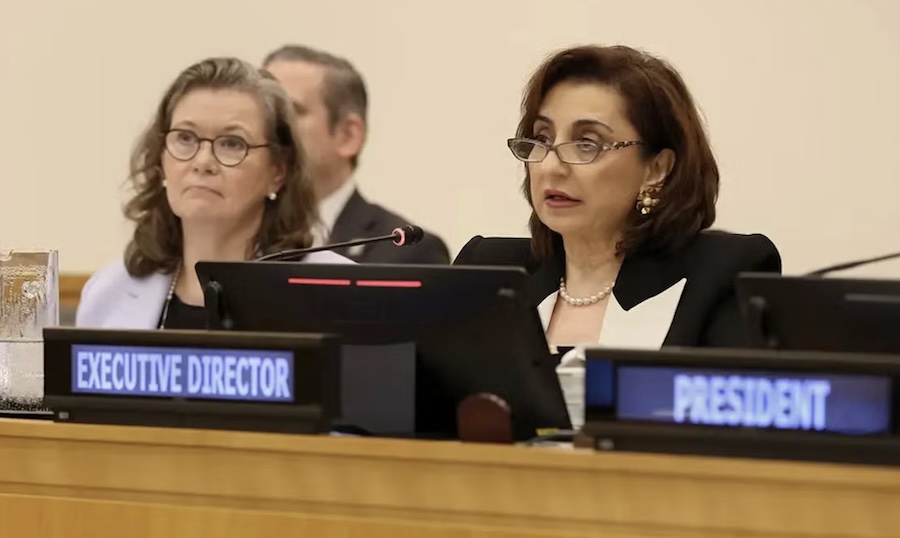
UN Women Executive Director Sima Bahous addresses the Annual Session of the UN Women Executive Board held in CR3 at UN Headquarters on 23 June 2026. Photo: UN Women/Radhika Chalasani.
Allow me to summarize:
° Over the 2022–2025 Strategic Plan period, UN Women invested nearly USD 2.35 billion across 135 countries in protecting and advancing norms, translating global commitments into programmes on the ground, and leading and supporting the UN system to deliver better for women and girls.
° In 110 countries, home to 3.1 billion women and girls, UN Women helped strengthen legal and policy environments for gender equality, contributing to stronger protections, expanded rights and greater opportunities for women and girls through 394 laws adopted, revised or repealed in line with international standards.
° Across 78 countries, 732 gender-responsive national and local policies, strategies and plans helped advance equal pay, the care economy, efforts to end violence against women, and strengthen resilience to conflict and climate change.
° In 50 countries, reforms supported by UN Women expanded women’s access to decent work, income generation, climate-resilient agriculture and care systems, while 1.6 million women directly accessed services, goods, resources, or information essential to their economic autonomy.
° We also helped make the promise of freedom from violence more real for women and girls. Through support to 180 laws and 213 strategies, policies, and action plans, nearly 1.7 billion women and girls benefited from stronger frameworks to prevent and respond to violence.
° In conflict and crisis, UN Women advanced women’s leadership, participation, and protection across 83 countries.
° Support for the Women, Peace and Security agenda contributed to 59 new National Action Plans, bringing total coverage to 117 countries and territories, while more than 2.5 million women and girls accessed protection services, cash assistance, and livelihood support in humanitarian and refugee response settings.
° Despite significant funding pressures, we lived up to our promise to women’s organizations, with more than USD 285 million channeled to civil society organizations, local women-led organizations and networks, helping sustain women’s leadership and frontline responses in communities and crises.
° Across 128 countries, more than 10,300 organizations strengthened their capacities and leadership, while more than 11,400 mechanisms enabled women’s meaningful and safe participation in decision-making.
Through the United Nations Trust Fund to End Violence against Women and the Women’s Peace and Humanitarian Fund, which UN Women hosts on behalf of the UN system, we continued to expand direct support to women’s rights organizations and advance locally led solutions where they are most needed.
Through these funds, despite scarcer resources, you are helping sustain women’s leadership across the humanitarian-development-peace nexus and ensuring that local women’s organizations remain at the forefront of response and recovery efforts.
These results are not just numbers. They show impact, they show lives changed. They do not just create an immediate effect for the women and girls we serve, but also an enabling environment for gender equality, for women’s rights, for normalizing women’s leadership, for changing laws, policies, and norms.
Allow me to share a few examples:
° In Ecuador, women gained stronger protections against violence in politics and greater opportunities to participate equally in public life through electoral reforms.
° In Afghanistan, over 350,000 women and girls accessed life-saving services in one of the world’s most restrictive environments for women’s rights, while 191 women-led organizations strengthened their capacity to support communities and sustain women’s leadership.
(Article continued in right column)
Protecting women and girls against violence, Is progress being made?
Does the UN advance equality for women?
(Article continued from left column)
° In Palestine, more than 323,000 people, the majority of whom are women and girls, received protection, cash, and livelihood support amid a devastating humanitarian crisis.
° In the Great Lakes region, women’s leadership in peace processes expanded, with women representing up to 40 per cent of the African Union mediation team for Eastern DRC.
° In Egypt, 330,000 women gained financial and digital literacy support, enhancing their economic opportunities and resilience.
° Across the Pacific Islands, more than 50,000 market vendors benefited from safer, more resilient livelihoods.
° In Ukraine, more inclusive humanitarian strategies advanced women’s rights and expanded the role of civil society in humanitarian response and recovery.
° In Viet Nam, a landmark population law strengthened the recognition of reproductive rights and unpaid care work, helping lay the foundation for stronger, gender-responsive care systems.
Our coordination efforts have shown impressive results. UNCT-SWAP [UN Country Team System Wide Action Plan] reporting increased by 105 per cent, from 61 UN country teams in 2021 to 125 in 2025. This growth is helping embed gender equality more consistently in UN country team planning, coordination, financing, and results.
We also continued to engage system-wide through the Gender Equality Acceleration Plan (GEAP), which raises the ambition of collective work on gender equality, seeking to deliver transformative change across the three pillars of peace and security, development and human rights, and supporting UNCTs and RCs [UN Resident Coordinators] in their work to prioritize gender equality as the linchpin for all the UN’s work in country.
My report also describes how we have built a stronger entity, better equipped to deliver for women and girls with the resources you entrust to us. Over the Strategic Plan period, we strengthened our internal governance mechanisms, advanced business transformation, and modernized corporate systems.
We also enhanced oversight, accountability, and transparency, including by further strengthening our Transparency Portal, recognized as a good practice in public accountability for results and resources.
We consistently exceeded corporate targets on follow-up to internal and external audit recommendations, and maintained five consecutive years with no long-outstanding audit recommendations from the UN Board of Auditors.
We embedded enterprise risk management into planning, performance, and oversight cycles while institutionalizing the Quarterly Business Review as a forward-looking, evidence-based performance management tool that connects strategic priorities, risks, and resources.
These reforms have made UN Women even more agile, transparent and results focused. They deliver stronger alignment from country to global level and a clearer line of sight between our strategic objectives, the resources we invest, and the results we deliver.
Our strengthened communications and partnership functions have further enhanced our visibility, stakeholder engagement, and resource mobilization effectiveness, helping sustain the trust and support of partners during a period of increasing financial pressure and change across the multilateral system.
Allow me to remind you that we do all this with the most modest of resources. We have weathered the current, uniquely difficult funding environment for the multilateral system better than most, but we are not unaffected.
Like many, we are asked to do more with less. So once more, I ask you to take back to capitals a call to resource this crucial mandate fully, to advocate for our agenda, and for investment in gender equality and women’s empowerment as the greatest multiplier for the SDGs [Sustainable Development Goals]. An investment in UN Women is your vehicle for their achievement.
We will speak more extensively on UN80 this afternoon, but I will reiterate now our full support for the Secretary-General’s UN80 reform efforts, as the United Nations’ youngest entity, born and raised through the reform process.
We continue to ensure that our three priorities permeate all aspects of the process:
1. A stronger gender architecture that delivers for all women and girls.
2. Gender mainstreaming in all work packages.
3. The inclusion of voices of civil society and women-led organizations and movements.
– – – – – –
If you wish to make a comment on this article, you may write to coordinator@cpnn-world.org with the title “Comment on (name of article)” and we will put your comment on line. Because of the flood of spam, we have discontinued the direct application of comments.