FREE FLOW OF INFORMATION
Copied and corrected by CPNN from United Nations transcript and video
Thank you, Madam President.
Your Excellencies, I’m honored to join you at this high level forum on the program of action on the culture of Peace.
I’m glad to be sharing this space again with you, Ambassador Chowdhury and to other colleagues in the room.
12 years ago, I sat in this very room to speak on the culture of peace.
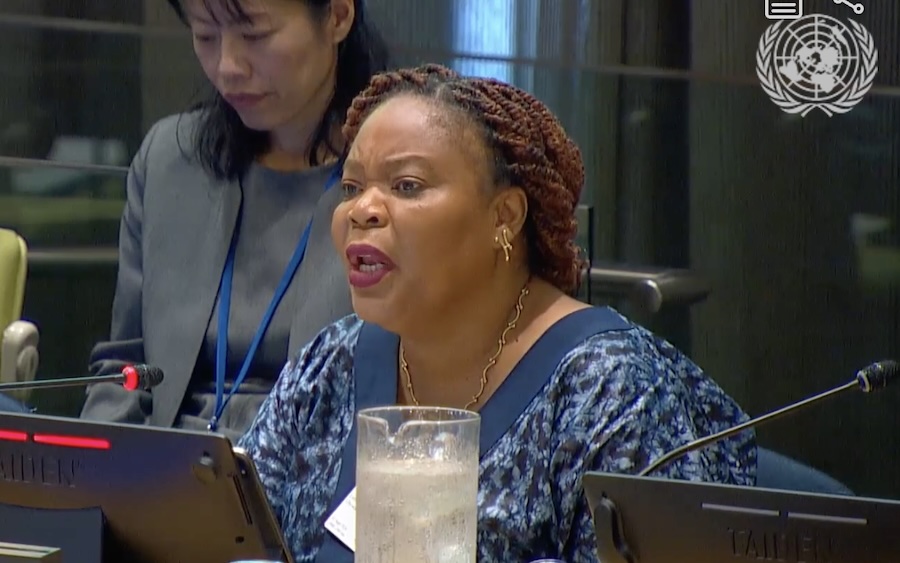
Frame from UN video
In those moments, we were faced with Ebola in the Mao River basin. ISIS was on the lips of everyone because of the war, the Syrian war was raging and the climate conversation had just ended in Peru, laying the groundworks for the Paris Agreement a year later.
That same year, we were preparing to celebrate the 15th anniversary of the UN Security Council Resolution 1325 as women peace builders.
In those moments as we prepared, we hoped our world would finally not only recognize our unique skills and potentials in conflict resolution and building peace in our communities, but strategically engage us as partners and thought leaders in the quest for peace in our world.
Fortunately or unfortunately, that would not be the case, and the struggle continues.
I am one of the thousands of women in Liberia who worked for years to end the Liberian Civil War.
In those years, we worked at the local level in different ways to end the war.
However, I wish I could say our processes were connected.
At the beginning, we were disconnected and it perpetuated a lot of divisions that separated our country and us as women.
Many of us recognize the futility of working separately. So the question we ask ourselves, how can we extinguish the fire of war with drops of water? And how can we extinguish the fire of war with a divisive mentality?
We came together, formed the Women of Liberia Mass Action for Peace, and Madam President spoke about it earlier on, bringing together Christian and Muslim women.
This marriage was far from easy. There was no honeymoon. We got married and we had to start working.
Our group included women from different income levels, rural and urban areas, ethnicity and faith.
In those early days, we spent many days negotiating amongst ourselves in order to resolve the conflicts that came up. Contrary to popular belief that grassroots women peace efforts lack planning, coordination, and strategy, we as Liberian women, like many other women across the world, were intentional. We planned every day for hours.
We deliberately sought out actors who will further our cause and build strategic alliances in the course of our work.
In that struggle, we inadvertently carried out the first mandate of Article 1 in the Declaration of the Culture of Peace. This article says, education, through education, dialogue and cooperation.
We fostered an environment conducive to peace. It is not easy as peace building is never easy. But in doing so, we expanded our initial goal of ending the Liberian Civil War.
We committed to building a culture of peace in a nation that had been devastated by war. 1 million of our compatriots were internally displaced, 500,000 were refugees. At that time, our population was about 3 million and we have an estimated 250,000 people who lost their lives.
Just to give you a picture that we were able to kill at least almost 10% of our population in 14 years of Civil War.
When negotiations negotiations failed in 1996 and 1999, the women of Liberia were able to contribute to lasting peace.
I can emphatically say 23 years without the resurgence of violence! Last August made it 23 years. in Liberia it is largely due to the communities, specifically the women’s active involvement. Not just in 2003, but from 2003, we have consistently continued to engage, ensuring that peace and the peace process remains on course.
If peace was never handed to the Liberian women, we labored, we persevered and recreated a culture of respect and constructive engagement.
(article continued in right column)
What is the United Nations doing for a culture of peace?
(article continued from left column)
This year, our world is in a maze of conflict and global issues: geopolitical instability marred by competition and fragmentation; trade tensions and supply chains disruption; climate and environmental crisis, AI is source of opportunities and concern. False information and information manipulation are deepening political and social divisions and undermining public trust in governments and democratic processes.
In all of these, women continue to suffer.
As we gather to consider the programs of action on the culture of peace, we must consider these three factors.
One, a culture of peace therefore requires more than absence of conflict. It requires inclusion, justice, dignity, dialogue, and in the world that we live in today, dialogue is far from everything that we do. It’s either you agree with me, or if you disagree, we can have a conversation and the willingness to build relationship across political divide, religious, ethnic, and social divides.
In a world of increasing political intolerance, my question to you all Your Excellency, is this possible to achieve?
The second part, a culture of peace becomes possible when women are not simply invited to participate, but are recognized as leaders, decision makers, and builders of a more just and inclusive society. For too long, women’s involvement in these processes has been decorative.
Sometimes I refuse invitations to come to the UN, just saying what Ambassador Chaudhury said, 80 years of male dominance. Now is the time for women’s leadership at the UN.
We continue to see resistance or welfare amnesia in women’s full and effective participation in building a culture of peace and peace building work.
Women across the world have been tested, have been proven worthy of building peace at all levels.
We don’t need to build a strong case on the behalf of women anymore. Unlike many global peace processes, women have the track record.
It is our role now as leaders in this room to help elevate women’s peace building work and review the difference in how national and global peace is negotiated.
Women peace building is not centered solely on deconstructing war. It is about building a culture of peace.
Today’s affirmation is more importantly, a challenge.
The United Nations, as we all sit here, is as strong as its member states. And all of the member state in this room is weak without its people. And by saying people, I mean all genders.
When we have elections in our countries, it’s not just the men that vote. The women vote also.
So it is important that men as well as women play a critical role in creating the culture of peace.
The third part is resources.
Many speakers talked about it. The Assistant Secretary-General talked about resources.
We use billions to make war we cannot use peanuts to build peace. Now is the time if we’re serious about building a culture of peace and involving women, we must give them the necessary resources.
But let me just emphatically state here that I’m really very proud of women across the world, despite the shrinking spaces, The shrinking resources, despite the political pushback that we’ve received, women are no longer waiting because we recognize that with or without donors funding, we become the ones who bear the greatest brunt in every crisis.
So we continue to work to keep our communities and our society stable.
So I think we must continue to applaud the efforts of women. While the world continues to watch and wait, women continue to do amazing work in their different countries.
I sincerely believe that the ultimate goal of all of our activities globally is to create a culture of peace that promotes respect of rights of others in the world where we all live in harmony.
This goal is achievable.
However, it will take hard work, thinking outside of the box, political will and sincerity.
I will end with this, giving each and every one of us in this room a homework And the homework is, as you go home today, look at your children, look at your community, look at your nation.
Think about the culture of peace and ask yourself, can we continue to do peace building without the hands of everyone?
Can we continue to operate our world, leaving women behind?
If we’re serious about building a culture of peace for our children and the next generation, we must sit and answer these questions sincerely.
Thank you, Madam President.
– – – – – –
If you wish to make a comment on this article, you may write to coordinator@cpnn-world.org with the title “Comment on (name of article)” and we will put your comment on line. Because of the flood of spam, we have discontinued the direct application of comments.