FREE FLOW OF INFORMATION
Copied and corrected by CPNN from United Nations transcript and video
Thank you, Madam President. I would like to begin by thanking you for a very powerful and meaningful opening statement. We appreciate that.
I have a special pleasure in welcoming Leymah Gbowee, because she was on previous occasion as the keynote speaker in the high level forum on the culture of peace. I’m very happy she joined us this time again.
I have also great pleasure in welcoming the permanent representative, the new permanent representative of Bangladesh. She is here and I’m very happy that Bangladesh mission is now headed by a woman leader. That’s a wonderful opportunity for me to meet her for the first time in this meeting.
Madam President, in 11 days from today, on 13 September, the United Nations will observe the 27th anniversary of the General Assembly’s unanimous adoption of the Declaration and program of action on a culture of peace. This high level forum convened by you, Madam President, provides the most appropriate setting for the celebration of this remarkable pathway to the global culture of peace as articulated by its apex body.
The theme of this forum rightfully is women’s leadership to promote the culture of peace.
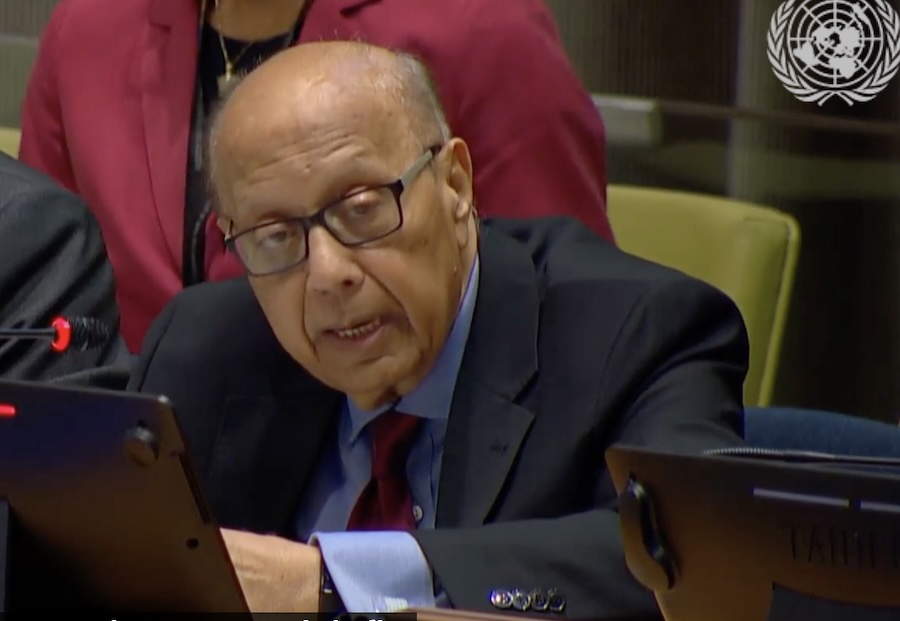
Frame from UN video
If I may add here that you yourself, Madam President, is a true embodiment of the core focus of this theme in your leadership of the United Nations General Assembly as one of its five women presidents, among the 80 individuals gracing this position since the birth of this organization.
Mandated by the UN resolutions, the successive presidents of the General Assembly have been convening the annual high level forums attracting the attention of member states and civil society since 2012, when your predecessor, PGA 66, Ambassador Al-Assad, took the initiative to convene the first forum.
I had the honor of introducing on behalf of the member states after successfully chairing the nine month long negotiations on the relevant resolution A 53243, which was adopted on 13 September in 1999, as you said.
The global movement for the culture of Peace, GMCOP, a coalition of civil society organizations have been spearheading advocacy initiatives effectively since 2011, as well as in organizing the annual high level forums on the culture of Peace convened by the president of the UN General Assembly from its beginning in 2012, all the way to 2022.
The forum has the distinction of being the only gathering which was addressed by the largest number of Nobel peace laureates, all women, and again, recognize Leymah’s presence here. Six times out of 11 forums.
Also, the forum’s panelists were always gender balanced on most occasions with more women participating.
At the United as the United Nations Under Secretary-General and High Representative for the most vulnerable countries and as the permanent representative of Bangladesh, my work has taken me to the furthest corners of the world.
I have seen time and again the centrality of women’s equality and the culture of peace in our lives.
This realization has now become more pertinent in the midst of the ever increasing militarism, militarization, and weaponization that is destroying both our planet and our people.
(article continued in right column)
What is the United Nations doing for a culture of peace?
(article continued from left column)
As we all know, the charter of the United Nations when signed in 1945, was the first international agreement to affirm the principle of equality between women and men.
The program of action on culture of peace accords a place of prominence to equality between women and men fourth among its eight action areas.
Women represent more than half of the global population, yet they continue to be underrepresented in leadership positions in every region of the world.
Unfortunately, in recent years, women’s rights are under threat from a backlash of conservatism and fundamentalism around the world.
Let me assert again that patriarchy and misogyny are the dual scourges pulling humanity back from our aspiration for a better world to live in freedom, equality and justice.
On 8th of March 2000, as the president of the UN Security Council, I could initiate and mobilize the council to recognize unanimously in a statement that and I quote, peace is inextricably linked with equality between women and men, end and affirmed the value of full and equal participation of women at all decision making levels. That is when the seed for the UN Security Council Resolution 13 25 was sown.
It was finally adopted on the 31st of October of the same year.
We should never forget that when women, more than half of the world’s 8 billion plus people, are marginalized, there is no chance for our world to get sustainable peace in the real sense.
It is my strong belief that unless women are engaged in advancing the culture of peace at equal levels at all times with men, sustainable peace would continue to elude us.
In various parts of the world, women have shown great capacity as peace builders. At the grassroots and community levels, women have organized to resist militarization, to create space for dialogue and moderation, and to weave together the shattered fabric of society.
As I reiterate time and again, women bring a new breadth, quality, and balance of vision to a common effort of moving away from the cult of war towards the culture of peace.
Women’s equality makes our planet safe and secure.
The slogan of global campaign on women peace and security, which we launched in London in June 2014 reiterates, and I quote, “If we are serious about peace, we must take women seriously.”
Let me end by emphasizing that feminism is not intended to pit women against men or men against women. Feminism is about smart policy, which is inclusive, uses all potential, and leaves no one behind.
I am proud to be a feminist. All of us need to be. That is how we make our planet a better place to live for all.
We should always remember that without peace, development is impossible and without development, peace is not achievable. But without women, neither peace nor development is conceivable.
I continue to emphasize that the culture of peace is not a quick fix. It is a movement, not a revolution, and women always bolster that movement immensely.
Let me conclude by underscoring here an unacceptable reality.
In its 81 years of existence, the United Nations has not yet elected a woman Secretary-General, eight decades plus nine men, not one woman. What an embarrassment, what a shame.
How can an institution that speaks of equality at every podium continues to model inequality at its pinnacle?
The credibility of the event’s advocacy depends on its own reflection in the mirror.
I thank you for your kind attention.
– – – – – –
If you wish to make a comment on this article, you may write to coordinator@cpnn-world.org with the title “Comment on (name of article)” and we will put your comment on line. Because of the flood of spam, we have discontinued the direct application of comments.