Tag Archives: East Asia

People’s Coalition on Food Sovereignty: Nine Demands for Food and Rights

. . SUSTAINABLE DEVELOPMENT . .

An article from the People’s Coalition on Food Sovereignty

The People’s Coalition on Food Sovereignty (see below) has formulated the following nine demands for food and rights that represent the aspirations of rural food producers to feed the world and pave the way for a just, equitable, and sustainable food system that guarantees the peoples’ right to food. This is the popular version of our policy recommendations  to ensure people’s right to food amid the COVID-19 pandemic.

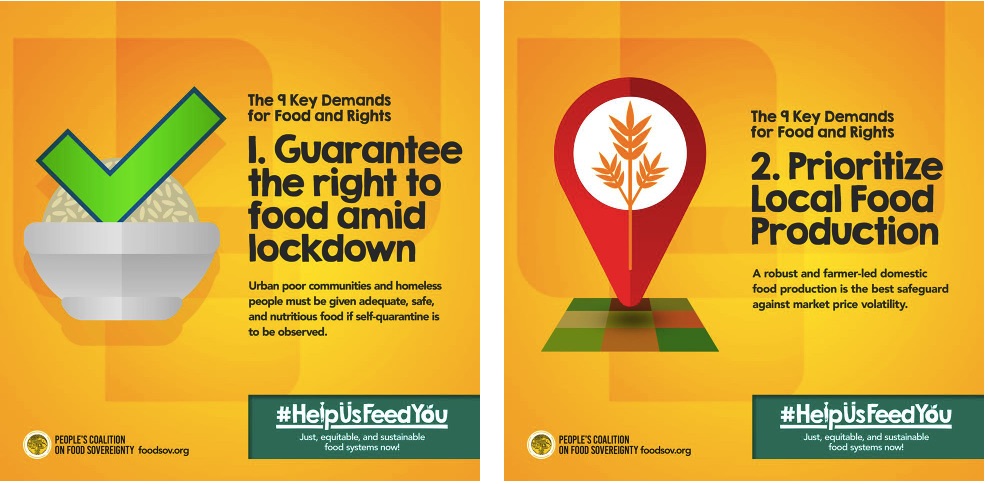
DEMAND 1: Guarantee the right to food amid lockdown

A global hunger crisis looms unless states guarantee people’s right to food.

The number of people suffering from extreme hunger worldwide is expected to double due to the pandemic.

Last year, 130 million were in acute hunger. This will spike to 265 million by the end of 2020 if people’s right to food remains to be neglected.

Prior pandemic, more than 820 million people – one in every nine in the world – are already hungry. On the other hand, over 2 billion people – one in every four – do not have regular access to safe, nutritious and sufficient food.

These numbers are also expected to rise due to movement restrictions imposed to curb the coronavirus spread. The poor and the homeless are extremely vulnerable.

States therefore have a crucial role in ensuring that people have access to adequate, safe, and nutritious food at all times, as mandated by the United Nations Committee on Economic, Social and Cultural Rights. States “have a core obligation to take the necessary action to mitigate and alleviate hunger even in times of natural or other disasters.”

DEMAND 2: Prioritize local food production

Promoting local food production is key in any nation’s food security.

A robust and farmer-led domestic food production is the best safeguard against market shocks and price volatility.

A total of 14 countries have imposed export bans on 20 variants of foodstuffs to prioritize local markets amid the global pandemic. Poor countries which rely on food imports are struggling to keep up with the building food shortage.

Rice, a major food-crop especially in Asia, have hit a seven-year high price as major rice exporters Vietnam and Cambodia decided to ban their export of the food staple to ensure local supply.

Staple food crops must be prioritized in local food production in order to shield the economy from fluctuations in the global market. Subsidies and investments for inputs (eg. seeds and fertilizers), irrigation, soil conservation, and other subsidies should be broadened and given directly to small food producers.

Imports of staple food crops that countries can grow domestically must be progressively reduced to shield both producers and consumers from global market shocks.

In order to sustainably meet the demand for food, states must utilize and further develop their pool of smallholder farmers, fisherfolk, agricultural workers, and other food producers who are within the communities vulnerable to the impacts of COVID-19. Staple food crops that can be grown domestically should be encouraged by the governments through subsidies to reduce the dependency on importation.

DEMAND 3: Recognize and extend support to farmers as essential workers

Farmers and rural peoples are at the frontlines of producing food for the world. They are essential workers and should be recognized and supported as such.

The food in our tables, in grocery aisles, in markets and restaurants, come from the hands of landless and smallholder farmers, farmworkers, fisherfolk, agricultural workers in plantations, rural women and youth, indigenous peoples, Dalits and pastoralists. Without them, food supply will be decimated.

Ironically, they are the most vulnerable in this pandemic. Prior the pandemic, the rural sectors already suffer from extreme poverty. 80% of 736 million people in extreme poverty – subsisting on less than USD 1.90 a day – live in rural areas, where social services including healthcare are also often inaccessible.

States must ensure that they are given adequate support in form of unconditional cash assistance, social protection, and production aid as essential workers. This will not only ensure domestic food supply but also cushion the impact of the pandemic to the already at-risk communities.

However, some state measures to contain the pandemic have resulted in their loss of income and livelihood. Movement restrictions to enforce social distancing have prevented rural peoples to access their production areas – be it farms or seas – while others are forced to throw away their harvest that cannot be transported and sold to urban areas. Policies that curtail their right to produce and displace them from their areas of production should be discontinued immediately.

The recognition, support, and protection of farmers and rural peoples as essential workers amid the pandemic is a necessary guarantee to domestic food security.

DEMAND 4: Set up and support local markets

The disconnect between food supply and demand has never been this huge.

While almost a billion people around the world sleep hungry at night, tons of food are wasted across fields caused by transportation and market bottlenecks. Every year, a third of the world’s food – amounting to as much as USD 1.2 trillion – is lost or goes to waste. With today’s pandemic, lockdowns and supply chain failures have put this problem into overdrive.

This has caused avoidable price fluctuations and increased unevenness in access to food despite record high global grain output.

Countries can address this by setting up and backing decentralized local markets led by food producers. Not only does it bridge the gap between domestic food producers and consumers, but it also avoids wastage of food that are not able to reach markets. Farmers are able to sell their produce and earn while consumers are assured supply of and access to safe, healthy, and nutritious food.

States should give utmost support to local markets led by food producers and create frictionless links with urban and peri-urban consumers.

DEMAND 5: Strengthen strategic national reserves

The right to food also means it should be affordable.

Countries should strengthen strategic national grain and food reserves to support stable prices.

With lockdowns in place to curb the spread of COVID-19, countries are scrambling to have a stable supply of and access to staple food for domestic consumption.

Since its inception, the WTO impositions discouraged the “costly” public food reserves to prioritize trade commitments. Subsequent programs from the IMF-WB and other IFIs have pushed to dismantle and/or privatize national food agencies to liberalize trade.

While the WB in 2009 admitted that this has proven detrimental to poor and developing countries, the damage has been done.

Today, net food importing countries are left vulnerable to the volatility of global food prices.

Disruptions in the global food supply chain also prompted food price hikes of 5% to 9% average since February. Staple food crops, especially in the Global South, are also no exception – rice, grains, wheat, and flour have a rising price trend since January.

To deal with this, states must establish and/or strengthen substantially their strategic national reserves to ensure price control, notwithstanding the WTO commitments to ensure that vulnerable countries have the range of policy measures against market shocks. Priority should be given at all times to locally produced food for buffer stocks. Privatized grain buffer stock must be nationalized to protect public interest in food security.

States can also establish and/or strengthen national food purchasing agencies to ensure fair farmgate prices while stabilizing consumer prices.

DEMAND 6: Review and revise national land use policies

After the toiling farmers and rural people, land is the most important asset for food security.

National land use policies must be reconsidered to reflect the increasing need for domestic food production.

For so long, local elites and corporations dispossess rural peoples of land through privatization of public and customary lands, deceptive lease-type schemes and financing programs.

(Article continued on right side of page)

Question for this article:
 
What is the relation between movements for food sovereignty and the global movement for a culture of peace?

How can we work together to overcome this medical and economic crisis?

Are economic sanctions a violation of human rights?

(article continued from left side of page)

World Bank’s market-assisted land reform programs have only accelerated this. The rapid expansion of large-scale industrial farming has despoiled the Global South as rural communities are robbed of their right to food with the push of the World Bank for industrial agriculture for what they deemed as food security.

Several governments in the Global South are quick in opening up millions of agricultural land as collateral for loans. Underdeveloped countries are seen as production hubs for the increasing demand for biofuel as well as monocultures of sugar, palm oil, cotton, and maize. Much of the arable land once dedicated to local food production have been converted to export crop production under the liberalized economy. This caused poverty among millions who relied on these lands as they are displaced, forced into cheap labor, and repressed.

In the past 20 years alone, land sold and leased to foreign and domestic investors has reached a total of 160.77 million hectares. Ironically, only 8% of these are for domestic food production.

Unsurprisingly, these countries that have become import-dependent and export-oriented with the guidance of the World Trade Organization and World Bank have also the highest number of poor and hungry.

In these times when the world is threatened by COVID-19, the role of foreign agribusiness and large-scale export crop production in undermining food security is exceptionally apparent. With supply chain bottlenecks and trade barriers going up, farmers in high-value for-export crops are experiencing loss in livelihood. Subsidy allotted to export production should be realigned to support food crop production for the domestic market while introducing a moratorium for biofuel production and other non-food crops.

DEMAND 7: Provide unconditional food and cash aid

An estimated 265 million people will be in extreme hunger this year amid the current crisis – double of that from last year. They represent the most vulnerable among the 2 billion people in the planet experiencing food insecurity.

Immediate food aid must be provided to countries most at-risk of food supply shortage, including access to institutional support from the Organization for Economic Co-operation and Development (OECD) countries and South-South Cooperation mechanisms without conditions.

Africa (73 million people) and Asia (43 million people) are home to world’s most hungry. In particular, West Asia and North Africa (WANA) experience worsening famine as conflicts and protracted crises aggravated over the years. Conflicts have disrupted food and livestock production as well as access to food across the region. The pandemic only exacerbates the fragility of the war-ravaged countries like Libya and Yemen as they lack resources to contain the virus while Iran and Turkey have the highest acceleration of cases with tens and thousands of affected.

Over the years, humanitarian funding has dropped significantly. In fact, in 2018, it fell by 77% in crisis-affected countries. In context, COVID-19 affects many more countries in comparison to the past Ebola crisis. Overseas military spending of OECD countries have increased while humanitarian food aid has declined.

In order to curb the effects of the pandemic in the most affected regions, funding for food and cash aid must be prioritized in the Official Development Assistance in the form of grants, especially using the undelivered ODA fund (estimated to be around US$2 trillion) by donor countries over the last decade.

Donor countries must not take advantage of the deplorable situation and further deteriorate economies through neoliberal policy reforms that has caused poverty in these countries in the first place.

Conditionalities must be decoupled from aid to truly remedy the impacts of the crisis while strengthening the food and health systems, and not further chain the Global South by undermining public resources to creditors.

Although domestic needs must be prioritized, food export restrictions for humanitarian purposes must be dismantled.

DEMAND 8: Lift sanctions and cease all military aggressions

International sanctions that include food and agriculture trade are war crimes. Moreover, blanket economic sanctions decimate nation’s livelihoods and developing countries’ international trade relations.

Countries like Sudan, Zimbabwe, Iran, Syria, the Democratic People’s Republic of Korea are suffering from sanctions initiated and backed by US and its G20 allies – severely limiting their policy options in facing a pandemic like the coronavirus.

In Venezuela and Bolivia, the US tried to put into power political allies using sanctions that created shortages and economic restrictions that the population suffered through within the script of the Hybrid War.

The economic and financial embargo imposed by the US against Cuba has impeded export of goods and services, procurement of resources, and trade since 1958. In particular, food trade, access to medicine and medical supplies, and exchange of scientific knowledge were greatly restricted, impacting the Cuban peoples for many decades.

Lifting these sanctions, especially today, is a humanitarian imperative and can potentially save countless lives.

People in extreme hunger heavily concentrate in Africa and Asia, specifically in Sub-Saharan Africa, South Asia and West Asia. Around 65% of them are in 10 countries – Yemen (15.9M), Democratic Republic of Congo (15.6M), Afghanistan (11.3M), Venezuela (9.3M), Ethiopia (8M), South Sudan (7M), Syria (6.6M), Sudan (5.9M), Northern Nigeria (5M), and Haiti (3.7M).

Most of these countries, including Palestine, are ravaged by a combination of wars of aggression, internal conflict, and sanctions-induced famines.

Yemen alone, is made a victim of man-made starvation as Red Sea ports have been subject to recurring blockades, searches, and restrictions by Saudi-led coalition forces, essentially cutting the lines for imported food supplies.

War and conflict refugees and internally displaced people in many regions hung on a knife’s edge as occupying forces continue to advance despite a global call for ceasefire. Some 160,000 Kurds found themselves as refugees as US abandoned the fight against ISIS, go-signalling Turkish troops to lay siege on war-afflicted Syria.

The US supplies Israel USD 142.3B in bilateral assistance and missile defense vying for the control of West Asia. Zionist Israel continues its attacks against Palestinians who also suffer from the 10-year blockade from Israel and Egypt.

Ending all military aggression and the immediate lifting of sanctions, especially on international trade in food and agriculture, should be part of the global humanitarian response to combat COVID-19.

DEMAND 9: Increase transparency and accountability

To truly address the serious public health crisis of rising food insecurity amid the COVID-19 pandemic, a human rights-based approach that will empower the hungry to fulfill their right to food should be adopted. The approach takes the principles of transparency, accountability, non–discrimination, equality and equity, rule of law and good governance.

States and public officials must be put accountable in addressing the urgent needs of the people amid the COVID-19 crisis. States are responsible in engineering appropriate plans and national goals to ‘flatten the curve’ and recover from the impacts of the pandemic. Participation of vulnerable sectors especially the rural poor, rural women, and indigenous peoples in crafting emergency response, relief, and rehabilitation should be guaranteed. Non-deliverance on that responsibility demands recourse from the people due to infringement of the fundamental rights to food and health.

Transparency and anti-corruption measures must be put into place alongside fast-tracked aid and relief programs to ensure the disbursement of funds for those in urgent need. Contracts must be made public to mitigate risks of overpricing, monopoly, and collusion.

Stringent policies should be placed against commercial activities that lead to price-gouging, hoarding, or the impediment of people’s right to food. To protect consumers, antitrust and similar laws need to work to ensure no single entity can dictate prices and control stocks of essential goods such as PPEs and food. Other than scammers and hoarders, price increase of high-demand goods can also be caused by disrupted supply chains, scarcity, or the underdeveloped capacity to produce essential goods. States need to prioritize providing supplies and facilities for frontliners, essential establishments and agencies, and poor communities and low-income individuals.

Tighter corporate control and accountability should be enacted to ensure that they are in line with the broader goals of food security and social justice. Agriculture, for instance, needs to be reexamined and refocused on domestic food production in comparison to the industrial agribusinesses that has deteriorated the environment and impoverished rural communities for decades, leaving them hungry and highly susceptible to infection.

* * * * *

The People’s Coalition on Food Sovereignty is a growing network of various grassroots groups of small food producers particularly of peasant-farmer organizations and their support NGOs, working towards a People’s Convention on Food Sovereignty. It was established first as an Asian component of the global agri-trade network on People’s Food Sovereignty in 2001 then eventually resulted in the collaboration of those involved in the People’s Caravan 2004 process and those who participated in the Asia Pacific People’s Convention on Food Sovereignty in Dhaka, Bangladesh in November 2004. . . . During the People’s Convention in Dhaka, the name “People’s Coalition on Food Sovereignty” was adopted due to the growing number of organisations beyond Asia who have been involved in the Food Sovereignty platform.

China to Expel New York Times, Washington Post, Wall Street Journal Reporters From Country

FREE FLOW OF INFORMATION

An article by Ken Meyer in Mediaite reprinted according to Creative Commons Attribution Non-Commercial License for non-commercial reproduction with credit to the source site.

The Chinese Ministry of Foreign Affairs announced that they will expel American journalists from three news outlets — the New York Times, Washington Post and the Wall Street Journal — who are stationed to work in the country.

The press release, entitled “China Takes Countermeasures Against US Suppression of Chinese Media Organizations in the United States,” claims that “the US government has placed unwarranted restrictions on Chinese media agencies and personnel in the US, purposely made things difficult for their normal reporting assignments, and subjected them to growing discrimination and politically-motivated oppression.” The announcement goes on to say that the Chinese government will direct a number of retaliatory measures against The New York Times, Washington Post, the Wall Street Journal, Voice of America and Time Magazine.

(Article continued in the column on the right)

Question related to this article:
 
Free flow of information, How is it important for a culture of peace?

(Article continued from the column on the left)

The first demand was for all five outlets to provide the government “written form information about their staff, finance, operation and real estate in China.” Most notably, the statement goes on by saying American journalists for The New York Times, Washington Post and The Wall Street Journal are all ordered to leave China, along with Hong Kong and Macao, in the next 10 days.

“In response to the US slashing the staff size of Chinese media outlets in the US, which is expulsion in all but name, China demands that journalists of US citizenship working with the New York Times, the Wall Street Journal and the Washington Post whose press credentials are due to expire before the end of 2020 notify the Department of Information of the Ministry of Foreign Affairs within four calendar days starting from today and hand back their press cards within ten calendar days. They will not be allowed to continue working as journalists in the People’s Republic of China, including its Hong Kong and Macao Special Administrative Regions.”

The statement continues by hinting at further “reciprocal measures against American journalists” in response to “discriminatory restrictions” on Chinese journalists.

Last month, China expelled three WSJ journalists over an opinion that called the country “the real sick man of Asia.” The piece focused on China’s failed attempts to stop the coronavirus before it became a global pandemic, and it was decried as “malicious slander” by a Chinese Foreign Ministry spokesman.

Amnesty International: New generation of young activists lead fight against worsening repression in Asia

… . HUMAN RIGHTS … .

An article from Amnesty International

A wave of youth-led protests across Asia is defying escalating repression and a continent-wide crackdown on freedom of expression and peaceful assembly, Amnesty International said today as it published its annual report on human rights in the region.

‘Human Rights in Asia-Pacific: A review of 2019’, which includes a detailed analysis of human rights developments in 25 countries and territories, describes how a new generation of activists are fighting back against brutal crackdowns on dissent, poisonous social media operations and widespread political censorship.

“2019 was a year of repression in Asia, but also of resistance. As governments across the continent attempt to uproot fundamental freedoms, people are fighting back – and young people are at the forefront of the struggle,” said Nicholas Bequelin, Amnesty International’s Regional Director for East and South-East Asia and the Pacific.

“From students in Hong Kong leading a mass movement against growing Chinese encroachment, to students in India protesting against anti-Muslim policies; from Thailand’s young voters flocking to a new opposition party to Taiwan’s pro LGBTI-equality demonstrators. Online and offline, youth-led popular protests are challenging the established order.” 

Hong Kong’s defiance echoes across the world

China and India, Asia’s two largest powers, set the tone for repression across the region with their overt rejection of human rights. Beijing’s backing of an Extradition Bill for Hong Kong, giving the local government the power to extradite suspects to the mainland, ignited mass protests in the territory on an unprecedented scale.

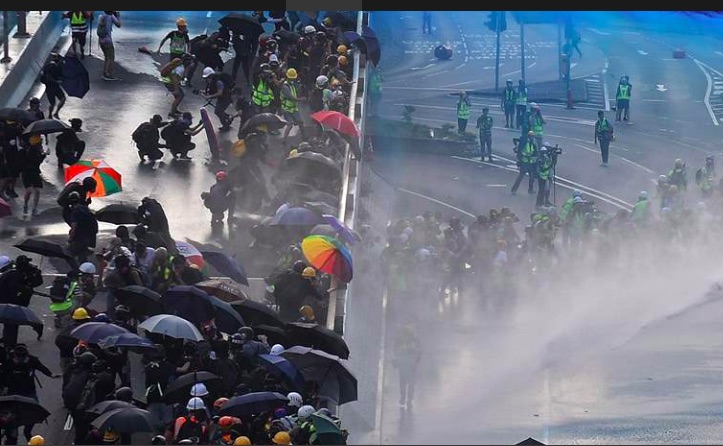
Since June, Hong Kongers have regularly taken to the streets to demand accountability in the face of abusive policing tactics that have included the wanton use of tear gas, arbitrary arrests, physical assaults and abuses in detention. This struggle against the established order has been repeated all over the continent.

In India, millions decried a new law that discriminates against Muslims in a swell of peaceful demonstrations. In Indonesia, people rallied against parliament’s enactment of several laws that threatened public freedoms. In Afghanistan, marchers risked their safety to demand an end to the country’s long-running conflict. In Pakistan, the non-violent Pashtun Tahaffuz Movement defied state repression to mobilize against enforced disappearances and extrajudicial executions.

Dissent met with crackdown

Peaceful protests and dissent were frequently met with retribution by the authorities.

Protesters faced arrest and jail in Vietnam, Laos, Cambodia and Thailand as repressive governments across South-East Asia took severe steps to silence their opponents and muzzle the media.

In Indonesia, several people were killed as police clamped down on protests with excessive force. Yet few steps were taken to hold anyone to account for the deaths; no police were arrested nor were any suspects identified. 

In Pakistan and Bangladesh, activists and journalists alike were targeted by draconian laws that restrict freedom of expression and punish dissent online.

(Article continued in right column)

(Click here for a Spanish version of this article or here for a French version.)

Question(s) related to this article:

What is the state of human rights in the world today?

(Article continued from left column)

And in Hong Kong, police deployed reckless and indiscriminate tactics to quell peaceful protests, including torture in detention. Demands for a proper investigation into the conduct of the security forces have yet to be met.

“The authorities’ attempts to crush any form of criticism and suppress freedom of expression were as ruthless as they were predictable, with those daring to speak out against repressive governments often paying a high price,” said Biraj Patnaik, South Asia Director.

“Asians are told their aspirations for fairer societies are fantasies; that economic disparities can’t be addressed; that global warming is inexorable and natural catastrophes unavoidable. Most emphatically of all, they are told that challenging this narrative will not be tolerated,” said Biraj Patnaik.

Minorities feel the weight of intolerant nationalism

In India and China, the mere risk of insubordination in nominally autonomous areas has been enough to trigger the full force of the state, with minorities conveniently deemed a threat to “national security.”

In the Chinese province of Xinjiang, up to a million Uyghurs and other predominantly Muslim ethnic minorities have been forcibly detained in “de-radicalization” camps. 
 
Kashmir, India’s only Muslim-majority state, saw its special autonomous status revoked as authorities imposed a curfew, cut access to all communications and detained political leaders.

In Sri Lanka, where anti-Muslim violence erupted in the wake of the Easter Sunday bombings, the election of President Gotabaya Rajapaksa dimmed hopes of human rights progress. Another self-styled strongman, Philippine President Rodrigo Duterte, continued his murderous “war on drugs.”

Governments have tried to justify repression by demonizing their critics as pawns of “foreign forces” and to bolster that repression through sophisticated social media operations. Neither ASEAN nor SAARC, the two main regional bodies, tried to hold their members to account, even in the case of gross human rights violations.

It has been left to the International Criminal Court to investigate crimes against humanity committed by the Myanmar military in Rakhine State against the Rohingya in 2017. The court is also looking into the thousands of killings carried out by police in the Philippines, and hearing an appeal on its decision not to authorize an investigation into war crimes and crimes against humanity in Afghanistan.

Meanwhile, Australia’s egregious offshore detention policies left refugees and asylum-seekers languishing in deteriorating physical and mental condition on the Pacific islands of Nauru and Manus, Papua New Guinea.

Progress against the odds

People speaking out against these atrocities were routinely punished, but their standing up made a difference. There were many examples where efforts to achieve human rights progress in Asia paid off.

In Taiwan, same-sex marriage became legal following tireless campaigning by activists. In Sri Lanka, lawyers and activists successfully campaigned against the resumption of executions.

Brunei was forced to backtrack on enforcing laws to make adultery and sex between men punishable by stoning, while former Malaysian prime minister Najib Razak took the stand on corruption charges for the first time.  

The Pakistani government pledged to tackle climate change and air pollution, and two women were appointed as judges on the Maldivian Supreme Court for the first time.

And in Hong Kong, the power of protest forced the government to withdraw the Extradition Bill. Yet, with no accountability for months of abuses against demonstrators, the fight goes on.

“Protesters across Asia in 2019 were bloodied, but not broken. They were stifled, but not silenced. And together, they sent a message of defiance to the governments who continue to violate human rights in pursuit of tightening their grip on power,” said Nicholas Bequelin.

Pocheon, Republic of Korea – International Cities of Peace

. .DISARMAMENT & SECURITY. .

A post by Fred Arment on the facebook page of International Cities of Peace.

Question for this article:

Can Korea be reunified in peace?

How can culture of peace be developed at the municipal level?
 
Great News! The first City of Peace on the Korean peninsula was established today [February 5] near the Demilitarized Zone (DMZ) in Pocheon. A major celebration was held at City Hall where Mayor Park signed a Proclamation as a crowd of media, dignitaries, and over 100 citizens packed the hall. The Mayor spoke of the City re-envisioning Pocheon as travel destination, a prosperous economic area, and a culture and arts center. I was humbled to speak at the Official Ceremony on the importance of Pocheon as a leading force in making the dream of Reunification of South and North Korea come true in order to benefit citizens of both countries. No doubt, “Citycraft” is at work in this historic peace building effort and progress has already been made. Please congratulate the citizens of Pocheon!

International Cities of Peace in China

.. DEMOCRATIC PARTICIPATION ..

Messages from the newsletter and Facebook page of Inernational Cities of Peace

In mid-December this year, I will be traveling to Nanjing, China for the third time in less than two years. The alliance between our organization and the two Peace Institutes in that City of Peace (our 169th and the first in China) are growing stronger. The mission for this trip is to determine criteria for more Cities of Peace in Southeast Asia. The trip is being funded by the UNESCO Chair on Peace Studies and the Memorial Hall for Victims of the Nanjing Massacre.


image from the video

December 20

REPORT #3 FROM CHINA. Kids and families! People are the same everywhere! Life went on as usual in Nanjing while I was awash in interviews focusing on the rising peace movement in China. CCTV with a billion viewers, Nanjing local TV with 10 million audience, Jaingsu Province TV with hundreds of millions highlighted peace messages, culminating in the Peace Commemoration which reached the entire Chinese population.

(Continued in right column)

Questions for this article:

How can culture of peace be developed at the municipal level?

(Continued from left column)

The photos of people in this Report are wonderful but the VIDEO LINKED AT THE END OF THIS POSTING is the first in a series of NANJING DIALOGUES FOR PEACE, where I was hosted by UNESCO Peace Chair, Professor Liu Cheng. The video is long, over 45 minutes but it focuses on International Cities of Peace as a platform for peace studies and global change. The attention to peace in China is made possible by the growth and global energy of our network — due to you, the individual City leaders, groups, and friends around the world. Thanks to everyone! Onward and upward. Here is the Dialogue link: https://youtu.be/Yi-sq2rHZaI.

 December 17

FIRST REPORT FROM CHINA: Every person involved with International Cities of Peace (Leaders, the Board, U.N. Reps, donors, organizers, partners, etc.) can be heartened this morning. In substantial part due to our City of Peace efforts — our Chinese partners have truly told me — Nanjing and China itself is making a huge transition. From a focus on mourning the victims of war (which is an honorable action), they are investing in actions focused on peace building and promotions that will shape behaviors that emphasize peace now and into the future. In Nanjing, I saw it with my own eyes. Deep challenges, yes, but transitions are evident. I will tell more as the week goes on. Thanks to all. This is important work we all share. I photographed these billboards around Nanjing. Peace is everywhere for all to see and inspire. Amazing to be honored for our work.

Pope Francis’ declaration in Hiroshima marks another historic step in the fight for the total elimination of nuclear weapons

DISARMAMENT & SECURITY .

A press release from 7ZEIZH

Pope Francis’ declaration in Hiroshima is another historic step in the fight for the total elimination of nuclear weapons, Roland Nivet and Edith Boulanger, national co-spokespersons of Mouvement de la Paix, have jointly declared.

The declaration of Pope Francis in Hiroshima on November 23, 2019 in which he states that “the use of atomic energy for military purposes is a crime” and that “a world without nuclear weapons is possible and necessary” and finally that “The time has come to renounce nuclear weapons and build a collective and concerted peace” is another historic step in the struggle for the total elimination of nuclear weapons. In his time the academician Jean Rostand speaking of the atomic weapon said “to prepare a crime it is already a crime”.

(Click here for the French version of this article.)

(Continued in right column)

Question related to this article:

Can we abolish all nuclear weapons?

(Continued from left column)

Six months into the beginning of the work of the review conference of the Nuclear Non-Proliferation Treaty (NPT) at the UN in May 2020 which will bring together all states, we can only welcome the fact that the Pope also calls “To support all international instruments of nuclear disarmament, including the Nuclear Non-Proliferation Treaty and the Nuclear Weapons Banning Treaty” adopted at the United Nations on 7 July 2017.

Pope Francis’ proposal for the money devoted to these works of death to be devoted to human development and the struggle for the climate corresponds to the slogan adopted by the 160 or so organizations of the Collective On the Move for Peace, which called for September 21 (International Day of Peace) to march “for peace, climate, social justice and nuclear disarmament”.

All peace-loving people, regardless of their ideological, religious, trade union or political beliefs or affiliations, will, we believe, find an additional reason to act for a world without nuclear weapons.

A few days ago we sent a letter to all French Parliamentarians proposing the adoption, as part of the preparation of the Budget 2020 of France, an amendment to this Finance Act to freeze the credits planned in 2020 to the modernization of nuclear weapons.

While the majority of the government has voted to double the funds earmarked for atomic weapons, we hope that the Pope’s statement will perhaps cause them to reflect and take into consideration our amendment proposal.

Pope Francis Calls Nuclear Weapons Immoral as Catholic Activists Face Jail For U.S. Nuke Base Action

DISARMAMENT & SECURITY .

An article from Democracy Now (licensed under a Creative Commons Attribution-Noncommercial-No Derivative Works 3.0 United States License).

Over the weekend, Pope Francis visited Hiroshima and Nagasaki, where the United States dropped the first atomic bombs in 1945, killing more than 200,000 people. Pope Francis said, “A world without nuclear weapons is possible and necessary.” The leader of the Cathoilc Church met with survivors of the Hiroshima and Nagasaki bombings and declared the possession of nuclear weapons to be immoral. The Pope’s visit comes as a group of seven Catholic peace activists are awaiting sentencing for breaking into the Kings Bay Naval Submarine Base in Georgia on April 4, 2018. The activists, known as the Kings Bay Plowshares 7, were recently convicted of three felony counts and a misdemeanor charge for entering the base armed with hammers, crime scene tape and baby bottles containing their own blood.


Video of interview

We speak with Martha Hennessy, one of the Kings Bay Plowshares 7. She is the granddaughter of Dorothy Day, the founder of the Catholic Worker movement. We are also joined by Pentagon Papers whistleblower Daniel Ellsberg. His most recent book is titled, “The Doomsday Machine: Confessions of a Nuclear War Planner.” Daniel Ellsberg was blocked from testifying in the recent trial of the Kings Bay Plowshares 7.

Transcript
This is a rush transcript. Copy may not be in its final form.

AMY GOODMAN: This is Democracy Now!. I’m Amy Goodman. “A world without nuclear weapons is possible and necessary.” Those were the words of Pope Francis this weekend as he visited Hiroshima and Nagasaki where the U.S. dropped the first atomic bombs in the world.—it was 1945—killing over 200,000 people. Pope Francis met with survivors of the Hiroshima and Nagasaki bombings and declared the possession of nuclear weapons to be immoral. In Hiroshima, Pope Francis spoke at the city’s Peace Memorial Park.

POPE FRANCIS: [translated] The use of atomic energy for the purpose of war is today more than ever a crime not only against the dignity of human beings, but against any possible future for our common home. The use of atomic energy for the purpose of war is immoral, just as the possessing of nuclear weapons is immoral, as I already said two years ago. We will be judged by this. Future generations will rise to condemn our failure if we spoke of peace but did not act to bring it about among the peoples of the earth. How can we speak of peace even as we build terrifying new weapons of war? How can we speak of peace even as we justify illegitimate actions by speeches filled with discrimination and hate?

AMY GOODMAN: The Pope’s visit to Hiroshima and Nagasaki comes as a group of seven Catholic peace activists are awaiting sentencing for breaking into the Kings Bay Naval Submarine Base in Georgia. It was April 4th, 2018. The activists, known as the Kings Bay Plowshares 7, who broke in on the 50th anniversary of the assassination of Dr. Martin Luther King, were recently convicted of three felony counts and a misdemeanor charge for entering the base armed with hammers, crime scene tape and baby bottles containing their own blood. They also carried an indictment charging the U.S. government with crimes against peace. The Kings Bay Naval Base is home to at least six nuclear ballistic missile submarines, each of which carries 20 Trident thermonuclear weapons. The activists said they were following the prophet Isaiah’s command to “beat swords into plowshares.”

We are joined now by two guests. Martha Hennessy is with us in New York, one of the Kings Bay Plowshares 7, granddaughter of Dorothy Day, the founder of the Catholic Worker Movement. And joining us from Berkeley, California, Pentagon paper whistleblower Daniel Ellsberg, his most recent book, The Doomsday Machine: Confessions of a Nuclear War Planner. Dan Ellsberg was blocked from testifying in the recent trial of the Kings Bay Plowshares 7. We welcome you both to Democracy Now! Martha, can you respond to Pope Francis going to Hiroshima, Nagasaki and saying that nuclear weapons are immoral?

MARTHA HENNESSY: Thank you, Amy. It’s good to be here. I think that we have before us a remarkable Pope, and he is certainly exhausting himself with this work of peacemaking and global solidarity-building. He is unequivocally speaking out against nuclear weapons. He does support the Treaty on the Prohibition of Nuclear Weapons. My heart rejoices to hear his words and to see him. He is very purposefully going to places that—places of sin and sorrow and grief and pain. He calls it a sacramental act to go to the sites. I feel complete affirmation in what he is trying to do with regards to our own action of walking onto the Naval Submarine Base in Kings Bay.

AMY GOODMAN: Has he weighed in on your trial or your sentencing?

MARTHA HENNESSY: I don’t think so. Not publicly, verbally, but he knows what is happening.

AMY GOODMAN: So describe what you did very briefly. You have been on before and described it. But also the sentence that you face. You were found guilty.

MARTHA HENNESSY: Yes, we were convicted, found guilty on all counts, October 24th.

AMY GOODMAN: And those counts were?

MARTHA HENNESSY: Conspiracy, depredation of governmental property, destruction of Naval property and trespass. And we are awaiting sentencing. We are facing—the initial threat was 20 years in prison, and I believe that the prosecution is now calling for 18 to 24 months. The judge has a reputation of ruling perhaps in the middle of the road. But I expect that I will receive a minimum of one year in federal prison.

AMY GOODMAN: I wanted to go back to Pope Francis Sunday holding a holy mass for over 30,000 Catholics at the Nagasaki Stadium in Japan.

POPE FRANCIS: [translated] In the belief that a world without nuclear weapons is possible and necessary, I ask political leaders not to forget that these do not defend us from threats to national and international security of our time. We need to consider the catastrophic impact of their use from a humanitarian and environmental point of view, renouncing to strengthen a climate of fear, mistrust and hostility fueled by nuclear doctrines.

No one can be indifferent to the pain of millions of men and women who still today continue to affect our consciences. No one can be deaf to the cry of the brother who calls from his womb. No one can be blind to the ruins of a culture incapable of dialogue.

(Continued in right column)

Question related to this article:

Can we abolish all nuclear weapons?

(Continued from left column)

AMY GOODMAN: That’s Pope Francis this weekend in Nagasaki, Japan. On August 9th, 1945, the U.S. dropped the second U.S. atomic bomb in the world on Nagasaki. Three days before, August 6, 1945, they dropped the first on Hiroshima. As you protest nuclear weapons, Martha Hennessy, at the Kings Bay Naval Base, you left a copy of Daniel Ellsberg’s book The Doomsday Machine on the site of your action. Why?

MARTHA HENNESSY: Daniel Ellsberg has brought us such critical information. The author of the Pentagon Papers releasing the scandal and the trauma of what the Vietnam War was and the other half of his story laid buried for many years regarding the nuclear arsenal. He was an insider who had to do research on understanding what the nuclear chain of command was for pressing the button, and he found out it was rather chaotic. It was unclear to the president. There were many people who actually had the capacity to press the nuclear button. And we felt the necessity of sharing his book and we wanted the people working at the base to read the book and to understand the history here.

AMY GOODMAN: Well, Dan Ellsberg is joining us from the University of California, Berkeley, who wrote The Doomsday Machine: Confessions of a Nuclear War Planner. Can you respond to this historic trip of Pope Francis to Hiroshima, Nagasaki, calling nuclear weapons illegal? This was your world. This was your work, Dan Ellsberg, as a high-level Pentagon and RAND Corporation official. The Plowshares 7 left your book at the site at Kings Bay. You attempted to testify at their trial. You were blocked. What would you have said?

DANIEL ELLSBERG: I believe that actions like theirs are necessary to moving this world away from nuclear weapons, as the Pope has called for. Many other approaches have been tried in the last 50 years and they have essentially failed. There is a major reason that runs through that history, and that is that we are, on the one hand, obliged by treaty, the highest law of the land, a ratified treaty, the Non-Proliferation Treaty, Article VI, to move in good-faith negotiations—in particular with what was in the Soviet Union, now Russia, but with all nuclear weapons states—for the effective elimination of all nuclear weapons. The U.S. has not considered negotiating for that goal for one minute of that half century. There has never been a minute of good faith, of intent to carry out Article Six.

So when the Pope Francis now, yesterday, makes this—puts—urges the same goal on the U.S. and all other countries, nuclear weapons states, it might seem redundant but it isn’t. He is saying that this should be taken seriously and he could not be more right. And of course, he’s a powerful voice in the world. I hope that—he has obviously undergone a considerable education on this, as have the people in Plowshares movement. And if he can pass that requirement on and its urgency to the bishops throughout the world, it will I am sure create conditions in which our own representatives will call on our executive branch at last to carry out what they are obliged to do in the treaty and what they have never done, and that is to negotiate seriously moving toward the elimination of nuclear weapons, a verifiable mutual elimination of nuclear weapons.

AMY GOODMAN: Martha, The New Yorker Magazine wrote a piece. The headline was The Pope and Catholic Radicals Come Together Against Nuclear Weapons.

MARTHA HENNESSY: Pretty significant. I would like to believe that Dorothy Day herself, my grandmother, very much influenced the U.S. Catholic Church in terms of holding on to the concept of peace and letting the U.S. bishops know how she felt about war. She opposed every war that occurred in her lifetime. It’s grand to see the Pope speaking out now. He is a Pope after the heart of Dorothy Day.
We can’t express our gratitude to people enough, to people like Dan Ellsberg and the many of those who have come before us—the Berrigan Brothers—all in their efforts—the Pope has said it’s not enough to simply speak out against nuclear weapons; we must act. We must walk. We walked onto that base. We need to raise a voice very clearly and even be willing to put our bodies on the line to help the world to understand that the malevolence, the secrecy, the lack of democracy from beginning to end with this nuclear arsenal, the production, the maintaining, the threat of using—it’s the greatest evil in the world that any of us can face in our lifetimes.

AMY GOODMAN: One of your sister protesters, Liz McAlister, the widow of Philip Berrigan, was one of the Plowshares 7. Last week, she just celebrated her 80th birthday. She, too, faces these charges and was in prison for a year and a half as she awaited the trial. Dan, what would you have said to the jury?

DANIEL ELLSBERG: What did I expect of the jury?

AMY GOODMAN: What would you have said? And why were you blocked?

DANIEL ELLSBERG: The judge refused to allow a defense of necessity or justification, a very old principle in English common law and American common law that an act under which under some circumstances or many circumstances would be illegal, like blocking a roadway, perhaps stealing a life preserver to throw it to somebody who was drowning, taking it from a nearby boat—an act like that that is meant as necessary to prevent an imminent greater evil, the death of someone, various things, would be legal. Not merely extenuating circumstances in a sense, but would actually be legal because it was the right thing to do under these circumstances. I am convinced from my own experience that that’s true of the acts here.

I would never have thought of risking prison for 115 years, which Nixon had in mind for me or indicted me for, in order to put out the Pentagon Papers, without the immediate example of people, all of whom had been influenced by Dorothy Day, among others, by the Berrigans, by Gandhi, by Martin Luther King and Rosa Parks.
I was led by those people to study those works and then I saw people enacting that in their own lives, risking prison to make the strongest possible case—that there was an emergency, in this case; in that case, to end the Vietnam War—and that it took special acts of conscience to wake people up to that necessity and get them to join in the protest. I felt the power of that act on my own life.

And I would not have thought of doing an act, copying these papers and giving them to the newspapers, without that example. They put in my head the question, “What can I do to help end this war now that I’m ready to go to prison, as they were?” And the question that really needs to be asked much more generally is by people confronting climate change, confronting the nuclear emergency, confronting wrongful wars like Yemen is, “Am I doing enough? Am I doing all that I could, including considering acts that would involve personal cost for me or some risks to my career?” Very few people can answer that comfortably in the notion that there’s really nothing more they can do.

So acts like this have proven in the women’s right to vote, in the unionization of autoworkers, for example, and other workers, in civil rights and gay rights—all of these things were proved essential—part—not all, but part of the movement—to regain these rights and ensure them, that people were willing to challenge laws that were in the way of those rights.

AMY GOODMAN: Finally, Martha Hennessy, your grandmother Dorothy Day is in the process of beatification and canonization on the way to becoming a saint in the Catholic Church?

MARTHA HENNESSY: Yes, yes.

AMY GOODMAN: Well, I want to thank you both for being with us. Martha Hennessy, when is your sentencing?

MARTHA HENNESSY: We don’t even have a date yet. Sixty to 90 days is what she said to us, the judge said, on October 24th. And we’re processing—we’re doing some motion filing. And so it takes time. And meanwhile, we just don’t know.

APAC Summit urges nations to maintain world peace

. . DEMOCRATIC PARTICIPATION . .

An article by Khorn Savi from the Phnom Penh Post

A joint declaration of the 2019 Asia-Pacific Summit in Phnom Penh urged countries around the world to address climate change and put aside disputes to ensure global peace.

The declaration which was issued on Tuesday evening also mentioned the necessity to focus more on issues concerning women, families and youths.

“The summit [reached a consensus] that there are growing threats to global peace and security because of social, political and economic causes.

“It also calls upon the world to acknowledge the importance of tolerance, mutual understanding, the role of civil societies, solution to disputes and world peace.

“Besides, the media’s role in creating awareness on climate change and the importance of global peace should be recognised,” said the declaration.
Additionally, the joint declaration said that long-lasting peace and happiness in society are the contributory factors of sustainable development.

“More resources should be used to address issues on women, such as domestic violence, workplace discrimination, limited education and opportunities [to promote gender equality]. Also, youths should be taking up more leadership responsibilities to play a significant role in building a culture of peace.

(Article continued in right column)

Question related to this article:

How can we develop the institutional framework for a culture of peace?

(Article continued from left column)

“Living in the interest of others is an effective means to overcome the divisive relations of humans and can pave the way for reconciliation to create one united global family.

“In this sense, the summit emphasised the need to strengthen unilateral ties between countries in the Asia-Pacific so that the region can achieve its true potential in the international stage,” said the declaration.

At the opening ceremony of the Asia-Pacific Summit on Tuesday, Prime Minister Hun Sen said: “As a [leader of the] Cambodian government, I would like to encourage the leadership of the government, civil societies and the private institutions to continue collaboration on addressing global issues.

“These issues include extremist activities, climate change, cross-border crimes and human trafficking, cybersecurity, as well as economic, social, and gender inequality.”

Social analyst Meas Nee said the world is concerned with the confrontation between superpower countries.

“More countries have raised their concerns about a possible repeat of a political bloc divide similar to that of the Cold War era as a result of the confrontation,” he said.

The concern should be given more emphasis to urge superpower countries to stop the confrontation and work towards reconciliation for global peace.

“Without a collective voice, the confrontation can escalate into a “third world war” which would be the greatest scourge for mankind,” Nee said.

Leaders of 72 municipalities attend Mayors for Peace assembly in Tokyo

.. DEMOCRATIC PARTICIPATION ..

An article from The Mainichi

A general assembly of Mayors for Peace’s domestic member cities was held here [in Tokyo] on Oct. 24, with leaders and senior officials of 72 municipalities across Japan in attendance.


Kunitachi Mayor Kazuo Nagami explains his city’s ideas on the definition of peace during a general assembly of Mayors for Peace’s domestic member cities, in Kunitachi, Tokyo, on Oct. 24, 2019. (Mainichi/Masamitsu Kurokawa)

(Continued in right column)

Questions for this article:

How can culture of peace be developed at the municipal level?

(Continued from left column)

Mayors for Peace is an international nongovernmental organization seeking a world without nuclear weapons through close collaboration among its member cities. The meeting, held in the Tokyo suburban city of Kunitachi, was the ninth of its kind and the first to be held in the capital.

In an opening speech, Hiroshima Mayor Kazumi Matsui, who serves as president of Mayors for Peace, pointed out that “home country-first” principles are casting a shadow over the world. “We would like to consider through this meeting how we can foster a ‘culture of peace’ and act on this cause as basic municipalities tasked with protecting the safety of citizens,” he said.

Kunitachi Mayor Kazuo Nagami stated, “We adopted a peace city declaration in 2000. We’d like to have in-depth discussions on the missions of mayors for peacebuilding.”

During the conference, the city of Kunitachi introduced its efforts to pass down the memories of the atomic bombings of Hiroshima and Nagasaki and the Tokyo Air Raids in the final days of World War II by training some 30 people from the postwar generation as storytellers.

According to the website of the Mayors for Peace’s secretariat and other sources, the NGO currently has 1,732 member municipalities in Japan, which account for more than 99% of all municipalities across the nation.

The meeting is set to adopt a statement on Oct. 25 calling for the Japanese government to boost efforts toward nuclear weapons abolition.

Asian church leaders call for greater interfaith cooperation

TOLERANCE & SOLIDARITY .

An article from Lutheran World

The Asia Church Leadership Conference (ACLC) has concluded in Indonesia with a call to all churches to work more closely together with other faith communities to promote urgent issues such as gender justice, environmental protection and care for the poor and needy.


Indonesian church leaders meet with the President of the Republic’s special envoy on interfaith relations and intercultural dialogue, Professor Syafiq Mughni (center). Photo: LWF/Isaac Henry

Pastors and lay people from across the region have been meeting with local Lutheran leaders in the North Sumatra town of Pematang Siantar to discuss the theme ‘Pursuing peace through interfaith relations in Asia’. It was preceded by an encounter of Asian women leaders and a meeting of the Global Young Reformers Network, which focused on ways of ensuring more meaningful participation of young people in the life of the churches.

The five-day gathering was hosted by three of Indonesia’s member churches of the Lutheran World Federation (LWF), the Simalungun Protestant Christian Church (GKPS), the Christian Protestant Church in Indonesia (GKPI) and The Indonesian Christian Church (HKI).

Peace can never be taken for granted

On the final day, delegates heard from Indonesia’s special envoy for interfaith relations and intercultural dialogue, Professor Syafiq Mughni, about ways in which his country seeks to promote peaceful cooperation among followers of the six officially recognized faith groups. Local leaders from some of those groups attended the session that focused on the five principles, known as Pancasila, upon which the nation was founded following independence in 1945.

Noting the huge diversity of ethnicities, languages and religions in his country, Mughni stressed that “peace can never be taken for granted”. Since he took up the post last year, he has organized conferences to foster good relations between the different faiths and to promote “a culture of peace” in schools and universities. As a Muslim leader, he has also met with Islamic leaders around the world to promote ‘Wasatiyya’, a term meaning the ‘middle way’ or moderate Islam, as the nation’s majority religion

(continued in right column)

Question related to this article:
 
How can different faiths work together for understanding and harmony?

(continued from left column).

LWF partnership with Islamic Relief Worldwide

Engaging in interfaith dialogue and cooperation was identified as a key point of the LWF’s strategic priorities  for the coming years and is particularly relevant to the Asian context where Christians form just a small minority in most countries. From India, where growing Hindu nationalism has led to attacks on Christian and Muslim communities, to Myanmar, where hard line Buddhism has fed persecution of the Rohingya Muslim minority, to Malaysia where the ongoing Allah controversy continues to cause problems for Christian media, religious tensions are never far away from the news headlines.

Highlighting the importance of interreligious cooperation as a way of increasing understanding between different faith communities, LWF Area Secretary for Asia, Rev. Dr Philip Lok noted that the LWF partners with Islamic Relief Worldwide and last year launched a manual on faith sensitivity in humanitarian responses to disasters and refugee crises. The guidelines, which were piloted in field work in Africa, Asia and the Middle East, cover medical, psychological and social issues, as well as practical aspects such as food, shelter and meeting places. Rev. Lok said the LWF “hopes that this kind of cooperation with other faith communities can help promote peace in the world.”

Dialogue at leadership and grassroots level

The Asia region of the LWF includes 55 member and associate member churches in 17 countries, from the Lutheran Church of Australia (LCA) in the South Pacific to The Evangelical Lutheran Church in Jordan and the Holy Land (ELCJHL). Delegates at the meeting heard about efforts of churches in many of those countries to promote dialogue at both leadership and grassroots level, despite many challenges stemming from the politicization of religion, as well as colonial histories and ongoing attempts at conversions by some Charismatic groups.

Speaking on the opening day  of the conference, LWF General Secretary Rev. Dr Martin Junge praised the commitment of churches in Asia to peace building, despite the difficulties they face. “The task of peace-making,” he said, “begins within ourselves, within our own churches, seeking to live in peace with each other.”

Participants also heard about the current political unrest in Hong Kong and efforts by churches there to provide a space for rest, counselling and reconciliation within a deeply divided society. Hong Kong delegates noted how Protestant and Catholic churches are supporting each other in this work and they urged people around the world to continue to pray for peace in their country.