2025 Goldman Environmental Prize Winners ‘Serve as Powerful Reminders of What Is Possible’

. . SUSTAINABLE DEVELOPMENT . .

An article by Jessica Corbett from Common Dreams

Seven grassroots Earth defenders from around the world were announced on Monday as the 2025 Goldman Environmental Prize winners.

“It’s been a tough year for both people and the planet,” said Jennifer Goldman Wallis, vice president of the Goldman Environmental Foundation, in a statement. “There’s so much that worries us, stresses us, outrages us, and keeps us divided. However, for me, these environmental leaders and teachers—and the global environmental community that supports them—are the antidote.”


2025 Goldman Prize winner Carlos Mallo Molina (right) and the Innoceana team work on scuba gear. (Photo: Goldman Environmental Prize)

“If we apply the same passion and logic that we use in the protection of our own families to our broader communities and ecosystems, then we will win,” she continued. “In these difficult times for environmental activists, these seven individuals serve as powerful reminders of what is possible through determination, resilience, and hope.”

Since 1989, the foundation has awarded the annual prize to individuals from the world’s six inhabited continental regions “for sustained and significant efforts to protect and enhance the natural environment, often at great personal risk.”

Africa: Semia Gharbi of Tunisia

Gharbi, a 57-year-old scientist and environmental educator, led a campaign against a corrupt waste trafficking scheme between Italy and Tunisia that led to the arrest of over 40 people from both countries and stronger European Union export rules.

(article continued in right column)

Question for this article:

Despite the vested interests of companies and governments, Can we make progress toward sustainable development?

(Article continued from the left column)

Asia: Batmunkh Luvsandash of Mongolia

After being born to a nomadic herder family and working as an electrical engineer for construction and mining projects, 81-year-old Luvsandash used his expertise to fight to protect 66,000 acres of Dornogovi province from extractive activities.

Europe: Besjana “Besi” Guri and Olsi Nika of Albania

The efforts of Guri, a 37-year-old who trained as a social worker, and Nika, a 39-year-old biologist and aquatic ecologist, to safeguard the Vjosa River from a hydropower dam development led to Albania and Europe’s first new national park protecting a wild river and its tributaries.

Islands: Carlos Mallo Molina of the Canary Islands

Mallo Molina, a 36-year-old born in mainland Spain, left his job as a civil engineer specializing in port construction to launch the conservation group Innoceana, which fought to protect the Canary Islands’ marine ecosystem from the proposed Fonsalía Port.

North America: Laurene Allen of the United States

Allen, a 62-year-old clinical social worker, campaigned for the closure of the Saint-Gobain Performance Plastics plant in Merrimack, New Hampshire, and continues to fight for cleanup efforts and stricter regulations regarding per- and polyfluoroalkyl substances (PFAS), commonly called “forever chemicals” because they persist in the environment and people’s bodies for long periods.

South and Central America: Mari Luz Canaquiri Murayari of Peru

Canaquiri Murayari is the 56-year-old president of the Kukama women’s organization Asociación de Mujeres Huaynakana Kamatahuara Kanawon, which won a landmark Rights of Nature court ruling that granted legal personhood to the Marañón River.

This year’s prize winners are set to be celebrated on Monday at an in-person and livestreamed ceremony in San Francisco, California, at 5:30 pm Pacific Daylight Time.

– – – – – –

If you wish to make a comment on this article, you may write to coordinator@cpnn-world.org with the title “Comment on (name of article)” and we will put your comment on line. Because of the flood of spam, we have discontinued the direct application of comments.


Despite Threats, Nearly 1,000 Israeli Air Force Reservists Demand End of Gaza War, Hostage Deal

. HUMAN RIGHTS .

An article from Haaretz

Nearly 1,000 Israel Air Force current and former reservists published a letter on Thursday morning (April 10) calling for the return of all hostages even at the cost of ending the war.

In the letter, signed by reserve and retired aircrew fighters, they wrote: “Currently, the war serves mainly political and personal interests, not security interests. The continuation of the war does not contribute to any of its declared goals and will lead to the deaths of the hostages, Israeli soldiers and innocent civilians, and to the attrition of the IDF reserve forces.”


IAF Commander Tomer Bar speaks at a graduation ceremony for Air Force pilots, in June.Credit: IDF Spokesperson’s Unit

The signatories to the letter added that “as has been proven in the past, only a deal can bring back the hostages safely, while military pressure mainly leads to the killing of the hostages and the endangerement of our soldiers.”

They also called on all Israeli citizens to mobilize to action and demand the end of the war and the return of all hostages. “Every day that passes puts their lives at risk,” they wrote.

The 970 signatories include many active reservists, some of them senior officers and pilots, and some who are no longer in active reserve duty.

After the full list of the signatories was leaked earlier this week, senior air force officers of the rank of brigadier general held phone calls with the signatories to urge them to retract on orders from IAF commander Tomer Bar.

(article continued in right column)

Question related to this article:

How can a culture of peace be established in the Middle East?

(article continued from left column)

On Tuesday, Bar met personally with reservists from the force to warn them against signing the letter, which was drafted and distributed by former air force members.

At these meetings, Bar warned that if they signed the letter, they would be dismissed from service. But he agreed with reservists that it would make sense to sign a cease-fire and hostage release deal in the near future.

IDF Chief of Staff Eyal Zamir also participated in one of these meetings.

Only 25 of the 970 Israel Air Force reservists who signed the letter protesting the renewed fighting in Gaza agreed to a retraction, despite being told they would be ousted if they didn’t.

Moreover, eight additional reservists added their signatures to protest the ouster threat, while additional reservists have yet to decide to retract their signature from the letter.

The letter’s drafters criticized Bar harshly during one meeting for threatening to oust the signatories. They said this crossed a legal and moral red line and infringed on the reservists’ right to voice their political opinions.

But Bar said this wasn’t a punishment. Rather, he said, “anyone who signs a text claiming that renewing the war is primarily political and undermines the hostages’ return isn’t capable of carrying out his missions in the reserves.”

Bar also charged that signing such a letter during wartime is illegitimate. He added that the Air Force is convinced its airstrikes aren’t hitting any hostages, and that in his view, military pressure on Hamas will further their release.

– – – – – –

If you wish to make a comment on this article, you may write to coordinator@cpnn-world.org with the title “Comment on (name of article)” and we will put your comment on line. Because of the flood of spam, we have discontinued the direct application of comments.
Pope Francis tried to change the Catholic Church for women, with mixed success

. . WOMEN’S EQUALITY . .

An article from The Conversation

Pope Francis, the head of the Catholic Church, died on Easter Monday at the age of 88. On Easter Sunday, he used his message and blessing to appeal for peace in Middle East and Ukraine.

Pope Francis will be remembered as a pastoral leader who cared deeply about the environment and those impacted by migration, poverty and war.

During his Pontificate, he did make important changes to the patriarchal structure of the Catholic Church – but did he go far enough?


Pope Francis meets a group of nuns at the Vatican. Andrew Medichini/AP

A pope for all?

Throughout his papacy, Pope Francis highlighted the struggles of women  in society. He took important steps to expand opportunities for women in the church and address its patriarchal structure.

This was showcased by his inclusion of women in the 2024 synod  (a global meeting of the whole church, represented by bishops) and his granting of voting  rights for 57 women out of a total of 368 attendees.

His appointment of around 20 women  to positions of authority in the Vatican is unprecedented.

This includes the recent 2025 appointment  of an Italian religious sister, Simona Brambilla, to lead a Vatican department.

During his papacy, Pope Francis also strongly supported the ongoing involvement of women in positions of leadership in the Roman Curia (the governance body of the church).

At local levels, in parishes, he made it possible for women to be formally appointed to the positions of catechist and lector  – roles previously reserved for men.

He also emphasised a need for more women to study and teach theology.

An ‘urgent challenge’

However, these changes barely scratched the surface  of securing full equality for women in the Catholic Church.

Pope Francis himself stated  women still encountered obstacles, and opportunities for women to participate were under-utilised by local churches.

In his autobiography, published in January this year, he wrote of the “urgent challenge” to include women in central roles at every level of church life.

He viewed this move as essential to “de-masculinising” the church and removing the problem of clericalism.

Importantly, the reasoning that underpins women’s limited role in the life of the church remains unchanged.

In particular, Pope Francis referred to gender stereotypes and supported the theology of complementarianism (a view that women are different but equally valued, where their central contribution is to motherhood, femininity and pastoral care responsibilities).

(Article continued in right column)

Questions related to this article:

Prospects for progress in women’s equality, what are the short and long term prospects?

(Article continued from left column)

While Pope Francis was genuinely committed to dialogue about and with women, his legacy remains contradictory.

Equality is still lacking

Women have been appointed to administrative and management positions, but decision making and ministry still largely rest with clerical men.

Pope Francis’ emphasis on the “feminine nature” women bring to roles, rather than their gifts and talents, limited women.

And although he called out discrimination against women in broader society, he expressed opposition to contemporary feminism, which he titled “gender ideology” and “machismo with a skirt”.

Moreover, despite ongoing discussions, Pope Francis appeared to be unresponsive to calls for a greater role for women in ministry.

Women cannot preach during Mass or be ordained to the priesthood or deaconate, despite multiple attempts by Catholic reform groups to advocate for women’s inclusion.

The 2023  International Survey of Catholic Women, which surveyed more than 17,000 Catholic women from 104 countries and eight language groups, found women across the world were keen for church reform that recognises women’s leadership capacities and ongoing contribution to church communities.

More than eight in ten (84%) of the women surveyed supported reform in the church. Two-thirds (68%) agreed women should be ordained to the priesthood, and three-quarters (78%) were supportive of women preaching during Mass.

The survey reported  on the deep frustration and despair women experienced for not having their gifts and talents recognised.

Women also stated they are dissatisfied with the burden of labour they carry in the church.

In this regard, Pope Francis did not address the financial burdens and exploitation of Catholic women who work for the church without adequate recognition or pay. This leaves women, particularly those working in parishes, open to exploitation.

More worryingly, decades after cases of abuse  were reported to the Vatican, Pope Francis publicly acknowledged  that women, particularly nuns, were significantly affected by spiritual and sexual abuse.

While this recognition is important, church responses to abuse remain inadequate and more needs to be done to safeguard women in pastoral settings.

With regard to sexual and reproductive decision-making, the International Survey of Catholic Women found the majority of respondents wanted more freedom of conscience around such issues. This is because when they are denied by church law, women’s agency was diminished and their vulnerability to situations of gendered violence increased.

The papacy of Pope Francis has made no reforms in this area, leaving many Catholic women frustrated and disappointed.

Hope for the future?

More than 60 years ago, Vatican II generated hope for change among Catholic women.

Pope Francis reignited that hope, and listened. But responses have been too slow and Catholic women are still waiting for genuine reform.

– – – – – –

If you wish to make a comment on this article, you may write to coordinator@cpnn-world.org with the title “Comment on (name of article)” and we will put your comment on line. Because of the flood of spam, we have discontinued the direct application of comments.
Germany’s Easter peace marches lament war-filled world

DISARMAMENT & SECURITY .

An article edited by: Darko Janjevic from Deutsche Welle (translation by google, reprinted by permission)

Thousands of people around Germany on Saturday joined in some 70 so-called Easter marches to demonstrate for peace, a tradition that dates back to the 1960s.

Some 100 events are planned up until Easter Monday, according to the Bonn-based activist group Netwerk Friedenskooperative (Peace Cooperative Network), which has coordinated the marches this year.

Easter marches are reportedly planned for cities including Cologne, Munich, Berlin, Leipzig, Bremen and Stuttgart.


‘Never again war’ is written on this 1924 banner by German artist Käthe Kollwitz, carried at an Easter march in Potsdam

Appeal to new German government

A spokesman for the group, Kristian Golla, said a focus of the demonstrations this year was an appeal to the incoming German coalition government  for Germany to “become capable of peace rather than war.”

(Continued in right column)

Question related to this article:
 
Is there resistance to the rearmament of Europe?

(Continued from left column)

“Instead of taking on new debt  and spending several billions of euros on arms, disarmament agreements and clever diplomacy are needed” to end Russia’s war on Ukraine  and establish a joint European security architecture guaranteeing peace, he said.

The marches started on Thursday and will continue until Monday, the last day of Easter holiday season in Germany.
Golla said that the attendance has been slightly higher than in previous years.

The demonstrations also include a three-day march that has started on Saturday in Duisburg and will continue until Monday through the Ruhr area via Essen, Gelsenkirchen, Herne and Bochum to Dortmund.

Gaza, US missiles

In addition to protesting against Russia’s invasion of Ukraine and the buildup of weaponry in Europe in response to it, demonstrators are also voicing their opposition to the war in the Gaza Strip and the planned stationing of US medium-range missiles in Germany.

The marches are taking place under different mottos in different cities. 

In Bonn, the motto is “Yes to peace — no to combat readiness,” in Kassel “Peace — disarmament — climate protection — come to the Easter march” and in Leipzig “Against rearmament and cuts to social services.”

The Easter peace marches in Germany had their heyday during the Cold War in the 1980s, when hundreds of thousands of people took part.

– – – – – –

If you wish to make a comment on this article, you may write to coordinator@cpnn-world.org with the title “Comment on (name of article)” and we will put your comment on line. Because of the flood of spam, we have discontinued the direct application of comments.
Eulogy for Pope Francis

FREE FLOW OF INFORMATION .

There will be many eulogies for Pope Francis.

We have a special way to do this at CPNN, because no one else has contributed more to the culture of peace in recent times. This is shown by the following list of CPNN articles.


Frame from video of the Pope’s message

Pope Francis calls for ‘disarmament’ while still hospitalized

Lula meets the Pope, talks world peace

Can Pope Francis bring peace to Ukraine?

Review of Against War: Building a Culture of Peace – a book by Pope Francis

Pope’s Video: “Let Us Develop A Culture Of Peace”

Pope Francis: “Hands off the Democratic Republic of the Congo, hands off Africa”

The Pope : “The time has come to live in a spirit of fraternity and build a culture of peace”

Pope urges inclusive and sustainable food systems

(Article continued in the column on the right)

Questions related to this article:

How can we carry forward the work of the great peace and justice activists who went before us?

(Article continued from the column on the left)

Pope, in Easter message, slams weapons spending in time of pandemic

Message of His Holiness Pope Francis for the celebration of the 53rd World Day of Peace, January 1, 2020

Pope Francis’ declaration in Hiroshima marks another historic step in the fight for the total elimination of nuclear weapons

Pope Francis Calls Nuclear Weapons Immoral as Catholic Activists Face Jail For U.S. Nuke Base Action

The Amazon Synod: “Plus Tard Sera Trop Tard”

Pope hopes his Arabian trip will help Islam-Christian relations

Pope Francis denounces nuclear weapons possession

Pope Francis meets ‘The Elders’ to discuss global concerns

Pope Francis: Make active nonviolence our way of life – a statement for the 50th Catholic Church’s World Day of Peace

‘Do Unto Others:’ Pope Francis’ Call to Action

ICLEI Leaders and Members to strengthen Pope Francis’ efforts on climate, modern slavery and sustainability

– – – – – –

If you wish to make a comment on this article, you may write to coordinator@cpnn-world.org with the title “Comment on (name of article)” and we will put your comment on line. Because of the flood of spam, we have discontinued the direct application of comments.

Ministers approve BRICS Environment declaration

. . SUSTAINABLE DEVELOPMENT . .

An article by Mayara Souto from BRICS News

BRICS Environment ministers approved a ministerial declaration on Thursday, April 3, at a high-level meeting in Brasilia. In the letter, the countries reiterate the importance of “environmental multilateralism” and “balanced and inclusive global governance” to achieve common goals to protect the environment. “We recognize the urgent need to address global and regional environmental challenges in a collaborative and science-based way,” reads an excerpt from the text.


Environment ministers from the 11 BRICS member countries approved the final declaration of the Environment Working Group on Thursday (March 3). Image: Isabela Castilho/BRICS Brasil

In her opening speech, Brasil’s Environment Minister Marina Silva highlighted the importance of the Global South to multilateralism and international cooperation.
“In the coming decades, the strength of our [BRICS] economies will make us even more influential. Today, we represent about half of the world’s population and 39% of the global GDP [Gross Domestic Product]. More than ever, BRICS is an increasingly fertile space for innovation, rich in cultural diversity, with strategic resources, and an immense quantity and quality of natural capital,” said the minister.

“Our countries are providers of services and ecosystems that are essential to the planet’s balance. They are also essential support to nature-based solutions that are in tune with the Earth’s capacity to assimilate. We are in a good position to lead a fair ecological transition that strengthens a more cooperative and less unequal multipolar world,” continued Marina Silva, who also welcomed the group’s new member countries: Egypt, Ethiopia, Indonesia, Iran, Saudi Arabia, and the United Arab Emirates.

Global warming

The ministerial declaration on the Environment includes the seven proposals that resulted from discussions regarding the four priority axes presented by the Brazilian presidency — desertification, land degradation, and drought; preservation, restoration, and enhancement of ecosystem services; plastic pollution and waste management; and collective leadership for climate action, in synergy with the United Nations 2030 Agenda for Sustainable Development.

The group highlights the impacts of climate change, and the “need to accelerate mitigation and adaptation actions” through the transition of economies to low carbon. The Paris Agreement is recognized in the declaration as an important commitment to the establishment of Nationally Determined Contributions (NDCs) — which seek to reduce greenhouse gas emissions to limit global warming to 1.5ºC.

Minister Marina Silva highlighted that BRICS is essential to maintaining this goal, especially in the current international context. “The rise of unilateralism and extremism is jeopardizing global stability and deepening injustices, affecting the most vulnerable populations in particular. This instability is further aggravated in the context of the climate emergency in which we are living. We have broken successive temperature records. Last year was the hottest in history, surpassing the critical limit of 1.5ºC for the first time. In this context, President Luiz Inácio Lula da Silva has reiterated the strategic role of BRICS as a space for dialogue and collective construction of solutions,” she declared.

(Article continued in the right column)

Question for this article:

What is the contribution of BRICS to sustainable development?

(Article continued from the left column)

Nevertheless, the BRICS WG also draws attention to the “national capacities and circumstances” of the group’s countries to combat climate change. The text encourages technology transfer and “adequate climate finance for developing countries,” which is the main challenge of COP30 (the United Nations Climate Conference), also under Brazilian presidency and to be held in November in Belém, Pará.

“BRICS represents almost 50% of the world’s population and almost 40% of the world’s GDP. Therefore, it is an absolutely important group from both a geopolitical and economic standpoint. And, naturally, when we talk about economics, it has everything to do with the issue of climate change — because solutions to climate change are naturally connected to changes in countries’ economies,” said Ambassador and president of COP30 André Corrêa do Lago, who was also present at the event.

The president of COP30 also highlighted the Brazilian presidency at COP for a new type of climate fund. “Financing has been a challenge since the beginning of the Climate Convention negotiations — and it is an extremely difficult and controversial issue. The fund that Brasil is proposing — the Tropical Forests Forever Facility (TFFF) — is especially innovative. There are different ways to finance forests for each type of activity. There was no formal mechanism designed specifically for forest conservation, and the TFFF addresses exactly that. It seeks to solve a problem that has not yet been solved,” he said.

Technical cooperation

Technical cooperation was highlighted as essential for the BRICS countries to advance in sustainable development. Strategic partnerships and the sharing of initiatives and technologies are being planned towards the group’s objectives. In this sense, the ministers established investment in “research and innovation for the development of green technologies and sustainable solutions.” There is also a provision for the creation of platforms to facilitate the exchange of information and experiences on the subject.

The conservation of biodiversity and the sustainable use of countries’ natural resources were also presented as a BRICS commitment to “combating the degradation of terrestrial and marine ecosystems.” Moreover, the group urged for the implementation of the Kunming-Montreal Global Biodiversity Framework — signed at the 15th Conference of the Parties to the UN Convention on Biological Diversity in Montreal, Canada, in 2022. The agreement establishes targets to reverse biodiversity loss by 2050.

Circular economy and integrated waste management were also included in the declaration as a way to reduce plastic and promote recycling. “We reiterate our commitment to eliminating environmental pollutants and developing sustainable value chains,” the document states.

Finally, the BRICS Environment ministers pledge to increase environmental education and raise public awareness regarding environmental responsibility through campaigns, educational programs, and community projects.

According to the text, the initiatives that were jointly signed by BRICS countries will be monitored regularly. “We conclude this Declaration by reaffirming our determination to work together towards a sustainable and prosperous future for all BRICS countries and for the world,” the document concludes.

Marina Silva added that, in addition to the ministerial declaration, the representatives of the 11 member countries also approved a work plan that includes a memorandum of understanding on environmental cooperation for the 2024-2027 period. The document provides for around 50 practical activities in strategic fields such as air quality, environmental education, biodiversity, waste and chemical management, water resources, coastal and marine areas, and climate change.

– – – – – –

If you wish to make a comment on this article, you may write to coordinator@cpnn-world.org with the title “Comment on (name of article)” and we will put your comment on line. Because of the flood of spam, we have discontinued the direct application of comments.

‘This Is Not Trump’s Country’: 255,000 Have Rallied With Sanders and AOC on Nationwide Tour

. . DEMOCRATIC PARTICIPATION . .

An article by Jake Johnson in Common Dreams

Across the United States—from Nampa, Idaho to Salt Lake City, Utah to Los Angeles, California—nearly 255,000 people have turned out in recent weeks for “Fighting Oligarchy” rallies headlined by Sen. Bernie Sanders and Rep. Alexandria Ocasio-Cortez, a progressive duo that has railed against President Donald Trump and the corporate-dominated systems that spawned him while outlining a vision of a more just future.


U.S. Sen. Bernie Sanders (I-Vt.) and Rep. Alexandria Ocasio-Cortez rally in Nampa, Idaho on April 14, 2025. (Photo: Natalie Behring/Getty Images)

Over the past six weeks, according to Sanders’ (I-Vt.) office, 254,931 have attended 17 rallies across 11 states and millions have viewed livestreams of the events online. The most recent swing—which included seven stops across four states in less than a week—drew 146,950 people, including in competitive districts with Republican representatives.

“This week, the American people turned out in enormous numbers,” Sanders said in a statement late Wednesday. “And their message was clear. They do not want oligarchy. They do not want authoritarianism. They are tired of massive income and wealth inequality and the greed of the billionaire class. They are tired of a corrupt political system that allows billionaires to buy elections. And, most importantly, they are prepared to fight back.”

The massive, enthusiastic rallies signal mounting nationwide anger over the Trump administration’s large-scale firings of federal workers, assault on fundamental rights, climate destruction, lawless detention and deportation of immigrants, and push to gut Medicaid and other key programs.

(Article continued in the column on the right)

Questions related to this article:

. . DEMOCRATIC PARTICIPATION . .

Where in the world can we find good leadership today?

The struggle for human rights, is it gathering force in the USA?

(Article continued from the column on the left)

“This is not Trump’s country. This is our country,” Ocasio-Cortez (D-N.Y.) said Wednesday. “The working class is coming together to defend democracy, fight for one another, and build a better future for all of us.”

The events also indicate a desire among Democratic voters for their leaders to respond more forcefully to the president and his billionaire cronies, including world’s richest man Elon Musk. One recent survey found that 70% of Democratic voters give their party a C grade or below for their response to Trump thus far.

“We need to fight the oligarchy, like the message says. And that’s real, even in a state like Montana, where we’re very red,” one rallygoer told the Montana Free Press at a Missoula event on Wednesday. In the 2024 election, Trump won Montana by just under 20 points and a Republican ousted three-term Democratic incumbent Jon Tester in the Senate.

Another sign of the U.S. public’s readiness to organize and fight back against the Trump administration’s abuses and far-right policy agenda was mass participation in a Wednesday call hosted by the Hands Off! coalition, which helped bring millions into the streets nationwide earlier this month.

According to organizers, tens of thousands of people joined the call, which comes ahead of another national day of action planned for May.

“What we have begun to build is powerful,” Rahna Epting, executive director of MoveOn, said Wednesday. “As Trump continues to chaotically and carelessly implement his wildly unpopular agenda, he creates more distrust, more outrage, and more backlash against it.”

During a stop in Salt Lake City on Sunday, Ocasio-Cortez told a crowd of 20,000 that “we can make a new world, a better country where we can fight for the dignity of all people.”

“It looks like living wages, Utah,” said the New York Democrat. “It looks like stable housing, Utah. It looks like guaranteed healthcare, Salt Lake City. And it looks like respect for all of our differences, no matter who we are or where we come from.”

– – – – – –

If you wish to make a comment on this article, you may write to coordinator@cpnn-world.org with the title “Comment on (name of article)” and we will put your comment on line. Because of the flood of spam, we have discontinued the direct application of comments.

Teaching Peace: Nurturing Young Peacemakers in Ghana through Education

… EDUCATION FOR PEACE …

An article by Mohammed Ibrahim from Peace News

In a region where ethnic and religious diversity sometimes fuels tension, Ghana stands out as one of West Africa’s most peaceful nations. This reputation, however, cannot be taken for granted. 

In September 2024, Ghana experienced incidents of violence over upcoming elections. Other countries in the region such as Mali and Guinea have dealt with ethnic and religious violence in recent decades, including violence committed by youth. 

But efforts are being made to sustain harmony, particularly through peace education in schools. Peace education and sensitization programs aim to empower students as peace ambassadors. Schools across the Ashanti and Central Regions of Ghana are teaching peace education, where students learn conflict resolution skills, social justice principles, and the value of peaceful coexistence. 


Students of St Paul’s Catholic Basic School being taught a peace education lesson, photo by CRPC.

“Ghana is a diverse country with different tribes and religions. Despite this, we have remained peaceful,” said Dr. Charles Ohene-Amoh, the Regional Executive Secretary of the Central Regional Peace Council (CRPC) of Ghana’s National Peace Council  (NPC).  “To sustain this, we must instill the culture of peace in our young people,” he told Peace News Network (PNN). 

Promoting Peaceful Coexistence in Diversity

In January 2025, the CRPC collaborated with St Paul’s Catholic Basic School to educate students on peacebuilding, which is crucial for the country’s future stability.

The initiative was a peace education sensitization program themed “Peaceful Coexistence in Diversity.” The program focused on: strengthening students’ understanding of peaceful coexistence, reducing classroom conflicts and bullying, promoting peer mediation, and conflict resolution. Dr. Ohene-Amoh emphasized the need for peace education in schools. 

“We believe that one of the most effective ways to prevent conflicts is to educate the youth on how to live in harmony… Schools provide the perfect setting because students are already gathered in large numbers, making it easy to reach them,” he said.

He highlighted that schools reflect the country’s diversity, with students from various ethnic, religious, and cultural backgrounds. The program teaches them to embrace differences rather than allow them to become sources of conflict.

“When we visit schools, we see Muslims, Christians, and traditionalists learning together. We teach them to appreciate their diversity and to coexist peacefully. The results have been encouraging.”

The initiative has already shown positive outcomes. When the CRPC revisits schools where the program has been implemented, they observe noticeable improvements in student interactions. “We see fewer conflicts among students. They have become more tolerant and better at resolving disagreements peacefully,” Dr. Ohene-Amoh added.

Peace Education as a Tool for Conflict Prevention

Beyond promoting peaceful coexistence, the program also prepares students for the future. Many of them may later join law enforcement agencies or other security sectors, where their conduct will be scrutinized.

“We made them understand that their behavior in school could affect their future careers. Many didn’t realize that background checks are conducted before recruitment into security services,” Dr. Oene-Amoh said.

He said that additionally, the program introduced peace classes in schools where students voluntarily learn about conflict resolution and earn certificates for their participation. While attendance is not mandatory, students who participate are encouraged with certificates. This motivates them, Dr. Ohene-Amoh explained, to take peacebuilding seriously and apply these lessons in their communities.

(Continued in right column)

Question for this article:

Where is peace education taking place?

(Continued from left column)

The Ghanaian government has also contributed to maintaining peace in schools by banning demonstrations within educational institutions. This has significantly reduced violence on school premises. “Since the ban, we have not recorded any violent attacks in schools. Combined with peace education, this has created a safer learning environment,” Dr. Ahone-Amoh said.

Youth and Political Manipulation

One major concern in many African nations is the role of youth in political violence. Politicians often exploit young people’s energy and passion, leading them into conflicts. However, with proper peace education, students are less likely to be used as tools for political violence.

“With peace education, the youth will understand the dangers of being manipulated for political purposes. They will think critically before engaging in violent acts,” Dr. Ohene-Amoh stated.

The Challenge of Funding

Despite the program’s success, funding remains a significant challenge. The CRPC struggles to reach all 23 districts in the region due to financial constraints. “We write to organizations for support because our resources are limited. Without adequate funding, it is difficult to reach every student who needs this education,” he said.

“Train a Child, and They Will Not Depart from It”

Barbara Yabom, the CRPC’s Program Manager, described Ghana as one of Africa’s most peaceful countries, largely due to its emphasis on peace education. She cited a biblical proverb, “When you train a child in the right way, they will not depart from it when they grow.”

She emphasized that many young people who engage in violent behavior come from backgrounds where conflict resolution skills were not taught. She said that by training them in peacebuilding early, “we hope to create a generation that values harmony.”

To Yabom, peace education should be a continuous process to instill the values of forgiveness and tolerance. “We have received delegations from countries like Malawi and Ivory Coast who come to learn how Ghana maintains its peace. Peace education is part of our success story.”

She stressed that peace education should not only focus on adults, and noted that it is unfortunate that some people think it should. Yabom added that children are future leaders, and that teaching them these skills now will help them grow up to be responsible citizens who resolve conflicts peacefully.

Calls for Peace Education in the Curriculum

Sam, a senior high school tutor from Aggrey Memorial A.M.E Zion Senior High School Mr Appiah whose school participated in the peace education program, advocated for peace education to be included in the national curriculum, saying that it would help address the “culture of impunity” among students, and reduce their exposure to violent influences from social media.

He noted that many students are unaware of the laws governing juvenile violence. “Some think they can act violently without consequences because they are young. But with education, they will understand that even in school, they must obey the law.”

Appiah believes peace education in schools plays a vital role in shaping students’ moral values. “If we sustain this effort, we will raise a generation of young people who value peace. ”

While challenges such as funding issues persist, the impact of peace education in Ghanaian schools is evident. By instilling values of tolerance, respect, and conflict resolution in students, Ghana is not only securing its present peace, but also building a future where harmony prevails.

As Dr. Ohene-Amoh aptly put it: “Peace is not merely the absence of conflict but the presence of justice and tolerance.”

(Editor’s note: Thank you to Transcend News Service for calling our attention to this article.)

– – – – – –

If you wish to make a comment on this article, you may write to coordinator@cpnn-world.org with the title “Comment on (name of article)” and we will put your comment on line. Because of the flood of spam, we have discontinued the direct application of comments.
UNAOC and Religions for Peace:  “A Call for Peace, the End of Wars and Respect for International Law

. TOLERANCE & SOLIDARITY .

A press release from Religions for Peace

The United Nations Alliance of Civilizations (UNAOC) and Religions for Peace (RfP) are joining forces to launch “A Call for Peace, the End of Wars and Respect for International Law”, an initiative aiming to amplify a condemnation against war while fostering a message of peace and upholding respect for international law.


A Call for Peace – Press Conference UNAOC-RfP on April 3, 2025

The initiative, presented on April 3 at the UNAOC headquarter in New York, will be held on 25–26 April 2025 in Gernika, Spain, a town that has become a universal symbol of the horrors of war and the enduring spirit of peace. The two-day event will kick off on 25 April with roundtable discussions at the Liceo Theatre, featuring religious leaders, faith-based actors, and civil society representatives, followed by a screening of “Why War”, a film by renowned filmmaker Amos Gitai. On 26 April, the high-level opening ceremony and the official launch of the “Call for Peace” initiative will take place in Fronton Jai Alai, with distinguished speakers led by Mr. Miguel Ángel Moratinos, Under-Secretary-General and High Representative for UNAOC, and Dr. Francis Kuria, Secretary-General of RfP.

(continued in right column)

Question related to this article:
 
How can different faiths work together for understanding and harmony?

(continued from left column)

“The enduring symbolism of Gernika, and its powerful message of peace and resilience, resonates more profoundly today than ever before,” emphasized Mr. Miguel Ángel Moratinos, High Representative for UNAOC. “In a world increasingly fractured by violence and division, this initiative is a powerful reminder that peace is not merely an ideal; it is a shared imperative. As we gather in Gernika, we reaffirm our collective responsibility to reject war, uphold international law, and champion dialogue over discord. Let this be a global call to action toward a future rooted in dignity, justice, and our common humanity.”

“In a world where the echoes of past conflicts still resonate and new wars threaten to engulf us, Religions for Peace stands alongside the UNAOC in this urgent call for peace,” remarked Dr. Francis Kuria, Secretary-General of Religions for Peace. “We recognize the profound spiritual and moral imperative to dismantle the structures of violence and build bridges of understanding. This initiative, launching from the
historic town of Gernika, is not merely a call to end wars but a summons to cultivate a global culture of peace, rooted in respect for international law and the inherent dignity of every human being.”

– – – – – –

If you wish to make a comment on this article, you may write to coordinator@cpnn-world.org with the title “Comment on (name of article)” and we will put your comment on line. Because of the flood of spam, we have discontinued the direct application of comments.
US: Millions March Against Trump-Musk in Nationwide ‘Hands Off’ Protests

. HUMAN RIGHTS .

An article from Common Dreams (reprinted according to Creative Commons CC BY-NC-ND 3.0)

In communities across the United States and also overseas, coordinated “Hands Off” protests are taking place far and wide Saturday [April 5] in the largest public rebuke yet to President Donald Trump and top henchman Elon Musk’s assault on the workings of the federal government and their program of economic sabotage that is sacrificing the needs of working families to authoritarianism and the greed of right-wing oligarchs.


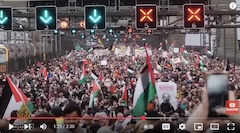
Video of protest in New York City

(Click on image to enlarge)

Indivisible, one of the key organizing groups behind the day’s protests, said millions participated in more than 1,300 individual rallies as they demanded “an end to Trump’s authoritarian power grab” and condemning all those aiding and abetting it.

“We expected hundreds of thousands. But at virtually every single event, the crowds eclipsed our estimates,” the group said in a statement Saturday evening.

“This is the largest day of protest since Trump retook office,” the group added. “And in many small towns and cities, activists are reporting the biggest protests their communities have ever seen as everyday people send a clear, unmistakable message to Trump and Musk: Hands off our healthcare, hands off our civil rights, hands off our schools, our freedoms, and our democracy.”

According to the organizers’ call to action:

They’re dismantling our country. They’re looting our government. And they think we’ll just watch.

On Saturday, April 5th, we rise up with one demand: Hands Off!

This is a nationwide mobilization to stop the most brazen power grab in modern history. Trump, Musk, and their billionaire cronies are orchestrating an all-out assault on our government, our economy, and our basic rights—enabled by Congress every step of the way. They want to strip America for parts—shuttering Social Security offices, firing essential workers, eliminating consumer protections, and gutting Medicaid—all to bankroll their billionaire tax scam.

They’re handing over our tax dollars, our public services, and our democracy to the ultra-rich. If we don’t fight now, there won’t be anything left to save.

(Article continued in the right column)

Questions related to this article:

The struggle for human rights, is it gathering force in the USA?

(Article continued from the left column)

The more than 1,300 “Hands Off!” demonstrations —organized by a large coalition of unions, progressive advocacy groups, and pro-democracy watchdogs—first kicked off Saturday in Europe, followed by East Coast communities in the U.S., and continued throughout the day at various times, depending on location. See here for a list of scheduled “Hands Off” events.

“The United States has a president, not a king,” said the progressive advocacy group People’s Action, one of the group’s involved in the actions, in an email to supporters Saturday morning just as protest events kicked off in hundreds of cities and communities. “Donald Trump has, by every measure, been working to make himself a king. He has become unanswerable to the courts, Congress, and the American people.”

In its Saturday evening statement, Indivisible said the actions far exceeded their expectations and should be seen as a turning point in the battle to stop Trump and his minions:

The Trump administration has spent its first 75 days in office trying to overwhelm us, to make us feel powerless, so that we will fall in line, accept the ransacking of our government, the raiding of our social safety net, and the dismantling of our democracy.

And too often, the response from our leaders and those in positions to resist has been abject cowardice. Compliance. Obeying in advance.

But not today. Today we’ve demonstrated a different path forward. We’ve modeled the courage and action that we want to see from our leaders, and showed all those who’ve been standing on the sidelines who share our values that they are not alone.

Citing the Republican president’s thirst for “power and greed,” People’s Action earlier explained why organized pressure must be built and sustained against the administration, especially at the conclusion of a week in which the global economy was spun into disarray by Trump’s tariff announcement, his attack on the rule of law continued, and the twice-elected president admitted he was “not joking” about the possibility of seeking a third term, which is barred by the constitution.

“He is destroying the economy with tariffs in order to pay for the tax cuts he wants to push through to enrich himself and his billionaire buddies,” warned People’s Action. “He has ordered the government to round up innocent people off of the streets and put them in detention centers without due process because they dared to speak out using their First Amendment rights. And he is not close to being done—by his own admission, he is planning to run for a third term, which the Constitution does not allow.”

The protest organizers warn that what Trump and Musk are up to “is not just corruption” and “not just mismanagement,” but something far more sinister.

“This is a hostile takeover,” they said, but vowed to fight back. “This is the moment where we say NO. No more looting, no more stealing, no more billionaires raiding our government while working people struggle to survive.”

(Editor’s note: This Common Dreams article includes many videos as well as the one cited on the image above. They include videos of protests in Washington, D.C., Boston, Philadelphia, Portland, ME, Buffalo, NY, St Paul, MN, Oakland County, MI, Columbus, OH, Colorado, Catawba County, NC, as well as London, Paris, Frankfurt and Brussels.)

– – – – – –

If you wish to make a comment on this article, you may write to coordinator@cpnn-world.org with the title “Comment on (name of article)” and we will put your comment on line. Because of the flood of spam, we have discontinued the direct application of comments.