USA: NCDD Launches Dialogue & Deliberation Training Partnership with American Library Association

.. DEMOCRATIC PARTICIPATION ..

An article by Roshan Bliss for The National Coalition for Dialogue & Deliberation(NCCD)

As we begin the new year, NCDD is excited to announce we are launching a two-year partnership with the American Library Association (ALA) that will train library staff across the country to use methods and processes from the dialogue and deliberation field to support their communities.


Our Libraries Transforming Communities: Models for Change partnership will take the form of both online and in-person trainings that we hope will help strengthen the capacity for libraries to serve not only as places of learning and research, but also as hubs for dialogue, engagement, and healing our divides.

We see this partnership as a chance to broaden the reach and the impact of our field’s work, as well as an opportunity to create new audiences and collaborative potentials for D&D practitioners in the future. We’ll be sharing more info on the partnership soon, but for now, we encourage you to read more about the upcoming trainings in the ALA announcement below or to find the original here.

Facing a Divided Nation, ALA Offers Free Training for Libraries

The ALA Public Programs Office and the National Coalition for Dialogue & Deliberation (NCDD) invite library professionals to attend a free learning series to explore various dialogue facilitation approaches and position themselves to foster conversation and lead change in their communities.

“As our nation becomes increasingly divided, ALA sees tremendous opportunity for libraries to be a leading force for reconciliation, progress, and common ground,” said ALA President Julie Todaro. “We are proud to make community engagement resources available to all libraries, free of charge, through this initiative.”

Through Libraries Transforming Communities: Models for Change, a two-year project, ALA and NCDD will produce ten webinars and three in-person workshops. Change-making leaders, such as Everyday Democracy, National Issues Forum, and World Café, will develop and lead the trainings, which will be customized to meet the needs of various library types and sizes: large public library systems; small, medium-sized, and rural public libraries; and academic libraries.

First four sessions announced

Registration is currently open for four learning sessions.

• Libraries of all types and sizes are invited to attend a one-hour introductory webinar about the resources and opportunities available throughout the initiative. Register for “Libraries Transforming Communities: Models for Change Overview” (Thursday, Feb. 9, 1 p.m. CST)

(Article continued in right column)

Questions for this article:

How important is community development for a culture of peace?

(Article continued from left column)

Representatives of public libraries serving large or urban communities are invited to attend the following three-part series:

• In Session 1, NCDD will discuss the range of dialogue and deliberation models available to large public library systems. Register for “Libraries Transforming Communities: Introduction to Dialogue & Deliberation” (Thursday, March 9, 1 p.m. CST)

• In Session 2, leaders from World Café will discuss their method for bringing together large groups of people in a series of small, conversational rounds to spark in-depth conversation. Register for “Libraries Transforming Communities: World Café” (Thursday, April 6, 1 p.m. CST)

• In Session 3, representatives of Everyday Democracy will share their Dialogue to Change process, which encourages diverse groups of people to come together, engage in inclusive and respectful dialogue, and find common solutions to community problems. Register for “Libraries Transforming Communities: Everyday Democracy’s Dialogue to Change Process” (Monday, May 1, 1 p.m. CST)

Each session will be recorded and archived for free on-demand viewing on the Programming Librarian Learning page.

Individuals who view all three webinars, live or recorded, will be invited to attend a free pre-conference workshop at the 2017 ALA Annual Conference in Chicago.

Future sessions for academic libraries and small, mid-sized, and rural public libraries

Future learning sessions will be designed for academic libraries (Fall 2017) and small, mid-sized and rural public libraries (Spring 2018). Details for future sessions will be announced in 2017. To stay informed about future offerings, sign up for the Programming Librarian e-newsletter.

Libraries Transforming Communities: Models for Change follows up on Libraries Transforming Communities (LTC), a two-year initiative offered in 2014-15 by ALA and the Harwood Institute for Public Innovation that explored and developed the Harwood Institute’s “Turning Outward” approach in public libraries.

With this second phase of LTC, ALA will broaden its focus on library-led community engagement by offering professional development training in community engagement and dialogue facilitation models created by change-making leaders such as Everyday Democracy and National Issues Forums.

LTC: Models for Change is made possible through a grant from the Institute for Museum and Library Services (IMLS) Laura Bush 21st Century Librarian Program.

You can find the original version of this announcement on the ALA’s Programming Librarian site at www.programminglibrarian.org/articles/facing-divided-nation-ala-offers-free-training-libraries.

USA: Video about the Ashland Culture of Peace Commission

. .DEMOCRATIC PARTICIPATION. .

A review by CPNN of the Youtube video The Ashland Culture of Peace Commission by Spencer Barrett

CPNN readers have been following the Ashland Culture of Peace Commission as it has developed over the past couple of years (see listing below). And now there is a video explaining it. The video has been produced by Spencer Barrett in Association with Peace Production through interviews with its commissioners, with an eye towards its significance as a model for the world’s transition to a culture of peace.


Photos of those interviewed, in order upper left to lower right. ACPC Executive Director David Wick, Environmental Spokesman Will Sears, Chief of Police Tighe O’Meara, Faith Unity Minister Norma Burton, Artist Wendy Seldon & Educator Nancy Grace
(click on image to enlarge)

The video starts appropriatedly from from 1999 UN Declaration and Program of Action for a Culture of Peace. David Wick, the Executive Director of the commission explains the origins of Commission since the idea was born in 2013 as a fulfillment of the UN proposal.

Will Sears, an ACPC Commissioner and Environmental Spokesman, stresses the importance of its being a grassroots initiative. “It’s got to come up from the bottom, but it’s being watched on a global scale.”

Tighe O’Meara, Ashland City Chief of Police and member of the Commission, explains that “We want to engage everybody on both sides of debates and problems. Let everyone be heard. Allow everyone their dignity.”

Commission member Norma Burton, a Faith Unity Minister in Ashland, says that “There are so many in the community that would really want to have a culture of peace. . . and yet we accept what society puts foward to us.”

Wendy Seldon of the Ashland Art Center, emphasizes that “One of the best things is getting the whole community thinking about the culture of peace and how they can bring that into their business, their home, the world.”

And Nancy Grace, ACPC Commissioner and Educator, adds that “We have actions in the community that open my heart and allow me to be bigger than I was coming in.”

In conclusion, Will Sears stresses that “We’re making a model that can be exported to other cities. And I can really see how this can spread around the world.”

And David Wick adds: “This is the right time, the right place, the right people.”

The video concludes with reference to two websites for further information:

Follow the Ashland Culture of Peace Commission at: www.AshlandCPC.org

Learn more about the culture of peace at: www.culture-of-peace.info

(Article continued in right column)

Questions for this article:

Egypt : Launch of the 27th session of the International Conference on Islamic Affairs

TOLERANCE AND SOLIDARITY .

An article in Nile International (translated by CPNN)

The Islamic Affairs Council launches the work of the 27th session of the International Conference on Islamic Affairs in the Ministry of Waqfs under the name of “the role of leaders and decision-makers in the spread of the culture of peace and the fight against terrorism and its challenges “.

The work of the international conference on Islamic affairs will take place for two days under the auspices of President Abdel Fatah El-Sissi.

The inaugural meeting was attended by the Minister of Waqfs Mohamed Mokhtar Gomaa, the Mufti of the Republic Dr. Chawki Gomaa, and ambassadors from many Islamic countries, both Arab and foreign.

The conference focuses on how to combat terrorism and extremism, the role of political and parliamentary leaders, international organizations, media and religious leaders in the spread of peace and the confrontation of terrorism and the role of political parties in consciousness-raising among young people.

A tourist, cultural and religious tour will be organized for the participants of the conference.

Also, foreign participants will organize a press conference to review their impressions of the situation in Egypt.

(Click here for the original French version of this article.)

Question for this article

Where are police being trained in culture of peace?

This discussion question applies to the following articles:

France: For an Emergency Plan to Overcome the Crisis

USA: The Failure of Police Use of Force Policies to Meet Fundamental International Human Rights Law and Standards

Film From USA: Camden’s Turn: A Story of Police Reform in Progress

Mexico: First International Congress on Social Prevention of Violence and Culture of Peace

Côte d’Ivoire: National Police: 639 staff trained in culture of peace

Côte d’Ivoire: Police nationale: 639 agents formés à la culture de la paix

Spain: The Second Latin American Congress makes Vila-real the international capital of police mediation

España: El II Congreso Iberoamericano sitúa a Vila-real como capital internacional de la mediación policial

Curitiba, Brazil: Military police discuss culture of peace

Curitiba, Brasil: Policiais militares discutem cultura de paz

– – – – Links for the following articles do not work because they were made by a version of PERL programming that is no longer supported. With three easy steps, you can find the article by its number. First, click on it before returning to this page. Your browser will say that the article is not available but in the address listed you can see that it was located at ViewArticle=xxxx where xxxx is the number of the article. Returning to this page, then click here for the listing of all years. Then click on the year that contains the number for the article you seek. It will send you to the page where you can easily search for the article by its title. – – – –

In India, special trainings and all-women peacekeeper units tackle sexual violence

UNESCO partners with Tunisian Ministry of the Interior to improve safety of journalists

L’UNESCO et le Ministère de l’intérieur de la Tunisie coopèrent pour améliorer la sécurité des journalistes

Côte d’Ivoire: National Police: 639 staff trained in culture of peace

… EDUCATION FOR PEACE …

An article by Daniel Assouman for Fraternité Matin (translated by CPNN)

In order to strengthen socio-security dialogue, the National Police School has strengthened the operational capacities of police officers. The program of five months was initiated by the Director General of the National Police, Kouyaté Youssouf..


(Click on photo to enlarge)

The director general of the national police, Commissary Major, Kouyaté Youssouf, plans to strengthen the dialogue within the institution and also between the police and the population, in order to guarantee security.

To this end, he has signed a partnership with “Verbatims”, a training and support institute for the prevention of conflicts related to identity. By means of 24 refresher and training sessions, 639 police officers, including 79 women and police of all ranks, received capacity building on culture of peace techniques.

These sessions, which began in November 2016 and ended on March 10, 2017, were structured around six modules. These included:
* the notion of ethnicity,
* prejudices and stereotypes,
* identities and conflicts at the micro-social level,
* identities and conflicts at the macro-social level,
* the notion of nationality,
* elections and political candidacies
   
(Article continued in right column)

(click here for the original French version)

Question for this article:

Where are police being trained in culture of peace?

(Article continued from left column)

Marie Stenbock-Fermor, Chair of the Verbatims Board of Directors, recalled that the Project, called “Support the Strengthening of Socio-Security Dialogue” (Pards) is financed by the European Union and Implemented by the United Nations Development Program (UNDP). Its general goal is to bring the police and the population closer together, in particular, through the organization of police-population dialogue workshops and public forums in order to reduce considerably the mistrust between the population and the police.

During the course of the work, the participants concentrated on reflections on the internal cohesion of the police and the image of the police within the population, according to the Marie Stenbock-Fermor. With regard to internal cohesion, she noted that within the police some deviant behaviors were observed by the hierarchy. For example, questioning colleague with regard to ethnicity and mentioning ethnic prejudices and stereotypes.

According to her, these behaviors that stem from different crises are sources of frustration, mistrust, contempt, withdrawal, fear between colleagues and they severely harm the efficiency of service to the population. That is why she found it necessary to carry out the training.

Returning to the image of the police within the population, she was reassuring. She pointed out that through training, there will be a real improvement in respect for the police by the population., especially to the extent that they perceive new behaviors on the part of the police officers both in terms of reception of complaints and treatment of persons who have committed offenses.

The Director of Training and the National Police School, Chief Police Commissioner Touré Kouacou Albert, who represented the Director General of the National Police, urged the participants to put into practice what had been learned . He transmitted the encouragement of the Director General of the National Police.

Photos: A look at International Women’s Day marches around the world

. . WOMEN’S EQUALITY . .

A photo essay by Dayana Morales Gomez for the Public Broadcasting Service

On International Women’s Day, women around the world celebrated by marching in more than 50 countries, taking off from work to make clear what “A Day Without A Woman” would look like and wearing red in solidarity. In New York, a bronze statue of a girl was installed to stare down the iconic Wall Street Bull over gender inequality.

The day was first observed in 1908 in New York City, where women marched for suffrage and workplace improvements. After several years of continuous demonstrations across the U.S. and Europe, March 8 was officially designated as International Women’s Day. The date is significant because it was the day a women’s march in Pretograd, Russia led to the start of the Russian Revolution.

This year, the United Nations used the day to shine a light on the 2030 Agenda, an ambitious plan to ensure girls and boys have equal access to education, that discrimination and violence against women are halted, and that forced marriage and female genital mutilation end.

Below, see photos of International Women’s Day demonstrations from around the world [click on photos to enlarge].


A woman holds a placard during a rally on March 8, 2017 for gender equality and against violence towards women on International Women’s Day in Kiev, Ukraine. Photo by Valentyn Ogirenko/Reuters.


Bangladeshi activists and garment workers attend a rally on March 8, outside National Press Club during International Women’s Day in Dhaka, Bangladesh. Photo by Zakir Chowdhury/Barcroft Images / Barcroft Media via Getty Images)


Thousands of demonstrators attend a rally for International Women’s Day on March 8 in Melbourne, Australia. Marchers were calling for de-colonisation of Australia, an end to racism, economic justice for all women and reproductive justice, as well as supporting the struggle for the liberation of all women around the world, inclusive of trans women and sex workers. Photo by Daniel Pockett/Getty Images


Nigerian women gather on March 8 to protest violation and sexual abuse against women during the World International Women’s Day in Lagos, Nigeria. Photo by Stringer/Anadolu Agency/Getty Images

(Article continued in the right column)

Question for this article

Do women have a special role to play in the peace movement?

(Article continued from the left column)


Costumed women shout slogans during a march on March 8 as part of International Women’s Day in Kiev. Photo by Sergei Supinsky/AFP/Getty Images


Georgian feminist supporters attend a rally on March 8 to mark the International Women’s Day in front of the Georgian parliament in central Tbilisi. Photo by Vano Shlamov/AFP/Getty Images


Palestinian women take part in a demonstration on March 8 to protest against sexual discrimination during the International Women’s Day in front of the unknown soldier’s monument in Gaza City, Gaza. Photo by Mustafa Hassona/Anadolu Agency/Getty Images


A man and his dog walk past the sculpture of a woman covered in paper and ropes as part of a performance to protest the lack of visibility of women in public spaces, on March 8, International Women’s Day in Oviedo, Spain. The covered statue is “La Pensadora” (The female Thinker) by Spanish artist Jose Luis Fernandez. Photo by Eloy Alonso/Reuters.


A statue of a defiant girl stands facing the Charging Bull sculpture in the Financial District of New York on March 8. State Street Global Advisors, a nearly $2.5 trillion investor and unit within State Street Corp., installed the bronze statue in front of Wall Street’s iconic charging bull as part of its new campaign to pressure companies to add more women to their boards. Photo by Jeenah Moon/Bloomberg via Getty Images.

Prospects for progress in women’s equality, what are the short and long term prospects?

Women’s equality is essential to the culture of peace; When we sent the draft Declaration and Programme of Action on a Culture of Peace from UNESCO to the UN General Assembly in 1998, we made it clear that the linkage is essential between women’s equality, development and peace: “Only this can replace the historical inequality between men and women that has always characterized the culture of war and violence.” In fact, at the dawn of humanity the monopolization of war and violence by men led to the historical exclusion of women from political and economic power (see my study Why There Are So Few Women Warriors for a scientific explanation). In order to achieve a culture of peace, the inequality must be reversed

This discussion question applies to the following articles:

Niger: Maradi’s Traditional Leaders Equipped to Promote Women’s and Children’s Rights

International Women’s Day: The Americas

International Women’s Day: Africa and Middle East

International Women’s Day: Asia/Pacific

International Women’s Day: Europe

International Women’s Day 2024: ‘Invest in women: Accelerate progress’

Sri Lanka adopts first National Action Plan on Women, Peace and Security

New report of Inter-Parliamentary Union shows that women MPs have never been so diverse

How the Islamic Revolution Gave Rise to a Massive Women’s Movement in Iran

Kazakhstan: Congress of World and Traditional Religious Leaders to Address Social Status of Women

Mexico: First “Festival of the Heroines of Independence”

Gabon: Women’s Commitment to Health and Sanitation in the Province Woleu-Ntem

Chile – Interview with Alondra Carrillo: “The feminist transformation of the State is unavoidable, it is a fact”

United Nations: Landmark gender equality forum concludes with concrete commitments, plan to advance parity by 2026

Women must no longer be ‘squeezed into a small corner’, landmark Forum declares

United Nations Committee on Elimination of All Forms of Discrimination against Women Holds General Discussion on Rights of Indigenous Women

Generation Equality Forum: Mexico City, 29-31 March 2021

Black-clad women rally in Australia to demand gender violence justice

Spain: First-person testimonies: this is how we fight for gender equality by activism and participation

Over a Million Mobilize for International Women’s Day in Latin America

International Women’s Day : Images from Europe and Asia

Statement by Phumzile Mlambo-Ngcuka, UN Women Executive Director, on International Women’s Day 2021

International Women’s Day 2021

‘Women and girls belong in science’ declares UN chief

Sinaloa, Mexico: III International Congress on women and the culture of peace

I am Generation Equality: Ixchel Lucas, youth advocate for girls’ leadership

Chile changing: transgender student leader lends voice to renewed protests

A crucial moment for women’s rights in Afghanistan

Thousands of women march in Chile again

International Women’s Day 2020

Devoted to discovery: seven women scientists who have shaped our world

UNWomen: In lead up to Generation Equality Forum, Action Coalition themes announced

Meet the Trailblazing Maasai Women Protecting Amboseli’s Wildlife

UNCSW63’s positive outcomes for women’s human rights to social protection systems, quality public services, including education, and sustainable infrastructure

Photos: International Women’s Day marked by strikes, protests and celebrations

Work-related gender gaps persist but solutions are clear – new ILO report

India Forms World’s Largest Women’s Wall for Gender Equality

Women in Iceland have walked out of work to dispute the gender pay gap

Adobe boasts gender equality in terms of salary across 40 countries

Executive Director remarks at the UN Security Council open debate on women, peace and security

Schoolgirls become world leaders for the day in equal rights campaign

Historic leap in Tunisia: Women make up 47 per cent of local government

UN Commission on the Status of Women: Participant Voices

Iceland will Be First to Require Proof of Equal Pay

Tunisia moves closer to achieving gender equality in politics

Eight ways 2015 was a momentous year for girls

– – – – Links for the following articles published prior to 2015 do not work because they were made by a version of PERL programming that is no longer supported. With three easy steps, you can find the article by its number. First, click on it before returning to this page. Your browser will say that the article is not available but in the address listed you can see that it was located at ViewArticle=xxxx where xxxx is the number of the article. Returning to this page, then click here for the listing of all years. Then click on the year that contains the number for the article you seek. It will send you to the page where you can easily search for the article by its title. – – – –

UN Asia-Pacific forum opens meeting to advance gender equality

Indian women rally to back demand for more seats in parliament

Equality between Women and Men in Audiovisual Media: Call for a project and publication of a manual

Égalité hommes-femmes dans les médias audiovisuels: appel a projet et publication d'un vade mecum

Bhutan’s first woman Gup leads the way for a new generation of women leaders

El progreso de las mujeres en el mundo: En busca de la justicia

Progrès des Femmes dans le Monde: en Quête de Justice

Progress of the World’s Women: In Pursuit of Justice

Cine: Una metáfora del amor

Film: A metaphor for love

Empowerment of Women Lauded

Cuba's Achievements in the Area of Gender Acknowledged

Workshop “Women & Work: Improve Your Skills”

Women vote in Kuwait for the first time

Did You Celebrate Women's Equality Day, August 26?

Click here for earlier discussion.

Iceland Will Be First to Require Proof of Equal Pay

. WOMEN’S EQUALITY .

An article by Vala Hafstad in Iceland Review

Iceland will become the first country in the world to require companies to prove they pay all employees the same, regardless of gender, ethnicity, sexuality and nationality, the country’s government announced yesterday, on International Women’s Day, the StarTribune reports. The story, originally from the Associated Press, has been covered by numerous foreign media.

The government stated it would introduce a bill in parliament this month that will obligate every company with 25 or more employees to obtain a certificate proving they provide equal pay for work of equal value. While equal-salary certificate policies exist in other countries, Iceland is believed to be the first country planning to make it mandatory for both public and private companies.

The plan is to eradicate the gender pay gap by 2022. Minister of Social Affairs and Equality Þorsteinn Víglundsson said, “the time is right to do something radical about this issue.”

He continued, “Equal rights are human rights. We need to make sure that men and women enjoy equal opportunity in the workplace. It is our responsibility to take every measure to achieve that.”

The World Economic Forum has ranked Iceland the best country in the world for gender equality, but Icelandic women still earn between 7 and 18 percent less than men, according to the Center for Gender Equality [Jafnréttisstofa] in Iceland.

Thousands of Icelandic women all over Iceland walked out of their workplaces at 2:38 pm on October 24 last year to protest the gender pay gap. The timing, 2:38 pm, was no coincidence. Compared to men’s earnings, organizers of the event estimated that women work without pay after that hour every day.

Question for this article

Peru: Art in the streets to promote the culture of peace

… EDUCATION FOR PEACE …

An article for El Peruano (translated by CPNN)

The Punto de Cultura program of the Ministry of Culture has linked up with the strategy of Barrio Seguro of the Ministry of Interior to promote and develop actions from the arts and other cultural expressions that help to encourage the participation of youth and vulnerable populations in promoting a culture of peace.


(Click on image to enlarge)

The deputy minister of cultural heritage of the Ministry of Culture, Jorge Arrunátegui, stressed the importance of the multisectoral strategy Barrio Seguro. “We consider that culture aids development and within that concept what we are looking for is a greater articulation. This articulation between the two ministries is designed to reach into neighborhoods, especially those that needan impulse to promote a culture of peace and expression of art and culture, “he said.

The purpose of the multi-sectoral strategy Barrio Seguro is to improve conditions for security and peaceful coexistence in vulnerable neighborhoods of Peru and to increase people’s confidence in the National Police of Peru.

It was explained that one of its strategic partners is the Ministry of Culture, through its Punto de Cultura program, which will contribute to the reduction of victimization and the strengthening of peaceful coexistence, through the positive use of free time.

Estefanía Lay, one of the leaders of the program, said that the idea is to foster opportunities for “positive use of public space”, where people feel safe and meet their neighbor in a park or square.

“It is precisely the Punto de Cultura program, through its proposals of art and culture that can generate those possibilities,” he said.

Since Puntos de Cultura was begun in 2011 to expand the exercise of cultural rights in the community, with special emphasis on children, youth and vulnerable population, it has reached 271 communities.

(Click here for the original Spanish article.)

Question for this article:

Nonviolent Peaceforce in South Sudan: The extremes of the human spirit

. . WOMEN’S EQUALITY . .

An article by Mel Duncan of Nonviolent Peaceforce

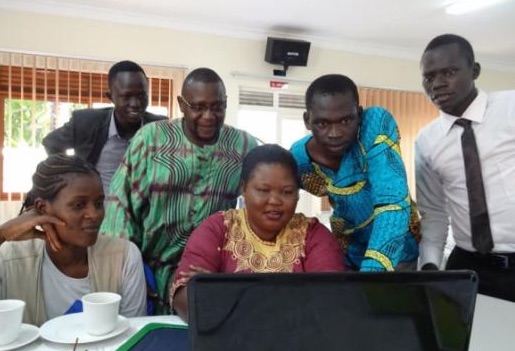
I have just returned from South Sudan. I am heartbroken and inspired. Adequate adjectives escape me. In such extremes, words can lose their meaning. How easily terms like famine, gender based violence, internally displaced, etc. can become abstractions even for the most compassionate of us. I was overwhelmed with anger as I stood with people in the dust, heat, and destruction while armed men lurked close by.


Yet, even in those conditions, I saw glimmers of resilience forming into action. For example, I sat in a hot, dark hut with 100 women, most of whom are rape survivors, as they talked about preventing children from becoming soldiers, intervening when violence flares and organizing rallies to bring opposing clans together. They told me about transporting a rape survivor in a wheelbarrow to a medical clinic. Even with limited resources, these women tirelessly work to protect themselves and others. They want a voice at the peace talks! Seldom have I felt such energy and spirit!

(Article continued in the right column)

Question for this article

Do women have a special role to play in the peace movement?

Can peace be achieved in South Sudan?

(Article continued from the left column)

NP’s teams are training and supporting these women peacekeepers ̶ close to a thousand at work in five locations. Regardless of how bleak the prognosis, we will align with those who without particular power or skill are nonviolently changing the world. The lead article in Sunday’s New York Times, War Consumes South Sudan, a Young Nation Cracking Apart illustrates the horror in places like Bentiu ̶ where we have a team of 21 civilian protectors. Amid the Times’ stories of murder, starvation and gang rape they neglect to tell about these remarkable women who have stepped through the brutality and are working to protect themselves and others. These women not only represent a personal resilience but more importantly, they embody the deepest strength of the human spirit.

    “My heart is moved by all I cannot save:
    so much has been destroyed
    I have to cast my lot with those
    who age after age, perversely,
    with no extraordinary power,
    reconstitute the world.”

    ― Adrienne Rich

(Thank you to Janet Hudgins, the CPNN reporter for this article.)