Colombia: Santos Welcomes Approval of Special Jurisdiction for Peace

FREE FLOW OF INFORMATION

An article by Prensa Latina

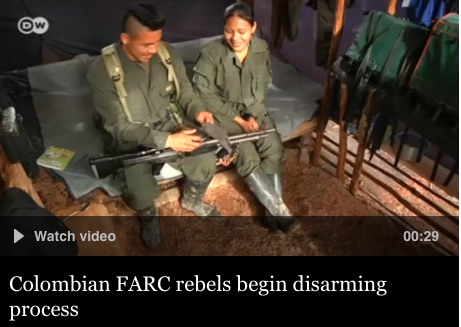
Colombian President Juan Manuel Santos welcomed today [Mar 14] the approval in Congress of the bill that will create the Special Jurisdiction for Peace (JEP), considered the backbone of the agreement with the FARC-EP.


President Santos

In his Twitter account, the President thanked the Senate for the validation of that rule on the eve – by 60 votes against two – during his final debate, one of the most controversial of the package planned to implement what was agreed with the Revolutionary Armed Forces of Colombia- People’s Army (FARC-EP), currently under disarmament.

The JEP sets up courts to investigate, prosecute and punish those responsible for the long war with the premises of zero impunity for crimes against humanity, but envisions pardons and amnesties in cases of political and related crimes.

It is the pillar for reconciliation, insisted the Executive when referring to the importance of such a mechanism aimed at implementing transitional justice, which contributes to move from war to a scenario of detente.

The heated discussions and absenteeism of some parliamentarians had hampered the passage of the aforementioned bill, so last night’s analysis was accompanied by representatives of victims’ organizations and other citizens in favor of the agreement with the FARC-EP.

Promoters of the popular initiative ‘Eye to the peace’, created to promote the implementation of the agreement between the Government and that guerrilla, remained on the outskirts of the Capitol and even within the Senate grounds to demand the validation of the JEP.

This methodology is part of an comprehensive system designed to clarify the truth, to apply justice, to repair damages caused to those directly affected by the confrontation (totaling almost eight million) and to offer guarantees of non-repetition.

(Click here for a Spanish version of this article.)

Question(s) related to this article:

Climate Change and Nepal

. . SUSTAINABLE DEVELOPMENT . .

An article by Shree Prasad Devkota and Navin Pandey for Transcend Media Service (abbreviated)

. . . Nepal has been combating hard to adapt to the effects of climate change and move towards climate resilience. One of the most important points to consider is the fact that most of the energy produced here is clean and from perpetual source. Nepal, being the second richest country in inland water resources in the world, produces 92% of its national grid energy via hydropower. Although the total potential for hydropower production is 83,000 MW; of which less than one percent (700 MW) is currently harnessed – the annual renewable energy potential sums up to 226,460 GWh comprising solar PV, wind and hydro. (UNDP, 2013)

In December 2009, Government of Nepal held the world’s highest altitude cabinet meeting on the slopes of Mount Everest to highlight the danger that global warming poses to Himalayan glaciers. The Everest Declaration included provisions like increasing the protected areas of country’s land from 20 to 25 percent, and developing communities’ capacity to cope with changing climate in addition to urging the developed nations to curb the carbon dioxide emission and simultaneously to contribute 1.5% of their GDP to Climate Fund to decrease greenhouse gases to pre-industrialization levels.

Similarly, Government of Nepal has initiated various programs like “Hariyo Ban”, “Chure Conservation Program” and watershed conservation under the Ministry of Forest and Soil Conservation to preserve the existing biodiversity and combat the changing climate patterns. The growing popularity of eco village concept and insitu conservation of endangered species in natural parks and reserves are all run very succinctly. Few initiatives like Community Forestry and Leasehold Forestry Programs even received global acclaim due to their effectiveness in forest conservation. A recent government survey shows that the forest cover has increased by five percent from earlier 39.6% (1998) to 44.74% (2016) of the total land area in the last decade- a green light for hope.

Initiatives like “Zero Carbon Nepal- Vision 2030” have been launched under National Planning Commission with approval of Confederation of Nepalese Industries to promote green economy and low carbon development by developing “Made in Zero Carbon Nepal” label for every Nepalese product that not only strengthens our economy but also establishes our identity as a carbon neutral country.

To this date, while the political debate over climate change has already been settled over the backdrop of various scientific facts published, countries around the world have started to come together to solve the issue. The developed countries and emerging economies lead in total carbon dioxide emissions while the developing and the least developed countries that have less share for carbon emission must suffer more. According to the Trading Economics Data, the 20 developed nations produce 80% of the total carbon while the rest world produces just 20%.

Analysing Nepal’s data, CO2 emissions per capita here is 0.14 metric tons while carbon sequestration capacity of our forest is as high as 3.1 tC/ha/yr (ICIMOD, 2013). In a global scenario of greenhouse gases emission, Nepal is not just a carbon neutral country, but a carbon negative country offering a net carbon sink through our lush green forests. The forests of Nepal store more than 913 million metric tons of carbon as of 2014(Journal of Forest and Livelihood).

(Article continued in right column)

Question for this article:

Despite the vested interests of companies and governments, Can we make progress toward sustainable development?

(Article continued from left column)

Nepal signed the United Nations Framework Convention on Climate Change (UNFCCC) on June 12, 1992, and ratified it on May 2, 1994. It is also a signatory to the Kyoto Protocol and became party to the conference from December 2005. As a party to the Convention, Nepal is obliged and committed to acting against the earth’s climate change and the adverse effects of human activities.

According to the voluntary schemes of the Kyoto Protocol, Nepal could earn the revenue of NRs. 4.5 billion, 11 billion and 18.4 billion at the rate of $5, $12, and $20 per ton CO2 sequestration respectively even if half of the existing forest area could be registered for the carbon credits. In addition to the above, Nepal can be at a position to reap a huge chunk of financial flow through the sale of the permissible average which has surplus of 0.07 ton CO2 per capita if the mechanism could be established under the emerging issue of the Polluter Pays Principle.

The world’s forests and forest soils currently store more than 1 trillion tonnes of carbon, twice the amount floating free in the atmosphere. Thus, increasing storage and preventingthe stored carbon from being released back to the atmosphere are two of the most important measures for combating global warming and conserving the environment.

The outside world should all learn from the progress made by Nepal in sector of forest conservation and use of clean energy in combating the climate change. Although Nepal being a small agrarian country contributing 0.016% of global Greenhouse gas emissions, the initiatives taken in such seriousness are reflective of our unfathomable love for nature and mother earth. These efforts are not only an act for solidarity; they are also an investment for our common future, contributing to green, healthy, and naturally liveable earth.

References:

Banskota, K., Karky, B.S., & Skutsch, M. (2012). Reducing carbon emission linking community managed forests in the Himalayas. Kathmandu: International Centre for Integrated Mountain Development.

DFRS, (2015). Forest resources of Nepal (1987‐2014). Kathmandu: Department of Forest Research and Survey, Ministry of Forests and Soil Conservation.

Dhungana, S.P., Oli, B.N., & Mandal, R.A. (2014). Claiming a bird in hand: Economic potential of plantation in Nepal under clean development mechanism. Journal of Forests and Livelihood. 12(1): 18‐27.

DoF, (2016). Forest cover change analysis of the Terai districts (1990/91‐2015/16). Kathmandu: Department of Forests. FAO, (2014). Global forest resource assessment 2014. Rome: Food and Agriculture Organization of the United Nations.

Liau, J., & Rasul, G.(2007). Climate change, the Himalayan mountains and ICIMOD. Sustainable Mountain Development. 53. Schoene, D., & Netto, M. (2005). The Kyoto protocol: What does it mean for forest and forestry. Unasylva. 222 (56).

UN commences nuclear abolition negotiations

DISARMAMENT & SECURITY .

An article by by Alyn Ware for Abolition 2000

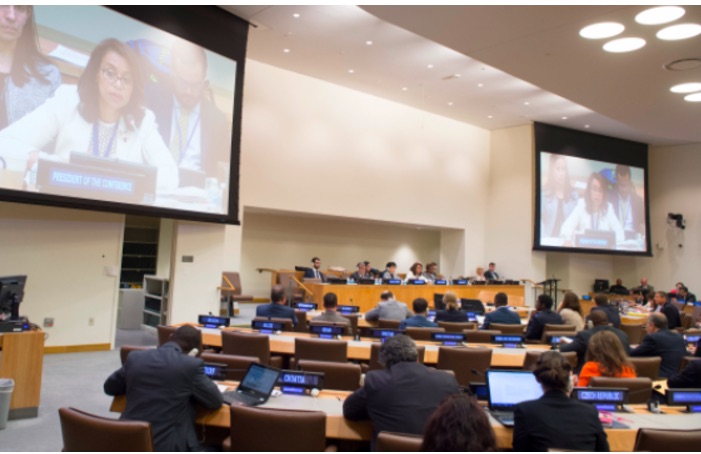
On 16 February, approximately 100 countries gathered at the United Nations for the first session of negotiations on a legal agreement to prohibit nuclear weapons. The participants included two nuclear-armed States (China and India) and one NATO country (Netherlands) with the remaining being non-nuclear countries. (See the list of states participating below).

The negotiations are being undertaken in accordance with UN General Assembly Resolution 71/258 Taking forward multilateral nuclear disarmament negotiations, adopted on December 23 by a vote of 113 in favour, 35 opposed and 13 abstaining.

This first session of the ban treaty negotiations, which took place on Feb 16, 2017, considered procedural matters such as the election of officers, agenda for the negotiations, rules of procedure and participation of NGOs. The substantive negotiations on the proposed ban treaty will take place March 27-31 and June 17 –July 7.

Ambassador Elayne Whyte Gómez of Costa Rica was elected as Chair of the negotiations. Costa Rica has a strong track record on multilateral nuclear disarmament including being a member of the Latin America and Caribbean Nuclear-Weapon-Free Zone, being one of the leaders of the initiative which achieved an Advisory Opinion from the International Court of Justice in 1996 on the general illegality of nuclear weapons, chairing the 2013 sessions of the Open Ended Working Group on Taking Forward Nuclear Disarmament Negotiations (OEWG) which along with the 2016 sessions of the OEWG led to the UN General Assembly decision to initiate the ban treaty negotiations, and submitting a Model Nuclear Weapons Convention to the United Nations General Assembly and NPT Review Conferences as a guide to comprehensive nuclear disarmament negotiations.

One of the issues discussed was whether NGOs would be able to participate in the negotiations – meaning that they would have permission to speak and submit written papers – or whether they would only be able to attend and observe the proceedings. The vast majority of states agreed that NGOs would be able to participate. However, states might be able to object to the participation of certain NGOs they believe are not genuinely engaged in the issue, but such objection would need to be accompanied by a written explanation circulated to all participants.

Another issue was whether the proceedings should be bound by consensus or open to a vote. The majority of states supported having the option to vote in order to ensure that one or two states are not able to veto proceedings, and this was reflected in the rules of procedure.

The agenda for the March negotiations will include a general exchange of views on elements for the prohibition treaty, including: principles and objectives, preambular elements, core prohibitions, effective legal measures, legal provisions and norms, institutional arrangements and other provisions.

136 Japanese parliamentarians join nuclear disarmament statement on eve of ban treaty negotiations

On Feb 15, the eve of the first session of the ban treaty negotiations, M.P. Keisuke Suzuki (LDP), Secretary-General of the Japan section of PNND, sent to New York the endorsements of 136 Japanese parliamentarians for A Nuclear-Weapon-Free World: Our Common Good’, a joint statement of legislators and religious leaders from around the world. The endorsers were from all political parties and included former foreign ministers, ambassadors and other high level parliamentarians.

The statement warns about the risks of a nuclear catastrophe, whether by accident, intent or miscalculation, calls upon world leaders to commit to nuclear abolition and to replace nuclear deterrence with shared security approaches to conflicts, and supports a nuclear weapons convention or framework of agreements that eliminate nuclear weapons.

‘In Japan, there is broad support among the public and among parliamentarians for the effort toward a nuclear-weapon-free world,’ said Mr Suzuki (LDP), ‘The number of MPs who responded positively is very encouraging.’

(Continued in right column)

Question related to this article:

Can we abolish all nuclear weapons?

(Continued from left column)

UNFOLD ZERO consultation as ban treaty negotiations commence

Also on Feb15 in New York, UNFOLD ZERO and PNND held the fourth in a series of Consultations on nuclear disarmament negotiations and parliamentary action.

The consultation included diplomats, lawyers and representatives of disarmament NGOs, parliamentary organisations, youth networks and religious & interfaith organisations. It focused on three key multilateral processes, i.e. the ban treaty negotiations, Non-Proliferation Treaty review cycle, and the 2018 UN High Level Conference on Nuclear Disarmament.

The ban treaty negotiations were introduced by a representative of Austria, the country that submitted the draft resolution to the UN on commencing the negotiations. The 2018 UN High Level Conference was introduced by a representative of Indonesia, the country which submitted (on behalf of the non-Aligned Movement) the resolution by which the UN decided to hold the conference. Some interesting observations and suggestions were made at the consultation.
Here are a few:

The ban treaty is not an alternative to the NPT, but rather a measure where-by non-nuclear States can undertake action to implement their nuclear disarmament obligations;

The UN High Level Conference has the capacity to engage all states: nuclear-armed, allied and non-nuclear.

The 2018 UN High Level Conference could build on the ban treaty negotiations by providing a platform for states to announce their signature and/or ratification, assuming the treaty is negotiated by then;

The High Level Conference could include multiple strands, some of which everyone could agree to and be adopted by consensus, and others of which could be adopted by vote and apply to those who vote in favour;

In addition to pushing for agreements at the High Level Conference on specific multilateral measures, governments should also be encouraged to make individual voluntary commitments and offer concrete measures that they have already adopted (a ‘gift basket’ for the conference).

This approach has been very productive at the Nuclear Security Summits and other high level conferences.

Civil society and the governments leading the process for the UN High Level Conference need to step up the visibility and promotion of the conference.

States that were present at the Feb 16 organisational meeting for the ban treaty (unofficial list)

Algeria, Antigua and Barbuda, Argentina, Armenia, Austria, Azerbaijan, Bahrain, Bangladesh, Barbados, Belarus, Belize, Benin, Bhutan, Botswana, Brazil, Brunei, Burkina Faso, Cambodia, Chile, China, Colombia, Congo, Costa Rica, Cote d’Ivoire, Cuba, Cyprus, Democratic Republic of the Congo, Dominican Republic, Ecuador, Egypt, El Salvador, Eritrea, Ethiopia, Gabon, Ghana, Guatemala, Guyana, Haiti, Honduras, India, Indonesia, Iran (Islamic Republic of), Iraq, Ireland, Jamaica, Jordan, Kazakhstan, Kenya, Kuwait, Lao People’s Democratic Republic, Lebanon, Lesotho, Libya, Liechtenstein, Madagascar, Malaysia, Malta, Marshall Islands, Mexico, Mongolia, Morocco, Myanmar, Namibia, Netherlands, New Zealand, Nicaragua, Niger, Nigeria, Oman, Papua New Guinea, Paraguay, Peru, Philippines, Qatar, Republic of Moldova, San Marino, Saudi Arabia, Senegal, Singapore, South Africa, Sri Lanka, Swaziland, Sweden, Switzerland, Syrian Arab Republic, Tajikistan, Thailand, The Former Yugoslav Republic of Macedonia, Togo, Trinidad and Tobago, Tunisia, Uganda, Ukraine, United Arab Emirates, United Republic of Tanzania, Uruguay, Venezuela, Viet Nam, Yemen, Zambia, Zimbabwe

How important is community development for a culture of peace?


Here are CPNN articles related to this theme:

Character Strengths That Support Peacebuilding

Search for Common Ground – Burkina Faso Promotes Community Resilience through Dialogue and Peace Initiatives in Ouahigouya

Mexico: In San Juan del Río, Rotary promotes a positive culture of peace

Ibarra, Ecuador: Culture of peace, the way towards a good coexistence

Colombia: Cultural spaces for the construction of peace

Call to strengthen the culture of peace and non-violence in Chiapas

2019 Tomorrow’s Peacebuilders Award winners announced

Côte d’Ivoire: Béoumi: Traditional leaders launch a caravan for peace

South Africa: Global Youth Peacemaker Network initiative offers ‘real hope for Cape Flats’

El Salvador: Associations present project to promote a Culture of Peace

Stories from Rotarian Action Group for Peace provide inspiration for peace

Honduras: New health clinic in gang-ridden suburb of San Pedro Sula rebuilds community

Spain: Junta of Andalucía highlights commitment of the community to dialogue and solidarity in the ‘School Day of Peace’

Nigeria: Federal government rallies support of stakeholders to promote peace, security

USA: NCDD Launches Dialogue & Deliberation Training Partnership with American Library Association

Mexico: Presentation of the project “Oaxaca Intercultural”

México: Presentan proyecto “Oaxaca Intercultural”

– – – – Links for the following articles published prior to 2015 do not work because they were made by a version of PERL programming that is no longer supported. With three easy steps, you can find the article by its number. First, click on it before returning to this page. Your browser will say that the article is not available but in the address listed you can see that it was located at ViewArticle=xxxx where xxxx is the number of the article. Returning to this page, then click here for the listing of all years. Then click on the year that contains the number for the article you seek. It will send you to the page where you can easily search for the article by its title. – – – –

Students march for peace and justice in Siquinalá, Escuintla (Guatemala)

Estudiantes caminan por la paz y la justicia en Siquinalá, Escuintla (Guatemala)

'Building a Culture of Peace for my Community' (Dominican Republic)

Realizan jornada “Construyendo una Cultura de Paz para mi Comunidad” (República Dominicana)

Land Reform for a Culture of Peace (Brazil)

Reforma Agrária por uma Cultura de Paz (Brasil)

Peru: Intiwawa Children of the Sun

Peace Promotion Can Work (Chicago)

Assault on Peaceful Co-existence (Nagaland, India)

Obreros y sindicatos reviven la Promesa [Puerto Rico]

Project launched to prevent young people from falling into crime [Honduras]

Lanzan proyecto para evitar que jóvenes caigan en delincuencia [Honduras]

The Centre for the Integral Development of Youth in Soacha, Colombia

Estragia de Centros de Desarrollo Integral Juvenil – Soacha, Colombia

Extreme Poverty is Violence – Breaking the Silence – Searching for Peace

Waking Souls for Social Change

Despertando almas para el cambio social

Fondation Idolè and the Culture of Peace

Fondation Idolè et la culture de la paix

Hope in a Shanty Town: Story of a Woman in Bangkok

Activities of the Santa Barbara Association for UNESCO

La Paloma Sabanera Coffee House and Bookstore

A Hartford Community Project Promotes Culture of Peace

Reforming the “Hooker”

UCONN Celebrates Kwanzaa

Ivy Walls: Local Lawyer's Fight to Help His Community

For prior discussion on this question, click here.

What is the relation between peace and education?


A classic response to this question is the following letter from Mohatma Gandhi to Maria Montessori:

To Madame Montessori

Even as you, out of your love for children, are endeavoring to teach children, through your numerous institution, the best that can be brought out of them, even so, I hope that it will be possible not only for the children of the wealthy and the well-to-do, but for the children of paupers to receive training of this nature. You have very truly remarked that if we are to reach real peace in this world and if we are to carry on a real war against war, we shall have to begin with children and if they will grow up in their natural innocence, we won’t have the struggle, we won’t have to pass fruitless idle resolutions, but we shall go from love to love and peace to peace, until at last all the corners of the world are covered with that peace and love for which, consciously or unconsciously, the whole world is hungering.

Mohatma Gandhi, Young India, 19-11-”31

Here are CPNN articles related to this theme:

Report of World Peace Foundation activities in DR Congo

The Gloria Fuertes School of Andorra demonstrates the “transformative power of education” at the UNESCO National Meeting of Schools

Dominican Republic: Ministry of Education develops program to promote a culture of Peace

National Coordinators of the UNESCO Associated Schools Network gather to reflect and share experiences

Promotion of the Culture of Peace: Salimane Karimou Launches the Project “Youth for Peace in Northern Benin”

Education in Burkina: More than 94,000 to learn in the 2023 literacy campaign

Mali: Culture of Peace and Living Together: Contribution of teachers

Forum in Brazil: Peace, How Is It Done?

Puerto Rico : Educate for a Culture of Peace

The Best Weapon for Peace : Maria Montessori, Education, and Children’s Rights

Europe: GENE Roundtables gather participating Ministries and Agencies twice a year to share national experiences and strategies

Mexico: The Academic of Education participates in the Conference for Peace of the Maguen David Hebrew School

For colleges in the United States: First Year Connect

Transatlantic Dialogue wins Luxembourg Peace Prize

“Education Nobel”, Global Teachers’ Prize includes three Brazilian teachers.

Dominican Republic: Education ministry continues training on ethics, culture of peace and protection of rights

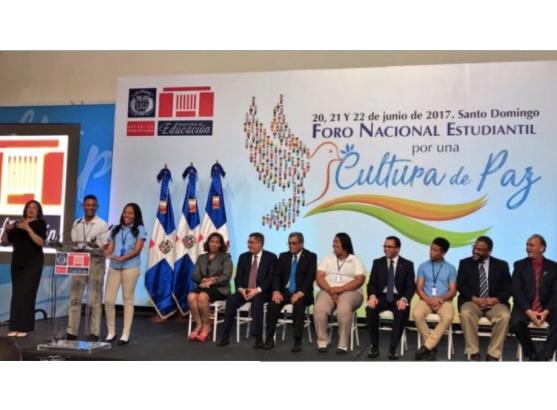
Dominican Republic: MINERD hosts National Student Forum for a Culture of Peace

Colombia: Barranquilla will host the first Ibero-American Education Congress

Delia Mamon: peace through education (Switzerland)

Angola: ISTP Holds International Symposium on Culture of Peace

Cyprus: Teachers from both sides attend seminars on peace education

Barueri, Brazil: Culture of Peace Project is launched at meetings of parents in all municipal schools

Dominican Republic: Reflections on the search for a culture of peace in schools

Culture of Peace and Education

Honduras: Program in 130 schools reduces violence and promotes culture

Book fair in Oujda, Morocco: Ambition for the Maghreb and Africa

Going the Distance for Peace: South Sudanese Educators and Policy Makers Focus on Youth by Training Secondary-School Teachers

El Salvador to prioritize culture of peace in its schools

Brazil: Senac promotes debate on culture of peace in the educational system

258,000 Iraqi children back at school in eastern Mosul as battle rages in west of city

USA: Teachers in High-Need Schools Share Why They Do What They Do

Addis Ababa: Pan-African Symposium on Education, Resilience and Social Cohesion

Netherlands: The Peaceable School

Spain: DemosPaz, a new Institute of UAM and the Foundation Culture of Peace

España: DemosPaz, un nuevo instituto de la UAM y Fundación Cultura de Paz

Latin America: Pedagogical Movement: new phase, new impetus

Amerique Latine: Mouvement pédagogique: nouvelle phase, nouvel élan

América Latina: Movimiento Pedagógico: nueva fase, nuevo impulso

– – – – Links for the following articles do not work because they were made by a version of PERL programming that is no longer supported. With three easy steps, you can find the article by its number. First, click on it before returning to this page. Your browser will say that the article is not available but in the address listed you can see that it was located at ViewArticle=xxxx where xxxx is the number of the article. Returning to this page, then click here for the listing of all years. Then click on the year that contains the number for the article you seek. It will send you to the page where you can easily search for the article by its title. – – – –

Building Peace Through Education In Pakistan

Maria Montessori et l’éducation à la guerre

Maria Montessori and education for war

Nicaragua:

Where in the World to Study Peace Education? Help us Build a Global Directory

Educators worldwide unite for quality education

Docentes unidos por la educación de calidad

Les enseignant(e)s du monde entier s’unissent pour une éducation de qualité

Interview: Even If Its People Hate Me, I Will Still Love Pakistan, Says Malala

Education at heart of trade union recommendations to G20

L’éducation au cœur des recommandations syndicales adressées au G20

A story of one of mothers I met (Palestine)

At UN, Malala Yousafzai rallies youth to stand up for universal education

Malala Yousafzai and Kailash Satyarthi win Nobel Peace Prize

Governments make record-setting pledges of $26 billion to fund education

New documentary highlights daily commitment of teachers around the world

UN chief teams up with global leaders, celebrities to get all children into school by 2015

Nations Unies : Malala Yousafzai encourage à lutter pour l'éducati

Naciones Unidas : Malala afirma que la paz es necesaria para la educación

For older discussion, click here.

258,000 Iraqi children back at school in eastern Mosul as battle rages in west of city

… EDUCATION FOR PEACE …

An article from Theirworld: A brighter future for every child (reprinted by permission)

At least 320 schools have reopened in eastern Mosul and nearby towns – allowing around 258,000 children to return to education while fighting continues in the west of the embattled Iraqi city. Some of the children had been out of school for more than two years, with girls largely banned from getting an education by the terror group Islamic State.


Heba, Noor, and Janna in a classroom at a recently reopened school in eastern Mosul, Iraq — UNICEF / Anmar

In February, UNICEF provided learning materials including science and maths kits to 87 of the East Mosul schools, reaching 73,780 children including 31,890 girls. The United Nations children’s agency said the need for furniture, teaching materials, and teacher training remains a challenge.

Concern about unexploded devices in and around schools is high. But with only a limited number of agencies authorised to deliver Mine Risk Education (MRE) sessions, the authorities are concerned. In Anbar province, MRE took place in 50 schools, with awareness and safety messages reaching an estimated 25,000 students, including about 45% of girls.

Paul St. John Frisoli, a senior education technical adviser on the Middle East region for the International Rescue Committee, said schools in Mosul can save children’s lives by giving student, teachers, school staff and parents crucial life-saving information about mine awareness.

In a blog for Refugees Deeply, he added: “IRC staff deployed into recently retaken villages and displacement camps around Mosul have observed high rates of distress among children and families.

(Article continued in right column)

Question for this article:

What is the relation between peace and education?

A culture of peace in Iraq, Is it possible?

(Article continued from left column)

“Education can help children cope with the consequences of conflict by providing a secure, predictable and nurturing environment. Having access to education offers children hope for and a sense of control over their future during crisis.”

Millions of children across the world miss out on school as a result of humanitarian emergencies including conflicts, natural disasters and health crises. Education can be lifesaving – not being in school in emergencies can leave children at risk of child labour, early marriage, exploitation and recruitment into child labour.

Military operations to retake western parts Iraq’s second largest city started on February 19 after Iraqi forces were successful in removing the terror group from the east.

The United Nations estimates that around 750,000 civilians remain inside the western section of the city.

Humanitarian groups are deeply concerned about the situation of civilians trapped there, including around 412,000 children.

Since February 19, more than 31,500 people – including 14,800 children – have been displaced from West Mosul. The majority of people have been sent to new IDP camps in south Ninewa.

In January, 70 schools reopened in Mosul. Hessam al-Din Abar, a representative at the Provincial Council in Nineveh, where Mosul is the capital, said schools had been turned into places for terrorists to train new recruits and promote extremism.

Many families would not allow their children to attend schools while ISIL – which seized the city in 2014 – was controlling them.

An estimated 3.5 million Iraqi children are missing out on education.

(Thank you to Janet Hudgins, the CPNN reporter for this article.)

Does the UN advance equality for women?


A resume of actions for women’s equality by the UN was made for the March 2017 meeting of the Commission on the Status of Women by Executive Director Phumzile Mlambo-Ngcuka.

This discussion question applies to the following articles:

International Women’s Day 2026: Rights. Justice. Action. For ALL Women and Girls.

UN Women Leaders Network to convene a diverse group of women leaders worldwide to advance women’s rights and leadership

Secretary-General Tells Security Council Open Debate ‘Standing with Women Is Good for the World’, Stresses Patriarchy ‘a Massive Obstacle’ to Culture of Peace

United Nations: CSW67 Opening statement: Digital rights are women’s rights

UN Security Council: ‘Radical change of direction’ needed in women, peace and security agenda

Call for Applications: Strengthening Young Women Peacebuilders’ Capacity in Complex Crises

One year driving action for gender equality. One year of Generation Equality

UN Women: International Women’s Day celebrates the contribution of women and girls as climate solution multipliers

United Nations : Commission on the Status of Women 2022

United Nations : UNiTE by 2030 to End Violence against Women

United Nations: Landmark gender equality forum concludes with concrete commitments, plan to advance parity by 2026

Women must no longer be ‘squeezed into a small corner’, landmark Forum declares

United Nations Committee on Elimination of All Forms of Discrimination against Women Holds General Discussion on Rights of Indigenous Women

Generation Equality Forum: Mexico City, 29-31 March 2021

Statement by Phumzile Mlambo-Ngcuka, UN Women Executive Director, on International Women’s Day 2021

International Women’s Day 2021

‘Women and girls belong in science’ declares UN chief

I am Generation Equality: Ixchel Lucas, youth advocate for girls’ leadership

International Women’s Day 2020

Devoted to discovery: seven women scientists who have shaped our world

UNWomen: In lead up to Generation Equality Forum, Action Coalition themes announced

The world went orange: Putting a spotlight on ending violence against women

UNCSW63’s positive outcomes for women’s human rights to social protection systems, quality public services, including education, and sustainable infrastructure

Bonita, a young change-maker inspires girls and women in Nepal through education

Executive Director remarks at the UN Security Council open debate on women, peace and security

An unprecedented upsurge of movements for women’s rights: UN Women annual report 2017-2018

What Is CSW and Why Are We in New York to Be Part of It?

UN Commission on the Status of Women (CSW62)

Africa: UN deputy chief says ‘messages of women’ vital to sustainable peace, development

UN: New films on Global Goals spotlight women’s journeys of resilience

UN report lays out concrete actions for accelerating progress towards women’s full and equal economic participation

Opening statement by Phumzile Mlambo-Ngcuka, UN Under-Secretary-General and Executive Director of UN Women for the 61st session of the Commission on the Status of Women

CSW at UN: Supporting People’s Actions to Empower Women at the Margins

UN Commission on the Status of Women – 2017

USA: University of Wisconsin receives UN chair for global work on gender, well-being and peace

Education International and other Global Union Federation delegations begin their work at the 60th Session of the UN Commission on the Status of Women

UN Commission on the Status of Women revamps working methods

U.N. Says Maternal Mortality Rate Has Nearly Halved since 1990

Gobiernos respaldan nuevas funciones para la Comisión de la Mujer

Les gouvernements approuvent de nouveaux rôles pour la Commission de la condition de la femme

UN Commission on Status of Women: Implementing the Beijing Platform for Action

Comisión de la Condición Jurídica y Social de la Mujer: Implementación de la Plataforma de Acción de Beijing

Commission de la condition de la femme: Application du Programme d'Action de Beijing

– – – – Links for the following articles published prior to 2015 do not work because they were made by a version of PERL programming that is no longer supported. With three easy steps, you can find the article by its number. First, click on it before returning to this page. Your browser will say that the article is not available but in the address listed you can see that it was located at ViewArticle=xxxx where xxxx is the number of the article. Returning to this page, then click here for the listing of all years. Then click on the year that contains the number for the article you seek. It will send you to the page where you can easily search for the article by its title. – – – –

Investing in women peacebuilders is best value for money

Advancing Women at the United Nations

Continuation of Statement by Phumzile Mlambo-Ngcuka

. WOMEN’S EQUALITY .

Continuation of the Opening statement by Phumzile Mlambo-Ngcuka, UN Under-Secretary-General and Executive Director of UN Women for the 61st session of the Commission on the Status of Women as published by UN Women

… There is a big opportunity for this Commission to recommend changes that match the ambitions of the Sustainable Development Goals in their scale of potential change. And when we do that we will address the needs of these women.

More than half of all women workers around the world—and up to 90 per cent in some countries—are informally employed. We cannot ignore them. This sector is just too big to fail.

Informal workers themselves are mobilizing to negotiate the changes they need, for example waste pickers through their local associations in Brazil, Colombia and India, and in many cases doing that successfully.

On International Women’s Day last week, Pakistan enacted a new law that recognizes home-based workers and entitles them to social protection.

Excellencies, let us look for a moment at some of the barriers that remain to be cracked.

There is under-representation of women in decision-making at all levels. They therefore have insufficient voice to drive the nature and extent of change needed.

There is still a myriad of laws in more than 150 countries that discriminate against women. This falls right in your court as decision-makers and law makers.

And we have to address the stereotypes, norms and practices that discriminate against women and girls, and have for generations denied women career paths on a par with men.

In this Commission, you have an opportunity to assist us to turn back these practices and to introduce changed practices both in businesses and in institutions. The global pay gap, at an average of 23 per cent, means that women are clearly earning consistently less than men.

Women regard this as daylight robbery. The deficit has robbed generations of women of income, future security and just reward. Each year they work three months more than men for equivalent pay.

In the digital age, we also seek technology-enabled solutions for women. We must therefore resolve to act on gaps in the access to technology that unfortunately have been growing. There are some 200 million fewer women online than men, and the gap is worryingly widening.

In a world that has moved to technology and will move even further, this obviously has to change for women too, as it is expected that 90 per cent of future jobs will need a level of digital literacy.

This Commission can drive faster change for multitudes of young people and older people who need to be ready for this future world of work.

Too few people are impacted by the actions to date that we have been driving in the economy.

Change is not yet addressing the root causes of women’s economic injustice, nor is it fulfilling their rights.

There is now an opportunity to act on the economic front. These changes must also mean a rights-based approach in which all people also enjoy democratic rights, free to organize, free to dissent, and human rights defenders free to support their fellow workers, fellow activists and not be killed and brutalized for doing this work. And young people must be free to be activists.

Advancing women’s equality in total could bring a potential boost of 28 trillion US dollars to global annual GDP by 2025. That is five years before the 2030 Agenda endpoint. Wouldn’t it be great if we were to achieve this?

Just fixing the informal economy could impact 80 per cent of the women working outside home in sub-Saharan Africa and remove the threat of extreme poverty.

The change of discriminatory laws in over 150 countries could affect more than 3 billion women and girls in the world. And that is what tipping the scale is about. This will be game changing.

Macroeconomic policies and related laws would contribute to inclusive growth and significantly accelerate progress.

Innovations in climate-smart agriculture and the low-carbon economy envisaged in the 2030 Agenda, as well as digital economies and information communications technologies can rapidly move opportunities ahead.

Mobile cellular networks already cover an area occupied by 95 per cent of the world’s population offering huge potential for digital and financial inclusion.

Investment in a pipeline of girls well educated in STEAM subjects [science, technology, engineering, arts and math], could increase the current 25 per cent of women in the digital industries’ workforce and build skills matches for the ‘new collar’ jobs of the Fourth Industrial Revolution coupled with the anticipated demands of the green economy.

(continued in right column)

Question for this article

(continued from left column)

Women also face difficulties when it comes to access to markets. Governments and the private sector can both make a significant contribution to this. If just 1 per cent more than existing annual global public procurement spending were to be directed to women’s enterprises, women could earn an additional 60-70 billion US dollars from supplying goods and services. This can be addressed in procurement policies and practices.

We have committed to eliminating violence against women including sexual harassment at work in the next 13 years by 2030.

That would give relief to many women who are traumatized by daily harassment at work. That includes the ability for women to have a fair hearing when they report violence and harassment at work.

Paid parental leave, more men sharing care work, and safe affordable childcare services together create many possibilities for more women to be active in the economy and enhance the essential parenting role of men.

The private sector has a role to play in this too, and in enabling women’s voices to be heard in shaping products, services and policies in the new industries, supporting asset ownership, digital and financial inclusion, and infrastructure development. When companies promote women, invest in their careers, and bring their voices into decision making, there is a better future for all.

Collectives like trade unions, and networks and associations like the International Domestic Workers Federation are vital, where the fight is not just for higher wages but for higher and equal wages. They are absolutely essential to ensuring that women are adequately represented to get the changes they want.

It is ever more urgent that we respect and protect women’s sexual and reproductive health and reproductive rights, and ensure the unmet needs of family planning for women are met. This would limit unwanted pregnancies and the consequences for mothers who may wish to work outside the home, and protect their rights .

Excellencies, what you agree to do during this CSW could be the much needed accelerator for the implementation and achievement of the 2030 Agenda. We must make, and can make, the world of work, work better for women, transforming economies and realizing rights.

We now have only 13 years until 2030. Every week and every month counts. So does the scale of the change we achieve, which must also benefit the displaced persons.

This Commission on the Status of Women must not be the Commission on the Status Quo.

This week the UN Secretary-General’s High-Level Panel on Women’s Economic Empowerment will present its final report. This contains important recommendations, all in line with the work of this Commission. The report will enable us to reach and motivate the partners who are essential for success.

At the UN, under the leadership of the Secretary-General, we are also making adjustments to support women in the world of work. We are committed to gender parity at senior levels by 2021. This is a challenge faced by many partners in both public and private sectors. Our Secretary-General joins the growing number of leaders who want a solution before 2030.
Incentives in every sector will be needed to recruit and retain female workers and also to make contributions to the business culture, and the norms and values that must change for women to realize economic justice.

Lessons from countries already making change are important to share. For this Commission, 35 countries have provided input on the review theme of how lessons from the Millennium Development Goals are being reflected in national processes and policies. We also expect progress on gender to be reflected in the reports for the July 2017 UN High-Level Political Forum. We also follow with interest the actions of countries that made critical commitments at the 2015 Global Leaders Meeting attended by more than 70 heads of state.

Partnerships are essential, especially our partnership with ILO that tonight will enable us to launch the forward-looking “Equal Pay Platform of Champions”, which will be attended by trade unions, by sports heroes, by film stars, governments and by youth.

Excellencies, we need to work together. There are challenges but there are also solutions. You have boldly committed to substantive and sustainable changes by 2030.

Across the world, civil society space is shrinking, and democratic actors and human rights defenders face daunting attacks. Strong movement building continues in the face of the existential threats that both provoke and besiege it.

We know that strong and autonomous women’s movements are a corollary of effective policy change on gender equality. We will consistently promote their safety and ability to organize.

At the same time, over the last two years, a resounding global gender equality compact has been accumulated, through the Beijing+20 Review, Agenda 2030 itself, the Paris Agreement on Climate Change, the New Urban Agenda and the New York Declaration on Migrants and Refugees.

These aspirations are shared by the world, for a better world; for women, for us all.

Thank you.

Opening statement by Phumzile Mlambo-Ngcuka, UN Under-Secretary-General and Executive Director of UN Women for the 61st session of the Commission on the Status of Women

. WOMEN’S EQUALITY .

A report by UN Women

Chair of the Commission on the Status of Women, H.E. Mr. Antonio de Aguiar Patriota, Secretary-General of the UN, President of ECOSOC, President of the General Assembly, Ministers and representatives from capitals, Women and civil society representatives,

At the outset, I would like to thank the Chair of CSW, his Excellency Ambassador Patriota, and his Bureau, for all their work in preparing this complex event.

I also want to thank the UN Women team across the world for their hard work and preparations, including the important regional pre-CSW consultations that allow us all to get together in this session and be as ready as we are.


In Cape Town, South Africa, UN Women Executive Director Phumzile Mlambo-Ngcuka meets girls involved in the Grassroots Soccer SKILLZ programme, a grantee of the UN Trust Fund to End Violence against Women. Photo: Karin Shermbrucker
Click on the image to enlarge

A special thanks to the representatives of Member States, civil society and youth who have travelled from all over the world to collaborate with us. And I thank Member States for their inclusion of civil society and youth in their delegations, helping to make this meeting truly universal in its deliberations.

There are 750 young people here who on Saturday and Sunday were engaged in an assembly and a festival of ideas. What an engagement that was! We also have 8,600 pre-registrations, which means that we potentially have the largest number ever of civil society representatives with us in this CSW61.

I would also like to acknowledge our Secretary-General, at his first Commission in his new capacity. Secretary-General, it is wonderful to have you with us here. I thank him for leading the agenda on gender equality from the front and for his insightful remarks and unwavering drive to tackle gender inequality from Day One of his tenure.

This Commission concerns itself with the status of women. It reviews the progress made by women and girls, and assesses the remaining challenges. It is a barometer of the progress we are making on achieving a world that is free of gender discrimination and inequality, a world that leaves no-one behind. It will help us measure achievement of the implementation of the 2030 Agenda for Sustainable Development. It also helps us to pursue action in priority areas and benefits from the Commission’s Agreed Conclusions.

The priority theme for CSW61, as set out in the Secretary-General’s report for the session, is “Women’s Economic Empowerment in the Changing World of Work”. Inclusive economies and a positive world of work are powerful ways of breaking away from the cycles of poverty that besiege our nations.

Currently, in the gender equality agenda, we see progress in some areas, but we also see an erosion of gains. The much-needed positive developments are not happening fast enough. We also need to work together to make sure we reach a tipping point in the numbers of lives changed.

We need swift and decisive action that can be brought about by the world of work so that we do not leave women even further behind.

Excellencies, let us agree to constructive impatience.

(continued in right column)

Question for this article

Does the UN advance equality for women?

(continued from left column)

The Sustainable Development Goals give us a framework to work for far-reaching changes. In this session of the Commission we will be able to bring renewed focus to the needs of those who are currently being left behind and those who are currently furthest behind.

They include young women; some of whom were at the Youth CSW. They include refugees and migrants. They include women affected by gender-based violence, including workplace sexual harassment.

They include women who are denied sexual and reproductive health and reproductive rights and services; and women facing discrimination on multiple and intersecting fronts over and above their gender: such as sexual orientation, disability, older age, race, or being part of an indigenous community.

They include women in the informal sector, and care givers, those who provide services in the home that are much needed to sustain society.

Almost all women do some form of work. If you are a woman you are a worker—period.

Virtually all economies rely on the unpaid care and domestic work that is largely provided by women and girls. Yet this form of work positions masses of women uniquely to be “left behind”.

Positive changes in the world of work must enable care work to be valued and to be shared by parents and within the family unit. This will bring about far-reaching positive changes for women, society and economies.

Investment into the care economy of 2 per cent of GDP in just seven countries could create over 21 million jobs. That would provide child care, elderly care and many other needed services.
The Secretary-General’s report gives greater attention to women who work at the base of the pyramid, as these are the ones who are at the highest risk of being left behind.

The Commission must also look at how to increase the participation of these women, as well as women’s participation in male-dominated sectors that have meaningful economic benefits.

The Commission can make fresh gains in how we bring the informal sector into a structured and meaningful economic relationship with benefits, respecting the rights of women in this sector.

The informal sector is dominated by the millions and millions of women who are the working poor. Women workers in the informal sector are all around us.

They are in the rapidly growing urban communities, as well as in rural areas. They are the under-the radar and under-valued cogs in the bigger wheels of the formal economy. They are the low-cost farm workers, flower sellers, street food vendors, care workers, and home-based producers of garments and car parts. Almost none of them have legal or social protection.

And they are missing out on the opportunities offered by the changing world of work, which has technology as one of its advantages…

[Editor’s note: We found it too difficult to abbreviate this speech into the usual length for a CPNN article without losing important statements; hence it is continued on the following page.]

Organizations sign agreement to promote a culture of peace in Dominican Republic

… EDUCATION FOR PEACE …

An article of Listin Diario (translated by CPNN)

The National Federation of Merchants and Entrepreneurs of the Dominican Republic (Fenacerd) and the Scala Foundation signed yesterday an agreement to promote a culture of peace in the country, as well as to develop programs of training and citizen coexistence.

 “On this occasion, we understand that it is time to strengthen the culture of peace, good practice and the common good through a dialogue with our consumers and suppliers that fosters cooperation and solidarity,” said Manuel Ortiz, President of Fenacerd, during the ceremony.

He added, furthermore, that this agreement will positively impact on an improvement of coexistence between merchants and citizens in general.

Meanwhile, the president of the Scala Foundation, Raisa Ruiz, stressed that this agreement promotes the construction of a culture of peace from a focus on rights and gender equality, values ​​and ethics of care.

In the first stage, both institutions are planning to organize activities to train the members of Fenacerd, through training workshops in the process of building peace and citizenship at the national level.

“It is time to promote attitudes of values ​​and good behavior especially in an environment like the one where violence prevails, which in the end degenerates into delinquency,” Ortiz said.

(click here for the original Spanish version)

Question for this article: