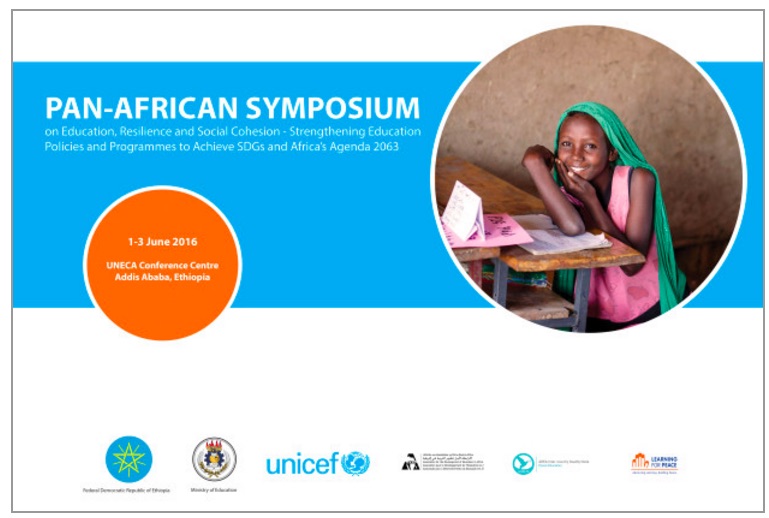
Addis Ababa: Pan-African Symposium on Education, Resilience and Social Cohesion

… EDUCATION FOR PEACE …

An article from UNICEF

Ensuring equitable access to education is key in addressing the root causes of conflict and instability in Africa, stakeholders said today [June 1] ahead of the Pan-African Symposium on Education, Resilience and Social Cohesion, at the United Nations Conference Centre in Addis Ababa.

africa
Click on image to enlarge

The three-day event shares evidence and best practices from UNICEF’s Peacebuilding, Education and Advocacy Programme (PBEA), and the Inter-Country Quality Node (ICQN) on Peace Education, established by the Association for the Development of Education in Africa (ADEA). In doing so, the Symposium will seek to assess how inclusive, equitable and innovative education policy and programmes can contribute to sustainable peace and development across the continent. Currently, three out of 10 children in Africa are living in conflict-affected settings and exposed to numerous risks.

“The capacity of education to support children develop and thrive is well documented, however we now also know that education can prevent and reduce the impacts of conflict,” said UNICEF’s Regional Director for Eastern and Southern Africa, Leila Gharagozloo-Pakkala. “If the right policies and interventions are in place, together with financial investment, education can be a driving force in achieving the Sustainable Development Goals.”

In Sub-Saharan Africa, 36 out of 45 countries are at medium or high risk of experiencing man-made disasters, the highest rate globally. Moreover, at least 327 million children in Sub-Saharan Africa live in fragile contexts and the majority of the estimated 29 million primary school aged children who are out of school are primarily found in fragile settings and are particularly at risk or threatened by conflict.

“We need to reorient Africa’s education and training systems to meet the knowledge, competencies, skills, innovation and creativity required to nurture the continent’s core values,” said Dr Martial de Paul Ikounga, African Union Commissioner for Human Resources, Science and Technology. “We will then promote sustainable development at the national, sub-regional and continental levels.”

The African Union Commission, under the Agenda 2063 “The Africa We Want”, envisions that by 2020 “all guns will be silent and a culture of peace and tolerance would be nurtured in Africa´s children and youth through peace.”

Oley Dibba-Wadda, the Executive Secretary of ADEA, sees education as “a key tool against all kinds of violence” and strongly appeals to African governments to “endorse and develop integrated, peaceful, inclusive approaches and strategies that support the implementation of a comprehensive program on non-violence, tolerance and peace, especially for the young generation.”

The high-level event in Addis Ababa, which is being attended by Ministers of Education from 16 African countries, including conflict-torn states, will close with concrete recommendations on how to strengthen education sector policy and programmes in Africa to address the risks faced by children and to support sustainable peace and development across Africa. The symposium will also provide evidence to inform both donor and public funding strategies and investment priorities.

“Education can play both a protective and preventative role. In doing this, education’s power is transformative and serves as a peace dividend, reducing inequities and grievances between groups and strengthening social cohesion” said the Ethiopian Minister of Education, Ato Shiferaw Shigute.

The symposium is co-organized by the Federal Democratic Republic of Ethiopia’s Ministry of Education, UNICEF, the Association for the Development of Education in Africa (ADEA), and the Inter-Country Quality Node (ICQN) on Peace Education.

Question for this article:

Banning Nukes: Divergence and Consensus at the UN Working Group on Nuclear Disarmament

DISARMAMENT & SECURITY .

Excerpts from an article by by Xanthe Hall for the International Physicians for the Prevention of Nuclear War

. . . So what did happen [at the May session of the Open-Ended Working Group – OWEG]? For the first time in many years a large number of states decided that they did not want consensus but confrontation on the issue of the illegitimacy of nuclear weapons. Tired with decades of patient discussions on micro-measures, principally for non-proliferation, and led by Argentina, Brazil, Costa Rica, Ecuador, Guatemala, Indonesia, Malaysia, Mexico and Zambia, states are now going for broke [Editor’s note: All of these countries are participants in nuclear-weapon-free zones].

oewg
ICAN protest in front of Australian embassy during the OEWG. Photo: ICAN [International Campaign to Abolish Nuclear Weapons]
Click on photo to enlarge

Despite the prospect that the nuclear-armed states are unlikely to attend, they have submitted a proposal to the OEWG to “convene a Conference in 2017, open to all States, international organizations and civil society, to negotiate a legally-binding instrument to prohibit nuclear weapons” (ban treaty) and “to report to the United Nations high-level international conference on nuclear disarmament to be convened no later than 2018 … on the progress made on the negotiation of such an instrument.”

On the final day of the OEWG resounding majority support for prohibition and the commencement of negotiations was repeatedly expressed. States are convinced that with this approach they can bring pressure to bear on the nuclear-armed and nuclear-dependent states to begin genuinely considering negotiating the elimination of their nuclear arsenals. . . .

The beauty of a stand-alone ban treaty is in its clarity, especially in terms of the moral imperative. It would leave no room for doubt as to the illegitimacy of nuclear weapons and would place any state that relies on nuclear weapons for their defence outside international law, if enough states were to support such a norm. Its entry into force could not be held hostage by nuclear-armed states reticence to ratify, as the CTBT has been. Given the present anger about the arrogance of the nuclear-armed states refusal to engage with the nuclear-free states which has been made explicit both through the boycott of the OEWG, but also through the ever hardening rhetoric of the nuclear umbrella states, it remains the most attractive option for states to pursue at the UN General Assembly in October. In this way, they can continue to put maximum pressure on the nuclear-armed states to take them seriously as the majority and therefore to respect their rights and security needs.

This debate has as much to do with redefining world order and democracy as it has to do with disarmament. As Mexico pointed out: there is nothing to be said against consensus when it is fair and reflects the truth. But when divergence exists and states with more power due to nuclear weapons wield a veto over the majority then there is nuclear oppression. Now the majority is rising up to liberate itself from this yoke with persuasive and well-thought out arguments for a comprehensive ban treaty. After more than twenty years of attending these often repetitive and boring diplomatic debates, I can hardly wait for the next one.

Question related to this article:

Angola protects wildlife, turns to ecotourism to diversify economy

. SUSTAINABLE DEVELOPMENT .

An article from the website of World Environment Day – United Nations Environment Programme

As the plane banks in off the Atlantic Ocean over Luanda, the capital of Angola, the chief driver of the southern African nation’s economy announces itself loud and clear. Dozens of hulking tankers and cargo ships sit low in the water off the bay, colourful containers are stacked up like Lego bricks along the long port, and workers bustle around the base of a loading crane that dominates the skyline. But all this activity belies the economic problems Angola has faced as the result of falling oil prices. . . .

With no sway over the global geopolitical and socioeconomic trends that have hit oil prices, Angola is looking to new industries such as ecotourism to drive growth and also help the global fight against climate change by gradually moving away from the domination of oil.

angola
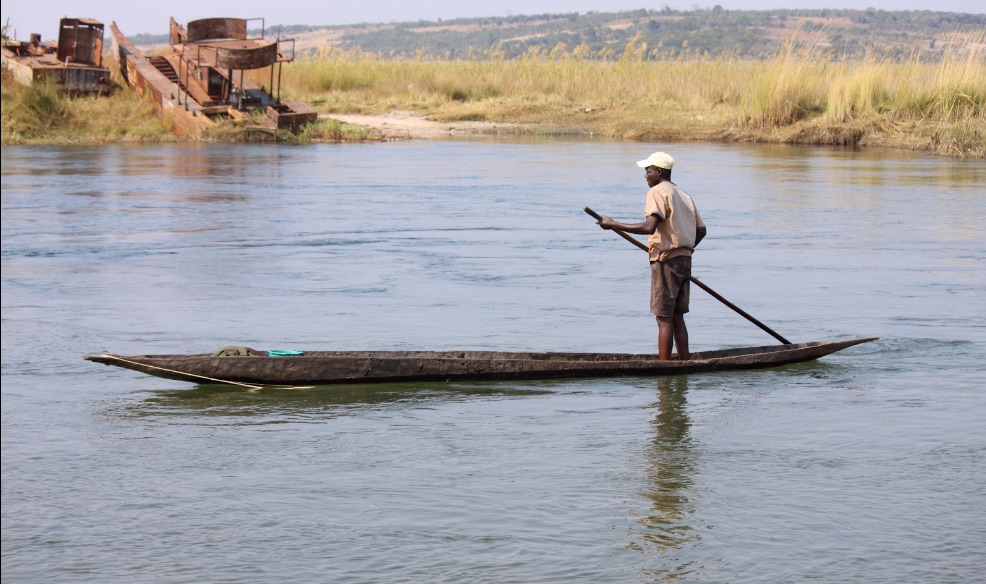
On the Cuito River
click on photo to enlarge

“We need to look at ways to diversify our economy and participate in the progress of our future generations,” said Environment Minister Maria de Fátima Jardim. “This is why our President has committed to protecting our elephants.”

The minister was speaking at the start of celebrations of World Environment Day, which Angola is hosting this year on 5 June as a sign of its commitment to combatting the illegal trade in wildlife.

Angola lost many of its elephants during a long civil war, which ran on-and-off from 1975 to 2002. It is unclear how many elephants remain, but those that do are facing pressure from poachers – both those seeking to profit from ivory and poor communities who rely on bushmeat to survive.

The nation is also a transit country for ivory, with carved goods coming over the border from the Democratic Republic of Congo for re-sale, largely to Asian nations.

The troubles facing Angola are part of a wider global problem. A new United Nations Environment Programme (UNEP)-INTERPOL report, released on 4 June, found that transnational criminal networks are profiting to the tune of up to $258 billion per year from environmental crimes, including the illegal trade in wildlife. This is a 26 per cent increase on previous estimates.

In response to its problem, Angola is introducing tougher penalties for poaching, shutting down its domestic illegal markets, and looking to provide alternative livelihoods for those at the bottom of the illegal wildlife trade chain. They are also training former combatants to become wildlife rangers.

“We have a big push to manage protected areas and create others for the benefit of our people,” said Abias Huongo, Director of Angola’s National Institute of Biodiversity. “For us to survive, other species need to survive. Together with the tourism ministry, we are exploring the potential of ecotourism to address the economic deficit with biodiversity.”

(Continued in right column)

Question related to this article:

How can tourism promote a culture of peace?

(Continued from left column)

It is also in Cuando-Cubango, a key region for biodiversity, where new lodges are opening. The Rio Cuebe lodge is one such place. A collection of cute and comfortable huts ranged along the leafy banks of a lazy river near Menongue, the lodge has been open for three years.

Regional ministers and biodiversity experts packed the lodge for a conference as part of World Environment Day celebrations, but most of the time it sits half empty. When guests come, they are usually expats working in the country.

However, UNEP Executive Director Achim Steiner believes this situation is about to begin changing.

“Angola has, over many years, relied on its fossil-fuel economy, whereas the last year has shown that kind of dependence can be a risk,” he said. “So, as Angola is managing the fall-out from the drop in oil prices it is looking at diversifying; this is where the notion of the green economy becomes relevant.

“Cuando-Cubango is a region that could provide an enormous opportunity for investment in terms of tourism: a unique area where in 20 years’ time the world will be paying thousands of dollars for an overnight stay.”

Steve Boyes, a National Geographic Society explorer, also believes a new path for Angola is opening up. Boyes and his team travelled to the source of the Cuito River – one of the two main rivers that flow into the Okavango River and feed the Okavango Delta, a 10,000-square-mile wetland that sits across the borders of Botswana, Namibia, and Angola.

As they travelled almost 1,600 miles in dug-out canoes over three months, Boyes and his colleagues saw first-hand the natural beauty Angola has to offer. The explorers have discovered three new species of plant, six new species of fish and four new species of reptile – all unique to Angola. Boyes and his partner John Hilton are working with the government to scope out ecotourism opportunities.

“We are talking about the largest undeveloped river basin on the planet,” he said. “It’s an incredible opportunity for conservation, for tourism development. To me, it’s the biggest tourism and rural development opportunity in Africa in the last few decades.

However, Boyes believes urgent action is needed to ensure wildlife is conserved. He is particularly concerned about bushmeat, having witnessed villagers move from subsistence to selling the meat in markets for profit – with the killing of animals now taking place at a larger scale.

“The scenic beauty and wildlife are all here. If we do it (conservation efforts) in five years’ time it would take thirty years to fix. If we do it now, it will take ten years to fix,” he said. “If we get 100 adventure travelers in on mountain bikes, they (villagers) will earn far more money than they get off bushmeat. There is a strong desire for a new beginning.”

The Elders welcome Paris conference as step towards two-state solution for Israel-Palestine

DISARMAMENT AND SECURITY .

An article by The Elders

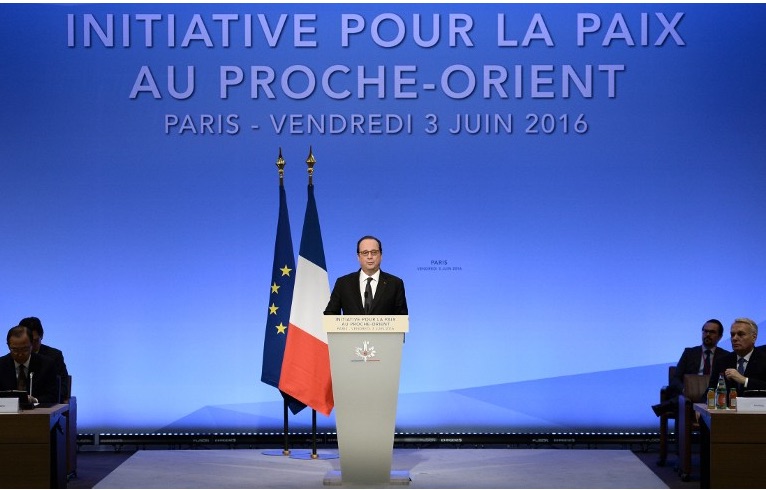
The Elders welcome the international conference being convened in Paris on 3 June by the French Government, aimed at reviving efforts to end the Israeli-Palestinian conflict.

conference
French President Hollande speaks to the Paris conference. Photo from AFP/Stephane de Sakutin, Pool.
Click on photo to enlarge

The last 18 months have seen worsening violence, a hardening of political rhetoric and a diplomatic impasse. The international community must push decisively to shift the dynamics on the ground and secure lasting peace for Israelis and Palestinians alike. A two-state solution that respects international law, addresses legitimate security concerns and upholds human rights remains the only way forward.

Kofi Annan, Chair of The Elders, said:

“This conference is an opportunity to revitalise international engagement on the Israeli-Palestinian conflict. After so many decades of conflict, people deserve to live in peace and dignity. This requires an end to occupation, and self-determination for the Palestinian people. The Elders call on all those involved to work constructively and in good faith towards this goal.”

The Elders note the conflicts raging in much of the wider Middle East and argue this makes it even more important that diplomatic efforts for a two-state solution are intensified.

Jimmy Carter, former President of the United States and Honorary Elder, said:

“The world cannot afford to forget about the Israeli-Palestinian conflict. Palestinians continue to be denied justice and human rights, and their leaders remain divided and disengaged from the search for lasting peace. This stokes resentment and support for extremism across the region. Equally, Israelis are ill-served by a government that promotes illegal settlements and flouts international law.”

(See right column for Final Communique)

Question related to this article:

Presenting the Palestinian side of the Middle East, Is it important for a culture of peace?

How can a culture of peace be established in the Middle East?

(continued from left column)

[Editor’s note: The final communique from the summit includes an urgent call for a two-state solution, as demanded by the Elders and by the the Arab Peace Initiative.]:

“The Participants met in Paris on June 3, 2016 to reaffirm their support for a just, lasting and comprehensive solution to the Israeli-Palestinian conflict.

“They reaffirmed that a negotiated two-state solution is the only way to achieve an enduring peace, with two states, Israel and Palestine, living side by side in peace and security. They are alarmed that actions on the ground, in particular continued acts of violence and ongoing settlement activity, are dangerously imperiling the prospects for a two-state solution.

“The Participants underscored that the status quo is not sustainable, and stressed the importance of both sides demonstrating, with policies and actions, a genuine commitment to the two-state solution in order to rebuild trust and create the conditions for fully ending the Israeli occupation that began in 1967 and resolving all permanent status issues through direct negotiations based on resolutions 242 (1967), 338 (1973), and also recalling relevant United Nations Security Council resolutions and highlighting the importance of the implementation of the Arab Peace Initiative.

“The Participants discussed possible ways in which the international community could help advance the prospects for peace, including by providing meaningful incentives to the parties to make peace. The Participants also highlighted the potential for regional peace and security as envisioned by the Arab Peace Initiative.

“The Participants highlighted the key role of the Quartet and key regional stakeholders. They welcomed the interested countries’ offer to contribute to this effort. They also welcomed France’s offer to coordinate it, and the prospect of convening before the end of the year an international conference.”

The film “Demain”, a manifesto?

. . SUSTAINABLE DEVELOPMENT . .

An article by Bruno Maresca in the Huffington Post (translated by CPNN)

Driven by popular acclaim – more than 700,000 cinema viewers in three months against 265,000 for The Titanic Syndrome Nicolas Hulot! – the film “Demain” [i.e. Tomorrow] , by Cyril Dion and Mélanie Laurent, released at the time of COP21, received the trophy for best documentary in the 2016 Caesars.

demain

This unusual success seems to be explained by two factors. First, they feature local initiatives around the world that show that it is possible, at different levels, to engage in the fight against climate change. Second, they show that these initiatives can be done now (food, energy, local economic processes, education and direct democracy) and, as such, they inspire action by showing what is already working. The film succeeds in showing that French society wants to escape from the present atmosphere of doom and gloom.

This willingness to explore initiatives that invent alternatives to the global system of production and consumerism is in the air. It is the subject of the journalist Eric Dupin in his innovative book, “The pioneers: a voyage in France” (La Découverte, 2014). His book explores the diversity and richness of initiatives and people who “explore, in a pragmatic way, other lifestyles, such as new ways of working.” It includes those who invest in shared housing, organic farming or alternative schools, those who share a great desire to escape , with varying degrees of radicalism, from the globalization of production and consumption.

At the end of his account, Eric Dupin is ultimately pessimistic. He stresses that the diversity of initiatives does not by itself produce a coherent movement that can converge to a coordinated action and thereby produce change. Is it not the case that his “pioneers”, like those of “Demain”, privilege above all a ‘culture of exemplary individuals”? “Each person doing something at his level” seems to be their credo, which is far from the search for a collective change, which would mean developing political institutions. For this reason, the pioneers – and they are many – do not seem themselves to be a social movement.

“Demain”, meanwhile, wants to convince us that we can change the world by spreading many examples of experiences, both small and large. But can they escape from pessimism? Can their experiences outweigh the destructive and reactionary forces of the world economic and political system? Two impressive sequences illustrate the problem, one at the beginning and one at the end of the film: the apocalyptic vision of the city of Detroit, abandoned since the collapse of the auto industry, and the financial crisis in Iceland, which got to the point that the civil society overthrew the country’s political class. After viewing the film by Cyril Dion and Mélanie Laurent and reading the book of Eric Dupin, we are confronted by the question: can we arrive at a new future by change from below, by the proliferation of individual initiatives? And finally, how should we explain the great attraction of “Demain”?

(Article continued on the right column)

(Click here for a version of this article in French)

Question for this article:

What is the relation between movements for food sovereignty and the global movement for a culture of peace?

(Article continued from the left column)

On the release of his book, the journal Libération called Eric Dupin a “pilgrim of utopia”.

On the websirte of Mediapart, Jean-Louis Legalery notes that after seeing the film “Demain”, viewers gave it a standing ovation, reminding him of the reaction to the film Z by Costa Gavras in 1979. The films that aroused spectators in the 1970s were eminently political; they called for collective mobilization to radically transform institutions. With hindsight, one can say they were driven by a high load of utopia (utopia that crashed against hard reality, as in the situation of Greece today).

Question: What are the consequences of the state subsidies paid to large farms?

Perhaps what works in “Demain” is this utopian vision that gives everyone the impression he can take part in something that is already going on. Instead of staying each in his virtuous corner, inscribed in the register of eco-gestures, one is invited to engage in something new, something that breaks with the dominant system, such as “urban farms” or “local currencies” and other initiatives shown in “Demain.” If these inventions are sufficiently taken up around the world, they could subvert the global economic system.

However, we are not seeing such a significant change in scenery. Farms with over 1,000 cows are now appearing in France, as in Denmark and Poland. And even if many people are changing their practices by sharing, recycling, carpooling, etc., it is difficult to disentangle this from a change in lifestyle necessitated by the stress of the economic crisis. A widespread changeover seems still far away. In the variety of examples shown in “Demain”, Africa and Asia are not very present.

But the real challenge of the transformation of production and consumption is in Asia, which, in 2030, will contain over 66% of the global middle class (against 28% in 2009, according to the OECD ). This emerging middle class, in strong numerical growth, is adopting the consumption patterns of the Western middle class, industrial power, private cars, expansion of suburban areas for access to the house, mass tourism, etc. Like a huge pendulum, the Western middle classes, being squeezed out by rising unemployment and inequality, adhere increasingly to the “small is beautiful” approach to local agriculture, solidarity businesses, alternative transport, renewable energy, etc.

What is unquestionably positive in “Demain” is that the Western middle classes want to reclaim the management of their daily lives, in their own life space, through collective initiatives of goodwill and kindness. They are engaged in a movement of self-awareness of their real interests, their need to live and consume differently.

This “self-consciousness” is what the middle classes had lost at the turn of the 1980s. When social struggles were diluted by access to welfare and mass consumption the middle class was reduced to being just a cog in the functioning of the global economy.

So let us dream, like many of its fans, that “Demain” is the flight of the swallow that heralds a new phase in the history of the middle class. Given the collective optimism that this film has inspired, it is possible to dream . . .

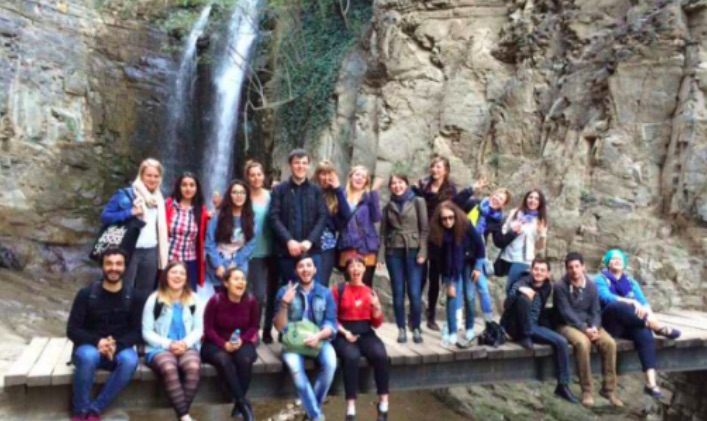
Georgia: Training Report: “Education for Peace – Developing Competences for Peace Education in the Youth Field”

TOLERANCE AND SOLIDARITY .

A report from the Global Campaign for Peace Education

The European Intercultural Forum e. V. just finalised the narrative report of their 1st training course in the frame of the Training Programme “Education for Peace – Developing Competences for Peace Education in the Youth Field” (Misaktsieli, Georgia – April 10-18, 2016)

Georgia
Click on photo to enlarge

You can find the report here and can find more information about the project on the project webpage.

Project Background

To aid communities and individuals affected by these conflicts, peace education – defined as a holistic, multidisciplinary and transformative process to develop competences in nonviolent conflict transformation, respect for human rights and active participation – is one approach of peace-building measures that aims at strengthening nonviolence and participatory means of conflict transformation to ensure human rights protection, nonviolence and participation as fundamental principles of societal life allowing young people to not only grow up in a peaceful environment without their personal development potentials being jeopardise, but also to contribute conflicts to be addressed nonviolently without making use of direct, structural and cultural violence.

Against this background, the project proposal aims to strengthen the competences of youth workers and youth educators in peace education for young people in order to empower young people to become pro-active agents of peaceful change via local community initiatives addressing societal conflicts.

Therefore, the youth workers and youth educators will participate in two e-learning modules and two training courses in Georgia on conflict transformation, peace education and training delivery. As a result the participants shall be enabled to design, implement and evaluate their own training courses and workshops on peace education for young people in their communities.

According to the Call for Participants, the project is funded by the European Union and the participating organizations are:

European Intercultural Forum e. V. (Germany)

Helsinki Citizens’ Assembly- Vanadzor (Armenia)

Academy for Peace and Development (Georgia)

Bridge to the Future (Azerbaijan)

Vinnytsia Regional Center for Information KREATIV (Ukraine)

The ASHA Foundation (United Kingdom)

Humana People to People (Latvia)

United Network of Young Peacebuilders (Netherlands)

Question for this article

A Tiny Reef in the Philippines Offered Early Proof That Marine Parks Also Help Fishers

. . SUSTAINABLE DEVELOPMENT . .

An article from Oceana, an organization that works internationally to better manage fish stocks to save the oceans and feed the world

Protected areas on coral reefs are often established in spots that already have lots of fish and high diversity, making it tough for scientists to tell how effective no-take zones really are at boosting the populations of commercially important species. But around Sumilon Island, a speck of land in the Central Philippines that hosted the country’s first ocean sanctuary, a history of on-again, off-again protection offers some of the most clear-cut proof that fishing bans work — and that they actually help fishers too.

philippines
Click on photo to enlarge

In the 1970s, Sumilon reef “was among the best in the world,” said marine biologist Angel Alcala. Alcala, along with Garry Russ of James Cook University, was the author of a landmark study tracking commercially important fish in Sumilon for 17 years.

From 1974 to 1983, a quarter of the island’s reefs were closed to fishing. Valuable species — including large predators like snapper, emperor fish, grouper and jacks — thrived alongside whale sharks and forests of coral.

After nearly a decade of protection, the reserve was opened to fishing from 1983 to 1985. In addition to the more conventional fishing gear like gillnets and traps, fishermen used dynamite to stun fish or dropped stone blocks on corals to flush out hidden animals, a practice called “muro-ami” that reduced swaths of the reef to rubble.

The fishing ban was reinstated in 1987 and lifted again in 1992. In 1995, the reserve was permanently closed to all fishers except locals using hook-and-line.

Alcala and Russ noted that the loss of large predatory fish was immediate and rapid as soon as fishing efforts picked up after a ban was lifted. But during protected periods, losses in fish populations were matched by gains, some of them dramatic.

(Article continued in the right side of the page)

Question for this article:

If we can connect up the planet through Internet, can’t we agree to preserve the planet?

(Article continued from the left side of the page)

The density, or the number of fish in a given area, of the sixblotch hind (Cephalopholis sexmaculata), a brilliantly colored member of the grouper family, increased by 200 percent from 1990 to 1991 and by 300 percent from 1994 to 1995. By 2000, the number of blackspot snapper (Lutjanus ehrenbergii) was 820 percent greater than the annual average between 1983 and 1997.

Biomass — which measures the weight of all individuals of one species — recovered more slowly. This is because it takes several years for large predatory fish, which tend to be slow-growing and long-lived, to grow to their full adult size; these fish did not regain their average adult pre-1983 size until 1999.

In 2000, after six years of continuous protection, fish biomass and population increases showed no signs of leveling off. From its low point in 1985, biomass had gone up by nearly 30 percent.

Outside of the reserve, fishermen’s haul increased by almost 30 percent — demonstrating that the “spillover” effect of a marine reserve more than compensated for the fact that fishers were working in a smaller area than before the permanent protections went into effect.

This finding, since replicated on nearby Apo Island, showed that permanent closures of even small areas of a reef could offer big benefits to small-scale fishers.

The island — which now hosts a resort in addition to the reserve — supports a vibrant community of fish and corals. It’s important to note, though, that the reefs aren’t as diverse as they once were due to poorly regulated fishing and tourism in the past. Compared to the 1970s, Alcala explained, “many marine species, especially some unique species of corals, have disappeared.”

Despite that, the legacy of Sumilon’s marine protected area has far outstripped its borders. Other marine sanctuaries in the Philippines, including the renowned Apo Island and Tubbataha Reefs Natural Park, a UNESCO World Heritage Site, have followed suit with no-take zones that sustain local fishing communities and healthy tourist industries.

(Thank you to Janet Hudgins, the CPNN reporter for this article)

Book review: A Student’s Guide to Starting a Career Working for Peace

… EDUCATION FOR PEACE …

A publication notice from Information Age Publishing

Author: David J. Smith, George Mason University

A volume in the series: Peace Education. Editor(s): Laura Finley, Barry University. Robin Cooper, Nova Southeastern University, published 2016

This book is a guide for college students exploring career options who are interested in working to promote peacebuilding and the resolution of conflict. High school students, particularly those starting to consider college and careers, can also benefited from this book.

peace jobs

A major feature of the book is 30 stories from young professionals, most recently graduated from college, who are working in the field. These profiles provide readers with insight as to strategies they might use to advance their peacebuilding careers.

The book speaks directly to the Millennial generation, recognizing that launching a career is a major focus, and that careers in the peace field have not always been easy to identify. As such, the book takes the approach that most any career can be a peacebuilding career provided one is willing to apply creativity and passion to their work.

CONTENTS
Peace Education Series Introduction, Laura Finley and Robin Cooper Preface. Acknowledgments. CHAPTER 1. What is a Peace Job? CHAPTER 2. Preparing for and Finding a Peace Job. CHAPTER 3. Peacebuilding Careers in Diplomacy. CHAPTER 4. Enforcing Peace and Justice Through Human Rights and Law. CHAPTER 5. Working in Conflict: NGO, IGO, Humanitarian, and Military Careers. CHAPTER 6. Teaching About Peace and Conflict. CHAPTER 7. Activism: Social Justice and Environmental Action. CHAPTER 8. A Healing Approach: Health, Community, and Faith-Based Strategies. CHAPTER 9. Creating Peace: The Arts, Science, Technology, and Media. CHAPTER 10. Pursuing Peacebuilding Education. APPENDIX A: 86 Peace Jobs for College Grads. APPENDIX B: Peace Jobs Glossary. APPENDIX C: Peace Jobs Career Resources. APPENDIX D: Additional Readings. About the Author.

(Thank you to Alicia Cabezudo for calling this to our attentionI)

Question for this article:

English bulletin June 1, 2016

. REFORMING THE UNITED NATIONS .

Since its creation over 70 years ago, the United Nations has been the hope of mankind “to save succeeding generations from the scourge of war.” But more and more, we are losing hope that in its present form it can succeed. This was especially evident in recent weeks when the great powers did not bother to send high-level delegations to the UN’s Humanitarian Summit despite the fact that 60 other countries sent their heads of state. While Germany was represented by its Chancellor Angela Merkel, the other great powers were essentially absent: Canada, France, Italy, Japan, the United Kingdom, the United States, Russia and China.

Therefore, it is not surprising that there is a rising chorus of demands for reform of the United Nations.

The most dramatic and far-reaching demand comes from Africa. This month the Pan-African Parliament, with representives from the 54 countries of Africa, has called upon the African Union to support its demand for a new UN body, a United Nations Parliamentary Assembly. The Parliament’s President explained that “It is long overdue that ‘We, the Peoples,’ as the UN Charter begins, have more say in global affairs. For this purpose, a UNPA needs to be established.” This could become a powerful voice for peace. Instead of reflecting the policies of Member States with their military budgets and military policies, the proposed Assembly would be composed of representatives of bodies directly elected by the people and without direct responsibility for military institutions.

Another call for extensive reform comes from a group including former UNESCO Director-general Federico Mayor. Their joint declaration calls for a “new UN System” with a General Assembly of 50% of States representatives and 50% of representatives of civil society, and adding to the present Security Council and Environmental Council and a Socio-Economic Council. In all cases, no veto but weighted vote.

Many calls for reform consider that the present Security Council, with veto powers by the five Permanent members, the victors of World War II, is outmoded and ineffective in dealing with today’s global problems.

There are ongoing meetings of the Intergovernmental Negotiations on Security Council Reform, but they are complicated by rivalries among the Member States. At the most recent meeting at the beginning of May, India called for additional Permament members, including themselves, Brazil, Japan and Germany, thus including the losers as well as the winners of World War II. But immediately there were objections from India’s rival Pakistan and from Japan’s rival North Korea, as well as from another group of 13 countries led by Italy. Another proposal was put forward by Ireland for a new category of Security Council members with an 8 year term. They proposed 6 seats in this category, with 2 each from the African and Asia-Pacific group, and 1 each from WEOG (Western Europe and Others Group) and GRULAC (Group of Latin American and Caribbean Countries).

At the recent Humanitarian Summit, the Arab League, which consists of 22 member states, including Algeria, Egypt, Iraq, Jordan, Qatar and Saudi Arabia, called for limitation on the veto power of the Permanent Security Council Members, echoing a similar demand by Turkish President Erdogan. This, too, was complicated by inter-state rivalries as their remarks were directed only against the use of the veto by Russia with regard to the war in Syria.

The Elders, the group of former heads of state and international agencies that was formed several years ago around Nelson Mandela, has made a series of recommendations regarding reform of the Security Council. They call for a new category of Council members with longer terms to counter-balance the five Permanent members, a pledge to restrict the use of their veto and more involvement of the civil society,

Another proposal of the Elders is for a more independent UN Secretary-General. This proposal is echoed in conclusions of the recent United Nations High Level Thematic Debate on Peace and Security, and it is already being implemented to some extent in new procedures to choose the next Secretary-General.

But the question remains: are these proposals radical enough to enable the UN “to save succeeding generations from the scourge of war?” In the view of the CPNN coordinator, we need a more radical approach; see his blog.


DISARMAMENT AND SECURITY

unsc

Intergovernmental Negotiations on Security Council Reform

WOMEN’S EQUALITY


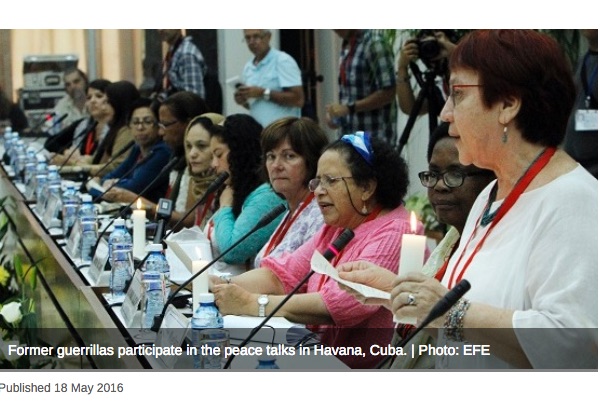
Peace in Colombia Is Impossible Without Us, Women Declare

EDUCATION FOR PEACE


Paris: A standing orchestra !!!

HUMAN RIGHTS


Red carpet film festival asserts Gaza’s pride and talent

TOLERANCE AND SOLIDARITY


Mali: The struggle against terrorism: Towards the creation of a global network of Ulemas

SUSTAINABLE DEVELOPMENT


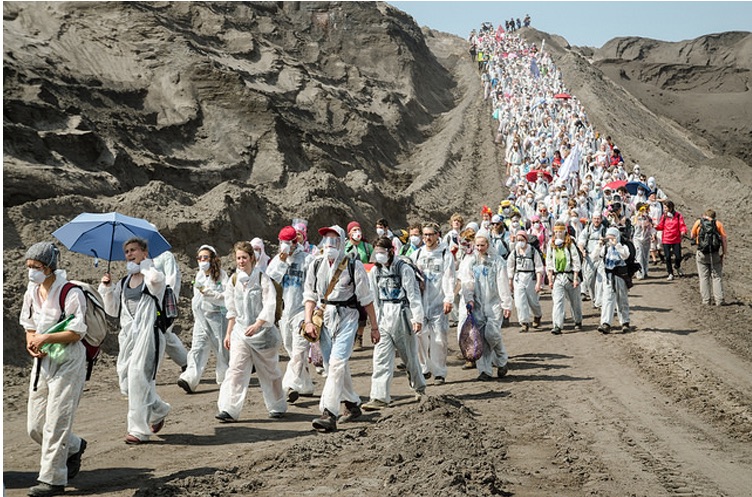
Tens of Thousands Take Part in Global Actions Targeting World’s Most Dangerous Fossil Fuel Projects

FREE FLOW OF INFORMATION


Colombia celebrates agreement to legally bind the peace accord

DEMOCRATIC PARTICIPATION


For the first time, a Peace Plan for Cali, Colombia

USA: Over Seventy Prominent Scholars and Activists Urge Obama to meet Hibakusha, Take Further Steps on Nuclear Disarmament

DISARMAMENT & SECURITY .

A letter published by Peace Action

To President Barack Obama, May 23, 2016

Dear Mr. President,

We were happy to learn of your plans to be the first sitting president of the United States to visit Hiroshima this week, after the G-7 economic summit in Japan. Many of us have been to Hiroshima and Nagasaki and found it a profound, life-changing experience, as did Secretary of State John Kerry on his recent visit.
letter
Click on photo to enlarge

In particular, meeting and hearing the personal stories of A-bomb survivors, Hibakusha, has made a unique impact on our work for global peace and disarmament. Learning of the suffering of the Hibakusha, but also their wisdom, their awe-inspiring sense of humanity, and steadfast advocacy of nuclear abolition so the horror they experienced can never happen again to other human beings, is a precious gift that cannot help but strengthen anyone’s resolve to dispose of the nuclear menace.

Your 2009 Prague speech calling for a world free of nuclear weapons inspired hope around the world, and the New START pact with Russia, historic nuclear agreement with Iran and securing and reducing stocks of nuclear weapons-grade material globally have been significant achievements.

Yet, with more than 15,000 nuclear weapons (93% held by the U.S. and Russia) still threatening all the peoples of the planet, much more needs to be done. We believe you can still offer crucial leadership in your remaining time in office to move more boldly toward a world without nuclear weapons.

In this light, we strongly urge you to honor your promise in Prague to work for a nuclear weapons-free world by:

Meeting with all Hibakusha who are able to attend;

Announcing the end of U.S. plans to spend $1 trillion for the new generation of nuclear weapons and their delivery systems;

Reinvigorating nuclear disarmament negotiations to go beyond New START by announcing the unilateral reduction of the deployed U.S. arsenal to 1,000 nuclear weapons or fewer;

Calling on Russia to join with the United States in convening the “good faith negotiations” required by the Nuclear Non-Proliferation Treaty for the complete elimination of the world’s nuclear arsenals;

Reconsidering your refusal to apologize or discuss the history surrounding the A-bombings, which even President Eisenhower, Generals MacArthur, King, Arnold, and LeMay and Admirals Leahy and Nimitz stated were not necessary to end the war.

Sincerely,

Gar Alperowitz, Professor of Political Economy, University of Maryland

Christian Appy, Professor of History at the University of Massachusetts,

Amherst, author of American Reckoning: The Vietnam War and Our National Identity

Colin Archer, Secretary-General, International Peace Bureau

Charles K. Armstrong, Professor of History, Columbia University

Medea Benjamin, Co-founder, CODE PINK, Women for Peace and Global Exchange

Phyllis Bennis, Fellow of the Institute for Policy Studies

Herbert Bix, Professor of History, State University of New York, Binghamton

Norman Birnbaum, University Professor Emeritus, Georgetown University Law Center

Reiner Braun, Co-President, International Peace Bureau

Philip Brenner, Professor of International Relations and Director of the Graduate Program in US Foreign Policy and National Security, American University

Jacqueline Cabasso, Executive Director, Western States Legal Foundation; National Co-convener, United for Peace and Justice

James Carroll, Author of An American Requiem

Noam Chomsky, Professor (emeritus), Massachusetts Institute of Technology

David Cortright, Director of Policy Studies, Kroc Institute for International Peace Studies, University of Notre Dame and former Executive Director, SANE

Frank Costigliola, Board of Trustees Distinguished Professor, niversity of Connecticut

Bruce Cumings, Professor of History, University of Chicago

Alexis Dudden, Professor of History, University of Connecticut

Carolyn Eisenberg, Professor of U.S. Diplomatic History, Hofstra University

Daniel Ellsberg, Former State and Defense Department official

John Feffer, Director, Foreign Policy In Focus, Institute for Policy Studies

Gordon Fellman, Professor of Sociology and Peace Studies, Brandeis University.
Bill Fletcher, Jr., Talk Show Host, Writer & Activist.

Norma Field, professor emerita, University of Chicago

Carolyn Forché, University Professor, Georgetown University

Max Paul Friedman, Professor of History, American University.

Bruce Gagnon, Coordinator Global Network Against Weapons and Nuclear Power in Space.

(letter continued in right column)

Question related to this article:

Can we abolish all nuclear weapons?

(letter continued from left column)

Lloyd Gardner, Professor of History Emeritus, Rutgers University, author Architects of Illusion and The Road to Baghdad.

Irene Gendzier Prof. Emeritus, Department of of History, Boston University

Joseph Gerson, Director, American Friends Service Committee Peace & Economic Security Program, author of With Hiroshima Eyes and Empire and the Bomb

Todd Gitlin, Professor of Sociology, Columbia University

Andrew Gordon. Professor of History, Harvard University
John Hallam, Human Survival Project, People for Nuclear Disarmament, Australia

Melvin Hardy, Heiwa Peace Committee, Washington, DC

Laura Hein, Professor of History, Northwestern University

Martin Hellman, Member, US National Academies of Sciences, Engineering, and Medicine Professor Emeritus of Electrical Engineering, Stanford University

Kate Hudson, General Secretary, Campaign for Nuclear Disarmament (UK)

Paul Joseph, Professor of Sociology, Tufts University

Louis Kampf, Professor of Humanities Emeritus MIT

Michael Kazin, Professor of History, Georgetown University

Asaf Kfoury, Professor of Mathematics and Computer Science, Boston University

Peter King, Honorary Associate, Government & International Relations School of Social and Political Sciences, The University of Sydney, NSW

David Krieger, President Nuclear Age Peace Foundation

Peter Kuznick, Professor of History and Director of the Nuclear Studies Institute at American University, is author of Beyond the Laboratory

John W. Lamperti, Professor of Mathematics Emeritus, Dartmouth College

Steven Leeper, Co-founder PEACE Institute, Former Chairman, Hiroshima Peace Culture Foundation

Robert Jay Lifton, MD, Lecturer in Psychiatry Columbia University, Distinguished Professor Emeritus, The City University of New York

Elaine Tyler May, Regents Professor, University of Minnesota, Author of Homeward Bound: American Families in the Cold War Era

Kevin Martin, President, Peace Action and Peace Action Education Fund

Ray McGovern, Veterans For Peace, Former Head of CIA Soviet Desk and Presidential Daily Briefer

David McReynolds, Former Chair, War Resister International

Zia Mian, Professor, Program on Science and Global Security, Princeton University

Tetsuo Najita, Professor of Japanese History, Emeritus, University of Chicago, former president of Association of Asian Studies

Sophie Quinn-Judge, Retired Professor, Center for Vietnamese Philosophy, Culture and Society, Temple University

Steve Rabson, Professor Emeritus of East Asian Studies, Brown University, Veteran, United States Army

Betty Reardon, Founding Director Emeritus of the International Institute on Peace Education, Teachers College, Columbia University

Terry Rockefeller, Founding Member, September 11 Families for Peaceful Tomorrows,

David Rothauser Filmmaker, Memory Productions, producer of “Hibakusha, Our Life to Live” and “Article 9 Comes to America

James C. Scott, Professor of Political Science and Anthropology, Yale University, ex-President of the Association of Asian Studies

Peter Dale Scott, Professor of English Emeritus, University of California, Berkleley and author of American War Machine

Mark Selden, Senior Research Associate Cornell University, editor, Asia-Pacific Journal, coauthor, The Atomic Bomb: Voices From Hiroshima and Nagasaki

Martin Sherwin, Professor of History, George Mason University, Pulitzer Prize for American Prometheus

John Steinbach, Hiroshima Nagasaki Committee

Oliver Stone, Academy Award-winning writer and director

David Swanson, director of World Beyond War

Max Tegmark, Professor of Physics, Massachusetts Institute of Technology; Founder, Future of Life Institute

Ellen Thomas, Proposition One Campaign Executive Director, Co-Chair, Women’s International League for Peace and Freedom (US) Disarm/End Wars Issue Committee

Michael True, Emeritus Professor, Assumption College, is co-founder of the Center for Nonviolent Solutions

David Vine, Professor, Department of Sociology, American University

Alyn Ware, Global Coordinator, Parliamentarians for Nuclear Non-proliferation and Disarmament 2009 Laureate, Right Livelihood Award

Dave Webb, Chair, Campaign for Nuclear Disarmament (UK)

Jon Weiner, Professor Emeritus of History, University of California Irvine

Lawrence Wittner, Professor of History emeritus, SUNY/Albany

Col. Ann Wright, US Army Reserved (Ret.) & former US diplomat

Marilyn Young, Professor of History, New York University

Stephen Zunes, Professor of Politics & Coordinator of Middle Eastern Studies, University of San Francisco