Mexico: Colima will host the Meeting of Youth Peace Leaders

TOLERANCE AND SOLIDARITY .

An article from El Pulso de Colima (translated by CPNN)

Youth Leaders for Peace will meet on May 9 in the Administrative Complex of Government of the State. A total of four forums will be set up to discuss the culture of peace and education for peace, according to Gamaliel Haro Osorio, state secretary of Youth.

The Youth Secretary invites all young people to attend this event that will feature international celebrities, along with the state government led by José Ignacio Peralta Sánchez, who has always been an ally for youth.

The celebrities include Mrs. Dolly Hirsh, survivor of the Holocaust; Rubén Pacheco Inclán, president of the Inter-American Bar of Lawyers; Francisco J. Guerra González, national coordinator of the World Embassy of Activists for Peace (EMAP); Max Trejo Cervantes, secretary general of the Ibero-American Youth Organization and Jorge Montemayor Paz, director of the EMAP National Orchestra.

Haro Osorio stated that the event will be totally free and will start at 08:30 in the morning, For further information contact 01 312 3145099 with staff of the Youth Secretariat and EMAP.

The official spokesman of the World Embassy for Peace Activists, Mario Moreno Contreras, said that more than 3,000 young people are expected to attend the project that is being presented for the first time in Colima. It encourages young people to develop not only as professionals, but in all the fields in which human being interact. “It’s about giving them the necessary tools to be good young people in a space that is open for ideas.”

Through a press release, the Secretaría de la Juventud mentions that Erika Arely Moreno Hernández, a youth leader from the center area, was present at the press conference to announce this event. She highlighted that through different projects they want to create and promote a Culture of peace among young people.

(Click here for the original Spanish version)

Question for this article

Grenoble, France : Ecole de la Paix

. . DEMOCRATIC PARTICIPATION . .

A talk by Matthieu Damian, Director of Ecole de la Paix at the Madrid forum on urban violence and education for peace, April 2017

In Grenoble, a few years ago we started an projet in education for peace to guide young people from Grenoble to become commited and responsible citizens. Because I only have 5 minutes to talk, i’ll go straight to the 6 mains points of the project.

First of all, we make a diagnosis of the territory concerned. We intervene in complicated suburbs facing unemployement, urban violence, etc. We go to schools, middle schools and secondary schools (different schools for children from 3 to 15 years old) and educational centres asking them to tell us their needs. We don’t impose ready-made solutions, we first figure out their needs.

As an association, we are committed to work in a long term perspective in those different suburbs, realizing that nothing can be gained without long term action.

Thirdly, we offer a number of educational tools from the Ecole de la Paix (School of Peace) based on what we call “mental pictures. ”

The comic strips drawns by Pixar called “Vice Versa”, speak of 5 main emotions : Fear, Anger, Joy, Sadness and Disgust. We can see that characters have, for each of these emotions, a lot of associated memories, either positive or negatives, which are mental pictures.

In l’Ecole de la Paix, (School of Peace), we provide a number of mental pictures in favour of « Living together ».

What do we mean by mental images ? It can be a story or an attitude or actions in favour of peace or in favour of violence. Our logic at the School of Peace is to provide a certain number of teaching tools to children. Thanks to them, once they have to make a decision, they will search in their memories and choose mental pictures they’re filled with to make a good decision.

(article continued in right column)

(Click here for the French version of this article)

Question related to this article:


How can culture of peace be developed at the municipal level?

(article continued from left column)

On the other hand, we know that if the child has negative mental pictures, he’ll make bad decisions. That’s why it is important to regularly repeat positive mental picture, and to adopt them. Because if you see people talking about positive mental pictures but aren’t adopting them, there is evidently a problem.

The forth aspect is an African proverb:  « It takes a whole community to raise a child ».

The Ecole de la Paix (School of Peace) cannot succeed alone, we’re not wizards. We involve judges, policemen, firemen, etc. in order to restore a dialogue between public authority and young people in those places where authority is less and less respected, whether it’s for a good or a bad reason. For example, when the police officer first comes into the room, the pupils have a negative corporal attitude, with their bodies leaning backwards. By the end of the meeting, their bodies are much more leaning forwards. They are listening much more and some are raising their hands.

Obviously, this cannot change everything but it helps them to play the role of civil society.

Fifthly, we intervene not only in schools but also in educational centres, on Wednesdays afternoon, to fortify messages we’ve sent out in schools. Pedagogy requires repetition.

Finally, we try to include parents in our action. To that end, we invite them to our actions at a theatre forum where their children do role-playing in which they react as citizens or not. We realize via the theatre forum that it is often the child who creates difficulties who has himself the solution of his bad behavior and is able to reestablish the « Living together ». It’s really a great thing to be able to say to a child « you’re creating difficluties but you also have to solution to solve it so show it us how». Very often, they take on this role with a lot of pleasure.

Kenya’s pastoralists look beyond patriarchy to property rights for women

. . WOMEN’S EQUALITY . .

An article by Wesley Langat for Thomson Reuters (reprinted by permission)

Norah Chepkulul, a single mother of two young sons, stands outside her home, a grass thatched hut surrounded by cactus-like euphoria trees on the dusty Maasai Mara road in Kenya’s Rift Valley. She has just finished milking her four cows and has asked the boys to keep an eye on the goats corralled in the little compound.

A few years ago, a single mother taking sole responsibility for her family would have been a rare sight among the pastoral Kipsigis and Maasai communities. Traditionally, the predominantly herder societies are patriarchal and men are the decision-makers and managers of land and stock. But over-grazing and the sub-division and privatisation of land and its transfer to agricultural use has forced herder communities to accept and adopt new land strategies, including applying for security of tenure and women in land transfer and inheritance.

“Getting married these days is no longer a priority,” Chepkulul told the Thomson Reuters Foundation. “I am not married and being a single mother is not easy. I stay at home with my four children as a mother – and as a father, too.”

Deeply-rooted obstacles in society, along with the big gap between new laws against gender discrimination and local custom and tradition however continue to be a problem for women.

Chepkulul, is one of the lucky ones. Her family acknowledged her daily battle to feed, house and educate her children and gave her a plot of land to work, flying in the face of cultural traditions.

“My family members saw the economic challenges I faced in bringing up my children, felt pity, and gave me a small portion of land to farm and put my house on,” she said.

“Sometimes when there is a financial challenge at home, for example hospital bills for the parents, you’re told to sell that cow and any other assets.

“For my brothers that is considered the last option – there is no equality at all. I wish they could realise that my children are the same as theirs.”

Local priest, Mathew Sigilai, believes that the combination of economic pressure and new gender equality laws in Kenya is slowly eroding deep-seated cultural beliefs.

“Things have changed and the population has grown and nowadays, getting married is not guaranteed,” he said.

(article continued in right column)

Question related to this article:

Can the women of Africa lead the continent to peace?

(article continued from left column)

CHANGING ATTITUDES

“As a parent, if my daughter is not married, I will not chase her away. Instead I give her a farm or a cow to earn a living and start off her life like a son.”

Chepkulul’s neighbour, 56-year-old Juliana, recalls her youth, a time when things were even tougher for unmarried women.

“When you were not married, it was difficult to find accommodation or a home. You would not be allowed to stay with your parents. Sometimes a neighbour sympathised with you and offered you an old house,” she said.

“But later, when they wanted it back, you had to leave and find another place … that was life for unmarried women, they were considered outsiders.”

A 2014 World Bank report, Gender at Work, showed that legal discrimination against women on inheritance and property rights remains common in many areas of the world, including the Middle East, North Africa, parts of South Asia, and sub-Saharan Africa.

However, between 1960 and 2010, the report said, Kenya had slashed the number of discriminatory laws against women’s property ownership and rights by more than half.

Purity Wawerua, a retired Kenya Wildlife officer who belongs to a different tribe agreed there had been important progress in women’s inheritance rights among the Maasai.

Land used to be a major source of disputes, particularly after long marriages ended in divorce, she said.

“When (the woman) goes back to her parents’ home, it becomes a problem,” she said. “Thanks to the new Kenyan constitution, equal rights are given to both genders.”

However, according to Mitchelle Oyuga, of the Federation of Women Lawyers in Kenya (FIDA-Kenya), there is still room for improvement.

“People have become quite aware that children are equal and it’s a provision in the new constitution,” she said.

“You are allowed to farm, to do any kind of work on that farm, but when it comes to selling the farm, women are given secondary rights,” she said.

At her home in the Rift Valley, Chepkulul agrees and says that speaking up for themselves remains the most difficult hurdle for many women.

“When you despair you feel like speaking out but no one can understand what you’re going through,” she said.

“Sometimes I have been thinking … that if God had really created human beings equally, there would be no discrimination on gender and all people would have been the same.”

(Thank you to Janet Hudgins, the CPNN reporter for this article)

The Mindanao-Sulu Peace and History Education Project (Philippines)

FREE FLOW OF INFORMATION

An article by Gail Ilagan for Minda News

Republic Act No. 10908 was signed into law on 21 July 2016, mandating the integration of Filipino-Muslim and Indigenous Peoples history, culture and identity in the study of Philippine History in both Basic and Higher Education. The law recognizes the ultimate objective of creating an inclusive history that accounts for all Filipinos, thus the need to integrate the history, culture and identity studies of Filipino-Muslims and Indigenous People in the grand narrative of Philippine history.


(Click on photo to enlarge)

Earlier in March 2016, the Transitional Justice and Reconciliation Commission (TJRC) released its main report and recommended among others to “integrate in the curricula at all educational levels… subjects on Bangsamoro history, indigenous peoples’ history, and corresponding lessons in art, literature, and language by promoting intercultural exchange and cultural diversity.”

There is however a dearth of resources on Bangsamoro and Lumad history, art, literature, and language. Many Philippine History textbooks for Basic Education are largely silent, misrepresentative, confused, or vague on these topics. Teachers have been known to decry that they don’t know what to teach about Mindanao and its peoples and that they haven’t been given authoritative sources on Mindanao history. There is a need, therefore, to generate educational materials that Basic Education teachers of Philippine History can use in the implementation of RA 10908.

The Mindanao-Sulu History and Peace Education Project seeks to respond to this need. Funded by the World Bank and implemented through the Catholic Education Association of the Philippines (CEAP), the project was conceived by Fr. Albert E. Alejo, SJ, one of the staunchest advocates for the Writing Mindanao, Righting Mindanao campaign.

(Article continued in right column)

Question for this article:

Can peace be achieved in Mindanao?

(Article continued from left column)
 
For this project, however, writing about Mindanao was not about turning out lengthy expositions, such as were attempted in the past. The Timeline project sought instead to introduce Mindanao through bite-size pieces intended to raise initial interest. It used no more than 50-word blurbs crafted by professional writers to introduce political, economic, cultural, and ecological events identified by reputable academics such as Patricio Abinales, Macario Tiu, and Karl Gaspar to be highlights in Mindanao history.

These blurbs, accompanied by pictures from the MindaNews archives, were laid out in an infographic  that could theoretically be mounted on the classroom wall and referred to during history classes. The infographic, printed on tarpaulin, does not require an LCD player – thus it has particular utility in schools where there is no electricity.

Towards the end of 2016, the infographic was reviewed by the National Historical Institute, the National Commission on Indigenous Peoples, the Office of Muslim Affairs and, more recently, by the Jesuit Basic Education Council. At each stop in the review process, more items of interest were added, such that the final product consists of 211 items plotted on a 7-meter stretch of canvas.

In March 2017, a full year after the Mindanao Timeline project was conceived, the Department of Education and the CEAP invited Basic Education teachers in Regions V, VII, and IX to pilot workshops on the utility of the tarp as instructional resource. Project Manager Pauline S. Bautista put together a multi-disciplinary team – consisting of Pauline, Fr. Alejo,Bagong Lumad artist  Joey Ayala, ADDU Psychology Department chair Dr. Nelly Limbadan, and myself – to deliver on a design that introduced the timeline in a fun and interactive manner.

Dr. Limbadan designed the tools to measure the cognitive reframing impact of the infographic workshop on the participants. The results indicate that the material did indeed expand the associations the participants now have of Mindanao and its people and generated the interest to visit the southern islands to learn more about it. Moreover, the participants were now more ready to account for a sense of multicultural awareness in the way they would handle instruction on Mindanao history in the future.

Every school that was represented in the pilot will receive a copy of the final Timeline tarp accompanied by a bound compilation with a page dedicated to each item on the infographic.  It is hoped that Philippine History teachers in grade school and high school would use these materials to complement the textbooks they are using.

(Thank you to the Peace Education News for sending us this article)

Mozambique: Taking steps on the long road to ending violence against women

. . WOMEN’S EQUALITY . .

An article from Oxfam

In Mozambique, still building respect for women’s rights and working to end violence against them.

Aida Changuane needed help: She was constantly quarreling with her son and daughter in law. Since her husband passed away a few years ago, it seemed the younger generation in her household was disrespecting her, at times depriving her of food, and she says she was constantly criticizing them. They thought she was interfering in their relationship. They fought a lot.


Aida Changuane, 56, led her family to find ways to resolve conflict and live a happier life together. Photo by Brett Eloff/Oxfam America.

“I was suffering,” she told me, standing outside a community office for the ruling FRELIMO political party in her town, Boane, about an hour from Mozambique’s capital Maputo. “I was sorry my husband passed away, I cried day and night.”

Changuane learned about an organization called Nweti (it means “moon” in the local language, signifying a hopeful light in the night). She attended special community dialogue meetings with Nweti’s trained activists who helped her find ways of provoking dialogue instead of confrontation. “I learned the life we were living was not proper, it was too violent, and they taught me how to handle things…I learned there should be dialogue…when there are problems I now ask them to sit down and discuss them.”

She stressed over and over again that her family is now living peacefully, and that she is much happier, despite her sadness in the loss of her husband.

I never got the impression that the conflict in Changuane’s home ever became physically violent, but that was not the case for 34 year old Virginia Machuene, who lives nearby in a smaller town called Massaca, an hour and a half by car from the capitol Maputo on the road west to Swaziland and South Africa, only about 15 kilometers from the border.

(article continued in right column)

Question related to this article:

Protecting women and girls against violence, Is progress being made?

(article continued from left column)

Machuene says she and her husband fought about a lot of things, and he was frequently physically violent. She also attended the community dialogue meetings and learned how to defuse these violent encounters, and brought her husband materials to read that got him to change his behavior.

“I realized violent confrontation is not good,” she says, with a firm look on her face. “Now I am feeling like I am leading a better life than before.”

What’s really changing?

I just went to Mozambique to look at the ways Oxfam has been working on decreasing domestic and gender-based violence. We’ve funded organizations like Nweti for years, and helped others to research and push for new laws designed to bring better respect to women’s rights and decrease violence.

We (Oxfam and all our partners) have been on this road for more than 20 years, but getting people to respect new laws, and encouraging the police and judges to enforce them, is not easy.

The stories of two women like Changuane and Machuene cannot imply a trend in a huge country like Mozambique, but they give me hope anyway. I’m going to keep looking at the question of what is changing here, what we can do to support this work.

As I go, I’ll try to remember the words of Virginia Machuene:

“What the activists [at Nweti] teach us is that in cases of violence, we should report it to community leaders. They teach us that women should not keep quiet when they suffer violence.”

“Nowadays people are changing…I can’t say why. Maybe it’s the church, the activists working with us here, or maybe the laws are changing, or because we have brochures that people can read and people can change. But not so many people are going through this kind of violence.”

(Thank you to Janet Hudgins, the CPNN reporter for this article)

English bulletin May 1, 2017

. MARCHING TO SAVE OUR PLANET .

Two major mobiliztions to preserve the planet took place this month in the United States and Canada. Close to a million people turned out across the United States and Canada for the March for Science on April 22. A week later, at least a quarter of a million turned out for the Peoples Climate March.

At the main March for Science in Washington, D.C., the American scientist Bill Nye, an honorary co-chair of the event, delivered a speech to a crowd of tens of thousands in pouring rain. ‘Show the world that science is for all. Our lawmakers must know and accept that science serves every one of us,’ Nye said before shouting out, ‘Save the world!’

For the Peoples Climate March a week later, over 200,000 people took part in the Washington, D.C. march and another 50,000 or so in 370 sister marches across the country. According to its national coordinator, ““This march grew out of the relationship building among some of the country’s most important progressive organizations and movements. . . . to pressure global leaders to act on climate change. There was a simple demand – act . . . act on climate while creating family-sustaining jobs, investing in frontline and indigenous communities and protecting workers who will be impacted by the transition to a new clean and renewable energy economy.””

If one were to map the largest turnouts, it would look almost the same as the map we published back in January for the women’s marches against the inauguration of President Trump, which, in turn was almost the same as the map for the election results.

The marches for science were appropriately set for April 22, which is recognized by the United Nations as Mother Earth Day.

The UN initiative came from Latin America, and, indeed, it was celebrated this year in most Latin American countries, including statements from the Presidents of Bolivia and Venezuela that linked it to the culture of peace and to socialism. In addition to Bolivia and Venezuela, we gave some details from celebrations in Mexico, Chile, Colombia, Honduras, Nicaragua, Panama, Peru and Argentina.

For example, in Honduras, public and private environmental organizations planted thousands of trees in urban and rural areas to raise awareness of the importance of caring for the planet, while in Argentina there were workshops, ecological activities and even the country’s first “bio festival” of music, held in the city of Rosario.

In addition to the science marches, there were many other celebrations of Earth Day across the United States and Canada. These included Earthday fairs with educational activities, tree planting and community environmental cleanups. Especially unique and appropriate was the earthday event in North Dakota, where the horseback riders of the Dakota Exile Healing Ride celebrated the “Sweet Corn Treaty” that occurred in 1870 with the Chippewa and Sioux tribes. They called for “sharing our homelands and responsibilities to the lands, and water as well as respect for each other’s cultures and traditions by sharing once again as Dakota did”.

One would have hoped that Earth Day would be celebrated around the world and would indicate a growing consciousness for the culture of peace, given that sustainable development is one of its eight program areas. Indeed, some claim that these celebrations involved “a billion people.” in “195 countries.” Unfortunately, our survey of Earth Day activities around the world failed to confirm any large participation outside of North and South America.

Certainly, there is a growing consciousness around the world that we must act to save our planet, a consciousness that complements the anti-war consciousness that we have seen on the UN International Day of Peace. Although the consciousness is worldwide, perhaps it is appropriate that the largest mobilizations at this time are taking place in the United States, since it is the American empire that poses the greatest threat to the environment.


FREE FLOW OF INFORMATION


Earth Day around the World – 2017

TOLERANCE AND SOLIDARITY


Beirut Declaration enhances role of religions in promoting human rights

DEMOCRATIC PARTICIPATION


Paraná, Brazil: Draft Law for Culture of Peace as public policy

SUSTAINABLE DEVELOPMENT


USA: Peoples Climate March a Huge Success: Final Count: 200,000+ March in D.C. for Climate, Jobs and Justice

WOMEN’S EQUALITY


Togo: Women’s groups in the Plateaux region sensitized on social cohesion and the culture of peace in Atakpamé

HUMAN RIGHTS


Sanctuary city leaders vow to remain firm, despite threats from U.S. attorney general

DISARMAMENT AND SECURITY


The Inside Story on Our UN Report Calling Israel an Apartheid State

EDUCATION FOR PEACE


Mexico, Los Cabos, Baja California Sur: Theater show celebrated on Theater Day

USA: Peoples Climate March a Huge Success: Final Count: 200,000+ March in D.C. for Climate, Jobs and Justice

. . SUSTAINABLE DEVELOPMENT . .

A press release from Peoples Climate Movement

Organizers are heralding today’s Peoples Climate March as a huge success, with over 200,000 people participating in Washington, D.C., and tens of thousands more taking part at over 370 sister marches across the country. Sister marches took place on Saturday across the world including in Japan, the Philippines, New Zealand, Uganda, Kenya, Germany, Greece, United Kingdom, Brazil, Mexico, Costa Rica, and more.


Scene from video on Common Dreams website

In the United States, tens of thousands more took to the streets at hundreds of events in nearly all 50 states, from the town of Dutch Harbor in Alaska’s Aleutian Islands to the streets of Miami, Denver, Los Angeles, Chicago and other major American cities. Early counts estimated that more than 50,000 people took place nationwide.

“This march grew out of the relationship building among some of the country’s most important progressive organizations and movements,” said Paul Getsos, National Coordinator for the Peoples Climate Movement. “In 2014, the march was planned as a singular moment to pressure global leaders to act on climate change. There was a simple demand – act. This march was planned before the election as a strategic moment to continue to build power to move our leaders to act on climate while creating family-sustaining jobs, investing in frontline and indigenous communities and protecting workers who will be impacted by the transition to a new clean and renewable energy economy.”

In Washington, the march topped 200,000 people at it’s peak, far outpacing the National Park Service’s permitted space for 100,000 people. The march extended for over 20 blocks down Pennsylvania, with tens of thousands more surging along the mall to push back on the Trump administration’s policies and stand up for “climate, jobs and justice.”

“The solidarity that exists between all of us is the key to having a strong, fair economy and a clean, safe environment,” said Kim Glas, Executive Director, BlueGreen Alliance. “We can tackle climate change in a way that will ensure all Americans have the opportunity to prosper with quality jobs and live in neighborhoods where they can breathe their air and drink their water. Together we will build a clean economy that leaves no one behind.”

The day’s activities in D.C. began at sunrise with a water ceremony led by Indigenous peoples at the Capitol Reflecting Pool. Participants included Cheyenne River Sioux tribal members who traveled 1,536 miles by bus from Eagle Bend, SD to attend the ceremonies.

At an opening press conference, representatives from front line communities spoke about the impact that climate change and pollution were already having on their lives and called out the Trump administration for worsening the crisis. They called for a new renewable energy economy that created good paying, union jobs, and prioritized low-income and people of color communities.

(continued in right column)

Question for this article:

Despite the vested interests of companies and governments, Can we make progress toward sustainable development?

(continued from left column)

The march began at 12:30 PM EDT and was led by young people of color from Washington, D.C. and Indigenous leaders from across the country. Tens of thousands of marchers headed up Pennsylvania Avenue in creatively named contingents, like “Protectors of Justice,” “Reshapers of Power,” and “Many Struggles, One Home.”

“When our communities are most threatened by climate; the solutions we build must allow us to have control of our resources and the energy we produce in an equitable and truly democratic way,” said Angela Adrar, Executive Director, Climate Justice Alliance. “They must create meaningful work that allows people to grow and develop to their fullest capacity. They must allow us to retain culture and traditions from our ancestors and give us the freedom of self-determination we so deserve so that we can thrive. This does not come easy and it must come with resistance and visionary opposition. Our existence depends on it.”

Art played a central role in the organizing of the mobilization and was on full display during the march. Dozens of giant parachute banners filled the streets, while puppets danced overhead. Some contingents carried sunflowers, a symbol of the climate justice community, while others simply raised their fists in resistance.

By 2:00 PM EDT, organizers had succeeded in their goal of completely surrounding the White House. Marchers sat down in the streets in a silent sit-in to recognize the damage caused by the Trump administration over the last 100 days and those who are losing their lives to the climate crisis.

They then created a movement heartbeat, tapping out a rhythm on their chests while drummers kept the time. The heartbeat was meant to show that while march participants came from many different backgrounds and communities, their hearts beat as one. It was a heartbeat of resistance, one that began with the Women’s March and will continue through the Peoples Climate March to May Day and beyond.

“Six months ago, my kids woke up to half a foot of water in our living room,” said Cherri Foytlin, director of BOLD Louisiana and spokesperson for the Indigenous Environmental Network. “Now, Trump wants to open up the Gulf Coast to even more offshore drilling. But we have a message for him: we are not afraid, and we will not stop fighting. With 100 and 500 year storms now coming every year, we are fighting for our lives.”

After the heartbeat, marchers rose up with a collective roar and continued down to the Washington Monument for a closing rally. Speakers at the rally celebrated the success of the day, while many marchers gathered in “Circles of Resistance,” some set up around their parachute banners, to talk about how to continue to build their movement.

As of 3:30 PM EDT in the afternoon, crowds of people still remained at the Monument while marches continued to take place across the country. The Peoples Climate Movement, a coalition of over 900 organizations representing many of the major social justice, labor and environmental groups in the country, has pledged to keep the momentum going after Saturday, from supporting the May Day marches on Monday to organizing at the local level.

“Today’s actions are not for one day or one week or one year,” said Getsos. “We are a movement that is getting stronger everyday for our families, our communities and our planet. To change everything, we need everyone.”

El Salvador Votes for Water over Gold

. . SUSTAINABLE DEVELOPMENT . .

An article by Pedro Cabezas for Inequality.org, a project of the Institute for Policy Studies

The people of El Salvador and their international allies against irresponsible mining are celebrating a historic victory. After a long battle against global mining companies that were determined to plunder the country’s natural resources for short-term profits, El Salvador’s Legislative Assembly has voted to ban all metal mining projects.


Members of El Salvador’s Legislative Assembly display banners reading “No to mining, yes to life” as they prepare to vote on a historic mining ban. Photo: Genia Yatsenko.
(Click on photo to enlarge)

The new law is aimed at protecting the Central American nation’s environment and natural resources. Approved on March 29 with the support of 69 lawmakers from multiple parties (out of a total of 84), the law blocks all exploration, extraction, and processing of metals, whether in open pits or underground. It also prohibits the use of toxic chemicals like cyanide and mercury.

In the lead-up to the vote, communities in the town of Cinquera had rejected mining through a local referendum and the Catholic Church of El Salvador had called for massive participation in a public protest to demand legislators to start discussions on the prohibition of mining. When the protest arrived at the legislative assembly, on March 9, they were greeted by a multi-party commission that committed to start discussions immediately and have legislation ready before the Easter holidays.

Despite the fact that there is a national consensus among communities, civil society organizations, government institutions, and political parties for a mining prohibition, the Australian-Canadian company OceanaGold and its subsidiaries in El Salvador have consistently attempted to slow the bill’s progress and sought to gain support for their so-called “Responsible Mining” campaign.

The company launched the campaign at a fancy hotel in San Salvador after losing a $250 million lawsuit against El Salvador in October 2016. The company had filed a claim with the International Center for the Settlement of Investment Disputes (ICSID), demanding compensation when the government declined to grant the firm a permit for a gold extraction project that threatened the nation’s water supply. In the face of tremendous opposition from a wide range of groups inside and outside El Salvador, the ICSID tribunal ruled against the company.

(Article continued in right column)

Question for this article:

Despite the vested interests of companies and governments, Can we make progress toward sustainable development?

(Article continued from left column)

When legislators announced that they would begin serious discussion on the mining ban, the company intensified its activities. Besides publishing paid communiqués in local pro-business newspapers, social organizations reported that OceanaGold representatives met with government officials to lobby against the bill.

On March 23, a pro-mining protest was organized by the El Dorado Foundation (the foundation created and funded by OceanaGold) in front of the Legislative Assembly while the Commission deliberated over the bill. It was later reported by FMLN Representative Guillermo Mata, President of the Environment and Climate Change Commission, that the busloads of people brought by the foundation from the Department of Cabanas had each been paid $7 plus a free lunch to attend. They were also directed not to talk to the press. Also on March 23, Luis Parada, the lawyer who led the defense team for El Salvador in the ICSID case, denounced through his twitter account a letter sent by OceanaGold and its subsidiary Pac Rim containing veiled threats of further legal action should El Salvador vote to ban mining.

But the push for a mining prohibition remained strong. To support the anti-mining coalition, Carlos Padilla, Governor of Nueva Vizcaya in the Philippines, visited El Salvador to share his province’s adverse experience with OceanaGold. On March 28, in presentations to El Salvador’s Environment and Climate Change Commission, Padilla reported that the mine had brought no significant economic growth, had violated human rights, and posed a threat to the province’s agricultural activity, the environment, and future generations.

His testimony helped break down the myths of economic growth and responsible, sustainable mining propagated by OceanaGold. After Padilla’s presentation the legislators on the Commission unanimously voted to advance the Law to Ban Metal Mining to the floor of the Legislative Assembly.

Also in advance of the assembly vote, many foreign organizations and individuals wrote to the president of the Legislative Assembly, Guillermo Gallegos, expressing solidarity with the people of El Salvador and support for the law.

By voting in favor of the mining ban, these lawmakers in El Salvador have chosen water over gold, and people and the environment over corporate profits. And they showed that even a very poor country can stand up to powerful global mining firms.

USA; Panel discussion on news and a ‘culture of peace’

FREE FLOW OF INFORMATION

An article by John Darling for the Ashland Tidings

In a time of alternate facts, public bullying and intense polarization of our public life, how can we use the media to foster a culture of peace, rather than violence? That’s the question addressed Monday by a panel at Southern Oregon University called “Cultivating a Culture of Peace in an Era of Trump: What’s the Media’s Role?”


Photo by John Carling
Click on the image to enlarge

Citing the “unprecedented antagonism of the Trump administration to media,” Jeff Golden, producer of “Immense Possibilities” on Southern Oregon Public TV, said our challenges didn’t start Jan. 20, because, years ago, much of the media abandoned its role in public service and became driven by profit.

This trend greatly increases the need for independent media, he notes, and much of it can flower on the internet.

“We’d be in much deeper trouble than we are now if not for independent media. Our challenge is very deep,” he said.

In the process, the journalist who supports a culture of peace “may not appear very peaceful. Journalists have to be combative and warriors for our own rights. You’ll do a more valuable job building a culture of peace than those who want to lie down.”

David Wick, executive director of Ashland Culture of Peace Commission, agreed, noting, “We’re not saying ‘let’s all just be peaceful.’ There always will be conflict, but peace is a powerful force. It’s not just sitting by the river on Lullaby Lane.”

The discussion is part of Independent Media Week, now in its 13th year. Sponsors include KSKQ Community Radio, the Ashland Culture of Peace Commission, Southern Oregon Jobs With Justice and the UN Club of SOU.

Its goals include “transforming attitudes, behaviors and institutions (for) harmonious relationships, (especially now) when the information landscape has been roiled by new national leadership.” It’s theme this week is “A well-informed citizenry is a cornerstone of democracy.”

(Article continued in the right column.)

Question(s) related to this article:

Free flow of information, How is it important for a culture of peace?

(Article continued from left column)

Hannah Jones, editor of SOU’s The Siskiyou newspaper, says the election “totally polarized us” leading her to “feel like a watchdog against someone who told us we’re wrong. We report the verifiable truth. It’s so easy to attack each other but that gets us in a culture of war and hate. People say journalism is dying, but it mustn’t.”

Several panelists referred to the slogan, “Speak truth to power,” coined by Bayard Rustin, a leader for social justice, nonviolence and gay rights, in 1942.

Journalists cyclically get too cozy with the powerful and begin to trust their sources too much, as happened with the widely liked Secretary of State Colin Powell as he claimed weapons of mass destruction in Iraq, said Jason Houk of Southern Oregon Jobs With Justice.

Jones responded with, “You can’t have peace without the truth.”

Seeking to avoid conflict has often led to the opposite of a culture of peace, added Golden, noting the mainstream media “failed in its job” by accepting the official story that Iraq had weapons of mass destruction, thus leading to a huge war.

“They didn’t want to be in conflict with President Bush,” he said, “and the results are there to see.”

Media are deeply self-examining now, as they were taught to be objective and balance opinions, said Golden, however, what do they do when faced with lies — and that the supposedly balancing point-of-view is comprised of alternate facts? And should journalists use the word “liar?”

David Adams, coordinator of the Culture of Peace News Network, and a creator of the Culture of Peace movement (speaking via a video link from New Haven, Conn.), said the trend is that more and more people, informed by media, want democracy and oppose war. However, the state has come to “monopolize the culture of war and use media as a weapon … while they create incidents (of conflict) to convince people they have to have war.”

Daily Tidings Editor Bert Etling, a member of the Ashland Culture of Peace Commission, cited the “hurricane” in Washington, advocating actions “opposite of the culture of peace,” fragmenting and setting religions against each other, and trying to frame media and politics as an “us vs them … degrading what the media says … and the value of the information.”

Beirut Declaration enhances role of religions in promoting human rights

TOLERANCE & SOLIDARITY .

An article from the Office of the United Nations High Commissioner of Human Rights

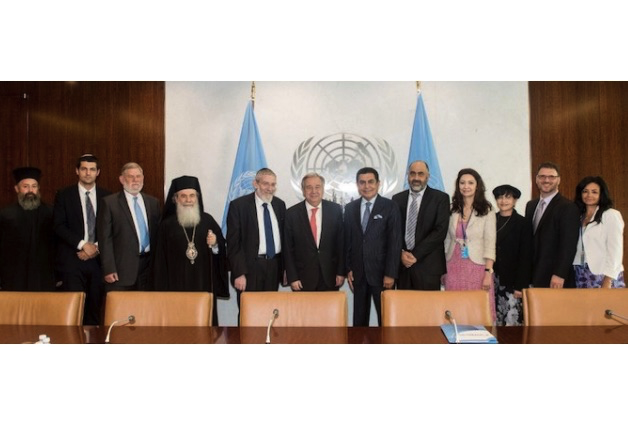
​​​A “Faith for Rights” initiative launched at a recent gathering of faith-based and civil society actors from around the world aims to unite religious communities of various faiths to counter discrimination and religious-based violence through a shared objective to promote human rights and to uphold the freedom of religion or belief.

“Our objective is to foster the development of peaceful societies, where diversity is not just tolerated but fully respected and celebrated,” UN High Commissioner for Human Rights Zeid Ra’ad Al Hussein said in a video message to participants at the two-day meeting hosted by the UN Human Rights Office in Beirut.

“Religious leaders, with their considerable influence on the hearts and minds of millions of people, are potentially very important human rights actors,” said Mr. Zeid.

Building on the 2012 Rabat Plan of Action that laid out religious leaders’ core responsibilities in countering incitement to hatred, the Beirut Declaration (pdf) expands those responsibilities to the full spectrum of human rights. It calls on believers of all faiths to join hands and hearts in articulating ways in which they can stand together in defending fundamental rights against discrimination and violence.

Sheikh Maytham Al Salman, a religious leader and rights defender from Bahrain, urged religious leaders and faith-based organizations to assume leading roles in countering hate campaigns targeting particular religious groups. “Religious hostility has risen to alarming stages,” he said.

(continued in right column)

Question related to this article:
 
How can different faiths work together for understanding and harmony?

(continued from left column)

Linked to the Beirut Declaration are 18 Faith for Rights commitments (pdf) to uphold human rights, including pledges to avoid invoking “State religion” in order to justify discrimination against any individual or group, to ensure gender equality and minority rights, to refrain from oppressing critical voices and to engage with children and youth.

The UN Special Rapporteur on the freedom of religion or belief Ahmed Shaheed said he was concerned about the explicit targeting of youth “by those who would prey on young minds.” He called on religious leaders to pay particular attention to the vulnerability of young people subjected to hate speech.

“Youths look up to religious leaders for guidance, mentoring, support and advice. Therefore there is a need to engage with those communities at a very early age and provide a mind-set that is tolerant, broad-minded and has respect for others,” said Mr. Shaheed. “It is important to go beyond the human rights council chamber out into the field and to engage people and ensure we develop solidarity and cross-community collaboration to mobilize people to support the freedom of religion or belief.”

Ibrahim Salama, chief of the UN Human Rights Treaties Branch, hailed the Beirut Declaration as a rights-based call to people of all faiths around the world to promote peaceful societies based on mutual respect.

“Rather than focusing on theological and doctrinal divides, the Beirut Declaration favours the identification of common ground among all religions and beliefs to uphold the dignity and worth of all human beings,” he said.

(Thank you to Böðvar Jónsson of Akureyri, Iceland, the CPNN reporter for this article)