Mexico: Cristina Ávila-Zesatti and peace journalism

FREE FLOW OF INFORMATION

An interview by Erik Flores for NTR Zacatecas

Although she could be considered a wandering soul, because she has changed cities more times than her years, Cristina Ávila-Zesatti still retains her two great dreams of 20 years ago: that of exercising a journalism that awakens consciousness and being grateful to the people who have helped her on her way.

In an interview with NTR Media, the writer commented that she provides an emotional break from conventional journalism that you read every day, because she has dedicated herself to peace journalism. For this she does not restrict herself to “good news”, but she approaches reality with another perspective and another ethical motivation. Instead of emphasizing conflicts, she highlights solutions.
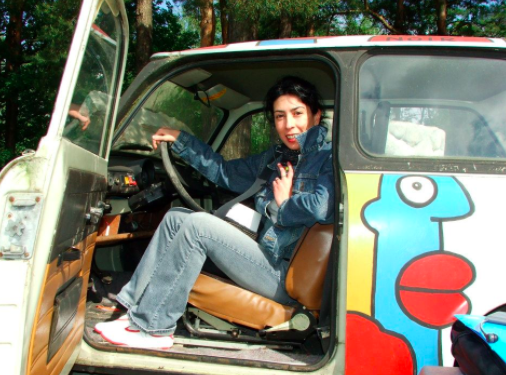
“I consider that conflicts, from open warfare to economic, political and ecological conflicts of all kinds, can be seen from the perspective of offering a solution. Even if only a description of the problem is made, this type of journalism achieves a completely different social change than one gets from conventional journalism,” she said.

On November 4, the Women’s Peacepower Foundation will award Cristina Ávila Zesatti the Woman Peace Award 2017 at its headquarters in Tampa, Florida, USA, for the work she has done for peace, especifically her peace journalism .

She has worked for “the great monsters” of the media and realized the difference between counting not only the problems but also peaceful, non-violent outlooks; “I found there is a whole social universe ignored by traditional journalism, even scorned, badly treated and a bad way to tackle content, and in this universe I discovered the peace that you can find in the world.”

For this reason, Ávila-Zesatti wrote her first book: “Mexico in the labyrinth of contradiction.” It shows how to bring peace to a country that is not officially at war by explaining the phenomenon of violence from the perspective of peace studies.

Now in Zacatecas she is writing “Peace that does exist (and that journalism ignores)”, in which 20 international stories of peace are told; for three years the book was rejected by eight publishers, and now in its second edition, Texere distributes it throughout Mexico.

 Culture of violence

Cristina Avila-Zesatti explains that “what we are seeing now is a very deep corruption since 2006, with the war against narco, when a very irresponsible civil war was declared, and now what scares us is physical violence, death. ”

However, she stressed that Mexico has for many years been immersed in a violent culture, “and now it is turning against us, that is why I am saddened so much the way that the media covers this phenomenon. It hurts us all. As a guild it does not help to heal, it does not help the country to heal, it does not help the country to understand itself in another way “.

She poses the question, if the narco traffic were to be terminated, by legalization or some other way, “would people stop killing?, would there be no more deaths from the drug? I do not think so because the wound in Mexico is much deeper. It is time that we start to face it in another way, because to divide the country into hitmen, policemen, military and ordinary people will not lead us to heal. We are killing each other, this is really a civil war, I do not think compartmentalizing violence is the solution. ”

“It is not that homicides are more important than femicides, but our great capacity as a people for cruelty is worrying. We are a cruel people. And you can see in simple comments about Enrique Peña Nieto, when people regret that the plane did not crash in which he was traveling.”

Ávila-Zesatti explains that “this speaks of the underlying, cultural, learned violence that we have normalized. You can see when there is a news about a riot in jail. The comments are: ‘the more they suffer, the better’. Even though journalism does not cause this, journalism creates a vicious cycle that puts us into a downward spiral from which it will be hard to escape. ”

(Interview continued in right column)

(Click here for the original program in Spanish)

Question for this article

Journalism in Latin America: Is it turning towards a culture of peace?

(Interview continued from left column)

That is why she has dedicated herself to peace journalism, “which is not “ipso facto” journalism, a journalism of reaction. It is not catchy headlines; I believe that journalists have in their hands an enormous responsibility to make ordinary people understand the world around them. ”

However, adds Cristina Ávila-Zesatti, “if journalists do not even understand what is happening around us, if we do not scratch deep, if we do not investigate, if we do not put together the pieces that allow us to have moral responsibility, to try to explain the world to others , we are part of the problem.”

For this woman from Zacatecas, “the world needs a “slow journalism,” because the world is going very fast. We need to explain what is happening, but the journalists themselves are not understanding it or giving themselves the opportunity to understand it. ”

On how to do peace journalism in Zacatecas, Cristina Ávila-Zesatti stressed: “one must have the intention. In Zacatecas and in Mexico, in general, I would be pleased to hear journalists who know what needs to be done.”

She added: “in Zacatecas I have not found the curiosity that the profession of journalism should have. Journalists are not well trained. They are very politicized, with many interests, which are completely removed from journalistic ethics. The first thing that is needed is to do something for society, to accept that the vocation and profession of journalist means that you never stop learing, because you are covering a reality that is constantly changing.”

“Journalists should always be learning, because we form minds. I have offered courses in peace journalism, but no one wants to take them. And it is paradoxical that in other countries I recognized for what I do for peace journalism while in Zacatecas I have not been able to do anything with it,” she lamented.

“I love my land very much, but precisely because I love her, I can not help but see her great reluctance to move forward from her stagnant situation; nevertheless, I always ask young journalists, above all, not to stop dreaming, not to surrender their dreams of changing the world. Imagine what it would be like if all the journalists decided to do journalism because we want things to change and improve,” she said.

Cristina Avila-Zesatti has rejected money offered for projects which, in her words, “what they want is for me to tell only about the violence in this country, but I do not want to tell only that part of my country. My country is violent and it is raping every day, but there is another part that we need to listen to, count and rescue, and that almost nobody wants to hear.”

She explained that the mass media incites frustration, fear and, therefore, an internal war, which will end up transforming into an external war, whether personal, family or social. We need another kind of journalism that can collaborate which what is peaceful and to face the world in a non-violent way.

“I believe in the power of the word. In my beginnings in journalism I dreamed of being a war correspondent and, in the end, I became a correspondent of peace. I look at the darkest part of the world from its most luminous side, and that part we all have, both personally and socially, and I still believe that the word has the choice between immensely healing or immensely destroying,” she added.

Tireless Activist

Cristina Ávila-Zesatti is a tireless activist. She rescues animals. She has earned a degree in Communication Sciences from the Universidad del Valle de Atemajac, a master’s degree in Documentary Drama from the Universidad Complutense de Madrid and a degree in Culture of Peace from the Universidad Autónoma de Barcelona.

For her pacifist activism she has received national and international awards from the Madrid Press Association in Spain; the Friedrich Ebert Foundation in Germany, and the Supreme Court of Justice (SCJN) in Mexico.

Cristina Ávila-Zesatti has given lectures and workshops in Mexico, Spain, Colombia and the United States; was editor in the Channel TV6, of Guadalajara; producer on Telemundo in western Mexico; producer and publisher of International News for Cable News Network (CNN); head of correspondents for NBC-Telemundo International, as well as associate producer in documentaries for MS-NBC Investigatives, Canadian Television and ARD German Public Television.

In 2003-2006 she dedicated herself to research journalism in Belgium, France and Spain, in social issues, and was a collaborator of the Mexican weekly journals Day Seven and Eme-Equis, among other publications.

Currently she edits Corresponsal de Paz on the Internet, which has an average of 30 thousand readers per month, with visits from more than 70 countries on five continents.
Brazil: Community mediation centers begin to work in Recife and Olinda

. . DEMOCRATIC PARTICIPATION . .

An article from Diario de Pernambuco (translated by CPNN)

The conflict mediators trained by the Secretariat of Justice and Rights (SJDH) began to work in two conflict mediation centers opened in the districts of Rio Doce in Olinda and Bomba do Hemetério in Recife. The spaces are part of a set of eight that will be implemented in six districts of the metropolitan region and managed by four Non-Government Organizations (NGOs), with the support of the State Government through the SJDH, and the Conflict Mediation Program of the Executive Secretariat of Rights Human Rights (SEDH). The partnership was signed on July 18 with the NGO’s, Collective Mulher Vida, Grupo Ruas and Praças, Cáritas Brasileira NE2 and Grupo Adolescer.


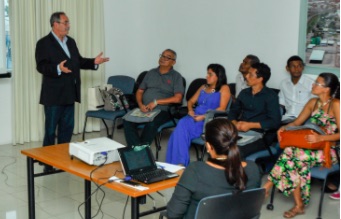
Seminar for Community Conflict Mediators in Recife

The Bomba do Hemetério community nucleus is in operation at the Giganda do Samba, at Rua das Pedras. The space, managed by Cáritas Brasileira NE2, has four mediators and offers initial assistance on Monday from 8am to 1pm and on Friday from 2pm to 5pm. It is necessary for the interested party to present their identity card and inform the contact telephone number. After an initial evaluation, the mediation will be scheduled.

(article continued in right column)

(Click here for the original article in Portuguese)

Discussion question

Mediation as a tool for nonviolence and culture of peace

(article continued from left column)

In Rio Doce, the community nucleus works at the Composer Antônio Maria Polyvalent School, located at Avenida Acácias. In the space, which is managed by the Collective Mulher Vida, the service is carried out by three mediators, on Wednesday from 9am to 11am, and on Friday, from 2pm to 4pm. Those interested must attend the place with photo identification and proof of residence.

Santo Amaro is the next neighborhood to have a center inaugurated. This Tuesday, at 13h, the Adolescent Nucleus opens the doors for the population. On Thursday it is the turn of the Grupo Ruas and Praças to start serving the community. The inauguration of the space happens at 13.30.

The mediators underwent training lasting 40 hours of classes, taught between July 18 and August 08 by the technical team of the Conflict Mediation Program of SEDH, formed by a psychologist, social worker and lawyer. Among the topics covered in the training were human rights, culture of peace, conflicts, community mediation, the role of mediator and the social assistance network.

Mexico: Tlalnepantla initiates program of Youth for a Culture of Peace

EDUCATION FOR PEACE .

An article by Huellas de Mexico (translated by CPNN)

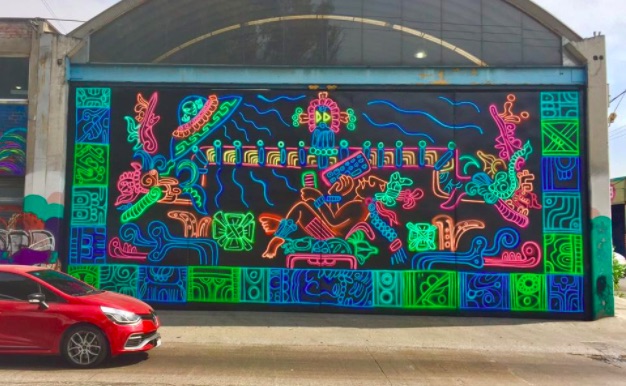
Mayor Denisse Ugalde Alegría has launched the program “Youth for a Culture of Peace”, which provides for the painting of murals with different messages in more than 120 public spaces to raise public awareness of the importance of promoting a healthy coexistence through positive actions.


A mural in Tlalnepantla

Speaking to more than 100 young people who gathered in the municipal esplanade, Denise Ugalde stressed that their participation is fundamental for the development of this municipality, as they represent 30 percent of the population.

She announced that starting on September 29 the city will implement the program “Drive for life, Drive for peace”, aimed at reducing the number of car accidents due to alcohol.

She said that according to statistics of the Pan American Health Organization, Mexico ranks seventh in the world in deaths from road accidents involving young people between 15 and 29 years of age, hence the challenge of the 2016-2018 administration is to raise public awareness about this problem.

(continued in right column)

(Click here for the original Spanish version of this article.)

Question for this article:

Do the arts create a basis for a culture of peace?, What is, or should be, their role in our movement?

(continued from left column)

Alejandra Rangel Díaz, director of the Municipal Institute for Youth, explained that the program “Youth for a Culture of Peace” was born from a project of several areas of the administration that seek to spread healthy coexistence between people through different activities.

She explained that on the instructions of the municipal president, the murals should carry short messages and images that promote a culture of peace, such as respect for people, animals and care for the environment.

She added that with the support of the Social Communication Coordination, to date 60 murals have been painted throughout the municipal territory, in which young people can freely express themselves, thus contributing to crime prevention.

She stressed that private initiatives have also joined in this project, providing their respective fences so that the people of Tlalnepantlenses can express themselves and thereby prevent them from falling into misconduct.

The municipal official said that this program is in addition to the nearly 100 events that were held on the occasion of the Youth Month, including a speech contest, a forum on human rights, sexual diversity talks, gender equity and participation youth policy.

In this event, attended by Eunice Santos, coordinator of Social Communication; Rubén Omar Herosa, representative of the Regional Red Cross; and Alejandra Rizo, president of Santa Monica Scouts; the artist, Antonio García Mendoza “AKO”, indicated that all the murals contain elements that besides promoting peace, convey a sense of identity and belonging.

It should be noted that as part of the program,”Youth for a Culture of Peace”, it is contemplated to give a new image to outdoor theaters, among them, the Algarabía, which soon will have a mural that will be selected through a contest.

USA: Campaign Nonviolence Mounts Nationwide “Week of Actions” September 16-24, 2017

DISARMAMENT & SECURITY .

A press release from prweb

Over 1000 marches, actions, events and rallies will take place in all 50 states, as part of Campaign Nonviolence’s upcoming “Week of Actions” culminating on International Day of Peace. People nationwide are joining together to urgently insist on unity and peace.


Thousands will be participating in Campaign Nonviolence’s “Week of Actions” from September 16-24, 2017. This unprecedented nationwide campaign of grassroots activism calls for an urgent unifying peace that is free from racism, war, poverty, and environmental destruction.

“People across the United States are taking Campaign Nonviolence to the streets to immediately end violence and injustices, and begin peacemaking,” said Dr. Ken Butigan, cofounder of Campaign Nonviolence and professor at DePaul University. “This unified voice calls for policy shifts to build peace, economic justice, and environmental healing.”

Campaign Nonviolence has grown from 230 events in its inaugural year of 2014, to more than 1,000 events today.

Campaign Nonviolence is sponsored by Pace e Bene, a non-profit organization building a culture of peace through active nonviolence and shared understanding and partnerships that protect human rights, abolish war and nuclear weapons, end poverty, challenge injustice, heal the planet—and meet today’s profound spiritual task: to create a just, peaceful and nonviolent world. True to the vision of Dr. Martin Luther King, Jr., Campaign Nonviolence teaches how to resolve conflicts peacefully at home and abroad.

(Article continued in right column)

Question for this article:

The peace movement in the United States, What are its strengths and weaknesses?

(Article continued from left column)

“Americans need a positive vision of hope and peace for our country and our world,” said the Rev. John Dear, the nationally known peace activist and cofounder of Campaign Nonviolence who is Nobel Peace Prize nominee and author of 35 books. “During this week of national actions, we are mobilizing local grassroots initiatives to end today’s culture of violence, greed, and war. We are engaging the vision and tools for nonviolent change that Mohandas Gandhi, Dr. Martin Luther King, Jr., and many others have activated for personal and global transformation.”

Following are a sampling of planned events.

* Delaware Peace Week will hold more than 60 events from vigils and teach-ins to meetings statewide.

* Raleigh and Chapel Hill, North Carolina, have declared “Campaign Nonviolence North Carolina Week,” with events that will advance a peace free from racism and discrimination, poverty, war, and environmental destruction.

* The Chicago area will host 100 events in support of nonviolence and the environment.

* To date, 1,000 people are expected to join the Lancaster, Pennsylvania, Peace Fest in Binns Park on Sunday, Sept. 24. Featured will be four bands and speakers that include the Rev. John Dear.

* Marches, prayer services, vigils, workshops, teach-ins, and rallies nationwide will include major events in Little Rock, Arkansas; Memphis, Tennessee; Albuquerque, New Mexico; Clinton, Iowa; Huntington, Indiana; Bangor, Maine; Lansing, Michigan; and Erie, Pennsylvania.

For a list of peacemaking rallies, with states and cities, descriptions, organizations and contact information, please visit: actions.campaignnonviolence.org.

Campaign Nonviolence is sponsored by Pace e Bene, a nonprofit, tax-exempt organization founded in 1989 by the Franciscan Friars of California. Campaign coordinators Ken Butigan and Father John Dear teach that nonviolence most effectively characterizes Jesus’ way. “It is a way that combines both the unmistakable rejection of violence, and the power of love and truth in action for justice, peace, and the integrity of creation.” For more information please visit: http://www.paceebene.org/about.

China’s Upcoming Transition to Electric Cars ‘Will Benefit the Whole Economy’

.. SUSTAINABLE DEVELOPMENT ..

An article from Sputnik News

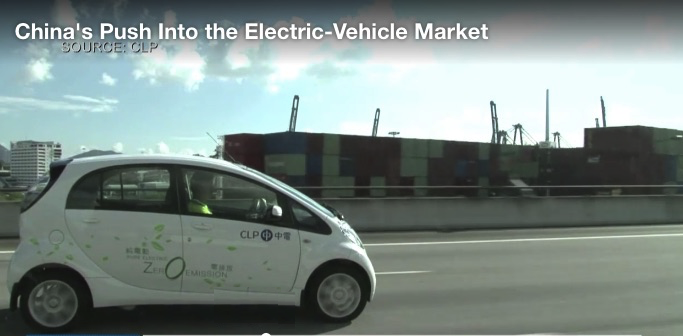
Chinese authorities intend to ban the production of combustion-engine cars and replace them with electric vehicles may well “benefit the country’s economy,” according to a Bloomberg New Energy Finance analyst.


Chinese car as seen in Bloomberg video

Earlier Xin Guobin, China’s Vice Minister of Industry and Information Technology, announced that the country intends to set a deadline for automakers to end sales of combustion-engine cars. According to the official, this move will be aimed at shifting the focus of the market towards electric cars, and is expected to have a profound impact on the environment in a country with some of the worst urban air pollution in the world.

And as Bloomberg New Energy Finance analyst Nannan Kou told Radio Sputnik, this move will benefit not just the environment but the country’s economy as well.

“China will just use less oil and switch to more renewable energy so this will benefit the whole economy and… the health of the people,” he said.

(Continued in right column)

Question for this article:

Are we making progress in renewable energy?

(Continued from left column)

Kou also added that this development will likely affect the oil exporters as China would require less fossil fuel. At the same time however, this shift to electric vehicles (EVs) would increase demand for batteries and the components required to manufacture them.

“In the future, with more EVs on the road China will use less oil, so that would impact those oil-exporting companies. On the other hand, when building more EVs you will definitely use more batteries, metals like lithium and cobalt… and the countries who export those minerals will benefit from it,” the analyst explained.

Finally, he pointed out that electric vehicles may be more attractive to drivers for reasons other than their relatively low price.

“In the future, because EVs are an ideal platform to apply autonomous driving, the drivers may not even need to manually drive a car. They could do other things while the autonomous car will take them from A to B, so I think that’s another benefit to the drivers,” Kou said.

Meanwhile, Honda has already announced it will introduce an electric car to Chinese buyers in 2018, according to Honda China COO Yasuhide Mizuno, in cooperation with Chinese business entities Guangqi Honda and Dongfeng Honda, creating a new brand.

Chinese startup automaker Nio also said it will begin selling its ES8 battery-powered SUV as soon as mid-December, according to a company statement.

At High-Level Forum, UN stresses importance of education in building ‘culture of peace’

FREE FLOW OF INFORMATION

An article from the UN News Centre

Education can promote ideals of non-violence, equality and mutual respect, United Nations officials said today [7 September] at a high-level event on how to achieve a culture of peace amid current global challenges and threats to stability, prosperity and the planet.


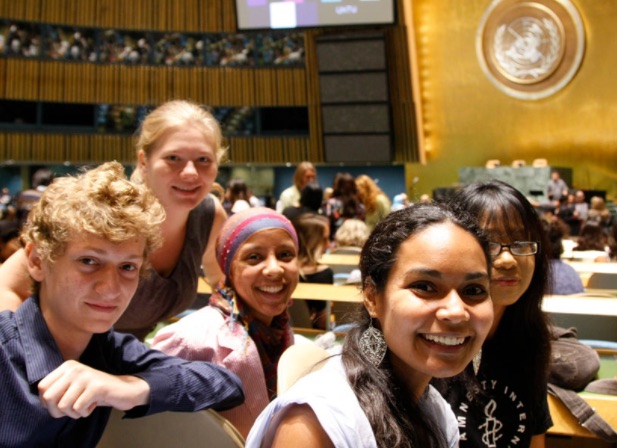
Young people at the launch of the International Year of Youth, celebrated annually on 12 August. UN Photo/Paulo Filgueiras

“We have to teach our children the values of peace, tolerance, equality and respect. They should be under no illusions as to the self-destructiveness of the alternative,” said the President of the General Assembly, Peter Thomson, who convened the all-day event in New York with a focus on early childhood development.

“We must equip them with the skills and education they need to peacefully resolve disputes; to confront injustice and intolerance; and to reject all forms of discrimination and hate,” he added.

Mr. Thomson noted that creating peaceful and just societies is dependent on eradicating poverty, increasing inclusive prosperity, promoting human rights, strengthening the rule of law, and building effective and accountable institutions – the goals of the Sustainable Development Agenda which has guided the international community’s anti-poverty efforts since 2015.

(continued in right column)

Question(s) related to this article:

What is the United Nations doing for a culture of peace?

(continued from left column)

“Fostering a culture of peace requires all of us – individuals, nations and international organisations – to work together to promote understanding of our common humanity,” the senior official said. “We must promote intercultural respect, strengthen interreligious understanding, and inspire people’s hopes for the future. Above all we must unite for peace.”

The event brought together representatives from UN Member States, UN system entities, civil society, media, the private sector and others with an interest in exchanging ideas and suggestions on ways to build and promote a Culture of Peace [see accompanying article with quotes from Member State], and to highlight emerging trends that impact its implementation.

In addition to early childhood education and investment in children, Secretary-General António Guterres stressed the need to invest in youth to promote world peace.

He called young men and women “the barometer of social discontent, economic marginalization and political exclusion,” and said they must be recognized as active agents of change and custodians of peace.

In a speech delivered by his Senior Advisor on Policy, Ana María Menéndez, the Secretary-General also recognized women’s contributions and participation in long-term peace efforts. He said that women’s meaningful participation generates a different perspective in solving problems, and needs to be supported in all aspects of life.

Mr. Guterres also highlighted the importance of investing in inclusion and cohesion, so that diversity is seen as a benefit and not a threat.

“To prevent intolerance, violent extremism and radicalization, we need to promote the inclusion, solidarity and cohesion of multi-ethnic, multicultural and multi-religious societies. It is the best antidote to racism, xenophobia, Islamophobia and anti-Semitism,” he noted.

The first such forum on the Culture of Peace was held in September 2012, and recognized the need for continual support to further strengthening the global movement for peace.

At UN Forum Member States call for implementation of the 1999 Declaration and Programme of Action on a Culture of Peace

FREE FLOW OF INFORMATION

A compilation by CPNN

At the recent United Nations High Level Forum on a Culture of Peace, delegations from around the world recalled the 1999 UN Declaration and Programme of Action on a Culture of Peace and called for its implementation. Here are excerpts from statements made at the Forum by delegations from Europe, Latin America, East Asia, South Asia and the Arab States.


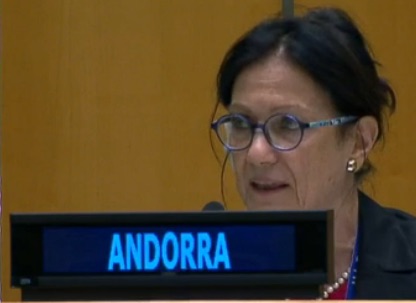
Her Excellency Mme. Elisenda Vives Balmaña, Permanent Representative to the United Nations from Andorra

On the other hand, just as they boycotted the UN Conference to ban nuclear weapons, the countries of NATO and their allies boycotted the forum. The only exception was the delegation from Belgium.

“Andorra applauds the action of UNESCO in favor of the culture of peace based on the universal values of tolerance, liberty, solidarity, human rights and gender equality. It is a concept that can be found already in the 1999 adoption by the General Assembly of resolution A/53/243 which proposes the promotion of peace through education which should be available to all children, with a particular attention to women.”

“Bangladesh along with all the stakeholders have been engaged in the Declaration and Programme of Action on a Culture of Peace which highlighted the priority areas for the full and effective implementation of this visionary and universally applicable idea.”

“Belgium remains convinced of the pertinence of the Declaration and Programme of Action on a Culture of Peace adopted in 1999.”

China: “States should accelerate the realization of the goals related to the culture of peace in the 2030 Agenda for Sustainable Development and effectively implement the General Assembly’s Declaration and Programme of Action on a Culture of Peace.”

Cuba: “Eighteen years after the adoption by the UN General Assembly of the Declaration and Programme of Action on a Culture of Peace, Cuba reaffirms its full validity and is grateful for the convening of this High-Level Forum, which allows to reflect on how much is yet to be done to achieve and enjoy a true cultue of peace, fostering understanding among peoples and tolerance of diffeences.”

“India welcomes and fully supports the landmark resolution A/53/243 on the Declaration and Programme of Action on a Culture of Peace. A culture of peace is the keystone of the foundation of a global order of peace and tolerance. In the long history of human civilization which have seen many years of warfare, the United Nations has been a guiding light in the 20th Century with the many initiatives it has taken to build a peaceful and just order.”

Lebanon: “This event gives us the opportunity, not only to celebrate, but also to review our commitment made almost two decades ago in the adoption of the Declaration and Programme of Action on a Culture of Peace.”

(continued in right column)

Question(s) related to this article:

What is the United Nations doing for a culture of peace?

(continued from left column)

Libya: “In 1999 the General Assembly adopted the Declaration and Programme of Action on a Culture of Peace which was considered a guide for governments and civil society to promote the culture of peace. This declaration linked the concepts of culture and peace as th main pillars of peacebuilding.”

Malaysia: “My delegation reaffirms its support and commitment for the continued and effective implementation of the Declaration and Programme of Action on a Culture of Peace which remains relevant to uphold respect for life as well as human values and diversity. It would be remiss for me to not mention the importance of values set about by the Declaration, including ending of violence, practice of education, dialogue and cooperation, as well as adherence to principles of justice, tolerance, cooperation and cultural diversity. It is our view that these principles , when applied, will address the challenges that we have been facing in attaining the culture of peace.”

Mexico: “The adoption of the Declaration and Programme of Action on a Culture of Peace represents an important step towards establishing integral strategies to promote the culture of peace that contributes to guarantee a sustainable peace in the long term.”

Pakistan: “The General Assembly Declaration and Programme of Action on a Culture of Peace of 1999 bound us all in a global commitment to build a new century of peace and coexistence.”

Qatar: “In conclusion, I would like to stress our commitment to implement the Declaration and Programme of Action on a Culture of Peace and we will continue to provide support to all efforts at the national, regional and international levels in order to promote the culture of peace and nonviolence so that we can benefit the entire humanity.”

Republic of Korea: “The 1999 Declaration and Programme of Action on a Culture of Peace expanded the parameters of the concept of peace, connecting it more firmly to development, empowerment, human rights and government transparency. In our rapidly changing world, we must zero in on those who can benefit the most from programs meant to promote a culture of peace and ask ourselves if they are being well served,”

Russian Federation: “The significance continues to grow of the inter-religious, inter-civilizational and intercultural dialogue and cooperation and promotion of principles and orientation, that was established by the Declaration and Programme of Action on a Culture of Peace in 1999.”

“Venezuela has actively supported all initiatives of the United Nations fostering a culture of peace, and the Declaration and Programme of Action on a Culture of Peace, as well as the International Year for the Culture of Peace, and innumerable specific actions which contributed to a culture of peace and nonviolence from 2000 to 2010.”

Editor’s note: The statements from Andorra, Bangladesh, Belgium, China, Cuba, Mexico, Pakistan, Republic of Korea and Russia are available as pdf images at https://papersmart.unmeetings.org/ga/71st-session/high-level-forum-on-the-culture-of-peace/statements/. Remarks from Andorra, Belgium, Cuba, Mexico and Russia are translated by CPNN. Statements from Lebanon, Libya, Qatar and Venezuela, are transcribed from the English language interpretations available at http://webtv.un.org/search/high-level-forum-on-the-culture-of-peace-general-assembly-71st-session/5567708131001/?term=&lan=english&page=2, while those from India and Malaysia are transcribed from the English language interpretations available at http://webtv.un.org/search/panel-discussion-on-sowing-the-seeds-on-the-culture-of-peace-at-high-level-forum-on-the-culture-of-peace-general-assembly-71st-session/5566146546001/?term=&lan=english&page=2.

IPI Forum at United Nations: Advancing the Culture of Peace

FREE FLOW OF INFORMATION

An article from International Peace Institute

On September 7th, IPI together with the Al-Babtain Foundation cohosted a policy forum on the culture of peace during the annual UN High-Level Forum entitled “Advancing the Culture of Peace.” This event provided input into the high-level forum by building upon the Declaration and Programme of Action on a Culture of Peace (A/RES/53/243) adopted by the UN General Assembly in 1999.


Video of Forum

Please note that the event was broadcast in native language. An English-language version will be forthcoming.

The eight pillars identified in the 1999 Programme of Action on a Culture of Peace echo today’s priorities set by the Secretary-General and the President of the General Assembly. The event on September 7th at IPI explored the connections among culture, peace, security, and development, focusing specifically on the connections between the culture of peace, the 2030 Agenda for Sustainable Development, and the 2016 resolutions on sustaining peace.

As there is significant overlap between the Sustainable Development Goals and the eight pillars, it is important to reflect on the ways sustainable development can be integrated into the culture of peace. Similarly, it is critical to consider ways to strengthen the structures, attitudes, and behaviors that both foster a culture of peace and sustain it. This event provided an opportunity to discuss the links among the three agendas, exploring the opportunities, risks, and best strategies moving forward.

Welcoming Remarks:
Ambassador Terje Rød-Larsen, President, International Peace Institute

Opening Remarks:
H.E. Mr. Peter Thomson, President of the UN General Assembly
Dr. Abdul Aziz Saud Al-Babtain, Chairman and Founder of Abdulaziz Saud Al-Babtain Cultural Foundation

Speakers:
H.E. Ms. Gillian Bird, Permanent Representative of Australia to the United Nations
H.E. Mr. Masud Bin Momen, Permanent Representative of the People’s Republic of Bangladesh to the United Nations
Mr. Oscar Fernandez-Taranco, UN Assistant Secretary-General for Peacebuilding Support

Moderator:
Dr. Adam Lupel, Vice President, International Peace Institute

Question(s) related to this article:

In India the energy revolution does not wait !

.. SUSTAINABLE DEVELOPMENT ..

An article by Auguste Bergot for La Releve et la peste

Since the Paris Agreement, India has taken its commitments for sustainable development very seriously. For the third most energy-consuming country in the world, the energy transition has been, in a sense, a windfall: it has enabled it to reconcile its development objectives – by making electricity accessible to its entire population – and asserting itself as a “superpower of renewable energies” on a global scale. By developing massively its photovoltaic panels, India has already managed to exceed all expectations, and is not ready to stop.


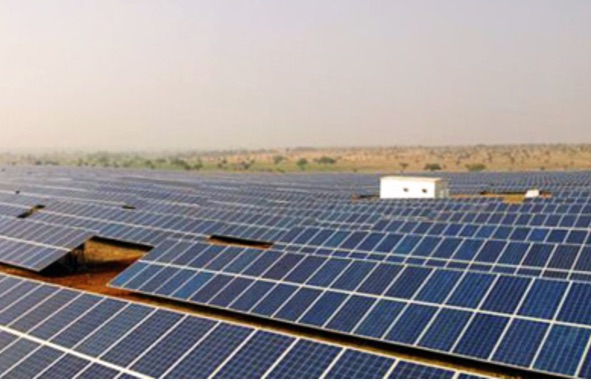
(Photovoltaic installation of Khilchipur (Madhya Pradesh, Inde) MWc, started up in 2014. Crédits : EDF EN)

India has more than 1.3 billion inhabitants. In this country, where the ventilator is an indispensable part of everyday life, the inhabitants show an increase in demand for electricity that is roughly similar to France or Germany. On the other hand, at the level of quantities, in 2014, people consumed on average 805.6 kWh compared to 6,937 kWh in France and 7,035 kWh in Germany, a huge difference that reflects serious inequalities in access to electricity in India.

Indeed, about 240 million Indians (nearly 2% of the population) still do not have access to electricity. This is a major problem as many Indian people still can not light up in the evenings. This prevents children from studying and poses food preservation problems. That is why, with the commitment of the COP21, India has set itself the goal of providing power to its entire population 24 hours a day by 2030.

To meet this objective, India could simply have relied on conventional energy sources, including coal, its traditional energy source. But instead, it decided to invest fully (and at high speed) in renewable energies, and particularly solar energy. It takes advantage of its 300 days of sunshine per year on average, which is particularly apt for development of this sector. This is why it is the leader of the International Solar Alliance, a coalition of 121 countries located between the Tropic of Capricorn and the Tropic of Cancer, which aims to “generalize solar energy in the world and mobilize $ 1 trillion of investment by 2030 [invested by the World Bank] “by making the best use of the photovoltaic potential of the countries of the South.

In addition, it appears that investors have identified the advantageous profile of India. As the World Bank points out, “the last call for tenders for a solar project in the Rajasthan desert was a record low rate of 2.44 rupees (the equivalent of 4 cents) per kilowatt hour. So the price of solar energy is already more competitive than that of coal, which is excellent news for the trend towards a gradual exit from coal (which still accounts for 69% of the Indian energy mix) .

(Continued in right column)

(Click here for a version of this article in French.

Question for this article:

Are we making progress in renewable energy?

(Continued from left column)

While the previous government had set a timid target of 22 gigawatts for 2022, the Minister of Energy of Narendra Modi’s government of India, Piyush Goyal, said that “it is not very difficult to envisage that India installs 10 GWp of photovoltaics per year and 6 to 8 GW of wind each year. The target was simply multiplied by 7: 160 GW of wind and solar energy by 2022. However, despite the unprecedented efforts of India, it seems difficult to imagine that the State can achieve its objective.
Indeed, even if the growth of the photovoltaic sector is spectacular in India (+632% in 2011, +154% in 2012, +64% in 2013 and +43% in 2014), it still had only in 2016 a production capacity of 9.01 GW, out of the 100 GW of the 160 planned for 2022 … However, it can be said without reservation that the 22 GW target set by the former government will be far surpassed if India follows this momentum. But far from being enough to dethrone the fossil energy sector, India will have to be patient and continue working to achieve its goals. It is estimated that Indian greenhouse gas emissions will continue to increase at least until 2030, before the efforts have a visible impact.

The triple problem faced by India today is how to reconcile its commitment to energy transition with its desire to bring electricity to the entire population and to meet the economy in full development. Thus, the measures put in place by the Modi government, in particular concerning the doubling of the coal tax and the aid for the closure of coal-fired power stations over 25 years of age, are at the same time a further step towards a revolution in energy and a thorn in the foot for the development of Indian industry.

An article published by La Tribune also notes that “if India is a new Eldorado for renewable energy, a high cost of capital and a financing market make it relatively complex.” However, massive investments by the World Bank are aimed at remedying these aporias. With a contribution of more than $ 1 billion in support to India’s solar plans, the World Bank and Indian State cooperation will develop Indian solar parks, develop solutions storage and contribute to the development of common network infrastructures.

Just a few months ago, the Indian government announced that it wanted to make its fleet of cars completely electric by 2030 to curb air pollution (according to Greenpeace, India became the country for the period 2016-2017 where air pollution causes the most deaths in the world).

The efforts of the Modi government to achieve the goals set by COP21 and to drive the so-called “southern” countries (formerly excluded from the ecological transition, despite their potential due to the excessively high costs of renewable energies) should be a source of inspiration for European leaders, who seem to be more concerned about half-hearted measures than strong and assertive international mobilization.

While India’s ambitions are beyond its own capabilities, they remain an ideal that deserves support and pursuit by the international community, not only on the basis of profits for corporations. Without this, we may have the bitter result that India is only the new playing field of investors who profit from a particularly juicy market …

(Thank you to Kiki Chauvin, the CPNN reporter for this article.)

China eclipses Europe as 2020 solar power target is smashed

.. SUSTAINABLE DEVELOPMENT ..

An article from Euractiv

China has reached its 2020 solar power target three years ahead of schedule, after installed capacity topped well over its 105GW target. Europe has been urged to show similar ambition.


The largest floating solar power farm in the world was recently hooked up to China’s power grid. [Sungrow]
(Click on image to enlarge)

New figures published by solar industry firm Asia Europe Clean Energy (Solar) Advisory (AECEA) last week revealed that China has exceeded its 2020 target of 105GW of installed solar capacity, after new builds in June and July pushed it up beyond 112GW.

Solar power is enjoying a sunny 2017 in China, after the first half of this year saw capacity increased by 24.4GW, dwarfing similar efforts in Europe, and cementing China’s status as the world’s leading solar nation.

(Thank you to Kiki Chauvin, the CPNN reporter for this article.)

(Click here for a version of this article in French.

Question for this article: