Category Archives: WOMEN’S EQUALITY

Argentina: Thousands of women march to the Plaza de Mayo to demand justice for Lucía Pérez

. . WOMEN’S EQUALITY . .

An article from Radio Mitre

Under the slogan “We are all Lucia. Patriarchal justice is impunity, ” thousands of women marched to Plaza de Mayo to claim justice for Lucía Pérez, who was found dead in Mar del Plata in October 2016.


Those accused of femicide and sexual abuse were acquitted at the end of November. In opposition to this ruling, the demonstration occupied more than two city blocks.

(article continued in right column)

(Click here for the original article in Spanish)

Questions related to this article:

Protecting women and girls against violence, Is progress being made?

(article continued from left column)

“Justice for Lucia / we march for life not femicide / not one less / we want to live”, was the chant that became louder and louder in the minutes before six o’clock, when thousands of women began the mobilization .

Marta Montero, Lucia’s mother, along with her son Matías, came especially from Mar del Plata, where there was also a mobilization in which Father Guillermo participated, to make his claim heard before the Courts, the point where the concentration began. The young man, who cried during several moments of the march, had in his hands a portrait of his sister with the words: “Justice for Lucia: it was a femicide.” Her death, in 2016, had prompted the first national strike of women.

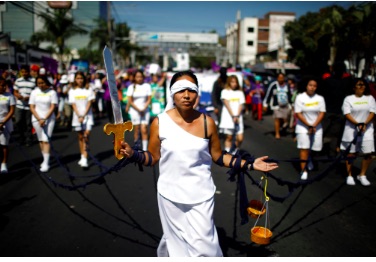
“Not one less, we want to live”, was one of the chants of the march, which stopped at Diagonal Norte and Cerrito so that the more than one hundred women who headed the march that reached Plaza de Mayo could lie down, as if dead, on the asphalt.

With photos of Lucía Pérez, women of all ages demanded Justice: from a little girl who is no more than 3 years old to Nelly Minyersky, historical reference of the National Campaign for the Right to Legal, Safe and Free Abortion, who has already passed 80. “Feminism is going to win, patriarchy is going to fall, it is going to fall”, was the cry that generated tears in some of the girls lying down on the pavement.

Israeli women hold mass rallies to protest rising violence against women

. . WOMEN’S EQUALITY . .

An article from Press TV

Tens of thousands of women have held a general strike as well as protests across the Israeli-occupied territories to voice their anger at the Tel Aviv regime’s failure to stem a sharp increase in violence against women.

On Tuesday, protesters staged separate rallies in several cities, calling on Israeli authorities to take action to stop the killings of females during domestic violence-related incidents.


A general view of protest against violence against women in Tel Aviv, Israeli-occupied territories, December 4, 2018 (By AP)

Dressed mainly in black with red hats, and carrying red balloons and torches, some 30,000 demonstrators gathered in central Tel Aviv to urge the Israeli administration to address the issue.

“Today we made history,” the protest’s organizers told the crowd. “Today the silence on the violence against women has turned to screams.”

Some 200 pairs of women’s shoes, painted red, were also placed on display on Habima Square in central Tel Aviv in a sign of protest.

(article continued in right column)

Questions related to this article:

Protecting women and girls against violence, Is progress being made?

How effective are mass protest marches?

(article continued from left column)

In occupied Jerusalem al-Quds, demonstrators chanted for Prime Minister Benjamin Netanyahu to “wake up,” carrying signs that read, “Women’s blood is not cheap” and “We are killed and the government is silent.”

Some women blocked the entrance to the city, holding signs stating, “Enough with the murder of females.”

Organizers of the protests demanded that a budget of nearly a $70 million be allocated to combating violence against women.

The strike was called last week in the wake of the recent murders of two teen girls, whose deaths brought the number of women, who were killed over the past year in domestic violence-related incidents to 24, the highest in years.

Over 300 institutions, municipalities, schools, and groups joined the strike and the protesters observed a moment of silence to mark the deaths.

A day earlier, activists poured red dye in public fountains in several cities to draw attention to the protest.

Shortly after the end of the rally, Netanyahu’s office announced that the prime minister would convene a meeting of the ministerial committee on violence against women on Wednesday morning.

On Monday, the opposition’s Zionist Union brought a no-confidence motion, denouncing the regime’s failure to curb such violence.

(Thank you to Janet Hudgins, the CPNN reporter for this article.)
Gabon: Panafrican Women’s Network presents its action to the Senate

. WOMEN’S EQUALITY .

An article from L’Union, Gabon

The Gabon section of the Pan-African Women’s Network for the Culture of Peace and Sustainable Development recently met with women senators.

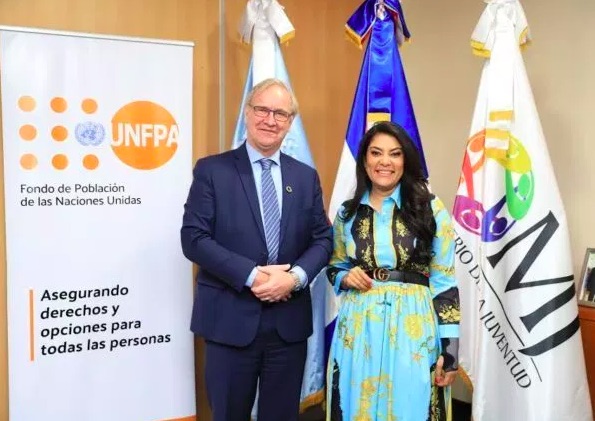
Conducted by the resident coordinator of the United Nations system, Stephen Jackson, the Gabonese section presented, its plan of action to the network of women senators of Gabon (Refeseg). The plan of action is articulated around two axes .

(Article continued in right column)

(Click here for the original article in French.)

Question for this article

Can the women of Africa lead the continent to peace?

(Article continued from left column)

The first deals with the culture of peace, the appropriation of Resolution 1325 and its corollaries, citizenship, education, training, peace and security, respect for human rights, respect for democratic principles, equality between men and women in positions of responsibility, the fight against the discrimination of women.

The second axis includes sustainable development, economic independence, environmental law, law and health, inclusive growth, leadership and association, art and traditional education.

The office of the Gabon section, headed by Victoire Lasseny Duboze, intends to mobilize more women from Gabon’s civil society throughout the country.
 

UN Women’s Org. hosts North Darfur peacebuilding workshop

. . WOMEN’S EQUALITY . .

An article from Radio Dabanga Sudan

The United Nations Women’s Organisation and a Sudanese training centre organised a workshop on strengthening women’s participation in peace building in Zamzam camp for displaced people in North Darfur yesterday.

The two-day workshop, focused on peace building and the Darfur peace dialogue, launched in the camp south of El Fasher city. The UN Entity for Gender Equality and the Empowerment of Women (‘Women’ in short) and the Maamoun Buheiri Training Centre hosted the session with the participation of more than 50 people, from women leaders in the camp to representatives of civil society organisations.

Question for this article

Can the women of Africa lead the continent to peace?

Manal El Aseil is the director of the Women and Family Department of the Ministry of Health and Social Development of North Darfur. The director told the Sudanese press: “The workshop aimed to raise awareness and promote a culture of peace. We discussed a number of working papers presented by a number of professors of El Fasher Univeristy and Omdurman Islamic University.”

A representative of the Maamoun Buheiry Centre explained that this workshop comes within a series of 50 workshops which the centre organises in cooperation with women partners in various Darfur states. They are financed by the African Bank in Sudan.

Last week, a number of Khartoum-based women’s and human rights organisations launched the #WeAreMany campaign to combat violence against women and youth, child marriage, and forced marriage. A Sudanese human rights organisation recently highlighted an increase in sexual and physical violence against women and children in the country, as well as endemic female genital mutilation (FGM).

France: More people marched in the demonstration #NousToutes than in the demonstration of the “Yellow Vests”

. . WOMEN’S EQUALITY . .

An article from the Huffington Post (translated by CPNN)

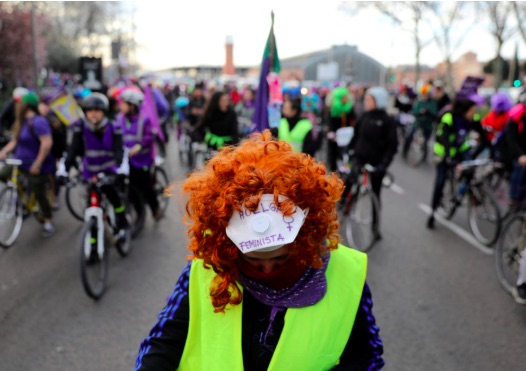
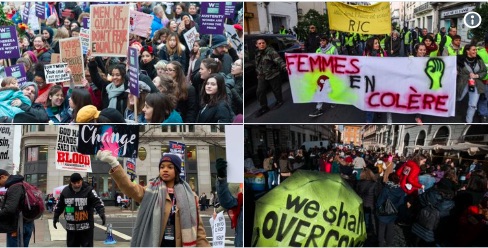
SEXISM – “Down with Rape!”: Tens of thousands of women and men, according to the organizers, took to the streets in France this Saturday, November 24 at the call of a collective that had called for a “feminist tidal wave” against sexist and sexual violence a year after the start of the #MeToo movement.


Video of the demonstration

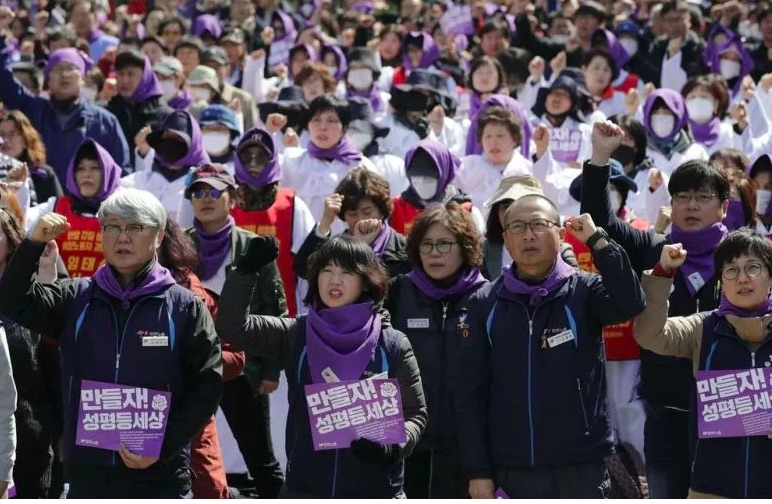
In contrast to the “yellow vests“, demonstrations in France [editor’s note: demonstrations against the rise in gasoline prices that turned to violence], the women’s demonstrations are adorned with purple, the color chosen by the movement #NousToutes for the actions organized on the eve of the International Day for the Elimination of Violence to women.

Similar events took place in other European cities, including Rome, Athens and Geneva.

“This is the biggest feminist mobilization that we have known in France,” said its organizer, Caroline De Haas, who announced that 50,000 people took to the streets, including 30,000 in Paris. Last year, there were 2000 in the Paris demonstration, according to police source.

On Saturday, police and prefectures estimated 12,000 demonstrators in Paris between Opera and Republic, 2400 in Lyon, 1500 in Marseille, 950 in Rennes, 850 in two processions in Nantes, 600 in Toulouse …

Many demonstrators carried placards “Down with rape!”, demanding the end of “the impunity of the aggressors” and “sufficient financial means” for the fight against this violence.

Muriel Robin, Eva Darlan and Vanessa Demouy were present

Personalities from diverse backgrounds, including actresses Muriel Robin, Eva Darlan and Vanessa Demouy, joined the Parisian march.

“I’m here to support all the victims and continue this fight that began well before me,” said Muriel Robin, wearing a purple scarf on her arm. She had gathered more than a thousand women in Paris in October against domestic violence.

(article continued in right column)

Click here for the original in French)

Questions related to this article:

Protecting women and girls against violence, Is progress being made?

How effective are mass protest marches?

(article continued from left column)

From Rennes to Lyon and Toulouse, the processions were composed mostly of women of all generations, but also of men. For Tanguy, a 19-year-old Rennes student, “it’s a movement that has no sex”, “a fight of both men and women, together, against inequalities”.

Rirette, 84, came to protest in Lyon for “equality of pay, rights and sexual behavior.” “Non-consent is a horrible thing and it is judged (by the courts) too lax,” denounced this former administrator.

“The street is ours”

“Sexism kills”, “You are not alone”, “The street is ours”, “No means no”, could be read on the signs in Lille, along with flags of political movements (Generations , EELV) and trade unions (CGT and Sud).

In Toulouse, the entire event sang with one voice several slogans carefully prepared: “Proud, ‘venerable’, not ready to be silent!”, “Freedom, equality, sorority”, “Your hand on my ass, my fist in your mouth “,” Tax cons, not tampons”…

Born in September and supported by a number of associations, the #NousToutes movement was “moving from testimony to action” one year after #MeToo, which boosted the number of sexual violence cases reported to the police by 23%.

In France, in 2016, 123 women were killed by their spouse or ex-companion, about one every three days. Each year, nearly 220,000 women experience violence from their spouses or ex-companions, according to official 2017 figures. In addition, more than 250 women are raped each day, and one in three has been harassed or sexually assaulted at work.

Equality between women and men “great cause of the five-year electoral period” Macron

A year ago, President Emmanuel Macron decreed equality between women and men “great cause of the next five year electoral period”, during a speech at the Elysee.

But “if there is no money, public policies will not follow,” said Caroline De Haas. Funds earmarked to help women who are victims of domestic violence are expected to rise to at least € 506 million a year from 79 today, five organizations including the Economic, Social and Environmental Council (EESC) said this week.

Hundreds of personalities and trade unionists – women and men – joined Saturday’s movement.

In Paris, men were excluded from a “small non-mixed space” to reassure” women victims of various forms of violence who did not feel comfortable to march with men around them. This initiative was criticized on social networks, including by feminist activists, and it attracted only five people, according to the person in charge of this space.

Sierra Leone News: Women’s Movement reinforces

. WOMEN’S EQUALITY .

An article by By Ophaniel Gooding in Awoko

A two-day national conference with the theme “the women’s forum we have the woman’s forum we need” concluded with the authoring of a communique by representatives of women’s group nationwide. The national conference which was organized by Campaign for Good Governance and the Women’s Forum Sierra Leone is to strengthen and reinforce the “Women’s Forum Sierra Leone and celebrating our Silver Jubilee of women’s movement,” said Maude R. Peacock the president of Women’s Forum Sierra Leone. 


Photo from the facebook page of the Women’s Forum Sierra Leone

This conference, funded by Trocaire, brought together women and women’s community based groups and Civil Society Organizations, across the sixteen Districts, with the aim of examining the strengths, opportunities and challenges affecting the women’s movement in our country; Reaffirming that ‘Women’s Rights are Human Rights’ and the fundamental rights of all as enshrined in Chapter 3 of the 1991 Constitution of Sierra Leone, including the elimination of all forms discrimination against women. 

(Article continued in right column)

Question for this article

Can the women of Africa lead the continent to peace?

(Article continued from left column)

CGG Executive Director, Marcella Samba explained that effective women’s participation in the democratic processes of any developing country is the foundation for good governance, gender equality and sustainable development; Reminding the Government of Sierra Leone of its duty to protect and promote the rights and advancement of women and girls in Sierra Leone. She applauded the efforts made over the past years by the various women and women led organizations to promote women’s advancement, empowerment and access to basic socio-economic services, despite the challenges. Also, appreciated the efforts and invaluable contributions made by the older women generation and urging the younger women generation to join the Women’s Movement, with particular focus on making Sierra Leone a better place for all. 

President of 50\50 group Dr Fatou Taqi acknowledged the challenges hampering the effective functioning, networking and collaboration of the Women’s Movement from having a formidable voice for change and transformation. 

YWCA Sierra Leone National President, Bondu Manyeh welcomed the new initiative of self- assessment and internal reform. Some of the recommendations in the communique were to ensure the promotion and strengthening of intergenerational dialogue among women and women’ groups across the country, and reinvigorate all aspects of the Women’s Forum Sierra Leone. Also to develop and implement a clear road map of the roles and responsibilities of the Women’s Forum of Sierra Leone and member organizations, and that emphasizes participation, communication, and empowerment of women. To promote the culture of peace and tolerance among the various women’s groups to improve interpersonal relationships and to solidify and achieve their economic, social, cultural, civil and political rights. Also to Provide capacity building of women for women’s groups for gender engagement and civic participation on a continuous basis. However, some of these recommendations are expected to be actualized within a 5 years time span, disclosed CGG Program Director, Bernadette French

Google’s ‘#metoo’ moment: Workers walk out over women’s rights

. . WOMEN’S EQUALITY . .

An article by Jane Lanhee Lee and Paresh Dave in Thomson Reuters (reprinted by permission)

Thousands of Google employees around the world briefly walked off their jobs on Thursday [November 1] to protest the company’s response to sexual harassment and demand that the world’s largest search engine address rising concerns about workplace inequality.

The protests took place in waves, beginning in Asia and then streaming across Europe and North America, with the final wave occurring at Google’s headquarters in Mountain View, California.


Frame from video on article website

The protests, which drew Google contract workers as well as employees, followed a New York Times report last week that Google in 2014 gave a $90 million exit package to a senior vice president, Andy Rubin, after he was accused of sexual harassment.

“This was the $90 million straw that broke the camel’s back,” Celie O’Neil-Hart, one of the protest organizers and who works on YouTube marketing, told reporters as she joined hundreds of other employees in the courtyard of Google’s Mountain View headquarters. “But there are so many stories that we’ve heard for so long, and it’s time for action and change,” said O’Neil-Hart as she teared up.

Rubin denied the allegation in the New York Times story, which he said contained “wild exaggerations” about his compensation. Google did not dispute the report.

Organizers said about 60 percent of Google’s offices participated, including Dublin, the company’s largest site outside the United States, as well as London, Zurich, Berlin and Singapore. They shared photographs on social media of hundreds leaving offices.

Many employees at the Mountain View walkout chanted “Women’s rights are workers rights,” and some wore blue ribbons in support of sexual harassment victims.

Seven U.S. employees who organized the demonstrations called on Google parent Alphabet Inc (GOOGL.O) to make harassment investigations fairer for accusers, share pay-equity data with workers and add an employee representative to its board.

Google Chief Executive Sundar Pichai, speaking an hour later at a New York Times conference in New York, said he was taking note of the “concrete steps” workers presented to improve the company’s culture and human resources processes.

“I want to make sure Google sets the bar,” he said, noting that a lack of gender and racial diversity was part of the issue. “We’re grappling with it, as with many places.”

(Article continued in the right column)

Question for this article

Protecting women and girls against violence, Is progress being made?

(Article continued from the left column)

Organizers and other employees said Google executives, like leaders at the dozens of companies affected by the #metoo movement, have been slow to address numerous structural issues such as unchecked power of male executives.

They want Google to publicly report its sexual harassment statistics and end forced arbitration in harassment cases. They also have asked that the chief diversity officer be able to directly advise the board.

Rana Abdelhamid, who works in Google Cloud’s marketing division in San Francisco, told reporters that the walkout was “about safety of women in the workplace,” adding that Google’s historical support for women’s causes caused her to be shocked when she learned of the multi-million-dollar payout.

“The numbers and facts don’t match with the intentions” of Google on equality and safety for underrepresented groups, she told Reuters. “We need to reprioritize energy and really focus on these issues.”

MONTHS OF BUILDUP

Since its founding two decades ago, Google has been known for its motto “don’t be evil,” a dictum preserved in its worker code of conduct, and its transparency with employees about corporate strategy.

But employees have internally organized for months to increase diversity and improve treatment of women and minorities.

Those issues have been top of mind since the 2016 election of U.S. President Donald Trump, a Republican, stunned Silicon Valley, where liberal and libertarian policies are popular.

Tech workers have become more vocal to protest both the president’s and their companies’ stances on immigration, defense and discrimination. Workers have said that they are driven by the sense that their technology pioneer employers should also be standard bearers on socioeconomic issues.

“We all know that the status quo is unacceptable and if there is any company who can solve this, it is Google,” said Thomas Kneeland, a Google software engineer in New York.

The dissatisfaction among Alphabet’s 94,000 employees and tens of thousands contractors has not noticeably affected the company’s share price. But employees, who warned they would demonstrate again if needed, expect Alphabet to face recruiting and retention challenges if their concerns go unaddressed.

Alphabet shares closed down 0.4 percent to $1,085.98 on Thursday.

Around the world, Google workers walked out carrying signs reading “Time’s up Tech,” “Happy to quit for $90M – no sexual harassment required” and “Not OK Google,” a reference to the “OK Google” phrase used to activate Google’s voice-operated Assistant.

Cathay Bi, a Google product manager, speaking through a megaphone before hundreds gathered in a bustling pedestrian plaza in San Francisco’s financial district, talked about the engines of change.

“This is what it means to be ‘Googley,’” she urged the crowd to chant, invoking a widely used term for the company’s culture. “People don’t change because of law and policies. Laws and policies change because of people.”

Women in Iceland have walked out of work to dispute the gender pay gap

. WOMEN’S EQUALITY .

An article from the World Economic Forum

Imagine if you worked a full day but stopped being paid at 2.55pm.

That’s the fate of women in Iceland, according to a protest group that organized rallies  across the country this week [October 21-27], demanding equal pay and rights and declaring “Don’t Change Women, Change the World!”


The sitting Prime Minister of Iceland, Katrin Jakobsdottir, joined the demonstration, according to the Bloomberg News Service.

While the protestors at ‘Kvennafrí 2018’, Women’s Strike, acknowledge that Iceland has made progress – it has the smallest overall gender gap of 144 countries ranked  by the World Economic Forum and has enacted the world’s first equal pay  law – they say they want faster and more meaningful progress.

(Article continued in right column)

Question for this article

Prospects for progress in women’s equality, what are the short and long term prospects?

(Article continued from left column)

Demonstrations were held in 16 towns and cities and the largest was in Reykjavík, where female musicians, poets, actresses and a 230-strong choir performed.

“Pay discrimination is wage-theft,” Jóhanna Sigurðardóttir, former Prime Minister of Iceland told the rally

Finding a voice

Social media is creating a wave of protest where women are speaking out, repeating #MeToo and telling the world that they have had enough.

That underscores the themes in the Forum’s Global Gender Gap Report 2017, which estimated it will take another 100 years  to achieve gender parity at the current rate of change and 217 years to close the economic gender gap. The 2018 report is due for publication in December.

Such themes have also been highlighted on social media via campaigns including #TimesUp  and #MeToo and the Forum’s ongoing work shows how addressing these issues is more than an ethical or moral concern.

“Gender parity is also fundamental to whether and how economies and societies thrive,” the report said. “A variety of models and empirical studies have suggested that improving gender parity may result in significant economic dividends.”

Iceland has the smallest gender gap, according to the Forum’s report, which focuses on four areas: Economic Participation and Opportunity, Educational Attainment, Health and Survival, and Political Empowerment. The nation has topped the rankings for the past nine years, reflecting a strong political and cultural will to change.

Adobe boasts gender equality in terms of salary across 40 countries

. WOMEN’S EQUALITY .

An article from Development Discourse

Software giant Adobe Monday [October 22] said it has achieved pay parity between women and men globally across 40 countries.

The company defines pay parity as ensuring that employees in the same job and location are paid fairly, regardless of their gender or ethnicity.


Shantanu Narayen, photo from Money Inc.

As a core element of its gender pay parity initiative, the company analysed its employees’ pay within job family and location, and then made some adjustments to employees’ pay based on that review.
(Article continued in right column)

Question for this article

Prospects for progress in women’s equality, what are the short and long term prospects?

(Article continued from left column)

These global pay adjustments, including those previously made in the US and India, impacted less than five per cent of Adobe employees and less than 0.2 per cent of global payroll costs, a company release said.

“I am proud that we have taken this important step towards fair recognition of all our people’s contributions — achieving this milestone is fundamental to who we are,” Adobe president and CEO Shantanu Narayen said.

In December 2017, Adobe announced US gender pay parity, followed by India pay parity in January this year. In 2016, Adobe announced pay parity between white and non-white employees in the US.

Adobe is committed to maintaining pay parity through its hiring, acquisition integration and annual pay review processes, the statement added.

“We are proud to continue creating a culture that fairly rewards and recognizes the contributions of all our employees across the globe,” said Donna Morris, executive vice president of Customer & Employee Experience, Adobe.

USA: Planned Parenthood Strikes Back: Preparing for the Worst in the Wake of Kavanaugh’s Confirmation

. HUMAN RIGHTS .

A blog by Miranda Martin for MS Magazine

Planned Parenthood isn’t waiting to see if the worst has yet to come for Roe v. Wade in the wake of Brett Kavanaugh’s confirmation to the Supreme Court. Instead, they’re planning to launch a multi-million dollar, nationwide campaign to ensure that abortion remains accessible—even if the landmark decision legalizing it nationwide is overturned.


Photo John Bright / Creative Commons

Kavanaugh’s confirmation to the Court  tips the scales against Roe  for the first time since it was decided in 1973; he would likely cast the fifth vote necessary to overturn the decision  and give states the power, once again, to criminalize abortion providers and their patients. Kavanaugh’s record shows that he is hostile to reproductive freedoms. Should Roe be overturned, women in over 20 states across the country could lose access to safe and legal abortion overnight.

According to Planned Parenthood, overturning Roe would leave over 25 million women with access to safe, legal abortion in their own state, including over 4.3 million Latina women and almost 3.5 million Black women of reproductive age.

Planned Parenthood has been preparing for such a moment since President Trump’s election in 2016. Trump ran on a platform of outlawing abortion and talked about “punishing” women who elect to undergo the procedure on the campaign trail; his administration has consistently attacked women’s access to reproductive health care and undermined their bodily autonomy.

“We know that we’ll need an ironclad network of states and providers across the country where abortion will still be legal and accessible,” Planned Parenthood executive vice president Dawn Laguens told the New York Times,  “no matter what happens at the Supreme Court.”

(Article continued in the right column)

Questions related to this article:

The post-election fightback for human rights, is it gathering force in the USA?

Abortion: is it a human right?

(Article continued from the left column)

The “Care for All” campaign, at face value, is simple: In states where abortion access is at risk, Planned Parenthood will mobilize against legislation that further restricts or outlaws abortion. In states where abortion access will likely remain in place even with Roe, they’ll work to expand access, opening more clinics and hiring more staff in order to keep them open for longer hours in order to accommodate women crossing state lines in pursuit of care. They’ll offer women traveling long distances transportation assistance through a Regional Access Network and push to expand telemedicine abortion access, in place now in 14 states, for those who can’t make the trip. The organization’s efforts will manifest first in states where abortion policies fall short of those in place along both coasts, specifically Illinois.

“In 2018 alone, advocates introduced 869 positive measures expanding reproductive health care—the highest number of policies introduced to advance reproductive rights in a single legislative session ever,” the organization noted in a press release announcing the new multi-pronged effort. “In tandem, advocates and pro-women’s health legislators blocked or delayed 93 percent of the state-level abortion restrictions introduced in the 2018 legislative session. Now, Planned Parenthood Action Fund will kick off the 2019 legislative session by doubling down on this work.”

Abortion access remains at risk even if Roe remains in place as long as a majority of Justices sitting on the Supreme Court are opposed to reproductive freedoms. Rulings in smaller cases on abortion and contraception are now likely to result in outcomes which further inhibit access, allow for obstruction and increase the burdens imposed on women seeking care.

In order to proactively shift cultural perceptions around abortion—and thus provide a buffer against further attacks on women’s reproductive rights—the organization also plans to engage with media more effectively and more often in order to smash stigma and break the silence around what is a safe and common medical procedure with widespread public support. A recent NBC/Wall Street Journal poll showed that Planned Parenthood is popular even amongst conservative voters: 57 percent  of Trump voters oppose women being restricted from accessing birth control, healthcare and cancer screenings.

In advance of their 2019 campaign kick-off, Planned Parenthood is doing all they can to mobilize pro-choice voters with a 20 million dollar  effort in coalition with other like-minded organizations. In total, they predict that they will engage 2.5 million voters  before the midterm elections on November 6.

“We know this is a winnable fight,” the organization told the New York Times  in a statement. “Each of us deserves the right to control our own bodies, including the right to decide if and when to become a parent.”