Category Archives: SUSTAINABLE DEVELOPMENT

Global South unites for sustainable development, urges shift in global balance of power

. . SUSTAINABLE DEVELOPMENT . .

An article from Xinhua, China News (with links added by CPNN)

Leaders of developing countries gathered in the Ugandan capital of Kampala over the past week, reaching a consensus to promote South-South cooperation to enhance their capability of pursuing sustainable development, seek strength from unity and increase the role of the Global South in international affairs.

High-level representatives of more than 100 countries and heads of United Nations agencies attended the 19th Summit of the Non-Aligned Movement (NAM) that concluded on Saturday and the 3rd South Summit of the Group of 77 (G77) that wrapped up on Monday.


UN Secretary-General Antonio Guterres (L) greets President of the UN General Assembly Dennis Francis (R) during the opening session of the Third South Summit of the Group of 77 and China in Kampala, January 21, 2024. /CFP

Participants said they are optimistic about the future of the Global South in world affairs, gearing up to influence the outcomes of the UN Summit of the Future scheduled for September in New York. UN Secretary-General Antonio Guterres described the September summit as a once-in-a-generation opportunity to reinvigorate global action, recommit to fundamental principles, and further develop the frameworks of multilateralism so they are fit for the future.

In the outcome documents of the two summits, the countries of the Global South said they hope to play an influential role in shifting the balance of the geopolitical landscape from conflict, confrontation and mistrust to diplomacy, dialogue, peace and understanding.

NAM countries, in their declaration over the weekend, said they would positively contribute to the summit to enhance cooperation on critical challenges and address gaps in global governance.

Developing nations stressed that there is a need to reform the multilateral global governance architecture, including the United Nations and the international financial system. This reform would make the institutions fit for purpose, democratic, equitable, representative and responsive to the current global realities and the needs and aspirations of the Global South, according to the NAM Kampala Declaration.

(Article continued in the column on the right)

(Click here for the original Spanish version of the article)

Questions related to this article:

How can ensure that development is equitable?

Where in the world can we find good leadership today?

(Article continued from the column on the left)

They said the current violation of international laws and UN resolutions on the Israeli-Palestinian crisis, coupled with the unfair treatment of developing countries facing debt distress amid a slow-growing global economy, are the key issues that have revitalized the call for a reformed global system.

Ugandan President Yoweri Museveni, who is also the chairperson of the NAM Summit, said the forum should be used to exercise considerable influence, particularly at the UN, for an effective transformative process. “In the negotiations for the Pact of the Future, the outcome document of the upcoming UN Summit of the Future, we should clearly define priorities that favor developing countries by maintaining unity, solidarity, and collective coordination among member states,” Museveni said.

Dennis Francis, president of the UN General Assembly, said addressing the current global challenges requires creativity and consensus-building to fashion effective solutions.

Francis said the current crises, ranging from the Ukraine-Russia, Israel-Palestine and those in Africa, raise questions about the relevance and value of the UN in terms of its ability to resolve global issues. He argued that the Summit of the Future will offer a historic opportunity to forge a new global consensus to transform the multilateral system to deliver better impact for people.

The Global South, according to Secretary-General Guterres, bears the responsibility of changing the form of the global system, noting that those who currently benefit from it are unlikely to lead its reform.

“We have a chance to cultivate a just, peaceful, and prosperous future, where no one is left behind. But for that, a lot needs to be changed and reformed. Together, let’s unite and fight to make that a reality,” Guterres told the 3rd South Summit on Sunday.

He urged the international community to reform and revitalize multilateralism so that it works for everyone, everywhere, and meets the challenges of today. “We rely on the G77 plus China to make the Summit of the Future a success. To seize this opportunity and to find common solutions. The summit will consider deep reforms of the international financial architecture,” the UN top envoy said.

(Editor’s note. Putting the terms “Group of 77” and “Kampala” into the Google search engine for the preceding month on February 16, we found articles about the event above from press in Uganda, India, Brazil, Bahamas, Philippines, South Africa, Jordan, Angola, Turkey, Sri Lanka, Guyana, Pakistan, Saint Vincent, Bhutan, Namibia, Cameroon, Yemen, Mongolia, Tanzania, Myanmar, Morocco, Cuba, Maldives, Kenya, Eritrea, Mozambique, Nigeria, Malaysia, Oman, Seychelles, Zimbabwe and Somalia, as well as from China and from the United Nations, but with the exception of an agency by the name of Newsbeezer, ABSOLOUTELY NO ARTICLE IN ENGLISH from a press agency based in Europe or North America! By using other languages, we found an article in French in the news site of l’Humanité which remarked that the event was totally ignored by the West (” un événement totalement passé sous silence dans les pays occidentaux”>. And in Spain, one could read about the event in Spanish on the news media that subscribe to EFE. )

Wealth of five richest men doubles since 2020 as five billion people made poorer in “decade of division,” says Oxfam

. . SUSTAINABLE DEVELOPMENT . .

A report from Oxfam

The world’s five richest men have more than doubled their fortunes from $405 billion to $869 billion since 2020 —at a rate of $14 million per hour— while nearly five billion people have been made poorer, reveals a new Oxfam report on inequality and global corporate power. If current trends continue, the world will have its first trillionaire within a decade but poverty won’t be eradicated for another 229 years.


“Inequality Inc.”, published today as business elites gather in the Swiss resort town of Davos, reveals that seven out of ten of the world’s biggest corporations have a billionaire as CEO or principal shareholder. These corporations are worth $10.2 trillion, equivalent to more than the combined GDPs of all countries in Africa and Latin America.

“We’re witnessing the beginnings of a decade of division, with billions of people shouldering the economic shockwaves of pandemic, inflation and war, while billionaires’ fortunes boom. This inequality is no accident; the billionaire class is ensuring corporations deliver more wealth to them at the expense of everyone else,” said Oxfam International interim Executive Director Amitabh Behar.

“Runaway corporate and monopoly power is an inequality-generating machine: through squeezing workers, dodging tax, privatizing the state, and spurring climate breakdown, corporations are funneling endless wealth to their ultra-rich owners. But they’re also funneling power, undermining our democracies and our rights. No corporation or individual should have this much power over our economies and our lives —to be clear, nobody should have a billion dollars”.

The past three years’ supercharged surge in extreme wealth has solidified while global poverty remains mired at pre-pandemic levels.
Billionaires are $3.3 trillion richer than in 2020, and their wealth has grown three times faster than the rate of inflation. 

Despite representing just 21 percent of the global population, rich countries in the Global North own 69 percent of global wealth and are home to 74 percent of the world’s billionaire wealth.
 

Share ownership overwhelmingly benefits the richest. The top 1 percent own 43 percent of all global financial assets. They hold 48 percent of financial wealth in the Middle East, 50 percent in Asia and 47 percent in Europe. 


Mirroring the fortunes of the super-rich, large firms are set to smash their annual profit records in 2023. 148 of the world’s biggest corporations together raked in $1.8 trillion in total net profits in the year to June 2023, a 52 percent jump compared to average net profits in 2018-2021. Their windfall profits surged to nearly $700 billion. The report finds that for every $100 of profit made by 96 major corporations between July 2022 and June 2023, $82 was paid out to rich shareholders.

° Bernard Arnault is the world’s second richest man who presides over luxury goods empire LVMH, which has been fined by France‘s anti-trust body. He also owns France’s biggest media outlet, Les Échos, as well as Le Parisien.
 

° Aliko Dangote, Africa’s richest person, holds a “near-monopoly” on cement in Nigeria. His empire’s expansion into oil has raised concerns about a new private monopoly. 
 

° Jeff Bezos’s fortune of $167.4 billion increased by $32.7 billion since the beginning of the decade. The US government has sued Amazon, the source of Bezos’ fortune, for wielding its “monopoly power” to hike prices, degrade service for shoppers and stifle competition.


“Monopolies harm innovation and crush workers and smaller businesses. The world hasn’t forgotten how pharma monopolies deprived millions of people of COVID-19 vaccines, creating a racist vaccine apartheid, while minting a new club of billionaires,” said Behar.

People worldwide are working harder and longer hours, often for poverty wages in precarious and unsafe jobs. The wages of nearly 800 million workers have failed to keep up with inflation and they have lost $1.5 trillion over the last two years, equivalent to nearly a month (25 days) of lost wages for each worker.

(Article continued on the right column)

Question for this article:

How can the growing economic inequality in the world be reversed?

(Article continued from the left column) 

New Oxfam analysis of World Benchmarking Alliance data on more than 1,600 of the largest corporations worldwide shows that 0.4 percent of them are publicly committed to paying workers a living wage and support a living wage in their value chains. It would take 1,200 years for a woman working in the health and social sector to earn what the average CEO in the biggest 100 Fortune companies earns in a year. 

Oxfam’s report also shows how a “war on taxation” by corporations has seen the effective corporate tax rate fall by roughly a third in recent decades, while corporations have relentlessly privatized the public sector and segregated services like education and water.

“We have the evidence. We know the history. Public power can rein in runaway corporate power and inequality —shaping the market to be fairer and free from billionaire control. Governments must intervene to break up monopolies, empower workers, tax these massive corporate profits and, crucially, invest in a new era of public goods and services,” said Behar. 

“Every corporation has a responsibility to act but very few are. Governments must step up. There is action that lawmakers can learn from, from US anti-monopoly government enforcers suing Amazon in a landmark case, to the European Commission wanting Google to break up its online advertising business, and Africa’s historic fight to reshape international tax rules.”

Oxfam is calling on governments to rapidly and radically reduce the gap between the super-rich and the rest of society by:
 

° Revitalizing the state. A dynamic and effective state is the best bulwark against extreme corporate power. Governments should ensure universal provision of healthcare and education, and explore publicly-delivered goods and public options in sectors from energy to transportation.
 

° Reining in corporate power, including by breaking up monopolies and democratizing patent rules. This also means legislating for living wages, capping CEO pay, and new taxes on the super-rich and corporations, including permanent wealth and excess profit taxes. Oxfam estimates that a wealth tax on the world’s millionaires and billionaires could generate $1.8 trillion a year. 
 

° Reinventing business. Competitive and profitable businesses don’t have to be shackled by shareholder greed. Democratically-owned businesses better equalize the proceeds of business. If just 10 percent of US businesses were employee-owned, this could double the wealth share of the poorest half of the US population, including doubling the average wealth of Black households.
 

Notes to editors

Download Oxfam’s report “Inequality Inc.” and the methodology note.

It will take 229 (almost 230) years to ensure the number of people living under the World Bank poverty line of $6.85 was reduced to zero.

According to the IMF’s World Economic Outlook Database, the combined GDP of economies in Africa in 2023 is $2,867 billion, while that of countries in Latin America and the Caribbean is $6,517 billion, for a total of $9.4 trillion.

Oxfam defines windfall profits as those exceeding the 2018-2021 average by more than 20 percent. 
 

Contact information

Annie Thériault in Peru | annie.theriault@oxfam.org | +51 936 307 990
Belinda Torres Leclercq in Belgium | belinda.torres-leclercq@oxfam.org | +32 (0) 472 55 34 43

For updates, please follow @NewsFromOxfam and @Oxfam

– – – – – –

If you wish to make a comment on this article, you may write to coordinator@cpnn-world.org with the title “Comment on (name of article)” and we will put your comment on line. Because of the flood of spam, we have discontinued the direct application of comments.

Movement Milestone: Global Fossil Fuel Divestment Surpasses 1600+ Commitments

. . SUSTAINABLE DEVELOPMENT . .

An article from Stand.earth

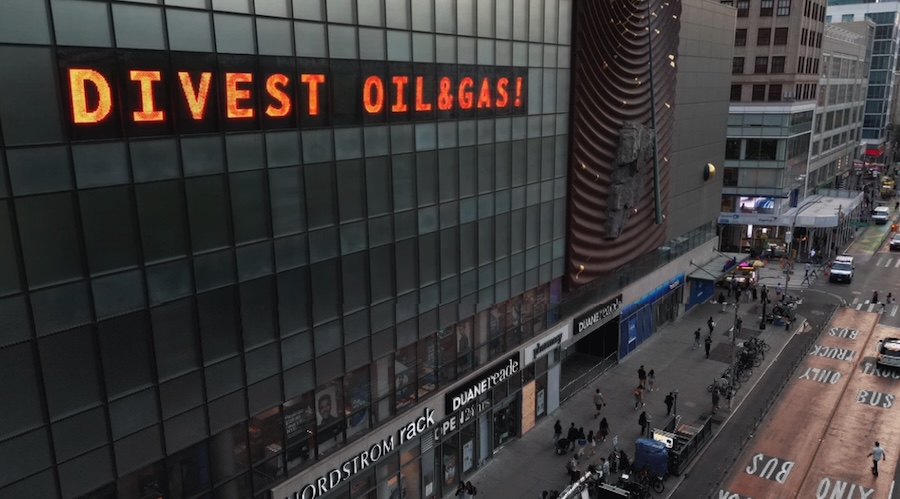
 On the heels of COP28, where world governments finally recognized the need to “transition away from fossil fuels” but failed to acknowledge the inevitable phase-out, the global fossil fuel divestment movement surpassed a major milestone, already leading the way to a fossil free world: 1600+ institutions, representing $40.6 trillion in assets, are cutting ties with the toxic energy of the past.

Swiss pension fund CPEG, the UK’s Wiltshire Pension Fund, and the largest private pension fund in the Netherlands are the latest to join the unstoppable movement. In 2023 alone, major divestment commitments were made by the Church of England, New York University, the National Academy of Medicine, and Triodos Bank.

“This 1600 commitment milestone is an undeniable proof of concept, all thanks to people-powered momentum, even in the face of climate chaos and collective grief,” said Amy Gray, Stand.earth Climate Finance Associate Director and coordinator of the Climate Safe Pensions Network. “Even in times of heartache, we are resolved in our work to hold polluters accountable for climate chaos, and to reclaim, repair, and rebuild healthy and safe communities.” 

From educational institutions and public pension funds, to faith-based and healthcare groups, to governments, nonprofits, and cultural institutions, fossil fuel divestment spans every sector of society, and continues to gain momentum with consistent reports of positive returns following fossil fuel divestment.

(continued in right column)

Question for this article:

Divestment: is it an effective tool to promote sustainable development?

(continued from left column)

Surpassing 1600 fossil fuel divestment commitments would not have been possible without millions of climate justice leaders around the world, countless economic, racial, and climate justice organizations, and steadfast support from Ellen Dorsey, who is stepping down from the Wallace Global Fund, as a long-time leader of the movement.

A June 2023 report from the University of Waterloo revealed that just six U.S. public pension funds would be $21 billion richer  had they divested from fossil fuels a decade ago. 

“This milestone follows years of attempted shareholder engagement, now a proven futile strategy, with fossil fuel corporations hell-bent on our destruction,” said Richard Brooks, Stand.earth Climate Finance Director. “Instead of financing climate chaos-causing fossil fuels, violence, and extraction, financial institutions like big banks and pension funds must protect people and planet alike, cutting ties with fossil fuels and reinvesting in proven community-led climate-safe solutions.”

Not only is a world beyond fossil fuels possible, millions are building it right now – it’s time for fossil fuel companies and their financiers – including major banks like Royal Bank of Canada and Citibank, and private equity firms like KKR – to stop holding us back.

The Global Fossil Fuel Commitments Divestment Database  is managed by Stand.earth, and is the world’s most comprehensive tracker of fossil fuel divestment commitments. 

Stand.earth also coordinates the Climate Safe Pensions Network, a group of 25+ grassroots campaigns across Turtle Island demanding local pension funds protect returns and our climate, phase out fossil fuel holdings, and reinvest in climate-safe solutions.

Stand.earth’s Climate Finance  program focuses on pushing the financial sector to divest from fossil fuel projects and invest in climate solutions, such as renewable energy infrastructure. We’re also pressuring major pension funds throughout North America to pull workers’ money out of fossil fuel companies that violate Indigenous rights and exacerbate the climate crisis, and reinvest in climate-safe solutions.

COP28 Fails to Deliver a Fossil Fuel Phaseout

. . SUSTAINABLE DEVELOPMENT . .

A survey of reactions by major NGOs concerned to the final statement of COP28, United Nations Climate Change Conference

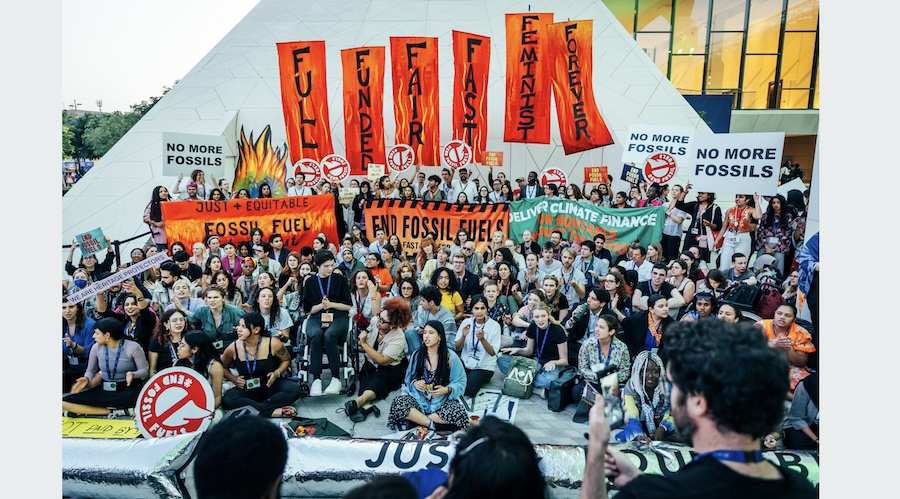
The Climate Action Network headlines “New path to transition away from fossil fuels marred by lack of finance and loopholes.” The text says “COP28 in Dubai sends an important signal on the end of fossil fuels but leaves more questions than answers on how to ensure a fair and funded transition that is based on science and equity. . . Although COP28 recognised the immense financial shortfall in tackling climate impacts, the final outcomes fall disappointingly short of compelling wealthy nations to fulfil their financial responsibilities – obligations amounting to hundreds of billions, which remain unfulfilled.”


(click on image to enlarge)

Friends of the Earth says “COP28 outcome undermined by dangerous distractions and lack of finance . . . (and) enormous loopholes which only serve to prolong the fossil fuel era. . . . “The COP28 deal has fallen short of delivering meaningful commitments on fossil fuel phaseout and urgently needed climate finance. The deal opens the door to dangerous distractions that will prevent a just and equitable energy transition– carbon capture utilisation and storage, hydrogen, nuclear, carbon removal technologies like geoengineering and schemes that commodify nature.”

Oxfam headlines its reaction, “COP28 outcome misses the mark on justice for the majority of the world.” “Everyone fighting against the global climate crisis has little to celebrate from this disappointing COP28. Its final outcome is grossly inadequate. Oil, coal and gas won again, but they had to struggle harder to do so and their era is nearing its end. COP28 was doubly disappointing because it put no money on the table to help poorer countries transition to renewable energies.”

(article continued in right column)

Question for this article:

Sustainable Development Summits of States, What are the results?

(Article continued from the left column)

The Pacific Island States (Alliance of Small Island States, AOSIS), said that the resulting deal falls severely short. ““We see a litany of loopholes,” the AOSIS statement said. “It does not deliver on a subsidy phaseout, and it does not advance us beyond the status quo. . . We do not see any commitment or even an invitation for Parties to peak emissions by 2025.”

Activists of Fridays for the Future demonstrated their displeasure with the results in a demonstration in front of the Swedish parliament. Their spokesperson, Greta Thunberg, said, “This text is toothless and it is nowhere even close to being sufficient to keep us within the 1.5 degree limit. It is a stab in the back for those most vulnerable. It was undemocratic. It was signed when many island states were not in the room. We cannot talk about climate justice without having those affected in the room.”

The Center for International Environmental Law says “COP28 was unquestionably a fossil fuel COP – not because it was hosted in a petrostate, presided over by a fossil fuel executive, and flooded by fossil fuel lobbyists, but because people power and mounting political will led by progressive governments finally put the central cause of the climate crisis at the center of the climate talks.  The test for governments was not just to talk about fossil fuels, it was to act on them, by delivering an unequivocal commitment to end the era of fossil fuels, to leave no loopholes for delay or inaction, and to ensure rich polluters move first and fastest, with real money on the table. They failed profoundly –

Greenpeace says “Although the final text made a call for a transition away from fossil fuels, the outcome of the climate talks failed to produce the words ‘fossil fuel phase out’, resulting in yet another year of lack of accountability for polluters, as the planet moves closer and closer to warming limits. . . . Both weeks of the climate negotiations were spent swatting away the polluting interests of the record high fossil fuel industry representatives in attendance, to the end. Despite rumors and hopes of an early or on time finish from weary summit goers, negotiations went into overtime through Tuesday night, the scheduled last day. The dash to a finish line resulted in a mostly disappointing final text . . .”

The press release of 350.org says “It is frustrating that thirty years of campaigning managed to get ‘transition away from fossil fuels’ in the COP text, but it is surrounded by so many loopholes that it has been rendered weak and ineffectual. The prize is finally on the table – a phaseout of fossil fuels and a world powered by renewable energy – but rather than clearing the way to it, we’ve been presented with yet another set of distracting doors that could still hold oil and gas expansion, and we don’t know just where the finance will come from.”

NGO’s were joined in their criticism by leading scientists.

Tourism as an engine of peace: strategies for sustainable development in Colombia

. . SUSTAINABLE DEVELOPMENT . .

An article from LABARRA

On November 23 and 24, the IV National Congress of Confetur (Confederación de la Industria Turística de Colombia) was held in the city of Bucaramanga. As part of the agenda, Arturo Bravo, Vice Minister of Tourism of the Ministry of Commerce, Industry and Tourism of Colombia, made an important intervention on the strategy of tourism for a culture of peace, promoted by the national government to build the country through tourism.


Colombia peace destinations seal

Among the most crucial points of the conversation, the importance of peace tourism territories, local economic development, purposeful tourism promotion and the construction of a culture of peace around tourism were highlighted. A complete look at a key sector not only in the country’s economic recovery, but also in the construction of peace.

Peace tourism territories: a strategic approach

According to the information presented by Bravo in the congress, the ministry has managed to identify “the tourist territories of peace and 12 subregions at the national level, where of the 170 PDET municipalities, which are the municipalities that have special plans for compliance with the agreements of peace, 88 have a tourist vocation.” These findings have allowed the Government to create a strategy that not only promotes these tourist territories of peace, but also provides tourism entrepreneurs with tools to promote the economic and social development of their regions.

As part of this strategy, the ministry has begun the first phase that involves an investment of 8.2 billion in these territories. Regarding this point, the vice minister highlights that, although it does not seem like an important figure, it corresponds only to the first phase of a project that hopes to mark a significant milestone for the sustainable development of these destinations and tourism in Colombia.

Impact of the conflict on tourism: a historical perspective

Colombia is a country plagued by violence, which for decades has experienced the scourge of political and economic wars, which has permeated all sectors of society. Faced with this problem, Bravo poses a very pertinent question: “How much has been the cost generated by the armed conflict for tourism?”
And from the eighties to 2000, the number of tourists was below 1,000,000, a result precisely of the intensity of the armed conflicts experienced at that time. That situation closed the doors of the country to non-resident visitors in Colombia. However, the achievement of the peace agreements with the United Self-Defense Forces of Colombia and the FARC, presented a notable change.

“With the first peace agreements with the United Self-Defense Forces of Colombia, tourism increased almost 21% (…) When the final agreement was finally signed with the FARC instrument, it rose to 38%.”

For Bravo, this increase may not seem so significant if seen outside of the Colombian context, however, taking into account that the time it took the country to reach these numbers, it is clearly an achievement. “When you see it in that context, in almost two decades we we,t from 1,000,000 tourists to 7,000,000; “It is, without a doubt, an enormous challenge and a great achievement as a country,” he states.

Although the 2020 pandemic brought a significant decrease, as it did throughout the world, the possibility of a new peace agreement with the ELN offers an optimistic horizon of seeking to exceed 7 million tourists by 2025.

Challenges and opportunities in the PDET territories (Development Programs with Territorial Focus )
Faced with this point, the vice minister highlights the cost generated by the armed conflict in the PDET territories. According to the figures he revealed during the congress, there are significant sociodemographic challenges, such as high rates of informality, unemployment and monetary poverty.

“Of the total number of employed people in these territories, 58% are informal, there is an unemployment rate of 12.8%, higher than the national average, and a monetary poverty rate of almost 78%,” he says. Furthermore, according to the vice minister, 50% of the victimizing events are concentrated in these territories.

However, Bravo shared some figures on tourism development in these territories, which show their development potential. “More or less 10% of the country’s total industry is concentrated in these municipalities. In Colombia, there are around 94,000 formal tourism companies, of which only 9,000 are in those territories,” says Bravo.

The vice minister highlights the concentration of service providers in accommodation, pointing out the need to diversify the value chain to include other aspects such as transportation, gastronomy and tourist activities.

“77.43% correspond to accommodation service providers, while only 12% are travel agencies and 1.2% correspond to gastronomic establishments. This means that many aspects of the value chain need to be developed,” but above all, “in these territories there is a need for new entrepreneurial options,” he concludes.

(article continued in right column)

(Click here for the Spanish original.)

Questions related to this article:
 
How can tourism promote a culture of peace?

What is happening in Colombia, Is peace possible?

(article continued from left column)

Peace tourism territories strategy: promoting local development

For the ministry, it was extremely important to create a strategy that promoted sustainable tourism within the framework of the consolidation of peace tourism territories. Thus, its proposal is based on four fundamental axes: the construction of tourist territories of peace, the development of economic opportunities, the consolidation of the culture of peace and the promotion of tourism with a purpose.

Construction of tourist territories of peace

Regarding the first point, Bravo comments that the challenge begins with understanding “what are the capabilities that these territories have” and from there strengthening human talent, improving staffing conditions and working as a network to share common experiences and challenges.

For Bravo, this last point has been vital, especially in terms of international cooperation. An example like that of Cuba, guest of honor of the Congress, is an example of everything that can be achieved in relation to the deepening of commercial and tourist relations.

Economic opportunities

During the congress, Vice Minister Bravo presented the Colombia peace destinations seal, a key element to promote economic opportunities in areas affected by the conflict. The seal, beyond being a badge, is a powerful narrative that carries with it a commitment to peace. Bravo emphasizes the importance of granting this seal to products, services and tourist activities from these areas.

A concrete example occurs in gastronomy: when buying from suppliers in areas of peace or connecting with people who have been signatories of the peace, victims or former victims, the peace seal can be applied. This not only highlights the quality of the products, but also builds a social fabric where everyone contributes to the peace process.

On the other hand, Bravo anticipates the holding of four regional roundtables in these peaceful tourist territories. With this strategic approach, we seek to promote collaboration between local entrepreneurs, promoting the development of direct local trade. This strategy not only benefits the timely development of the tourism product, but also addresses the challenge of the productive chain of tourism, crucial in remote regions of the country.

In a context where positive and ethical narratives are essential, the tourism sector emerges as a key agent for the positive transformation of Colombia.

And precisely, regarding this point, the vice minister was very emphatic about the need to improve connectivity so that the tourist services in these areas can reach tourists effectively. According to the president, connectivity is not only about facilitating access to destinations, but also about connecting strategies between entrepreneurs efficiently. Thus, business efficiency, in this context, becomes a key component for the success of the strategy.

Consolidation of the culture of peace

The third axis, for its part, focuses on the culture of peace, highlighting the importance of working with different ethical principles, especially on issues of historical memory. The objective is clear: to avoid glorifying war, not to repeat the tragedy and, above all, not to repeat victimization.

According to the vice-minister, enhancing memory tourism allows us to tell a different story and rescue what makes these territories great. “There we have to work hard on the construction and strengthening of peace narratives, to avoid negative tourism, and move on to positive tourism, one that does not make us forget, but does help us build towards the future,” he comments.

Tourism promotion with purpose

The fourth axis focuses on purposeful tourism promotion, headed by the implementation of the “Colombia Destinations of Peace” seal. This approach seeks to sell an emotion, a different way of contributing to the national purpose of building peace. The invitation is to actively participate in this initiative, where tourism promotion is not only about destinations, but about telling positive stories of what happened in those territories.

The Vice Minister points out the existence of previous programs, such as Peace and Coexistence tourism, which have already consolidated destinations for the culture of peace. The region of Urabá stands out; they will host the next congress and is presented as a destination of peace. The idea is to take advantage of these advances and consolidated experiences, sharing the lessons learned through networks and inter-institutional cooperation.

(Editor’s note: Regarding Urabá, see the The ‘Island of Enchantment‘: the mysterious island that “appears and disappears” in Urabá)

Without a doubt, the vision presented by Vice Minister Arturo Bravo within the framework of the IV National Congress of Confetur, reveals a comprehensive approach that will allow tourism to be positioned as a catalyst for peace and development in Colombia. The proposed strategy addresses not only tourism promotion and local economic development, but also the construction of a culture of peace through other narratives.

The 3rd Edition of the Biennale of Luanda THEME: “Education, Culture of Peace and African Citizenship as tools for the sustainable development of the continent”

. SUSTAINABLE DEVELOPMENT . .

A media advisory from the African Union

INVITATION TO THE REPRESENTATIVES OF THE MEDIA

What:  The 3rd Edition of the Biennale of Luanda   THEME: “Education, Culture of Peace and African Citizenship as tools for the sustainable development of the continent”

When: 22-24 November 2023, Luanda, Angola.

Who: The event is organized by the African Union and the Government of the Republic of Angola (the National Biennale Management Office) in partnership with the United Nations Educational, Science and Cultural Organization (UNESCO).

Why: The Biennale of Luanda – “Pan-African Forum for the Culture of Peace” aims to promote the prevention of violence and conflict resolution, by encouraging cultural exchanges in Africa and dialogue between generations. It is held every two years in Luanda, the capital city of Angola.

The 34th Ordinary Session of the Assembly of the Union, 6 & 7 February 2021, Addis Ababa, Ethiopia, underlined the Pan-African Forum for the Culture of Peace in Africa – Biennale of Luanda, as a privileged space for the promotion of cultural diversity and African unity, provides a unique platform for governments, civil society, the artistic and scientific community, the private sector and international organisations to discuss and define strategies for the prevention of violence and conflict with a view to building lasting peace in Africa.

(Continued in right column)

Question related to this article:

The Luanda Biennale: What is its contribution to a culture of peace in Africa?

Can the African Union help bring a culture of peace to Africa?

(Continued from left column)

Objectives:

The aim of the Biennale of Luanda for the Culture of Peace in Africa is to work towards a daily and sustainable individual and collective appropriation and implementation, on the continent, of the concept of a culture of peace. 

This initiative reinforces the implementation of Goals 16 and 17 of the United Nations 2030 Agenda for Sustainable Development and the 7 Aspirations of the African Union’s Agenda 2063, in particular its ”Silencing the Guns by 2030″ initiative. 

Background:

The first edition of the Biennale of Luanda, “Pan-African Forum for the Culture of Peace” was held from 18 to 22 September 2019 in Luanda, which was a celebration of various African values, beliefs, forms of spirituality, knowledge and traditions that contribute to the respect of human rights, cultural diversity, the rejection of violence and the development of democratic societies. 

The second edition of the Biennale of Luanda took place from 27 November to 2 December 2021 and was celebrated under the African Union’s 2021 theme, “Arts, Culture and Heritage: Levers for Building the Africa We Want”.

For more information, visit the Biennale of Luanda webpage.

Journalists are invited to cover the 3rd Edition of the Biennale of Luanda.

For further inquiries, please contact:
Ms. Ebba Kalondo | Spokesperson to the Chairperson, African Union Commission | E-mail: kalondoe@africa-union.org
Mrs Christiane Yanrou-Matondo | Principal Communication Officer, Cabinet of the Chairperson | E-mail: Yanrouc@africa-union.org
Ms. Limi Mohammed | Web Administrator, African Union Commission, Political Affairs, Peace and Security Department, Governance and Conflict Prevention Directorate E-mail: shashlm@africa-union.org
Mr. Gamal Eldin Ahmed A. Karrar | Senior Communication Officer | Information and Communication Directorate (ICD), African Union Commission | E-mail: GamalK@africa-union.org

Information and Communication Directorate, African Union Commission I E-mail: DIC@africa-union.org


Web: www.au.int | Addis Ababa, Ethiopia | Follow Us: Facebook | Twitter | Instagram | YouTube

Tourism at the International Day of Peace Has a Double Meaning

. . SUSTAINABLE DEVELOPMENT . .

An article by  Juergen T Steinmetz in E-Turbo News

The International Institute for Tourism will meet in New York this weekend to recognize the International Day of Peace 2023.

Louis D’Amore, the American founder and president of the International Institute for Peace Through Tourism will give the leadership of this organization to Indian native Ajay Prakash, CEO of Mumbai-based Nomad Travels  at a dinner at Kellari Taverna, 19 W 44th Stree, New York on Saturday, September 23, at 6.30 pm -10.00 pm.

The International Day of Peace

Speaking in New York, Ajay Prakash, the president-elect for the International Institute for Peace Through Tourism, stated that 2023 marks the midpoint in the implementation of the Sustainable Development Goals and the celebration of the International Day of Peace 2023 coincides with the  SDGSummit2023 to mark this mid-point milestone.

This year’s theme is “Actions for Peace:

Our Ambition for the #GlobalGoals.”

It is a call to action that recognizes our individual and collective responsibility to foster peace. IIPT was formed 37 years ago with precisely this vision – that Tourism could become a global peace Industry and that every tourist is potentially an Ambassador of Peace.

IIPT has only one purpose – to spread greater awareness of the power of Tourism as a vehicle for Peace. The aim of “Peace through Tourism” is to eliminate, or at least reduce, the conditions that lead us to a perception that violence is necessary.

(continued in right column)

Question related to this article:

How can tourism promote a culture of peace?

(continued from left column)

It’s obvious to everyone that Peace is a prerequisite for the success of tourism, but the converse is equally true and Tourism can also be a powerful force to foster Peace. But to be effective Peace has to be marked by a positive presence, not an absence – it is not simply the absence of war or conflict; it is the presence of tolerance, acceptance of love, and understanding which together address and mitigate the very cause of conflict. As the Dalai Lama said, “Love and compassion are necessities, not luxuries. Without them, humanity cannot survive.”

There is no Planet B for humanity (yet!) and it is imperative to check the acceleration of climate change and the proliferation of conflict. Tourism, as one of the biggest global industries, has the potential to foster a Culture of Peace and to work for the creation of a more equitable and sustainable world.

Let us on World Peace Day pledge to invoke this higher paradigm of tourism. Let us integrate responsibility, sensitivity, and ethics into the core of our business strategy, and let us together pledge to further the role of Tourism as a Force for Good. If each one of us in the industry takes a step in this direction, we have the power to make the change.

Never underestimate the power of one.

A river starts as a drop, a few more drops join and it becomes a trickle, the trickle becomes a stream and finally, it’s a mighty river that sustains life until it goes and meets the sea. That is how movements are born, too. Let us today resolve to work for a more responsible, peace-sensitive tourism.

Ajay Prakash, 
IIPT Global President-elect      

About the Institute for International Peace through Tourism (IIPT)

The International Institute for Peace through Tourism (IIPT) is a not-for-profit organization dedicated to fostering travel and tourism initiatives that contribute to international understanding, cooperation among nations, improved quality of the environment, cultural enhancement, and the preservation of heritage, poverty reduction, reconciliation and healing wounds of conflicts; and through these initiatives, helping to bring about a peaceful and sustainable world. 

‘End Fossil Fuels’ Protests Kick Off Worldwide Ahead of UN Climate Ambition Summit

. . SUSTAINABLE DEVELOPMENT . .

An article by Jessica Corbett from Common Dreams (licensed under Creative Commons CC BY-NC-ND 3.0)

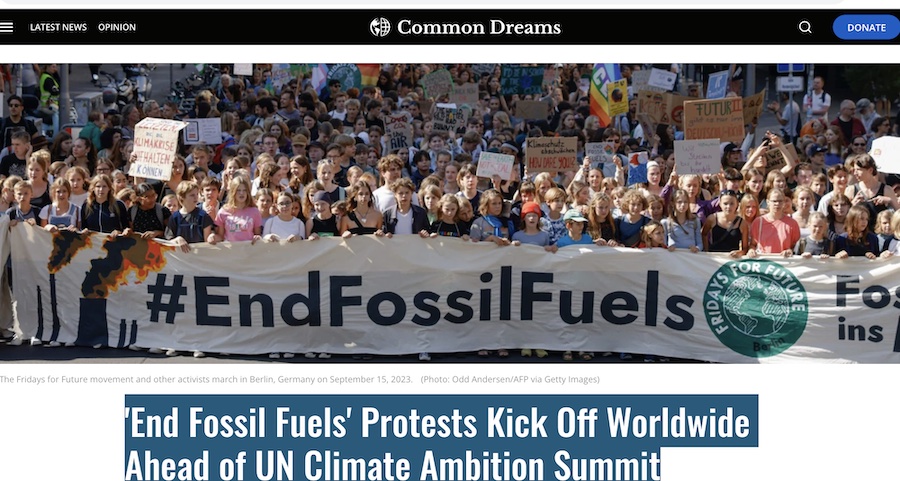
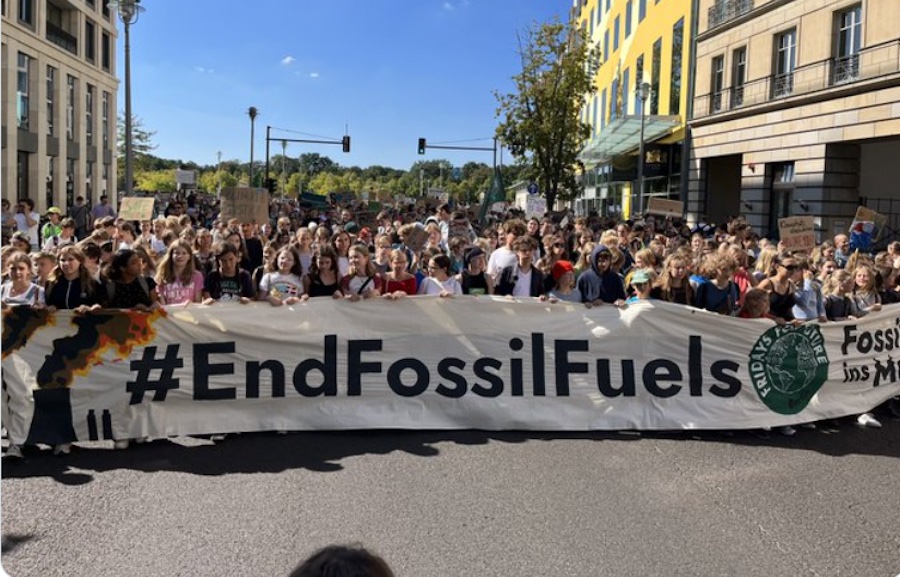
Hundreds of demonstrations around the world demanding “rapid, just, and equitable phaseout from fossil fuels in favor of sustainable renewables” began Friday ahead of United Nations Secretary-General António Guterres’ Climate Ambition Summit in New York City next week.


The Fridays for Future movement and other activists march in Berlin, Germany on September 15, 2023. (Photo: Odd Andersen/AFP via Getty Images)

“From Pacific nations, heavily affected by sea-level rise and storms, through Mumbai to Manila, London to Nairobi, over 650 actions are planned in 60 countries, culminating in a march in New York City on September 17,” according to protest organizers.

The Global Fight to End Fossil Fuels “opposes the fossil fuel industry, which has made obscene profits at the expense of the world’s people, biodiversity, and a safe and livable climate,” added organizers, who expect millions to join the protests over the coming days. “It calls on governments and companies to immediately end fossil fuel expansion and subsidies.”

Demonstrators, journalists, and supporters shared footage from Friday’s actions on social media with the hashtag #EndFossilFuels.


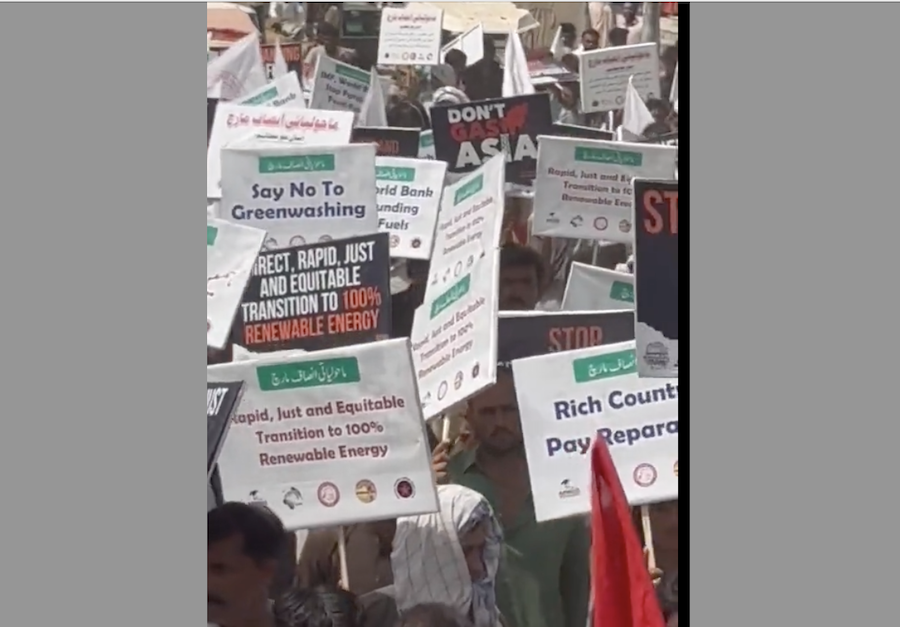
Protest in Pakistan


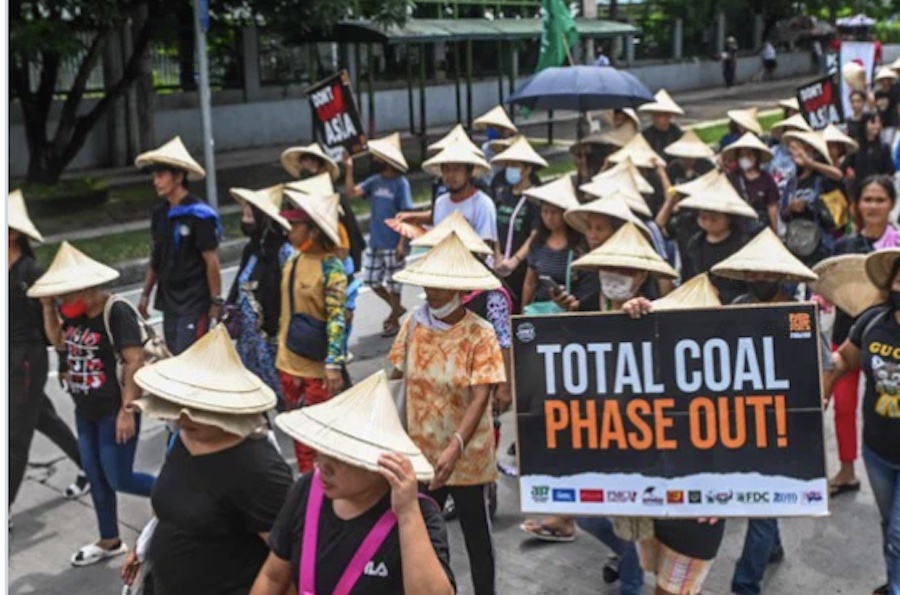
Protest in Philippines

The actions come amid the hottest  summer on record and as experts continue to sound the alarm over unwavering environmental destruction, especially by the fossil fuel industry and its political and financial backers.

International scientists revealed  this week that six of nine barriers that ensure Earth is a “safe operating space for humanity” have been breached, which followed recent findings  that greenhouse gas concentrations, global sea level, and ocean heat content hit record highs last year.

Climate chaos—fueled by oil and gas giants that have spent decades lying about their planet-heating pollution along with rich governments and institutions that continue to break their promises and pump billions of dollars into the fossil fuel industry—is already killing people. The death toll from flooding in Libya this week has climbed to 11,300.

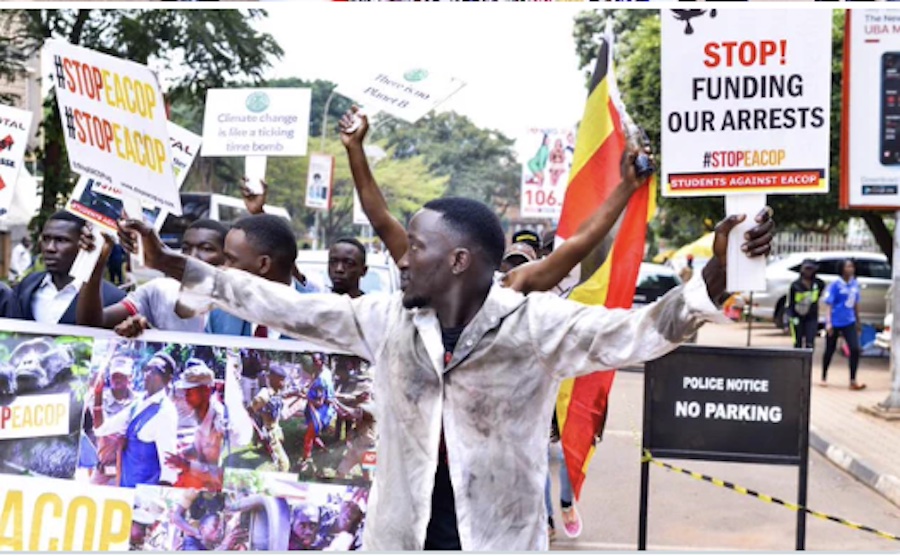
Protest in Uganda

Protest in Berlin

(article continued in right column)

Question for this article:

Despite the vested interests of companies and governments, Can we make progress toward sustainable development?

Are we seeing the dawn of a global youth movement?

(Article continued from the left column)

“The world is at a tipping point,” said Tyrone Scott of the War on Want and the Climate Justice Coalition in the United Kingdom ahead of protests this weekend. “Climate catastrophe is already devastating the lives and livelihoods of people across the world and primarily those in the Global South, who are least responsible for causing it.”

“We must uproot the systems of exploitation and oppression which keep the majority of the world’s population in poverty while lining the pockets of corporates and rich shareholders. This is a watershed moment. How we respond will determine how the world is shaped for generations,” Scott stressed. “We demand an end to fossil fuels. We demand a fast and fair transition. We demand climate justice.”

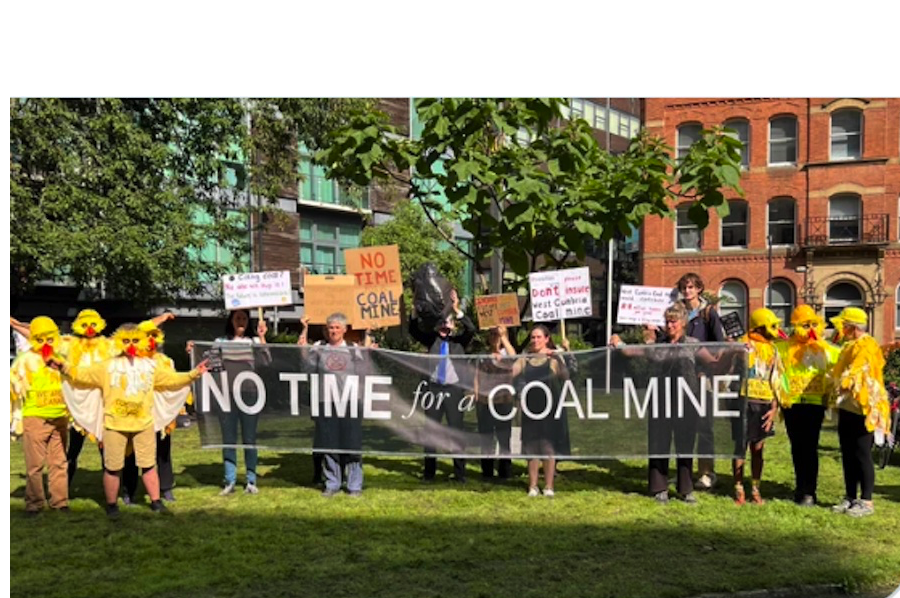
Protest in Manchester, UK

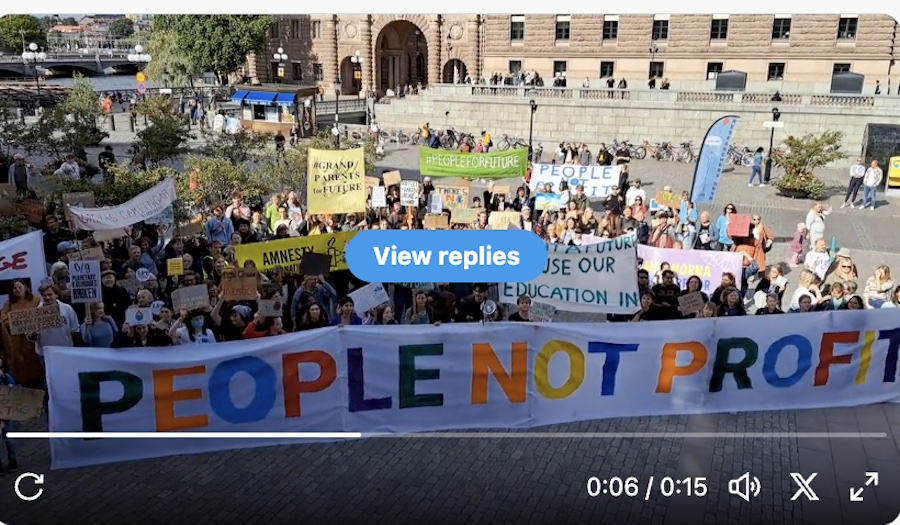
Protest in Stockholm

Tens of thousands of activists from across the United States are expected to join the March to End Fossil Fuels in New York City on Sunday. Marchers—backed by hundreds of organizations and scientists—have four key demands for President Joe Biden:

° Stop federal approval for new fossil fuel projects and repeal permits for climate bombs like the Willow project  and the Mountain Valley Pipeline;

° Phase out fossil drilling on our public lands and waters;

° Declare a climate emergency to halt fossil fuel exports and investments abroad, and turbocharge the buildout of more just, resilient distributed energy (like rooftop and community solar); and

° Provide a just transition to a renewable energy future that generates millions of jobs while supporting workers’ and community rights, job security, and employment equity.

“Despite his numerous and explicit pledges to the contrary, President Biden has turned out to be a strong supporter of fossil fuels,” Food & Water Watch  Northeast region director Alex Beauchamp, an organizer of the NYC march, said in a statement Friday.

“With each passing day, Biden’s failure to lead on clean energy drives the planet deeper into the abyss of irrevocable climate chaos,” he added. “We’re marching to send a message that true climate leadership means halting new oil and gas drilling and fracking, and rejecting new fossil fuel infrastructure like pipelines and export terminals—beginning now.”

Betamia Coronel, senior national organizer for climate justice at the Center for Popular Democracy, highlighted  in a Friday opinion piece for Common Dreams that “BIPOC communities have always lived at the intersection of wealth disparity and the climate crisis,” and “it is Black, Indigenous, immigrant, working-class people of color who have been leading the efforts in the lead up to this historic march in NYC.”

Dozens of actors, activists, and climate leaders—including Bill McKibben, Blair Imani, Cornel West, Jameela Jamil, Jane Fonda, Rev. Lennox Yearwood Jr., Mark Ruffalo, Naomi Klein, Rosario Dawson, Rep. Rashida Tlaib (D-Mich.), Rebecca Solnit, and Vanessa Nakate—joined more than 700 groups on Friday in sending a pre-march letter to the U.S. president.

“The U.S. is the top global oil and gas producer and the largest historic greenhouse gas emitter. It is imperative that the U.S. change course and become a true global climate leader by ending the extraction and use of fossil fuels,” they wrote, urging Biden to commit to phasing out fossil fuels at the U.N. summit on September 20. “The world is watching.”

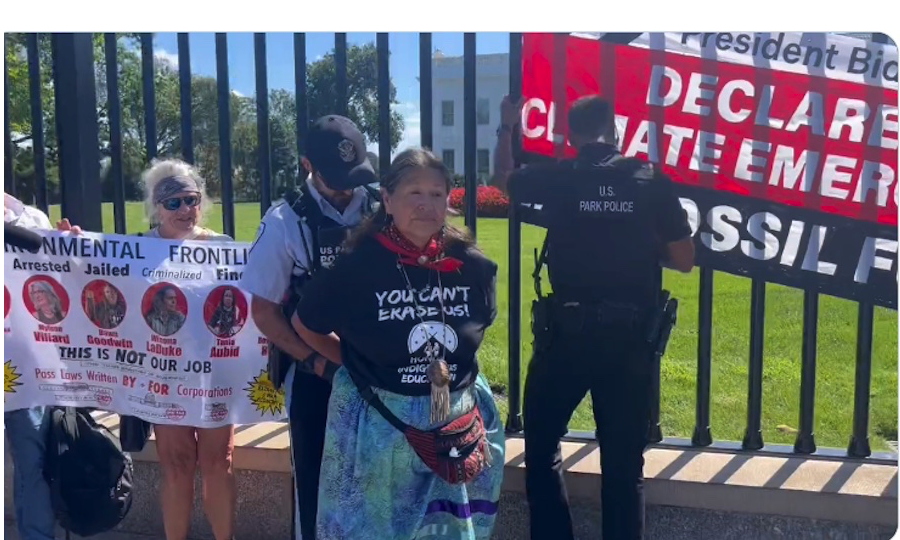
Biden has also faced mounting pressure to declare a climate emergency this year, as the United States has endured a record-setting number of billion-dollar disasters, from a deadly fire in Hawaii to Hurricane Idalia. Since last week, eight campaigners have been arrested outside the White House for a series of protests demanding a climate emergency declaration and other executive action to end the era of fossil fuels.

Protest in Standing Rock, USA

Organizers planned to continue the nonviolent civil disobedience campaign in Washington, D.C. on Friday, and warned that “each day Biden delays in taking this step is precious time lost to save lives and secure a livable future for humankind and countless other species.”

Africa Climate Summit Issues Nairobi Declaration

. SUSTAINABLE DEVELOPMENT . .

An article by Abayomi Azikiwe (editor of Pan-African News Wire) published by the Transcend Media Service

Despite statements of intent, western industrialized countries have not yet provided the resources needed for the transition to renewable energy production which benefits the majority of people on the continent

Nairobi, Kenya, the commercial center for the East Africa region, hosted the Africa Climate Summit which attracted thousands of delegates, investors and observers to discuss the worsening plight of the continent as it relates to environmental degradation.


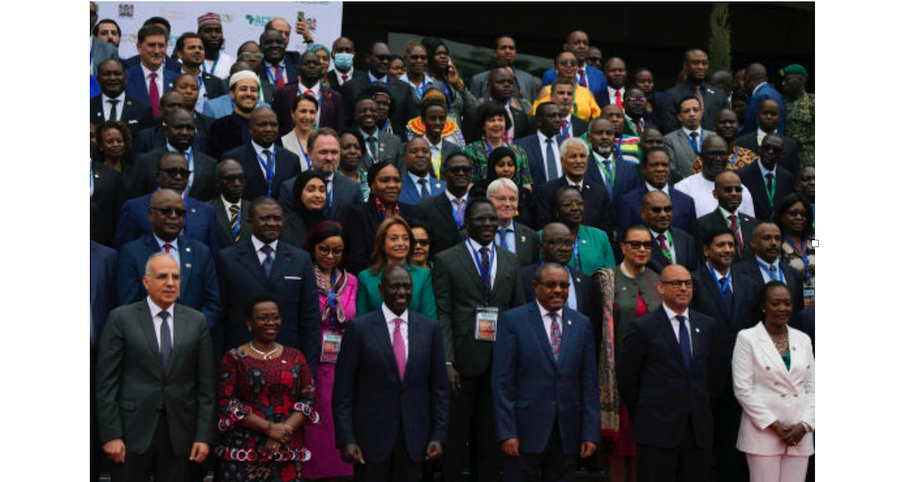
Head of states and delegates pose for a group photo, during the official opening of the Africa Climate Summit at the Kenyatta International Convention Centre in Nairobi, Kenya, Monday, Sept. 4, 2023.(AP Photo/Khalil Senosi)

The meeting was scheduled from September 4-8 at the Kenyatta International Convention Center (KICC) where registered delegates from governments and non-governmental organizations articulated their views on what is needed in the present period to avert an even larger climate disaster for Africa’s 1.3 billion people.

This summit was held under the theme, “Africa Climate Summit 2023: Driving Green Growth & Climate Finance Solutions for Africa and the World.” The governmental leaders met for three days while the entire week was dedicated to the current situation and potential solutions.

Outside the ACS, there were thousands more representing coalitions, traditional communities and mass groupings, many of which were critical of the gathering and the way in which western governments, multi-national corporations and international financial institutions are seeking to dominate the dialogue on Africa climate issues and economic development. A host of delegates were present from the United States and the European Union (EU) making pledges to assist the AU member-states in halting the impact of greenhouse gas emissions and other pollutants.

In the language for the summit overview, it states that:

“The inaugural Africa Climate Summit, championed by HE President [William] Ruto, aims to address the increasing exposure to climate change and its associated costs, both globally and particularly in Africa. With the expectation of escalating climate crises in terms of frequency and intensity, urgent action is required to mitigate these challenges. The Summit will serve as a platform to inform, frame, and influence commitments, pledges, and outcomes, ultimately leading to the development of the Nairobi Declaration.”

However, the previous commitments made by western states and multinational corporations have not yet been honored. The purpose of the ACS 2023 was to reach a consensus among African governments on a program to be taken to the United Nations Climate Summit (COP28) which will be held in the United Arab Emirates (UAE) in December.

The adoption of the Nairobi Declaration was designed to position the AU member-states in their negotiations within the broader international community. Nonetheless, it remains to be seen how the AU can either convince or force the industrialized capitalist states to provide the necessary reforms that will turn the tide towards green and sustainable energy.

During the ACS it was acknowledged by the AU member-states and some corporations that Africa is one of the least responsible regions for the rise in global warming. Consequently, the continent requires assistance in preventing further extreme weather events, droughts and the subsequent food deficits which are plaguing various regions of East Africa.

(article continued in right column)

Question for this article:

Can the African Union help bring a culture of peace to Africa?

(article continued from left column)

An article published  in the French newspaper Le Monde on the ACS noted:

“The declaration called for ‘concrete action’ on reforms that lead to ‘a new financing architecture that is responsive to Africa’s needs’, including debt restructuring and relief.

Ruto said it was time to overhaul global financial systems that ‘perpetually place African nations on the backfoot. We demand a fair playing ground for our countries to access the investment needed to unlock the potential and translate it into opportunities,’ he said. Leaders also pressed the world’s wealthy polluters to honor their pledges, including to provide $100 billion a year for clean energy and to help them brace for climate disasters.”

Defeating Climate Change Requires a Struggle Against the Current World Order

As long as the multinational corporations and banks can earn enormous profits under the existing economic system, the realization of change will require organized pressure from the AU member-states and their constituencies. This ACS gathering was not the first time that these demands have been put forward to the leading imperialist states.

When Republic of South Africa President Cyril Ramaphosa paid a state visit to the U.S. nearly one year ago, he emphasized that his country along with others on the continent would need billions of dollars to address the goals set by the annual United Nations Climate Summit. Every year, the U.S., U.K. and the EU are able to veto significant resolutions at the COP meetings which would place definite responsibilities on the imperialist states.

During 2022, when the COP27 Summit was held in Egypt, a host of promises were made by the imperialist states which have yet to be fulfilled. Yet one year later, these same economic and political interests continue to pretend that they will make amends for their industrial and agricultural policies which are the main contributors to the rise in pollutants.

The New York Times wrote a report  on the ACS pointing out that there are serious questions being raised by people in Kenya about the effectiveness of the Nairobi Declaration:

“Outside the halls of the convention center, Kenyans were asking tougher questions about whom the conference and its lofty goals really served. ‘The energy discussion masks our economic crisis,’ said Mordecai Ogada, an author and a leading Kenyan voice on environmental issues. ‘Yes, we get most of our electricity from renewables. But we pay foreign companies to generate that power exorbitantly in foreign currency,’ he said. ‘Manufacturing has become expensive, which drives inflation. As far as the lives of Kenyans are concerned, the source of energy is completely immaterial.’”

In Kenya over recent months, the government of President Ruto has lifted fuel subsidies and raised taxes on essential goods. The hardships caused by these measures sparked demonstrations which were organized by the political opposition in the country. In real terms, the Kenyan national currency has lost one-third of its value over the last two years.

The overall global crisis prompted by the COVID-19 pandemic and its consequences are largely to blame for the sharp rise in prices. Therefore, to insulate the people of Africa from external shocks, there must be a radical shift in the international division of labor and economic power which has reinforced the dependency inherited from the colonial system.

Africa News quoted a participant  in the demonstrations involving thousands outside the ACS 2023 meeting. This activist called Babawale from the Friends of the Earth Africa said:

“We are here to demand that Africa’s energy system must be de-colonized, it must be brought out from the hands of the culprits, it is time for the African people to stand together and make a demand, that what we need now is systems change, not climate change, what we need now is that Africa’s energy systemic must be de-colonized. It should be put in the hands of people, this is not the time that we should promote carbon markets it is not going to put to an end the different climate crisis that Africa is facing.”

During the demonstrations by civil society and mass organizations surrounding the Kenyatta International Convention Center, people carried banners which read: “Stop the neo-colonial scramble for oil and gas in Africa.” In Kenya alone, the government would need approximately $US62 billion to address the necessity of reducing emissions which contribute to climate change.

AU member-states overall would require an estimated $US290 billion to $US440 billion to achieve the same objectives. These resources will not be given by the imperialist states absent of a protracted campaign for climate justice and a sweeping redistribution of wealth on a global scale.

Indigenous trade unionists from around the world call for more inclusion and solidarity: “We are not just there to sing the songs and do the opening prayer”

… . HUMAN RIGHTS … .

An article from Equal Times (published under a Creative Commons Attribution-NonCommercial 4.0 International licence)

More than 476 million people worldwide (6.2 per cent of humanity) belong to Indigenous peoples, most of whom live alongside the societies that colonised their ancient lands hundreds of years ago. In the 21st century, after a long journey during which they were not always able to survive colonial oppression without losing their identity, language or part of their culture, Indigenous peoples have won significant gains in various regions of the world but they continue to face challenges such as discrimination and limited opportunities, making it very difficult for them to enjoy fair labour market integration. Four out of five Indigenous workers earn a living from informal employment, and the remainder most often work in highly precarious sectors, without any form of social protection, where they are exposed to all kinds of rights abuses.

To mark the International Day of the World’s Indigenous Peoples, established by the United Nations in 1982, and to coincide with the call made by the ITUC for governments around the world to sign up to the Indigenous and Tribal Peoples Convention (C169) of the International Labour Organization (ILO) – which, despite being launched in 1989, has only been ratified by 24 countriesEqual Times interviewed three Indigenous trade union leaders from three continents.

 Māori, Sami and Mapuche trade union leaders talk to Equal Times. From left to right: Laures Park (New Zealand), David Acuña (Chile) and Sissel Skoghaug (Norway). (Equal Times/Composition by Fátima Donaire)

David Acuña Millahueique, the president of CUT Chile, the main trade union organisation in his country, speaks to us from the Americas. Acuña, who became the first leader of Mapuche origin to head the union a year ago, is currently involved in the historic process of developing a new constitution for Chile and the CUT is working to ensure that it enshrines freedom of association and decent work as fundamental rights in a country where the current constitution, in force since the military dictatorship (1973-1990), still does not provide for labour rights. Sissel Skoghaug, vice president of Norway’s LO union confederation for the past decade and a representative of the Sami people, the ancient nomadic ethnic group of the Arctic and the only Indigenous people left on the continent, joins us from Europe. And from Oceania, we speak to Laures Park, who holds the position of Matua Takawaenga (Māori for “chief mediator”) with the New Zealand teachers’ union NZEI Te Riu Roa, where she is not only the main focal point for all matters relating to the Indigenous people of the island nation, but is also the acting union leader when the national secretary is absent, which is also seen as a symbolic gain for the Māori.

What is the current situation of the First Nation peoples in your country, in terms of social and labour integration or discrimination?

LAURES PARK (L.P.): In New Zealand there is still discrimination. There are lots of concerns, but there’s lots of integration as well. It depends on socioeconomic and geographical conditions. The Māori, who are about 12 per cent of the national population, tend to fill the lower paid labour-intensive jobs. They tend to be cleaners, rubbish collectors and landscape gardeners – those kinds of jobs. And yes, there are also a lot of Māori that move to the city and get jobs in the public service, but you have to move to get that kind of work. Poverty-wise, that’s probably very high for Indigenous people in New Zealand, and that’s because of poor access to education where they live, as well as lack of employment.

SISSEL SKOGHAUG (S.S.): So much injustice has been done to the Sami people. The authorities almost managed to rob an entire people of their identity and their language. As the Truth and Reconciliation Commission recently concluded, this also applies to the Kven people and the Forest Finns. [But] especially in Norway and parts of Sweden, the Sami culture has been experiencing a very strong renaissance over the last four decades. Young people, and also quite a few in my generation, are taking back the heritage that was lost two or three generations back.

DAVID ACUÑA MILLAHUEIQUE (D.A.M.): The labour situation of people of Indigenous origin comes from the forced integration of the Indigenous society into the dominant society of the colonisers. Before reaching the situation we have now, there have even been periods of slavery, which initially involved working for a very basic income as day labourers, apprentice carpenters, bricklayers or bakers, for example. Many of those who migrated from rural to urban areas worked in these trades, while the majority of the Indigenous women worked as domestic and care workers. Today, a large percentage of the new generations have achieved access to various levels of formal education, so we have moved on from the worker who formerly did not know how to read or write to the literate workers of today, enabling a minimal level of social mobility in some cases.

What about the acknowledgment and respect for First Nation cultures, languages and rights, and their integration in the work environment?

S.S.: Nowadays, in Norway we have the Sami Parliament (Samediggi), established in 1989. That is the representative body of the Sami people in the country, and it promotes political initiatives and has authority on a number of issues. At the same time, the main Sami language is also an official language in Norway. Much more has been achieved since assimilation and discrimination was the official order of the day.

L.P.: In New Zealand it goes from one extreme to the other. There is a whole sector of the population that doesn’t even know about it or doesn’t care, because Māori don’t have anything to do with their lives. But there is also another part of the population that is learning the language and participating in the customs, and is very much part of all the things that happen in the education system [where there are a number of selected schools where the Māori language is taught to everyone since early childhood].

There is a whole generation of Māori who only speak Māori, and their families only speak Māori when they are out and about, and this can cause a bit of stress with other people, mainly white people. But on the other side, when we’re downtown, other people are delighted to hear Māori being spoken out in the community. So it varies. You get some people that see it as: “Oh, God, you’re trying to hide something from us,” and other people who think that’s just lovely to hear it. And we have a Māori television channel, and the number of non-Māori who watch it is just incredible. So, as I say, [the situation] varies.

D.A.M.: In Chile, the process of Indigenous integration has been strongly marked by social discrimination and also, in many cases, employment and racial discrimination, which have led to irreparable cultural losses, such as the use of our own mother tongue, especially as of the third generation [of Mapuche people who settled in the cities in the mid-twentieth century]. We were migrants in our own land, because we had to go to the more developed cities, and we lost everything from our language to our customs with these migration and integration processes.

The first generations of Indigenous migrants had to adjust to a new way of life, and of course, they had to behave like Chileans, and ended up “half-Chileanised”, often trying to hide or disguise their Mapuche ancestry, and little by little this began to take hold, to the extent that people even avoided using their own language and customs, all in an attempt to adopt the traits of a society that was not our own and steadily adapt to it. It has only been as of the fourth generation, to which I belong, that we began to see a gradual process of self-identification with our origins. Over the last five or six years, there has also been a reclaiming of the Mapuche flag itself, which became visible in 2019 with the social uprising, during which one of the most popular and most visible symbols in the protests was the Mapuche flag. There was almost a commercial boom, the Mapuche flag was suddenly selling so well. That showed that we were recognising an identity that we had lost until then.

(Article continued in right column)

(Click here for the French version of this article, or here for the Spanish version .)

Question(s) related to this article:
 
The right to form and join trade unions, Is it being respected?

Indigenous peoples, Are they the true guardians of nature?

(Article continued from left column)

Has your country ratified the ILO’s Indigenous and Tribal Peoples Convention (C169), from 1989? How does that affect the current First Nation peoples’ life in the country? How important is C169 for your people?

S.S.: In 1990, Norway was the first country to ratify the ILO’s Convention 169. I am proud of LO Norway’s role in making ILO 169 happen, and making it happen first in our own country. Alongside the Constitution and the Sami Act, ILO’s Convention 169 is one of the central pillars of the Norwegian Sami policy. ILO 169 is a monument to the collective spirit of cooperation that characterised Norway at the start of the 1990s. This collective spirit also carried the majority population through a rough period of unemployment and financial and political turmoil.

L.P.: In New Zealand the government has not ratified it, and their explanation is that our new laws need to comply with a lot of other previous laws before they ratify it. That doesn’t change things for us. If we want to make a point, we will still use the C169 and it still holds weight. In some ways, [the fact that New Zealand hasn’t ratified C169] probably supports our argument.

D.A.M.: Yes, Chile ratified it in 2008. By doing so, the state of Chile committed to a state policy of recognition for Indigenous peoples and pledged to establish policies of recognition and respect for this section of society. When national policies are developed that may affect the social, cultural, political and environmental conditions in which Indigenous communities live, we always end up with a consultation. That’s as far as we have got for now, but it is an important achievement, because it is a tool that gives Indigenous communities a voice in what directly impacts on them, and that’s something we didn’t have before.

Why did you join a union, what difficulties did you find in your working environment and in the unions themselves, just for being Indigenous?

L.P.: I joined when I was a teacher. Many years ago, we were talking about how to encourage Māori people to become interested in trade unions. That’s when it became a lot more relevant for me. And since then, that’s been the push – to make sure that unions work for Māori.

We have a saying, that was said by a very old tipuna [ancestor]: “There is but one eye of the needle through which all threads must pass: the white, the red, the black.” For our union, that actually is exactly the sentiment that we think people should embrace, because only by joining together and going in the same direction can we make things work. Otherwise, we’re pulling against each other.

D.A.M.: I’ve been working since I was 17; I had to support my family from a very young age and I’ve always been closely linked to work. When I was getting to know the trade union world, one day a union came to look for representatives at the supermarket where I was working, and there were two colleagues who put themselves forward as union reps. Three could be elected, and these guys had no class consciousness, let’s say, they were not very pro-worker, they were more pro-management, they were very close to the company. So, I said, “No, if we want to fight for labour rights, we need to have agreements with the company, but also disagreements and to fight for the rights we believe in.” It was time, a decision, to say: “Either I keep watching everything stay the same, or I make some kind of change,” and I chose to make a change, with all the sacrifices this also entails.

Given the leadership position that you have reached in your organisation, what does that symbolise for you and the continued struggle for Indigenous rights?

D.A.M.: It is a source of pride for me and my family. My first May Day as president was a personal milestone for me. That day, I acknowledged my identity, I said: “I am a retail worker, I am Mapuche and I come from an Indigenous community in Lleulleu, in the Los Ríos region.” More than a trade union leader, I see myself as a worker and, today, I also strongly recognise my historical legacy: that my mother was a migrant from the south of Chile to the capital, and that we lost our language, we lost part of our culture, but we did not lose our attachment to the territory. Recognising this is very important to me, because I feel proud to be representing, in this role, a people as combative as the Mapuche people were and are today in their territorial claim, which is still pending.

S.S: I have in later years discovered that my own family lost most of our Sami and Kven identity, including the language, as a result of the many decades of Norwegianisation policy. But we are taking back our heritage, with my daughter and son leading the way with language studies and much more. In my public appearances, I am very proud to be wearing the gakti (Sami traditional dress), which I recently had made. I feel that this process in itself is a victory over the injustice that was done.

How can the trade unions better help the Indigenous and First Nation peoples reach real integration in the working world?

D.A.M.: With solidarity and respect. Respect for identity, for beliefs, but also solidarity, inclusion within the world of work.

S.S.: We will look into what we in LO Norway can do to help combat racism, like we have done in the workplace. So far, in the working world, LO Norway has been a strong advocate for the legislation against discrimination now in place in Norway. Thanks to that, nowadays employees and job applicants enjoy equal opportunities, regardless of their ethnicity, religion, sex or responsibilities as caretakers. All Norwegian employers are obliged to work actively, in a targeted way and systematically, to promote equality and prevent discrimination in the workplace, according to the Equality and Anti-Discrimination Act. This employer activity duty is a preventative work that employers are expected to do before incidents of discrimination occur.

L.P.: Trade unions could change themselves internally and employ more Indigenous people in their organisations. And they shouldn’t be afraid to promote these things amongst the affiliates; at the moment it is seen a little bit as window dressing. But we all belong to this country, so we all should be doing the same thing across the board, not just letting people maybe be inclusive or maybe just say, and this is me being rude: “Go over there and play with your marbles while we get on with the real work over here”. Trade unions need to be more inclusive and more promotional about First Nations, so that we are not just there to sing the songs and do the opening prayer.

How can First Nation peoples contribute, with their particular sensibilities, culture and experiences, to the current global debates about just transition, social justice, labour and human rights and the democratic health of our societies?

D.A.M.: In Chile, the Indigenous peoples come from a culture of struggle that calls for many rights that were taken from them: the right to land is one of their main demands, but there are also the ancestral cultures, especially ancestral medicine, which now forms part of the entry of Mapuche culture into society in a way that was inconceivable before, because there has been, over the last 15 or 20 years, a cultural shift that has allowed the culture of the Indigenous peoples to re-emerge. Today almost every district has a Mapuche ruca, a ceremonial centre for gastronomy, culture and traditional medicine, such that, beyond a flag and a combative tradition, what is also emerging is an ancestral culture that speaks of solidarity, inclusion and participation, respect for elders and for one’s own body.

S.S.: I think we need to go back to that spirit of cooperation that characterised Norway at the start of the 1990s. We live again in a time of crisis and a lot is at risk. The polarisation we see both in the world and in our part of it gives room for forces that do not wish neither minorities, nor majorities or democracies well. Rights that have been won will not automatically be there forever. The fight is never over. We know all about this in the labour movement.

L.P.: When I think about just transition, and particularly climate change as well, I think Indigenous people or First Nations people have a lot to offer. But the powers that be don’t ask. For example, when you think about areas that are now suffering from drought and lack of water and so on, Indigenous people in Australia have lived like that for years. So, how come people don’t talk to them? About how you survive in those situations? And what is it that you bring to the table about those conversations? There are ways of doing things wisely, sustainably, that Indigenous people have always done, that they will continue to do. There’s a whole lot of that knowledge that First Nations hold and probably just use it like the everyday life common sense that it is for them. If anybody bothered to investigate or talk about it, I think First Nations have a lot to offer, but one: do they have a voice? And two: do people listen to what they have to say?