Pope Francis denounces nuclear weapons possession

DISARMAMENT & SECURITY .

An article from Abolition 2000

On Friday Nov 10, Pope Francis denounced the possession of nuclear weapons, in what appears to be a departure from the Roman Catholic Church’s position of conditional (and temporary) acceptance of nuclear deterrence and mutually assured destruction.

Video of Pope’s address to conference

In a presentation to participants in a high-profile Vatican conference on nuclear disarmament, including representatives of Abolition 2000 member-organisations and affiliated networks, Pope Francis said that ‘humanity cannot fail to be genuinely concerned by the catastrophic humanitarian and environmental effects of any employment of nuclear devices. If we also take into account the risk of an accidental detonation as a result of error of any kind, the threat of their use, as well as their very possession, is to be firmly condemned.”

‘Pope Francis is taking a pro-active approach toward nuclear disarmament which is to be commended, celebrated and supported’ says Alyn Ware, Co-convener of the Abolition 2000 Interfaith working group and a participant in the conference. ‘This should give encouragement to people of all faiths – and also non-religious people – to feel new hope and to be inspired to act for nuclear abolition.’

Pope Francis did not directly criticize world leaders such as U.S. President Donald Trump, who has openly threatened nuclear war with North Korea over that country’s continuing development of nuclear arms. However, he remarked that “International relations cannot be held captive to military force, mutual intimidation, and the parading of stockpiles of arms. Weapons of mass destruction, particularly nuclear weapons, create nothing but a false sense of security. They cannot constitute the basis for peaceful coexistence between members of the human family.”

While previous popes have strongly called for the abolition of nuclear weapons, in general they also granted conditional moral acceptance to the system of nuclear deterrence. Pope John Paul II, for example, said in a message to the U.N. in June 1982 that the system of deterrence could be judged “morally acceptable” as “a step on the way toward a progressive disarmament.”

The exception was Pope Benedict XVI who also condemned the possession of nuclear weapons: ‘One can only encourage the efforts of the international community to ensure progressive disarmament and a world free of nuclear weapons, whose presence alone threatens the life of the planet and the ongoing integral development of the present generation and of generations yet to come’.

Jonathan Granoff, President of the Global Security Institute, proposed that Pope Francis turn his condemnation of nuclear weapons into church doctrine by including this in a papal encyclical. The encyclical Pacem in Terris released by Pope John XXIII, accepts nuclear weapons as a deterrent. The encyclical Laudato si, released by Pope Francis in 2015, notes the risks of nuclear weapons but does not condemn possession outright.

(Continued in right column)

Question related to this article:

Can we abolish all nuclear weapons?

(Continued from left column)

“The church should be saying the ethic of nuclear deterrence is not morally warranted any longer,” said San Diego Bishop Robert McElroy, who also serves as a member of the U.S. bishops’ committee on international justice and peace. McElroy pointed to the fact that the conditional acceptance of deterrence was given with the understanding that the nations of the world would gradually move to disarm.

The Vatican conference, brought together Nobel Peace laureates, government representatives, religious leaders, United Nations officials, academics, and non-governmental representatives.This included leaders from ICAN, which is the 2017 recipient of the Nobel Peace Prize for their actions to promote and achieve the treaty.

Cardinal Peter Turkson, the head of the Vatican dicastery, said that the participants at the event had gathered “for a very candid conversation about how to achieve a world free of nuclear weapons. This conversation is urgently needed, given the current tensions among nuclear weapons states and given the tensions between nuclear weapons states and states seeking to become nuclear weapons states.”

The new Treaty on the Prohibition of Nuclear Weapons was a key topic at the conference. Many of the participants commended the Vatican for being one of the three signatories that have already ratified the agreement. However, it was also recognised that none of the nuclear powers and no NATO members have signed on to the measure.

Mexican Ambassador Jorge Lomonaco, one of the leaders of the initiative to achieve the treaty, said that the treaty was one of the ‘jigsaw pieces of the framework required to achieve a nuclear-weapon-free world.’ He noted that this is a contribution that non-nuclear States have made. He urged everyone to move beyond divisions about the treaty – to end the debate on whether one supports it or not – and work now on the other pieces of the jigsaw, especially those pieces requiring action by the nuclear-armed and allied states.

Cardinal Pietro Parolin, the Vatican’s Secretary of State, told the conference their considerations were taking place during a “decidedly disheartening state of affairs” across the world.

‘In such a fractious and uncertain world there are many voices that contend the time is not ripe for disarmament and that weapons provide security. There is an insinuation that disarmament is a utopian dream,’ said UN High Representative Izumi Nakamitsu. ‘However, I believe that quite the opposite is true. In a fractious and uncertain world, more than ever we need disarmament as a diplomatic key to unlock the door to peaceful solutions.’

Cardinal Parolin noted that 2017 marks the 50th anniversary of Pope Paul VI’s encyclical Populorum progressio, which proposed that the world’s governments set aside a portion of their military spending for a global fund to relieve the needs of impoverished peoples. Paraphrasing the encyclical, Parolin stated: “Is it not plain to everyone that such a fund would reduce a need for those other expenditures that are motivated by fear [or] stubborn pride? Countless millions are starving. We cannot approve a debilitating arms race.”

“Nuclear armament is never an appropriate policy to achieve a long-term basis for peace,” said Cardinal Turkson. “And true security is not found in the size of our military or the number of weapons we possess, but when every human need for food, for housing, for healthcare, for employment and dignity is met — that’s when we begin to fashion peace.”

A number of Abolition 2000 member-organisations are active in the Move the Nuclear Weapons Campaign which acts to cut nuclear weapons budgets and re-direct these resources for social, environmental and economic needs. This includes actions in legislatures of the nuclear-armed States to slash nuclear weapons budgets. It also includes actions that can be taken by governments, cities, churches, universities, banks and others to end investments in corporations manufacturing nuclear weapons See Abolition 2000 working group on Economic Dimensions of Nuclearism.

USA: Fearing Trump, Congress Holds First Hearing in Decades on President’s Nuclear Authority

DISARMAMENT & SECURITY .

An article by Jessica Corbett in Common Dreams (reprinted according to provisions of Creative Commons Attribution-Share Alike 3.0 License)

Despite Sen. Bob Corker’s (R-Tenn.) insistence that the congressional hearing on Tuesday about the authority to use nuclear weapons “is not specific to anybody,” it is the first hearing on this topic in decades, and comes at a time when U.S. President Donald Trump seems to have made a sport out of taunting North Korea’s leader as his nation advances its nuclear abilities.


Youtube video of Congressional hearings

Even before Trump took office and started threatening North Korea with “fire and fury,” the Pentagon had developed a $1.7 trillion plan > under Barack Obama “to build a new generation of nuclear-armed bombers, submarines, and missiles, as well as new generations of warheads to go with them”—even though, as William Hartung describes in an excerpt from his new book about nuclear weapons, “in every sense of the term, the U.S. nuclear arsenal already represents overkill on an almost unimaginable scale.”

Trump’s behavior throughout his campaign and presidency has heightened concerns about the threat of nuclear annihilation and has, for months, provoked global demands that the U.S. Congress strip Trump of his nuclear authority. “A tough-guy attitude on nuclear weapons, when combined with an apparent ignorance about their world-ending potential,” writes Hartung, “adds up to a toxic brew.”

Thus, advocates of nuclear disarmament welcomed the decision by Corker, chairman of the Senate Foreign Relations Committee, to hold the first nuclear authority hearing since 1976. Several groups and individuals offered real-time analyses and critiques of the testimonies, tweeting with the hashtag #NoRedButton.

(Article continued in right column)

Question for this article:

Are we more than ever in danger of perishing in a nuclear war?

(See responses below)

(Article continued from left column)

A key takeaway seemed to be the president’s sweeping authority over whether the U.S. ever uses its nuclear weapons—and, as Ploughshares Fund president Joe Cirincione put it, “If a crazy president orders a legal nuclear strike from one of the already vetted war plans, there is no one that can stop him.”

Sen. Chris Murphy (D-Conn.) said members of Congress are concerned the president “is so unstable, is so volatile” that under the current authorization process, “he might order a nuclear weapons strike that is wildly out of step with U.S. national security interests.”

As Bloomberg News outlined—with help from Global Zero co-founder and nuclear expert Bruce G. Blair—earlier this year, despite brief consultation with military and civilian advisers, the commander-in-chief “has the sole authority to use nuclear weapons.”

“About five minutes may elapse from the president’s decision until intercontinental ballistic missiles blast out of their silos, and about fifteen minutes until submarine missiles shoot out of their tubes,” Bloomberg notes. “Once fired, the missiles and their warheads cannot be called back.”

“Trump can use the nuclear codes just as easily as he can use his Twitter account,” Sen. Ed Markey (D-Mass.) quipped during the hearing.

“There may be plans in place, right now, at the White House, to launch a preemptive war with North Korea using nuclear weapons—without consulting Congress,” Markey added. “No one human being should ever have the power.”

Earlier this year, Markey and Rep. Ted Lieu (D-Calif.) introduced legislation that would prevent the president from launching a nuclear first strike without a declaraton of war by Congress, with Markey saying at the time that “neither President Trump, nor any other president, should be allowed to use nuclear weapons except in response to a nuclear attack.”

Although the bill has been praised as fears continue to mount in the U.S. and beyond, many critics of nuclear weapons point to it as merely, in the words of Global Zero executive director Derek Johnson, “an important first step to reining in this autocratic system and making the world safer from a nuclear catastrophe.”

Creating a new normal, students across Bangladesh say no more sexual harassment

. . WOMEN’S EQUALITY . .

An article from UN Women

Women, everywhere, have had enough. Around the world, they are saying #metoo, no longer willing to suffer sexual harassment in silence. In cities across Bangladesh, sexual harassment against women is a daily reality. A project implemented by the Bangladesh National Women Lawyers Association (BNWLA) and UN Women in four major universities is engaging male and female students, as well as teachers, to challenge gender stereotypes, speak out and learn how to prevent sexual harassment. Koyesh Miah from Shahjalal University of Science and Technology and Sumaya Rahman Kanti from the University of Rajshahi, recently spoke to UN Women about their experience. They too, have had enough, and will not be silent bystanders.


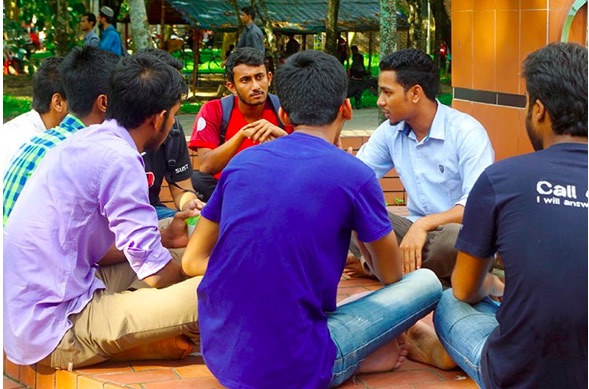
caption: Students gather to share their experience and organize to prevent sexual harassment on campus.

It’s simple they say. “Let’s learn to respect women as our equals!” says 23-year-old student Koyesh Miah, from Sylhet.

In homes, schools and public spaces across Bangladesh, women and girls face sexual harassment every day. “Many men in Bangladesh do not see women as equals in any respect. Gender-based violence and harassment is considered normal,” says Miah. “Growing up, we saw discrimination against girls everywhere. They get less food and poorer education than boys; throughout their lives, they receive fewer opportunities than their male counterparts.”

“Before we joined the campaign group, many of us thought [sexual harassment] was harmless fun…We didn’t realize how our behaviour affected women and girls.

Through the campaign, students got the opportunity to hear from their female classmates about the way they feel about sexual harassment. It helped us understand how much this so-called ‘funny’ behaviour humiliated women and girls…how it affects their self-esteem, confidence, mobility and opportunities.

Today I know how to raise my voice against sexual harassment. Whenever and wherever a girl faces harassment in front of me, now I never think twice about protesting.”
 
Until recently, Miah used to be a silent bystander, like many others when other men sexually harassed women. Since participating in the “Building Capacity to Prevent Violence Against Women Project” implemented by UN Women and Bangladesh National Women Lawyers Association (BNWLA), things are changing and Miah fully understands the serious ramifications of sexual harassment and is ready to tackle it head on.

The project, which started two years back in October 2015, was initiated in four major universities across Bangladesh—Shahjalal University of Science and Technology in Sylhet, East West University in Jahangirnagar, University of Dhaka, the capital of Bangladesh, and the University of Rajshahiin Rajshahi—with generous support from Embassy of Sweden in Dhaka. The project has set up Sexual Harassment Prevention Committees (SHPC) which meet weekly or monthly, and provide a safe space for students to share their experience and organize to prevent sexual harassment on campus.

(article continued in right column)

Question related to this article:

Protecting women and girls against violence, Is progress being made?

What role should men play to stop violence against women?

(article continued from left column)

During one of Miah’s campus meetings, a student shared how her friend was being harassed by a guard outside their hostel. When the harassment escalated, she reported the incident. The guard was transferred, but not fired. Miah uses this case as an example and says “this made us realize how difficult it is for girls to feel safe when someone who is supposed to protect them acts like this.”

On the other side of the country, Sumaya Rahman Kanti, aged 21, from the University of Rajshahi in the north-west part of the Bangladesh, believes that it is crucial to involve men in campaigns against sexual harassment. She says, “men must strongly say no to sexual harassment first and act accordingly. They shouldn’t walk away from any situation where a girl is being harassed, rather, they should take immediate steps to prevent any form of sexual harassment or violence.”

“Women are being harassed regularly regardless of how they look, what they wear, or what their educational or family background is.
There are laws, but no implementation… Women shouldn’t wait for someone to protect them or to speak for them. If we don’t ask for justice, if we don’t ask for change, nobody will come forward.”
 
Kanti knows, first-hand, the impact of sexual harassment: “As a female student, I know how other female students suffer, and the kinds of barriers and obstacles they need to overcome. I have faced this harassment too, and I don’t want any other girl to suffer what I’ve suffered, and I want to make people understand that being born a girl in our society is not a sin.”

UN Women has helped in establishing and expanding on-campus mechanisms in all four universities to prevent violence and support survivors. Sexual Harassment Prevention Committees now manage dedicated telephone hotlines, among other forms of assistance, and have clearly defined procedures for investigations, as well as referrals to university authorities and law enforcement.

“Changing the culture starts with the young,” says Mahatabul Hakim, UN Women Programme Analyst in Bangladesh.. “We started this project because there was an urgent need for an intervention. A survey by UN Women in 2013 showed that 765 female students faced sexual harassment within university campuses in Bangladesh. The project targeted male and female students, so that together they can create a new normal by refusing to accept sexual harassment against women.”

Both Miah and Kanti feel that these campaigns in their campuses have been extremely helpful. Kanti has seen a change on campus and among leaders of student unions, which are affiliated to various political parties. She says, “before the campaign, many political leaders misused their power to harass female students. However, this year they’re involved with our campaign, and they have committed to protest and take necessary actions to prevent any kind of harassment they see around.”

Koyesh Miah agrees, adding: “Today I know how to raise my voice against sexual harassment. Whenever and wherever a girl faces harassment in front of me, now I never think twice about protesting.”

Using theatre, music, arts and sport, students and faculty have engaged 20,000 people in the last two years. The momentum for change continues to build, as more students like Kanti and Miah step in to stop sexual harassment and start challenging the various forms of gender inequality in their daily lives.

As the next step of the programme, UN Women is working with university authorities to strengthen institutional response to violence against women on campus. Safety Audits have been completed in all four universities; authorities will be trained on gender-responsive budgeting, so that appropriate resources are allocated to prevent violence; and accountability mechanisms within universities will also be strengthened.

Mexico: Expanding the Women’s Network against Gender Violence

. . WOMEN’S EQUALITY . .

An article from the Heraldo de Coatzacoalcos

As part of the program “Strengthening for Security” (Fortaseg) carried out by the City Council of Coatzacoalcos and the program Desarrollo Integral de la Familia (DIF), under the direction of its Gender Unit, 25 women from the Benito Juárez Norte colony received their certificates as members of the Women’s Network against Gender Violence.

(article continued in right column)

Question related to this article:

Protecting women and girls against violence, Is progress being made?

(article continued from left column)

The Director of Gender Unit of the DIF, Liliana Alonso Martínez, stressed that more women will be added to the network. Its purpose is outreach to women who have been victims of violence so that they know where to go to request assistance, whether legal, medical or psychological.

Within the framework of this accreditation, dozens of people gathered inside Plaza Forum, to add their signatures against gender violence and in favor of a culture of peace in Coatzacoalcos.

(click here for the original Spanish version of this article.)

Peru: Launch of the national extrajudicial conciliation campaign

… EDUCATION FOR PEACE …

An article from La Republica

The national mega-campaign of the “Week of Extrajudicial Conciliation” began yesterday [November 13]. The purpose of the campaign is to promote and disseminate out-of-court conciliation as an alternative dispute resolution mechanism of the General Directorate of Public Defense and access to Justice in Tacna.

“This is a tool that encourages and forms the culture of peace in our country,” said Christian Fernández, general secretary of the Free Conciliation Center of the Justice Ministry of Tacna.

He also said that the main mission of this process is for the parties involved in a conflict to reach consensual solutions, which are recorded in an act that has a value similar to a judicial decision.

During the week various activities will be carried out to promote this campaign.

(click here for the Spanish version)

Question for this article:

Mexico: Marcos Aguilar Inaugurates Forum “Towards a Culture of Peace”

… EDUCATION FOR PEACE …

An article from the Diario de Querétaro

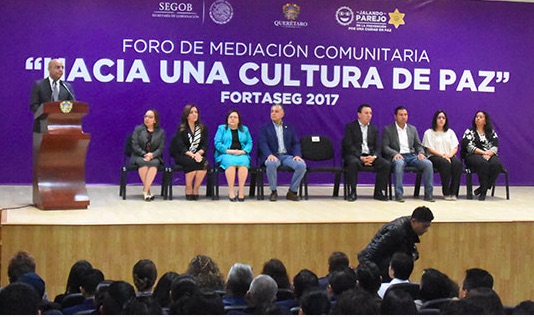
The municipal president of Querétaro, Marcos Aguilar Vega, inaugurated the first forum of community mediation “Towards a culture of peace” Fortaseg 2017, where state and municipal public servants will learn to promote a social transformation through mediation.


Marcos Aguilar inaugurated the first Community Mediation Forum “Towards a Culture of Peace”, FORTASEG 2017. Photos: Yolanda Longino

After seeing a protest at the first Community Mediation Committee of the Felipe Carrillo Puerto delegation, the mayor said that lack of communication is one of the most recurrent causes of conflicts and crimes that put people’s lives and assets at risk.

The mayor said that if we achieve an assertive communication, that puts the accent on the collective benefit, we will achieve a definitive step for social cohesion and the strengthening of the Rule of Law.

The mayor said that if we achieve an assertive communication, that puts the accent on the collective benefit, we will achieve a definitive step for social cohesion and the strengthening of the Rule of Law.

He said that the objective of the Community Mediation Committee is that citizens on an equal basis have the means to peacefully resolve their conflicts, without jeopardizing the fundamental principles of coexistence and mutual respect.

(continued in right column)

(click here for the Spanish version)

Question for this article:

Mediation as a tool for nonviolence and culture of peace

(continued from left column)

He said that this government’s commitment is to trust citizens; “To understand each other as fellow citizens is the only way to build a friendly, just and prosperous city.”

“Today more than ever we need a united society that forms a common front against the evils that threaten our well-being such as crime, corruption and the deterioration of the social fabric,” he said.

He pointed out that governments come and go, but citizen initiatives remain; He asserted that a culture of peace will be achieved if each citizen, neighborhood, colony and community live by the fundamental principles that govern the culture of peace.

The Municipal Public Security Secretary, Juan Luis Ferrusca Ortiz said that community mediation is a new way of approaching psychosocial problems; it privileges neighborhood leadership through the creation of committees that promote alternative spaces for peaceful conflict resolution.

He reported that the community mediation model, whose investment is 980 thousand pesos from the resources of Fortaseg 2017, began in several areas of the Felipe Carrillo Puerto delegation.

He said that this model will also be taken to other of the six remaining municipal delegations, encouraging participation in community mediation committees.

Adriana Báez Sosa, who is responsible for the program, stressed that the capital will be a pioneer in the practice of community mediation, which is committed to strengthening the exercise of citizenship.

“This is a great step forward in the municipality of Queretaro, since it recognizes the importance of the community, as well as generating citizen participation, as they are key elements for the solution of conflicts in the community,” she acknowledged.

She indicated that this project started with a diagnosis, followed by the creation of a committee of citizens interested in contributing their time to the community, followed by a process of training, dissemination and operation of these areas.

El Salvador: Project to promote a culture of peace

.. DEMOCRATIC PARTICIPATION ..

An article from La Prensa Grafica (reprinted for non-commercial purposes)

Roberto Rubio, the executive director of the National Foundation for Development (FUNDE), launched the challenge: “We invite you to start changing the country. No more no less”. And that implies, he assured, to imagine “a country in peace.” That is the concept behind the citizen campaign “Préstale tu voz a SAL”, which FUNDE is carrying out with the support of the Seattle Foundation and in alliance with the Espacio Ciudadano network. They are joined by the embassies of the United States of America (USA) and Colombia.

“Small steps matter. The change on a large scale begins with individual commitment, “said the US diplomatic representative, Jean Manes, during the launch of the initiative, on Wednesday night.

(continued in right column)

(Click here for the Spanish original of this article)

Questions for this article:

How can culture of peace be developed at the municipal level?

(continued from left column)

On behalf of Colombia, Ambassador Julio Anibal Riaño said that the great example is the city of Medellín, which went from being the face suffered by narcoterrorism to a model of coexistence. “The greatest strength of Medellín is its people,” said the diplomat, referring to the “social re-engineering” that Mayor Federico Gutiérrez executed in the city. “Security,” said the mayor through a video that was transmitted during the launch of the citizen campaign, “is neither left nor right,” but a responsibility of all.

According to Rubio, “Préstale tu voz a SAL” is part of the “Somos Paz” movement, which seeks to promote the culture of peace in El Salvador through all daily activities. He explained that its purpose is to change impunity at all levels of society.

Manes noted that the city of Chattanooga in the United States went from being, in a span of 20 years, “the dirtiest city in America” ​​to receiving recognition from the United Nations for having executed a total transformation. In addition, 10 years later, this model allowed the population of the American city to profit economically. It was only achieved, said Manes, when citizens, NGOs and businessmen got involved in a shared project.

Colombia: Unesco recognizes schools in Norte de Santander for their work towards peace

EDUCATION FOR PEACE .

An article from Compartir Palabra Maestra. (Reprinted according to the rules of Creative Commons Recognition-NoComercial-ShareIgual 4.0 International License)

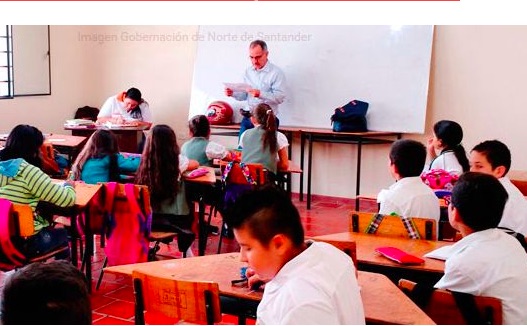
During the National Educational Forum 2017 held in the capital of the country and encouraged by Unesco and the Ministry of Education, Norte de Santander was present this year with two proposals which were among the 12 best being recognized by the two organizing entities.

One of the proposals presented was that of the Cristo Obrero Educational Institution, located in the neighborhood of La Ermita de Cúcuta, who undertook a project called ‘School reconciliation, commitment of all for a culture of peace’ by which they promote healthy coexistence in the institution.

In total, 600 strategies were presented throughout Colombia, with initiatives focused on the search for a Colombia without conflicts. The presentations included topics such as reconciliation, democracy, reconstruction of historical memory, society, violence and human rights.

(continued in right column)

(Click here for the original version of this article in Spanish)

Questions for this article:

Peace Studies in School Curricula, What would it take to make it happen around the world?

What is happening in Colombia, Is peace possible?

(continued from left column)

Ángel Ramiro Peñaranda, a teacher at the Cristo Obrero School who leads the Cucuteño project, indicated that this curriculum for peace “did not exist before.” It contains subject plans, parcelers and class preparers.

“I never thought that this could be an experience for the Ministry, but with the support of the rector of the school, it was presented in the forum,” the teacher told a media outlet in the city of Cúcuta.

The other educational center that represented the northern department of Santander was the La Salle School in Ocaña, with the demonstration of a pedagogical strategy to promote peace within the campus. The institution participated with the ‘Project of democracy, culture, peaceful experience and youth’.

“The project includes three lines of work. The student representative is responsible for raising awareness of the fulfillment of duties and promotion of rights by all students, leading to the adoption of a school peace manifesto,” he added.

He added, “this new achievement of the institution is a pride for Norte de Santander, because we can make it known not only to Colombia, but to the whole world, because teachers strengthen the construction of peace in our country through what we do pedagogically “.

 The two institutions are part of the 40 that make up the Nortesantandereana Network for a School without Violence that works day by day for better coexistence and relationships among citizens.

Gwangju, South Korea: The 1st Asian Literature Festival

EDUCATION FOR PEACE .

An article by Brother Anthony from the Korea Times

The vast, recently completed Asia Culture Center in the heart of Gwangju, South Jeolla Province, was the scene of Korea's first Asian Literature Festival last week, Nov. 1 to 4. It brought together writers from Asia and beyond, together with a number of Korean writers, for a time of sharing and encounters designed to establish stronger bonds between writers across the globe.


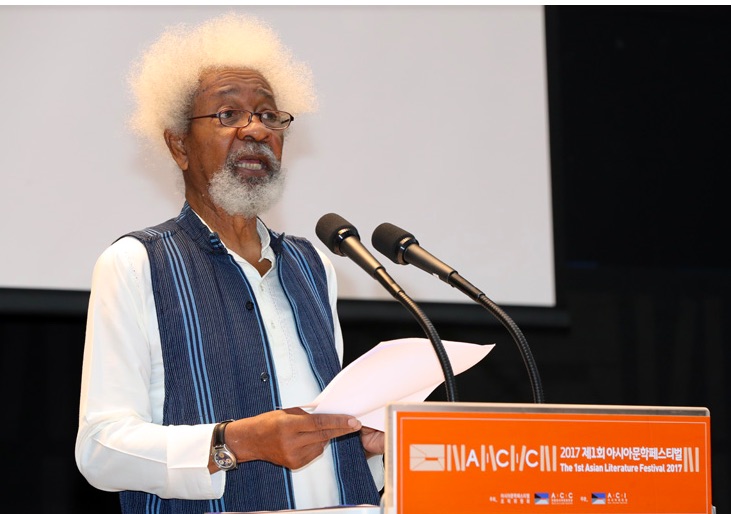
Nobel Prize laureate Wole Soyinka from Nigeria speaks at Asian Literature Festival in Gwangju, Nov. 4. / Yonhap

In his opening remarks, the senior Korean poet, Ko Un, stressed until now the sheer size of the region known as "Asia," together with its linguistic diversity, have been a great obstacle to free communications between the writers of the region. Korean poets have remained unaware of and unable to read the poetry written in other countries and on other continents, and vice versa. Ko Un recalled how the Korean poet Oh Sang-sun wrote a poem titled "Asia's Night" in 1920, in the aftermath of Japan's suppression of the Korean March 1 Independence Movement. He proposed poets coming together now in friendship might be able to produce, nearly a century later, a response he called "Asia's Morning."

In his opening address, the 1986 Nobel Prize laureate Wole Soyinka from Nigeria stressed that humanity today faces a vital choice between freedom and stagnation. Creativity, he said, is only possible in freedom and today, in parts of Africa, the Middle East and Southeast Asia, fundamentalist religious intolerance is resulting not only in the destruction of many nations' artistic heritage but in the uprooting and scattering of whole populations. In response, he called for the festival's participants to work together to develop a new "Culture of Peace," binding "all peoples together from Africa to Korea and around the globe."

The Asia Culture Center was built around and under the former Jeolla Provincial Office and other buildings on Geumnam-ro Street, which today form a memorial complex to the victims of the 5.18 Democratic Uprising. It was the site of the final massacre of the civilian militia when the army retook control of the town in the early morning of May 27, 1980. President Roh Moo-hyun first suggested turning the site into a cultural center for the whole of Asia. It was only natural that the festival participants should begin by making a solemn visit to the May 18th National Cemetery, led by Ko Un, and together pay their respects to all who lived and died for Korea's democratization, in 1980 and also both before and since then. Ko Un paid special tribute to poets Kim Nam-ju and Jo Tae-il and activist Yun Han-bong. In the Memorial Hall at the cemetery the visitors saw a special display of poems selected from Ko Un's great "Maninbo" cycle, commemorating some of those who died in the Uprising.

A number of poets from across the world spoke during the festival. The great Spanish poet Antonio Colinas said, in particular, "The poems and prose of the East possess literary and vital roots, about which we still need to learn, of which we must perform a radical reading to escape the chaos toward which we are heading." He concluded, "The poetry of the past has lasted and must endure today in the face of the uniformity and chaos that foments global dehumanization. This was possible because the poetry of the past has been faithful to its primary mission, to go beyond words."

(continued in right column)

Question for this article:

How can poetry promote a culture of peace?

(continued from left column)

French poet Claude Mouchard evoked his encounter with a homeless Sudanese refugee in France; finally that man lived for eight years in his home and they struggled to communicate despite the language barriers. Mouchard took scraps of their shared conversations and turned them into poetry. The man one day died of a heart attack in the poet's arms, but his words remain, noted by the poet as "perhaps poems." American poet Zack Rogow traced the influence of Asian poetry and art, especially that of Japan, to the writers and artists of France and Russia.

That evening, Ko Un and singer Na Yoon-sun joined forces in a concert, Ko Un's dramatic readings of his poems alternating with the vibrant voice of the immensely popular singer before a packed theater. Ko Un's manner of reading his poems has long made him a celebrity in literary festivals across the globe and at 84 he continues to impress and deeply move audiences.

At the heart of the festival were poets and novelists from a number of Asian countries: Ayu Utami from Indonesia, Damdinsuren Uriankhai from Mongolia, Duo Duo from China, Sagawa Aki from Japan and Shams Langeroodi from Iran, as well as a dozen writers, mostly poets, from Korea. Each of the overseas guests was accompanied by a personal interpreter to facilitate communication. During visits to the top of Mount Mudeung, to the bamboo groves and a traditional garden in Damyang, freewheeling exchanges formed the essence of the festival, as poet met poet across the barriers of distance and language. One literary translator spoke on the last day to stress the essential role of the translator in enabling multiple local literatures written in so many mutually incomprehensible languages to cross all frontiers and become truly "Asian literature" and "world literature."

A jury had screened in advance the work of the foreign participants and the first Asian Literary Award was given to Damdinsuren Uriankhai from Mongolia, whose work combines traditional nomadic poetry with modern, more universal features in a remarkable way. Always dressed in traditional Mongolian robes, his calm smile and warm presence were especially impressive throughout the festival. He received his award from the hands of the poet Do Jong-hwan, who is the current minister of Culture, Sports and Tourism.

The climax of the festival came with the keynote speech by Nobel laureate Wole Soyinka on Saturday afternoon. In it he said, "We know that when we set out into the realms of imagination, we experience liberation at its most unsullied. We are not only free, we see humanity as the very repository and expression of freedom, beyond doctrine and politics." He evoked the many ways in which power has always felt threatened by the freedom of creativity, and striven to crush it, whether in the Chinese Cultural Revolution or the Spanish Inquisition or in the Stalinist USSR, and especially pointed at the current wave of Islamic violence, including in his own land of Nigeria. He paid tribute to the young Kenyan poet Kofi Awoonor who was killed in a terrorist attack on a Nairobi shopping mall. "Poetry is the antithesis of power, and negation of boundaries, not merely physical boundaries but frontiers of thought and imagination that run contrary to our human avocation. Border crossing is the very condition of true explorers." He quoted lines by an ancient Japanese poet, by British, American poets, Sylvia Plath and Swedish poet Tomas Transtromer, before widening his references to ask, "Do you know Tierno Bokar, the Sage of Bandiagara? Do you know the Ozidi Epic? Do you even know the Legend of Shaka Zulu or indeed the narratives of Fagumwa? Do you know of the compendium of Ifa oracular poetry? The lamp of the voyager, however luminous, must submit to the sunrise of universal Enlightenment. The ecumenical spirit of poetry urges on the explorer in all creatures endowed with the power of imagination."

To conclude, the participants issued a Declaration "The Morning of Asia: For the Furtherance of Democracy, Human Rights, and Peace" affirming the vital role of literature in the construction of a world of peace, free of discrimination and violence.

The writer is a professor emeritus at Sogang University.

Qatar: DICID chief highlights role in spreading peace

. TOLERANCE & SOLIDARITY .

An article from The Peninsula, Qatar’s Daily Newspaper

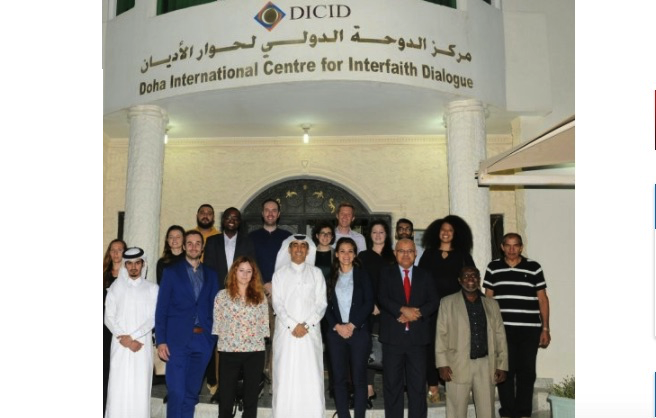
Chairman of the Doha International Center for Interfaith Dialogue (DICID) Dr Ibrahim bin Saleh Al Nuaimi highlighted the role of the centre in spreading the culture of peace and coexistence among diverse segments of society, in cooperation with leaders of various religions, during a meeting with a delegation of youth leaders from Europe and America yesterday.

Al Nuaimi noted that the DICID is the institution concerned with interreligious and intercultural dialogue and capacity building in the field of dialogue and culture of peace in Qatar, stressing the center’s great interest in the youth sector and its keenness on involving them in its various activities, both in its annual conferences and in roundtables. Al Nuaimi gave a brief presentation of the center’s various activities, notably its annual Interfaith Dialogue Conference, which brings together people interested in interfaith dialogue, as well as local community roundtables, publications and other activities.

(continued in right column)

Question related to this article:
 

How can different faiths work together for understanding and harmony?

(continued from left column)

For their part, the members of the youth delegation praised the center’s efforts in consolidating the values of coexistence and dialogue between religions and cultures.

The visit of the young leaders to the DICID comes as part of its activities and interactive programmes, which seek to establish communication and interaction with all cultures, religions and communities, especially with the youth.

The visit also comes as part of the activities of the United Nations Alliance of Civilizations (UNAOC) Fellowship programme aimed at deepening the mutual understanding between the countries of Europe, America, Arab and Islamic countries.