.. HUMAN RIGHTS ..
A lecture from the United Nations
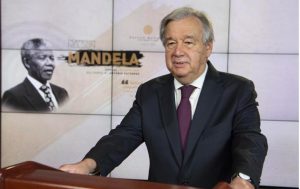
United Nations Secretary-General António Guterres delivered the 18th Nelson Mandela Annual Lecture virtually on Nelson Mandela International Day (18 July).
My dear friends, President Cyril Ramaphosa, excellencies, distinguished guests, friends,
It is a privilege to join you in honouring Nelson Mandela, an extraordinary global leader, advocate, and role model.
I thank the Nelson Mandela Foundation for this opportunity and commend their work to keep his vision alive. And I send my deepest condolences to the Mandela family and to the Government and people of South Africa on the untimely passing of Ambassador Zindzi Mandela earlier this week. May she rest in peace.
I was fortunate enough to meet Nelson Mandela several times. I will never forget his wisdom, determination and compassion, which shone forth in everything he said and did.
Last August, I visited Madiba’s cell at Robben Island. I stood there, looking through the bars, humbled again by his enormous mental strength and incalculable courage. Nelson Mandela spent 27 years in prison, 18 of them at Robben island. But he never allowed this experience to define him or his life.
Nelson Mandela rose above his jailers to liberate millions of South Africans and become a global inspiration and a modern icon.
He devoted his life to fighting the inequality that has reached crisis proportions around the world in recent decades – and that poses a growing threat to our future.
And so today, on Madiba’s birthday, I will talk about how we can address the many mutually reinforcing strands and layers of inequality, before they destroy our economies and societies.
Dear friends, COVID-19 is shining a spotlight on this injustice.
The world is in turmoil. Economies are in freefall.
We have been brought to our knees – by a microscopic virus.
The pandemic has demonstrated the fragility of our world.
It has laid bare risks we have ignored for decades: inadequate health systems; gaps in social protection; structural inequalities; environmental degradation; the climate crisis.
Entire regions that were making progress on eradicating poverty and narrowing inequality have been set back years, in a matter of months.
The virus poses the greatest risk to the most vulnerable: those living in poverty, older people, and people with disabilities and pre-existing conditions.
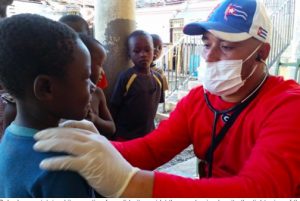
Health workers are on the front lines, with more than 4,000 infected in South Africa alone. I pay tribute to them.
In some countries, health inequalities are amplified as not just private hospitals, but businesses and even individuals are hoarding precious equipment that is urgently needed for everyone. A tragic example of inequality.
The economic fallout of the pandemic is affecting those who work in the informal economy; small and medium-size businesses; and people with caring responsibilities, who are mainly women.
We face the deepest global recession since World War II, and the broadest collapse in incomes since 1870.
One hundred million more people could be pushed into extreme poverty. We could see famines of historic proportions.
COVID-19 has been likened to an x-ray, revealing fractures in the fragile skeleton of the societies we have built.
It is exposing fallacies and falsehoods everywhere:
The lie that free markets can deliver healthcare for all;
The fiction that unpaid care work is not work;
The delusion that we live in a post-racist world;
The myth that we are all in the same boat.
Because while we are all floating on the same sea, it’s clear that some are in superyachts while others are clinging to drifting debris.
Dear friends, Inequality defines our time.
More than 70 per cent of the world’s people are living with rising income and wealth inequality. The 26 richest people in the world hold as much wealth as half the global population.
But income, pay and wealth are not the only measures of inequality. People’s chances in life depend on their gender, family and ethnic background, race, whether or not they have a disability, and other factors.
Multiple inequalities intersect and reinforce each other across the generations. The lives and expectations of millions of people are largely determined by their circumstances at birth.
In this way, inequality works against human development – for everyone. We all suffer its consequences.
High levels of inequality are associated with economic instability, corruption, financial crises, increased crime and poor physical and mental health.
Discrimination, abuse and lack of access to justice define inequality for many, particularly indigenous people, migrants, refugees and minorities of all kinds. Such inequalities are a direct assault on human rights.
Addressing inequality has therefore been a driving force throughout history for social justice, labour rights and gender equality.
The vision and promise of the United Nations is that food, healthcare, water and sanitation, education, decent work and social security are not commodities for sale to those who can afford them, but basic human rights to which we are all entitled.
We work to reduce inequality, every day, everywhere.
That vision is as important today as it was 75 years ago.
It is at the heart of the 2030 Agenda for Sustainable Development, our agreed blueprint for peace and prosperity on a healthy planet, captured in SDG 10: reduce inequality within and between countries.
Dear friends, Even before the COVID-19 pandemic, many people around the globe understood that inequality was undermining their life chances and opportunities.
They saw a world out of balance.
They felt left behind.
They saw economic policies channeling resources upwards to the privileged few.
Millions of people from all continents took to the streets to make their voices heard.
High and rising inequalities were a common factor.
The anger feeding two recent social movements reflects utter disillusionment with the status quo.
Women everywhere have called time on one of the most egregious examples of gender inequality: violence perpetrated by powerful men against women who are simply trying to do their jobs.
The anti-racism movement that has spread from the United States around the world in the aftermath of George Floyd’s killing is one more sign that people have had enough:
Enough of inequality and discrimination that treats people as criminals on the basis of their skin colour;
Enough of the structural racism and systematic injustice that deny people their fundamental human rights.
These movements point to two of the historic sources of inequality in our world: colonialism and patriarchy.
The Global North, specifically my own continent of Europe, imposed colonial rule on much of the Global South for centuries, through violence and coercion.
Colonialism created vast inequality within and between countries, including the evils of the Transatlantic slave trade and the apartheid regime here in South Africa.
After the Second World War, the creation of the United Nations was based on a new global consensus around equality and human dignity.
A wave of decolonization swept the world.
But let’s not fool ourselves.
The legacy of colonialism still reverberates.
We see this in economic and social injustice, the rise of hate crimes and xenophobia; the persistence of institutionalized racism and white supremacy.
We see this in the global trade system. Economies that were colonized are at greater risk of getting locked into the production of raw materials and low-tech goods – a new form of colonialism.
And we see this in global power relations.
Africa has been a double victim. First, as a target of the colonial project. Second, African countries are under-represented in the international institutions that were created after the Second World War, before most of them had won independence.
The nations that came out on top more than seven decades ago have refused to contemplate the reforms needed to change power relations in international institutions. The composition and voting rights in the United Nations Security Council and the boards of the Bretton Woods system are a case in point.
Inequality starts at the top: in global institutions. Addressing inequality must start by reforming them.
And let’s not forget another great source of inequality in our world: millennia of patriarchy.
We live in a male-dominated world with a male-dominated culture.
Everywhere, women are worse off than men, simply because they are women. Inequality and discrimination are the norm. Violence against women, including femicide, is at epidemic levels.
Globally, women are still excluded from senior positions in governments and on corporate boards. Fewer than one in ten world leaders is a woman.
Gender inequality harms everyone because it prevents us from benefitting from the intelligence and experience of all of humanity.
This is why, as a proud feminist, I have made gender equality a top priority, and gender parity now a reality in top UN jobs. I urge leaders of all kinds to do the same.
And I am pleased to announce that South Africa’s Siya Kolisi is our new global champion for the United Nations-European Union Spotlight Initiative, engaging other men in fighting the global scourge of violence against women and girls.
Dear friends, Recent decades have created new tensions and trends.
Globalization and technological change have indeed fueled enormous gains in income and prosperity.
More than a billion people have moved out of extreme poverty.
But the expansion of trade and technological progress have also contributed to an unprecedented shift in income distribution.
Between 1980 and 2016, the world’s richest 1 per cent captured 27 per cent of the total cumulative growth in income.
Low-skilled workers face an onslaught from new technologies, automation, the offshoring of manufacturing and the demise of labour organizations.
Tax concessions, tax avoidance and tax evasion remain widespread. Corporate tax rates have fallen.
This has reduced resources to invest in the very services that can reduce inequality: social protection, education, healthcare.
And a new generation of inequalities goes beyond income and wealth to encompass the knowledge and skills needed to succeed in today’s world.
Deep disparities begin before birth and define lives – and early deaths.
(Continued in right column)
Questions for this article:
What is the legacy of Nelson Mandela for us today?
(Continued from left column)
More than 50 per cent of 20-year-olds in countries with very high human development are in higher education. In low human development countries, that figure is 3 per cent.
Even more shocking: some 17 per cent of the children born twenty years ago in countries with low human development have already died.
Dear friends, Looking to the future, two seismic shifts will shape the 21st century: the climate crisis, and digital transformation. Both could widen inequalities even further.
Some of the developments in today’s tech and innovation hubs are cause for serious concern.
The heavily male-dominated tech industry is not only missing out on half the world’s expertise and perspectives. It is also using algorithms that could further entrench gender and racial discrimination.
The digital divide reinforces social and economic divides, from literacy to healthcare, from urban to rural, from kindergarten to college.
In 2019, some 87 per cent of people in developed countries used the internet, compared with just 19 per cent in the least developed countries.
We are in danger of a two-speed world.
At the same time, by 2050, we estimate that accelerating climate change will affect millions of people through malnutrition, malaria and other diseases, migration, and extreme weather events.
This creates serious threats to inter-generational equality and justice. Today’s young climate protestors are on the frontlines of the fight against inequality.
The countries that are most affected by climate disruption did the least to contribute to global heating.
The green economy will be a new source of prosperity and employment. But let us not forget that some people will lose their jobs, particularly in the post-industrial rustbelts of our world.
This is why we call not only for climate action, but climate justice.
Political leaders must raise their ambition, businesses must raise their sights, and people everywhere must raise their voices.
There is a better way, and we must take it.
Dear friends, The corrosive effects of today’s levels of inequality are clear.
We are sometimes told a rising tide of economic growth lifts all boats.
But in reality, rising inequality sinks all boats.
Confidence in institutions and leaders is eroding. Voter turnout has fallen by a global average of 10 per cent since the beginning of the 1990s.
People who feel marginalized are vulnerable to arguments that blame their misfortunes on others, particularly those who look or behave differently.
But populism, nationalism, extremism, racism and scapegoating will only create new inequalities and divisions within and between communities; between countries, between ethnicities, between religions.
Dear friends, COVID-19 is a human tragedy. But it has also created a generational opportunity.
An opportunity to build back a more equal and sustainable world.
The response to the pandemic, and to the widespread discontent that preceded it, must be based on a New Social Contract and a New Global Deal that create equal opportunities for all and respect the rights and freedoms of all.
This is the only way that we will meet the goals of the 2030 Agenda for Sustainable Development, the Paris Agreement and the Addis Ababa Action Agenda – agreements that address precisely the failures that are being exposed and exploited by the pandemic.
A New Social Contract within societies will enable young people to live in dignity; will ensure women have the same prospects and opportunities as men; and will protect the sick, the vulnerable, and minorities of all kinds.
Education and digital technology must be two great enablers and equalizers.
As Nelson Mandela said and I quote, “Education is the most powerful weapon we can use to change the world.” As always, Nelson Mandela said it first.
Governments must prioritize equal access, from early learning to lifelong education.
Neuroscience tells us that pre-school education changes the lives of individuals and brings enormous benefits to communities and societies.
So when the richest children are seven times more likely than the poorest to attend pre-school, it is no surprise that inequality is inter-generational.
To deliver quality education for all, we need to more than double education spending in low and middle-income countries by 2030 to $3 trillion a year.
Within a generation, all children in low- and middle-income countries could have access to quality education at all levels.
This is possible. We just have to decide to do it.
And as technology transforms our world, learning facts and skills is not enough. Governments need to prioritize investment in digital literacy and infrastructure.
Learning how to learn, adapt and take on new skills will be essential.
The digital revolution and artificial intelligence will change the nature of work, and the relationship between work, leisure and other activities, some of which we cannot even imagine today.
The Roadmap for Digital Cooperation, launched at the United Nations last month, promotes a vision of an inclusive, sustainable digital future by connecting the remaining four billion people to the Internet by 2030.
The United Nations has also launched ‘Giga’, an ambitious project to get every school in the world online.
Technology can turbocharge the recovery from COVID-19 and the achievement of the Sustainable Development Goals.
Dear friends, Growing gaps in trust between people, institutions and leaders threaten us all.
People want social and economic systems that work for everyone. They want their human rights and fundamental freedoms to be respected. They want a say in decisions that affect their lives.
The New Social Contract, between Governments, people, civil society, business and more, must integrate employment, sustainable development and social protection, based on equal rights and opportunities for all.
Labour market policies, combined with constructive dialogue between employers and labour representatives, can improve pay and working conditions.
Labour representation is also critical to manage the challenges posed to jobs by technology and structural transformation – including the transition to a green economy.
The Labour movement has a proud history of fighting inequality and working for the rights and dignity of all.
The gradual integration of the informal sector into social protection frameworks is essential.
A changing world requires a new generation of social protection policies with new safety nets including Universal Health Coverage and the possibility of a Universal Basic Income.
Establishing minimum levels of social protection, and reversing chronic underinvestment in public services including education, healthcare, and internet access are essential.
But this is not enough to tackle entrenched inequalities.
We need affirmative action programmes and targeted policies to address and redress historic inequalities in gender, race or ethnicity that have been reinforced by social norms.
Taxation has also a role In the New Social Contract. Everyone – individuals and corporations – must pay their fair share.
In some countries, there is a place for taxes that recognize that the wealthy and well-connected have benefitted enormously from the state, and from their fellow citizens.
Governments should also shift the tax burden from payrolls to carbon.
Taxing carbon rather than people will increase output and employment, while reducing emissions.
We must break the vicious cycle of corruption, which is both a cause and effect of inequality. Corruption reduces and wastes funds available for social protection; it weakens social norms and the rule of law.
Fighting corruption depends on accountability. The greatest guarantee of accountability is a vibrant civil society, including a free, independent media and responsible social media platforms that encourage healthy debate.
Dear friends, Let’s face the facts. The global political and economic system is not delivering on critical global public goods: public health, climate action, sustainable development, peace.
The COVID-19 pandemic has brought home the tragic disconnect between self-interest and the common interest; and the huge gaps in governance structures and ethical frameworks.
To close those gaps, and to make the New Social Contract possible, we need a New Global Deal to ensure that power, wealth and opportunities are shared more broadly and fairly at the international level.
A new model for global governance must be based on full, inclusive and equal participation in global institutions.
Without that, we face even wider inequalities and gaps in solidarity – like those we see today in the fragmented global response to the COVID-19 pandemic.
Developed countries are strongly invested in their own survival in the face of the pandemic. But they have failed to deliver enough support needed to help the developing world through these dangerous times.
A New Global Deal, based on a fair globalization, on the rights and dignity of every human being, on living in balance with nature, on taking account of the rights of future generations, and on success measured in human rather than economic terms, is the best way to change this.
The worldwide consultation process around the 75th anniversary of the United Nations has made clear that people want a global governance system that delivers for them.
The developing world must have a far stronger voice in global decision-making.
We also need a more inclusive and balanced multilateral trading system that enables developing countries to move up global value chains.
Illicit financial flows, money-laundering and tax evasion must be prevented. A global consensus to end tax havens is essential.
We must work together to integrate the principles of sustainable development into financial decision-making. Financial markets must be full partners in shifting the flow of resources away from the brown and the grey to the green, the sustainable and the equitable.
Reform of the debt architecture and access to affordable credit must create fiscal space for countries to move investment in the same direction.
Dear friends, As Nelson Mandela said: “One of the challenges of our time… is to re-instill in the consciousness of our people that sense of human solidarity, of being in the world for one another and because of and through others.”
The COVID-19 pandemic has reinforced this message more strongly than ever.
We belong to each other.
We stand together, or we fall apart.
Today, in demonstrations for racial equality… in campaigns against hate speech… in the struggles of people claiming their rights and standing up for future generations… we see the beginnings of a new movement.
This movement rejects inequality and division, and unites young people, civil society, the private sector, cities, regions and others behind policies for peace, our planet, justice and human rights for all. It is already making a difference.
Now is the time for global leaders to decide:
Will we succumb to chaos, division and inequality?
Or will we right the wrongs of the past and move forward together, for the good of all?
We are at breaking point. But we know which side of history we are on.
Thank you.
(Thank you to Phyllis Kotite, the CPNN reporter for this article.)