Category Archives: global

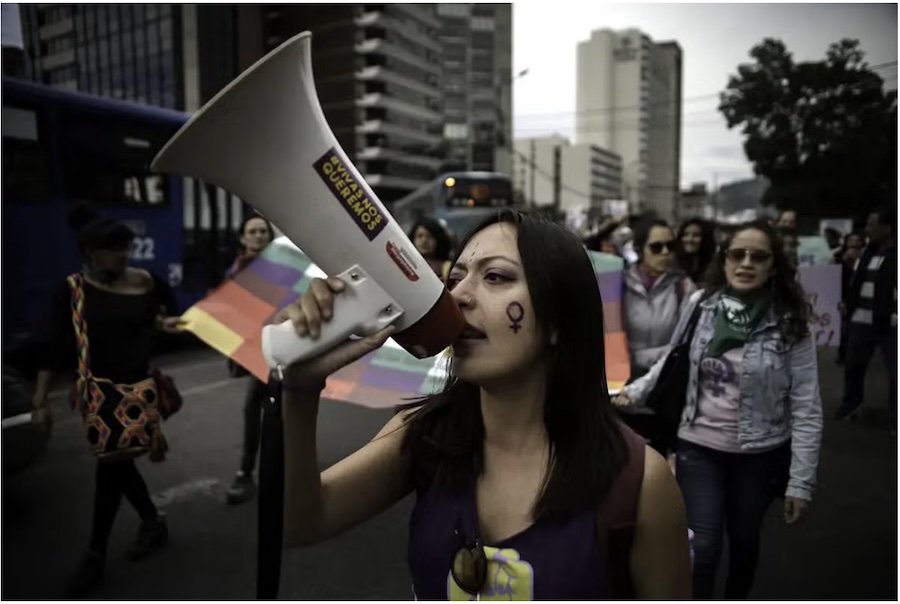
CODEPINK at International Working Women’s Day 2025

. . WOMEN’S EQUALITY . .

An article from Codepink

This year’s International Working Women’s Day was a welcome respite from the chaotic, maddening, and often heart-wrenching news cycle that is defining 2025. Our local chapters showcased last weekend that we will never let ourselves be defined by, nor distracted by the chaos and cruelty that’s being unleashed on us and our sisters all over the world. Instead, we focused on meeting people where they are at and growing the movement one person at a time.


From Los Angeles to Dallas, from Massachusetts to London, UK, our local chapters centered international working women’s resistance to send a powerful and urgent reminder that if women around the world are standing together – liberation from imperialism and militarism is inevitable! 

CODEPINK’s birth 23 years ago also culminated in powerful action on IWWD 2003, kicking off our alternate, feminist vision for peace against the backdrop of U.S. militarism and violence against women at home and in the Global South. 

Our chapters are doing the hard work of movement building. Many of them showed up to Women’s Day events in their community and brought flyers that educate on war and peace in a way that makes sense to anyone and everyone. This sparked lively conversation with people our movement wouldn’t otherwise reach. Scroll down to read more and see action photos!

CODEPINK Bay Area honored the revolutionary struggles of working women within Turtle Island and the Global South by holding community-led workshops to oppose fascism. Bay Area Organizer Cynthia stated, “The event was a beautiful collaboration of many groups. People were happy to receive our CODEPINK flyers. A highlight was the Palestinian Feminist Collective workshop where we learned about the crucial role of women in Palestinian life and resistance.”

CODEPINK London, UK took to the streets to mark the International Feminist Strike 2025 as part of a global anti-colonial movement.

We asked our CODEPINK London Regional Organizer, Nuvpreet: In the spirit of IWWD, what does true solidarity with international women look like? 

(Article continued in right column)

Questions related to this article:

Do women have a special role to play in the peace movement?

(Article continued from left column)

“As feminists in the imperial core, we must recognize that our governments fund, support, and maintain systems of militarism and colonial domination that harm women across the world. Our role is to oppose and end these systems so that women across the world can live in peace.”

CODEPINK Milwaukee did not let their local IWWD protest forget the women of Palestine! They brought signs, chants and extra PINK to the streets of Milwaukee! The women of Palestine are our sisters!!!

CODEPINK North Carolina showed up at their first event together with the message that militarism and war has no place in our feminism! Or at IWWD!

We asked our National Co-Director, Danaka: How do we care for ourselves and each other all year round? 

“It’s pretty easy to get swept up in the constantly devastating news cycle. But I try and remember that feeling defeated isn’t helping anyone…it’s not helping me, and it’s certainly not doing anything for women in the Global South who my country is bombing, starving, or exploiting. When I practice my feminist values of care, solidarity, and curiosity – how could I ever feel hopeless? There’s billions of people in the world with kind hearts, we just need to organize them.” 

CODEPINK NYC joined partners to host an educational screening of Leila and the Wolves (Leila wa za’ib) followed by a discussion on women leading resistance and liberation movements. 

Kurt from CODEPINK NYC reflected after, “The discussion was just as impactful as the movie itself. It felt good to be in a room where people could share their thoughts openly, even when the topics were tough. I walked away feeling really grateful for the chance to connect in community over such an important film. Thanks to everyone who made the event happen!” 

Our chapters have their work cut out for them as they disrupt the war narrative everywhere. And the work hasn’t stopped at IWWD! Last week, CODEPINK London, UK made news launching  BasesOffCyprus, a brand new coalition-led campaign to end joint US/UK surveillance flights aiding Israel’s genocide, which forced the UK government to publicly respond. Our chapter in Missouri is organizing to stop Israel Chemicals Limited from opening up a new facility in St. Louis. CODEPINK North Dakota is working on kicking Elbit Systems out of their state. The chapter in Chicago is part of a massive coalition to divest from Israeli bonds. They are taking on the war machine locally while educating and activating their friends and neighbors. 

Thank you to all those that brought messages of peace and justice to their International Working Women’s Day actions! We cannot do this work without each of our amazing local leaders, online organizers and global partners. 

– – – – – –

If you wish to make a comment on this article, you may write to coordinator@cpnn-world.org with the title “Comment on (name of article)” and we will put your comment on line. Because of the flood of spam, we have discontinued the direct application of comments.
Sign the Peace Clock Manifesto

DISARMAMENT & SECURITY .

An article from Code Pink

Join us to pivot from Doom to Peace and disarm the world from nuclear weapons. Sign the Manifesto!

Over the years, the hands of the clock have been reset, forward and backward, as scientists and policy makers estimated how immediate the nuclear danger loomed, based on the perils faced by other countries obtaining nuclear weapons as well as new arms control measures, weapons limitations, and agreements, particularly between the US and Russia for disarmament measures. At its most optimistic, the Doomsday hands were moved to 17 minutes to midnight in 1991 when the US and USSR announced the complete cessation of nuclear testing.

Shockingly, despite years of nuclear arms control measures, resulting in arsenals down from a high of 70,000 bombs at the peak of the world’s nuclear insanity, to about 12,000 today, 11,000 of which are in the US and Russia with nearly 4,000 poised and ready to go, with another 1000 held by the six other nuclear weapons states—UK, France, China, India, Pakistan, Israel, and North Korea– the clock has never been set closer to Doomsday than it is today—At 90 seconds to midnight! (1)

It’s time to transform the clock and change the conversation! Dire warnings about Doomsday have done little to increase our world’s safety these 77 years. It’s time to pivot our focus from doom to the many small necessary steps we each need to engage in to create peace. The fear of doom encourages compromise with those who are only interested in building Empire and the war economy. This never brings us to our goal of peace. We must stop giving our blessing and consent to endless steps to “control” arms that lead to ever more danger as illustrated by the aging Doomsday clock.

Instead, we must demand their abolition, as we move to a nuclear free world at peace unthreatened by catastrophic annihilation and the ultimate climate change; a nuclear winter.

Let us deemphasize procedural steps that keep up stuck, which scholars have already named: ‘anti-preneurism’ steps towards illusory progress. (2)

(Continued in right column)

Question related to this article:
 
Can we abolish all nuclear weapons?

(Continued from left column)

We are at a turning point in history. It is time to change the conversation with bold new proposals. Proposals that are guaranteed to bring us a respite from the growing terror. Proposals that will bring a shift in planetary consciousness allowing us to respond cooperatively to the impending cataclysmic climate disaster down the road! Proposals that will usher in a rising dawn and change our focus from Doom to Peace. Mother Earth grows impatient with the folly of humankind.

We will take steps that lead to peace on earth and mobilize, expose and render powerless the MICIMATT (Military, Industrial, Congressional, Intelligence, Media, Academic Think Tank complex) in our work for peace. Bringing about:

° US acceptance of Russian and Chinese proposals for treaties to ban weapons in space and cyberwar

° The reinstatement of the 1972 Anti-Ballistic Missile Treaty with Russia and removal of US missiles from Romania and Poland

° Removal of US nuclear weapons from five NATO states in a deal for Russia removing its recently placed nuclear weapons in Belarus

° All nuclear weapons off high alert and separate the warheads from their delivery systems as China does – following the wisdom of the East

° The dissolution of NATO and respect of a reformed United Nations empowering global democracy, where all countries have decision-making power, not just imperial powers.

° US, China, Russia, India, Pakistan, UK, France, North Korea, and Israel completely disarm.

Russia and China have offered to be willing partners in these initiatives. They have been proposing them to the United States and voting on them in the UN for more than ten years. Let us together make this real for the people and the planet.

1 Status Of World Nuclear Forces

2 Resistance to the emergent norm to advance progress towards the complete elimination of nuclear weapons

– – – – – –

If you wish to make a comment on this article, you may write to coordinator@cpnn-world.org with the title “Comment on (name of article)” and we will put your comment on line. Because of the flood of spam, we have discontinued the direct application of comments.
Global Day of Action to Close Bases

FREE FLOW OF INFORMATION

An announcement from World Beyond War

We call on individuals and organizations around the world to join the Global Day of Action to #CloseBases on February 23 by organizing protests at military base sites near you.

The thousands of military bases, both foreign and domestic, around the world are a critical piece of the war machine that must be dismantled. Closing bases is a necessary step to shift the global security paradigm towards a demilitarized approach that centers common security — no one is safe until all are safe.

Video for Global Day of Action

Top 5 Reasons Why We’re Calling for a Global Day of Action to #CloseBases

1. Bases often perpetuate colonialism, removing Indigenous people from their lands. From Panama to Guam to Puerto Rico to Okinawa to dozens of other locations across the world, militaries have taken valuable land from local populations, often pushing out Indigenous people in the process, without their consent and without reparations. For example, the entire population of the Chagos Islands was forcibly removed from the island of Diego Garcia by the UK so that it could be leased to the U.S. for an airbase.

2. Bases cost an exorbitant amount of $$. The cost of U.S. foreign military bases alone is estimated at $80 billion a year, money that could be better spent on healthcare, education, renewable energy, and so much more.

3. Bases exacerbate environmental damage and the climate crisis. Military emissions are exempted from climate agreements, like the Kyoto Protocol. The construction of bases has caused irreparable ecological damage, such as the destruction of coral reefs and the environment for endangered species in Henoko, Okinawa. Furthermore, it is well documented at hundreds of sites around the world that military bases leach toxic so-called “forever chemicals” (PFAS/PFOS) into local water supplies, which has had devastating health consequences for nearby communities.

Continued in right column)

Questions related to this article:
 
How can we be sure to get news about peace demonstrations?

(Continued from left column)

4. Bases can have violent and harmful impacts on local communities. Militaries have a notorious legacy of sexual violence, including kidnapping, rape, and murders of women and girls in nearby communities. Yet troops stationed at foreign bases are often afforded impunity for their crimes due to Status of Forces Agreements (SOFAs) with the so-called “host” country. Bases can also bring a rise in property taxes and inflation in areas surrounding them which has been known to push locals out.

5. Bases heighten tensions and provoke war-making. The presence of hundreds of thousands of troops, massive arsenals, and thousands of aircraft, tanks, and ships in every corner of the globe facilitates war-making and promotes an arms race. Additionally, bases make locations into targets for attack. And foreign bases implicate countries in the crimes of foreign militaries.

Actions Around the World on February 23

Click here for the map with details on the planned actions.

Click here for the Action Planning Toolkit.

Core Mobilization Organizers

International Peace Bureau (Global)
No to War – No to NATO Network (Global)
Pace e Bene (U.S.)
RootsAction (U.S.)
Veterans For Peace (U.S.)
War Industry Resisters Network (U.S.)
War Resisters’ International (Global)
World BEYOND War (Global)

Click here and go to the bottom of the page for the full list of endorsing organizations.

RESULTS

Reports from the Global Day of Action to Close Bases

– – – – – –

If you wish to make a comment on this article, you may write to coordinator@cpnn-world.org with the title “Comment on (name of article)” and we will put your comment on line. Because of the flood of spam, we have discontinued the direct application of comments.
An excerpt from remarks by President Trump at the World Economic Forum

DISARMAMENT & SECURITY .

Excerpt from a press release of The Whitehouse

(Editor’s note. The following excerpt from remarks by President Trump at the World Economic Forum illustrates the impression one gets from the new President that it is impossible to know if his words can be taken seriously. Or are they just part of a game he is playing with the world, much like Charlie Chaplin’s portrayal of Hitler playing with a toy balloon of the world. Let us hope they can be taken seriously in this case.)

How do you see the relationship between the U.S. and China in the next four years under your leadership?

THE PRESIDENT:  He called me.  But I see it very good.  I think that we’re going to have a very good relationship.  All we want is fairness.  We just want a level playing field.  We don’t want to take advantage.  We’ve been having massive deficits with China.  Biden allowed it to get out of hand.  He’s — $1.1 trillion deficit.  It’s ridiculous, and it’s just an unfair relationship. 

And we have to make it just fair.  We don’t have to make it phenomenal.  We have to make it a fair relationship.  Right now, it’s not a fair relationship.  The deficit is massive, as it is with other countries — a lot of Asian countries, actually.  But we have deficits that are very big, and we can’t keep doing that, so we’re not going to keep doing that. 

But I like President Xi very much.  I’ve always liked him.  We always had a very good relationship.  It was very strained with COVID coming out of Wuhan.  Obviously, that strained it.  I’m sure it strained it with a lot of people, but that strained our relationship.  But we always had a great relationship, I would say, and we look forward to doing very well with China and getting along with China. 

 Hopefully, China can help us stop the war with, in particular, Russia-Ukraine.  And they have a great deal of power over that situation, and we’ll work with them. 

And I mentioned that with — during our phone conversation with President Xi, and hopefully we could work together and get that stopped. 

We’d like to see denuclearization.  In fact, with President Putin, prior to a — an election result, which was, frankly, ridiculous, we were talking about denuclearization of our two countries, and China would have come along.  China has a — a much smaller, right now, nuclear armament than us or field than us, but they’re — they’re going to be catching it at some point over the next four or five years. 

And I will tell you that President Putin really liked the idea of — of cutting way back on nuclear.  And I think the rest of the world, we would have gotten them to follow.  And China would have come along too.  China also liked it. 

Tremendous amounts of money are being spent on nuclear, and the destructive capability is something that we don’t even want to talk about today, because you don’t want to hear it.  It’s too depressing. 

(Continued in right column)

Question related to this article:
 
Can we abolish all nuclear weapons?

(Continued from left column)

So, we want to see if we can denuclearize, and I think that’s very possible.  And I can tell you that President Putin wanted to do it.  He and I wanted to do it.  We had a good conversation with China.  They would have been involved, and that would have been an unbelievable thing for the planet.

And I hope —

MR. BRENDE:  Mr. President, when you’re —

THE PRESIDENT:  — it can be started up again.

MR. BRENDE:  — back here in Davos next year, will — will there be then a peace agreement with — with Ukraine and Russia by then?

THE PRESIDENT:  Well, you’re going to have to ask Russia.  Ukraine is ready to — to make a deal. 

Just so you understand, this is a war that should have never started.  If I were president, it would never have started.  This is a war that should have never, ever been started.  And — and it wasn’t started during my — there was never even talk about it.  I knew that it was the apple of President Putin’s eye, but I also knew that there was no way he was going in, and he wasn’t going to go in. 

And then, when I was out, bad things happened, bad things were said, a lot of stupidity all around, and you end up with what you have.  Now you have all these bombed-out cities — they look like demolition sites — with many people killed. 

I think the — the thing that you’ll see about Ukraine is that far — far more people have died than is being reported. 
And I’ve seen that.  But far, far more people have died.

When you look at a city that’s become a demolition site, where big buildings have been collapsed by missiles hitting them and everything else, and they say, “One person was slightly injured.”  No, no, many people were killed.  Those are big buildings.  I was surprised at how — that was my business.  These are buildings that go two and three blocks long.  They’re 20 stories high.  They’re big, powerful buildings.  Then they were knocked down, and there were a lot of people in those buildings.  They had announced that two people were injured.  That’s not true.  So, I think you’re going to find that there were many more people killed in Ukraine and the Ukraine war than anybody has any idea. 

But if you look now, so many of the — the people being killed are soldiers just facing each other with guns, rifles, and drones — the new form of warfare — drones.  And it’s a very sad thing to see.

And when you see pictures of the fields that I see, nobody wants to see it.  You’ll never be the same.

– – – – – –

If you wish to make a comment on this article, you may write to coordinator@cpnn-world.org with the title “Comment on (name of article)” and we will put your comment on line. Because of the flood of spam, we have discontinued the direct application of comments.
Mazin Qumsiyeh: Old story- new twist

FREE FLOW OF INFORMATION .

A blog Jan 24, 2025 by Mazin Qumsiyeh (abbreviated)

Will history repeat itself but now with a very different outcome especially in the era of global environmental catastrophe powered by greed and militarism? To review reality locally and globally helps us find answers. Locally, Israeli apartheid forces are now doing in our parts of the West Bank what they did to Gaza. Ethnic cleansing, destruction of property, and massive violations of human rights ranging from right to move right to worship, right to simple dignified life.  People here are scared that this is merely the beginning of accelerated genocide and ethnic cleansing  as perpetrated in Gaza.  

We have repeatedly warned of the consequences of Western collusion with genocide and ecocide.  The fate of Gaza will be the fate of humanity if not enough people wake up in time to the global reality of simply unsustainability of “might makes right” colonial policies.  

At Trump’s inauguration, the billionnaires were in the front row while his picks for secretaries were behind them. This image sums the momentous transformations gripping our planet. It used to be argued that the deep state consist of moneyed interests, largely hidden. Now we reached a point that murderous moneyed interests no longer work behind the scenes. The ultraright and fascists and neoNazis and Zionists are front and centre and openly cause millions to suffer with impunity. They even brag about their “common interests”.

For example, let us take the spectacle of the “World Economic Forum”  this past week (for a run-in I had with this forum in 2006, see http://qumsiyeh.org/theworldeconomicsforumcontroversy/). The right wing CEOs and government officials like the President of Argentina openly declared building an alliance of leaders around the world who believe and practice policies of “money trumps people”. At the same forum convicted felon Donald Trump delivered a belligerent, triumphalist, and (textbook) colonialist speech touting a vision of the world where elite business interests trump human rights.

(article continued in right column)

Question related to this article:

Presenting the Palestinian side of the Middle East, Is it important for a culture of peace?

The fate of Gaza, will it be the fate of humanity?

(article continued from left column)

Eisenhauer warned US citizens in his farewell speech: “In the councils of government, we must guard against the acquisition of unwarranted influence, whether sought or unsought, by the military–industrial complex. The potential for the disastrous rise of misplaced power exists, and will persist. We must never let the weight of this combination endanger our liberties or democratic processes. We should take nothing for granted. Only an alert and knowledgeable citizenry can compel the proper meshing of the huge industrial and military machinery of defense with our peaceful methods and goals so that security and liberty may prosper together.”

Eisenhauer did not anticipate how horrific it would be in the 21st century nor did not anticipate an alliance of neocolonial powers reinvigorated and working towards the same  goals: making the rich richer, the poor poorer, and wrecking the global environment while unleashing militarism and wars in unprecedented cruelly like we see in Palestine (genocide and ecocide). Our species is at a pivotal moment in history never experienced before. We are then many, they are the few. If more of the many mobilize quickly we may still have a chance to save ourselves and our planet. . . .

Stay Humane and keep hope alive

Mazin Qumsiyeh
A bedouin in cyberspace, a villager at home
Professor, Founder, and (volunteer) Director
Palestine Museum of Natural History
Palestine Institute of Biodiversity and Sustainability
Bethlehem University
Occupied Palestine
http://qumsiyeh.org
http://palestinenature.org
facebook pages
Personal https://www.facebook.com/mazin.qumsiyeh.9
Institute https://www.facebook.com/PIBS.PMNH

– – – – – –

If you wish to make a comment on this article, you may write to coordinator@cpnn-world.org with the title “Comment on (name of article)” and we will put your comment on line. Because of the flood of spam, we have discontinued the direct application of comments.
UN-Tourism Candidate is Placing Tourism at the Heart of Peace and Reconciliation

. . SUSTAINABLE DEVELOPMENT . .

An article from eTurboNews

Mouhamed Faouzou Deme from Senegal has made headlines in Africa, wanting to become Africa’s choice in the upcoming UN Tourism election for Secretary-General.

He is the only one of the four competing candidates for the highest UNWTO post who provided feedback to eTurboNews on the role of tourism for peace. Once Secretary-General Zurab took his helm in 2018, UNWTO’s long-year relationship with the International Institute for Peace of Tourism was eliminated, forcing IIPT chairman Louis D’Amore to cancel his carefully planned summit in Montreal. IIPT never fully recovered from this disappointment after this.

Its former Secretary-General, Dr. Taleb Rifai, fostered this unique relationship between UNWTO and IIPT. Mouhamed pledged to reinstate this, should he become Secretary-General, and responded to WTN. He stated:

Tourism stakeholders, professionals, and political actors have continued to recall the importance of placing tourism at the heart of peace and reconciliation programs to enable the sector to mobilize its capacity for action.

This is often in favor of investment, development, and social inclusion.

Adherence to freedom, justice, democracy, tolerance, solidarity, cooperation, pluralism, cultural diversity, dialogue, and understanding promotes peace.

(article continued in right column)

Questions related to this article:
 
How can tourism promote a culture of peace?

(article continued from left column)

Tourism is a vector of peace, respect, openness, and dialogue.

Tourism has the value of peace because it is only built and carried out in an environment of security, stability, and conviviality.

The main idea behind the concept of peace in tourism is that peace exists when people travel freely around the world.

It helps travelers to get to know new people, cultures, and values.

This experience can increase mutual understanding between people who have lived in diverse cultural contexts.

Furthermore, peace tourism aims to reduce the root causes that create situations where violence is perceived as inevitable.

It does not replace other types of tourism practices but rather aims to facilitate their improvement.

Its impact goes far beyond economic benefits. It is interesting to look at tourism as a social force rather than an industry and see how we can use it to establish a culture of peace.

Tourism connects people and the planet. It is a vector of trust and goodwill.

Understanding culture can change behavior and consolidate peace.

Tourism’s role in supporting peace is also reflected in its contribution to the fight against poverty, the preservation of culture, and protecting the environment.
– – – – – –

If you wish to make a comment on this article, you may write to coordinator@cpnn-world.org with the title “Comment on (name of article)” and we will put your comment on line. Because of the flood of spam, we have discontinued the direct application of comments.

The International Institute for Peace through Tourism: A personal memoire

. . SUSTAINABLE DEVELOPMENT . .

Excerpts from the reflections by Timothy Marshall, Chairman, IIPT Board of Directors

As we end this year, I have been asked to share some reflections on my journey with our Brother Lou D’Amore. . . When launching IIPT, Brother Lou’s vision was and is to make the world’s largest industry, travel and tourism, the first global peace industry; with the belief that every traveler is potentially an ambassador for peace.


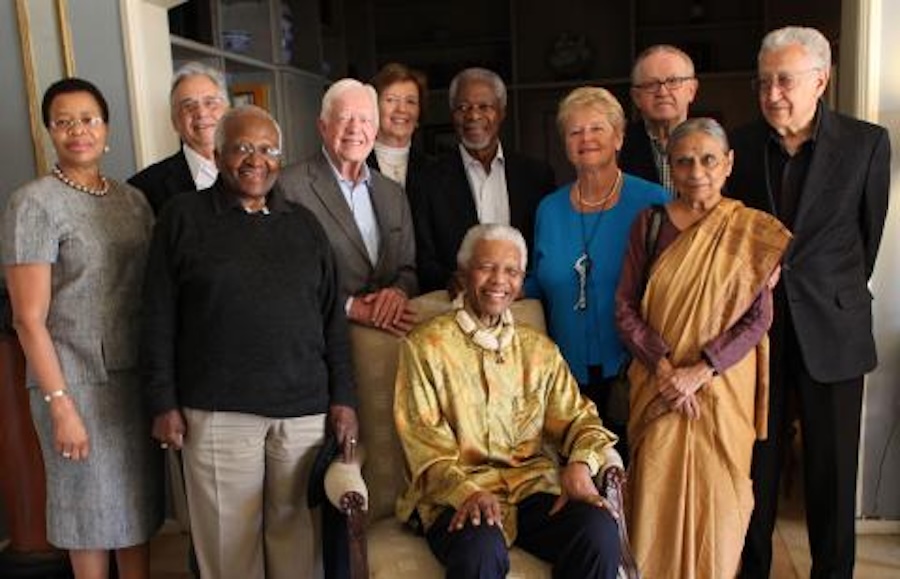
Lou D’Amore, left, and Timothy Marshall, right, with Tukwini Mandela

THE BEGINNING YEARS: LAUNCH OF SUMMITS, CONFERENCES AND CHAPTERS

As the creator and global leader of the ‘Peace Through Tourism’ movement, IIPT launched its first global conference on Sustainable Tourism Development in Vancouver in 1988. The theme was: “Tourism: A Vital Force for Peace”. Eight hundred persons from sixty-eight countries were in attendance; and Pope John Paul II and U.S. President Ronald Reagan were featured in video-taped messages. The Vancouver Conference first introduced the concept of ‘Sustainable Tourism Development’ four years prior to the U.N. Conference on Environment and Development in Rio de Janeiro, Brazil. The Vancouver conference also introduced a new paradigm for a ‘Higher Purpose of Tourism’ which incorporated the Mission of IIPT. Today, we hear this concept espoused all over the globe. However, nearly 40 years ago when IIPT was founded, the industry’s focus was almost exclusively on economics and finance, and these concepts were very foreign.

Approximately 6 months after our first global conference, the first Caribbean conference on socially and environmentally responsible tourism was held in 1989 in the Bahamas. It featured Dr. D’Amore; along with Mr. Stanley Selingut, who established the first Caribbean eco-tourism resort based in St. John, U.S. Virgin Island; as well as representatives from Indonesia and the Pacific, who all gave case studies. This led to two subsequent conferences on eco-tourism in the Caribbean, and a major new focus on sustainable tourism by the Caribbean Tourism Organization . . .

Our first Global Summit was held in Amman, Jordan in 2000. King Abdullah II was our Royal Patron; and Mr. Harvey Golub, Chairman of American Express, and Chairman of WTTC, served as our first Summit Chair. I was asked to convene our first Coalition of Partners meeting which was attended by thirty-two organizations from around the world; each of whom committed to a Millennial Project. Many good initiatives came out of this, and it is our hope to resurrect this body with a new gathering of like-minded NGO’s and other organizations going forward.

Our first African Conference was held in Nelspruit, South Africa in 2002, eight years after Mr. Mandela became President. It included a host of Ministers of Tourism throughout the African continent. . .

PEACE WITH OUR CREATOR

IIPT has played a meaningful role in the spirituality and tourism sector— from a major conference at the site of St. Francis of Assisi’s home in Assisi, Italy… to sacred Himalaya travel and treks in Bhutan… to dedicating a global peace park at Bethany Beyond the Jordan, site of Christ’s baptism in the Jordan River…to the dedication of a global peace park at the martyrs trail in Uganda, where record crowds flocked to Uganda for the 50th anniversary of the canonization of 32 Christian martyrs who were burned to death for their refusal to denounce Christianity. The Uganda Martyrs Trail was dedicated as a legacy of IIPT’s 4th African Conference and is an important tourist attraction. This event has also been designated as a national holiday in Uganda and has become a major event on the global catholic calendar.

(article continued in right column)

Questions related to this article:
 
How can tourism promote a culture of peace?

(article continued from left column)

Through these and other initiatives, IIPT has been fortunate to have interfaith forums at our events around the world. These gatherings have facilitated interfaith and intercultural dialogues. At our second global conference in Montreal, eight different religions gathered at the top of Mount Royal overlooking the City of Montreal. That conference profoundly demonstrated that when we focus on the importance of love, mutual respect, and living in peace, it becomes clear that our similarities are much greater than our differences.

PEACE WITH EACH OTHER

. . . Over the years, we have assembled a wonderful network of industry strategic partner organizations like PATA and the Africa Travel Association who signed an historic MOU at our 2005 Summit in Thailand. This MOU promoted travel between the African and Asian continents. One of our closest partners, Skal International, has joined forces with us to establish peace cities and towns in wonderful places around the world. Under the principle of ‘healing wounds of conflict’, one of our Board members, Don King, led an IIPT initiative to support the Al-Awon Charity in Azraq, Jordan, which provides educational services for 160 Syrian refugee children who, along with their families, fled the conflict in Syria. This special IIPT project is one way that we try to bring our principles to life and make a tangible impact in the lives of people who are hurting.

The theme of our 25th Anniversary celebration at World Travel Market in London was “Building a Culture of Peace Through Tourism”. . . .

‘PEACE WITH NATURE AND THE EARTH’

This can be seen in almost everything we have done; but can most directly be seen through the dedication of over 450 global peace parks in Africa, Asia, Central America, Europe, the Middle East, Australia, the Indian Ocean and the Pacific, Canada, the United States, and Mexico. This initiative was launched in Canada on its 125th Birthday with 350 peace parks across Canada. It has now spread to six of the seven continents around the world. In addition to Victoria Falls, a world heritage site and one of the seven wonders of the world located on the border of Zambia and Zimbabwe, IIPT has dedicated a major global peace park at the renown Puer National Park in China, along with the dedication of a global town of peace in the Danzhai Wanda village of China, which is an international tourism destination dedicated to poverty reduction. . . .

One of our most impactful initiatives regarding peace with nature was the hosting of one of the world’s earliest global summits on Climate Change in Lusaka, Zambia in 2011. This Summit brought together some of the top thought leaders and practitioners from every major sector around the world and led to the adoption of the Lusaka Declaration which is housed at the United Nations.

THE BUILDING OF A WONDERFUL FAMILY

During the month of September 2023, I was pleased to Chair our Global Strategic Planning Retreat in New York where members of the IIPT Family gathered to begin the process of transitioning from Lou’s presidency to Ajay Prakash becoming the newly elected President of the Institute. The weekend began on Friday evening with food and drinks in a beautiful setting on the Hudson River as family members were welcomed to New York and celebrated being together once again. . . .

As I prepare to close these reflections, it seems appropriate to return to our beginning days where the ‘CREDO OF THE PEACEFUL TRAVELER’ became our anchor:

“GRATEFUL FOR THE OPPORTUNITY TO TRAVEL AND EXPERIENCE THE WORLD AND BECAUSE PEACE BEGINS WITH THE INDIVIDUAL, I AFFIRM MY PERSONAL RESPONSIBILITY AND COMMITMENT TO:
– JOURNEY WITH AN OPEN MIND AND HEART,
– ACCEPT WITH GRACE AND GRATITUDE THE DIVERSITY I ENCOUNTER,
– REVERE AND PROTECT THE NATURAL ENVIRONMENT WHICH SUSTAINS ALL LIFE,
– APPRECIATE ALL CULTURES I DISCOVER,
– RESPECT AND THANK MY HOSTS FOR THEIR WELCOME,
– OFFER MY HAND IN FRIENDSHIP TO EVERYONE I MEET,
– SUPPORT TRAVEL SERVICES THAT SHARE THESE VIEWS AND ACT UPON THEM,
– AND BY MY SPIRIT, WORDS AND ACTIONS,
– ENCOURAGE OTHERS TO TRAVEL THE WORLD IN PEACE.”

(Editor’s note: Thank you to Bea Broda for sending us the IIPT End-of-year newsletter that contained this memoire)

– – – – – –

If you wish to make a comment on this article, you may write to coordinator@cpnn-world.org with the title “Comment on (name of article)” and we will put your comment on line. Because of the flood of spam, we have discontinued the direct application of comments.
With Israel’s destruction of Kamal Adwan Hospital, UN rapporteur calls for global medical boycott

. . HUMAN RIGHTS . .

An article from Nation of Change

Francesca Albanese, the UN Special Rapporteur for the Israeli-Occupied Palestinian Territories, reacted forcefully to the complete destruction by the Israeli military of Kamal Adwan Hospital at Beit Lahia in northern Gaza and the arrest and abuse of its patients and its director. She called for a world-wide medical boycott of Israel, writing at “X” :

“I urge medical professionals worldwide to pursue the severance of all ties with Israel as a concrete way to forcefully denounce Israel’s full destruction of the palestinian healthcare system in Gaza, a critical tool of its ongoing genocide.”

She was concurring with San Francisco-based physician and author Rupa Marya.

Muhammad Muhsin Watad at the Israeli newspaper Arab 48 explained that last Friday, “the Israeli army stormed Kamal Adwan Hospital after hours of besieging it. They burned its facilities, mistreated those inside, including patients, the injured, and medical staff, before taking into custody several individuals and forcing others [including women] to strip in the severe cold and undergo forced evacuation, all while gunfire and tank shelling occurred in the surrounding area.” Some 350 staff and patients were illegally detained by Israeli forces, though most were subsequently released.

The actions were part of Israel’s strategy of forcibly displacing 400,000 Palestinians from northern Gaza and making it uninhabitable for them, as the occupying army systematically detonates buildings and destroys neighborhoods. The forced displacement of an occupied population is a war crime. Gaza Palestinians are huddling in tents or sleeping rough amid heavy downpours and frigid temperatures in which several babies are known to have died in recent days.

Also on Friday, having emptied and burned the hospital, the Israelis detained its director and other medical staff.

(continued in right column)

Question related to this article:

How can war crimes be documented, stopped, punished and prevented?

How can a culture of peace be established in the Middle East?

(continued from left column)

Watad at Arab 48 says that the Government Media Office in Gaza is alleging that Abu Safieh was subjected to physical and psychological abuse. He was forced to strip out of his medical coat and clothing and was used as a human shield. His children called on the international community to pressure Israel to release their father, whose fate remains unknown.

He was last seen walking outside the ruined hospital toward the turret of an Israeli tank.
When dissidents in other countries have faced tanks, they have been celebrated widely in U.S. media. American mass media “news” for the most part have ignored Abu Safieh and his fate.

Medical boycotts are not unprecedented. Physicians in the allied victor states of WW I boycotted  the German scientific and medical establishment on the grounds that German researchers and physicians were guilty of praising German militarism and denying German war guilt. They even founded alternative associations, such as the one to fight tuberculosis set up in Berlin, and held international congresses only in French and English, excluding German-speakers.

Medical boycotts of Israel have also been proposed  previously, as with the 2007 call of some British physicians for non-cooperation with the Israeli Medical Association for failing to uphold ethical standards in their treatment of Palestinians in the Occupied Territories. They urged that the IMA be kicked out of the World Medical Association.

As I have noted before, the Rome Statute  underpinning the International Criminal Court, which went into effect in 2002, lists among “War Crimes” “ix) Intentionally directing attacks against buildings dedicated to religion, education, art, science or charitable purposes, historic monuments, hospitals and places where the sick and wounded are collected, provided they are not military objectives.” The Israeli army’s allegations that hospitals in Gaza are armed camps and weapons depots is ridiculous, and such assertions have been disproven whenever newspapers of record such as the Washington Post have investigated them.

– – – – – –

If you wish to make a comment on this article, you may write to coordinator@cpnn-world.org with the title “Comment on (name of article)” and we will put your comment on line. Because of the flood of spam, we have discontinued the direct application of comments.
English bulletin January 1, 2025

PEACE ADVANCES IN AFRICA, LATIN AMERICA

While Europe and North America, exhaust themselves with the culture of war, Africa and Latin America continue to advance toward a culture of peace.

Last month, the bulletin described the leadership from the heads of state in Brazil, Colombia and Mexico.

This month, we have published articles advancing the culture of peace at at regional and local levels in Colombia (2), Mexico (2), Ecuador and Chile.

The anthropologist and peace activist Angela Lederach describes the process of “slow peace” in the Colombian territory of Montes de María. She draws three conclusions: first, slow peace is a multigenerational process; second, slow peace centers social-environmental relations; and finally, slow peace demands a shift from technical projects to social movements.

The city government of Cúcuta in Colombia has carried out workshops for youth on historical memory and culture of peace. The workshops, using Hip Hop culture as an educational and transformative tool, contributed to the process of reparation and reconciliation of the victims of the armed conflict.

The National Union of Education Workers and the National Commission for Human Rights of Mexico held a “Peaceful School Coexistence” Drawing Contest as part of the campaign “Arm yourself with courage for a Culture of Peace!”, which promotes respectful and reflective relationships in schools. The winning paintings are presented in the CPNN article.

Also in Mexico, the state government of Jalisco, through the Secretariat of Planning and Citizen Participation, has began the training process in Culture of Peace for the reconstruction of the social fabric, in order to promote communities of care in the municipalities of the State.

In Ecuador, the project “Promoting a culture of Peace and Democracy through the strengthening of Indigenous Justice” has achieved great successes, as more than a thousand people from indigenous organizations have been trained in Indigenous Justice, Gender and New Masculinities and Community Communication, with a high participation of women.

In Chile, the Universidad San Sebastián has launched the innovative Collaborative Project of Vinculación con el Medio Transforming conflicts . Its objective is to strengthen the virtues and skills necessary to resolve disputes peacefully in the school community. Through this initiative, law students actively participate in mediation workshops at Colegio Providencia, promoting a culture of peace that transcends the classroom.

In Africa, the culture of peace is being promoted at the continental, regional and national levels.

The African Union has held its third edition of the youth, peace and security in Africa dialogue Bujumbura, Burundi. Over 1,200 participants, including policymakers, young leaders, and representatives of international institutions are attending and reflecting on effective ways to promote peace education in Africa.

The final report of the 2023 Biennale of Luanda, “Pan-African Forum for the Culture of Peace”, has just been published. The Biennale is a joint initiative of the Government of the Republic of Angola, UNESCO and the African Union that aims to promote conflict resolution and prevention of violence, encouraging cultural exchange and intergenerational dialogue in Africa. The next edition is scheduled for next year.

In Cameroon, students from over 20 countries on the continent, gathered at the Pan African University Institute of Governance, Humanities and Social Sciences,, the African Union’s premiere institution of higher learning, for a strategic discussion on how to promote a culture of peace on the continent. Besides masterclasses and panel discussions with experts from UN agencies, development partners, diplomatic corps, government, and academia, the young scholars also shared experiences of what peace means to them.

The Sougourounoma Initiative for Education, Peace and Health, based in Burkina Faso, has organized the second edition of the International Youth Forum on the Culture of Peace. The meeting, under the theme “Youth, Religion, Mediation and Climate Change in the Sahel and West Africa”, brings together young people from Benin, Mali, Niger, Ivory Coast and Burkina Faso. It allows participants to discuss issues related to peace, including the link between peace and climate change, conflict analysis and interreligious dialogue.

More than 300 young people from across Niger gathered in Maradi recently to explore the part they can play in building peaceful communities, as published by the Bahá’í World News Service. A young participant explained, “The conference helped us understand that we cannot be mere observers of harmful social forces affecting our neighborhoods and villages—we must be active participants in building peace.”

In Abidjan, the Caucus of Women of Côte d’Ivoire for Peace planned a meeting for peace with an expected attendance of more than 5,000 women, including women from the institutions of the Republic, elected officials, women from public and private administration and women economic operators around the theme of peace”.

Last month we concluded: “while leaders from Europe and North America continue to aggravate global warming and threaten World War III, Lula, Petro and Sheinbaum give us hope and vision to help us overcome these crises, which, as Petro says, threaten the extinction of humanity.

This month we can conclude that their hope and vision is shared at the local and regional levels throughout Africa and Latin America.

“Let us listen to them and take action with them!”

SUSTAINABLE DEVELOPMENT

Slow Peace: Three Lessons from Grassroots Peacebuilders in Colombia

HUMAN RIGHTS

Activists Occupy Canadian Parliament Building to Protest Gaza War & Arming of Israel

FREE FLOW OF INFORMATION

Personal Souvenirs of Federico Mayor

WOMEN’S EQUALITY

Women of Côte d’Ivoire commit to the Culture of Peace: more than 5,000 women expected at the Palais des Sports on December 21


TOLERANCE & SOLIDARITY

2nd International Youth Forum on the Culture of Peace: Religion, Mediation and Climate Change in the Sahel

EDUCATION FOR PEACE

Chile: Transforming conflicts: USS promotes a culture of peace

DEMOCRATIC PARTICIPATION

Colombia: Cúcuta Mayor’s Office Successfully Concludes Workshops on Historical Memory and Culture of Peace

DISARMAMENT & SECURITY

Third edition of dialogue on youth, peace, security in Africa opens in Bujumbura, Burundi

Nonviolence News Special Report: 366+ Success Stories in 2024

EDUCATION FOR PEACE .

An article from Nonviolence News

In the sweep and bustle of the year’s struggles, it’s sometimes hard to see past the disaster headlines. Yet, remarkable progress was made by nonviolent movements worldwide. In this special report, Nonviolence News has gone into our archives and pulled out the gains, victories, and successful solutions that occurred in 2024. We counted 366+ stories – this article highlights many of them and you’ll find the others in the complete list in our Research Archives.

Let’s start with the big ones. Mass protests erupted many times this year from Argentina to France, Indonesia to Georgia. Some of them rose up against tyrants and autocrats and won. South Koreans, for example, held immense mass protests to prevent the president from implementing martial law and stealing power. Even after they succeeded, over 1 million people returned to the streets to force their politicians to impeach the president. In Bangladesh, students launched demonstrations to end unfair job quotas … and wound up ousting the prime minister, forcing the chief justice to resign, and bringing back exiled Nobel Prize Laureate Muhammad Yunis to lead the new government.

It was a remarkable year for people-powered democracy. Bolivians thwarted a coup attempt. Mexico elected its first female president. Indigenous Guatemalans held a 100-day sit-in to ensure the landslide-winning presidential candidate could take office. Indonesian protesters compelled their parliament to halt an election bill they felt would weaken the chances of opposition candidates. Kenyan protesters got President Ruto to withdraw a finance bill with tax hikes. Senegalese students and poor people kept their elections on track amidst the president’s repeated attempts to delay them.

When we organize, we win. 

That major lesson is becoming more obvious with each new study. In 2011, researchers Erica Chenoweth and Maria J. Stephan unequivocally proved that nonviolent action works twice as often as violence. This year, several new studies grabbed headlines touting the effectiveness of nonviolent action. The Climate Emergency Fund demonstrated that disruptive actions are having notable impacts and lowering carbon emissions. Another report found that protest movements are 6 to 12 times more cost effective than charities at making change. And you know where the best movement organizers in the world are located? Africa. That continent has hosted more mass movements than any other region in the world and boasts the highest rates of success.

Looking at labor struggles, a study on 2023 worker strikes showed that the uptick in organizing has led to wage increases that haven’t been seen in 35 years. When workers organize, it pays off – literally. Being in a union means you’ll make $1.3 million more over your lifetime than if you’re non-unionized. In 2024, workers showed that strikes, boycotts, and protests are effective. Argentina’s labor unions mobilized 1.5 million workers in a general strike that halted President Melei’s ‘mega-degree’ of austerity measures. The French Farmer Protests used tractor roadblocks around Paris to secure promises of cash, eased regulations, and protection from unfair competition among other demands.

Across the US, strikes and other actions won wage increases for workers at Waffle House, Kroger warehouses, Cornell University, Apple, American Airlines, Boston University, Northern New Mexico College, Boeing, Daimler Truck, US Foods, Washington State University, and General Motors. Strikes also worked for automotive technicians, dockworkers, nurses, and steelworkers. In addition, labor organizing made important gains around remote work, contract tiers, back pay and reinstatement, collective bargaining, labor laws for domestic workers, unionization, the right to disconnect from work-related calls, union-busting, healthcare plans, retaliatory license revocations, workplace safety, and farmworker protections.

Other campaigns for economic justice made gains, too. Massachusetts passed a “Tax The Rich” law in 2022, which not only supplied $1.5 billion for the free school lunch program, it also provided much-needed improvements to their public transportation system and tuition-free education for community college students. Its success prompted 10 other states to try to do the same. Connecticut’s Baby Bonds Program to bridge the racial wealth gap has inspired other states to explore the strategy. Twenty-two states raised their minimum wages this year. 

In the United States, debt relief measures – once considered an impossible dream – are growing with Los Angeles abolishing medical debt for 150,000 people, St. Paul, Minnesota, erasing $100 million in medical debt, Arizona abolishing $2 billion, New York City pledging another $2 billion, and a grassroots group in Maine fundraising to eliminate medical debt for 1,500 people.

Swiss retirees campaigned for a pension boost and rejected later retirement ages. South Africa and Iceland both report that their 4-day work week programs were a huge success. Cuban protesters forced food rations from their government during widespread shortages. Mexico’s first female president is de-privatizing oil and gas, electricity and internet companies. And a strategic, determined campaign by US diabetes patients used picketing and protests to get some of the insulin production industry to lower prices on the life-saving drug.

Seeing these stories makes you wonder what our world would be like if these policies were the norm, not the exception. Imagine what your city or town would feel like if medical debt was abolished, babies received investments in their futures, the 4-day work week was standard, and the rich were taxed to make society safer and healthier for everyone.

Keep envisioning this world … and add in these successful programs from 2024. Imagine if you lived in a city where doctors prescribed ‘culture vitamins’, nature, and ‘walking therapy’ for mental health and social connection, acclimatization programs forged deep friendships between locals and new arrivals, the library had no late fees, and city-wide rent reductions took place regularly. Imagine if, in all cities nationwide, Housing First policies ended homelessness, low-income residents got free passes on public transit, teen courts used peer-to-peer strategies to keep youth out of jail, and school lunches came from local farms and cooks. Every city in the nation could have free or affordable electric car shares that make vehicles accessible to everyone, free childcare, and bike give-away programs that equalize pedal power for all. If one community can use these tools, they can be implemented in many more. We could have gender equity in transit drivers, speed cameras, and lower speed limits leading to fewer accidents; anti-overdose vending machines saving lives, and agrihoods providing local food and green spaces. Clean air laws could ban high polluting cars and increase kids walking to school. Community investments could replace over-policing on subways. Unarmed mental health crisis responders could be used instead of police with guns. And empathy programs could not only stop school bullying, they could transform bullies into changemakers.

(continued in right column)

Question(s) related to this article:

Can peace be guaranteed through nonviolent means?

(continued from left column)

These kinds of nonviolent solutions reduce harm and save lives through economic and social justice. And when it comes to saving lives, there’s another set of stories worth lifting up, too: the remarkable work of peace teams, violence prevention programs, and unarmed protective accompaniment. These programs are stopping violence in Sudan, Guatemala, Honduras, Mexico, and Colombia. Women’s Protection Teams are offering physical safety and gender-based empowerment in Iraq. They’re working to prevent Missing & Murdered Indigenous Women/People and racist murders from claiming more lives in Winnipeg, Canada. They’re stopping political violence during the lead-up to the United States’ elections. They’re also providing protective presences after hate crimes and training targeted Asian communities in how to increase community safety. Violence prevention programs are at work in dozens of cities across the United States, addressing gun violence. The use of large anti-racist demonstrations in the United Kingdom also prevented right-wing attacks on mosques and Muslim community members in the wake of mass shooting.

When it comes to racial justice, the clear super-stars of organizing in 2024 were Indigenous Peoples. Land Back efforts regained a wilderness lodge in Alaska, 31,000 acres in Penobscot territory in Maine, and 1,000 acres of the Onondaga Nation’s ancestral lands in New York. The Winnebago Tribe in Nebraska regained 1,600 acres that was seized illegally 50 years ago. Shasta Indian Nation in California won back 2,800 acres. Year after year, the Prairie Band Potawatomi have bought back land to re-establish their reservation in Illinois. British Columbia formally affirmed Indigenous ownership of 200 islands by the Haida Gwaii. The 5,700-year-old sacred site of Shellmound was returned to the Ohlone through the Sogorea Te’ Community Land Trust. The University of Minnesota returned 3,400 acres to the Fond du Lac Band of Lake Superior Chippewa.

On top of all those impressive victories, there’s a growing trend to put national parks and wilderness areas into Indigenous stewardship, either directly or in co-management agreements. Ahousaht and Tla-o-qui-aht First Nations will care for Clayquot Sound’s forests. The Chumash Tribe will oversee a 4,500 acre marine sanctuary. The Miccosukee Tribe will costeward the Everglades National Park. The Kitasoo Xai’xais First Nation’s marine protected area recently became Canada’s first certified “blue park”. The Yurok Tribe will co-manage the ‘O Rew Redwoods Gateway.

LGBTQ+ issues have been in the crosshairs of conservative kickback, but some major victories were also achieved this year. Thailand became the first Southeast Asian country with equal marriage laws for same-sex couples. Hong Kong’s top court affirmed same-sex marriage rights, particularly LGBTQ+ housing and inheritance rights. Mexico made trans-femicide a crime. The US reinstated protections for LGBTQ+ persons under Title IX. Washington State now requires LGBTQ+ inclusive curriculums.

While the pro-Palestinian movement has not yet achieved a ceasefire in Gaza, they did achieve an extensive number of strategic objectives in the longer effort to halt the genocide. The International Court of Justice found that BDS – Boycott, Divest, Sanction – is not only legal, it’s obligatory. Boycotts in Kuwait, Lebanon, Qatar, Syria, Iran, Iraq, parts of Turkey, and other regional nations led to a 48.2% drop in profits for US-brands like KFC, Pizza Hut, Baskin Robbins, Costa Coffee, and Krispy Kreme. BDS also forced Pret a Manger to drop plans to open 40 stores in Israel.

Cities, businesses, pension funds, and universities divested from either some or all of Israel companies or weapons makers, including Norway’s sovereign wealth fund and pension fund, APCO Worldwide, Itochu Corporation, MIT, the Union of Painters and Allied Trades, Union Theological Seminary, Sacramento State University, Trinity College, Evergreen College, Portland State University, UC Davis, Hamtramck, MI; Richmond and Hayward, CA; Portland, Maine; and a host of others.

In addition, Germany, Spain, and Belgium Wallonia Region halted weapons shipments to Israel. Canada suspended 30 weapons shipments. Activists in Morocco, Spain, and Gibraltar worked together to halt 300,000 barrels of military-grade fuel from reaching Israel. Bogota, Colombia, blocked coal exports to Israel. The US even withheld a token military shipment (a pittance compared to its massive funds and weapons handouts to Israel). The movement also pushed Australia, Canada, Sweden, and other countries to restore UNRWA funds.

When we look back at 2024, we should remember the gains that were hard-won and significant, even if the final victory has not yet come. The climate movement is confronting this same challenge, winning over and over again, yet losing so much as continued inaction hurtles the planet into collapse. In the face of genocide and ecocide, it is understandable to feel despair and futility. But a closer look at the progress on climate issues should remind us to keep going.

Renewables now power 45% of the European Union’s energy, and it’s contributed to the EU’s record 8.3% decrease in greenhouse gas emissions. In the US, 80% of new electricity generation came from solar. The US put $64 million of housing funds into energy efficiency, solar panels, and heat pumps. Solar power at US K-12 schools has quadrupled this decade. Electric vehicles outnumber gas cars in Norway. Tajikistan required all new buildings to install solar panels. One month after the last dam was removed from the Klamath River, salmon were already spawning in traditional egg-laying grounds. An impressive 77% of universities in the United Kingdom have divested (or committed to divest) from fossil fuels.

Thanks to the relentless disruptions of Just Stop Oil, the United Kingdom committed to ending all new fossil fuel permits for exploration and extraction. The UK also blocked a major coal mine and is forcing all mining projects to be weighed against the climate crisis. Norway halted plans for deep-sea mining, as did Hawai’i. Minneapolis, MN, organizers shut down a polluting foundry. Courts blocked three harmful methane gas projects in South Texas. The KXL Pipeline’s cancellation appeal got thrown out of court. Amazon dropped a plan to tap into a gas pipeline to power its data center. Greenpeace activists’ drilling rig occupation halted a gas project in the North Sea. Earthjustice blocked a toxic copper mine in the Minnesota Boundary Waters Area. Portuguese activists halted an ‘ecocidal’ airport. India’s climate movement blocked an Adani coal mine. Tree-sitters saved a stand of old growth forest from logging in Oregon. New England activists closed the region’s last coal plant. A US federal court invalidated Wyoming oil and gas leases for failing to consider climate impacts. California towns are banning new gas stations. Rural Maine communities stopped a mine near their iconic Mt. Katahdin. The Dutch pension fund divested $3 billion from oil and gas. Hawai’i replaced its last coal plant with a battery for solar and wind. The US funded 60 new solar projects to install 1 million new systems for low-income families. The ozone layer is expected to be fully recovered from human-caused damages by 2064.

Each of these wins came about because of relentless, bold, creative nonviolent action that grabbed headlines, halted destructive industries, built solutions, pressured political leaders and decision makers, and persevered despite the odds being stacked against them.

Upon reflection, 2024 was not just a year of disaster and political upheaval. It was also the year that Julian Assange was finally freed. It was the year Net Neutrality was restored. It was the year that corrupt leaders fell from power in South Korea and Bangladesh. When we remember all of these, we also remember the most important thing of all: nonviolent action achieved all this. 

What will we use nonviolence to accomplish in 2025? 

_______

Note: as impressive as this article is, it’s only a fraction of what was achieved in 2024. You can explore all 366+ stories in our 56-page Research Archive where we’ve sorted them by issue. 

Image: Bangladesh victory march, 2024. Photo by Rayhan9d, CC BY-SA 4.0

– – – – – –

If you wish to make a comment on this article, you may write to coordinator@cpnn-world.org with the title “Comment on (name of article)” and we will put your comment on line. Because of the flood of spam, we have discontinued the direct application of comments.