Category Archives: TOLERANCE & SOLIDARITY

Guatemalan Women Healing Toward Justice: Speaking tour

TOLERANCE AND SOLIDARITY .

An announcement from the Network in Solidarity with the People of Guatemala

We are excited to announce our Fall 2016 speaking tour Guatemalan Women Healing Toward Justice, featuring Maudí Tzy of the Alliance to Break the Silence and End Impunity! Through her work as a psychologist and a member of the Community Studies and Psycho-social Action Team (ECAP), Maudí has played a crucial role in integrating healing practices into movements for social and environmental justice in Guatemala.

Guatemala

Most recently, Maudí has been working in a multidisciplinary team to support the women survivors of Sepur Zarco in their landmark case against former military personnel for sexual violence and slavery committed during Guatemala’s internal armed conflict. In February of this year, this case made history by successfully trying sexual slavery as a crime against humanity —a first in the Americas for a case carried out in a national court.

This October, the Network in Solidarity with the People of Guatemala (NISGUA) is honored to accompany Maudí Tzy on a tour of the Southwest and Western United States to celebrate this historic victory by building toward cross-border movements for gender justice and an end to violence against women!

Each year, NISGUA’s speaking tour gives local organizers an opportunity to connect their communities with an activist working on the front lines of social movements in Guatemala. This year, we look forward to connecting Maudí with students, youth, communities of faith, women, indigenous peoples, and communities of color to share strategies for resilience and struggle while exploring the international impact of the Sepur Zarco case. We are especially interested in creating opportunities for horizontal exchange with similarly impacted communities and those supporting survivors and struggling against patriarchal and state violence in their communities.

We can’t make this happen without your support!

This year’s tour is tentatively scheduled for October 7-21 and will focus primarily on the Southwest and West Coast regions. As I write this, we anticipate events in Austin, Tucson, Los Angeles, San Francisco, and the Pacific Northwest, but no matter where you live, we want to hear from you!

If you live in or near these cities, contact us today at david@nisgua.org to learn about how to bring the tour to your community! If you live outside the region, reach out to learn about organizing a listening party in your city so that your community can tune

(Thank you to Janet Hudgins, the CPNN reporter for this article)

Mali: The struggle against terrorism: Towards the creation of a global network of Ulemas

TOLERANCE AND SOLIDARITY .

An article from Malijet (translated by CPNN)

The Malian Association for Peace and Well-being (AMPS) returns to its quest for a peaceful and tolerant Islam in Mali. The first attempt was postponed after the terrorist attack of November 20, 2015 against the Radisson Blue hotel. This time, the organizers have set a new date for the conference to be held from 14 to 16 May 2016 in the Bamako International conference Centre.

Mali

According to the president of AMPS, Mamadou Moussa Diallo, the objective of this meeting is to understand and claim Islam as a factor of peace, tolerance, solidarity and sharing. To achieve this goal, he explains, speakers will come from several countries to discuss topics such as “violence as seen by Islam”, “Islam: the relationship between religious extremism and poverty”, “Islam, peace and development “,” the media and the culture of peace.”

“On the sidelines of the conference, we also intend to set up a global network of religious leaders to prevent the rise of extremism in Africa and the world,” said the president of the association. “We need such a global network of Ulemas to struggle against the terrorist forces that have have gained strength by their international cooperation.”

(Click here for the original French version of this article.)

Question for this article

UK Stop the War Coalition: Convoy to Calais

TOLERANCE AND SOLIDARITY .

Announcement from the Stop the War Coalition

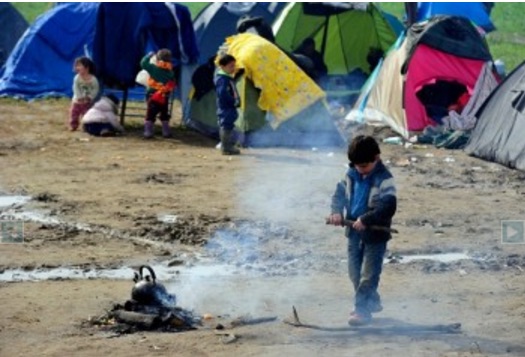
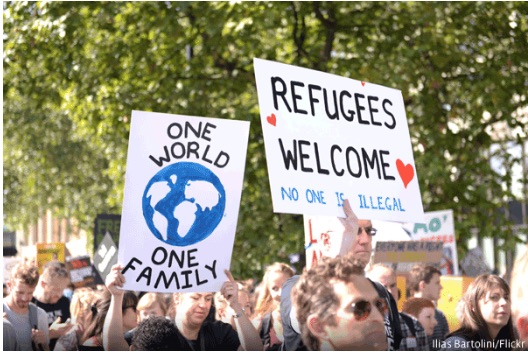
Now more than ever we need a huge response to the refugee crisis to counter the racist rhetoric across Europe trying to demonise and disenfranchise victims of war, oppression and poverty. Some of the largest mass movements in Britain have joined together with major trade unions to show solidarity.

Calais

The Convoy to Calais will leave Central London for Calais on Saturday June 1 at 10 am. Organised by: Stop the War Coalition, Stand up to Racism, People’s Assembly Against Austerity, War on Want, Unite the Union, Communications Workers Union, Momentum and the Muslim Association of Britain

If you can give aid of any sort, material or financial, for our Convoy to Calais please do. Better still come on the Convoy yourself. Any vehicle will do: lorry, bus, coach, van, minibus, car, taxi, motorbike or scooter!

This is practical aid but it is also a huge moving protest at the way governments across the continent are failing refugees. This is the time to come together and say: stop the scapegoating, solidarity with the refugees.

REFUGEES ARE WELCOME HERE.

For more information email – calaisconvoy@gmail.com

Download PDF Flyers here: http://bit.ly/1SfhwLl

Download Model Resolution here: http://bit.ly/1rp3qP4

(Thank you to Janet Hudgins, the CPNN reporter for this article)

Question for discussion

Central Africa: ICGLR Summit On Formal Peace Education in the Great Lakes Region Concludes in Nairobi

. TOLERANCE & SOLIDARITY .

An article from conference website

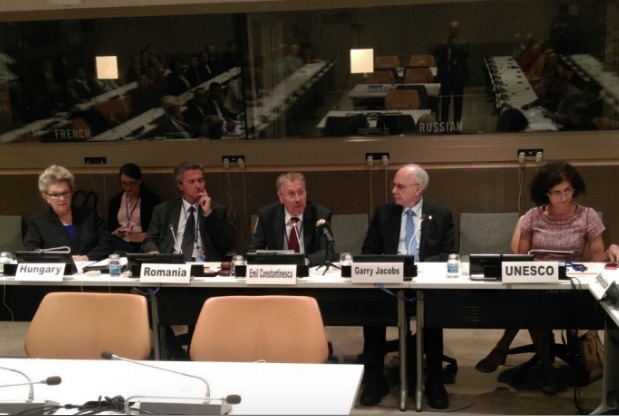
The International Conference on the Great Lakes Region (ICGLR) has concluded a two-day Regional Peace Education Summit, which it co-organised with Interpeace and UNESCO in Nairobi, Kenya. Delegates at the summit, held from 3-4 March 2016, included officials of Government Ministries responsible for Education, Gender and Youth members of the national parliaments and provincial governments, and practitioners from Burundi, the DRC, Rwanda and Uganda, as well as technical experts in peacebuilding and peace education from Interpeace and UNESCO.

summit

Ambassador Josephine Gaita, ICGLR National Coordinator of the Republic of Kenya, officially opened the summit on March 3rd. The summit focused on the implementation of formal peace education in three ICGLR member states, namely Burundi, the Democratic Republic of Congo (DRC), and Rwanda. The Republic of Uganda was also present as an active observer, while the Republic of South Sudan was represented by the country’s ICGLR National Coordinator.

Proceedings included presentations on the state of peace education in Burundi, the DRC, Rwanda and Uganda, expert presentations on the policy and practice of peace education, plenary discussions and sessions where each delegations could reflect on their country specific ideas on the way forward for effective implementation of formal peace education. Participants expressed the need for regional level peace education strategies to respond to conflicts in the Great Lakes which have often had a cross border dimension.

The summit was premised by two prior occasions. The first was an Extraordinary Summit of ICGLR Heads of States on Youth Unemployment, held on 24 July 2014 in Nairobi, which emphasized the important role of the youth in the pursuit of peace, security and stability within the region. The second was a 2014 participatory action research process carried out by Interpeace and its six partner organisations in Rwanda, Burundi and the eastern DRC. The research was based on consultations with diverse actors across the Great Lakes region and revealed that most people considered identity-based stereotypes and manipulations as a fundamental obstacle to sustainable peace in the region. The research participants suggested that peace education could serve as a priority intervention to address challenges related to identity-based stereotypes and manipulation, arguing that peace education could both strengthen existing peacebuilding efforts and help in the prevention of conflict among future generations.

(Article continued in right column)

Question related to this article:

Solidarity across national borders, What are some good examples?>

(Article continued from left column)

Interpeace’s Regional Director for Eastern and Central Africa (ECA), Johan Svensson, lauded the national delegations and the ICGLR for taking into account the sentiments of the local populations in their efforts to achieve sustainable peace and security both in their countries and in the region.

“Your commitment as stakeholders is inspiring because you are responding directly to your people’s call for peace education,” Mr Svensson remarked at the summit.

The summit revealed that peace education efforts already existed in all the three countries, albeit at varying levels of implementation. Among some of the challenges discussed was the need to develop comprehensive peace education frameworks and to foster a pedagogy that would create harmony in the understanding of integration of peace education in the three countries. These findings were emphasized by ICGLR Executive Secretary, Professor Ntumba Luaba, who called for the creation of a regional ICGLR peace education programme and acknowledged the delegates for making the first steps in the regional cause for peace education. Ministry representatives of the country delegations committed to sharing the findings of the summit with the concerned actors in their respective countries, in order to make sure that the summit results will inform future peace education efforts.

“Peace education has the potential to create a new generation of women, men and youth who will be the guardians of peace in the region,” Professor Ntumba told participants at the summit.

Professor Luaba also lauded ICGLR’s partnership with Interpeace, which made it possible for the summit to take place, and suggested the organisation of a similar Peace Education summit with participation from all the twelve ICGLR Member States. The ICGLR Member States include the Republic of Angola, the Republic of Burundi, the Central African Republic, the Republic of Congo, the Democratic Republic of Congo, the Republic of Kenya, the Republic of Rwanda, the Republic of Sudan, the Republic of South Sudan, the United Republic of Tanzania, the Republic of Uganda and the Republic of Zambia.

(Thank you to the newsletter of the Global Campaign for Peace Education for sending us this news.)

There’s a Place in India Where Religions Coexist Beautifully and Gender Equality Is Unmatched

TOLERANCE & SOLIDARITY .

An article in the Huffington Post by Chandran Nair, Global Institute for Tomorrow (reprinted according to the principle of “fair use”)

Back in the summer of 2015, the heart of a Hindu man was transported across Kerala for a Christian patient in dire need of a new one. Funds were raised by a Muslim businessman to pay for the operation and performed by the state’s top heart surgeon: a Christian. The entire state became engrossed as the story unfolded. An Indian Navy helicopter and an ambulance — both dispatched by Kerala’s Chief Minister Oommen Chandy — sped the heart from Thiruvananthapuram to Kochi.

Kerala
Photo by Frank Bienewald via Getty Images

Kerala is known by the motto “God’s Own Country.” Some may think the moniker is presumptive, but anyone who has seen its forests, its backwaters, its beaches and its bounty of agricultural produce and spices will know it is well deserved.

Over centuries, people from many different communities and cultures traveled through and lived in Kerala — Jewish and Christian migrants, Arab merchants, European traders and colonizers. The city of Kochi has India’s oldest active synagogue and the oldest European church, both from the sixteenth century.

But perhaps “God’s Own Country” deserves a new and highly relevant interpretation. Kerala is a symbol of religious coexistence — not simply tolerance — in a world that is struggling with new strains of virulent intolerance and violence. The state has a unique mix of three of the world’s largest religions: roughly 30 percent Muslims, 20 percent Christians and 50 percent Hindus. This split is unique in India — not many other places have such significant populations of both Christians and Muslims living with a not too large majority of Hindus — and perhaps unique even globally.

Given this mix, the rarity of communal violence is striking; a few small-scale incidents are exceptions to a norm of stability and coexistence. The various religions have evolved to integrate and include their neighboring faiths; for example, the Hindu Edappara Maladevar Nada Temple has a shrine dedicated to Kayamkulam Kochunni, a popular nineteenth-century Muslim “Robin Hood.” Keralites believe themselves to be, first and foremost, Indian Malayalis.

Some may say this tolerance is no surprise, given the long histories of both Christians and Muslims in Kerala. But one need only look at Eastern Europe or the Middle East, where long-standing bonds within a once diverse community were ruptured within a single generation.

So what might explain this peaceful and secular coexistence? There are many possible reasons but one striking thing about Kerala that may offer an explanation is its near-universal provision of not just basic needs, but also public and social services. Kerala’s literacy rate — 94 percent — is in the same range as much richer areas like the Gulf, China and Europe. The state’s infant mortality rate is 12 per 1,000 births, compared to 40 per 1,000 births for India as a whole. Kerala’s toilet coverage is almost universal — 97 percent. Earlier this year, Kerala became the first state in India to achieve 100 percent primary education.

(Article continued in right column)

Question related to this article:


How can different faiths work together for understanding and harmony?

(Article continued from left column)

It should also be noted that Kerala has a level of gender parity unmatched by any other state in India and, in fact, many places around the world. Kerala is one of only two Indian states where women outnumber men; all other Indian states have more men — sometimes significantly so. While India as a whole has significantly lower female literacy than male literacy, Kerala’s rates are roughly equal. Kerala also boasts the largest women-empowering network in the country: the Kudumbashree Mission, which boasts over four million members.

By global standards, Kerala is by no means rich: it has an average income of about $1,300. However, in many important social indicators, it outperforms not just other Indian states, but several other countries with higher per capita incomes — like Malaysia, with an average income of about $11,000, and the UAE, with an average income of about $44,000.

Kerala’s government has very effectively made the provision of social services one of the central pillars of policy and thus development towards social cohesion. Chief Minister Chandy noted three reasons for his state’s success: education, health and infrastructure. In all of these areas, the government has actively strived to improve services to a global standard, even though he acknowledged that infrastructure in areas such as transportation still had much room for improvement.

When the basic needs of life — food, water, sanitation, housing, education, healthcare — are denied, resentment against the “other” can fester. Racial, ethnic and religious divisions can be exploited and can erupt into communal violence — in both the developing and developed worlds. Whether it is Myanmar, the Dominican Republic, Paris or Baltimore or elsewhere, resentment between groups is driven, in part, by a feeling that of being denied access to basic economic and social rights. Part of the backlash against immigrants and “foreign” groups is a misdirected “solution” to a real problem: stagnating incomes and lessening job opportunities for the working classes.

But when social needs are provided on a universal basis, there is less cause for grievances that can be nurtured or exploited. No group feels like they are being left behind. The burden is shared and the work of reducing the drudgery of daily life to uplift people becomes a collective responsibility. There is clear evidence that this focus on needs, and its community-based approach often led by volunteers, is part of what makes Kerala a success.

This is not to say that Kerala is perfect — it still has a long way to go before it really sees high development measured according to global standards. But it may be a model of how to keep multiethnic and multi-religious communities stable in the long-term.

Rather than platitudes about multiculturalism or a hope that rising incomes will make everyone forget their cultural roots, an aggressive and universal expansion of social services may instead be the answer to communal tensions. It could make all of India — not just Kerala — “God’s Own Country.”

Landmark Vatican conference rejects just war theory, asks for encyclical on nonviolence

TOLERANCE AND SOLIDARITY .

An article by Joshua J. McElwee for the National Catholic Reporter

The participants of a first-of-its-kind Vatican conference have bluntly rejected the Catholic church’s long-held teachings on just war theory, saying they have too often been used to justify violent conflicts and the global church must reconsider Jesus’ teachings on nonviolence.
Members of a three-day event co-hosted by the Pontifical Council for Justice and Peace and the international Catholic peace organization Pax Christi have also strongly called on Pope Francis to consider writing an encyclical letter, or some other “major teaching document,” reorienting the church’s teachings on violence.

vatican

There is no ‘just war,'” the some 80 participants of the conference state in an appeal they released Thursday morning.

“Too often the ‘just war theory’ has been used to endorse rather than prevent or limit war,” they continue. “Suggesting that a ‘just war’ is possible also undermines the moral imperative to develop tools and capacities for nonviolent transformation of conflict.”

“We need a new framework that is consistent with Gospel nonviolence,” say the participants, noting that Francis and his four predecessors have all spoken out against war often. “We propose that the Catholic Church develop and consider shifting to a Just Peace approach based on Gospel nonviolence.”

NCR’s sister publication Celebration offers a FREE resource guide on Pope Francis’ The Face of Mercy. Get it here.
FaceofMercy_coverSMALL.jpg
Just war theory is a tradition that uses a series of criteria to evaluate whether use of violence can be considered morally justifiable. First referred to by fourth-century bishop St. Augustine of Hippo, it was later articulated in depth by 13th-century theologian St. Thomas Aquinas and is today outlined by four conditions in the formal Catechism of the Catholic Church.

The Rome conference, held Monday through Wednesday [April 10-13], brought experts engaged in global nonviolent struggles to reconsider the theory for the first time under the aegis of the Vatican.

It comes after a number of theologians have criticized continued use of the theory in modern times, saying that both the powerful capabilities of modern weapons and evidence of the effectiveness of nonviolent campaigns make it outdated.

At a press event launching the conference’s final appeal document — given the title “An Appeal to the Catholic Church to Re-Commit to the Centrality of Gospel Nonviolence” — several of the event’s participants said the church should simply no longer teach the just war theory.

“I came a long distance for this conference, with a very clear mind that violence is outlived,” said Archbishop John Baptist Odama of Gulu, Uganda. “It is out of date for our world of today.”

“We have to sound this with a strong voice,” said the archbishop. “Any war is a destruction. There is no justice in destruction. … It is outdated.”

The Catechism currently outlines as one criteria for moral justification of war that “the use of arms must not produce evils and disorders graver than the evil to be eliminated” and notes that “the power of modern means of destruction weighs very heavily in evaluating this condition.”

Odama, who also leads Uganda’s bishops’ conference, said the conditions in the Catechism “are only given to say in reality there should be no war.”

“This is where the group was very strong,” he said, referring to the conference. “We should not give now, at this moment, reasons for war. Let us block them and promote relationships of harmony, of brother and sisterhood, rather than going for war.”

Marie Dennis, an American who serves as a co-president of Pax Christi International, said she and the conference group “believe that it is time for the church to speak another word into the global reality.”

(article continued on the right side of the page)

Question for this article

Where in the world can we find good leadership today?

Readers’ comments are invited on this question and article. See below for comments box.

(article continued from the left side of the page)

“When we look at the reality of war, when we look at the teachings of Jesus, we’re asking what is the responsibility of the church,” she said. “And it is, we believe, a responsibility to promote nonviolence.”

Dennis also said she understands that people may raise concerns in rejecting the just war theory over needing to stop unjust aggressors. Her group, she said, agrees that violent aggressors have to be stopped.

“The question is how,” said Dennis. “Our belief would be that as long as we keep saying we can do it with military force, we will not invest the creative energy, the deep thinking, the financial and human resources in creating or identifying the alternatives that actually could make a difference.”

“As long as we say that dropping bombs will solve the problem we won’t find other solutions and I think that’s feeling more and more clear to us,” he said.

The April conference on just war theory had been discussed for months and was the first cohosted by the Vatican’s pontifical council and Pax Christi, an international Catholic coalition akin to Amnesty International that maintains separate national groups in many countries.

The conference was organized around four sessions allowing participants to dialogue and share experiences with one another. The only scheduled talk at the event was given by Cardinal Peter Turkson, the head of the pontifical council, who also read a letter sent to the participants by Francis.

Among other participants were bishops from Nigeria and Japan, and leaders of the Rome-based umbrella groups for men and women religious around the world. Also taking part were a senior policy fellow at the U.S. Institute of Peace, several noted theologians, and Irish Nobel Peace Prize winner Mairead Maguire.

The group’s final appeal states succinctly: “The time has come for our Church to be a living witness and to invest far greater human and financial resources in promoting a spirituality and practice of active nonviolence.”

“In all of this, Jesus is our inspiration and model,” they state. “Neither passive nor weak, Jesus’ nonviolence was the power of love in action.”

Odama said Jesus “always asked his followers not to resort to violence in solving problems, including in his last stage of life.”

“On the cross, [Jesus] said, ‘Father forgive them because they don’t know what they’re doing,'” said the archbishop. “In this statement, he united the whole of humanity under one father.”

“He does not take violent words and violent actions,” said Odama. “That is the greatest act of teaching as to how we should handle our situations. Not violence.”

Dennis said that part of the goal in organizing the conference “was to ultimately lead to an encyclical or a process that would produce major Catholic teaching on nonviolence.”

“We haven’t run into a roadblock yet,” she said. “There are no promises.”

“What we really hope will happen is a process that will engage the Vatican and the Catholic communities around the world in exactly these questions,” said Dennis. “What can we know better about the role that nonviolence can play in shifting our world to a better place?”

Ken Butigan, a lecturer at DePaul University in Chicago and executive director of the non-profit group Pace e Bene, said: “We have gotten a green light for months that this is something that Pope Francis is excited about moving forward on.”

“We are determined to support that momentum at this historical moment,” he said. “We know Pope Francis has a vision and we’re here to support that vision.”

(Thank you to Janet Hudgins, the CPNN reporter for this article.)

GLOBAL YOUTH RISING: Empowering passionate activists and peace workers from around the world– JULY 2016

TOLERANCE AND SOLIDARITY .

A press release from Ilona Traista, Global Youth Rising

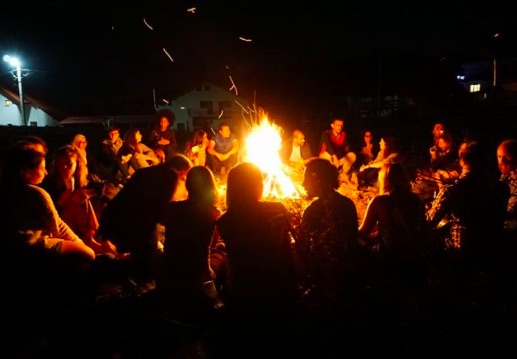
Join us for a global gathering that brings together activists, peace workers and others who are working to make the world a better place as we come together to discuss key issues such as what’s happening in Syria, Iraq, Libya and Yemen and we work to create solid collaborative movements and plans of action for tackling these issues. PATRIR, in co-ordination with several partners including National Peace Academy, PAX, UNOY, the World Peace Initiative, IAHV and Building Bridges for Peace, is now accepting applications for GLOBAL YOUTH RISING – a summer camp and global gathering.

rising
Video of Global Youth Rising Peace Summer Camp 2016

This 10 day event this July will bring together passionate, motivated organizations, youth activists and peace workers from around the world to learn, share, collaborate and gain practical skills, tools and inspiration to empower them to achieve real and meaningful change in the world.

There are few forums in the world where people passionate about creating change can come together; Global Youth Rising aims to change this, bringing together extraordinary and dedicated activists, practitioners and global trainers who will facilitate trainings and workshops on a range of important topics including: tackling violent extremism and discrimination; healing from trauma (especially for those working with refugee/asylum seeking populations); building effective action in our communities; using arts and creativity for social transformation; fostering inner peace and well-being; building solidarity with citizens’ peace movements and activists in Syria, Yemen, Libya, Iraq and Ukraine; peace education; environmental justice and environmental movements; and practical peacebuilding skills (e.g. using social and digital media for activism).

As well as trainers from PATRIR, PAX, Peace Revolution, IAHV, National Peace Academy, UNOY and an alliance of other organizations, this is a horizontal forum where participants and organizations will be able to share their own experiences from their own communities and countries or work internationally, learning from each other and working to create solid international movements and projects.

The camp and global gathering will also include morning well-being sessions, including yoga, breathing techniques and meditation; the opportunity for non-formal learning such as forum theatre, strategy sessions on building movements, discussions, peace circles and film nights. Participants will also have the chance to explore the beautiful Transylvanian countryside and take part in excursions including mountain hiking and white-water rafting!

The Global Youth Rising summer camp & global gathering 2016 is the perfect opportunity to come together with dedicated activists from around the world and deepen your skills, knowledge, capacities and passion for real change — or to support youth and youth organisations in your community for the experience of a lifetime.

Dates are 10-20th July 2016 in Romania.
Deadline for Applications: May 30. (May 5th for those requiring a visa)

Question for this article

Search for Common Ground: Take Action to End Violence against Civilians

TOLERANCE AND SOLIDARITY .

An email from Shamil Idriss, President and CEO of Search for Common Ground

Violence against civilians – from mass shootings to genocide – is a horror we all want to prevent. Such terrible tragedies should be unconscionable. Learn more and take action:

1. Save lives from Boko Haram

Recently, Boko Haram murdered at least 86 individuals, kidnapped children, and burned down homes in Dalori, Nigeria. It happened just 11 miles one of our bases of operation. Click here for Program Manager Gideon Poki’s take as he speaks with TIME Magazine about the violence. Thankfully, none of our staff or their families was harmed. But, Boko Haram has killed about 20,000 people and driven 2.5 million Nigerians from their homes in 6 years. They’ve been gaining momentum, with deep roots in economic desperation and grievances. Boko Haram’s increasing attacks terrorize civilians in northeast Nigeria, leaving broken families, widespread loss of life and property, breakdown of basic services, hunger, and increased poverty.

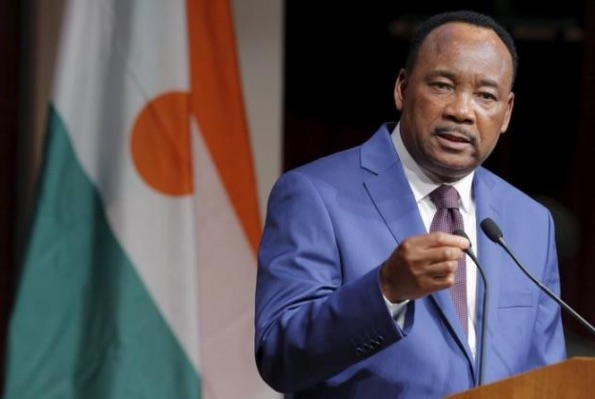
idriss

Right now, Search is piloting an early warning system in two communities at the heart of the attacks. Think of it like Paul Revere’s ride or a tornado siren, using trained volunteer community responders. Check out a similar system we used to help stop violence around Nigeria’s elections last year. We need to expand this vital warning system to more communities. We also need to bring civilians and government officials together, building trust so they can anticipate threats and prevent them together. Give now to stop violence against civilians.

2. Urge U.S. Congress to take action

After mass violence, the world looks back in shame. Why did we allow it to happen? Couldn’t we have saved thousands, even millions, of lives? Genocide and other mass violence is an unspeakable crime that can be prevented. If you’re a U.S. citizen, here’s a chance to join the effort.

(article continued on the right side of the page)

Question for this article

Islamic extremism, how should it be opposed?

Readers’ comments are invited on this question and article. See below for comments box.

(article continued from the left side of the page)

The Genocide and Atrocities Prevention Act will create opportunities for civilian-led efforts to prevent mass violence:

• Authorizes the President to establish an Atrocities Prevention Board (APB). It will coordinate the U.S. government’s efforts to prevent and respond to atrocities.

• Trains all Foreign Service Officers in recognizing early warning signs of emerging conflict or atrocities – similar to how Search is training Nigerian community responders (above).

• Makes mass violence prevention the U.S.’s official policy, so that resources and political will may be mobilized in time to save lives.
Through the Peace Alliance, you can easily send letters to your representatives in Congress. Urge them to support the bill.

3. Listen and share radio spots

Radio can cut across diverse landscapes to the most rural areas. It can divide people and stir up hate, as it was used in the Rwandan genocide. Or it can dispel rumors and build peace. Our fearless radio partners around the world are an objective voice in a biased news cycle. In celebration of World Radio Day, we’ve rounded up some of the most critical ways we used radio in 2015 to stop violence and bring people together. From Burundi’s political violence to Nepal’s earthquake response to Niger’s refugee tensions, radio is a powerful tool to prevent violence from spinning out of control. Check out our radio spots.

We can all agree that violence against mothers and fathers, boys and girls who are simply going to work and school, living their lives, is wrong. We’re getting smarter, as people, as countries, and as a global community, about how to stop mass atrocities before they happen. Understand what’s at stake and what we can do. Then let’s come together and get it done.
  
Thank you for your tireless efforts,

Muslims Advance Consensus for Citizenship for All: The Marrakesh Declaration

TOLERANCE & SOLIDARITY .

A press release by Religions for Peace, Marrkesh, 27 January 2016

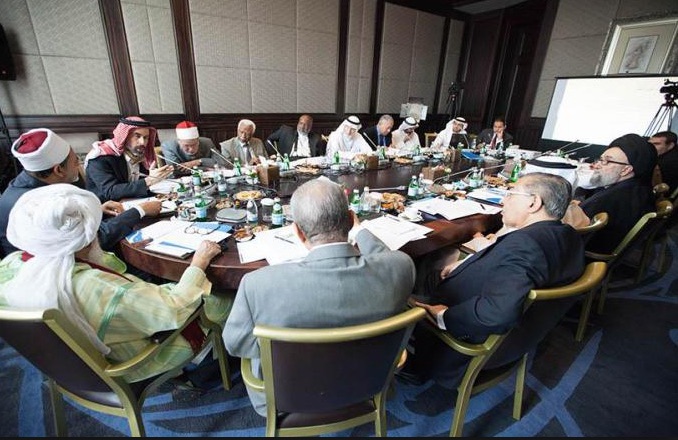
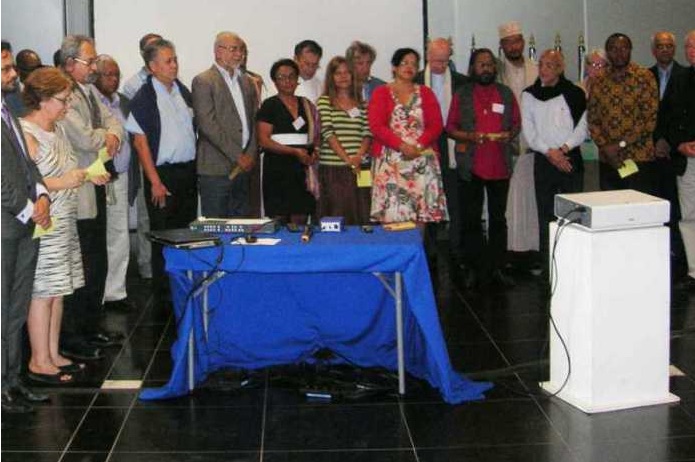
At the invitation of His Majesty King Mohammed VI, 250 of the world’s eminent Islamic leaders convened to discuss the rights of religious minorities and the obligation to protect them in Muslim majority states.

Marrakesh
 Shaykh Abdullah bin Bayyah, President, Forum for Promoting Peace and Co-Moderator, Religions for Peace, addressing the gathering

This position has historic roots dating to the time of Prophet Mohammed and the Medina Charter. Today’s Declaration was issued at a time of heightened social hostility fueled by violent extremism, widespread Islamophobia and the denial of rights, sometimes justified by misrepresentations of Islamic teachings.
 
The conference was organized by the Moroccan Ministry of Religious Endowments and Islamic Affairs and the Forum for Promoting Peace in Muslim Societies based in Abu Dhabi. His Eminence Shaykh Abdullah bin Bayyah, the President of the Forum for Promoting Peace and Co-Moderator of Religions for Peace (RfP), offered the keynote address that set the framework for deliberation among the Islamic leaders. Fifty senior leaders from the world’s diverse religious traditions other than Islam were invited as observers of the Islamic deliberations.
 
A summary of the Marrakesh Declaration includes:
 
• “The objectives of the Charter of Medina provide a suitable framework for national constitutions in countries with Muslim majorities, and are in harmony with the United Nations Charter and related documents, such as the Universal Declaration of Human Rights.”
 
• “Affirm[s] that it is impermissible to employ religion for the purpose of detracting from the rights of religious minorities in Muslim countries.”
 
• “Call[s] upon representatives of the various religions, sects and denominations to confront all forms of religious bigotry, vilification and denigration of what people hold sacred, as well as all words that promote hatred and racism.”
 
The fifty religious leaders other than Muslims:
 
• Expressed their gratitude to the Islamic leaders for their unflinching courage and devotion to their tradition and for welcoming non-Muslims among them as observers;
 
• Affirmed values shared with the Islamic leaders;
 
• Asked forgiveness for past and current injuries for which their communities are complicit;
 
• Shared particular concerns over violence in the name of religion, limitations of citizenship, restrictions on freedom of religion or belief, and xenophobia, especially Islamophobia;
 
• Committed to follow-up work in solidarity with Muslim brothers and sisters to build a culture of peace; and,
 
• Respectfully expressed the hope that this convening of Islamic leaders will be continued by future regional conferences.
 
Every attack, every hate crime, every insult, every humiliation is amplified in the media and sends out a polarizing wave, fueling the rise in hostility. Only religious communities cooperating — standing shoulder-to-shoulder in solidarity — can transform this vicious cycle into a virtuous one, in which the good deeds of each community call out to and reinforce the good deeds of the others. RfP is committed to supporting all religious communities in collaborative efforts to build a virtuous cycle for Peace.
 
Read the Marrakesh Declaration Summary in Arabic Here.

Read the Marrakesh Declaration Summary in English Here


Question related to this article:

How can different faiths work together for understanding and harmony?

This discussion question applies to the following articles:

Creating Harmony in the World: Working through Our Faiths in Dialogue
Alternate Focus: Balance in Media Coverage in Middle East
The Parliament of the World's Religions (Barcelona, Spain)
Asian Religious Leaders Urge Religions To Teach Peace
Living Faiths Together – Tool kit on inter-religious dialogue in youth work
Sharing the right to Jerusalem's past
The Doha Pre-Forum of the United Nations Alliance of Civilizations
Peace For Childrens in Primary Schools in Iraq
Dialogue in Nigeria — a new DVD teaching-tool for peacemakers
4th Annual International Conference on Religion, Conflict and Peace
First Religious Youth Service Project in Pakistan
World Harmony Day at the UN Highlights the Culture of Peace
Report of Diversity Talk Series 2013, in Lahore, Pakistan
Journée d'étude à Tunis: Religions et cultures au service de la paix
Workshop in Tunis: Religions and cultures in the service of peace
Out of the spotlight, Moroccan Islamic party promotes interfaith dialogue
Muslim and Christian youth come together in Mombasa, Kenya
Greeting of Peace from United Social Welfare Society, Pakistan
Interfaith Cultural Study Tour to Nepal: Pakistan Youth Explore the Mysteries of Nepal
One Nation, One Blood (Pakistan)
Teachings of Peace
Overview of the Book, Paganism an Introduction to Earth-Centered Religions
La líder de un movimiento interreligioso Dena Merriam recibirá el 31 Niwano Peace Prize
Dena Merriam, Founder and leader of The Global Peace Initiative of Women to receive the Niwano Peace Prize
Pakistan: Scholars adopt charter of peace, support coexistence
Lebanese dialogue aims to strengthen unity in diversity
Un an du “Projet Revalorisation du Vivre Ensemble – REVE” au Niger
A Year-long Project for “Living Together – REVE” in Niger
Beating the drum for peace: A chat with the general secretary of the South Sudan Council of Churches

United Nations: Experts call for efforts to save indigenous languages

TOLERANCE AND SOLIDARITY .

An article from Xinhua News

Endangered indigenous languages are being brought back from the brink of extinction but there is still much work to be done, a group of indigenous language experts told reporters here Thursday [United Nations, January 21].


indigenous
Edward John (FLICKR)

“There are examples of us not just holding onto our languages, but using them to educate new generations, using them in our homes again,” said Amy Kalili, an expert in the Hawaiian language, who participated in a panel of indigenous language experts here this week.

The panel provided examples of indigenous languages being revitalized around the world, from Maori in New Zealand to Hawaiian in Kalili’s native Hawaii.

It is now possible to study in the Hawaiian language from infancy through to doctoral level, said Kalili, mostly due to community efforts to save the language from extinction.

Kalili said that saving indigenous languages would also benefit the global community through preserving vital indigenous knowledge.

“The wealth of knowledge that we have to offer the global community is codified in our native languages,” she said.

However, Grand Chief Edward John from the Tl’azt’en Nation in British Columbia, Canada said that sadly one Indigenous language dies every week or two weeks.

“If there’s an animal or plant or fish going extinct, people are up in arms over that, but when a language is going extinct, no one says anything,” he said.

And while technology may offer some assistance, it is not the answer in and of itself, said John.

“We now need to get the elders into these gadgets so that they can use this technology to teach the young people,” he said. “Technology in and of itself won’t be the answer, but it’s a tool.”

Tatjana Degai from Kamchatka in the far East of Russia said that despite a multicultural approach and government support for indigenous languages in Russia, some languages are still on the brink of extinction.

“Our language is surviving, in Russia which is a multicultural country (with) over 200 different languages”, she said.

“Some languages are spoken by a million people, some languages are spoken by thousands, and mostly it is indigenous languages of the people of North Siberia and the far-East which are at the brink of extinction,” she said.

There are between 6,000 and 7,000 languages globally, said John. One of the panel’s recommendations is for countries to help map out the indigenous languages within their own borders, he added.

Question for discussion