TOLERANCE & SOLIDARITY .
an article by Nohad Topalian, Al-Shorfa
A group of Lebanese intellectuals of various political, ideological and sectarian affiliations met in Beirut in February for the “Permanent Conference for Peace in Lebanon”, an on-going dialogue that aims to find constructive ways to build and reinforce peace, co-existence and democracy in the country.
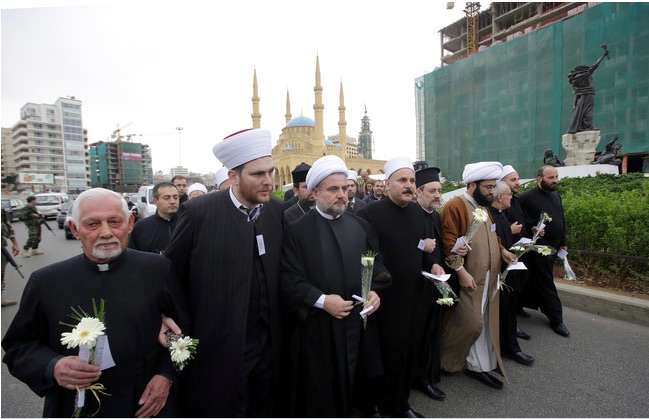
Clerics representing the various Lebanese religious communities march for peace in central Beirut on the eve of the anniversary of the civil war in April 2013. [Joseph Eid/AFP]
The conference, which opened in early February, is a reincarnation of the “Permanent Conference for Inter-Lebanese Dialogue”, which had been formed in 1993 and played a prominent role in promoting a culture of dialogue and co- existence among Lebanon’s various sects and Lebanese in general.
“The timing of the launch of the conference is linked to two factors: the outbreak of violence at an extraordinary level in the region and its impact on Lebanon, and the inability of the political class of all affiliations to grasp the gravity of the violence and [failure] to work to avert its consequences on Lebanon,” said political thinker Samir Frangieh of the March 14 Alliance, who launched the conference.
“So it was necessary to launch a cry to mobilise civil society to build some sort of a safety net in the country,” he told Al-Shorfa.
The conference, he said, aims to work on several levels to restore a culture of peace in Lebanon and launch initiatives in various areas to establish the principles of co-existence, as well as educate Lebanese expatriates about how Lebanon serves as a model of conflict resolution.
“Lebanon is the only country in the world where Muslims and Christians share authority, and the only country in the Muslim world where Sunnis and Shias share in operating this system of rule alongside Christians,” he said.
The conference seeks to give prominence to moderates within all the Lebanese sects without directly changing the positions of their political parties, as well as seeks to help strengthen democracy, Frangieh said.
“We talk about promoting and enhancing co-existence [because] it has a positive effect on democracy, particularly since we in Lebanon have a model of democracy that is based on two principles, the first relating to the rights of individuals, and the second to guarantees for groups,” he said, adding that some countries in the region need this model to break the cycle of violence.
Future bloc MP Mohammed Qabbani said the conference is significant because its participants are convened on a national, not sectarian basis.
“We have been suffering from sinking ever deeper in the sectarian and denominational quagmire in recent years, to such an extent that it has become our daily language,” he told Al- Shorfa. “But I reject this logic because I regard Lebanon’s four million citizens, and many times that number abroad, as one people, not a collection of sects sharing one land that is falsely called a country.”
“So we must start at the root level and the culture. […] We are one people in everyday life, one regardless of whether the citizen belongs to a church or mosque,” Qabbani said. . . .