All posts by CPNN Coordinator

About CPNN Coordinator

Dr David Adams is the coordinator of the Culture of Peace News Network. He retired in 2001 from UNESCO where he was the Director of the Unit for the International Year for the Culture of Peace, proclaimed for the Year 2000 by the United Nations General Assembly.

Cuba a ‘Champion’ of Children’s Rights: UNICEF

. HUMAN RIGHTS .

An article from Telesur TV

The United Nations Children Fund, or Unicef , has declared Cuba a ‘champion’ in children’s rights. According to Unicef 99.5 percent of Cuban children under six years of age attend an early childhood education program or institution.

María Cristina Perceval, the regional director for Latin America and the Caribbean region, said, Cuba’s exemplary model of early education, “Educa a Tu Hijo (Educate Your Child),” is being adopted by many other nations. 

Perceval, who made the comments during a recent event in Cuba’s capital, Havana, also highlighted the significant advances made by the country in health. The Caribbean nation was the first to work towards the elimination of maternal and child transmission of HIV / AIDS in 2015. 

Health and education policies form the core of Cuba’s socialist programs. Cuba first initiated the social program focused on children’s well-being, 26 years ago. The Unicef in the region works in collaboration with the government in these social programs.

(Article continued in right column)

Questions related to this article:

Rights of the child, How can they be promoted and protected?

Does Cuba promote a culture of peace?

(Article continued from left column)

The ‘Educate Your Child’ initiative promotes the role of family and community in children’s formative years. Through the program, the government also prioritizes the participatory methodologies and social commitment in the area of child development. 

“The government has installed a mechanism for communities to not only deal with emergency situations, but also with other phenomena, with efficacy, professionalism, and speed,” Perceval added. 

“We are grateful to share this information that the education mechanism which incorporates childhood education, elimination of vertical transmission of HIV, and prevention of teen pregnancies. Champions, champions, champions!”

According to the 2016 Unicef report which cited the official statistics from the Ministry of Education, “There are more than 855,000 children under six years of age in Cuba, of whom 99.5 percent attend an early childhood education program or institution.”  

“Cuba has adopted a holistic approach to early childhood development (ECD), providing children under six and their families with a system of integrated services that aims to promote the best start in life for all children and the maximum development of each child’s potential,” the report added.

Perceval also pointed out that communities have played an essential role in “allowing with much humility to work on what is lacking,” adding that there is work to be done against gender violence in the region. 

“The Federation of Cuban women is immensely fierce, but we have known that violent practices could occur in public spaces and have insisted on eradication of all types of child abuse in communities and institutions,” The U.N. senior official added.

International Solar Alliance – A Symbol of Hope and Cooperation

.. SUSTAINABLE DEVELOPMENT ..

An article by Dr Ravi P Bhatia from Transcend Media Service

Renewable energy is being tapped and promoted in many parts of the world to meet the challenges of environmental pollution, global warming and climate change. One of the main factors behind the environmental challenge is the factor of our dependence on coal powered energy production that is highly polluting and is causing various types of adverse effects including on the health of human beings.


These issues were discussed in great detail in the UN Convention of Climate Change held in Paris in December 2014 and commitments made by several countries including the major ones – USA, China, India, France Germany, Japan and others about taking measures to not increase the global warming beyond 1.5 degree Celsius by the end of the century. This would necessitate both financial commitments as well as by adopting technological measures such as stressing increased production and utilization of renewable energy.

As is well known by now, renewable energy does not have these adverse effects and hence it is being promoted worldwide. Of course tapping the renewable sources and putting them in practice have their own distinct difficulties but they do not cause the pollution that is so damaging. Renewable energy is produced mainly from the sun (solar energy), wind power, tidal waves. Great emphasis is being laid on harnessing the sun’s energy through the use of solar cells that convert sun’s rays into electricity.

(Continued in right column)

Question for this article:

Are we making progress in renewable energy?

(Continued from left column)

Unfortunately, USA appears to be backing out from its commitments on climate change made in Paris as well as the following year in Marrakesh. The responsibility of mitigating the effects of climate change is falling primarily on India, France and China. In order to meet the challenges of global warming and climate change, India had proposed an alliance of countries called the International Solar Alliance (ISA) two years back, with support of France and several countries of Africa, Asia and Latin America.

The first meeting of ISA is being held in New Delhi from 11 March with the Prime Minister Narendra Modi and the French President Emmanuel Macron co-chairing the inaugural meeting. Speaking on the occasion Mr. Modi referred to the wisdom of India’s ancient Vedas that had clearly stressed the importance of our Sun for sustaining life – human, animal and plant, on the Earth. This was manifested in India’s respect for the Sun in various epics and its Mantras. He stressed that “We have to look at the balanced and all-encompassing philosophy of the Vedas to meet the challenge of climate change. We have to take urgent steps towards this objective.” The French President also spoke about the significance of solar power and renewable energy to meet the global challenge and committed both financial and technological support for this noble venture.

It was stressed by both the leaders that with these commitments and the active support of the 32 countries that have ratified the framework agreement of the Alliance, the target of about 175 GW of energy from renewable sources could be met by the end of 2022. Of this, solar and wind energies would contribute 100 and 60 GW respectively.

Many participating countries also spoke in favor of renewable energy and promised that they would also take appropriate steps, however small they may be to promote renewable energy in their countries. They also sought financial and technological support which France and India agreed to provide.

The inaugural meeting of the Solar Alliance gives us hope that the challenges of environmental pollution, global warming and climate change are being recognized and addressed by many countries. This meeting also encourages the coming together of different nations — developed and developing, to meet common challenges through goodwill and cooperation.

March 28: 1st meeting of UN High-Level Conference on Nuclear Disarmament

DISARMAMENT & SECURITY .

A newsletter received by email from Unfold Zero

On March 28, the United Nations will hold the preparatory meeting for the 2018 UN High-Level Conference on Nuclear Disarmament.

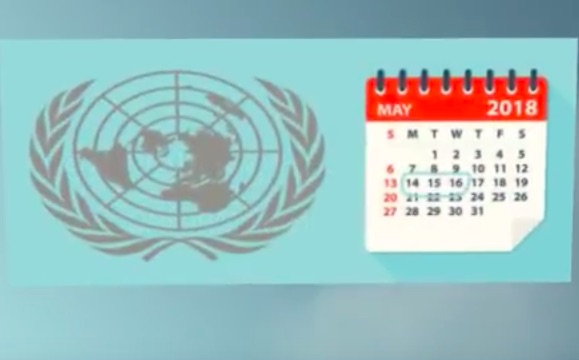
At the preparatory meeting, UN member states will appoint the President (Chair) and other officials, adopt the agenda and agree on the rules of procedure for the UN High-Level Conference, which will take place at the UN from May 14-16.


Frame from the Reach-High video to promote the UN High-Level Conference

This will include a decision on whether to restrict NGO participation in the High-Level Conference to only ECOSOC organisations, or open it up to the range of disarmament organisations that are permitted to participate in other UN disarmament forums (See UN High-Level Conference: Call for wider NGO participation).

In addition, a number of UN member states will likely use this occasion on March 28 to announce their participation (or non-participation) in the UN High-Level Conference,

(Continued in right column)

Question related to this article:

Can we abolish all nuclear weapons?

(Continued from left column)

What will be your government’s position?

Will your government announce its intention to attend the UN High-Level Conference at the highest level, in order to support and advance nuclear risk-reduction and disarmament measures?

Will your government support a wide participation of disarmament NGOs in the UN High-Level Conference, or accept a restriction to only allow ECOSOC organisations the possibility to attend?

If you have not already asked your government these questions, click here for a sample letter to send to your prime minister, foreign minister and UN ambassador (plus contacts for many of them).

The Abolition 2000 Youth Network invites young and ‘young at heart’ to be a part of a global video action to support the UN High-Level Conference.

Send to marzhan@pnnd.org your video clip of ‘reaching high for a nuclear-weapon-free world.’ They will compile the videos and show to world leaders to encourage them to take action at the High-Level Conference. Click here to view the promo video.

Best wishes and we look forward to seeing many of you in New York for the UN High-Level Conference and civil society side-events in May, 2018.

Yours sincerely

UNFOLD ZERO

2018 Global Week of Action Against Gun Violence

DISARMAMENT & SECURITY .

A communication from International Action Network on Small Arms (IANSA)

Dear IANSA friends and members,

We are pleased to announce the 2018 Global Week of Action Against Gun Violence will be held from May 7 to May 14, 2018! Launched by IANSA in 2003, the annual Week of Action (WoA) is a chance for us to advocate collectively for an end to illicit trade and misuse of small arms and light weapons.

The theme for this year’s campaign is: “End the Crisis of Gun Violence”. Taking place one month before the Third Review Conference (RevCon3) on the UN Programme of Action to Prevent, Combat and Eradicate the Illicit Trade in Small Arms and Light Weapons in All Its Aspects (PoA), this year’s Week of Action will be an opportunity for urge governments to:

* Exert greater control over ammunition–the component that makes guns lethal.

* Make concrete commitments to increasing women’s participation in small arms control.

* Provide greater support for survivors of gun violence.

* Crack down on corruption that facilitates the illicit trade in small arms and ammunition.

* Enact or strengthen legislation to disarm domestic violence abusers.

Within communities, the WoA is also a chance to:

* Raise awareness of intimate partner violence and the increased dangers of having a gun in the home.

* Network with young people who are also concerned about gun violence and help amplify their voices.

* Raise awareness of the support that survivors of gun violence need.

* Bring civil society organizations together for a common goal.

(Article continued in right column)

Question related to this article:

Do you think handguns should be banned?, Why or why not?

(continued from left column)

* Raise awareness of the Sustainable Development Goals–particularly SDG 16.4, “significantly reduce illicit financial and arms flows”, SDG 5.2, “eliminate all forms of violence against all women and girls”, and SDG 4.A, the aim to “provide safe, non-violent, inclusive and effective learning environments for all”.

Suggested actions for the week include:

* Meeting with parliamentarians or government officials to press for concrete actions and compromises to reduce gun violence that can be reported at RevCon3;

* Engaging media outlets to ensure gun control and disarmament remain a priority in your country – linking it with the upcoming RevCon3;

* Launching a social media campaign (Twitter, Facebook, Instagram and blogs) to push governments to take meaningful and effective actions to prevent gun violence. Where possible, use the hashtags #WeekOfAction #EndGunViolence #IANSA

* Holding seminars or workshops

* Organizing rallies or marches

* Participating in television, radio or newspaper interviews

* Conducting community awareness surveys

* Holding sports or arts activities that highlight the importance of reducing gun violence

* Releasing relevant studies and publications

The logos for this year’s Week of Action can be found in English, Spanish, French and Portuguese here. For a report on activities carried out last year, click on this link. Our briefing papers, including “What is RevCon3,” a “Global Overview of the Small Arms Problem, “The Programme of Action on Small Arms: Incomplete without the Inclusion of Ammuntion”, “Civil Society Advocacy Guide,” and “Five Key Issues for RevCon3” can be found here. Our video “Silencing the Guns” can be found here.

We are grateful for your upcoming contributions and look forward to this meaningful week of activism! If you have any further questions, please contact me at rose.welsch@iansa.org.

Sincerely,

Rose, UN Liaison Officer, International Action Network on Small Arms (IANSA)
777 United Nations Plaza, 3E, New York, NY 10017 USA

Brazil: World Social Forum concludes in Salvador

FREE FLOW OF INFORMATION

An article written by Comunicação CUT no Fórum (translated by CPNN)

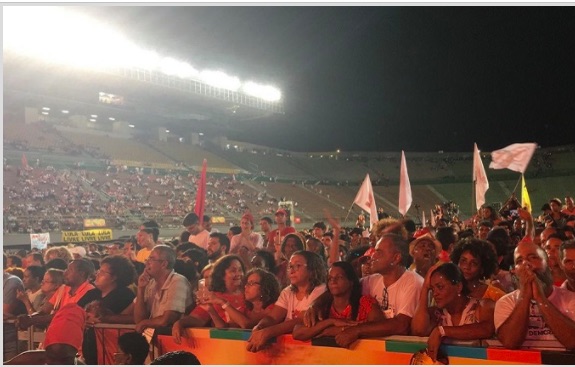
The thirteenth edition of the World Social Forum came to an end on Saturday (March 17), attracting more than 60,000 people to the various activities and debates held during the five-day event.


(Photo: Alan Alves/ G1 – Click on image to enlarge)

The main venue was on the campus of the Federal University of Bahia (UFBA), in Ondina, but other spaces of the Bahia capital held activities as well, including the Exhibition Park, the Isba Theater and the Pituaçu stadium..

The tone to the Forum was set by discussions of democratization of communication, financial system, work, education and youth, future of work, science and technology, employment and income, rights for migrants and refugees, national sovereignty and science and technology. “This is my first forum and the debates have been very rich and complementary and show the importance of our struggles and confrontations against the advance of neoliberalism,” says Chilean student Maribel Diaz.

Cedro Silva, the president of the Central Única dos Trabalhadores da Bahia highlighted the importance of the event held in the capital of Bahia. “CUT Bahia is proud to have organized the World Social Forum here in Salvador. The positive result is that we are sure that people from other states, from other countries, will return to their places of origin full of energy and possible solutions for a possible society that respects the rights of all.”

Here is a review of what was promoted during the 5 days of activities at WSF 2018

Income Generation

A democratic and collective space between social organizations; the World Social Forum was also the opportunity for many families to earn extra money and support themselves. This is the case of Maria Andrezina, an artisan from Tocantins. She traveled a distance of more than 1500 km in three days of travel to expose and sell the crafts she makes from golden straw. This craft has been developed by her family for generations and is their only source of income. “With the money from the sales I can pay the bills and kept the expenses of the house. The Forum is an excellent opportunity,” she says.

Ensuring income is also one of the goals of Thais Maciel, member of a collective of mothers. Born in Brasilia, Thais traveled to Brazil with her son Davi, who is one year and six months old along with other mothers to sell their crafts. “I have traveled this country and David has been with me for two months. With the sale of these crafts I keep my expenses and his expenses. That’s what matters to me. I do not want to get rich, I want to support my family and participate in moments like this,” she says.

Products of family agriculture, clothing, and ecological bed, table and bath items were also found throughout the Federal University Campus, supporting an economy of solidarity.

The Future of Work

The Future of Labor was a priority theme in the CUT Tent during the five days of the World Social Forum.

In this year’s edition, the themes and priorities of the CUT were: 1) democracy and work, 2) the future of work, 3) food production / food sovereignty; and, 4) migrations.

The activities brought together hundreds of participants from different categories in the two Tents (Margarina and Chico).

For these activities held at the tent, CUT brought special guests such as; Márcio Porchman, of the Perseu Abramo Foundation; João Felício, from CSI; Vitor Baez, from CSA; the ambassador Celso Amorim, former minister of Foreign Affairs; and Valter Sanches, of Industrial, among others.

Participation of trade unions

The participation of the trade unions was decisive for the success of the 2018 World Social Forum in Bahia.

With their flags of struggle and thematic in defense of the workers of Bahia and Brazil, the unions contributed to the construction of a better world.

Throughout the 5 days of debates more than 100 activities were registered and debated in the Tent for the Future of Work. Recognition, unity and commitment to workers sum up the participation of trade unions.

Forinho

For the first time in the history of the World Social Forum, a special space was reserved for children, the Forinho. While David’s mother sold handicrafts, he joined the Forinho, along with other children.

The Children’s Forum amused the children with games and recreational activities. “While I’m in the debates, in the fight, she’s having fun,” says David’s mother.

(Article continued in right column)

(Click here for the original article in Portuguese.)

Question for this article:

World Social Forums, Advancing the Global Movement for a Culture of Peace?

(Article continued from left column)

Artistic and cultural interventions

National artists such as Tulipa Ruiz, Ilê Aiyê and Ana Cañas participated in the World Social Forum. Ana Cañas from São Paulo participated in the World Assembly of Democracies, held in the Pituaçu stadium with the participation of several development leaders such as former President Lula and former Honduran leader Manuel Zelaya, and paid tribute to councilor Marielle Franco of PSOL, who was assassinated in Rio de Janeiro on the night of last Wednesday (March 15). At the same event, the Afro bloc Ilê Aiyê made a presentation, highlighting black culture and rejecting racism and all forms of prejudice. The singer Tulipa Ruiz gave a presentation to the youths who were camped in the Parque de Exposições.

Defense of the Lula and Democracies

The high point of the Forum took place on Thursday and included the participation of former President Lula, former President Dilma Rousseff and former Honduran leader Manuel Zelaya. The president was acclaimed in the event of Launching of the Committee of International Solidarity in Defense of Lula and the Democracy in Brazil, realized in the tent for Future Work. The Committee aims to develop worldwide support to overturn the coup and system of repression that has been established in Brazil. Organized by the Central Única dos Trabalhadores and the Perseu Abramo Foundation, the launch of the Committee was also attended by the ambassador and former defense minister, Celso Amorim, and Professor of the University of Coimbra, Portugal, Boaventura de Sousa Santos.

That night was the most awaited moment of all the programming and was also the one of greater adhesion. Thousands of people gathered at the Pituaçu Stadium to attend the World Assembly in Defense of Democracies and to see closely the great exponents of left-wing movements and parties. The most eagerly awaited guest was former President Lula, but the audience was also thrilled to be moved and to imagine a better future for our country with speeches by the governor of Bahia Rui Costa, Senator Gleisi Hoffman, federal deputy and presidential candidate Manuela D ‘Ávila, former president of Honduras, Manuel Zelaya, as well as trade union leaders and representatives of social movements and students. All were united to struggle for the preservation of the democratic state of right that has been constantly threatened by the coup government of Michel Temer.

Assembly of Women

During the Assembly of Women held in Pelourinho, the women approved a document that expresses their indignation at the situation to which they are submitted. The document proposes ways to defend women around the world.

The document includes 11 proposals that will be part of the internationalist agenda. Among the demands of women are:

* public policies that guarantee productive and reproductive work;

* recognition of the identity of expression and gender and recognition of women’s rights;

* an end to feminicide, transfeminicide and all forms of violence against women practiced in all spheres, whether public or private;
access to political power;

* the end of the persecution and the murder of women human rights defenders;

* access to universal education that is emancipatory, transformative and non-sexist and racist;

* an end to the imprisonment of blacks, natives, immigrants and poor people;

* dismantling of the patriarchal structure of the media.

The women spoke out against racism, xenophobia, genocide and all forms of discrimination; against capitalism, colonialism and imperialism that exploits and expropriates women all over the planet.

The women approved a motion of repudiation for the death of councilwoman Marielle Franco and another one of solidarity with the struggle of the women of Venezuela.

At the end of the Assembly, the participants left in a march to the Town Square with the sound of the Didá Band of the Terreiro de Jesus.

Youth Camp

As of today (March 17), a new phase of social and political confrontations is on the scene for hundreds of young people in the country. The Intercontinental Youth Camp brought together young people from all over the country to talk about politics and youth rights in Brazil and in the world.

It was three days of debates, integration and lots of fun for the young people at the Parque de Exposições in Salvador.

Ágora dos Futuros

On the morning of the last day (March 17), the results of various activities were presented.
 
The last day of the World Social Forum reserved an important moment of convergence among the 19 axes of discussion that were part of the event. Members from various parts of the world have transformed the UFBA Central Library into the “Agora of the Futures”, a space destined to expose actions that will keep alive the flame of knowledge that was created during the 13th edition of the World Social Forum in Salvador.
 
More than 60 thousand people from 120 countries took part in the activities and 1500 collectives, organizations and entities were registered.
 
Some 1400 self-organized activities were carried out with the participation of representatives from countries around the world, such as Canada, Morocco, Finland, France, Germany, Tunisia, Guinea, Senegal and Central America.

France: Citizen vote against nuclear power

. . SUSTAINABLE DEVELOPMENT . .

An article from La Depeche

From March 11 to 18, 2018, the members of the action group France Insoumise have launched several demonstrations against nuclear power.

Following the three themes, defined at the convention led by Jean-Luc Mélanchon in Clermont Ferrand, this group of 22 members have elevated the debate to a national level. “We are a political movement and not a political party. We are the leading opposition force on the Left, “claims Jean Bech, one of the leaders of the action group.

(article continued in right column)

(Click here for the french version of this article.)

Question related to this article:

Is there a future for nuclear energy?

(article continued from left column)

The arrival of the former Japanese minister, stationed during the Fukushima accident, precipitated the program. “Our goal is to make the French aware of the danger of nuclear power. There are alternative solutions, and we should seek them ahead of the next deadlines of nuclear power plants. We must act now.”

Locally, Jean Bech and its members will be present on the markets of Tuesday and Saturday with urns for a citizen vote. Without being official, it will allow people to express themselves. A ballot box will receive the ballots whose main indication will be “yes or no to exit from nuclear power.”

A stand will also be built during the festival “printemps des Plantes” on March 18. “There will also be a distribution in mailboxes, and people can also express themselves via the website. An ID will be just requested. We want this vote to be as wide as possible, while keeping a genuine aspect. “All this information will be sent back to the national level, there will be a follow-up of the results. Our actions will continue during the year with different themes to be decided, depending on current events. Among the priorities for 2018 will be the fight against poverty in all its forms and the fight against tax evasion. Website: https://nucléaire.vote

USA: Enough! A Million Students Walk Out of Schools to Demand Action on Guns in Historic Day of Action

DISARMAMENT & SECURITY .

An article from Democracy Now (reprinted according to terms of Creative Commons Attribution-Noncommercial-No Derivative Works 3.0 United States License)

In a historic day of action, more than a million students from over 3,000 schools walked out of classes to protest gun violence on Wednesday [March 14]. Walkouts occurred in all 50 states as well as some schools overseas. The nationwide student walkouts occurred one month after 17 students and staff were shot dead at Marjory Stoneman Douglas High School in Parkland, Florida. At many schools, students walked out for 17 minutes—one minute for each person murdered in Parkland. The students at Marjory Stoneman Douglas High School are now organizing a massive March for Our Lives on March 24 in Washington, and solidarity marches are planned across the country. We air moments from marches in New York and talk with Luna Baez and Citlali Mares, two students in Denver, Colorado, who helped organize their school’s walkout for gun reform Wednesday.

Video on Democracy Now website

Transcript

NERMEEN SHAIKH: In a historic day of action, more than a million students from over 3,000 schools walked out of classes to protest gun violence on Wednesday. Walkouts occurred in all 50 states, as well as some schools overseas. This was the scene outside one school here in New York City.

PROTESTERS: No guns, no violence! No guns, no violence! No guns, no violence! No guns, no violence! No guns, no violence! No guns, no violence! No guns, no violence!

CHELSEA: My name is Chelsea. I go to the High School of Fashion Industries. And today we’re here to protest against what happened at Parkland. We’re here to stop gun violence in schools and everywhere.

PROTESTERS: I’m a student, not a target! I’m a student, not a target! I’m a student, not a target! I’m a student, not a target!

LAURA RICHMOND: My name is Laura Richmond. I go to High School of Fashion Industries. And we’re here protesting gun violence all across America. Guns don’t solve problems, they create problems. And obviously, as you can see, we all feel strongly about this. This is something that’s been going on for far too long. And if people—if adults aren’t going to take action, we need to take action.

PROTESTERS: No guns, no violence! No guns, no violence! No guns, no violence! No guns, no violence!

KAYLA CONCEPCION: My name is Kayla Concepcion. I go to the High School of Fashion Industries. We are protesting to disarm the NRA and the mass school shootings that has happened across the country. It has to end now. And it starts with every school protesting. And we are here today to stop this shooting! Today! Every school should walk out right now and go and protest!

PROTESTERS: Disarm the NRA! Disarm the NRA! Disarm the NRA! Disarm the NRA! Disarm the NRA!

AMY GOODMAN: The nationwide student walkouts occurred one month after 17 students and faculty were shot dead at Marjory Stoneman Douglas High School in Parkland, Florida. At many schools, students walked out for 17 minutes—one minute for each person murdered in Parkland. The students at Majory Stoneman Douglas High School are now organizing a massive March for Our Lives on March 24th in Washington, D.C. Democracy Now! will be there, broadcasting live the entire march. Solidarity marches are planned for across the country. In Brooklyn, New York, a walkout occurred at Edward R. Murrow High School.

ANASTASIA BEIRNE-MEYER: We are standing here today, halting our education to show that we will not be living in fear of a school shooter. We will not be next. We will not sit in our classrooms wondering why Congress is not working as hard as we are. We will not overlook the fact that it is the students’ responsibility to speak out against the dangers of guns. And I’m not just talking about mass shootings. I’m talking about the militarization of our law enforcement and the normalization of these weapons in our communities. We will not let our future be dictated by the millions of dollars from the National Rifle Association that prevent stronger gun laws.

AMY GOODMAN: We begin today’s show in Denver, Colorado, where we’re joined by two organizers of a student walkout at Kunsmiller Creative Arts Academy in Denver, Colorado. We’re joined by Lali Mares and Luna Baez. Luna is the daughter of the undocumented activist Jeanette Vizguerra, who’s one of the founders of the Metro Denver Sanctuary Coalition. Jeanette Vizguerra took refuge, sanctuary, in Denver, but now is now out, because there is a private bill that protects her.
Luna Baez and Lali Mares, we welcome you both to Democracy Now! Luna, let’s begin with you. Talk about what happened yesterday at your middle school.

LUNA BAEZ: What happened yesterday at our middle school was we walked out in support of better gun laws and for the 17 that fell during the Parkland school shooting.

NERMEEN SHAIKH: You talk about what kind of response you and Luna received when you started to organize this protest. What did teachers and students at your school say to you?

CITLALI MARES: Some of our teachers were very hesitant about the walkout. A lot of them supported us, but we knew that there are some that weren’t going to be able to help us to the maximum we needed. And then the students felt like it was very important, and it was important for them to walk out with us, because they knew that it affected them in a very big way.

NERMEEN SHAIKH: And what about your school principal and other school administrators?

CITLALI MARES: We didn’t hear much about our principal. Our vice principal was out there while we were walking out. So, it was good to have that kind of support while we were there.

AMY GOODMAN: Luna, can you talk about why you chose to be one of the organizers of this protest? And what grade are you in?

(Article continued in right column)

Question related to this article:

Do you think handguns should be banned?, Why or why not?

(continued from left column)

LUNA BAEZ: I am in eighth grade. And the reason I chose to be one of the organizers was because from what I know. Me and Lali had a bit more experience than the other children—

AMY GOODMAN: In organizing?

LUNA BAEZ: —and the other students. Yes.

AMY GOODMAN: And would you say that experience comes from organizing around your mom, Jeanette Vizguerra?

LUNA BAEZ: Yes.

AMY GOODMAN: And do you see these issues as linked? Can you talk about your mom just for a few minutes? I visited her in Denver at the Unitarian Church, where she had taken sanctuary, before she was able to come out because she’s protected by a bill that was passed in Congress.

LUNA BAEZ: So, I would say it would be linked, because my experience with media and all things related to that are from my mom’s process.

AMY GOODMAN: And, Lali, why did you choose to help organize this student walkout? And what demands are you making of President Trump, of Congress, of the NRA?

CITLALI MARES: I chose to organize, to help organize the walkout because I knew that this wouldn’t just affect us as a school, it would affect everyone in the United States and out of the United States, because this is something that’s bigger. And with a bigger group of students, it can allow us to create a bigger impact.

And I would just want the president to pass something that says that we can—we have better laws about guns, not necessarily taking away the guns, but nobody needs that type of weapon in their house, where somebody who doesn’t need that has it in their hands and something like Parkland can happen.

NERMEEN SHAIKH: And, Lali, how many students participated from your school in the walkout? Were you surprised by how many did or how many didn’t?

CITLALI MARES: Yes, we expected maybe 20, 25, 30. We didn’t expect that big of a group, and we thought it would just be eighth graders walking out with us. As Luna and I were walking the halls, we noticed that high schoolers were joining some of the sixth and seventh graders. So, I would say about 70, 80. It wasn’t a big a—like a big size, but it was large for us as our first walkout.

AMY GOODMAN: And, of course, 2,000 Denver-area students also walked out all over, many marching to the state Capitol. I want to thank Luna Baez and Citlali Mares for joining us from Kunsmiller Creative Arts Academy in Denver, as we go back to more voices from the nationwide student walkout on Wednesday.

PROTESTERS: No more silence! End gun violence! No more silence! End gun violence!

AHRIANA MERRYWEATHER: All these people have come together today so that they can express how they feel about gun violence and all these things and how kids don’t feel safe in their schools, which is the one place we should feel safe, because that’s where we spend most of our time.

REEM ARAJAI: I hope that the president will step up, stop accepting money from the NRA, because if all of the deaths that have occurred aren’t enough to convince him, then I guess it just has to be us protesting right now.

SIMONE HICKS: If you can protect guns this much and don’t have the same regard for the people who are going to create your country in the future, then we’re in trouble. The kids are the future. If you’re not protecting the kids, then what’s left?

PROTESTERS: I call BS! I call BS! I call BS!

NUPOL KIAZOLU: My name is Nupol Kiazolu. I’m 17 years old, and I’m president of the Youth Coalition for Black Lives Matter New York. I’m out here also because I lost my father to gun violence, and I lost many family members and friends to gun violence. Gun violence is not a new issue. It affects our communities every single day, and it affects black and Latino communities disproportionately. I came here to give honor to those 17 lives that were lost, because those people were heroes. But we don’t need any more martyrs. We need justice. And that starts here and now.

PROTESTER 1: This is about people—gay, straight, black, white, religious, nonreligious—coming together so their kids don’t have to be afraid to go to school.

CAROLINA THOMAS: Hi. My name’s Carolina Thomas, and I’m 12 years old. And I’m here today because I’m sick and tired of hearing that someone has died at school innocently. I am sick and tired of hearing that someone has been killed at school while learning how to read or write. Why are we fighting for something that the adults should be fighting for? Why are we here marching and walking out of school, when the people of Congress should be protecting us?

PROTESTER 2: It makes sense to me that the only problem is the guns. Get rid of the guns, get rid of the violence. We have the most guns than any country on the face of this world. We’re the richest country that’s ever existed on the planet, and we can’t deal with these issues? It doesn’t make any sense.

PROTESTERS: Donald Trump, Mike Pence, gun control is common sense! Donald Trump, Mike Pence, gun control is common sense!

MARIA LOPEZ: As students, we’re here uniting our voices to advocate for like more stricter gun laws and for a safer school environment, because that’s why we come here. We come here for an education, and we don’t come here to be worrying, “Am I going to go home or not?”

JOEY ZARATE: In order to get our stronger message across, we needed to hold it here, where everyone gets to hear that we are together, we are one, we are with Florida. At the end of the day, we just want our schools to be safe and never be shot up again. That’s why we say, “Never again.”

PROTESTERS: Enough is enough! Enough is enough! Enough is enough!

PROTESTER 3: We grow guns. We place them in the hands of Americans and say, “Go play.” The inevitable senseless violence that follows is succeeded by senseless silence.

AMY GOODMAN: Voices from the nationwide student walkout on Wednesday. It’s estimated about a million people walked out, not only in the United States, but calling for gun control all over the world, in solidarity with the students at Parkland.

This is Democracy Now! We’ll be in Washington, D.C., on March 24th, covering the March for Our Lives, organizing the student survivors of Parkland, organizing around the Valentine’s Day massacre, calling for comprehensive gun control.

This is Democracy Now! When we come back, we go to Alabama to hear about another school shooting, just a few weeks after Parkland, that hasn’t gotten anything like the attention of what happened in Florida. Stay with us.

World Social Forum opens in Salvador de Bahia

FREE FLOW OF INFORMATION

Information from Radio Reloj Cuba, Prensa Latina and Prensa Latina

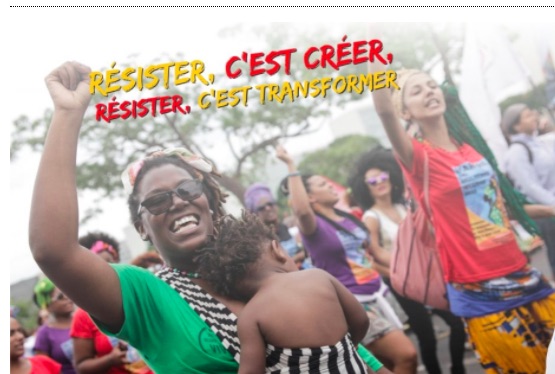
On March 14, with the cry of Fora Temer replicated in tens of thousands of voices, the Brazilian city of Salvador de Bahia opened its doors to the thirteenth World Social Forum.

The traditional march opened the meeting officially, with an intense program for which more than 1600 self-managed activities by groups, organizations and entities were registered.


(Click on photo to enlarge)

This Friday, the World Assembly of Women will take place, with more than twenty thousand participants and from which it is intended to constitute a single front to defend women´s rights and face machismo and violence.

Mariana Dias, President of the National Union of Students, pointed out that the meeting takes place in the midst of a difficult situation in Brazil and Latin America, marked by setbacks from the social and political points of view.

The conference began on Tuesday, March 13th and runs until Saturday, March 17th. . . .

Even before the opening march, the first denunciation launched here today at the World Social Forum was against the attempts of Michel Temer”s government to leave Brazilian civil society without a voice.

The denunciation was made at a press conference, after the public media network Brazil Communication Company (EBC) announced that it will not cover the event because its board did not authorize correspondents to travel here.

Shortly after taking the Presidency of the Republic, Temer eliminated the Curator Council of the EBC, appointed a new director by decree and changed the functional structure of the company.

On the importance of this 13th World Social Forum (WSF), President of the National Union of Students (UNE) Mariana Diasin told the media that the event is taking place in the middle of a difficult situation, not only in Brazil, but in Latin America and the world.

She said that in recent years there have been historical setbacks, from the social and political points of view, as a result ‘there is a perverse withdrawal of rights’, which were achieved after many years of struggle.

(Article continued in right column)

Question for this article:

World Social Forums, Advancing the Global Movement for a Culture of Peace?

(Article continued from left column)

She said that Brazil is living a very delicate time after the interruption of the democratic process (with the parliamentary-judicial coup d’etat carried out in 2016 against constitutional President Dilma Rousseff) and currently a neoliberal agenda is implemented without taking into account the opinion and willingness of the people. . . .

This is the seventh time since its creation in 2001 that Brazil welcomes thousands of participants at the World Social Forum. . .

With a birth certificate in Porto Alegre, where it was held again in 2002, 2003, 2005 and 2012, the great meeting of social, people’s and trade union movements was also organized in 2009 by another Brazilian city, Belem.

Besides Brazil, another five nations were already witness to these events: India, in 2004; Kenya, in 2007; Senegal in 2011: Tunis, in 2013 and Canada, in its more recent edition of 2016.

In its Salvador de Bahia event, starting today with a grand march from Cmpo Grande until the Castro Alves square, in the ancient center of the city, the World Social Forum ‘has everything to i9mpact politically in the present situation’, valued the member of the Facilitating Group, Carlos Tiburcio.

For the journalist and director of the web Radio Democracia en el Aire – Red de Resistencia Democrática, there are strong reasons for this global venue to become a great trench of resistance to the offensive of international capital, and will also have special importance for tje social and political Brazilian forces.

According to the also founder of the Forum, over 1300 self-paid activities were already registered for the event, whose fundamental nucleus will take place in Campus Ondina, of the Federal University of Bahia.

The Forum’s program includes, among others, a colloquium on March 14 on the state of exception in Brazil and inequalities, democratic fragility and power of elites.

Work sessions of the meeting will start with the panel ‘Tutoring democracies: media, power and manipulation’, in charge of journalists Ignacio Ramonet and Martin Granovsky.

Other issues to be debated there are judicialization of politics or the politicization of justice; Inequalities: which, why and until when?; Racism, violence and discrimination: human rights in the coup d’état Brazil.

The colloquium will conclude with a debate about the left’s challenges: the fight for unity in an uncertain future, for which he announced the presence of director of the Center of Social Studies of Portugal, Boaventura de Sousa Santos.

As part of the program there will also be the World Women and Peoples Assemblies, Movements and Territories in Resistance, as well as the so-called convergence activities, the self-managed ones and others of political-cultural nature.

Mexico: Tlalnepantla hosts the “Encounter of Women for Peace”

. . WOMEN’S EQUALITY . .

An article by Lauro Galicia for Acustiko Noticias

In the ‘Encounter of Women for Peace’ in Tlalnepantla, State of Mexico, successful women shared local and international experiences to counter scenarios of violence and insecurity .


(Click on photo to enlarge)

In leading this meeting, the mayor Denisse Ugalde Alegría recognized the work of Rosa Cristina Parra Lozano, specialist in communication for development and citizen activism, as well as Margarita Solano Abadía, promoter of peace journalism, who participated as speakers and have been leaders in their respective areas.

She emphasized that each women of this municipality, whether operating in the field of politics, business, restaurant, sports and social, can lay the foundations for peace building and make a difference in their community.

She recalled that in order to make a common front against violence and crime, in Tlalnepantla the Neighborhood Networks of Security program was launched, an initiative that engages the citizenry in the construction of safe and peaceful environments.

(Article continued in the right column)

(Click here for the original in Spanish.)

Question for this article

Do women have a special role to play in the peace movement?

(Article continued from the left column)

One week after the installation of the first alarm system in the municipality, about 14 thousand citizens of Tlalepantla have already been organized in neighborhood security networks, defining 199 points of installation of the 324 alarms, which means an advance of 61.5 percent.

She pointed out that daily meetings are held for the formation of these networks, which are composed of 70 neighbors on average. The networks aim to strengthen the capacities of organization, collaboration and solidarity, to promote and address violence and insecurity that afflict the municipality .

Ugalde Alegría added that about 500 public servants from all areas of the administration, have already been sensitized and trained in these issues of attention to citizenship, in addition to having held work meetings aimed at restoring public confidence.

She explained that among the communities that have already installed the alarm systems, are Santa María Tlayacampa, Jardines de Santa Mónica, Electra, Cuauhtémoc, Unidad Habitacional El Tenayo, Lázaro Cárdenas, San Juan Ixhuatepec, Leandro Valle, Los Pirules and Prensa Nacional, to name a few.

The meeting was moderated by Angélica Garnica Sosa, integrator of Culture of Peace. Colombian journalist Margarita Solano shared her experience of what she experienced in Ciudad Juárez, considered at one point as the most dangerous and violent city in the world.

Also, activist Rosa Cristina Parra narrated her experience as coordinator of the worldwide mobilization against the FARC and the work she promoted so that Colombia regains peace.

Women of Tlalnepantla exchanged points of view with the speakers, and expressed their interest in continuing to work in this municipality to consolidate a culture of peace and thereby build a safe place for their families.

On the way to the World Social Forum in Bahia

FREE FLOW OF INFORMATION

An article from Attac

The next World Social Forum (WSF) will take place in Salvador de Bahia, Brazil, from 13 to 17 March 2018.

This WSF session is unlikely to have the same impact as the WSFs of the 2000s, but it will bring together many participants, mainly from the city and state of Salvador but also from the Americas (North and South). South) as of some European countries, starting with France.


(Click on photo to enlarge)

The Brazilian political situation, with a presidential election to be held in the autumn of this year, will obviously weigh on this WSF, which will be mobilized against the austerity policies at work in the country.

In this context, several elements that justify Attac’s presence and involvement in this WSF deserve to be highlighted.

(Article continued in right column)

(Click here for the article in French.)

Question for this article:

World Social Forums, Advancing the Global Movement for a Culture of Peace?

(Article continued from left column)

* The international situation is very unstable, a consequence of the weakening of American domination, and is marked by the coming to power of “populist”, xenophobic leaders tempted by authoritarian policies. It is therefore particularly important for movements around the world to be able to analyze this new situation and to exchange the experiences of the various resistance struggles that are developing on all continents.

* This WSF will be another opportunity to debate on the situation and balance sheet of left-wing governments in South America. These debates that continue regularly at each international meeting (Montreal WSF or People’s Summit in Buenos Aires during the WTO Ministerial for example) and are interesting for all movements, in America as on other continents.

* Salvador is one of the cities of Brazil where the population of African origin is the most important (Brazil having been the country in America with the most slaves). Discrimination, the aftermath of slavery and post-colonial issues will therefore be central.

Attac France will therefore be present at the World Social Forum in Salvador, with a delegation composed of members of the Board of Directors and facilitators of the “Systemic Alternatives” project (a project led by Attac France, Solon Foundation of Bolivia and Focus On The Global South, based in Southeast Asia that has helped to publish the book Le Monde emerges).

If you wish to contact the Attac delegation on site, you can contact fsm2018@attac.org.

Registration for the Forum is on the wsf2018.org website; when you register on this site do not forget to join the organization “Attac France”.