Tag Archives: global

Global Youth Rising 2016 – Reflections

TOLERANCE AND SOLIDARITY .

An article from Global Youth Rising

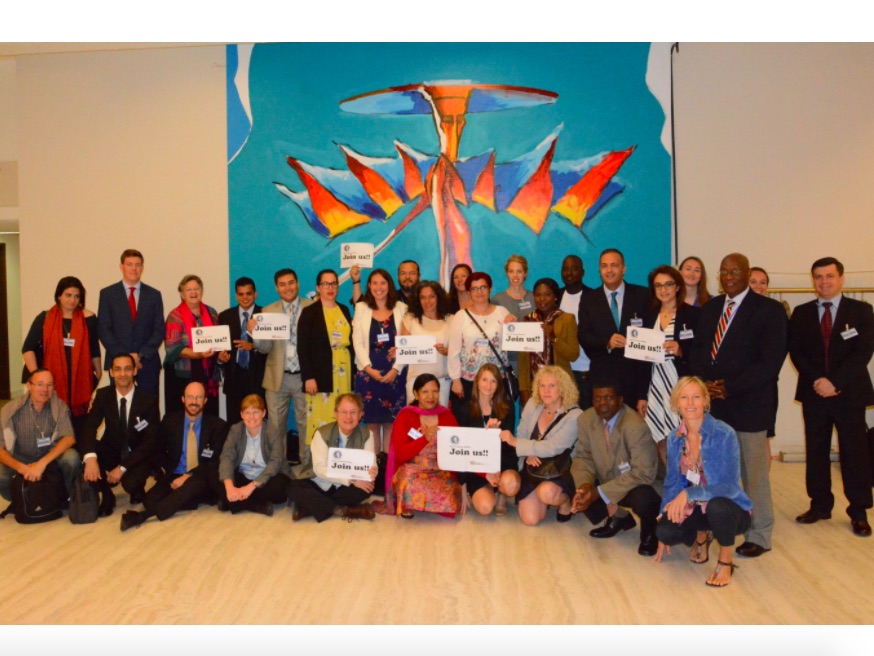
This year, from the 10-20th of July, PATRIR and its partner organisations brought together 70 peacebuilders and activists from around the world. Coming from Argentina, Armenia, Bangladesh, Belgium, Canada, the Czech Republic, Egypt, France, Germany, Guatemala, India, Iraq, Ireland, Italy, Lebanon, Libya, Mexico, the Netherlands, Norway, Philippines, Romania, Serbia, Spain, Switzerland, Ukraine, the UAE, the UK, the USA and Vietnam, some of our participants and trainers represented organisations, while others came because of their personal interest and journeys towards peace.

global youth rising
Click on photo to enlarge

The International Youth Forum took place in the mountains of Transylvania, where the mornings brought stunning sunrises over the valleys and the nights brought clear night skies and campfires (when they didn’t bring thunderstorms and rain!). Such a peaceful setting was perfect for morning strolls, for those who didn’t take part in morning yoga or enjoy a coffee on the terrace.

We started our journey by coming together to talk about the challenges facing the world today, and we were able to hear about what had brought each person here – what they were passionate about, what changes they wanted to make in the world, and what they wanted to get out of Global Youth Rising. Some had come because they were passionate activists in their own countries, others because they wanted to learn more about peace. We heard about human rights abuses, discrimination, environmental challenges and peace education from around the world as each of us shared our motivations for coming to Global Youth Rising.

After a day of reflection, where our reflection groups were first created, participants were able to get to know each other in the evening through a Living Library exercise. Looking back on the experiences that had shaped and defined them, everybody wrote down the title that they would have if their life were a book. Others selected the book they would most like to read and were able to “borrow” that person to hear their stories; a beautiful way to start truly getting to know each other.

The following days brought together an array of workshops – often too many to choose from! Participants were given the chance to focus on peacebuilding, learning lessons from the field and inspiring examples of real change; about Monitoring and Evaluation; Peace Education; EU Advocacy; Conflict Analysis, and many other topics. Those who wanted to learn to manage their emotions and develop inner peace were able to sign up to a 3-day workshop from the International Association of Human Values, who specialise in using breathing techniques to help people in the field of peacebuilding deal with trauma and difficult emotions.

In the evenings, we shared campfires, danced together, watched documentaries and heard some moving and inspiring stories from some of our trainers. Jo Berry, Bjørn Ihler and Asma Khalifa shared their experiences of trauma, but each one shared how they had learnt to humanise the person or people who had caused their suffering – a powerful reminder that those of us who commit to peacebuilding need to practice peace not only in our everyday lives but when we are faced with painful, and at times life-shaking, situations.

(Article continued in right column)

Question for this article

Is there a renewed movement of solidarity by the new generation?

(Article continued from left column)

The following morning, we woke up to news of the attack in Nice; another stark reminder of why we are doing what we do. Later that evening, news of the military coup in Turkey arrived. In the mountains, where things were safe and peaceful, we might have felt detached and a million miles away from everything; but when members of our group were from France or lived in Turkey, the reality didn’t feel very far from home. Some of us reported feeling small – as if nothing we did could make a difference. In response to that, some of us came together with Erika Kulnys (a powerful singer-songwriter who focuses on social justice themes) and wrote a song. While a song can’t always change the world, it can remind us that most people in the world want peace, and that we are always able to turn to each other when the skies are stormy. . . .

Over the next few days, PAX joined us and brought some of their Activist Hive workshops to Global Youth Rising, including the Activist Lab where participants created campaigns in 30 minutes and Activist TV, where powerful 1-2 minute films were made over the course of a couple of hours. Workshops gradually gave way to action groups as a lot of our participants and trainers were fired up and ready to start building plans and projects to actually do something. In just two days, we filmed a solidarity video for Black Lives Matter, worked on a statement as a response to events in Nice, learnt and filmed choreography for the Break the Chain dance (for One Billion Rising), while several new ideas and collaborations were formed and will continue to be worked on over the coming months.

Our evenings were inspired by some participants’ TED-style talks, where we learnt about Nineveh under Da’esh occupation, how social media brought about revolutionary change in Guatemala, about V-day and One Billion Rising’s campaign to end sexual violence against women, a community created for peace in Portugal, peace journalism in Lebanon, the Black Lives Matter movement in the US, the Japanese government’s Ship for Youth Peace programme, and the creation of the Peace Science Digest. We also shared an Open Mic night where we were able to discover how talented so many of our participants and trainers are – it turns out we have a lot of talented poets, singers, and dancers in the world of peacebuilding!

On the last day, we heard about all the new ideas and projects that are being dreamt up and started, but it
was also a day to reflect on what we had learnt and what we would take forward with us both personally and professionally. We ended with a beautiful graduation ceremony, where 1-2 people were invited to give appreciation to each person as they received their certificate. The result was a lot of hugs, and a lot of love being shared – a lot of solid friendships were definitely created during our 10 days in the mountains!

Now, as we return back to our ‘real lives’ post-GYR, we have heard that a few people have felt down, lonely, perhaps frustrated as their enthusiasm is dismissed as naïve idealism by friends or family members. It can be difficult to keep the momentum going, to stay motivated in our quest to make the world a better place when we are not surrounded with people just as passionate as we are. But we will all stay in touch via the Facebook group and our working groups focusing on specific issues, and we will always be able to support and motivate each other when things seem tough. And, of course, we can always meet again… at Global Youth Rising 2017!

Developing Nations Seek Tax Body to Curb Illicit Financial Flows

. . SUSTAINABLE DEVELOPMENT . .

An article by Thalif Deen for the Inter Press Service News Agency (reprinted by permission)

Despite Western opposition, the 134-member Group of 77 is continuing to pursue a longstanding proposal for an inter-governmental UN-affiliated tax body aimed at combating corporate tax dodging and curbing illicit financial flows, including money laundering and off-shore banking.

taxes
Click on image to enlarge

The proposal has already been shot down twice by Western nations, first, at the Financing for Development (FfD) conference in Addis Ababa in July last year, and more recently, at the 14th session of the UN Conference on Trade and Development (UNCTAD 14) in Nairobi last month.

But a G77 source told IPS the proposal is very much alive – and still on the negotiating table.

The proposal by the G77, the largest single coalition of developing countries, calls for the establishment of a standing intergovernmental group of experts to address tax issues, including international tax issues, and to assist countries better mobilize and employ fiscal revenues.

This includes international initiatives to counter tax avoidance and tax evasion, as well as strengthening the capabilities of developing countries to address tax avoidance and tax evasion practices.

In Africa alone, the estimated resources leaving the continent, in the form of illicit financial transfers, was nearly 530 billion dollars between 2002 and 2012, according to UNCTAD.

The three key causes of illicit financial outflows are largely commercial tax evasion, government corruption and criminal activity, including money laundering.

Bhumika Muchhala, Senior Policy Researcher, Finance and Development Programme, at the Malaysia-based Third World Network (TWN), told IPS the key reason why the global tax system has failed is that more than half of the world’s countries are currently excluded from the decision making processes on global tax standards.

“We in global civil society hope that the G77 and China, both in New York and Geneva, will continue to persistently raise the need for an intergovernmental tax body, under the auspices of the United Nations, in every relevant conference, negotiation and discussion within the UN, regional commissions, Bretton Woods Institutions and other international institutions, particularly the Organization for Economic Cooperation and Development (OECD) which has a monopoly role in global tax governance by developed country donors”, she said.

“We know by examples of history that truly meaningful reforms and establishment of new bodies that break old rigid structures of imperialism, exclusion and unequal power requires a long arc of time and needs to be pushed through every open crack in the status quo by repeated and persistent demands by a group that takes the leadership to exert collective pressure,” she added.

As to whether the G77 and China will bring up the proposal again, Muchhala said, the hope is they will continue to persistently bring it up in every possible space, conference and discussion.

Dr Manuel Montes, Senior Advisor on Finance and Development at the Geneva-based South Centre, told IPS the proposal was meant to create an intergovernmental process, whose deliberations would have brought up in the agenda issues of interest to developing countries.

(Article continued in the right side of the page)

Question for this article:

Can UN agencies help eradicate poverty in the world?

Where in the world can we find good leadership today?

(Article continued from the left side of the page)

Right now, he said, agenda-setting is made in OECD, which the G20 countries commissioned to put out the 15 action items under Base Erosion and Profit Shifting work.

The G77 proposal did not survive the Nairobi outcome even though there is this text that allows UNCTAD to work on tax issues as a matter of research, including assistance to developing countries to design and implement policies and actions aimed at improving the efficiency of trade transactions as well as the management of transport operations.

Additionally, it should also continue to cooperate with member States in implementing ASYCUDA, the automated system for customs data, and work on taxation as it relates to investment policy.

The upgrading of the UN Committee of Experts on International Cooperation in Tax Matters to an intergovernmental level was the last outstanding item that prevented agreement at the FfD conference in Addis Ababa.

“The developed countries, led by the US, blocked the proposal,” Dr Montes said.

The OECD dominance in this regard could have been mitigated somewhat if the UN process in tax cooperation had been upgraded to an intergovernmental level, as proposed in the Addis Ababa conference.

The OECD secretariat “reports” to its member states, and changes in agenda have to be first accepted by its member states, even though it has been making a lot of effort increasing the participation of developing country officials and the UN– but by invitation.

The OECD would still be an important and perhaps a dominant player in such a UN process, but it would not be the sole source of the intergovernmental agenda and norm setting, he declared.

Martin Khor, Executive Director of the South Centre who participated in UNCTAD 14, told IPS the developing countries under G77 and China succeeded in defending their development interests and in obtaining a renewed mandate for UNCTAD to continue their work.

“They had to face major developed countries and their groupings that were quite insistent on narrowing the scope of UNCTAD’s future work and thus the scope of the UN.”

As a result, he said, there was unfortunately no mandate for the UN to set up an inter-governmental group on how to deal with tax issues as the developed countries prefer to use their group, the OECD to make decisions on issues like tax evasion and tax havens.

There are other examples in the areas of trade, debt and finance where the outcomes could have been much better but were instead disappointing.

Nevertheless the renewal of UNCTAD’s mandate for its next four years work was an achievement of UNCTAD 14, given the shaky state of North-South cooperation on global economic issues, said Khor.

Prerna Bomzan, Policy Advocate for LDC Watch, representing the 48 least developed countries (LDCs), told IPS: “Given its historic role in contributing to defining the LDC category, we welcome the re-statement of UNCTAD’s mandate to strengthen its focus on the trade and development needs of LDCs. This is in accordance with the Istanbul Programme of Action and other relevant outcomes on LDCs.”

However, she said, this mandate must be further strengthened, focusing on building consensus with development partners so that they deliver on their key long-standing commitments to LDCs, such as 100 per cent duty-free-quota-free market access on a lasting basis; simpler and preferential rules of origin: a meaningful service waiver and eliminating domestic cotton subsidies”.

UN: National Human Rights Institutions will play a more strategic role in education

…. HUMAN RIGHTS ….

An article from the Danish Institute for Human Rights

A new UN resolution on Human Rights Education emphasizes the strategic role of National Human Rights Institutions concerning the promotion of human rights education.

humanrights

The United Nations Human Rights Council agreed on a new resolution on Human Rights Education and Training at the Human Rights Council’s Thirty-first session this spring. The resolution reconfirms and supplements state parties’ commitment to national implementation of international standards for human rights education five years after the UN Declaration on Human Rights Education and Training from 2011. Due to a timely and targeted effort and a fair portion of good luck, The Danish Institute for Human Rights manged – through the international coordinating committee of the human rights institutions (GANHRI) – to give NHRIs remarkable space for manoeuvring on the educational scene.

Human rights education is important in order for children, youth and adults to know their rights and duties and to respect and uphold the rights of others. Moreover, it’s important that duty bearers such as teachers, police, social workers and other civil servants who act on behalf of the state, know their duties to respect, protect and fulfil the state’s human rights obligations whether behind the desk formulating policies or acting on the ground with vulnerable citizens.
The new resolution text reads that states “Recognizes the important role of national human rights institutions in promoting effective policies on human rights education and training, and calls upon them to contribute further to the implementation of human rights education programmes”.

(Article continued in the right column)

Question(s) related to this article:

What is the state of human rights in the world today?

(Article continued from the left column)

“This is the first time we see a resolution on education which stresses the strategic role of NHRIs on promoting effective policies for human rights education and training. Focus has shifted from NHRI assisting in conducting education programmes on human rights, to assisting in the development of effective policies at the structural level. In other words, this reflects the shift in focus amongst NHRIs to work across their NHRI mandates such as coordination, giving advice and monitoring on human rights education. They will thereby have a more far reaching and sustainable impact on the education sector”, says Cecilia Decara, Senior Adviser at The Danish Institute for Human Rights who has worked on impacting the resolution together with Olga Ege, who is also a Senior Advisor at the institute.

The new paragraph also have a deep impact on the work of NHRIs, says Cecilia Decara: “It reflects that there is a need for NHRIs to work both on the structural level influencing the adoption of effective policies for human rights education, and also contribute to the implementation of programmes. It’s the conjunction of working at both levels, which qualifies the monitoring and follow up process e.g. giving advice to duty bearers.”
The new resolution will be helpful to set a further framework for our advice and network on human rights education with less experienced NHRIs, Cecilia Decara adds.

The UN Human Rights Council also decided to “convene at its thirty-third session a high-level panel discussion to mark the fifth anniversary of the United Nations Declaration on Human Rights Education and Training”. This high-level panel discussion will focus on good practice and challenges of the implementation of the declaration.

(Thank you to the Global Campaign for Peace Education for calling this article to our attention)

Trees talk to each other and recognize their offspring

. . SUSTAINABLE DEVELOPMENT . .

An article by Derek Markham in Treehugger

The Lorax might have spoken for the trees, but it turns out that trees can speak for themselves. At least to other trees, that is. While it’s not news that a variety of communication happens between non-human elements of the natural world, the idea of mycelia (the main body of fungi, as opposed to the more well-known fruiting bodies – mushrooms) acting as a sort of old-school planetary internet is still a fairly recent one, and may serve as a spore of a new breed of forestry, ecology, land management.

Simard
TED talk by Suzanne Simard

Paul Stamets famously posited that “mycelia are Earth’s natural Internet,” and a variety of research has borne out that concept, but like many things we can’t see an obvious connection between, most of us tend to ignore the micro in favor of the macro. And when it comes to conservation and natural resources, our systems may be falling prey to the lure of reductionist thinking, with a tree being considered merely a commodity in the forest, which can be replaced simply by planting another tree. In fact, many reforestation efforts are considered successful when a large number of trees are replanted in areas where clearcutting has rendered large tracts of land treeless, even if those replanted trees are essentially turning a once diverse forest into a monocropped ‘farm’ of trees.

(Article continued in the right column)

Question for this article

When you cultivate plants, do you cultivate peace?

(Article continued from the left column)

A recent talk at TEDSummit 2016 by forest ecologist Suzanne Simard seems to put the lie to the idea that a forest is merely a collection of trees that can be thought of as fully independent entities, standing alone even while surrounded by other trees and vegetation. As Simard, who has put in about three decades of research work into Canada’s forests, puts it, “A forest is much more than what you see.”

“Now, we know we all favor our own children, and I wondered, could Douglas fir recognize its own kin, like mama grizzly and her cub? So we set about an experiment, and we grew mother trees with kin and stranger’s seedlings. And it turns out they do recognize their kin. Mother trees colonize their kin with bigger mycorrhizal networks. They send them more carbon below ground. They even reduce their own root competition to make elbow room for their kids. When mother trees are injured or dying, they also send messages of wisdom on to the next generation of seedlings. So we’ve used isotope tracing to trace carbon moving from an injured mother tree down her trunk into the mycorrhizal network and into her neighboring seedlings, not only carbon but also defense signals. And these two compounds have increased the resistance of those seedlings to future stresses. So trees talk.” – Simard

I’m a bit of a fungi nerd, and with good reason, as fungi are one of the key elements of life on Earth while being one of the least understood, at least in terms of the sheer volume of varieties and how they interact with the rest of the systems on the planet. I’m currently reading Radical Mycology: A Treatise on Seeing and Working With Fungi, which is an incredible foray into the world of fungi, and was kind of blown away by the fact that of an estimated 15 million species on Earth, some 6 million of them may be fungi, and yet only about 75,000 of them, or 1.5%, have been classified as now. This means that the study of mycology is one of the areas of the life sciences that is still relatively untapped, and because of what we’re now starting to learn about fungal networks and mycelial ‘internets,’ could be a key element in our journey to a more sustainable world.

(Thank you to Janet Hudgins, the CPNN reporter for this article.)

A solar-powered plane just flew around the world

. . SUSTAINABLE DEVELOPMENT . .

An article by Kate Yoder for Grist

The scrappy plane we’ve all been rooting for just completed the first solar-powered flight around the world, no fossil fuels burned. On Tuesday, Solar Impulse 2 ended its epic 24,500-mile journey and landed back home in Abu Dhabi.

airplane

The one-seater plane, sporting 17,000 solar cells on its wings, is as wide as a Boeing 747 but light as a feather — well, as light as a car, anyway. Though the 16-month trip was largely a stunt to promote renewable energy, it’s a milestone for aviation as well.

Bertrand Piccard, one of two Swiss pilots who flew the Solar Impulse, predicted that medium-size electric planes will begin carrying passengers within the next decade. We’re a fan of that possibility — and the EPA might be, too. The agency recently announced plans to begin limiting carbon emissions from airplanes since they pose a threat to public health.

One thing we can say now: Renewable energy is gellin’ — as in Magellan.

(Thank you to Janet Hudgins, the CPNN reporter for this article.)

Question for this article

U.N. passes landmark resolution condemning internet shutdowns

FREE FLOW OF INFORMATION

Press release from Access Now

Today [July 1] the United Nations Human Rights Council agreed by consensus to a resolution supporting human rights online, despite efforts by hostile states to eliminate key provisions in the text. The landmark document specifically condemns internet shutdowns and renews 2012 and 2014 resolutions that declared, unequivocally, that human rights apply online just as they do offline.

internet
(click on photo to enlarge)

“The U.N. has boldly spoken against the pressing problem of internet shutdowns. This unanimous statement by the world’s highest human rights body should give governments pause before they order blocking, throttling, and other barriers to information,” said Peter Micek, Global Policy and Legal Counsel at Access Now. “Development and human rights protections are strengthened in tandem when networks remain open, secure, and stable. All stakeholders, from telcos to activists to judges, must band together to demand an end to shutdowns.”

The resolution faced opposition by a small number of influential member states who attempted to water down the text. Access Now joined a group of civil society organizations to urge Human Rights Council member states in a letter to pass the resolution by consensus, citing its importance for bridging the gender digital divide; advancing the Sustainable Development Goals; and incorporating a human rights-based approach into expanding internet connectivity. As the letter notes, the Human Rights Council had twice previously affirmed by consensus that “the same rights that people have offline must also be protected online.”

(Article continued in right column)

Latest Discussion

Is Internet freedom a basic human right?

(Article continued from left column)

“This resolution marks a major milestone in the fight against internet shutdowns. The international community has listened to the voices of civil society — many of whom have suffered under shutdowns themselves — and laudably pushed back on this pernicious practice,” said Deji Olukotun, Senior Global Advocacy Manager at Access Now. “Shutdowns harm everyone and allow human rights crackdowns to happen in the dark, with impunity. Citizens can’t participate fully in democratic discourse during elections. The Human Rights Council’s principled stance is a crucial step in telling the world that shutdowns need to stop.”

The #KeepitOn campaign is supported by nearly 90 organizations from 41 countries around the globe who are pushing back on internet shutdowns at every level, from governments to telcos to tech companies to everyday internet users. The full list of organizations is available on the campaign website:https://www.accessnow.org/keepiton/

The U.N. resolution follows a recent shutdown in Turkey surrounding bombing attacks, one in Bahrain around protests, and another in Algeria to prevent cheating on school exams. Notably, police in Ghana have backtracked from claims that they intend to block social media during upcoming elections in November 2016, after an uproar from civil society groups, politicians, and the U.N.

Last year, Access Now recorded at least 15 internet shutdowns around the world, and has already recorded 20 shutdowns in the first half of 2016.

(Thank you to Janet Hudgins, the CPNN reporter for this article)

Petition: Another Route to Peace

TOLERANCE AND SOLIDARITY .

A message received by CPNN concerning the Petition for Peace

Dear Members of the Network of the Felix Houphouet-Boigny Foundation for Peace Research,

We announce the call to sign the petition for the creation of an appropriate structure of the UN in charge of interreligious and intercultural dialogue for peace. This international initiative, called “another route to peace” was initiated July 3, 2016 by the Pan-African Centre for Social Prospects (CPPS) headed by Professor Albert Tevoedjre.

petition
Click on the photo to enlarge

For more information on this petition, we urge you to go to the link below: http://www.petitionpourlapaix.com/index.php/the-petition

To sign the petition, click on the following link: http://www.petitionpourlapaix.com/#gkMainbodyTop

* * * * * * * * * * *
Petition: Another Route to Peace

It has now been a little more than one year since the initiative was taken by Professor Albert Tévoédjrè – an African scholar, a Beninois political figure, President and founder of the Pan-African Social Prospects Centre (CPPS), former special representative of the UN Secretary General in Côte d’Ivoire – and other prominent experts from diverse fields (including culture and social engagement) and with varied professional experiences agreed to foster international support for the African Education Initiative for Peace and Development through Interreligious and Intercultural Dialogue.

In light of the tragic impasse of military response to the terrorist threat that plunges our planet into mourning every day, these figures have agreed to offer their experience, their reputation and their lucid generosity with the aim of sharing intelligence and knowledge in the interest of public safety. In each country, they want a unifying focal point of creative energies to stand out and to shine, thus helping the African Initiative become a new chain of human security that goes beyond short-lived survival and defence operations. Other figures in the fight for human life will be welcome to help build the resolute and powerful network of engineers expected to come forth from this credible peace-bringing mechanism that will operate through collective and communal action, responding to the immediate needs of populations.

(continued in right column)

(Click here for the French version of this article.)

Question for this article

Islamic extremism, how should it be opposed?

(continued from left column)

Through this movement, we wish to connect this initiative to citizens of the world who are fuelled by the same desire for peace and living together despite our differences.

The objective is to collect as many signatures as possible in Africa and across the globe to get the UN Secretary General to act by creating an appropriate federative structure for interreligious and intercultural dialogue for peace to:

– Create a framework for interreligious and intercultural dialogue within the Member countries;

– Promote meetings between young people from diverse socio-cultural and religious backgrounds to facilitate and strengthen the mechanisms of “living together”;

– Create a network of focal points in each country and give priority to joint actions for development with have been established and administered by inter-religious and intercultural groups;

– Develop joint social innovation projects, based on interreligious and intercultural dialogue which, within each country of African and the world, will culminate in a common minimum level of social development for all citizens;

– Increase the number of training centres and university institutions specifically focused on interreligious and intercultural dialogue specifically dedicated to joint actions of inclusive development;

– Contribute to the shaping of the proposal for an international day for interreligious and intercultural dialogue to foster development.

Appeal made in Cotonou, Benin, on Sunday, 3 July 2016

9th International Conference of Museums for Peace, Belfast, Northern Ireland

.. DEMOCRATIC PARTICIPATION ..

An article by Peter van den Dungen (Hon.), General Coordinator, International Network of Museums for Peace (INMP)

The 9th international conference of the International Network of Museums for Peace (INMP) will be held in Belfast, 10th – 13th April 2017. The conference is hosted by Ulster University, with the support of Visit Belfast.

museums

The conference theme, ‘Cities as Living Museums for Peace’, will highlight (among other subjects), Belfast’s social and political transformation from a divided, troubled city to one which models peace consciousness through post-conflict healing and reconciliation.

The conference invites participation from peace educators, including directors and curators of human rights and peace museums, artists, architects, journalists, policy-makers, as well as researchers, scholars, and students of such fields as education, history, museum studies, cultural memory studies, conflict resolution.

The opening day of the conference marks the 19th anniversary of the signing of the Good Friday Agreement, perhaps the most important and far-reaching agreement in the Northern Ireland peace process of the 1990s. The opening reception will be held at Stormont (Parliament Building), on the same estate where the historic agreement was signed.

The conference also marks the 25th anniversary of INMP – a global network of peace museums, memorials, gardens and other peace related sites that share the aim to cultivate a global culture of peace.

The call for paper, panel and poster presentations is now open, until 1st November. For more information and an application form, go to www.museumsforpeace.org or contact conference@museumsforpeace.org

Question for this article:

International Peace Bureau World Congress 2016: “Disarm! For a Climate of Peace – Creating an Action Agenda”

DISARMAMENT & SECURITY .

Press release of The International Peace Bureau

Given the omnipresent atmosphere of political confrontation and the worldwide armament, the International Peace Bureau (IPB) organizes the World Congress on global disarmament and military spending. The event takes place from September 30th until October 2nd 2016 at the Technical University of Berlin. About 1000 guests from all over the world are expected to participate at the Congress.

IPB

The IPB World Congress is supported by the International Trade Union Confederation (ITUC), UNI Global Union, the Stockholm International Peace Research Institute (SIPRI), by international religious organisations (of different persuasions), organisations from the environmental and development policy sector as well as by the three big political foundations in Germany: Heinrich Böll, Friedrich Ebert and Rosa Luxemburg.

You will find an overview of our supporters at: https://www.ipb2016.berlin/partners/.

What is the International Peace Bureau?

Founded in 1891/92, the International Peace Bureau (IPB, www.ipb.org) is the oldest existing international peace network. It counts more than 300 member organizations in over 70 countries and was awarded the Nobel Peace Prize in 1910. Over the course of time, 13 prominent IPB leaders were also awarded the Nobel Peace Prize.

The IPB devotes itself to the vision of a world without war. The main focus of its work is “Disarmament for Sustainable Development”. Within this programme, it mainly strives for the re-allocation of governments’ military spending. For 6 years, the IPB has been the coordinator of the Global Campaign on Military Spending (including the Global Days of Action on Military Spending, GDAMS. Since the 1980s, the IPB has promoted the worldwide campaign for nuclear disarmament, aiming at the abolition of all nuclear weapons.

What is the aim of the Congress?

According to official SIPRI records, the combined military budgets of the world’s governments totalled $1,7 billion in 2015. In the same year, 900 million people suffered from hunger. Every day, 10.000 children die of curable diseases. Social inequalities are increasing.

In the face of these growing social challenges and the desperately needed financial resources to mitigate and adapt to climate change, money must under no circumstances be wasted by investing in the military sector.

Global disarmament must be put on the international agenda. Therefore, the Congress wants to help build support for a peace agenda, bringing about a peaceful and fair distribution of the world’s resources.

(Article continued in right column)

Question related to this article:

How can the peace movement become stronger and more effective?

(continued from left column)

The Congress will centre on questions of global transformation. How can we encourage fundamental and desperately needed changes? How can we foster cooperation and dialogue in order to reach common security goals?

Transformation to peace is among the biggest challenges of the 21st century. Thus, the Congress is set up as international peace gathering with a clear message: “no to war and confrontation”. The people’s active participation, promoting a new international democracy, is inseparably linked with the successful development of the worldwide peace process.

Humans are led to support wars, often seduced by lies and false concepts of ‘the enemy’. Nevertheless, people all over the world stand up for freedom and peace, often by organising great public events.

One big aim of the Congress is to make a major contribution to the international peace movement. A range of ideas will be discussed and a “Plan of Action for Peace” will be presented. Attempts will be made to bring together theoretical considerations and real transformation strategies. Moreover, the Congress shall be an impulse for the initiation of more peace actions all around the world.

The organisers confront the world of war with a clear vision of a world of peace.
Several prominent guests joined the Congress. Among the speakers in the plenaries, in panel discussions and working groups will be, among others, the Nobel Peace Prize laureates Tawakkol Karman from Yemen and Mikhail Gorbachev (via video), the founder of the “Right Livelihood Award” Jakob von Uexküll, the laureates of the “Right Livelihood Award” Vandana Shiva and Alyn Ware, prominent economists like James Galbraith, Noam Chomsky (via video) and Samir Amin, the Co-President of the Club of Rome Ernst Ulrich von Weizsäcker, the secretary generals of ITUC and UNI Global Union Sharan Burrow and Philip Jennings, the former Director General of UNESCO Federico Mayor Zaragoza, the former Defence Minister of Ecuador and current Permanent Representative of her country to the United Nations in Geneva María Fernanda Espinosa Garcés, the director general of the United Nations office in Geneva Michael Møller, and the chairman of ver.di Frank Bsirske.

The Congress will be opened by the President of the Technical University of Berlin, Christian Thomsen, and by the Senator of finance in Berlin, Matthias Kollatz.

Preparatory Events: Already 6 preparatory seminars have taken place in various parts of the world: https://www.ipb2016.berlin/congress/preparatory-events/

You will find the provisional, already quite extensive, program at http://www.ipb2016.berlin/program/program-structure/.

The latest news will also be published on Facebook: www.facebook.com/IPBcongress2016.

A diverse program of cultural, informational and other side-events will accompany the Congress. Moreover, there will be an independent “Youth Gathering”.

More information will be published at www.ipb2016.berlin.

The Global Campaign for Peace Education

… EDUCATION FOR PEACE …

Excerpts from the website of The Global Campaign for Peace Education

The Global Campaign for Peace Education provides coverage of peace education from around the world, including original articles, research and stories cultivated from journals and independent and mass media sources. We especially encourage article and event submissions from our readers.

gcpe

Campaign Goals

The Global Campaign for Peace Education seeks to foster a culture of peace in communities around the world. It has two goals:

First, to build public awareness and political support for the introduction of peace education into all spheres of education, including non-formal education, in all schools throughout the world. Second, to promote the education of all teachers to teach for peace.

Campaign Statement

A culture of peace will be achieved when citizens of the world understand global problems; have the skills to resolve conflict constructively; know and live by international standards of human rights, gender and racial equality; appreciate cultural diversity; and respect the integrity of the Earth. Such learning can not be achieved without intentional, sustained and systematic education for peace.

The urgency and necessity of such education was acknowledged by the member states of UNESCO in 1974 and reaffirmed in the Integrated Framework of Action on Education for Peace, Human Rights and Democracy in 1995. Yet, few educational institutions have undertaken such action. It is time to call upon ministries of education, educational institutions and policy makers to fulfill the commitments.

A campaign to facilitate the introduction of peace and human rights education into all educational institutions was called for by the Hague Appeal for Peace Civil Society Conference in May 1999. An initiative of individual educators and education NGOs committed to peace, it is conducted through a global network of education associations, and regional, national and local task forces of citizens and educators who will lobby and inform ministries of education and teacher education institutions about the UNESCO Framework and the multiplicities of methods and materials that now exist to practice peace education in all learning environments. The goal of campaign is to assure that all educational systems throughout the world will educate for a culture of peace.

(Continued in right column)

Question for this article:

Where is peace education taking place?

(Continued from left column)

Campaign Form

The Campaign is a non-formal network comprised of formal and non-formal educators and organizations, each working in their own unique ways to address the goals above.

This form allows Campaign participants to focus their energies towards meeting the goals and needs of their constituents – while at the same time promoting and making visible the growing global network of educators working for peace.

The Campaign helps to connect educators and facilitate the exchange of ideas, strategies and best practices through its website and newsletters. It is presently coordinated by the Peace Education Initiative at The University of Toledo.

TONY JENKINS: Global Coordinator
KEVIN KESTER: Book Review Editor
OLIVER RIZZI CARLSON: Editor

Original endorsers:

International Organizations

* International Association of Educating Cities
* International Association of Educators for Peace
* International Association of Educators for World Peace
* International Peace Bureau
* International Teacher
* International Youth Cooperation (The Hague)
* Living Values: An Educational Programme
* Mandate the Future/Worldview International Foundation (Colombo)
* Pan Pacific and Southeast Asia Woman’s Association
* Peace Boat
* Pax Christi International
* Peace Child International
* Peace Education Commission
* International Peace Research Association
* UNICEF
* UN High Commissioner for Refugees
* Youth for a Better World International

Click here for the list of National and Local Organizations.