Center for Justice and Peacebuilding partners with UNDP and Iraqi youth to build culture of peace

DISARMAMENT & SECURITY .

An article by Lauren Jefferson for the Augusta Free Press

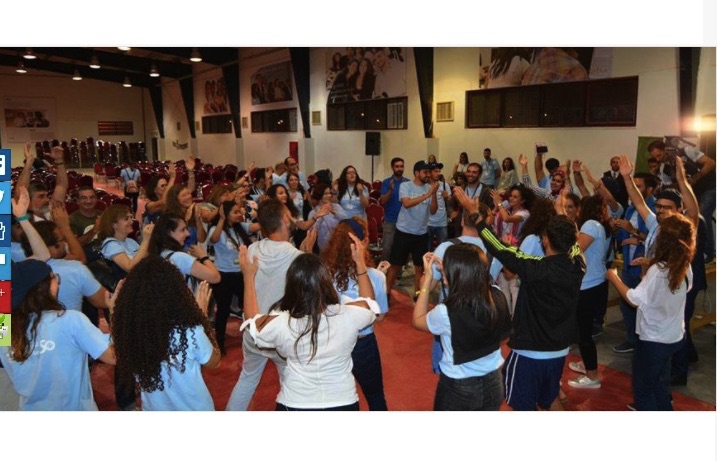
In an Iraqi mall on Valentine’s Day, shoppers were treated to a unique sight. Twenty-eight young people wearing traditional dress from the many cultures in the country congregated to sing, dance, and hand out flowers and balloons with messages of love and co-existence. The event, one of 42 created and implemented by Iraqi youth across Iraq, was to promote peaceful coexistence and tolerance among Iraqi communities struggling through a divisive political climate.

The project brings together Eastern Mennonite University’s Center for Justice and Peacebuilding and the Iraqi al-Amal Association in a multi-phase project that focuses on youth and academics to build a culture of peace in the country.

As key stakeholders in Iraqi social fabric, youth and academics are “seen as instrumental in strengthening social cohesion and promoting civil society initiatives and dialogue between various ethnic and religious groups,” according to the project grant, which is funded by the United Nations Development Programme (UNDP).

Five EMU faculty and alumni are involved: Dr. Alma Abdul-hadi Jadallah, president and managing director of Kommon Denominator, and CJP adjunct faculty; Aala Ali MA ’14, UNDP development officer; Cynthia Nassif MA ’14 of Lebanon , and Najla El Mangoush MA ’15 of Libya, both doctoral students at George Mason University; and Ahmed Tarik MA ’16, of Iraq. Nassif, Mangoush and Tarik designed workshops on conflict resolution in Arabic for both youths and academics. Jadallah provided the first training for youth in October 2016, followed by two others for youth and three for academics from Iraqi universities. While the academic trainings will lead to a peace building curricula that would be shared by universities across Iraq, the youth trainings culminated in a series of community peacebuilding project proposals.

Mangoush appreciated the opportunity to work together with CJP alumni on one project, “practicing our beliefs and skills as peacebuilders from different Arabic countries to assist peace in Iraq.” An important aspect of the project, she adds, is “acknowledging the need to promote peace from a local perspective and through religious tolerance.”

(Continued in right column)

Question related to this article:

A culture of peace in Iraq, Is it possible?

(Continued from left column)

More than 563 youth from Najaf, Nineveh and Baghdad applied to participate in the trainings. Seventy-two were selected, with criteria including age, potential, experience, connections, responsibility, diversity and vision.

After the trainings, participants created project proposals that employed sports, arts, social media, listening and dialogue to address a variety of topics: women’s rights, children’s education, displaced persons and host community engagement, interfaith dialogue and conflict resolution workshops, according to Nassif. El Mangoush and Nassif evaluated and selected proposals for funding.

Muntather Hassan, youth program coordinator for the Iraqi al-Amal Association, has attended each training, worked with youth on their proposals, and watched selected projects come to fruition.

A Facebook page that provides a space for artworks created on the theme of peace. Five artists started this project, and they’ve been joined by 50 others.Besides the Valentine’s Day project, other funded projects include:

Visitation programs in Erbil, where Muslim activists visited internally displaced Christian children in Erbil, and in Baghdad, where both Christian and Muslim activists visited Muslim children.

Though Iraq is full of problems, Hassan says young people see a chance to make a difference and to address issues “the older generation can’t see.” They are motivated, he said, by the desire to live a normal life without fear, “ordinary needs that give them motivation.”

“A journey like this comes once a life,” wrote one participant. Another shared that he felt “loved, respected, supported and listened to.” Yet another learned not all Muslims are ISIS.”

“Mohammed came back from Erbil as a different person, a better one,” said one participant’s parents.

About the Center for Justice and Peacebuilding

Eastern Mennonite University’s Center for Justice and Peacebuilding offers graduate programs in restorative justice (the first program of its kind in North America) and conflict transformation, as well as professional development and training for global peacebuilders through several programs: the Summer Peacebuilding Institute, Women’s Peacebuilding Leadership Program, Strategies for Trauma Awareness and Resilience (STAR), and the Zehr Institute for Restorative Justice. CJP’s vision is to prepare, transform, and sustain leaders to create a more just and peaceful world.

Pan-African initiatives for peace: Are they advancing?

A recent meeting of the Pan-African Parliament continued working on the concept of a Pan-African passport as well as initiatives to open the borders of the countries of Africa to trade and travel by all Africans. The rich tradition of Pan-Africanism provides an alternative model to that of empires and states. A Pan-African union could be based on a culture of peace rather than culture of war. It would be within the tradition of peace-building by Nelson Mandela. And it would fulfill the dream of that great African-American, W.E.B. Dubois, which he shared at the end of his life with Kwame Nkrumah and the people of Ghana, an Africa at peace with itself and the world.

* * * * * * * * * * * *

This question applies to the following CPNN articles:

Mali: Ségou: capital of peace and national reconciliation of the regions of central Mali

Pan-African Parliament session adopts recommendations and resolutions

Pan-African Parliament calls on African Union to support the creation of a UN Parliamentary Assembly

Togo: Literary contest appeals to African youth for a culture of peace

Togolese Republic to host “Second African Peace Conference”

The Gambia: African youth calls for intergenerational bridges

Africa: How to Achieve the Freedom Promised

Africa’s Contribution to the Global Movement for a Culture of Peace

Pan-African Parliament session adopts recommendations and resolutions

FREE FLOW OF INFORMATION

Excerpts from the website of the Pan-African Parliament

The Pan African Parliament (PAP) on Thursday wound up its two-week fourth Ordinary Session of the Fourth Parliament by adopting a total of seven resolutions and five recommendations that are aimed at impacting PAP’s work as well as the wellbeing of the African people.


Video of Parliamentary Session

The PAP has been holding its ordinary session at the Parliament’s Headquarters in Midrand, South Africa since May, 8 and the sitting was kick-started with the special address by Malawi’s and Burkinabe Presidents, H.E Arthur Peter Mutharika and Roch March Kaboré, respectively.

In his closing remarks, PAP President, Honourable Roger Nkodo Dang, described the Ordinary Session as a success, not only because of the various crucial issues that the Parliament discussed but also the presence of the two African Heads of State that graced its official opening on May 8.

The PAP President also expressed gratitude to various dignitaries and experts who interacted with PAP Members and shared with them several experiences and technical knowledge to enable PAP execute its role effectively.

He said the recommendations and resolutions that the PAP Plenary had adopted should enable national parliaments to take an active role towards achieving Africa’s goal of integration and other initiatives to benefit the people of Africa.

The PAP President also expressed gratitude to various dignitaries and experts who interacted with PAP Members and shared with them several experiences and technical knowledge to enable PAP execute its role effectively.

Concept of the African Passport

The House also resolved to promote and support free movement of people in Africa and the African passport through, among other initiatives, raising awareness, popularizing and demystifying the concept of the African Passport and also allaying fears that African countries had concerning free movement of persons within the continent.

(Article continued in the column on the right)

Question(s) related to this article:

Pan-African initiatives for peace: Are they advancing?

(Article continued from the column on the left)

The PAP members therefore proposed formulation of a Protocol on free Movement of Persons that must be presented before African Union (AU) Heads of State for adoption at their January, 2018 Summit. The House also resolved to draft a Model Law on Free Movement of People in Africa and the African Passport to entrench people’s free movement in the legislation of all African countries.

Towards a borderless continent

Another resolution that the PAP Plenary adopted was the establishment of a Pan-African Parliamentary Forum on Trade, Customs and Migration that would advocate for the ratification and domestication of relevant trade agreements that would eventually advance establishment of One Border Posts across African countries and ultimately a borderless continent with safe migration, cross border trade and protected refugee rights. The forum would also promote regional integration and establishment of Continental Free Trade Area.

Other key resolutions that the PAP Plenary adopted were the resolution on the African transport sector aimed at ensuring that the continental Parliament takes the lead in its oversight role over implementation of AU infrastructure projects particularly those under NEPAD; a resolution on the development of a Model African Law on Police and Model Treaty for Mutual Legal Assistance for Police Cooperation in Africa; and a resolution on the establishment of the PAP Alliance on the Sustainable Development Goals.

The PAP Members also adopted resolutions on Holding of Autonomous Election Observation Missions; Conferment of Observer Status in the PAP to the Parliament of Palestine; and Declaration of Support to Palestinian Prisoners.

The PAP Plenary, in accordance with its Rules and Procedures, also adopted several recommendations pertaining to the parliament, the AU and its organs, Regional Economic Communities (RECs) and AU Member States and their organs and institutions.

The continental Parliament recommended that the AU Policy Organs adopt the Draft Model Law on the Protection of Cultural Property and Heritage and urged AU member states to adopt it and apply it to their domestic legislations. PAP members also recommended that the AU, RECs and African countries adopt and ratify global, continental and regional instruments that were related to women and girls’ rights to access educational systems.

United Nations: Inter-Religious Coalition Aims For Peace in the Middle East

. TOLERANCE & SOLIDARITY .

An article by Joan Erakit from the International Press Syndicate

There is a famous bible passage that alludes to the unfortunate kinship between siblings; a child is questioned by God about his brother and he, at the time having killed his brother, denies allegiance by asking: “Am I my brothers keeper?” Some may interpret the parable about Cain and Able as follows: being humans, we are brothers by birth meant to look out for one another, yet circumstances have arisen that have turned us against each other. In the end, it is religion that is called upon to solidify bonds, bringing people from various backgrounds and points of view, together on the same page.

Religion, an often complex topic within political arenas, found its way to the United Nations Headquarters in New York for a political panel around the role of religious leaders in the peace building process in the Middle East.


Photo: Religious Leaders from Israel and Palestine pose with UN Secretary-General António Guterres (6th from left) and UNAOC High Representative Nassir Abdulaziz Al-Nasser (6th from right). Credit UN Photo
(Click on photo to enlarge)

With the support of the government of Spain, represented by the Minister of Foreign Affairs and Cooperation Alfonso Maria Dastis, and the United Nations Alliance of Civilizations (UNAOC), led by High Representative Nassir Abdulaziz Al-Nasser, religious leaders from Israel and Palestine converged on July 18 at the UN to defend and demand their seat at the peace building table, emphasizing the need for the UN to formally acknowledge that religion could no longer be kept out of the Israeli-Palestinian conflict.

Representatives of the three monolithic faiths in the region – Christianity, Islam and Judaism — attended the meeting in New York, and in a show of support, the UN Secretary-General António Guterres joined the discussion.

He delivered his remarks to a packed room that also consisted of the esteemed panelists: Sheikh Raed Badir, member of the Palestinian Ulama Council; Patriarch Theophilos III of Jerusalem, Patriarch of the Holy City of Jerusalem and all Palestine, Syria and beyond the Jordan River; Dr. Adina Bar Shalem, founder and president of the Haredi College in Jerusalem, Rabbi Avraham Giesser, Rabbi of Ofra and Council Head for the State religious educational system of Israel and finally, Rabbi Michael Melchoir, the community Rabbi of Jerusalem and president of the Mosaica Religious Peace Initiative.

Unfortunately, due to unforeseen circumstances, one of the panelists, Sheik Imad Abed Al-Hamid Al-Falouji, chairman of the Adam Center for Dialogue of Civilizations in Palestine and a collaborator of Rabbi Melchoir, could not obtain a visa to the U.S. and thus joined the discussion via videoconference.

“The Holy Land has a special place in the hearts of billions of people around the world,” Guterres said, later adding, “With every passing day, frustration grows, hope diminishes, and the perspective of a peaceful resolution of the Israeli-Palestinian conflict seems more distant.”

The Secretary-General’s words were well received given that the speakers gathered had spent time together in Spain for the Alicante Declaration, a summit for religious peace in the Middle East hosted by the Spanish government and UNAOC in November of 2016.

The Declaration itself was devised as proof that religious leaders from all three monolithic faiths had agreed to partner and become responsible for creating a peaceful existence among their followers, more specifically stating:

“We vehemently call for the cessation of incitement, misrepresentation and distortion of the image of the other and of the neighbor. We commit ourselves to educate future generations to uphold mutual respect. Drawing upon the religious traditions, and our understanding of what is best for our communities and peoples, we call for a solution that recognizes the right of the two peoples to exist with dignity.”

(Article continued in right column)

Question related to this article:
 
How can different faiths work together for understanding and harmony?

(Article continued from left column)

It cannot be denied that the Israeli-Palestinian conflict has troubled the Middle East and thus the entire world, for years and that various initiatives have been undertaken by groups and individuals on both sides to mediate a solution – almost always failing.

At the same time, it cannot be denied that religion, at its core, has the power to influence people. “We firmly believe that Religion is not the source of the problem. On the contrary, religion can be part of the solution,” according to Al Nasser.

Thus in an effort to offer a new avenue for which to broker mediation, UNAOC has approached the situation differently by working with religious leaders on both sides of the conflict in hopes of securing them a seat at the peace building table.

“The Alliance is one of the UN’s main leading entities promoting interfaith and intercultural dialogue. We recognized that peace cannot be in attained through the endeavors of politicians alone. For this reason, we value the partnership and engagement of various players such the civil society, the private sector, the academia and most of all, the Religious Leaders and faith-based organizations,” Al-Nasser said.

Given that religious leaders are there to provide guidance to those who seek its solace and understanding, and because their status in society tends to hold extreme gravitas, it is only fitting that they play an important role in shaping the spiritual journey’s of humanity – especially when it comes to conflict.

Whether it was the passionate words of Al-Falouji, who himself shared in a videoconference his personal experience of working across religious lines or the poetic words of the Patriarch Theophilos who confidently deemed Jerusalem as the common home for Jews, Christian and Muslims – one thing was certain: religion is a political tool, and in this case, one that is seeking to bridge peace between two historically fraught sides.

“As I have continuously stressed, the two-state solution is the only path to ensure that Palestinians and Israelis realize their national and historic aspirations and live in peace, security and dignity. The expansion of illegal settlements, or the violence or the incitement undermine this prospect,” said Guterres.

Speaking with candor, the Secretary-General urged religious leaders in the audience not to dismiss the opportunity for which they had to change the narratives about their respective faiths – narratives that had been distorted by extremism and radicalization. Instead, it was his solemn plea that religious leaders, local and regional might utilize their influence to foster messages of peace, resolution and commonality among congregants.

By appealing to the core values of all three monolithic faiths irrespective of both conflict lines through the Religious Peace Initiative, Guterres believed that a dialogue could at least be started.

In theory, this is a promising desire that would hopefully do just as the Secretary- General hopes. In practice, it will require a concrete action plan that not only holds religious leaders in the region accountable for their declarations, but also provides them with capacity building, tools and spaces to begin these dialogues among their followers.

“We firmly believe that religion is not the source of the problem. On the contrary, religion can part of the solution,” Al-Nasser concluded.

Sitting in the room at the UN Headquarters, one could not help but notice the sense of urgency possessed by the panelists to engage in the peace building process – they were all thoroughly prepared with passionate statements of a life that would see no conflict in the Middle East, “a dream” as Rabbi Melchoir put it.

After a fruitful summit in Spain and a productive meeting at the United Nations, the coalition of religious leaders ready to bring Muslims, Christians and Jews together must prepare to develop not only a cohesive message, but a method of dialogue that speaks to all three faiths and that is felt by men, women and children in such a way that they look upon each other as a brothers keeper, and not his enemy.

Africa: UN deputy chief says ‘messages of women’ vital to sustainable peace, development

. WOMEN’S EQUALITY .

An article from the United Nations

Urgent action is needed now towards the meaningful participation of women in peace processes, as well ensuring their voices are heard in all aspects of society, the United Nations deputy chief told reporters in Abuja today [20 July] as part of a first-ever UN-African Union trip focused on women, peace and security.


Video: UN Deputy Secretary-General Amina J. Mohammed (second from the left), alongside UN Women Executive Director Phumzile Mlambo-Ngcuka, Special Representative of the Secretary-General on Sexual Violence in Conflict Pramila Patten, and Minister of Women Affairs and Social Development of Nigeria, Aisha Alhassan, speaking to the press in Abuja
.

Urgent action is needed now towards the meaningful participation of women in peace processes, as well ensuring their voices are heard in all aspects of society, the United Nations deputy chief told reporters in Abuja today [20 July] as part of a first-ever UN-African Union trip focused on women, peace and security.

“It is about action. It is about implementation,” Deputy Secretary-General Amina Mohammed told the press in the Nigerian capital, where she also spotlighted the importance advancing gender equality as a precondition for sustainable development for all.

During the joint AU-UN high-level trip, which will move on from Nigeria to the Democratic Republic of Congo (DRC), Ms. Mohammed will be accompanied by UN Women Executive Director Phumzile Mlambo-Ngcuka, the UN Special Representative on Sexual Violence in Conflict, Pramila Patten, and the Special Envoy of the AU on Women, Peace and Security, Bineta Diop.

“It is a new era,” Ms. Mohammed continued, “a new era where we have many tools at our disposal.”

“We know that from the economy to stability and peace, we are not able to achieve our goals if we are only investing in half of the population. “Human resource is a major asset of a nation and a continent. Women often account for half. But they lack the investment we need,” she added, urging that women’s voices be heard in all aspects of society.

Ms. Mohammed cited various challenges, which went beyond abject poverty to encompass high maternal mortality rates, extremism and education gaps.

(continued in right column)

Question for this article

Does the UN advance equality for women?

(continued from left column)

“What we really want to do is to hear and bring the messages of women – women in decision-making, women who bear the brunt and carry the burden of many of the tragedies that we see – to see how we can come out of this, how we can be a constructive partner in finding the solutions to sustainable development,” she stressed.

According to Ms. Mohammed: “It makes economic sense. It’s not charity. It is about rights […] it’s a huge part of our economic development.”

Over the past two days, the deputy UN chief met with the acting President and key ministers on these and other issues that affect development.

nvesting in Sustainable Development Goals can help prevent conflict
From the activities of Boko Haram in Nigeria’s north-east to the conflicts between Fulani herdsmen and farmers, she said conflicts drain the country’s economy of resources that could be better used for development.

“Without peace we cannot have development. Whatever investments that we are putting into development we are seeing them eroded by the lack of peace,” she underscored.

Ms. Mohammed also spoke about meeting with young refugee girls, who, living in camps, fled tragedies, including some of the freed Chibok girls. “We heard stories that young girls should not have to tell, and these have been a tragedy for all of us,” she lamented.

However, the deputy UN chief was inspired by their spirit as they “refuse to be victims and are survivors with a future that is bright.”

“We saw girls […] who talked about their dreams – no longer their nightmares,” she said, adding that while challenges remain as there are many girls still left behind, “it shows that there is hope.”

Ms. Mohammed underscored the importance of strengthening partnerships with Nigeria and the African Union for a scaled-up response to support women and girls who face these tragedies.

Turning to the Sustainable Development Goals (SDGs), she emphasized that by investing in them, “we can look at the root causes […] we can prevent the conflict from happening.”

Also, as present conflicts are resolved, the SDGs provide an opportunity “to invest in the day after, to make sure that we are building back so that we don’t lose the dividend of peace.”

Ghana: WANEP builds capacity of front line Peace Actors

. . SUSTAINABLE DEVELOPMENT . .

An article by Prosper K. Kuorsoh for the Ghana News Agency

Northern Ghana, needs a certain culture of peace in order to derive maximum gains from the numerous agriculture interventions being implemented in the area. Creating this enabling environment would require strengthening the peace-building mechanisms and structures which, would lead to the adoption of meaningful and acceptable procedures to control and manage land and other natural resources and their related grievances.

Mr. Albert Yelyang, National Network Coordinator for WANEP-Ghana said this when he addressed participants during the opening of a two-day training for front line peace actors in Wa.

He noted that addressing these gaps in agriculture would require improving governance in the sector which also would imply enabling a more peaceful environment for the successful implementation of agriculture/wealth creation projects in Northern Ghana

(Article continued in the right side of the page)

Question for this article:

What is the relation between the environment and peace?

(Article continued from the left side of the page)

For this reason, the West Africa Network for Peace-building (WANEP-Ghana) is building the capacities of local front line peace actors across the Northern, Upper East and the Upper West Regions for them to help create the enabling environment for a successful implementation of the Northern Ghana Governance Activity (NGGA) and its sister interventions as well as the government flagship agriculture projects

He explained that the NGGA was born out of the realisation that in order to increase income and wealth through agriculture in Northern Ghana, there was the need to address some of the challenges and gaps in the sector.

The training brought together traditional authorities and institutions, civic institutions, faith based groups, civil society, departmental heads, Regional and District Security Committees and the media.

It was on the theme: “Understanding the Operations of the Updated WANEP-Ghana’s Early Warning and Response System for Dialogue and Mediation, and Natural Resource and Conflict
Management”.

The NGGA is a five-year USAID funded agriculture project being implemented by a consortium of NGOs led by Care International in Ghana and partnered by ActionAid Ghana, SEND-Ghana and WANEP-Ghana.

Mandela’s vision for a better world

FREE FLOW OF INFORMATION

A press release from The Elders

The Elders, an international group of ex-world leaders founded by Nelson Mandela, releases a short documentary celebrating their ten years of work across the globe.

• The film features never-before seen footage of Nelson Mandela, President Carter and Richard Branson meeting in 2007 to set the agenda of their work.

• The film’s launch coincides with both Nelson Mandela’s birthday and International Nelson Mandela Day.


Film: Mandela’s Vision for a Better World

Tuesday 18th July 2017 marks a significant milestone for The Elders as they celebrate ten years since Nelson Mandela founded the group, brought together for peace, justice and human rights. The group will gather in Cape Town to celebrate a decade of accomplishments with a screening of the documentary, and to launch their latest campaign, Walk Together; which aims to show solidarity with those who are most downtrodden and vulnerable in today’s world.

We have nothing to lose, we have our careers behind us. So we should be free to raise our voices and steer people in the right direction.” –Kofi Annan, former UN Secretary-General and Nobel Peace Laureate

The film begins with footage from The Elders’ first meeting in 2007, and includes unseen footage of Nelson Mandela with accompanying interviews from President and Nobel Peace Laureate, Jimmy Carter; Co-Founder of The Elders, Graça Machel; and first female President of Ireland, Mary Robinson.

(Article continued in the column on the right)

Question related to this article:
 
Where in the world can we find good leadership today?

What is the legacy of Nelson Mandela for us today?

(Article continued from the column on the left)

The documentary celebrates their work across the world, providing insight into the delicate negotiations that have gone on to address conflicts and geopolitical tensions in Iran, the Korean Peninsula, Cyprus and Israel/Palestine, and the group’s public advocacy on issues such as climate change, child marriage, equality for girls and women, and refugees and migration.

We have all come a long way in the past decade, but our long walk to freedom, following in Madiba’s footsteps, will continue.” –Graça Machel

The Elders invite all viewers and supporters to join the Walk Together campaign to continue Nelson Mandela’s walk to freedom and tackle faultlines of division. We encourage you to share the video via Facebook or Twitter, or to feature the video on your website to help The Elders celebrate the achievements of the past decade and to continue to give the citizens of our world hope for the next ten years.

About The Elders

The Elders are independent leaders using their collective experience and influence for peace, justice and human rights worldwide. The group was founded by Nelson Mandela in 2007.

The Elders are Martti Ahtisaari, Kofi Annan (Chair), Ban Ki-moon, Lakhdar Brahimi, Gro Harlem Brundtland (Deputy Chair), Hina Jilani, Ricardo Lagos, Graça Machel, Mary Robinson and Ernesto Zedillo.

Ela Bhatt, Fernando Henrique Cardoso, Jimmy Carter and Desmond Tutu are Elders Emeritus.

Find out more

For biographies of the Elders, blogs, photos, videos and more information about their work please go to www.theElders.org.

(Thank you to Janet Hudgins, the CPNN reporter for this article)

Gambian Youth Engage in the Promotion of Peace, Sustainable Development and Global Citizenship

. . SUSTAINABLE DEVELOPMENT . .

An article from Webwire

From 3 to 8 July 2017, within the framework of the UNESCO Participation Programme, the Gambian National Commission for UNESCO, in partnership with UNESCO and UNFPA, gathered more than 200 young people from all regions of the country and their teachers, for a weeklong training at the Independence Stadium, Bakau, The Gambia. Students and their teachers learned how to promote fundamental values of peaceful co-existence, and better understand the concepts of Global Citizenship, Sustainable Development and Peacebuilding. At the end of the event, the participants adopted a Declaration calling youth organizations and national authorities for actions in favour of the integration of Global Citizenship Education and Education for Sustainable Education into the education system, the development of education and entrepreneurship programmes and the participation of community-based youth organization to decision-making processes.


Group Work during the Youth/Students Engagement to Foster Global Citizenship, Sustainable Development Initiatives and Peace Building in The Gambia Workshop ( Press Release Image: http://photos.webwire.com/prmedia/6/210972/210972-1.jpg )

After 22 years of autocratic rule and with 58% of the population under 25 years of age in the Gambia, young women and men are major agents of political change. “Young people are engine of growth, as they constitute the labour force of the Gambia. The peace and development of this country is in the hands of young people” emphasized Mr. Kunle Adeniji, head of the UNFPA Gambia Office. They have a very important role to play to ensure sustainable and peaceful development in the country.

(article continued in right column)

Question related to this article:

Will UNESCO once again play a role in the culture of peace?

(article continued from left column)

“Today, more than ever, it is important to raise awareness on the role that Gambian youth can play to support the implementation of Sustainable Development Goals (SDG). Their active participation is fundamental to the achievement of a peaceful and sustainable development and a proper management of issues related to education and skills, illegal migration, rise in crime rates, and climate change”, explained Hadjan Doucouré, Coordination officer of the Banjul Liaison Desk of the UNESCO Dakar Office.

This 6-days workshop aimed at empowering the Gambian youth from ASPNet, UNESCO Clubs Networks and Youth Organizations by providing them with the necessary life skills, and introducing them to the concepts of Global Citizenship and Sustainable development.

During the first 3 days, participants were introduced to SDG 16 which promotes peaceful and inclusive societies for sustainable development, and SDG 4 which calls on countries to ensure that all learners are provided with the knowledge and skills to promote sustainable development. SDG Target 4.7 particularly stipulates: “By 2030, ensure that all learners acquire the knowledge and skills needed to promote sustainable development, including, among others, through education for sustainable development and sustainable lifestyles, human rights, gender equality, promotion of a culture of peace and non-violence, global citizenship and appreciation of cultural diversity and of culture’s contribution to sustainable development.

To encourage the participants to engage their communities, families and friends through innovative way and contribute to socio-economic transformation of their communities, the organizers devoted 2 days of training to the development of entrepreneurial skills and creative thinking.

The 6-day event concluded with one-day sports competition supported by the Youth Empowerment though Education and Sports Foundation.

Members of Parliament from Middle East find innovative solutions to regional water issues

.. DEMOCRATIC PARTICIPATION ..

Two articles from the The Inter-Parliamentary Union

Members of Parliament from the Middle East, including Israel and Palestine, have declared that access to clean water should not be politicized and should not be used as a weapon in regional conflicts. In a second roundtable, organized by the Inter-Parliamentary Union’s (IPU) Committee on Middle East Questions, MPs from Egypt, Israel, Jordan, Morocco, Palestine and the United Arab Emirates have also agreed concrete measures to tackle the water crisis that threatens to further aggravate regional instability.


Members of the IPU Committee on Middle East Questions gathered in Geneva on 6-7 July to find innovative solutions to regional water issues. ©IPU/Jorky

The areas earmarked for action include: mapping those communities most threatened by water scarcity, establishing a regional parliamentary network on water governance and supporting MPs’ on shaping equitable and sustainable legislation on water management.

The roundtable meeting, which took place from 6-7 July, was one of a series of events intended to bring together MPs from the Middle East with water management experts in a bid to help meet the challenge set out in Sustainable Development Goal 6, which calls for viable management of water and sanitation.

Experts from the European Organization for Nuclear Research (CERN), the development organization WaterLex and Synchrotron-light for Experimental Science and Applications in the Middle East (SESAME), a Jordan-based group that brings scientists together from across the region, worked with the MPs to identify technological solutions to water safety, availability, accessibility and affordability.

“The Middle East is one of the most water-stressed regions in the world. This is a major contributing factor to the conflicts here. Our aim is to use our joint expertise in technology and policymaking to help relieve a major source of tension and, hopefully, create an environment where peace-building can move ahead,” said Committee President Denise Pascal Allende.

The outcomes of this second round table will be presented to IPU Members at its October Assembly with clear steps for on-the-ground implementation.

(continued in right column)

Questions for this article:

How can parliamentarians promote a culture of peace?

(continued from left column)

“This round table is the latest effort by IPU to build trust and transform elements that can potentially cause or exacerbate conflict into reasons for co-existence,” said IPU Secretary General Martin Chungong. “The constructive non-political discussions between MPs and experts that occurred throughout this meeting show that regional solutions can be found to regional problems; and, most importantly, that, by uniting different experts and communities through the neutral lens of science, peace can move from an aspiration to concrete reality.”

IPU welcomes new water-sharing deal between Israel and the Palestinian Authority

The Inter-Parliamentary Union (IPU) applauds the new agreement between Israel, the Palestinian Authority and Jordan to deliver water to drought-stricken Palestinian communities in the West Bank and Gaza. We acknowledge the contributions of all participating governments, including the US, to address this longstanding humanitarian issue.

The five-year pipeline project will move water from the Red Sea to the Dead Sea. It will deliver 22 million cubic metres of water to the occupied West Bank, and some 10 million will go to Gaza. This agreement builds on the 2013 memorandum of understanding between Israel, Jordan and the Palestinians to construct a water desalination plant at the Red Sea.

This recent water-sharing deal comes on the heels of the Second Roundtable on water organized by IPU’s Committee on Middle East Questions. Areas designated for action following the roundtable include: increasing regional water supply through science and technology, mapping communities most threatened by water scarcity, establishing a regional parliamentary network on water governance and supporting MPs’ on shaping equitable and sustainable legislation on water management.

“As we stated during our Roundtable, water should not be used as a weapon in regional conflicts,” explained IPU Secretary General Martin Chungong. “By depoliticizing access to safe water, we hope that this new deal reinforces other peace-building initiatives such as the one we are leading at the IPU. Together we can reach our common goal to transform factors of conflict into elements of co-existence, cooperation, reconciliation and prosperity.”

Belarus: OSCE parliamentarians adopt Minsk Declaration with comprehensive recommendations for peace and prosperity

DISARMAMENT & SECURITY .

Information from the press release of the OSCE Parliamentary Assembly

The OSCE Parliamentary Assembly adopted the 2017 Minsk Declaration today [July 9] with recommendations to national governments, parliaments and the international community to help shape policies in the fields of political affairs, security, economics, environment, and human rights. More than 260 parliamentarians from 55 OSCE countries and several Partners for Co-operation participated in the five-day Annual Session in Minsk held under the theme “Enhancing mutual trust and co-operation for peace and prosperity in the OSCE region.”


Belarusian delegation voting on the OSCE PA Minsk Declaration in plenary session, 9 July 2017

Parliamentarians representing the collective voice of one billion people from across the OSCE area adopted the Minsk Declaration with recommendations and pronouncements on issues including counter-terrorism, conflict resolution, climate change, migration, and strengthening the OSCE’s human rights enforcement mechanisms. (Full text available in English, French and Russian.)

[Editor’s note: Of particular importance for readers of CPNN, the Minsk Declaration included two paragraphs concerning negotiations for a ban on nuclear weapons – see below]

The Declaration “urges participating States to recommit to multilateral diplomacy in the pursuit of comprehensive security and to implement OSCE confidence-building measures” to reduce the risk of conflict. It calls for governments to “develop measures aimed at blocking the funding of terrorist organizations … including by improving legal frameworks and law enforcement methods, strengthening the security of international transportation, and by tracking the movements of terrorists within countries and across borders.”

In the economic and environmental dimension, the Declaration “urges all OSCE participating States to recognize the urgency of the climate crisis and its related challenges” and underlines that “domestic economic policies should prioritize clean energy projects, investment and innovation to promote sustained growth and ensure that negative effects on the environment are minimized.” It further calls on all OSCE countries “to ratify the 2015 Paris Agreement on climate change [and] to fulfill their obligations under the agreement.”

(Continued in right column)

Question related to this article:

Can we abolish all nuclear weapons?

(Continued from left column)

In the economic and environmental dimension, the Declaration “urges all OSCE participating States to recognize the urgency of the climate crisis and its related challenges” and underlines that “domestic economic policies should prioritize clean energy projects, investment and innovation to promote sustained growth and ensure that negative effects on the environment are minimized.” It further calls on all OSCE countries “to ratify the 2015 Paris Agreement on climate change [and] to fulfill their obligations under the agreement.”

On human rights, the Declaration “calls on OSCE participating States to respect the human dignity and equal rights of all their citizens by implementing to the fullest extent all OSCE commitments concerning human rights, fundamental freedoms, pluralistic democracy, and the rule of law.” It urges an immediate end to “the harassment, imprisonment, mistreatment, and disappearance of political opponents, human rights defenders, journalists, and other members of civil society.”

The Assembly also adopted resolutions on the crisis in and around Ukraine, the death penalty, new voting technologies, energy and water security, religious discrimination, legislative responses to new psychoactive substances, preventing child sexual exploitation, and promoting gender-inclusive conflict mediation.

The Declaration and resolutions will now be shared with parliaments and foreign ministers of OSCE countries, to serve as policy input ahead of the OSCE’s 2017 Ministerial Council meeting this year in Vienna.

[Editor’s note: Here are the two paragraphs from the Minsk Declaration concerning a ban on nuclear weapons. It should be noted that despite this advice of their parliamentarians, most of the member states of these delegations boycotted the UN negotiations,:

20. Welcoming the launch of negotiations at UN headquarters in New York between 123 countries this spring to establish an international ban against the possession, use, threat of use, acquisition, stockpiling, or deployment of nuclear weapons;

( . . . )

48. Calls on all countries to participate in UN negotiations on nuclear disarmament and to pursue the adoption of nuclear risk reduction, transparency and disarmament measures; ]