FREE FLOW OF INFORMATION
An article by Alison Weir in Mint Press News
Wikileaks publisher Julian Assange has finally been imprisoned, an objective long sought by powerful parties he helped to expose over the past dozen years.
Assange’s “crime” was revealing deep, embarrassing, sometimes deadly, malfeasance by numerous actors, including the U.S. government, the media, the Democratic Party-Clinton machine, and Israel.
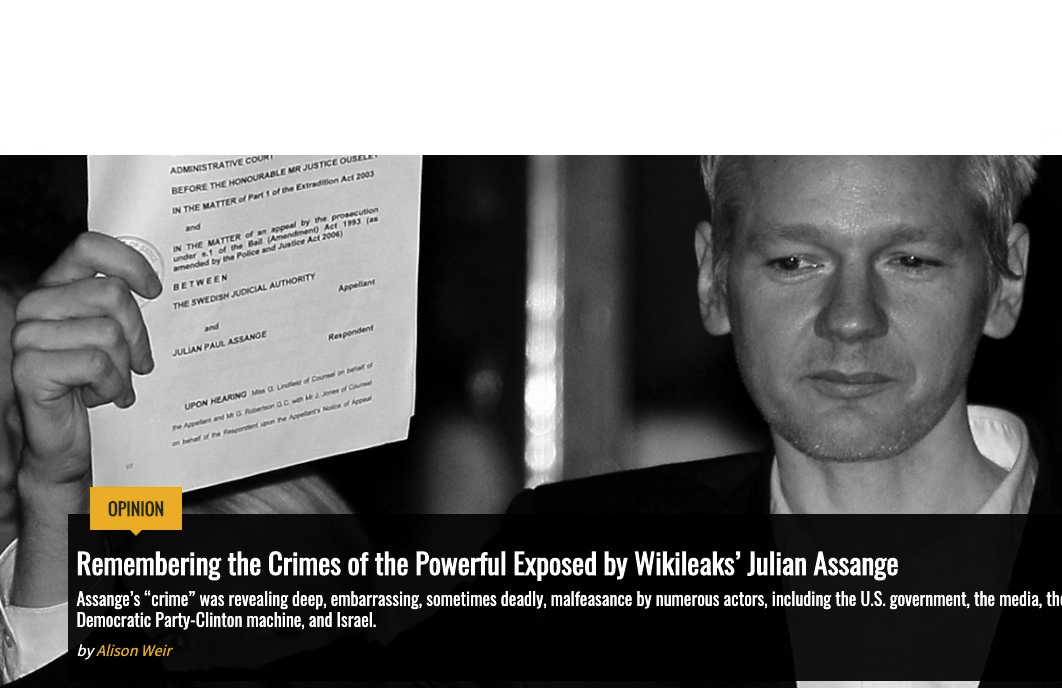
Feature photo | WikiLeaks founder Julian Assange holds up a court document for the media after he was released on bail, outside the High Court, London, Dec. 16, 2010. Kirsty Wigglesworth | AP
Wikileaks revealed the U.S. government’s cover-up of torture, cruelty, the killing of civilians, spying on its own citizens and others. It exposed Democratic Party cheating and manipulation, the fraudulence of “Russiagate.” It unmasked Israeli plans to keep Gaza on the brink of collapse, to use violence against Palestinian nonviolence, to make war upon civilians. All of this will be detailed below.
Without Wikileaks’ exposés, many of these actions would quite likely have remained hidden from the general public, as the perpetrators hoped.
The actual charge against Assange is allegedly conspiring with Chelsea Manning “to commit computer intrusion,” violating a somewhat problematic law with what one expert terms “overly expansive wording.”
The government seems to have resorted to this charge after the Justice Department had concluded in 2013 that it could not charge Assange for publishing the Iraq and Afghanistan war logs (which revealed various U.S war crimes detailed below), because government lawyers said this would also require charging various U.S. news organizations and journalists.
The Washington Post reported that Justice officials “realized that they have what they described as a ‘New York Times problem.’ If the Justice Department indicted Assange, it would also have to prosecute the New York Times and other news organizations and writers who published classified material, including The Washington Post and Britain’s Guardian newspaper.”
Even the current charge, when examined closely, turns out to be problematic on free press grounds. As Glenn Greenwald notes: “Assange is charged with helping a source preserve anonymity, a common practice by investigative reporters.”
Assange is being held in a maximum-security prison in London that has been called the UK’s Guantanamo. It has been used to detain alleged terrorists, sometimes indefinitely.
Assange’s recent dramatic arrest in Britain has elicited excellent articles by a number of writers – including Chris Hedges,, Jonathan Turley, Pepe Escobar”>,Pepe Escobar, Ray McGovern, John Pilger, Jonathan Cook, David Swanson, and Paul Craig Roberts. Many of these were published by Consortium News, which, unlike mainstream media and journalism organizations, has been regularly covering the escalating persecution of Assange for his Wikileaks revelations.
This article will quote from these valuable articles and others, and will also present additional information about Wikileaks’ exposés on Israel, which have largely gone unmentioned.
The arrest
Journalist Pepe Escobar writes that April 11th, the date of Assange’s arrest, “will live in infamy in the annals of Western ‘values’ and ‘freedom of expression.’ The image is stark. A handcuffed journalist and publisher dragged out by force from the inside of an embassy…”
“The U.S. magically erases Ecuador’s financial troubles, ordering the IMF to release a providential $4.2-billion loan. Immediately after, Ecuadorian diplomats ‘invite’ the London Metropolitan Police to come inside their embassy to arrest their long-term guest.
“Let’s cut to the chase. Julian Assange is not a U.S. citizen, he’s an Australian. WikiLeaks is not a U.S.-based media organization. If the US government gets Assange extradited, prosecuted and incarcerated, it will legitimize its right to go after anyone, anyhow, anywhere, anytime.
“Call it The Killing of Journalism.”
Media attacks and the black propaganda campaign against Wikileaks
Many others in addition to Escobar have noted that the persecution of Assange threatens all journalists. Yet, the media have a history of largely opposing or ignoring Assange.
As Chris Hedges reports:
“Once the documents and videos provided by Manning to Assange and WikiLeaks were published and disseminated by news organizations such as The New York Times and The Guardian, the press callously, and foolishly, turned on Assange. News organizations that had run WikiLeaks material over several days soon served as conduits in a black propaganda campaign to discredit Assange and WikiLeaks.”
John Pilger describes this campaign:
“In 2008, a plan to destroy both WikiLeaks and Assange was laid out in a top secret document dated 8 March, 2008. The authors were the Cyber Counter-intelligence Assessments Branch of the US Defence Department. They described in detail how important it was to destroy the “feeling of trust” that is WikiLeaks’ “centre of gravity”.
This would be achieved, they wrote, with threats of ‘exposure [and] criminal prosecution’ and a unrelenting assault on reputation. The aim was to silence and criminalise WikiLeaks and its editor and publisher. It was as if they planned a war on a single human being and on the very principle of freedom of speech.
Their main weapon would be personal smear. Their shock troops would be enlisted in the media — those who are meant to keep the record straight and tell us the truth.”
Pilger writes in a more recent article: “Assange’s principal media tormentor, The Guardian, a collaborator with the secret state, displayed its nervousness this week with an editorial that scaled new weasel heights. The Guardian has exploited the work of Assange and WikiLeaks in what its previous editor called ‘the greatest scoop of the last 30 years.’ The paper creamed off WikiLeaks’ revelations and claimed the accolades and riches that came with them.
“With not a penny going to Julian Assange or to WikiLeaks, a hyped Guardian book led to a lucrative Hollywood movie. The book’s authors, Luke Harding and David Leigh, turned on their source, abused him and disclosed the secret password Assange had given the paper in confidence, which was designed to protect a digital file containing leaked US embassy cables.
When Assange was still trapped in the Ecuadorian embassy, Harding joined police outside and gloated on his blog that “Scotland Yard may get the last laugh.”
Media watchdog FAIR reports that virtually all the mainstream media, from left to right, have cheered Assange’s recent incarceration, concluding: “It seems clear he shares virtually nothing in common with those in positions of influence in big media outlets, who have been only too happy to watch his demise.”
The Onion, which satirizes the tone and format of typical news outlets, summarizes Assange’s real “crime” in an article entitled Media Condemns Julian Assange For Reckless Exposure Of How They Could Be Spending Their Time. The piece includes an imaginary quote from Fred Hiatt, Washington Post editorial page editor:
“It’s abundantly clear that Mr. Assange was focused on exposing documented evidence of U.S. war crimes in Iraq and Afghanistan without so much as a thought for the journalists who faithfully parroted the U.S. military’s talking points when we could have been investigating information that ran contrary to that narrative—does he realize how that makes us look?”
Media half-truths
British journalist Jonathan Cook lays out the media’s sins of omission and commission.
“For seven years, we have had to listen to a chorus of journalists, politicians and ‘experts’ telling us that Assange was nothing more than a fugitive from justice and that the British and Swedish legal systems could be relied on to handle his case in full accordance with the law. Barely a ‘mainstream’ voice was raised in his defense in all that time.
From the moment he sought asylum, Assange was cast as an outlaw. His work as the founder of Wikileaks – a digital platform that for the first time in history gave ordinary people a glimpse into the darkest recesses of the most secure vaults in the deepest of Deep States – was erased from the record.
Assange was reduced from one of the few towering figures of our time – a man who will have a central place in history books, if we as a species live long enough to write those books – to nothing more than a sex pest, and a scruffy bail-skipper.
The political and media class crafted a narrative of half-truths about the sex charges Assange was under investigation for in Sweden. They overlooked the fact that Assange had been allowed to leave Sweden by the original investigator, who dropped the charges, only for them to be revived by another investigator with a well-documented political agenda.
They failed to mention that Assange was always willing to be questioned by Swedish prosecutors in London, as had occurred in dozens of other cases involving extradition proceedings to Sweden….”
Cook concludes: “This was never about Sweden or bail violations, or even about the discredited Russia-gate narrative, as anyone who was paying the vaguest attention should have been able to work out. It was about the U.S. Deep State doing everything in its power to crush WikiLeaks and make an example of its founder.”
What caused the US government and others to desire Assange and Wikileaks’ destruction? Let’s look at what they revealed.
Assange’s Wikileaks exposes Israel
Wikileaks published a number of diplomatic cables and emails that exposed Israeli plans and actions, and U.S. collusion, that Israel and its partisans wished to keep hidden. Below are some of them.
Israel planned to keep Gaza on “brink of collapse”.
In 2008 Wikileaks published a cable from the U.S. Embassy in Tel Aviv to Washington, that Israel had designated Gaza as a “hostile entity.”
The cable said: “As part of their overall embargo plan against Gaza, Israeli officials have confirmed [to U.S. officials] on multiple occasions that they intend to keep the Gazan economy on the brink of collapse without quite pushing it over the edge.”
The U.S. cable, classified “secret,” recommended that the U.S. try to persuade Israel to abandon this policy. The cable said that the U.S. should encourage Israel to “review its present policies (as requested by the Office of the Quartet Representative and the PA) while pressing the Israelis to approve as much funding each month as possible under security constraints…”
Israel used control over Palestinian money to control Gaza
The leaked cable also described how Israel used its control over Palestinian currency to control Gaza. The cable said Israel’s “monetary policy towards Gaza is consistent with its declaration that Gaza is a ‘hostile entity.’
The cable reported that Israel “believes that maintaining the shekel as the currency of the Palestinian Territories is in Israel’s interests.”It reported that Israel “treats decisions regarding the amount of shekels in circulation in Gaza as a security matter.” Requests by Palestinian banks to transfer shekels into Gaza are approved or denied by the National Security Council (NSC), an organ of the Israeli security establishment, not by the Bank of Israel.
The cable reported that Israel’s NSC “has the final say in permitting new liquidity into Gaza” and used this power to suppress Gaza’s economy.The cable reported that Israel had decided “that Gaza should receive just enough money for the basic needs of the population but it is not interested in returning the Gazan economy to a state of normal commerce and business.”
Israel colluded with PA and Fatah
A 2007 U.S. diplomatic cable, also marked secret, revealed the way in which Israel was using the Palestinian Authority and Fatah, the party of President Mahmoud Abbas.
The cable, from the U.S. embassy, reported information given the by Israeli Security Agency (ISA) Head Yuval Diskin to U.S. officials.
Diskin was concerned that Fatah’s weakness compared to Hamas “bodes ill for Israel,” especially since Israel had “established a very good working relationship” with the Palestinian Authority. He said that PA security agencies were sharing almost all the intelligence they collected with Israel. Diskin said: “They understand that Israel’s security is central to their survival in the struggle with Hamas in the West Bank.”
Israel planned violence against Palestinian nonviolence
A 2010 U.S. cable published by Wikileaks was entitled: “IDF PLANS HARSHER METHODS WITH WEST BANK DEMONSTRATIONS.”
The cable, again from the U.S. embassy, reported that Israel was greatly concerned by Palestinian nonviolence.
A diplomat wrote: “Less violent [Palestinian] demonstrations [were] likely to stymie the IDF. As MOD Pol-Mil chief Amos Gilad told USG interlocutors recently, “we don’t do Gandhi very well.”
The cable reported that an official “expressed frustration with ongoing demonstrations in the West Bank.” He said that the IDF would start to be “more assertive in how it deals with these demonstrations, even demonstrations that appear peaceful.”
The cable reported that the official said Israel would “start sending trucks with ‘dirty water’ to break up these protests, even if they are not violent… (NOTE: dirty water is a reference to the IDF’s chemically treated water that duplicates the effects of skunk spray. End note.)”
The cable reported that Israeli officials had ordered the Palestinian security force commanders “that they must stop these demonstrations or the IDF will.”
Israel’s nuclear monopoly, helping Israel by opposing Assad
Wikileaks posted an email memo to Hillary Clinton saying: “What Israeli military leaders really worry about — but cannot talk about — is losing their nuclear monopoly.
”The memo recommended: “The best way to help Israel deal with Iran’s growing nuclear capability [sic] is to help the people of Syria overthrow the regime of Bashar Assad.” It reported: “Israel’s leadership understands well why defeating Assad is now in its interests.”
The 2012 memo was apparently by James P. Rubin, assistant secretary of state during the Bill Clinton administration (and husband of CNN’s Christiane Amanpour). Rubin emailed it to Hillary Clinton, who then forwarded it to her aide to print out for her.
Susan Rice worked to protect Israel at the UN
Foreign Policy’s Colum Lynch reported on diplomatic cables published by Wikileaks from U.S. Ambassador to the United Nations Susan Rice. They showed Rice working to stymie a UN investigation into Israel’s 2008-2009 invasion of Gaza, an investigation that led to the Goldstone report.
“In one pointed cable,” Lynch wrote, “Rice repeatedly prodded U.N. Secretary-General Ban Ki-moon to block a recommendation of the board of inquiry to carry out a sweeping inquiry into alleged war crimes by Israeli soldiers and Palestinian militants.
“In another cable, Rice issued a veiled warning to the president of the International Criminal Court, Sang-Hyun Song, that an investigation into alleged Israeli crimes could damage its standing with the United States at a time when the new administration was moving closer to the tribunal. ‘How the ICC handles issues concerning the Goldstone Report will be perceived by many in the US as a test for the ICC, as this is a very sensitive matter,’ she told him, according to a Nov. 3, 2009, cable from the U.S. mission to the United Nations.”
Another cable reveals that “Rice assured Israeli Foreign Minister Avigdor Lieberman during an Oct. 21, 2009, meeting in Tel Aviv that the United States had done its utmost to ‘blunt the effects of the Goldstone Report’ and that she was confident she could ‘build a blocking coalition’ to prevent any push for a probe by the Security Council, according to an Oct. 27, 2009 cable.”
Lynch wrote that the diplomatic cables published by Wikileaks “provide a rare glimpse behind the scenes at the U.N. as American diplomats sought to shield Israel’s military from outside scrutiny of its conduct during Operation Cast Lead.”
They “also demonstrate how the United States and Israel were granted privileged access to highly sensitive internal U.N. deliberations on an ‘independent’ U.N. board of inquiry into the Gaza war, raising questions about the independence of the process.”
Eizenstat worked to influence Hillary on Israel
A 2015 Wikileak consisted of an email from former U.S. Ambassador to the EU Stuart Eizenstat to top Clinton foreign policy advisor Jake Sullivan that was also sent to Hillary Clinton. The email revealed Eizenstat’s close ties to Israel and is another example of how advisors like Eizenstat and Rubin work to influence Clinton’s positions.
Eizenstat had held numerous influential positions in both Israel and the U.S., including Chief Domestic Policy Adviser under President Jimmy Carter and Executive Director of the White House Domestic Policy Staff and Deputy Secretary of the Treasury under Bill Clinton.
His bio states that Eizenstat “served as the presidents’ special representative on Holocaust-related issues and negotiated major Holocaust restitution agreements with a number of European countries, and at the time of his ambassadorial nomination, he sat on the following boards: the Weizmann Institute of Science, The Jerusalem Foundation, Brandeis University, the Council on Foreign Relations, the Council for Excellence in Government Center for National Policy, the Overseas Development Council, the International Management and Development Institute, the American Jewish Committee and the UJA Federation of Greater Washington. He was chairman of the Feinberg Graduate School of the Weizmann Institute and served on the board of directors of Hercules Incorporated; PSI Energy, Inc.; and the Israel Discount Bank of New York.”
For his work, the Government of Israel presented Eizenstat with the Courage and Conscience Award.
Eizenstat noted in his email that the widely known Obama-Netanyahu animosity placed “Hillary in an extremely difficult position, caught between the President she served and the organized parts of the Jewish community.” He advised her on how to maneuver this.
Eizenstat wrote: “Permit me to suggest some points she might make. By way of background, I have very deep connections to the State of Israel and to its elected officials and leading academics. I go to Israel two to three times a year, perhaps 50 times since my first visit in 1965. My grandfather and great-grandfather are buried in Israel, and I have scores of relatives and friends there.”
Eizenstat explained his central role in U.S.-Israel policies:
“During the Clinton Administration, I was responsible for the economic dimension of the peace process, working with Yasir Arafat, the Jordanians and the Israeli government…” He said that he co-chaired with Dennis Ross the Jewish People’s Policy Institute of Jerusalem (JPPI), a think tank funded by the Jewish Agency and major American Jewish federations and foundations, “focusing on strategic challenges facing Israel and the Diaspora around the world.”
Eizenstat recommended that Hillary “should stress the enduring commitment of the United States to Israel’s security interests, not only direct military threats, but attacks against Israel in the form of the Boycott, Divestment, Sanctions (BDS) campaign, on campuses in the U.S. and Europe. She should express grave concern for the increase in anti-Semitism in Europe and violent attacks by radical Islamic terrorists (Obama refuses to use this term; she will need to decide what language to use and then stick with it)…
“Third, and critically, she should express a strong feeling that Israel MUST remain a bipartisan issue, as it has been since its formation. She should sharply criticize those in the U.S. and in Israel who are injecting Israel into a partisan context…”
Hillary’s campaign team advised that she only talk about Israel at private fundraisers
Wikileaks published emails showing that in 2015 Hillary Clinton’s campaign team was concerned that mentioning Israel during election speeches would alienate Democratic party activists.
Campaign manager Robby Mook emailed that they “shouldn’t have Israel at public events.” He was especially concerned about “activists.”
After some debate about strategy, speechwriter Dan Schwerin suggested a basic text for her to use that omitted Israel. He said, “Then she can drop in Israel when she’s with donors.”
Israeli general admits that US and Israeli security interests “often clash”
A 2009 diplomatic cable describing a meeting Assistant Secretary of Defense Ambassador Alexander Vershbow with senior Israeli defense officials in Israel reported that an Israeli general “acknowledged the sometimes difficult position the U.S. finds itself in given its global interests, and conceded that Israel’s security focus is so narrow that its QME concerns often clash with broader American security interests in the region.”
The cable also showed Israeli officials promoting the belief that Iran was about to acquire nuclear weapons. The cable shows that US diplomats were skeptical, the report including the parenthetical comment: “It is unclear if the Israelis firmly believe this or are using worst-case estimates to raise greater urgency from the United States.”)
(Article continued in the column on the right)
Questions related to this article:
Julian Assange, Is he a hero for the culture of peace?
Free flow of information, How is it important for a culture of peace?
How can war crimes be documented, stopped, punished and prevented?
(Article continued from the column on the left)
Israeli Chief of Staff reveals Israel is preparing for a war against civilians
Wikileaks posted a Dec. 23, 2009 secret diplomatic cable from the U.S. Embassy in Tel Aviv that described a briefing by IDF Chief of General Staff Lt General Gabi Ashkenazi of a U.S. Congressional delegation consisting of House Armed Services Committee Chairman Ike Skelton (D, MO), Representative Steve Israel (D-NY), and Representative Tim Murphy (R, PA).
The cable reported: “Ashkenazi began the meeting by expressing his appreciation for the Committee’s support for Israel over the years.”
Ashkenazi “said he is preparing the IDF for a big war” and said that the next battle would be conducted in Gaza and southern Lebanon.
The cable also quoted Ashkenazi as telling the US representatives “the IDF cannot allow a situation in which it is restricted from operating in urban areas,” suggesting that the Israeli military would be even more violent than its invasion of Gaza a year before, in which Israeli forces killed about 1,400 Palestinians, including more than 900 civilians, many of them children. Middle East expert Juan Cole writes : “Planning to bomb civilian areas with foreknowledge that you will thereby kill large numbers of civilians is a war crime.
Ashkenazi admitted that “there were mistakes made.” The report said: “He noted that Israeli soldiers were also hit by mistake. The same tank battalion that hit the house of Dr. Abul Eish and killed his two daughters also hit an IDF infantry unit.”
Cole reports that Ashkenazi had told a delegation “that Israeli unmanned drones had had great success in identifying rocket emplacements in southern Lebanon, and that it had been aided in this endeavor by the US National Security Agency, which spies on communications.”
According to Cole, “Israel could have a peace treaty with Syria and Lebanon tomorrow by giving back the Golan Heights and the Shebaa Farms, and by accepting a two-state solution. Instead, its Dr. Strangeloves are planning out massive bombings of areas thick with innocent civilians and willing to subject Tel Aviv to two months worth of rocket fire.”
The impact of Israel’s actions on the U.S.
Cole discussed what this could mean for the United States:
“Nor will the United States be held harmless from the blowback in the region caused by another Israeli war of aggression. Before September 11, Israel hawks used to make fun of Americans who warned that eventually there would be hell to pay for the Israeli strangulation of the Palestinians (for the argument, see this posting). And, imagine what a war would do to gasoline prices and to the world economy.”
Cole concluded: “My deepest fear is that US support for Israeli militarism, and the terrorism that support inevitably engenders, will be what finally finishes off the civil liberties enshrined in the American Constitution.”
Former US Treasury Undersecretary and journalist Paul Craig Roberts worries that this is already in process: “As the grand jury [for Assange] was secret because of ‘national security,’ will the trial also be secret and the evidence secret? Is what we have here a Star Chamber proceeding in which a person is indicted in secret and convicted in secret on secret evidence? This is the procedure used by tyrannical governments who have no case against the person they intend to destroy.”
Israel misled the public about Hamas; Israel opposes a lasting ceasefire
Another secret US diplomatic cable published by Wikileaks reported on a trip to Israel by Senator Kirsten Gillibrand (R-NY). Gillibrand’s group was briefed on “the Gaza security situation” by the IDF Southern Command and the Israel Security Agency (Shin Bet) on September 2nd and 3rd, 2009.
(At the time, Gillibrand was facing an upcoming fight to retain her position in the Senate in what was expected to be a close election in 2010 – she had been appointed by the governor to the seat after Hillary became Secretary of State).
The cable reported: “Israel Major General Yoav Gallant told the CODEL [Congressional Delegation] that the Southern Command’s role is to manage the threat from Gaza.”
While Israel publicly portrays Gaza as filled with extremists who hate Israel because of Islamic extremism, the Wikileaks disclosure shows that privately its officials tell a different story.
Gallant was quoted as telling Gillibrand: “Sixty percent of Gaza’s population is under the age of twenty and the average income is one-twenty-fifth of the average income of Israelis in Sderot (a relatively poor Israeli town). Gaza has no natural resources except for fishing. Those factors would be reason enough for Gazans to fight, even without religious extremism.”
Gallant admitted that Israel opposed a lasting ceasefire with Hamas, since “a lasting ceasefire is likely to lead to a stronger Hamas.”
An Israeli official said that one of the reasons that Fatah couldn’t make concessions to reconcile with Hamas was “because of the U.S. position,” suggesting that the US has played a role in the continuing division between Hamas and Fatah.
The briefing disclosed that Israeli officials were displeased that Egypt didn’t always do what Israel government told it to do. An Israeli official complained “that Shin Bet and the Mossad gave Egyptian intelligence the names of the top 300 smugglers in the Sinai, but Egypt did not act against any of them.”
While Israel always blames Hamas for any and all violence against Israel, the cable revealed that privately Israeli officials are aware that other, newer groups are often responsible.
Israeli Officials said that these groups “oppose the rule of Hamas,” which has tried to suppress them.
Israel & US decide to hide delivery of US bunker-busting bombs to Israel (for targeting Iran)
A secret 2009 diplomatic cable reported on the “Executive Session of the 40th Joint Political Military Group (JPMG)”. The US group was led by Andrew Shapiro, Assistant Secretary of State, Bureau of Political-Military Affairs. They met with top Israeli officials.
The cable reported that the combined group decided that the upcoming delivery of GBU-28 bunker busting bombs to Israel “should be handled quietly to avoid any allegations that the USG [United States Government] is helping Israel prepare for a strike against Iran.”
The cable also reported: “The GOI [Government of Israel] made the case for “crippling sanctions” against Iran.
Israeli was concerned about Russia & Turkey
The same 2009 secret cable reported that Israel was extremely concerned about Russia, reporting:
“The GOI [Government of Israel] was not confident that Moscow will be helpful in any Iranian sanctions effort — GOI participants opined that Russia is considered a ‘mystery’ with respect to their views on Iran. The GOI raised the Russian S-300 sale to Iran, noting that the transfer is still pending. GOI participants argued that Moscow seeks a return to superpower status.” (This suggests that Israel’s continual concern about Russia could be a factor in the promotion of the widespread – and dangerous – anti-Russia discourse in the US.)
Israel was also worried that Turkey wasn’t toeing the Israeli line:
“The GOI raised the current direction the Government of Turkey has taken toward Syria and Iran — and away from Israel. Israeli participants argued that Turkey has been supportive of Hamas in Gaza while pursuing a more ‘Islamic’ direction with the goal of becoming a regional superpower. The GOI argued that the Turkish military is losing its ability to influence government decisions and strategic direction. After this past year, GOI participants said they have a ‘bad feeling’ about Turkey.”
Efforts “at the highest levels” of the US government to remove restrictions for Israelis concerning dual citizenship
The same 2009 secret cable discussed above also revealed that there were efforts at the top levels of the US government to allow dual Israel citizens in the US to have access to sensitive technology:
“The GOI raised the issue of dual citizenship within the context of access to sensitive technology. U.S. participants acknowledged Israeli concerns, noting that the issue is being worked at the highest levels of the USG to reach consensus on how to proceed.”
(Dual citizenship used to be prohibited in the United States until this was overturned in 1967 on behalf of Israel; Abe Fortas was the swing vote.)
Since 2006 Wikileaks has exposed a multitude of misdeeds of governments throughout the world (e.g. exposing corruption in Kenya.) Below are some of the exposés about the U.S.
Exposing US war crimes
Iraq and Afghanistan
Chris Hedges reports: “The half a million internal documents leaked by Manning from the Pentagon and the State Department, along with the 2007 video of U.S. helicopter pilots nonchalantly gunning down Iraqi civilians, including children, and two Reuters journalists, provided copious evidence of the hypocrisy, indiscriminate violence, and routine use of torture, lies, bribery and crude tactics of intimidation by the U.S. government in its foreign relations and wars in the Middle East. Assange and WikiLeaks allowed us to see the inner workings of empire—the most important role of a press—and for this, they became the empire’s prey.”
Jonathan Turley writes:
“The key to prosecuting Assange has always been to punish him without again embarrassing the powerful figures made mockeries by his disclosures. That means to keep him from discussing how the U.S. government concealed attacks and huge civilian losses, the type of disclosures that were made in the famous Pentagon Papers case. He cannot discuss how Democratic and Republican members either were complicit or incompetent in their oversight. He cannot discuss how the public was lied to about the program.”
Below are some of the Wikileaks revelations about U.S. war crimes, as reported by BBC:
One of the Wikileaks documents shows the US military was given a video apparently showing Iraqi Army (IA) officers executing a prisoner in the northern town of Talafar.
“The footage shows the IA soldiers moving the detainee into the street, pushing him to the ground, punching him and shooting him,” states the log, which also names at least one of the perpetrators.
“In another case, U.S. soldiers suspected army officers of cutting off a detainee’s fingers and burning him with acid…..
“In one incident in July 2007, as many as 26 Iraqis were killed by a helicopter, about half of them civilians, according to the log.
“Another record shows an Apache helicopter gunship fired on two men believed to have fired mortars at a military base in Baghdad in February 2007, even though they were attempting to surrender. The crew asked a lawyer whether they could accept the surrender, but were told they could not, “and are still valid targets”. So they shot them.”
The Guardian also summarized some of the Wikileaks’ revelations:
* US authorities failed to investigate hundreds of reports of abuse, torture, rape and even murder by Iraqi police and soldiers whose conduct appears to be systematic and normally unpunished.
* A US helicopter gunship involved in a notorious Baghdad incident had previously killed Iraqi insurgents after they tried to surrender.
* US and UK officials insisted that no official record of civilian casualties exists but the logs record 66,081 non-combatant deaths out of a total of 109,000 fatalities.
“The numerous reports of detainee abuse, often supported by medical evidence, describe prisoners shackled, blindfolded and hung by wrists or ankles, and subjected to whipping, punching, kicking or electric shocks. Six reports end with a detainee’s apparent death.
“As recently as December the Americans were passed a video apparently showing Iraqi army officers executing a prisoner in Tal Afar, northern Iraq. The log states: “The footage shows approximately 12 Iraqi army soldiers. Ten IA soldiers were talking to one another while two soldiers held the detainee. The detainee had his hands bound … The footage shows the IA soldiers moving the detainee into the street, pushing him to the ground, punching him and shooting him.”
“The report named at least one perpetrator and was passed to coalition forces. But the logs reveal that the coalition has a formal policy of ignoring such allegations. They record “no investigation is necessary” and simply pass reports to the same Iraqi units implicated in the violence. By contrast all allegations involving coalition forces are subject to formal inquiries. Some cases of alleged abuse by UK and US troops are also detailed in the logs.
“In two Iraqi cases postmortems revealed evidence of death by torture. On 27 August 2009 a US medical officer found “bruises and burns as well as visible injuries to the head, arm, torso, legs and neck” on the body of one man claimed by police to have killed himself. On 3 December 2008 another detainee, said by police to have died of “bad kidneys”, was found to have ‘evidence of some type of unknown surgical procedure on [his] abdomen’.
“A Pentagon spokesman told the New York Times this week that under its procedure, when reports of Iraqi abuse were received the US military ‘notifies the responsible government of Iraq agency or ministry for investigation and follow-up’.
“The logs also illustrate the readiness of US forces to unleash lethal force. In one chilling incident they detail how an Apache helicopter gunship gunned down two men in February 2007.
“The suspected insurgents had been trying to surrender but a lawyer back at the base told the pilots: ‘You cannot surrender to an aircraft.’ The Apache, callsign Crazyhorse 18, was the same unit and helicopter based at Camp Taji outside Baghdad that later that year, in July, mistakenly killed two Reuters employees and wounded two children in the streets of Baghdad.”
In reading about the actions in Iraq, it’s important to remember that pro-Israel neocons were a major factor in the U.S. invasion.
Democratic primaries rigged to oust Bernie Sanders< Wikileaks stated that it had “exposed how those at the top of the U.S. Democratic Party had worked tirelessly to tilt the scales in favor of Hillary Clinton as she faced off against Bernie Sanders in the race to be the Democrat presidential candidate.
”These revelations eventually prompted the resignation of five of the most senior members of the Democratic Party in the aftermath of the Democratic Convention, including DNC Chair Debbie Wasserman Schultz.
Hedges reports: “Assange, who with the Manning leaks had exposed the war crimes, lies and criminal manipulations of the George W. Bush administration, soon earned the ire of the Democratic Party establishment by publishing 70,000 hacked emails belonging to the Democratic National Committee (DNC) and senior Democratic officials. The emails were copied from the accounts of John Podesta, Hillary Clinton’s campaign chairman.
“The Podesta emails exposed the donation of millions of dollars from Saudi Arabia and Qatar, two of the major funders of Islamic State, to the Clinton Foundation.
“It exposed the $657,000 that Goldman Sachs paid to Hillary Clinton to give talks, a sum so large it can only be considered a bribe. It exposed Clinton’s repeated mendacity. She was caught in the emails, for example, telling the financial elites that she wanted “open trade and open borders” and believed Wall Street executives were best positioned to manage the economy, a statement that contradicted her campaign statements.
“It exposed the Clinton campaign’s efforts to influence the Republican primaries to ensure that Trump was the Republican nominee.
“It exposed Clinton’s advance knowledge of questions in a primary debate.
[These were given to Hillary by prominent Democratic activist and former CNN commentator, now Fox News pundit Donna Brazile. The scandal quickly blew over. Salon reported in 2016 that Brazile was “far-from-contrite” and “recycled her discredited claims that the hacked emails that exposed her perfidy against presidential candidate Sen. Bernie Sanders were somehow altered by Russian intelligence agents.” Turley points out that Brazile is “now back on television, but Assange, however, could well do time.”]
“It exposed Clinton as the primary architect of the war in Libya, a war she believed would burnish her credentials as a presidential candidate.”
CIA Spied on American citizens & friendly nations
Hedges reports: “WikiLeaks has done more to expose the abuses of power and crimes of the American Empire than any other news organization. In addition to the war logs and the Podesta emails, it made public the hacking tools used by the CIA and the National Security Agency and their interference in foreign elections, including in the French elections.”
“[Wikileaks] intervened to save Edward Snowden, who made public the wholesale surveillance of the American public by our intelligence agencies, from extradition to the United States by helping him flee from Hong Kong to Moscow. The Snowden leaks also revealed that Assange was on a U.S. ‘manhunt target list.’” (More on Snowden here.)
Wikileaks’ publication of Vault 7: CIA Hacking Tools Revealed, “the largest ever publication of confidential documents on the agency,” revealed that the CIA “had produced more than a thousand hacking systems, trojans, viruses, and other ‘weaponized’ malware.”
The documents revealed that the CIA’s “exploits against a wide range of U.S. and European company products include Apple’s iPhone, Google’s Android and Microsoft’s Windows and even Samsung TVs, which are turned into covert microphones.”
Misleading the public about “Russiagate”
Hedges notes: “The Democratic leadership, intent on blaming Russia for its election loss, charges that the Podesta emails were obtained by Russian government hackers, although James Comey, the former FBI director, has conceded that the emails were probably delivered to WikiLeaks by an intermediary. Assange has said the emails were not provided by ‘state actors.’”
Pilger reports: “The Guardian published a series of falsehoods about Assange, not least a discredited claim that a group of Russians and Trump’s man, Paul Manafort, had visited Assange in the embassy. The meetings never happened; it was fake.”
The Vault 7 documents revealed that some of the CIA’s tools enabled it to make hacking, emails, etc. appear to come from a different source, calling into question claims about alleged Russian hacking.
Former top CIA analyst Ray McGovern and former NSA Technical Director William Binney, in a detailed article disputing Russiagate contentions, wrote that Wikileaks’ Vault 7 documents revealed that the CIA had the ability to “break into computers and servers and make it look like others did it by leaving telltale signs (like Cyrillic markings, for example).”
(For more on Russiagate see this and this.)
U.S. plans for regime change in Syria and Venezuela
John Pilger writes that Wikileaks documents provided “the detailed description of American ambassadors of how the governments in Syria and Venezuela might be overthrown. It is all available on the WikiLeaks site.”
British military’s secret document calling investigative journalists “a major threat”
Pilger reports: “A decade ago, the Ministry of Defense in London produced a secret document which described the ‘principal threats’ to public order as threefold: terrorists, Russian spies and investigative journalists. The latter was designated the major threat.”Assange’s Wikileaks revealed all this to us, and more.
Extradition to the US could place Assange’s life in danger
And now Assange is in “Britain’s Guantanamo,” awaiting possible, perhaps probable, extradition to the U.S. If this happens, his lawyers say, “he may risk torture and his life would be in danger.”
UN Special Rapporteur on torture Nils Melzer has issued a statement warning that extradition “could expose him to a real risk of serious violations of his human rights, including his freedom of expression, his right to a fair trial and the prohibition of cruel, inhuman or degrading treatment or punishment.”
Melzer urged the British Government “to refrain from expelling, returning or extraditing Mr. Assange to the United States or any other jurisdiction, until his right to asylum under refugee law or subsidiary protection under international human rights law has been determined in a transparent and impartial proceeding granting all due process and fair trial guarantees, including the right to appeal.”
Numerous organizations, as reported by journalist Elizabeth Vos , have opposed his prosecution, including the ACLU, The Freedom of the Press Foundation, the Center for Investigative Journalism, Amnesty Ireland, Committee To Protect Journalists, Reporters Without Borders, Human Rights Watch, the Center for Constitutional Rights, the National Union of Journalists, the The Knight First Amendment Institute and Digital Rights Watch.
Yet, he remains in prison, while the mainstream media and others applaud this.
The bottom line
Consortium News asks: “if Your Country Were Committing War Crimes Would You Want to Know? ” One thing is clear. The perpetrators don’t want Americans to know and are trying to shoot the messenger.
But to prevent countless lives from being destroyed abroad, and eventually, at home, it’s essential that Americans learn the profoundly disturbing actions that Wikileaks revealed. And then for everyone, across the political spectrum, to demand that these actions stop.