Category Archives: FREE FLOW OF INFORMATION

EU Statement at UN High-Level Forum on the Culture of Peace: Women’s Leadership to Promote a Culture of Peace

FREE FLOW OF INFORMATION

A publication of the Delegation of the European Union to the United Nations in New York

Mr President,

I have the honour to speak on behalf of the European Union and its Member States. 
The Candidate Countries North Macedonia, Montenegro*, Albania*, the Republic of Moldova, and Georgia, as well as Armenia, Monaco, San Marino and the United Kingdom align themselves with this statement.

We reaffirm our full support for the Culture of Peace agenda and welcome the focus of the discussion this year on women’s leadership in promoting the culture of peace. 


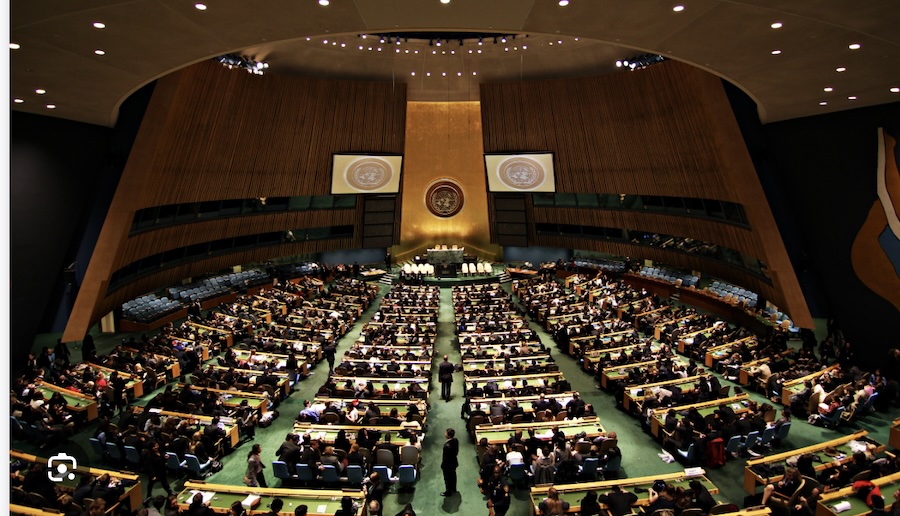
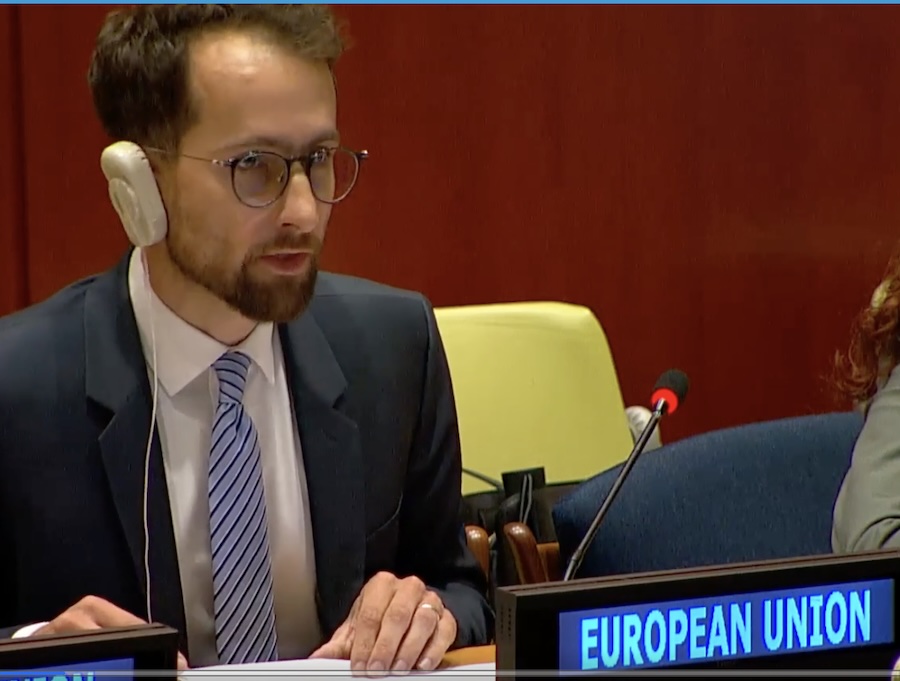
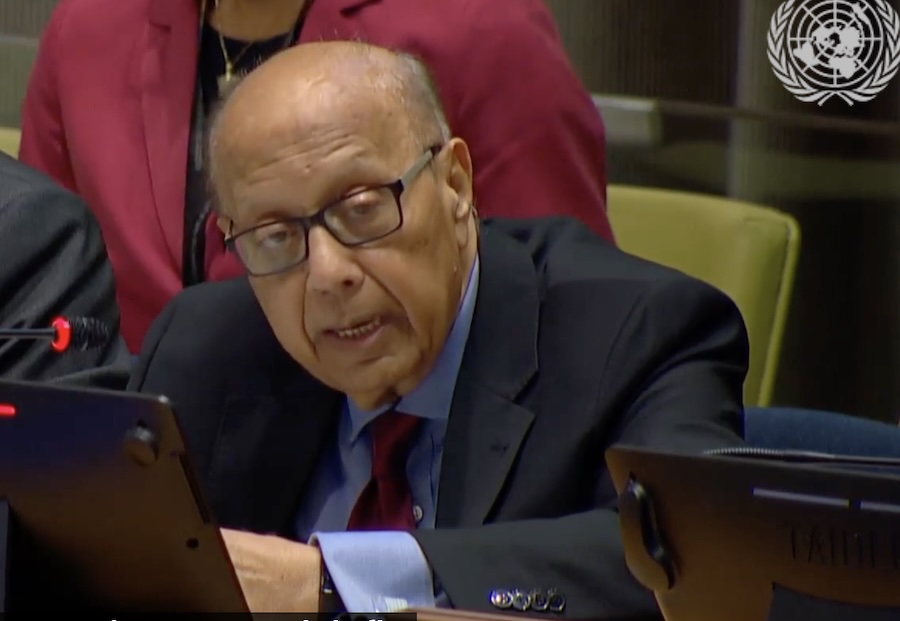
Frame from the UN video

The EU was born from the ashes of war, with the determination to turn competition into partnership, conflict into cooperation. We have learned to nurture the culture of peace and adopted it as part of our DNA. The principles and values guiding us today are informed by this very experience. 

Today, as a global peace actor, the EU is committed to the peaceful settlement of conflicts, dialogue and diplomacy, as well as respect for international norms and obligations. We stand firm in our conviction that today’s complex challenges can only be resolved through collective commitment and action, through effective multilateralism, with the United Nations at its core. 

Chair, 

Peace can only be achieved and sustained with a holistic approach that tackles the root causes of conflicts. It requires strengthening societies through the promotion of human rights and fundamental freedoms, democratic participation and civic space, inclusive and sustainable development, as well as the rule of law and good governance, served by well-functioning justice systems. A comprehensive approach to peacebuilding also requires strengthened coherence between humanitarian action, development and peacebuilding efforts, particularly in fragile and conflict-affected contexts. 

(article continued in right column)

Question(s) related to this article:

What is the United Nations doing for a culture of peace?

(article continued from left column)

Peace is where the rights and dignity of every person are respected and where all have equal opportunities to thrive, without any discrimination, intimidation or violence, and where diversity and pluralism are celebrated. This requires investments into education from an early age, the empowerment of young persons, the inclusion of those marginalised, as well as gender equality and the empowerment of all women and girls – the focus of today’s discussion. 

Chair,

Women play a fundamental role in building and maintaining resilience in societies through their contributions in all aspects of life. Societies can only be strong if they are underpinned by the full and equal contributions of women and girls. 

In times of conflict, women have proven to be at the forefront of prevention, mediation and conflict resolution. Their full, equal and meaningful participation in peace processes, peacebuilding, post-conflict recovery and decisions-making is a prerequisite for sustainable and inclusive peace. The Women, Peace and Security Agenda is central to advancing this goal, and therefore, its implementation is a strategic imperative. 

However, this requires the elimination of structural barriers that women and girls face in society. This includes eradicating discriminatory gender norms, threats, harassment, reprisals and violence against them, including women peacebuilders and women human rights defenders, providing a safe and enabling environment, and taking proactive steps to promote women’s leadership at all levels. 

The EU remains strongly committed to this end. We support women mediators’ networks, systematically include women experts in our mediation support teams, and integrate a gender perspective throughout their work. We also promote women’s participation in peace processes, making sure that at least one third of participants in all EU-supported peace process activities are women. We further support women leaders and experts in directly engaging in negotiation and political processes through dedicated women’s advisory bodies. And finally, we fund women peacebuilders, women-led and civil society organisations and women human rights defenders to advance mediation, conflict prevention and inclusive governance in conflict-affected communities in various regions of the world. 

Chair,

The Culture of Peace agenda remains at the heart of our work as we strive to achieve peace, prosperity and human rights for all. The EU stands firm in this commitment and is taking action to cultivate it today and every day. 

I thank you. 

– – – – – –

If you wish to make a comment on this article, you may write to coordinator@cpnn-world.org with the title “Comment on (name of article)” and we will put your comment on line. Because of the flood of spam, we have discontinued the direct application of comments.

Statement of Anwarul Chowdhury at the UN High-Level Forum on the Culture of Peace

FREE FLOW OF INFORMATION

Copied and corrected by CPNN from United Nations transcript and video

Thank you, Madam President. I would like to begin by thanking you for a very powerful and meaningful opening statement. We appreciate that.

I have a special pleasure in welcoming Leymah Gbowee, because she was on previous occasion as the keynote speaker in the high level forum on the culture of peace. I’m very happy she joined us this time again.

I have also great pleasure in welcoming the permanent representative, the new permanent representative of Bangladesh. She is here and I’m very happy that Bangladesh mission is now headed by a woman leader. That’s a wonderful opportunity for me to meet her for the first time in this meeting.

Madam President, in 11 days from today, on 13 September, the United Nations will observe the 27th anniversary of the General Assembly’s unanimous adoption of the Declaration and program of action on a culture of peace. This high level forum convened by you, Madam President, provides the most appropriate setting for the celebration of this remarkable pathway to the global culture of peace as articulated by its apex body.

The theme of this forum rightfully is women’s leadership to promote the culture of peace.


Frame from UN video

If I may add here that you yourself, Madam President, is a true embodiment of the core focus of this theme in your leadership of the United Nations General Assembly as one of its five women presidents, among the 80 individuals gracing this position since the birth of this organization.

Mandated by the UN resolutions, the successive presidents of the General Assembly have been convening the annual high level forums attracting the attention of member states and civil society since 2012, when your predecessor, PGA 66, Ambassador Al-Assad, took the initiative to convene the first forum.

I had the honor of introducing on behalf of the member states after successfully chairing the nine month long negotiations on the relevant resolution A 53243, which was adopted on 13 September in 1999, as you said.

The global movement for the culture of Peace, GMCOP, a coalition of civil society organizations have been spearheading advocacy initiatives effectively since 2011, as well as in organizing the annual high level forums on the culture of Peace convened by the president of the UN General Assembly from its beginning in 2012, all the way to 2022.

The forum has the distinction of being the only gathering which was addressed by the largest number of Nobel peace laureates, all women, and again, recognize Leymah’s presence here. Six times out of 11 forums.

Also, the forum’s panelists were always gender balanced on most occasions with more women participating.

At the United as the United Nations Under Secretary-General and High Representative for the most vulnerable countries and as the permanent representative of Bangladesh, my work has taken me to the furthest corners of the world.

I have seen time and again the centrality of women’s equality and the culture of peace in our lives.

This realization has now become more pertinent in the midst of the ever increasing militarism, militarization, and weaponization that is destroying both our planet and our people.

(article continued in right column)

Question(s) related to this article:

What is the United Nations doing for a culture of peace?

(article continued from left column)

As we all know, the charter of the United Nations when signed in 1945, was the first international agreement to affirm the principle of equality between women and men.

The program of action on culture of peace accords a place of prominence to equality between women and men fourth among its eight action areas.

Women represent more than half of the global population, yet they continue to be underrepresented in leadership positions in every region of the world.

Unfortunately, in recent years, women’s rights are under threat from a backlash of conservatism and fundamentalism around the world.

Let me assert again that patriarchy and misogyny are the dual scourges pulling humanity back from our aspiration for a better world to live in freedom, equality and justice.

On 8th of March 2000, as the president of the UN Security Council, I could initiate and mobilize the council to recognize unanimously in a statement that and I quote, peace is inextricably linked with equality between women and men, end and affirmed the value of full and equal participation of women at all decision making levels. That is when the seed for the UN Security Council Resolution 13 25 was sown.

It was finally adopted on the 31st of October of the same year.

We should never forget that when women, more than half of the world’s 8 billion plus people, are marginalized, there is no chance for our world to get sustainable peace in the real sense.

It is my strong belief that unless women are engaged in advancing the culture of peace at equal levels at all times with men, sustainable peace would continue to elude us.

In various parts of the world, women have shown great capacity as peace builders. At the grassroots and community levels, women have organized to resist militarization, to create space for dialogue and moderation, and to weave together the shattered fabric of society.

As I reiterate time and again, women bring a new breadth, quality, and balance of vision to a common effort of moving away from the cult of war towards the culture of peace.

Women’s equality makes our planet safe and secure.

The slogan of global campaign on women peace and security, which we launched in London in June 2014 reiterates, and I quote, “If we are serious about peace, we must take women seriously.”

Let me end by emphasizing that feminism is not intended to pit women against men or men against women. Feminism is about smart policy, which is inclusive, uses all potential, and leaves no one behind.

I am proud to be a feminist. All of us need to be. That is how we make our planet a better place to live for all.

We should always remember that without peace, development is impossible and without development, peace is not achievable. But without women, neither peace nor development is conceivable.

I continue to emphasize that the culture of peace is not a quick fix. It is a movement, not a revolution, and women always bolster that movement immensely.

Let me conclude by underscoring here an unacceptable reality.

In its 81 years of existence, the United Nations has not yet elected a woman Secretary-General, eight decades plus nine men, not one woman. What an embarrassment, what a shame.

How can an institution that speaks of equality at every podium continues to model inequality at its pinnacle?

The credibility of the event’s advocacy depends on its own reflection in the mirror.

I thank you for your kind attention.

– – – – – –

If you wish to make a comment on this article, you may write to coordinator@cpnn-world.org with the title “Comment on (name of article)” and we will put your comment on line. Because of the flood of spam, we have discontinued the direct application of comments.

Tabling of the Ocean of Peace Alliance and Australia-Fiji Vuvale Union

FREE FLOW OF INFORMATION

An article from the Foreign Ministry of Australia

Ministerial statement 11 August 2026

At a time of great uncertainty, risk and contestation, the Albanese Government recognises that Australia cannot afford to be a passive observer of the profound changes occurring around us.

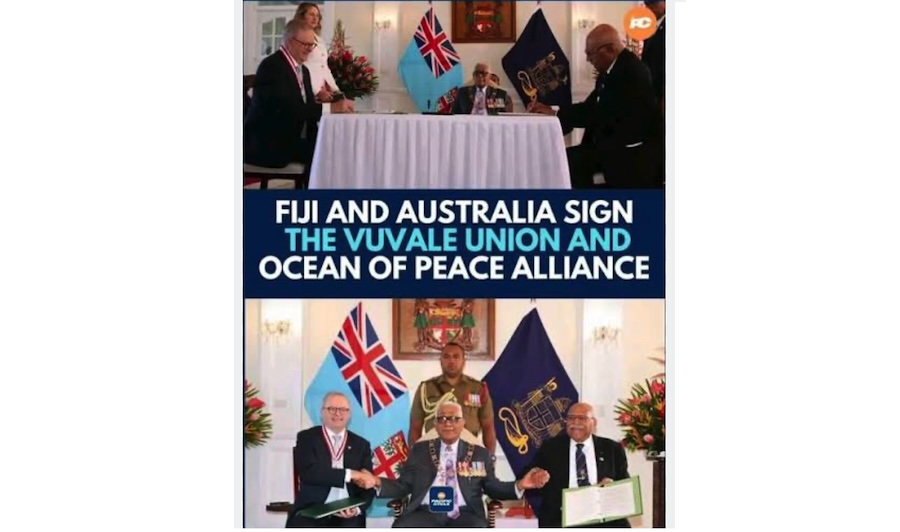
Photo from Instagram

The Ocean of Peace: Vision to Treaty  weighs the benefits and risks of turning the Ocean of Peace Declaration, endorsed by Pacific leaders in 2025, into a legally binding agreement.

The paper proposes negotiating a new regional peace and security treaty as a Protocol to the Treaty of Rarotonga.

Peace is never a given.

And we are not here to just occupy the space.

For the past four years, we have been building Australia’s future in our
region.

A future built through partnerships, not coercion.

A future built by the countries and peoples of our region.

And that is why, from the outset, the Albanese Government has listened to our region, engaged with respect and humility, and acted on our shared priorities.

We are investing in being the partner of choice for our immediate region, including the Pacific.

We are using all tools of statecraft to invest in Pacific relationships, trust and regionalism.

Embracing Pacific leadership and backing initiatives that make our region safer, more prosperous and more resilient.

And we could not have had a better partner in this than Fiji.

Under Prime Minister Rabuka, Fiji has crafted and tirelessly championed a vision of our Blue Pacific as an ‘Ocean of Peace’ that the Pacific family has embraced.

As Prime Minister Rabuka described it:

“a region in which strategic competition is managed; where stability is the touchstone of regional relationships; and where coercion is eschewed.

A region where differences are resolved peacefully’.

Fiji is a leader in our region, and one of only three Pacific island countries with a military.

Australian and Fijian service men and women have stood shoulder to shoulder in two world wars, in deployments to support our region’s security, and in peacekeeping missions across the world.

And it is in the shared pursuit of peace, stability and prosperity, that we deepen our partnership.

I know Prime Minister Albanese was deeply moved to receive Fiji’s highest honour – the Companion of the Order of Fiji – on the same day as signing these landmark treaties.

As the name of our treaty suggests, Australia and Fiji are one family, one Vuvale.

Australia was honoured to accept Prime Minister Rabuka’s proposal for the Ocean of Peace Alliance.

An Alliance is the highest act of trust between two nations.

This is Fiji’s first Alliance and only Australia’s fourth.

It will build ever deeper levels of interoperability.

We will, plan, train, exercise and deploy together, strengthening our combined capability, to enhance our respective sovereignty and to ensure our nations’ and our region’s security at a time of fracture and of disruption.

The Vuvale Union Treaty is equally important.

It will be a multi-generational endeavour to integrate our economies, our security and our peoples.

(Article continued in right column)

Question for this article:

Where in the world are zones of peace?

(Article continued from left column)

It is backed by more than a billion dollars of investment over a decade, including grants and loans.

On Security: together, we will elevate our fight against the scourge of transnational crime and illicit drugs.

With an investment of $181 million, the AFP will work hand in hand with the Fiji Police Force to disrupt criminal networks and strengthen intelligence to interdict drugs before they reach Fijian or Australian shores.

We will support Australian doctors and nurses to enhance specialist training for Fiji’s health workers, boosting Fiji’s response to fastest-growing HIV outbreak in the world.

Under our economic pillar, we will finance nation-building infrastructure – ports, and major climate adaptation projects – strengthening Fiji’s role as a regional hub.

And we will back Fiji’s economic diversification agenda, supporting secure digital infrastructure, enhancing critical infrastructure investment screening, and increasing supply chain resilience.

Our final pillar is our People.

Australia and Fiji are linked by deep personal connections, including more than 100,000 people in Australia with Fijian heritage.

Our multifaith, multicultural communities and First Nations peoples share a strong bond.

For thousands of years, Australia’s First Nations peoples have maintained connections across our region.

During World War II, Fijian missionaries, skilled farmers, builders and sailors, worked alongside the Yolŋu people and elders still recall the esteem with which they were held.

The theme of this year’s Garma festival was ‘Bukmak’ – a local Yolŋu word meaning “everyone”.

The same name was gifted to the Bukmak Forum established through the Vuvale Union.

The Forum will bring together government, traditional, faith and business leaders as our two nations build a shared future.

Yolŋu elder Djapirri Mununggirritj travelled forty hours from Yirrkala to stand with our Prime Ministers at the Treaty’s signing.

And a Fijian delegation, including Fiji’s Minister for Women, Sashi Kiran, and traditional leaders, joined this year’s Garma festival.

This reflects the spirit of shared history, purpose and vision that drive the partnership between Australia and Fiji.

And the foundations upon which we have now chosen to elevate our bilateral relationship.

Colleagues, these two treaties tabled in Parliament today will transform our relationship, far beyond what was contemplated when we started this journey together.

They will form a durable structure for generations of the future.

I have just returned from Fiji where Pacific Islands Forum Foreign Ministers reaffirmed our Leaders’ call to give practical effect to the Blue Pacific Ocean of Peace Declaration.

And these are the first two treaties to answer that call.

As Prime Minister Rabuka has said, these treaties reaffirm Fiji and Australia as trusted partners working together not only to benefit each other, but as contributors to a more stable, peaceful and resilient Blue Pacific continent.

We know that in these unprecedented and dangerous times, we are stronger together.

And everything we do will also be aimed at supporting our Pacific region.

Investments in Fiji will flow on to the Pacific family, which relies on Fiji as a regional hub for transport, logistics, education and healthcare.

Mr Deputy President, these two treaties send an unequivocal signal of our commitment to each other and to the Pacific family.

They will help realise the vision of an Ocean of Peace to make us all more secure, prosperous and resilient.

I commend the Ocean of Peace Alliance and Vuvale Union treaties to the Senate for consideration.

Media enquiries

Minister’s office: (02) 6277 7500
DFAT Media Liaison: (02) 6261 1555

[Editor’s note: Click here for a copy of the Blue Pacific Ocean of Peace Declaration. Note that it commits to cultivating a culture of peace grounded in the Pacific Way. As described here, it is supported by Australia, Cook Islands, the Federated States of Micronesia, the Republic of Fiji, French Polynesia, the Republic of Kiribati, the Republic of the Marshall Islands, New Caledonia, the Republic of Nauru, New Zealand, Niue, the Republic of Palau, the Independent State of Papua New Guinea, Samoa, Solomon Islands, the Kingdom of Tonga, Tuvalu and the Republic of Vanuatu]

– – – – – –

If you wish to make a comment on this article, you may write to coordinator@cpnn-world.org with the title “Comment on (name of article)” and we will put your comment on line. Because of the flood of spam, we have discontinued the direct application of comments.

United Nations: Strengthening Culture of Peace

FREE FLOW OF INFORMATION

Excerpt from UN Meetings Coverage and Press Releases

The Assembly adopted the draft resolution titled “Follow-up to the A/80/L.77/Rev.1) by a recorded vote of 169 in favour to 2 against (Israel, United States), with no abstentions.

Through that text, the Assembly reiterated that the Programme’s objective is to strengthen the global movement for a culture of peace and called on all concerned to renew their attention towards this end.  In that regard, the Assembly’s President was requested to consider convening a high-level forum during the eightieth session devoted to the Programme’s implementation.

Bangladesh’s representative, who introduced the draft, highlighted his country’s 25-year role in facilitating this initiative and said that the resolution has long served as a platform for reaffirming a shared commitment to peaceful coexistence.  “Investing in a culture of peace is an investment in our survival,” he urged.  

However, while the representative of the United States said that his delegation supports such a culture, he opposed the draft because of its “politicized, controversial and distracting references”.

Action paragraphs of the resolution:

1. Reiterates that the objective of the effective implementation of the Programme of Action on a Culture of Peace is to strengthen further the global movement for a culture of peace, and calls upon all concerned to renew their attention to this objective;

2. Invites Member States to continue to place greater emphasis on and expand their activities promoting a culture of peace at the national, regional and international levels and to ensure that peace and non-violence are fostered at all levels;

3. Invites the entities of the United Nations system, within their existing mandates, to integrate, as appropriate, the eight action areas of the Programme of Action into their programmes of activities, focusing on promoting a culture of peace and non-violence at the national, regional and international levels;

4. Commends the United Nations Educational, Scientific and Cultural Organization for strengthening efforts to mobilize all relevant stakeholders within and outside the United Nations system in support of a culture of peace, and invites the Organization to continue to enhance communication and outreach, including through the culture of peace website;

5. Also commends the practical initiatives and actions by relevant United Nations bodies, including the United Nations Children’s Fund, the United Nations Entity for Gender Equality and the Empowerment of Women (UN-Women) and the University for Peace, as well as their activities in further promoting a culture of peace and non-violence, in particular the promotion of peace education and activities related to specific areas identified in the Programme of Action, and encourages them to continue and further strengthen and expand their efforts;

6. Stresses the importance of addressing the underlying drivers of violence and conflict to promote a culture of peace;

7. Encourages Member States, United Nations entities and other relevant actors to adopt a holistic approach to the cross-cutting dimensions of peace, development, humanitarian action and human rights in order to prevent the recurrence of conflict and violence and build lasting peace;

8. Underlines that early childhood development contributes to the development of more peaceful societies through advancing equality, tolerance, human development and promoting human rights, and calls for investment in early childhood education, including through effective policies and practices, towards promoting a culture of peace;

(article continued in right column)

Question(s) related to this article:

What is the United Nations doing for a culture of peace?

(article continued from left column)

9. Encourages Member States, United Nations entities, regional and subregional organizations and relevant actors to
consider instituting mechanisms to involve youth in the promotion of a culture of peace, tolerance and intercultural and interreligious dialogue and develop, as appropriate, an understanding of respect for human dignity, pluralism and diversity, including, as appropriate, through education programmes, that could discourage their participation in acts of terrorism, violent extremism as and when conducive to terrorism, violence, xenophobia and all forms of discrimination;

10. Encourages the United Nations Alliance of Civilizations to increase its activities that focus on peace education and global citizenship education in order to enhance an understanding among young people of values such as peace, tolerance, openness, inclusion and mutual respect, which are essential in developing a culture of peace;

11. Encourages the United Nations peacebuilding architecture to continue to promote peacebuilding and sustaining peace activities, as outlined in its resolutions 72/276, 75/201 and 80/11, and to advance a culture of peace and non-violence in post-conflict peacebuilding efforts at the country level, and recognizes the important role of the Peacebuilding Commission in this regard;

12. Emphasizes the critical importance of an inclusive, resilient and sustainable recovery from the COVID-19 pandemic, and in this regard calls upon States to promote the values of a culture of peace, inter alia, in countering rising inequalities, discrimination, exclusion, hate crimes and violence;

13. Urges the appropriate authorities to provide age-appropriate education in children’s schools that builds a culture of peace and non-violence, including lessons in mutual understanding, respect, tolerance, active and global citizenship and human rights;

14. Encourages the involvement of media, especially the mass media, in promoting a culture of peace and non-violence, with particular regard to children and young people;

15. Commends civil society, non-governmental organizations and young people for their activities in further promoting a culture of peace and non-violence, A/80/L.77/Rev.1 26-08769 7/7 including through their campaign to raise awareness of a culture of peace and the peaceful settlement of disputes;

16. Encourages civil society and non-governmental organizations to further strengthen their efforts to promote a culture of peace, inter alia, by adopting their own programme of activities to complement the initiatives of Member States, the United Nations system and other international and regional organizations, in line with the Declaration and Programme of Action;

17. Invites Member States, all entities of the United Nations system and civil society organizations to accord increasing attention to their observance of the International Day of Peace on 21 September each year as a day of global ceasefire and non-violence, in accordance with its resolution 55/282 of 7 September 2001, and of the International Day of Non-Violence on 2 October, in accordance with its resolution 61/271 of 15 June 2007;

18. Requests the President of the General Assembly to consider convening a high-level forum, as appropriate, and within existing resources, devoted to the implementation of the Programme of Action on the occasion of the anniversary of its adoption, during the eightieth session, and requests the Secretariat to provide the required logistical support for its effective organization within their respective mandates and existing resources;

19. Invites the Secretary-General, within existing resources, in consultation with the Member States and taking into account the observations of civil society organizations, to explore mechanisms and strategies, in particular strategies in the sphere of information and communications technology, for the implementation of the Declaration and Programme of Action and to initiate outreach efforts to increase global awareness of the Programme of Action and its eight areas of action aimed at their implementation, including through public information activities by the Department of Global Communications of the Secretariat;

20. Requests the Secretary-General to submit to the General Assembly at its eighty-third session a report, within existing resources, on actions taken by Member States, on the basis of information provided by them, and those taken system-wide by all concerned entities of the United Nations to implement the present resolution;

21. Decides to include in the provisional agenda of its eighty-first session the item entitled “Culture of peace”.

– – – – – –

If you wish to make a comment on this article, you may write to coordinator@cpnn-world.org with the title “Comment on (name of article)” and we will put your comment on line. Because of the flood of spam, we have discontinued the direct application of comments.

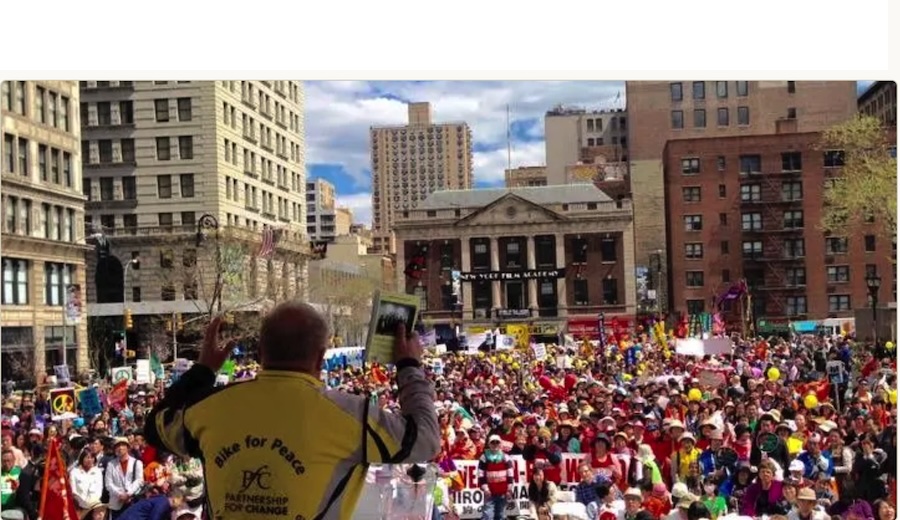
Bike for Peace turns 50. In 2026-27 we visit all nine nuclear powers with one appeal, a nuclear-free world by 2045

FREE FLOW OF INFORMATION .

Excerpts from web pages of Bike for Peace: 2026 travels ; and general history

Bike for peace is a Norwegian-based peace organization that works to organize peace rides on bicycles all over the world. We collaborate with various peace organizations, schools and universities to promote and focus on the education of peace, non-violence, conflict resolution and the fight against nuclear weapons.

We open with Round-the-World in September 2026 and an appeal to the UN. The full programme, eight tour segments visiting all nine nuclear powers, runs from August 2026 to the end of December 2027. After that follow Egypt, Pakistan and Saudi Arabia, Russia, China and Central Asia, Israel and Palestine, the nuclear-armed states of Europe, and finally Peace Boat’s global voyage.

1 SEPTEMBER – 31 OCTOBER 2026

Round-the-World and the UN appeal

Helsinki, New Delhi, Kuala Lumpur, Bali, Brisbane, Suva, Honolulu, Phoenix, Mexico City, Oklahoma City, Atlanta and New York. We hope to meet UN Secretary-General António Guterres in New York in late October.

18-25 NOVEMBER 2026

Egypt, Aswan Forum

Cairo and Aswan. Participation at the 6th Aswan Forum for Sustainable Peace and Development.

JANUARY 2027

Pakistan and Saudi Arabia

Islamabad and Riyadh, Jeddah. Meetings with Pakistani peace organisations and the Saudi foreign ministry.

Question related to this article:

How can we be sure to get news about peace demonstrations?

(article continued from left column)

15-29 MARCH 2027

Russia, lecture tour

Moscow, Vladimir, Nizhny Novgorod, Kazan, Perm and Yekaterinburg. Track 2 dialogue and lectures at universities.

17 APRIL – 7 MAY 2027

China and Central Asia

Beijing, Xi’an, Lanzhou, Urumqi, Almaty and Astana along the Silk Road.

19-26 MAY 2027

Israel and Palestine
Tel Aviv, Jerusalem, Ramallah and Bethlehem. Meetings with peace organisations and academia on both sides.

6-20 JUNE 2027

Europe’s nuclear-armed states

London, Paris, Rome and Berlin. Key disarmament actors and NATO nuclear-sharing states.

24 OCTOBER – 29 NOVEMBER 2027

Peace Boat, global voyage

Lectures on Peace Boat’s 127th Global Voyage. Sharing the campaign and the 2045 Appeal with roughly one thousand fellow travellers from more than seventy countries.

Follow the tour as we travel

Updates from the road. No marketing. You can unsubscribe at any time. To subscribe, go to this page, enter your email, then click “yes” and “subscribe.”

Get more involved

We need more hands. Tell us briefly how you can help, and we will be in touch.

To get involved, go to this page, enter your name and email, then click “send.”

– – – – – –

If you wish to make a comment on this article, you may write to coordinator@cpnn-world.org with the title “Comment on (name of article)” and we will put your comment on line. Because of the flood of spam, we have discontinued the direct application of comments.

UNAM, Mexico: Establishment of Commission to Develop Content on a Culture of Peace

FREE FLOW OF INFORMATION

An article from Gaceta UNAM

An Academic Working Commission has been established at the National Autonomous University of Mexico (UNAM) with the aim of contributing to and supporting high school education through the development of educational courses on a culture of peace for students and faculty,

This commission is comprised of the University Program on a Culture of Peace and the Eradication of Violence (PUCPAZ), the general directorates of the National Preparatory School and the National School of Sciences and Humanities, the High School Academic Council, the General Directorate of Incorporation and Revalidation of Studies (DGIRE), and the Institute of Legal Research.

Leticia Cano Soriano, head of PUCPAZ, led a ceremony held at the Program’s offices in the Engineering Tower. She explained that the design, development, and integration of an elective course and a training course are part of the University’s strategy to disseminate a culture of peace across all levels of education, beginning in secondary school and later being integrated into higher education.

The Master of Social Work commented that it is important to develop this elective course and training program to offer students and faculty tools that allow them to incorporate a culture of peace and violence prevention into academic activities, with an emphasis on human rights, interculturality, and community social fabric. She also emphasized integrating these themes with other subjects in the high school curriculum.

Sergio Abraham Reyes Pantoja, Academic Secretary of PUCPAZ, explained that, based on the University Program’s Founding Agreement, one of the program’s objectives is the development of its own educational content on a culture of peace. In addition to advising institutions on mainstreaming these topics into their curricula, the commission also promotes the development of human resources for teaching. The aim is to establish plans and strategies at the high school level for disseminating a culture of peace and implementing specific actions to eradicate violence in university environments.

(Continued in right column)

(Click here for a Spanish version of this article)

Question related to this article:

How can we develop the institutional framework for a culture of peace?

Is there progress towards a culture of peace in Mexico?

(Continued from left column)

During the meeting, Consuelo Arce Ortiz, secretary of the Academic Council of the UNAM High School, stated that it is essential to begin with an understanding of the regulations, specifically the General Regulations for the Presentation and Approval of Study Plans and Programs. This will provide greater academic validation, and the need to address a culture of peace has already been raised, calling the University to action.

Arce Ortiz added that the commission’s intention is to place the dignity of individuals at the center of education, fostering positive attitudes and positively impacting the lives of the school and teaching community.

Restorative Approach

Mara Hernández Estrada, from the Institute of Legal Research, mentioned that collaborative work is crucial to ensure the classroom becomes a suitable pedagogical environment for fostering a culture of peace, especially in conflict management, and with a restorative approach.

She emphasized the importance of addressing students’ needs to prevent negative impacts in the classroom, aligning with the ethics of care, and raising awareness about violence.

Speaking next, Alejandro Benítez Jiménez, Continuing Education Coordinator at the DGIRE (General Directorate of Educational Research), shared that the affiliated system serves more than 17,000 students in 28 states across Mexico, who follow 263 different curricula, and that they will now be able to incorporate these courses to promote a culture of peace.

In developing new courses, she noted, it is essential to consider the needs of affiliated schools both in Mexico City and throughout the country. She added that the new courses for students and faculty will be an important opportunity to convey not only the message of fostering a culture of peace, but also the teaching strategies to achieve it.

Finally, Jacqueline Leyva Chávez, coordinator of the Institutional Tutoring Program at the General Directorate of the College of Sciences and Humanities, emphasized that the course topics are particularly relevant because students face diverse challenges, and the training must include specific strategies to effectively support and guide them.

– – – – – –

If you wish to make a comment on this article, you may write to coordinator@cpnn-world.org with the title “Comment on (name of article)” and we will put your comment on line. Because of the flood of spam, we have discontinued the direct application of comments.

Catholic Institute for Nonviolence: new developments

. . DEMOCRATIC PARTICIPATION . .

Email received from Pace é Bene (see authors below)

We are happy to announce that Ken Butigan, a long-time Pace e Bene trainer and organizer, has been selected to be the co-director of the Catholic Institute for Nonviolence. He will continue to serve as Strategy Consultant at Pace e Bene, where he has worked for many years.

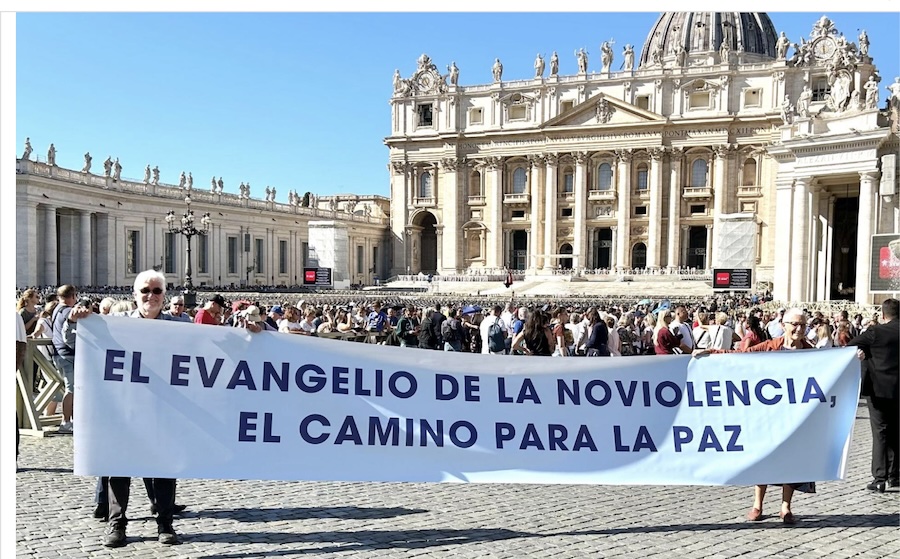
With Pope Francis’ blessing, the institute was launched in 2024 with the aim of making nonviolence research, resources, and lived experience more accessible to Catholic Church leaders, communities, and institutions worldwide. It is a project of Pax Christi International’s Catholic Nonviolence Initiative, with which Pace e Bene has been actively involved since CNI was established after a landmark conference ten years ago this spring. [The institute is based in Rome.]


Ken Butigan and Marie Dennis in St. Peter’s Square, October 2024. Photo: Pax Christi International.

The “Nonviolence and Just Peace” conference was held at the Vatican and cosponsored by the Pontifical Council for Justice and Peace and Pax Christi International in April 2016. It brought scores of theologians, scholars, Church leaders and, most significantly, practitioners from war zones and other hot spots around the world together to gather in hope of seeing this 2,000 year-old institution actively re-embrace the nonviolence proclaimed and lived by Jesus.

(Article continued in right column)

Question related to this article:


How can we develop the institutional framework for a culture of peace?

(Article continued from left column)

After a year of planning (which Ken Butigan and John Dear, representing Pace e Bene, were part of with so many others, including Marie Dennis of Pax Christi), the conference was a dazzling, multi-layered conversation that culminated in an assembly-wide, consensus-based document entitled, An Appeal to the Catholic Church to Re-Commit to the Centrality of Gospel Nonviolence.

CNI was formed as a project of Pax Christi not long after the conference, with leadership from around the world, including Pace e Bene. CNI has been at it ever since, building relationships at the Vatican and with partners worldwide, holding two other conferences in Rome, publishing books, papers and articles; sponsoring many webinars and seminars, and organizing countless meetings. All of this has been focused on inviting the Church to come to a richer and deeper understanding of a nonviolence that combines the power of rejecting violence, the power of refusing to harm others, and the power of love in action. We have been heartened by the prophetic call to nonviolence Pope Francis made repeatedly and that Pope Leo has continued.

The spirit of nonviolence is present in the pope’s recent encyclical, Magnifica Humanitas, including its call to “disarm AI” and its declaration that “the ‘just war’ theory, which has all too often been used to justify any kind of war, is now outdated. Humanity possesses far more effective and capable tools for promoting human life and resolving conflicts.”

Ken is grateful for all the ways Pace e Bene has supported CNI and the Catholic Institute for Nonviolence. We look forward to deepening and broadening our ongoing partnership in working to advance nonviolence in the Church and the world.

Peace and all good,
Erin, Ken, Rivera, Stacie, Layal, Rosie, Mili, and the Pace e Bene Team

– – – – – –

If you wish to make a comment on this article, you may write to coordinator@cpnn-world.org with the title “Comment on (name of article)” and we will put your comment on line. Because of the flood of spam, we have discontinued the direct application of comments.

World Peace Foundation: who is asking what’s next for peace? Part 2

. . DEMOCRATIC PARTICIPATION . .

An article by Michelle E. Anderson from the World Peace Foundation

This April, WPF launched its newest research program on the future of peace. In part one this essay begins with a preliminary global mapping of contemporary peace-focused work and some of the different approaches and patterns that emerged across contexts. Part two turns to futures-oriented thinking and explores how WPF’s approach seeks to bring these conversations into dialogue.
Current ways of engaging the future

In order to think beyond stakeholders who identify with peace-related work, this mapping also explored who was engaging with questions of the future more broadly, and in what ways. This included the field of futures studies, which encompasses methods such as forecasting, foresight, and scenario-building, as well as other domains that work in the business of long-term change but in less explicit ways. These preliminary observations reveal a range of ways of understanding the future itself, and the different assumptions that shape how it is approached.

There is a group of actors that look at the future as something to anticipate and plan for- these are often multilateral institutions or governments, or groups that support them. In these contexts, foresight is integrated into governance processes, often through scenario-building and risk analysis. For example, the United Nations Futures Lab  is a strategic foresight unit that describes itself as “dedicated to future-proofing the UN and multilateral system.” The OECD Strategic Foresight Unit  is more outward looking, partnering with governments in member states on the basis that strategic foresight “helps policy makers improve the effectiveness of governments by identifying opportunities, challenges, risks and disruptions that may arise over the coming years.”

Other work focuses less on anticipating the future and more on reshaping the systems that will produce it. Institutions such as the Stockholm Resilience Centre  or the New Economics Foundation, for example, engage with the future with “transformation” in mind, pursued through collaborative efforts between local changemakers, researchers, and policy advocates to redesign economic, ecological, and governance structures. While not typically framed in terms of peace, their work is among a set of future-oriented efforts that address many of the underlying challenges– such as climate and economics– that shape its possibility.

A smaller and more diffuse but informative strand of work approaches the future as something to be reimagined and contested. Drawing on speculative, decolonial, feminist, and abolitionist traditions, among others, these types of efforts emphasize imagination, narrative, and the role of alternative epistemologies in shaping what futures become thinkable. Within this, the future is not simply something to be predicted or designed, but something that is actively constructed through political and cultural processes. Recent work on reproductive justice futures  and futurisms  offers a useful example of this orientation. Emerging from a black feminist tradition that links bodily autonomy (the goal) to social, economic, and environmental justice (the conditions through which that goal can be realized), it treats the future as something to be collectively defined through questions of care, experimentation, governance, and access to resources. Abolitionist approaches similarly emphasize that transformative futures are not simply distant ideals, but are built through present-day practices and experimentation, including community care networks, participatory defense initiatives, mutual aid, and other efforts that attempt to prefigure alternative social arrangements. Within these approaches, the future is both expansive and immediate: not something deferred until ideal conditions emerge, but something actively constructed through political, social, and cultural practice.

Another area of work that helps to expand this picture is that related to climate futures. In contrast to more clearly defined and explicitly-named “futures” strands such as reproductive justice futures, “climate futures” spans a wide range of modes of working, from forecasting and risk management  to frameworks that rely on justice and imaginaries. Some efforts, such as the Climate Futures Initiative  at Princeton, attempt to bridge scientific, normative, and policy-oriented approaches by examining questions related to climate justice, international equity, environmental values, and the political mechanisms through which scientific knowledge shapes decision-making.  Others, such as the Undisciplined Environments  platform for scholars and activists, approach climate futures through more critical and experimental lenses that foreground environmental humanities, alternative imaginaries, and the cultural dimensions of ecological crisis. Still others have written about using climate imaginaries  as tools for justice-centered policy evaluation, highlighting another possibility for combining deep theoretical work with practical outcomes. Work under the umbrella of “climate futures” illustrates how different orientations toward the future can coexist within a single domain, and possibly in support of one another.

Many transformative futures-oriented approaches can be traced to concepts of political imagination and imaginaries. While a wide range of understandings of “political imagination” exist, broadly speaking, it is concerned with how visions of the future take shape, whose perspectives gain traction, and how dominant ways of organizing social and political life are reproduced or contested. Much of this literature still also emphasizes the limits of imagination, which is not neutral and can be constrained, co-opted, or detached from the institutional and material conditions that shape what can be realized in practice. Increasingly, however, these ideas are not only the subject of analysis but are being taken up as part of practice. One strand of this includes participatory, artistic, or narrative-based approaches that treat imagination as part of processes of social and political change. Initiatives such as University of Southern California’s Civic Imagination Project, which uses workshops, storytelling, and collaborative worldbuilding exercises to help communities imagine and identify actions toward alternative social and political futures, or Adelaide University’s future-focused interactive museum exhibit  on practicing alternative futures, illustrate how imagination can function as both a method and a site of intervention, offering space not only for new futures to be envisioned, but also for collective reflection on how they might be pursued in practice.

Across these different orientations toward the future, peace is rarely the central organizing concept, yet the domains of focus are precisely those that shape how peace is constituted in practice. As a result, many of the most consequential questions about the future of peace are being taken up indirectly, across fields that do not name them as such. This points to a more diffuse landscape of work that does not sit neatly within either “peace” or “futures” as defined fields, but nonetheless grapples with many of the same underlying questions. Rather than forming a clearly bounded field, these efforts are dispersed across domains, practices, and vocabularies, often without being recognized as part of a shared conversation.

Bringing peace and futures into conversation

This initial mapping points not to a simple divide between or within peace work, futures work, and adjacent approaches, but to a complex landscape shaped by different assumptions about the future and how it can be engaged. These assumptions, in turn, shape how questions of peace are framed, where they are located, whether they are made explicit or remain implicit, and what becomes visible or obscured when it is not named as such.

(Article continued in right column)

Question related to this article:


How can we develop the institutional framework for a culture of peace?

(Article continued from left column)

One pattern that this mapping endeavor made clear is that institutions explicitly identifying with peace or peacebuilding tend to work in present- or near-term timelines, and most often through governance, security, or post-conflict recovery frameworks. While this does not mean that questions of the future are entirely absent, they are not often treated as a sustained or central area of inquiry. Some policy and multilateral institutions have held dialogues or produced reports that incorporate elements of foresight such as scenario-building, risk analysis, or the identification of emerging trends. These modes inherently attend to how existing systems might be strengthened, adapted, or made more resilient in the face of shifting geopolitical, technological, or environmental conditions, but without fundamentally challenging the underlying assumptions or institutional logics in which they operate. For example, a 2025 report from the Stimson Center on the Future of International Cooperation  argues for the need to strengthen global governance through measures such as expanding the jurisdiction of international courts, reinforcing human rights compliance mechanisms, establishing new coordinating bodies such as a United Nations Climate Change Council, and improving regional capacity and financing structures. These recommendations reflect a focus on reforming and strengthening existing institutions rather than rethinking the systems within which they operate.

Other efforts have gone somewhat further in attempting to rethink the assumptions, relationships, and practices through which peacebuilding is carried out. For example, Humanity United’s 2025 report, A Pathway to Peace, grounds its rationale in the many challenges facing peacebuilding today, including the limited adaptability of multilateral institutions and shrinking financial support for peace and humanitarian efforts. Drawing on input from peacebuilders around the world, it proposes an “engagement framework” centered on more inclusive, locally grounded, and adaptive approaches. However, this framework- perhaps necessarily in its effort to provide practical guidance for the current moment- remains largely oriented toward improving how peace efforts are carried out in relation to existing funding structures and institutional arrangements. Interestingly, the report acknowledges that their proposals may still challenge established assumptions about expertise, neutrality, and power, and may be met with resistance, highlighting a tension between efforts to rethink practice and the institutional contexts in which they are situated. It may also be a nod to Humanity United’s listed topical focus on “innovative pathways for peace,” suggesting that these efforts are part of an emerging area of work oriented toward linking imagination, innovation, and action.

There have been some efforts by explicitly peace-focused actors to take up questions of the future that argue for a more transformative approach, though these also mostly remain episodic. For example, the Re-thinking Peace and Conflict Studies in a Postcolonial World  conference held in Tunis in 2025 brought together scholars from multiple regions and disciplinary backgrounds to reflect on how the field itself might be reoriented. Discussions emphasized the need to move beyond dominant frameworks and rethink how knowledge is produced and whose perspectives are centered. This was reflected not only in the themes of the conference but in how it was organized, with one participant describing it as “a plurivocal ecology of knowledge,” a collaborative way of working that privileges neither centre nor periphery. While such efforts suggest a growing recognition of the need to think beyond existing models, they do not yet cohere into a sustained area of work across organizations.

Beyond individual reports or convenings, there are some early attempts to build more sustained platforms for this kind of exchange.  For example, the Alliance for Peacebuilding’s “Future of Peace and Security” project seeks to bring together practitioners, policymakers, and researchers to examine how emerging trends, including shifts in technology, geopolitics, and governance, may shape the conditions for peace and conflict. In doing so, it creates space for forward-looking reflection within established networks.

Even so, what emerges from this mapping is a fundamental disjunction between those engaged in more imaginative or visioning work and those operating within policy and institutional frameworks. At a moment when dominant systems are fracturing, this divide is not just analytical but consequential. This suggests that the broader imperative is not simply to introduce future-oriented thinking into peace work, but to create spaces where different ways of engaging the future– whether anticipatory, structural, or imaginative– can be brought into conversation with different understandings of peace, and where long-term connections between them can and should take shape.

Implications for the Future of Peace

This dispersed landscape of conceptualizations and approaches relevant to the future of peace presents both opportunity and challenge. How can these different modes of thinking be brought into conversation without collapsing one into the other? How can they be used as building blocks for something new, rather than being forced into existing frames or reduced only to familiar forms such as policy forecasting or abstract scenario-building?

The Future of Peace program is an effort to explore synergies between approaches that are often kept entirely separate. It takes seriously the need for grounded analysis while also creating space for more expansive and exploratory thinking about what peace could be, and how those possibilities take shape in practice. The aim is not only to bridge existing efforts, but to open up novel ways of working across them.

Rather than centering a single framework, we aim to bring into conversation a range of people, modes of working, and schools of thought that are rethinking peace in different ways. This includes perspectives that have long challenged dominant assumptions about order, governance, and coexistence, alongside work grounded in policy and practice, without being limited to either.

In these early stages, the program is being shaped through a set of evolving guiding questions. Among them are the following: How is peace being reimagined in the current moment, and by whom, particularly in ways that look to longer-term futures or alternative possibilities? What would it mean to take these reimaginings seriously as starting points for inquiry and even guidance, rather than treating them as peripheral to policy or practice?

As the Future of Peace program develops, this work will continue through further mapping, engagement with different bodies of work and practice, and the cultivation of conversations that bring these perspectives into closer relation. The aim is not only to identify what exists, but to better understand how different approaches to peace and the future can inform one another, and where new connections or directions may be needed, helping to build a foundation for the program’s ongoing work.

At a moment marked by uncertainty, polarization, and rapid transformation, revisiting the question of peace is both necessary and fraught. The aim of the Future of Peace program is not to resolve these tensions, but to work within them, opening space for new ways of thinking about what peace is, how it is shaped, and what it might yet become.

We see this as an ongoing conversation, and an invitation to think together about the future of peace. This mapping is necessarily partial, and this essay even more so. We welcome hearing from those whose work is represented here, as well as those we may not have captured but who are engaging related questions and challenges. We look forward to connections, reflections, and suggestions as this work continues to take shape.

– – – – – –

If you wish to make a comment on this article, you may write to coordinator@cpnn-world.org with the title “Comment on (name of article)” and we will put your comment on line. Because of the flood of spam, we have discontinued the direct application of comments.
UAB School for a Culture of Peace annual report: highest number of armed conflicts in the world in the past decade

FREE FLOW OF INFORMATION

A report from the Universitat Autònoma de Barcelona

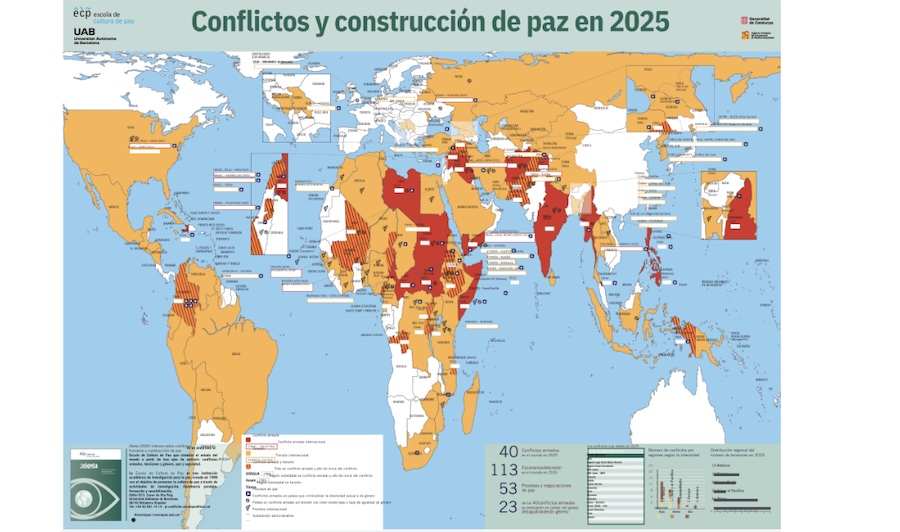
The UAB School for a Culture of Peace publishes today its annual report—one of the main yearbooks in Spain on conflictivity, human rights and peacebuilding. The report identifies 40 wars currently existing in the world, the highest figure in the past decade, and warns about the increase of international conflicts and humanitarian consequences.

(click on map to enlarge)

The world is experiencing a new upsurge in global armed violence. In 2025, 40 active armed conflicts were registered (37 in 2024), the highest number since 2011 and one of the highest since the School for a Culture of Peace (ECP) of the Universitat Autònoma de Barcelona has been producing its annual reports on international conflict. This is one of the main conclusions of the report Alert 2026! Report on conflicts, human rights and peacebuilding, published on 3 June. The report is mainly based on qualitative analysis of studies and information provided by the United Nations, international organisations, research centres, media and NGOs, among others, as well as the experience acquired in field research.

According to the study, there were 40 armed conflicts and 113 scenarios of socio-political tension around the world in 2025. Africa continues to concentrate the highest number of wars (17), followed by Asia and the Pacific (12), and the Middle East (7), while Europe and America register two armed conflicts each.

Rise in international conflicts

The report particularly warns of the increase in international conflicts. In 2025, nine clearly internationalised wars were recorded, the highest number since the ECP uses its current classification methodology. Among the new armed conflicts identified are the confrontation between India and Pakistan, the serious escalation between Thailand and Cambodia, and the war between Israel, the United States and Iran, known in 2025 as the “12-day war” and which was reopened in 2026. The ECP research team warns that this evolution reflects a deterioration in global security and is a reflection of an international system in which many powerful actors do not prioritise prevention, addressing the root causes of disputes and supporting dialogue.

Sudan, Gaza, Haiti and Ukraine: worsening of the humanitarian situation

The report concludes that almost half of the world’s armed conflicts worsened during 2025. Among the most serious cases are the Western Sahel region, Sudan, Haiti, Somalia, Gaza, Myanmar and the war between Russia and Ukraine. The ECP warns of the increase in civilian casualties, the bombing of populated areas, the destruction of infrastructure and the violations of international humanitarian law.

(Continued in right column)

Question related to this article:

Where in the world are zones of peace?

(Continued from left column)

Setbacks in women’s rights

Coinciding with the 25th anniversary of UN Resolution 1325 on Women, Peace and Security, the report warns of a global backsliding in women’s rights. According to the study, 70% of the highest-intensity armed conflicts take place in countries with low or medium-low levels of gender equality. Twenty-three of the 40 armed conflicts that took place in 2025 took place in countries with low or medium-low levels of gender equality, and 16 of the 20 high-intensity armed conflicts in 2025 (80%) took place in countries where the International Lesbian, Gay, Bisexual, Trans and Intersex Association had documented legislation or policies that criminalise LGBTIQ+ people.

Moreover, women’s participation in UN-led peace processes continues to decline. The UN verified more than 4,600 cases of conflict-related sexual violence in 2024, a 25% increase over the previous year. A total of 93% of the victims were women and girls.

Over 117 million forcibly displaced people

The report notes that forced displacement remains at historically high levels. In mid-2025, there were 117.3 million forcibly displaced people worldwide, including refugees and internally displaced persons. Although the figure represents a slight decrease from the previous year, partly attributed to the return of people to countries such as Syria, Afghanistan and Sudan, the ECP highlights that the overall volume remains extraordinarily high. Afghanistan, Syria, Sudan, Ukraine and Venezuela account for 65% of the world’s refugee population.

An internationally renowned report

Alert 2026!, which this year reaches its 25th edition, is one of the main yearbooks produced in Spain on conflict, human rights and peacebuilding. The study combines data from the United Nations, international organisations, research centres and specialised fieldwork. The objective of the report is to offer tools for analysis and preventive warnings to political leaders, international organisations, the media and actors involved in the peaceful resolution of conflicts.

UAB School for a Culture of Peace report: Alert 2026! Report on conflicts, human rights and peacebuilding

– – – – – –

If you wish to make a comment on this article, you may write to coordinator@cpnn-world.org with the title “Comment on (name of article)” and we will put your comment on line. Because of the flood of spam, we have discontinued the direct application of comments.
– – – – – –

(Click here for a Spanish version of this article)

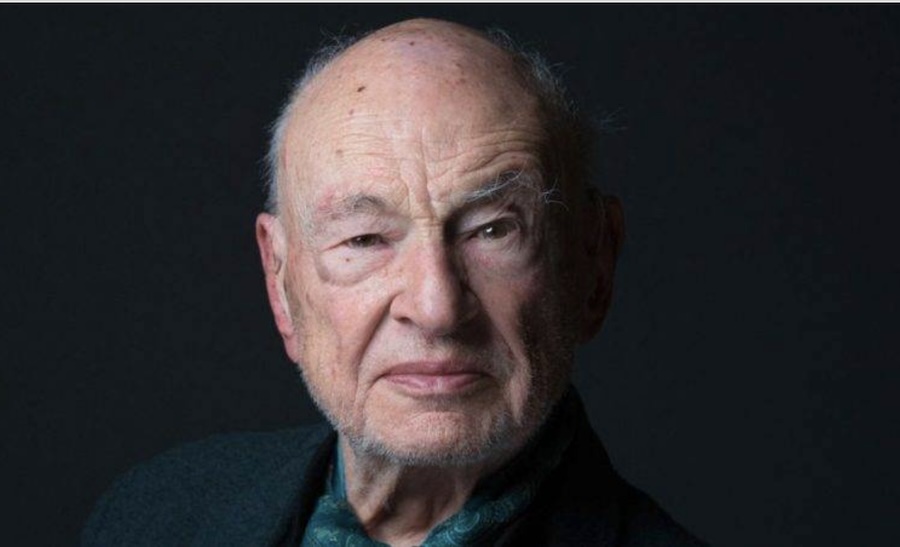
Edgar Morin deplores “the world’s silence in the face of the carnage in Gaza”

FREE FLOW OF INFORMATION

An article from L’Orient le Jour (translation by CPNN)

(Editor’s note: Edgar Morin passed away on May 29, 2026, at the age of 104 years.)

While Edgar Morin’s public appearances are rare, this one will undoubtedly remain one of his most striking. “I am both stunned and outraged by the fact that those who represent the descendants of a people who have been persecuted for centuries (…) can not only colonize an entire people (…) but, in addition, after the massacre of October 7, have committed a veritable, massive carnage against the people of Gaza.”


An extremely popular intellectual figure in France, Edgar Morin is the author of a transdisciplinary body of work translated into 27 languages ​​and published in 42 countries. Photo AFP)

With shining eyes and a high-pitched voice, emphasizing each word, the 102-year-old French philosopher and sociologist delivered a short plea on Saturday, February 10 [ 2024], to a packed house at the Marrakech African Book Festival, where he was the guest of honor, deploring “a horrific tragedy.” The Israeli offensive has killed more than 28,000 people in Gaza since the start of the war more than four months ago, according to the Hamas-run Ministry of Health.

(Article continued in the column on the right)

(Click here for the original version in French)

Questions related to this article:

How can we carry forward the work of the great peace and justice activists who went before us?

How can we best express solidarity with the people of Gaza?

(Article continued from the column on the left)

Jewish Resistance Fighter

The message is all the more powerful because it comes from the son of Jewish immigrants from Thessaloniki, born Edgar Nahoum, who joined the Resistance in 1943 as a lieutenant in the Free French Forces formed by General de Gaulle, later adopting his Resistance name, Morin. Influenced by Marx, this man, who studied philosophy, psychology, sociology, and the history of political science, has always aspired to become what he calls a “humanologist,” or to understand what it means to be human by combining different fields of knowledge.

The excerpt in question has been shared tens of thousands of times on X, where the intellectual’s humanity has been widely praised, including by some French political figures on the left. “Edgar Morin thinks and speaks truthfully on behalf of all those who still possess a human touch in the face of the genocide in Gaza,” lauded Jean-Luc Mélenchon, leader of La France Insoumise (LFI), on X. “A century and a perspective still capable of indignation, of condemning the silences,” tweeted Olivier Faure, First Secretary of the Socialist Party.

In a recent opinion piece in Le Monde, Edgar Morin had already addressed the tragedy in Gaza, while also expressing alarm at the proliferation of conflicts worldwide and climate change. “Crises feed off one another in a kind of multi-faceted ecological, economic, political, social, and civilizational crisis that is steadily intensifying,” he wrote, before calling for “fundamental resistance of the mind” against “hatred and contempt.”

In his final address, the sociologist denounced “the silence of the world, the silence of the United States, protectors of Israel, the silence of the Arab states, the silence of the European states that claim to be defenders of culture, humanity, and human rights.” He concluded: “The only thing left, if we cannot resist in a concrete way, is to bear witness.”

– – – – – –

If you wish to make a comment on this article, you may write to coordinator@cpnn-world.org with the title “Comment on (name of article)” and we will put your comment on line. Because of the flood of spam, we have discontinued the direct application of comments.