All posts by CPNN Coordinator

About CPNN Coordinator

Dr David Adams is the coordinator of the Culture of Peace News Network. He retired in 2001 from UNESCO where he was the Director of the Unit for the International Year for the Culture of Peace, proclaimed for the Year 2000 by the United Nations General Assembly.

UN: New films on Global Goals spotlight women’s journeys of resilience

. WOMEN’S EQUALITY .

An article from UN Women

On 12 June, the Leave No One Behind Coalition, together with UN Women launched four new films that show how the Sustainable Development Goals (SDGs)—a set of 17 global goals unanimously adopted by governments worldwide—can truly transform the lives of women and girls.

The films show that notwithstanding the barriers, women and girls are finding ways to forge ahead.


Eunice and Josephine

Trapped in the informal sector, Eunice and Josephine had to leave their jobs working in the flower industry in Kenya because the chemicals used were making them ill. In the film, which focuses on economic empowerment, we witness their struggle to find work and feed their families.

Juddy’s story

Juddy talks about overcoming her disability to become an entrepreneur. She is now a leader in her community, teaching other women how they can empower themselves and overcome poverty. Her story shows what is possible when we tackle inequalities

Josephine and Cecilia

Josephine and Cecilia, made difficult decisions to flee their homes to avoid Female Genital Mutilation and early forced marriage. Their story shows the importance of education and tackling harmful practices. Josephine, who is now studying for a degree in law, is a role model for other girls in the community

(continued in right column)

Question for this article

Does the UN advance equality for women?

(continued from left column)

Tracy

Tracy grew up in one of the poorest areas of Nairobi, but is a talented clarinet player. Tracy joined an orchestra, which provided her with a scholarship and opened new doors for her, showing how quality education and opportunity can transform lives.

* * *

The SDGs can be achieved if policies are implemented to unlock the potential of women and girls. The films are intended to raise awareness and spark dialogues in the lead-up to the High-Level Political Forum on Sustainable Development in July 2017, in New York. Governments and the international development community will come together to review SDG progress.

The Leave No One Behind Coalition is urging governments to put the women and girls who are furthest behind first, to make sure that they have the same life chances as everyone else.

The 2030 Agenda and the SDGs present a roadmap for achieving gender equality and women’s empowerment over the next 13 years. The 17 “Global Goals” that are deeply interconnected, have the potential to end poverty, tackle climate change and other pressing challenges, and once and for all, close the gender gap in homes, schools, the economy and politics.

At the heart of the Global Goals is a commitment to ensure that ‘no one is left behind’. Too often, it is women and girls who are left furthest behind, with fewer opportunities to escape poverty, violence or restrictive cultural practices. Conversely, without empowering women and girls, the Global Goals cannot be achieved.

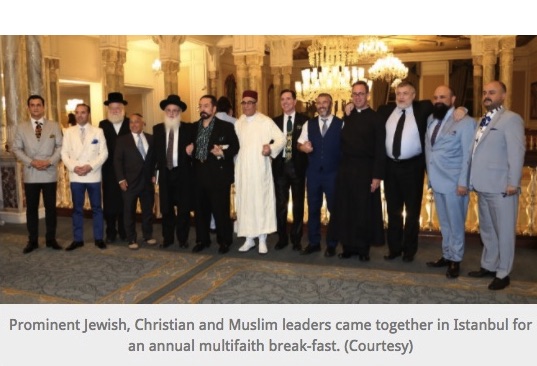
Jewish, Christian, Muslim Leaders Feast Together for Interfaith Ramadan Break-Fast in Istanbul

TOLERANCE & SOLIDARITY .

Excerpt from an article in Breaking Israel News

Last Thursday [June 8], a delegation of rabbis joined Adnan Oktar, a prominent Turkish Muslim cleric, at the Çırağan Palace Ballroom in Istanbul for his traditional iftar feast ending a day of fasting during Ramadan. More than 750 people from different religions and nationalities, including Jewish and Christian clergy and lay leaders, joined Oktar for the annual event hosted by Oktar’s organization, the Movement for the Culture of Peace and Reconciliation.


(Click here to enlarge image and caption)

The guest list included a number of illustrious attendees, several of them Israeli: the chief rabbi of the city of Shoham, Rabbi David Stav; retired Chief Justice of the Supreme Rabbinical Court of Israel Rabbi Abraham Sherman; Anglican priest Todd William Kissam from Maryland; and Co-Chairman of the Muslim–Jewish Friendship Organization in France, Imam Mohamed Azizi.

Read more at https://www.breakingisraelnews.com/89564/israeli-delegation-joins-iftar-feast-istanbul-prominent-pro-israel-muslim-cleric/#KOeX07EqCGTAQ8gJ.97

Question related to this article:

Theme of 2017 SIGNIS World Congress: Media for a Culture of Peace: Promoting Stories of Hope.

EDUCATION FOR PEACE .

Excerpt from the program of the SIGNIS World Congress 2017

Dear participants in the SIGNIS World Congress 2017,

It is my pleasure to bid you welcome to our World Congress, a unique opportunity to share and celebrate, to renew our thinking and learn from the experiences and insights of fellow communicators from all corners of the globe. The theme of the Congress is Media for a Culture of Peace: Promoting Stories of Hope.

By coming together, renewing old friendships and forming new ones across so many different languages and cultures, we are sending a first and most eloquent message of hope. Because the Congress is, first and foremost, about encountering friends, old and new, face to face. In cementing friendships, nothing beats a smile, a handshake, an embrace. We will have plenty of opportunities to celebrate those encounters. The Congress is also a time to learn from others and to contribute our experience. There will be plenary sessions and workshops covering a wide variety of areas of the rapidly changing world of communications. We are challenged to respond positively and creatively to those changes, and the Congress provides a truly global, culturally diverse environment, ideally suited to promote the required responses.

(continued in right column)

Question for this article:

Do the arts create a basis for a culture of peace?, What is, or should be, their role in our movement?

(continued from left column)

I look forward to a Congress where there is an active dialogue across generations as well as cultures. New situations require new approaches, a capacity for thinking “outside the box” which is the trademark of the younger generation, and I hope that they will contribute their energy and dynamism.

For SIGNIS, the Congress is the time to chart the course for the future, in continuity with a long, fruitful history of almost 90 years of service, but also with imagination and inventiveness, as our times demand. I want to thank you for participating and contributing to our exchange of ideas and experiences, an essential factor in our planning. I know the effort, financial and otherwise, that many of you had to make to be here. I want to express our deepest gratitude to you all for that.

I certainly hope that the experience of this Congress will change us all in a most positive way, so that when we go back to our daily work as communicators, its memory will translate into feelings of renewal, dynamism and, most of all, inspired commitment.

May God bless you all and bless SIGNIS.

Gustavo Andújar, President of SIGNIS

Spike in Colombian violence underlines ongoing need for peacebuilding, prayer

FREE FLOW OF INFORMATION

An article from the Mennonite World Review

Partners of Mennonite Central Committee in Colombia continue to walk with people affected by more than 50 years of violence as new armed conflict emerges even after a peace accord.
Violence among armed groups is escalating as FARC-EP guerrillas demobilize, threatening Mennonite Brethren churches in the Chocó region.


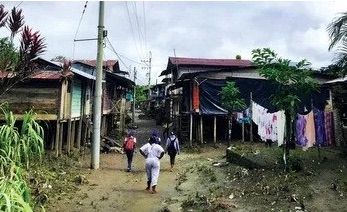
Members of a Colombian Mennonite Brethren Conference visit a rural community in the San Juan region shortly after the community experienced significant flooding. The community is stuck in the middle of violence between the Gaitanista Self Defence Forces of Colombia, a paramilitary group that occupies the area, and a guerrilla group vying for power. — Brendah Ndagire/MCC

The country’s largest rebel group, FARC-EP — the Revolutionary Armed Forces of Colombia — signed a peace accord with the government last year. But “there is still a long journey toward peace,” said Amy Eanes, an advocacy support specialist for MCC in Colombia.

Some armed groups are becoming more active, hoping to assert dominance and claim territory once occupied by the FARC-EP.

This is especially true in rural areas of the Chocó region, where MCC partners with the Mennonite Brethren Conference, whose members are working and praying for peace.

Living in fear

A member of one of the churches, Maria Camila, whose real name isn’t being used to protect her identity, says another guerrilla group is fighting the Gaitanista Self Defence Forces of Colombia, a paramilitary group that normally occupies the area, and it’s very dangerous there now.

(Article continued in right column)

Question related to this article:

What is happening in Colombia, Is peace possible?

(Article continued from left column)

Armed conflict between the two groups broke out in February, months after the peace accord was signed by the FARC-EP. In one part of the town, the guerrilla group threatened to shoot civilians if they didn’t open their doors because the guerrilla fighters believed members of the paramilitary group were hiding there.

“Even though you know that God says that wars will come and in the midst of all these things God will protect you, it was something so terrible — to feel the shootout, to hear the sounds,” she said. “I just said, ‘Lord, have mercy on us and watch over us,’ but we thought this was going to be the end.”

Camila has never felt so unsafe. “We aren’t free to walk around at night. We all live shut in our houses,” she said. “All of us in the community are frightened. That’s why we’re living like this.”

She has little faith the peace accord will make a difference in her community or other rural areas in Colombia.

“In reality, the hope we have is from God,” she said.

Teaching peace

MCC continues to support partners in Colombia that work on peacebuilding initiatives and assist some of the most vulnerable families, particularly those displaced by violence. The conflict has resulted in 7 million internally displaced people.

In April, MCC embarked on a three-year peace-education project with the Mennonite Brethren Regional Council of Chocó to promote an understanding of a culture of peace and how to encourage peacebuilding among youth and young adults.

One of MCC’s partners, the Church Coordination for Psychosocial Action, supports churches and organizations, enabling them to provide trauma awareness and healing, build resilience and contribute to peacebuilding and reconciliation in Colombia.

MCC works with a number of Mennonite churches and organizations in Colombia who have been actors for peace for many years.

“The churches are figuring out what this post-accord period will look like for them, and I think it’s important to walk alongside these partners,” Eanes said.

Peace Brigades International is recruiting field volunteers for Kenya

EDUCATION FOR PEACE .

An email from Peace Brigades International (PBI)

As you know, volunteers are the heart of PBI’s work. Canadians in the field act as our witnesses, voices, and peacekeepers. They deter violence against human rights defenders, advocate with our diplomats and government, and show the world that Canadians like you and I are watching and prepared to act when defenders are in danger.

The power of an international presence is profound. In the words of former PBI volunteer, Hans-Ulrich Krause: “There are two privileges attached to a foreign passport in a conflict area. You can use it to board the next flight out of trouble. Or you can use it as a tool to help protect human rights.”

Today, the situation for human rights defenders in Kenya is more alarming than ever. Our projects in KENYA is one of newest, but already many local defenders have told us just how desperate their needs for international protection are. And with your support and solidarity, we can respond.

One way is to volunteer! PBI is now recruiting new field volunteers for Kenya for placement in 2018. Information about the Kenyan recruitment campaign can be found here

Application deadline has been extended to: Friday 30th June 2017.

In Kenya, most attacks against human rights defenders continue to go unpunished. Click here to read the powerful story of Rahma Wako.

(Article continued in the right column)

Question for this article:

Can peace be guaranteed through nonviolent means?

(Article continued from the left column)

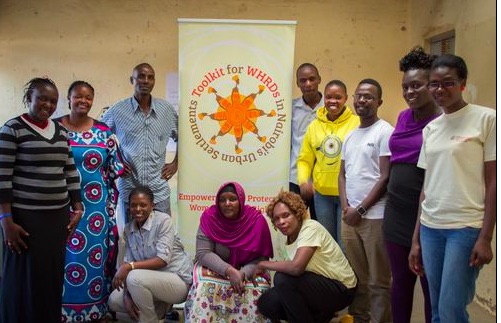
But the Kenyan project also creates great and original tools such as a toolkit for Women Human rights defenders.

Don’t let them stand alone. Please help us safeguard the lives of more human rights defenders with a gift today.

P.S. If you’re wondering what the day-to-day of a PBI volunteer looks like, watch the powerful video below by Sophia Kerridge, a volunteer in Colombia.

Sophia Kerridge has been a PBI volunteer in Colombia for a year. In this short video she explains what the team of volunteers do, her experience, and the situation for HRDs.

To become a PBI field volunteer is an incredible opportunity to provide protective physical and political accompaniment to at-risk defenders. You will help to deter violence, and you will create space for them to continue their critical work toward peace, justice and human rights.

Volunteers receive specialized training, return flights, room and board, medical insurance, and small monthly stipends. If you are selected for training, please contact PBI-Canada to discuss how we can support you!

Did you know that a $50 donation to one of our projects can enable a human rights defender to receive a PBI security training workshop? This knowledge saves lives. The Kenyan Project is in need of support.

(Thank you to Janet Hudgins, the CPNN reporter for this article.)

U.S. Conference of Mayors to Vote on Resolution to Move Money from the Military to Human and Environmental Needs

.. DEMOCRATIC PARTICIPATION ..

An article from World Beyond War

New Haven, CT, Charlottesville, VA, Montgomery County, MD, Evanston, IL (see page 14 of linked document), New London, NH, and Ithaca, NY, have passed resolutions opposing the Trump budget’s moving of money from everything else to the military, urging that money be moved in the opposite direction.


(Click on image to enlarge)

Those passed by Ithaca and New Haven will be voted on by the U.S. Conference of Mayors. Ask your mayor to contact the U.S. Conference of Mayors now to endorse resolutions #59 and #60.

Your town or city or county can also go ahead and pass its own. For more tips and sample materials from Ithaca, NY, click here.

You can also watch/listen to this webinar done with Code Pink and U.S. Peace Council.

Steps you can take:

Contact mary@worldbeyondwar.org to ask for help

Form a coalition of local groups concerned about the cuts, the military increase, or both

Find out how to speak publicly at local government meetings and how to submit a proposal or get one on the agenda for a vote; or ask council members/ aldermen / supervisors to sponsor it.

Collect organizations’ or prominent people’s or lots of people’s names on a petition

Hold rallies, press conferences

Write op-eds, letters, go on radio, tv

Use http://costofwar.com to calculate local trade-offs

(continued in right column)

Questions for this article:

How can culture of peace be developed at the municipal level?>

(continued from left column)

Make use of this petition signed by many prominent people and over 20,000 people total

Revise the draft below:

Resolution Proposed for __________, ___

Whereas President Trump has proposed to move $54 billion from human and environmental spending at home and abroad to military spending[i], bringing military spending to well over 60% of federal discretionary spending[ii],

Whereas polling has found the U.S. public to favor a $41 billion reduction in military spending, a $94 billion gap away from President Trump’s proposal,

Whereas part of helping alleviate the refugee crisis should be ending, not escalating, wars that create refugees[iii],

Whereas President Trump himself admits that the enormous military spending of the past 16 years has been disastrous and made us less safe, not safer[iv],

Whereas fractions of the proposed military budget could provide free, top-quality education from pre-school through college[v], end hunger and starvation on earth[vi], convert the U.S. to clean energy[vii], provide clean drinking water everywhere it’s needed on the planet[viii], build fast trains between all major U.S. cities[ix], and double non-military U.S. foreign aid rather than cutting it[x],

Whereas even 121 retired U.S. generals have written a letter opposing cutting foreign aid[xi],

Whereas a December 2014 Gallup poll of 65 nations found that the United States was far and away the country considered the largest threat to peace in the world[xii],

Whereas a United States responsible for providing clean drinking water, schools, medicine, and solar panels to others would be more secure and face far less hostility around the world,

Whereas our environmental and human needs are desperate and urgent,

Whereas the military is itself the greatest consumer of petroleum we have[xiii],

Whereas economists at the University of Massachusetts at Amherst have documented that military spending is an economic drain rather than a jobs program[xiv],

Be it therefore resolved that the ____________ of ___________, ________, urges the United States Congress to move our tax dollars in exactly the opposite direction proposed by the President, from militarism to human and environmental needs.

[i] “Trump to Seek $54 Billion Increase in Military Spending,” The New York Times, February 27, 2017, https://www.nytimes.com/2017/02/27/us/politics/trump-budget-military.html?_r=0

[ii] This does not include another 6% for the discretionary portion of veterans’ care. For a breakdown of discretionary spending in the 2015 budget from the National Priorities Project, see https://www.nationalpriorities.org/campaigns/military-spending-united-states

[iii] “43 Million People Kicked Out of Their Homes,” World Beyond War, http://worldbeyondwar.org/43-million-people-kicked-homes / “Europe’s Refugee Crisis Was Made in America,” The Nation, https://www.thenation.com/article/europes-refugee-crisis-was-made-in-america

[iv] On February 27, 2017, Trump said, “Almost 17 years of fighting in the Middle East . . . $6 trillion we’ve spent in the Middle East . . . and we’re nowhere, actually if you think about it we’re less than nowhere, the Middle East is far worse than it was 16, 17 years ago, there’s not even a contest . . . we have a hornet’s nest . . . .” http://www.realclearpolitics.com/video/2017/02/27/trump_we_spent_6_trillion_in_middle_east_and_we_are_less_than_nowhere_far_worse_than_16_years_ago.html

[v] “Free College: We Can Afford It,” The Washington Post, May 1, 2012, https://www.washingtonpost.com/opinions/free-college-we-can-afford-it/2012/05/01/gIQAeFeltT_story.html?utm_term=.9cc6fea3d693

[vi] “The World Only Needs 30 Billion Dollars a Year to Eradicate the Scourge of Hunger,” Food and Agriculture Organization of the United Nations, http://www.fao.org/newsroom/en/news/2008/1000853/index.html

[vii] “Clean Energy Transition Is A $25 Trillion Free Lunch,” Clean Technica, https://cleantechnica.com/2015/11/03/clean-energy-transition-is-a-25-trillion-free-lunch / See also: http://www.solutionaryrail.org

[viii] “Clean Water for a Healthy World,” UN Environment Program, http://www.unwater.org/wwd10/downloads/WWD2010_LOWRES_BROCHURE_EN.pdf

[ix] “Cost of High Speed Rail in China One Third Lower than in Other Countries,” The World Bank, http://www.worldbank.org/en/news/press-release/2014/07/10/cost-of-high-speed-rail-in-china-one-third-lower-than-in-other-countries

[x] Non-military U.S. foreign aid is approximately $25 billion, meaning that President Trump would need to cut it by over 200% to find the $54 billion he proposes to add to military spending

[xi] Letter to Congressional leaders, February 27, 2017, http://www.usglc.org/downloads/2017/02/FY18_International_Affairs_Budget_House_Senate.pdf

[xii] See http://www.wingia.com/en/services/about_the_end_of_year_survey/global_results/7/33

[xiii] “Fight Climate Change, Not Wars,” Naomi Klein, http://www.naomiklein.org/articles/2009/12/fight-climate-change-not-wars

[xiv] “The U.S. Employment Effects of Military and Domestic Spending Priorities: 2011 Update,” Political Economy Research Institute, https://www.peri.umass.edu/publication/item/449-the-u-s-employment-effects-of-military-and-domestic-spending-priorities-2011-update
U.S. Conference of Mayors to Vote on Resolution to Move Money from the Military to Human and Environmental Needs

.. DEMOCRATIC PARTICIPATION ..

An article from World Beyond War

New Haven, CT, Charlottesville, VA, Montgomery County, MD, Evanston, IL (see page 14 of linked document), New London, NH, and Ithaca, NY, have passed resolutions opposing the Trump budget’s moving of money from everything else to the military, urging that money be moved in the opposite direction.

Those passed by Ithaca and New Haven will be voted on by the U.S. Conference of Mayors. Ask your mayor to contact the U.S. Conference of Mayors now to endorse resolutions #59 and #60.

Your town or city or county can also go ahead and pass its own. For more tips and sample materials from Ithaca, NY, click here.

You can also watch/listen to this webinar done with Code Pink and U.S. Peace Council.

Steps you can take:

Contact mary@worldbeyondwar.org to ask for help

Form a coalition of local groups concerned about the cuts, the military increase, or both

Find out how to speak publicly at local government meetings and how to submit a proposal or get one on the agenda for a vote; or ask council members/ aldermen / supervisors to sponsor it.

Collect organizations’ or prominent people’s or lots of people’s names on a petition

Hold rallies, press conferences

Write op-eds, letters, go on radio, tv

Use http://costofwar.com to calculate local trade-offs

Make use of this petition signed by many prominent people and over 20,000 people total

Revise the draft below:

Resolution Proposed for __________, ___

Whereas President Trump has proposed to move $54 billion from human and environmental spending at home and abroad to military spending[i], bringing military spending to well over 60% of federal discretionary spending[ii],

Whereas polling has found the U.S. public to favor a $41 billion reduction in military spending, a $94 billion gap away from President Trump’s proposal,

Whereas part of helping alleviate the refugee crisis should be ending, not escalating, wars that create refugees[iii],

Whereas President Trump himself admits that the enormous military spending of the past 16 years has been disastrous and made us less safe, not safer[iv],

Whereas fractions of the proposed military budget could provide free, top-quality education from pre-school through college[v], end hunger and starvation on earth[vi], convert the U.S. to clean energy[vii], provide clean drinking water everywhere it’s needed on the planet[viii], build fast trains between all major U.S. cities[ix], and double non-military U.S. foreign aid rather than cutting it[x],

(continued in right column)

Questions for this article:

How can culture of peace be developed at the municipal level?

(continued from left column)

Whereas even 121 retired U.S. generals have written a letter opposing cutting foreign aid[xi],

Whereas a December 2014 Gallup poll of 65 nations found that the United States was far and away the country considered the largest threat to peace in the world[xii],

Whereas a United States responsible for providing clean drinking water, schools, medicine, and solar panels to others would be more secure and face far less hostility around the world,

Whereas our environmental and human needs are desperate and urgent,

Whereas the military is itself the greatest consumer of petroleum we have[xiii],

Whereas economists at the University of Massachusetts at Amherst have documented that military spending is an economic drain rather than a jobs program[xiv],

Be it therefore resolved that the ____________ of ___________, ________, urges the United States Congress to move our tax dollars in exactly the opposite direction proposed by the President, from militarism to human and environmental needs.

[i] “Trump to Seek $54 Billion Increase in Military Spending,” The New York Times, February 27, 2017

[ii] This does not include another 6% for the discretionary portion of veterans’ care. For a breakdown of discretionary spending in the 2015 budget, see the National Priorities Project

[iii] “43 Million People Kicked Out of Their Homes,” World Beyond War, and “Europe’s Refugee Crisis Was Made in America,” The Nation

[iv] On February 27, 2017, Trump said, “Almost 17 years of fighting in the Middle East . . . $6 trillion we’ve spent in the Middle East . . . and we’re nowhere, actually if you think about it we’re less than nowhere, the Middle East is far worse than it was 16, 17 years ago, there’s not even a contest . . . we have a hornet’s nest . . . .” quoted in Realclearpolitics.

[v] “Free College: We Can Afford It,” The Washington Post, May 1, 2012

[vi] “The World Only Needs 30 Billion Dollars a Year to Eradicate the Scourge of Hunger,” Food and Agriculture Organization of the United Nations

[vii] “Clean Energy Transition Is A $25 Trillion Free Lunch,” Clean Technica. See also: solutionaryrail

[viii] “Clean Water for a Healthy World,” UN Environment Program

[ix] “Cost of High Speed Rail in China One Third Lower than in Other Countries,” The World Bank

[x] Non-military U.S. foreign aid is approximately $25 billion, meaning that President Trump would need to cut it by over 200% to find the $54 billion he proposes to add to military spending

[xi] Letter to Congressional leaders, February 27, 2017

[xii] See survey results

[xiii] “Fight Climate Change, Not Wars,” Naomi Klein

[xiv] “The U.S. Employment Effects of Military and Domestic Spending Priorities: 2011 Update,” Political Economy Research Institute

USA: A Call to Mobilize the Nation through 2018

…. HUMAN RIGHTS ….

An article by Rev. John Dear, published by Pace e Bene

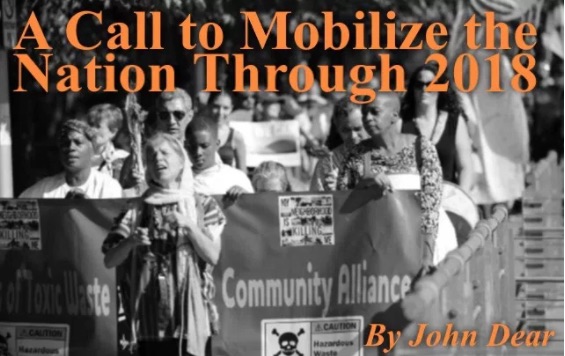
While the media and the nation sit transfixed over the Trump scandals and attacks on democracy, those of us who work for justice and peace know that we have to keep working, resisting, and mobilizing people across the country if we are going to have the social, economic and political transformation we need for our survival.

In other words, we’ve only just begun. Instead of giving up, giving in, or throwing in the towel, instead of sitting glued to the tube, we’re going forward. The campaign for a new culture of nonviolence is on!

No, you may say, it’s too much, I need to take a break from the news, from the movement, from the struggle. There’s nothing we can do, anyway. We can’t make a difference. I give up.

That is not only not helpful, it’s simply not true. We have more power than we realize. If we mobilize together and resist, we can prevent injustices, wars and other horrors from occurring. Doing nothing because we are overwhelmed or too dispirited is not helpful to anyone and certainly not the poor, the victims of our wars, or Mother Earth. It’s also not helpful to ourselves. For the sake of our own humanity, our own integrity, our own sanity, we need to carry on the struggle now more than ever, with boldness, creativity and steadfast nonviolence.

To this end, my friends and I at Campaign Nonviolence have issued a new call inviting people to commit themselves to the struggle over the next eighteen months, from now through the Congressional elections of November, 2018, to building a movement of movements that connects the dots of violence and injustice for a groundswell of activism, organizing, marches, demonstrations, and political conversion we’ve not yet seen.

“The time has come for us to pool our nonviolent power to resist the tragedy we face and to signal, once and for all, our determination to build a world of peace, racial justice, economic equality, and a healthy planet for all,” the statement begins. “We call on you—and all people everywhere—to join us in training for nonviolent action, in creating community for nonviolent action, and in taking nonviolent action in this challenging time.”

This call to mobilize over the next eighteen months is not just an electoral strategy, we insist. What we want is “a referendum for a nonviolent future.”

Campaign Nonviolence proposes the following concrete steps:

First, join the September 16-24, 2017 national week of action, where over 1000 marches and rallies calling for an end to war, racism, poverty and environmental destruction and for a new culture of peace and nonviolence will take place across the nation covering all fifty states. (Register your event here!)

Second, take a nonviolence training and then organize nonviolence trainings in your community. We all need to brush up on our nonviolence, and these trainings offer principles and methods for nonviolent strategies and guidance and the hand’s on help of role-playing and practicing your nonviolent response. (Look for trainings and trainers on the Nonviolence Training Hub co-sponsored by Campaign Nonviolence and Pace e Bene at www.nonviolencetraininghub.org

(Article continued in the right column)

Questions related to this article:

The post-election fightback for human rights, is it gathering force in the USA?

(Article continued from the left column)

Third, form and join an affinity group. We are in deep water these days, and we cannot sustain our nonviolent resistance or build a movement on our own; we need one another. We encourage everyone to form or join an affinity group of just 5 to 10 people where you can support one another for public action, study nonviolence, reflect on the current situation and envision a way forward. Affinity groups have long played a part in our movements. In Latin America, where they are called “base communities,” they are practically a requirement for survival.

Fourth, join the Nonviolent Cities project and announce your city as a “Nonviolent City.” Based on the ground-breaking work of “Nonviolent Carbondale,” Illinois, the Nonviolent Cities project supports local leaders around the country who are envisioning their community as a city of nonviolence. With over forty cities currently exploring this vision, Campaign Nonviolence calls upon activists, organizers, students and religious and political leaders to use this tool as a way to organize locally, resist injustice, end violence, and set a new path for your community to one day become a culture of peace and nonviolence.

Fifth, plan a local or regional gathering or conference in the Spring, 2018, to build for the fall convergence, help spread the word, and mobilize the groundswell of public action. We encourage everyone everywhere to organize your own day-long planning sessions or retreats next spring so that we can stay focused on the task of movement building.

Sixth, mobilize thousands of local public actions across the nation during the Campaign Nonviolence national week of action next September 15-23, 2018, as well as come to Washington, D.C. for the Campaign Nonviolence Convergence, where we will cover nonviolence training, a day of lobbying for justice and disarmament on Capitol Hill, and a silent march from the Martin Luther King, Jr. Memorial to the White House. With the impending mid-term Congressional elections, we will call for a referendum for a nonviolent future.

“We are in new territory, and things will likely get worse before they get better,” our call declares. But they will definitely get worse if we all do not think big, take bold action, envision a new future, and join together across every divide in an unprecedented historic movement. We need to commit ourselves now to redoubling our efforts over these next eighteen months, to mobilize like never before. In the past, if we were peaceful people, we now also have to become activists. If we were activists, now we have to become organizers. We all have to step up to the plate in new mature ways and meet this time head on with boldness, love and determination.

Through the brilliant work of Erica Chenoweth and Maria Stephan in their book, Why Civil Resistance Works, we know that nonviolent strategies for social change are twice as effective as violent ones, that when people gather together to do the impossible through nonviolent movements, positive change usually occurs.

But we also know this: movements which activate 3.5% of the population are very likely to succeed. For us, that means 12 million people. I believe we can do that. Over the course of the next eighteen months, we can build an unprecedented movement of movements to challenge the violence of our country and lay new groundwork for a culture of peace and nonviolence.

“A culture of nonviolence is not an unattainable dream,” Pope Francis wrote last month in his open letter to Chicago, “but a path that has produced decisive results. The consistent practice of nonviolence has broken barriers, bound wounds, healed nations.”

I hope we can all spread the vision, continue to build up our grassroots movement of nonviolence, and mobilize the nation not just for steadfast resistance but the long haul transformation into a new culture of nonviolence.

To read the full text of the call click here!

Morocco: The International Festival of Amazigh Culture from 14 to 16 July in Fez

EDUCATION FOR PEACE .

An article from Atlas Info

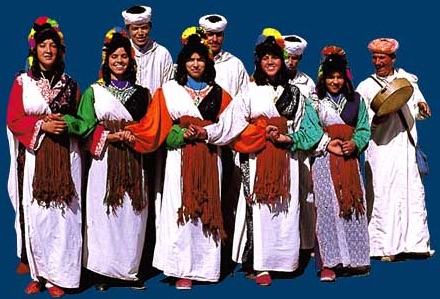
The 13th edition of the international festival of Amazigh culture will take place from 14 to 16 July in Fez under the theme “Amazighity and cultural diversity in the face of extremism”.

Initiated by the Fès-Saiss Association and the Center Sud Nord in partnership with the Esprit Foundation of Fez, the Fès-Meknes region, the BMCE Foundation and the Moroccan National Tourist Office (ONMT), this event promotes coherent strategies for the consolidation of intercultural dialogue, social cohesion and the strengthening of democratic culture.

This international festival, which has become an unmissable event, is part of actions and efforts to promote Amazigh culture through the enhancement of Amazigh intangible heritage, cultural diversity and their contributions to the culture of peace.

The festival features a multitude of activities including artistic evenings with the participation of Abdelhafid Douzi, Aicha Tachinwite, Hadda Ouakki, Said Senhaji, Ibtissam Tisket and Hassan El Berkani, Italian Laura Conti, besides the Ahidous dance of Tahla and Flamenco, and many other stars of the Amazigh and Mediterranean song.

The 12th edition of the International Festival of Amazigh Culture was initiated under the theme “Amazighité and the Mediterranean cultures: Living together”.

(Click here for the original version of this article in French)

Question for this article:

Northern Ireland School Receives Evens Prize for Peace Education 2017

EDUCATION FOR PEACE .

A press release from the Evens Foundation

New-Bridge Integrated College in Loughbrickland, Northern Ireland, is the laureate of the Evens Prize for Peace Education 2017. For this year’s biennial European prize, the Evens Foundation looked for strategies implemented in secondary schools for dealing with ‘hot topics’ in a constructive way. 13 high quality projects from all over Europe were selected for the shortlist.

According to the international jury of experts, New-Bridge Integrated College developed an impressive and strongly embedded project that continues to break new ground in relation to integrated education in Northern Ireland, and of which the approach is very transferable to other EU countries and contexts. The project arose in the polarized education system in Northern Ireland, but also integrates more recent problematics (social and cultural mix, mixed-ability students). It helps teachers to respond to everyday diversity as well as to transform controversial subjects into a learning opportunity.

The project is steered by the school and has strong leadership, both from the Senior Leadership Team and the Community Relations, Equality and Diversity team. It also has a solid peer-learning dimension: the project was developed by teachers for their colleagues. It focuses on both knowledge and skills development, and works with teachers, pupils and families. The cross-curricular approach to controversial issues is being mainstreamed into formal education processes across the school, and is accepted by all stakeholders.

To ensure a consistent approach to teaching controversial issues, the project offers teachers specific training, ideas, tools and activities to work positively with controversial or sensitive issues when they arise, as well as material to prepare lessons on controversial subjects. It does not expect teachers to follow extensive training courses but rather to start working and build their competences and confidence to deal with such topics step by step, at their own pace.

(continued in right column)

Question for this article:

Peace Studies in School Curricula, What would it take to make it happen around the world?

(continued from left column)

The laureate will receive a cash award of €25,000, of which some is to be used to share their vision and good practices with colleagues in other European countries.

The prize‐giving ceremony will take place on 9 November 2017 in London in the framework of the next Conflict Matters conference. On this occasion, all shortlisted candidates will also be invited for an exchange seminar in order to share experiences and good practices.

Jury members for Evens Prize for Peace Education 2017

Tomas Baum (BE), Director of the Flemish Peace Institute

Maria Carme Boqué Torremorell (ES), Head of Teaching, Department of Education, Ramon Llull University, Barcelona

Christel De Jonge (BE), DG Education and Culture, European Commission

Jonathan Even-Zohar (NL), Director of Euroclio (European Association for History Educators)

Joanna Grzymała-Moszczyńska (PL), researcher and PhD. student, Institute of Psychology, Jagiellonian University, Krakow

David Kerr (UK), Head of Initial Teacher Training, University of Reading; Consultant Director of Education, Citizenship Foundation

Claudia Ruitenberg (CA/NL), Associate Professor, Philosophy of Education, Department of Educational Studies, University of British Columbia