Tag Archives: global

The Peace Prize for city initiatives in conflict prevention, resolution or peace building

.. DEMOCRATIC PARTICIPATION ..

Adapted from the flyer and website of the UCLG City of Bogotá Peace Prize

Has your local government successfully worked to prevent or overcome conflict or to create dialogue? Or does it help local governments in conflict areas in their efforts to achieve or maintain peace? Then consider nominating it for the UCLG City of Bogotá Peace Prize!

prize
Click on image to enlarge

The UCLG City of Bogotá Peace Prize is a triennial award for (a coalition of) local governments that have implemented initiatives in conflict prevention, resolution or peace building, that are proven to have had a significant positive impact. The prize aims to contribute to full acknowledgement of the important but often overlooked role of local governments as peace building actors, thus creating a more effective approach to conflict resolution.

Nominations can be submitted through the website of the Peace Prize until the 30th of June 2016. The application form is online at : http://www.peaceprize.uclg.org/en/apply.

Nominated cases are assessed by a high level expert jury. The winning local government will receive a modest prize package worth €20.000, aimed at strengthening its peace projects and facilitating learning and exchange.

The first award ceremony of the UCLG City of Bogotá Peace Prize will take place at the UCLG World Congress in Bogotá, on 12-15 October 2016. Here, the local governments that will be nominated as finalists will get the opportunity to present their approaches and the jury will declare the final winner.

(Continued in right column)

Questions for this article:

How can culture of peace be developed at the municipal level?

(Continued from left column)

The members of the jury are:

Lakhdar Brahimi holds a commendable array of experiences in international relations and is now considered to be among the most prominent human rights and peace advocates in the world. His background has ensured him membership of the The Elders: a group consisting of independent global leaders working together for peace and human rights.

Dr. Tarik Kupusovic has been the Lord Mayor of Sarajevo during the second half of the war in Bosnia-Herzegovina and the siege of Sarajevo (1994-96). As President of the country’s Association of Towns and Cities he has established close relations with many cities and mayors of the world to restore the workings of local autonomous government in his country’s devastated cities.

Dr. Aisa Kirabo Kacyira of the Republic of Rwanda is the Deputy Executive Director and Assistant Secretary-General for UN-HABITAT providing critical leadership to promote sustainable cities and human settlements globally.

Dr. Tadatoshi Akiba is the former mayor of Hiroshima and has considerable experience in communicating the dire realities of atomic bombing and has brought great improvements to municipal policies in the field of fiscal health, transparency, citizen service and youth violence.

Rafael Grasa is the President of the International Catalan Institute for Peace. In his research, Professor Grasa focuses on the resolution and transformation of conflict, non-military aspects of security and human security, decentralized governance and prevention of violent behaviour.

Wim Deetman is the former mayor of The Hague and has been instrumental in positioning the city in the international peace and security domain leading to the International Criminal Court being situated in The Hague. As a legacy for his political engagement the Wim Deetman Foundation has been established in his name providing students from developing countries the chance to pursue a master`s degree in the area of peace and justice in The Hague.

Banning Nukes: Divergence and Consensus at the UN Working Group on Nuclear Disarmament

DISARMAMENT & SECURITY .

Excerpts from an article by by Xanthe Hall for the International Physicians for the Prevention of Nuclear War

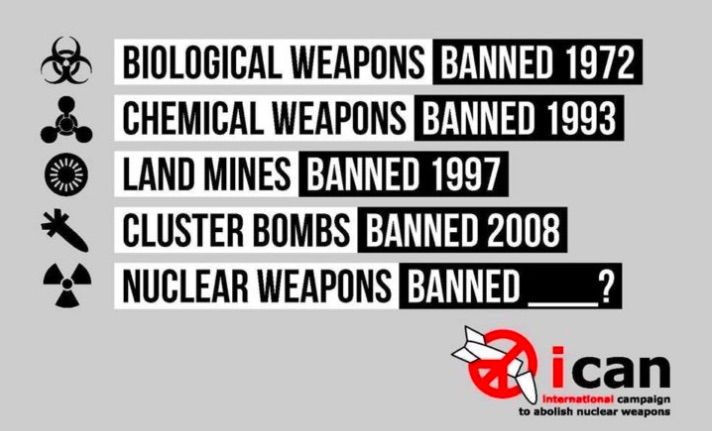
. . . So what did happen [at the May session of the Open-Ended Working Group – OWEG]? For the first time in many years a large number of states decided that they did not want consensus but confrontation on the issue of the illegitimacy of nuclear weapons. Tired with decades of patient discussions on micro-measures, principally for non-proliferation, and led by Argentina, Brazil, Costa Rica, Ecuador, Guatemala, Indonesia, Malaysia, Mexico and Zambia, states are now going for broke [Editor’s note: All of these countries are participants in nuclear-weapon-free zones].

oewg
ICAN protest in front of Australian embassy during the OEWG. Photo: ICAN [International Campaign to Abolish Nuclear Weapons]
Click on photo to enlarge

Despite the prospect that the nuclear-armed states are unlikely to attend, they have submitted a proposal to the OEWG to “convene a Conference in 2017, open to all States, international organizations and civil society, to negotiate a legally-binding instrument to prohibit nuclear weapons” (ban treaty) and “to report to the United Nations high-level international conference on nuclear disarmament to be convened no later than 2018 … on the progress made on the negotiation of such an instrument.”

On the final day of the OEWG resounding majority support for prohibition and the commencement of negotiations was repeatedly expressed. States are convinced that with this approach they can bring pressure to bear on the nuclear-armed and nuclear-dependent states to begin genuinely considering negotiating the elimination of their nuclear arsenals. . . .

The beauty of a stand-alone ban treaty is in its clarity, especially in terms of the moral imperative. It would leave no room for doubt as to the illegitimacy of nuclear weapons and would place any state that relies on nuclear weapons for their defence outside international law, if enough states were to support such a norm. Its entry into force could not be held hostage by nuclear-armed states reticence to ratify, as the CTBT has been. Given the present anger about the arrogance of the nuclear-armed states refusal to engage with the nuclear-free states which has been made explicit both through the boycott of the OEWG, but also through the ever hardening rhetoric of the nuclear umbrella states, it remains the most attractive option for states to pursue at the UN General Assembly in October. In this way, they can continue to put maximum pressure on the nuclear-armed states to take them seriously as the majority and therefore to respect their rights and security needs.

This debate has as much to do with redefining world order and democracy as it has to do with disarmament. As Mexico pointed out: there is nothing to be said against consensus when it is fair and reflects the truth. But when divergence exists and states with more power due to nuclear weapons wield a veto over the majority then there is nuclear oppression. Now the majority is rising up to liberate itself from this yoke with persuasive and well-thought out arguments for a comprehensive ban treaty. After more than twenty years of attending these often repetitive and boring diplomatic debates, I can hardly wait for the next one.

Question related to this article:

The film “Demain”, a manifesto?

. . SUSTAINABLE DEVELOPMENT . .

An article by Bruno Maresca in the Huffington Post (translated by CPNN)

Driven by popular acclaim – more than 700,000 cinema viewers in three months against 265,000 for The Titanic Syndrome Nicolas Hulot! – the film “Demain” [i.e. Tomorrow] , by Cyril Dion and Mélanie Laurent, released at the time of COP21, received the trophy for best documentary in the 2016 Caesars.

demain

This unusual success seems to be explained by two factors. First, they feature local initiatives around the world that show that it is possible, at different levels, to engage in the fight against climate change. Second, they show that these initiatives can be done now (food, energy, local economic processes, education and direct democracy) and, as such, they inspire action by showing what is already working. The film succeeds in showing that French society wants to escape from the present atmosphere of doom and gloom.

This willingness to explore initiatives that invent alternatives to the global system of production and consumerism is in the air. It is the subject of the journalist Eric Dupin in his innovative book, “The pioneers: a voyage in France” (La Découverte, 2014). His book explores the diversity and richness of initiatives and people who “explore, in a pragmatic way, other lifestyles, such as new ways of working.” It includes those who invest in shared housing, organic farming or alternative schools, those who share a great desire to escape , with varying degrees of radicalism, from the globalization of production and consumption.

At the end of his account, Eric Dupin is ultimately pessimistic. He stresses that the diversity of initiatives does not by itself produce a coherent movement that can converge to a coordinated action and thereby produce change. Is it not the case that his “pioneers”, like those of “Demain”, privilege above all a ‘culture of exemplary individuals”? “Each person doing something at his level” seems to be their credo, which is far from the search for a collective change, which would mean developing political institutions. For this reason, the pioneers – and they are many – do not seem themselves to be a social movement.

“Demain”, meanwhile, wants to convince us that we can change the world by spreading many examples of experiences, both small and large. But can they escape from pessimism? Can their experiences outweigh the destructive and reactionary forces of the world economic and political system? Two impressive sequences illustrate the problem, one at the beginning and one at the end of the film: the apocalyptic vision of the city of Detroit, abandoned since the collapse of the auto industry, and the financial crisis in Iceland, which got to the point that the civil society overthrew the country’s political class. After viewing the film by Cyril Dion and Mélanie Laurent and reading the book of Eric Dupin, we are confronted by the question: can we arrive at a new future by change from below, by the proliferation of individual initiatives? And finally, how should we explain the great attraction of “Demain”?

(Article continued on the right column)

(Click here for a version of this article in French)

Question for this article:

What is the relation between movements for food sovereignty and the global movement for a culture of peace?

(Article continued from the left column)

On the release of his book, the journal Libération called Eric Dupin a “pilgrim of utopia”.

On the websirte of Mediapart, Jean-Louis Legalery notes that after seeing the film “Demain”, viewers gave it a standing ovation, reminding him of the reaction to the film Z by Costa Gavras in 1979. The films that aroused spectators in the 1970s were eminently political; they called for collective mobilization to radically transform institutions. With hindsight, one can say they were driven by a high load of utopia (utopia that crashed against hard reality, as in the situation of Greece today).

Question: What are the consequences of the state subsidies paid to large farms?

Perhaps what works in “Demain” is this utopian vision that gives everyone the impression he can take part in something that is already going on. Instead of staying each in his virtuous corner, inscribed in the register of eco-gestures, one is invited to engage in something new, something that breaks with the dominant system, such as “urban farms” or “local currencies” and other initiatives shown in “Demain.” If these inventions are sufficiently taken up around the world, they could subvert the global economic system.

However, we are not seeing such a significant change in scenery. Farms with over 1,000 cows are now appearing in France, as in Denmark and Poland. And even if many people are changing their practices by sharing, recycling, carpooling, etc., it is difficult to disentangle this from a change in lifestyle necessitated by the stress of the economic crisis. A widespread changeover seems still far away. In the variety of examples shown in “Demain”, Africa and Asia are not very present.

But the real challenge of the transformation of production and consumption is in Asia, which, in 2030, will contain over 66% of the global middle class (against 28% in 2009, according to the OECD ). This emerging middle class, in strong numerical growth, is adopting the consumption patterns of the Western middle class, industrial power, private cars, expansion of suburban areas for access to the house, mass tourism, etc. Like a huge pendulum, the Western middle classes, being squeezed out by rising unemployment and inequality, adhere increasingly to the “small is beautiful” approach to local agriculture, solidarity businesses, alternative transport, renewable energy, etc.

What is unquestionably positive in “Demain” is that the Western middle classes want to reclaim the management of their daily lives, in their own life space, through collective initiatives of goodwill and kindness. They are engaged in a movement of self-awareness of their real interests, their need to live and consume differently.

This “self-consciousness” is what the middle classes had lost at the turn of the 1980s. When social struggles were diluted by access to welfare and mass consumption the middle class was reduced to being just a cog in the functioning of the global economy.

So let us dream, like many of its fans, that “Demain” is the flight of the swallow that heralds a new phase in the history of the middle class. Given the collective optimism that this film has inspired, it is possible to dream . . .

Book review: A Student’s Guide to Starting a Career Working for Peace

… EDUCATION FOR PEACE …

A publication notice from Information Age Publishing

Author: David J. Smith, George Mason University

A volume in the series: Peace Education. Editor(s): Laura Finley, Barry University. Robin Cooper, Nova Southeastern University, published 2016

This book is a guide for college students exploring career options who are interested in working to promote peacebuilding and the resolution of conflict. High school students, particularly those starting to consider college and careers, can also benefited from this book.

peace jobs

A major feature of the book is 30 stories from young professionals, most recently graduated from college, who are working in the field. These profiles provide readers with insight as to strategies they might use to advance their peacebuilding careers.

The book speaks directly to the Millennial generation, recognizing that launching a career is a major focus, and that careers in the peace field have not always been easy to identify. As such, the book takes the approach that most any career can be a peacebuilding career provided one is willing to apply creativity and passion to their work.

CONTENTS
Peace Education Series Introduction, Laura Finley and Robin Cooper Preface. Acknowledgments. CHAPTER 1. What is a Peace Job? CHAPTER 2. Preparing for and Finding a Peace Job. CHAPTER 3. Peacebuilding Careers in Diplomacy. CHAPTER 4. Enforcing Peace and Justice Through Human Rights and Law. CHAPTER 5. Working in Conflict: NGO, IGO, Humanitarian, and Military Careers. CHAPTER 6. Teaching About Peace and Conflict. CHAPTER 7. Activism: Social Justice and Environmental Action. CHAPTER 8. A Healing Approach: Health, Community, and Faith-Based Strategies. CHAPTER 9. Creating Peace: The Arts, Science, Technology, and Media. CHAPTER 10. Pursuing Peacebuilding Education. APPENDIX A: 86 Peace Jobs for College Grads. APPENDIX B: Peace Jobs Glossary. APPENDIX C: Peace Jobs Career Resources. APPENDIX D: Additional Readings. About the Author.

(Thank you to Alicia Cabezudo for calling this to our attentionI)

Question for this article:

Calls for UN Security council reform at Istanbul summit

DISARMAMENT & SECURITY .

An article by Handan Kazanci & Ilgin Karlidag, Anadolou Agency, Turkey

World leaders in Istanbul have called for an urgent change to the United Nations Security Council, limiting the power of veto by its five permanent members, including Russia.

ArabLeague
Ahmed Ben Hali with UN Secretary-General Ban Ki-Moon
Click on photo to enlarge

Arab League Assistant Secretary-General Ahmed Ben Hali told the World Humanitarian Summit in Istanbul on Tuesday: “Reform of the UN Security Council is urgently needed. “The use of veto should be rationalized. There should be a departure from the approach of management of crisis … to depart from double standards in dealing with issues of peace and security and to prosecute those committing war crimes and crimes against humanity.”

The Arab League consists of 22 member states, including Algeria, Egypt, Iraq, Jordan, Qatar and Saudi Arabia.

Ben Hali’s comments echoed those of summit host and Turkey’s president, Recep Tayyip Erdogan, who on Monday said the UN Security Council must “urgently” change in order to fulfill its functions.

Each of the permanent members – Russia, China, France, the United Kingdom and the United States – have the power of veto, allowing them to block draft council resolutions – even when these have broad international support.

Erdogan called for the veto by the council’s five permanent members to be limited, a move which Russia – a permanent member of the UN Security Council – is against.

In 2012, Russia and China vetoed a UN Security Council resolution calling for Syrian President Bashar al-Assad to step down. The move sparked criticism worldwide and prevented substantial UN-backed action with regards to the Syrian civil war.

Russian President Vladimir Putin declined his invitation to the Istanbul summit, the humanitarian news agency IRIN reported on May 10. In his place, Putin sent a delegation, whose head, Russian Deputy Emergencies Minister Sergey Voronov, said on Tuesday that his country opposes any limitations to the power of veto by any permanent member of the Security Council.

According to James Nixey, the head of the Russia and Eurasia Programme at London-based Chatham House, Putin’s non-attendance at the summit is not surprising. “Vladimir Putin would be rather embarrassed at a world humanitarian summit considering the criticism his regime takes for its aggressive behavior abroad and its human rights record at home,” told Anadolu Agency on Tuesday. “Russia views its veto as pure power, and there is zero chance that it would endorse any move to give up wielding such power, which it has used so effectively in the past,” he added.

Criticized internationally for its role in backing the Assad regime, Russia said in a statement obtained by IRIN that it “refuses to be bound by the results of a process it says failed to include its views”.

Question for this article:

Tens of Thousands Take Part in Global Actions Targeting World’s Most Dangerous Fossil Fuel Projects

. . SUSTAINABLE DEVELOPMENT . .

An article from Ecowatch (abridged)

Twelve days of unprecedented worldwide action against fossil fuels concluded Sunday showing that the climate movement will not rest until all coal, oil and gas is kept in the ground. The combined global efforts of activists on six continents now pose a serious threat to the future of the fossil fuel industry, already weakened by financial and political uncertainty.

ecowatch
The UK’s largest opencast coal mine was shut down for a day.
Photo credit: Tim Wagner

Tens of thousands of activists took to the streets, occupied mines, blocked rail lines, linked arms, paddled in kayaks and held community meetings in 13 countries, pushing the boundaries of conventional protest to find new ways to demand coal, oil and gas stay in the ground. Participants risked arrest—many for the first time—to say that it’s time to Break Free from the current energy paradigm that is locking the planet into a future of catastrophic climate change. . .

Highlights include:

Thousands worldwide risked arrest during the actions, many for the first time.

$20 million worth of coal shipments were halted by activists shutting down the largest coal port in the world in Newcastle, Australia.

The UK’s largest opencast coal mine was shut down for a day.

Hundreds stood up to South Africa’s most powerful family with a march that delivered coal to their front door, despite their attempts to silence civil society by pressuring police to revoke permits for a march.

Dozens of people occupied train tracks overnight on both coasts of the United States to stop oil-filled ‘bomb trains’ from rolling through communities — including less than 100 feet from low-income public housing in Albany, New York.

3,500 people shut down one of Europe’s biggest carbon polluters in Germany, occupying a lignite mine and nearby power station for more than 48 hours, reducing the plant’s capacity by 80 percent.

10,000 marched against a proposed coal plant in Batangas, the Philippines.

3,000 sent an ear-splitting message to Indonesia’s president with a whistle demonstration against coal in Jakarta, and a few days later 12 activists climbed the cranes supplying coal for the Cirebon Coal Power Plant, and dropping banners to “Quit Coal” and for “Clean Energy, Clean Air.”

Community members blocked traffic outside the gates of Brazil’s largest thermal coal plant, in Ceará.

On land and water, indigenous communities and local activists blockaded the Kinder Morgan tar sands facility in Metro-Vancouver, unceded Coast Salish Territories.

150+ local activists marched and occupied the entrance of two fossil fuel refineries, which are the largest unaddressed source of carbon pollution in the Northwest of the U.S.

In Aliaga, Turkey 2,000 people marched to the gates of the Izmir region’s largest coal dump, and surrounded it with a giant red line, as a call to end plans for the massive expansion of coal in the country.

“The global climate justice movement is rising fast. But so are the oceans. So are global temperatures. This is a race against time. Our movement is stronger than ever, but to beat the odds, we have to grow stronger,” Naomi Klein, award winning journalist/author, said.

Question for this article:

United Nations High Level Thematic Debate on Peace and Security: Closing remarks

FREE FLOW OF INFORMATION

An article from the webpage of the the President of the United Nations General Assembly

Honourable Ministers, Excellencies, distinguished guests, ladies and gentlemen. We have come to the end of what I believe has been a truly enriching discussion on the UN’s role in maintaining global peace and security. I would like to thank all those who contributed so actively to this event including our speakers, those of you visiting from capitals, our interpreters, colleagues in DGACM, civil society representatives and of course, you, the membership.

unga

Discussions these past few days demonstrate that across the membership, there is a feeling that we are at a watershed moment in terms of both the challenges we are facing in maintaining international peace and security and the way we must tackle those challenges.

Taken together, the recommendations included in the three UN reviews and other relevant processes, provide us with a very solid basis from which to move forward.

Indeed, through this debate we have identified some of the key themes and connectors between these reviews, but what we need now is sustained political engagement and actual implementation.

Shortly after this meeting, I will therefore produce a summary of the key messages from this debate which I will share with both member states, the current Secretary-General and Secretary-General candidates.

I also intend to invite the Secretary-General to brief the membership on how the UN is jointly implementing the relevant recommendations emerging from all three reviews and to consider producing a possible roadmap to that effect.

Among the key messages and my own personal reflections are the following:

First, on the need to rebuild trust.

The UN’s inability to protect civilians in conflicts; the disturbing allegations of sexual abuse and exploitation by peace keepers; the lack of adequate tools to respond to complex conflicts, to international terrorism or to global challenges with a clear security dimension, have undermined global confidence in the UN’s role in maintaining peace and security.

On this seventieth anniversary, therefore, we need to enhance the trust on which institutional cooperation is build.

Trust between member states, large and small and between member states and the UN, that we will adhere the commitments of the UN Charter to ensure our collective security; that we will uphold our obligations under international humanitarian law; that we will rejuvenate the ability of the United Nations to confront new and evolving threats.

(Article continued in the column on the right)

Questions related to this article:

Can the UN help move the world toward a culture of peace?

(Article continued from the column on the left)

Second, on prevention.

As Leymah Gbowee reminded us – if we spend peanuts on prevention and trillions on war, then we cannot expect to achieve peace.

Greater resources, analysis, research should therefore be dedicated to the UN’s diplomatic and preventive functions.

Furthermore, the search for conflict resolution whether through UN managed missions, efforts pursued with regional organizations or multi-national action authorized by the security council, must be ground in an overall political framework.

Third, on the role of women. Practically everyone agrees that women must be more involved right across the continuum of sustaining peace.

But agreement is not enough. Leadership and targeted steps to make this happen are needed now.

Similarly tools must be developed to place communities at the heart of peace operations.

Fifth, in today’s world the UN must increasingly look to build partnerships at political and operational level with regional and sub-regional organizations; with other multi-lateral partners, with civil society and with the private sector.

Sixth, we have to reduce fragmentation across the three UN pillars notably by enhancing the Peacebuilding Commission’s role and by taking the SDGs as our collective vision and guide. Greater efforts should also be made to improve the effectiveness and efficiency of the UN, including at Headquarters.

Seventh, in relation to the fight against radicalism and terrorism, consideration should be given to identifying concrete ways for the UN to effectively contribute to the international efforts to counter terrorist entities when encountered in mission environments.

Eighth, large-scale displacement may be a consequence of instability or feed into new or existing tensions. Properly responding to these flows in the longer term demands that we focus on addressing the underlying root causes.

And finally, taking office on 1 January 2017, the next Secretary-General will

need to foster support from the UN Security Council and all Member States’ to advance peace, justice and security across our world. In particular, she or he will need support to implement the practical recommendations contained in the three reviews.

_________

To conclude, let us remember that the current or the future Secretary-General can only do so much.

Ultimately, the shift we need – in mind-set, in our financing and partnership mechanisms, in our systems and operations – will only happen if it is supported and driven by governments and leaders around the world

I hope that you and your leaders will rise up to this challenge.

I thank you again for your participation and continued support.

A Joint Declaration on the Environment, Social Inequality and Elimination of Nuclear Threat, with a Proposal for UN reform

DISARMAMENT & SECURITY .

From the Website of the Joint Declaration

We, individuals and institutions that are profoundly concerned about the earth’s present state, particularly by potentially irreversible social and environmental processes, and about the lack of an effective, democratic multilateral entity respected by all that is essential for world governance at this extraordinarily complex and changing time,

mayor

URGE YOU

to adhere to this joint declaration in order to contribute to the rapid adoption of the following measures, the grounds for which are attached hereto as Document I and Document II.

Environment

The current tendencies, resulting from a deplorable economic system based solely on making fast profits, must be urgently reversed to avoid reaching a point of no return. Both President Obama –“we are the first generation to feel the effect of climate change and the last generation who can do something about it”- as well as Pope Francis –“(…) intergenerational solidarity is not optional, but rather a basic question of justice, since the world we have received also belongs to those who will follow us”- have with wisdom and leadership warned of the immediate actions that must be taken concerning climate change. We must invent the future. The distinctive creative capacity of human beings is our hope. As Amin Maalouf has underscored, “unprecedented situations require unprecedented solutions”.

We live at a crucial moment in the history of mankind in which both population growth and the nature of our activities influence the habitability of the earth (anthropocene).

All other interests must be subordinated to an in-depth understanding of reality. The scientific community, guided by the “democratic principles” so clearly set forth in the UNESCO Constitution, should counsel political leaders (at the international, regional, national and municipal levels) concerning the actions to be taken, not only in their role as advisors, but also to provide foresight. Knowledge to foresee, foresight to prevent.

It is clear that accurate diagnoses have already been made but that they haven’t led to what is really important: the right and timely treatment.

Communications media and social networks must constantly strive to achieve a resounding outcry, a sense of solidarity and responsibility, adopting personal and collective resolutions at all levels –including radical changes in institutions- capable of halting the current decline before it is too late.

As President Nelson Mandela reminded us, “the supreme duty of each generation is to properly take care of the next”.

2-Social inequality and extreme poverty

It is humanly intolerable that each day thousands of people die of hunger and neglect, the majority of them children between the ages of one and five, while at the same time 3 billion dollars are invested in weapons and military spending. This is particularly true when, as is currently the case, funds for sustainable human development have been unduly and wrongfully reduced. The lack of solidarity of the wealthiest toward the poor has reached limits that can no longer be tolerated. For the transition from an anti-ecological economy of speculation, delocalization of production and war to a knowledge-based economy for global sustainable and human development, and from a culture of imposition, violence and war to a culture of dialogue, conciliation, alliances and peace, we must immediately proceed to do away with the (G7, G8, G20) groups of plutocrats and re-establish ethical values as the basis for our daily behaviour.

3-Elimination of the nuclear threat and disarmament for development

The nuclear threat continues to pose an unbelievably sinister and ethically untenable danger. Well-regulated disarmament for development would not only guarantee international security, but would also provide the necessary funds for global development and the implementation of the United Nations’ priorities (food, water, health, environment, life-long education for all, scientific research and innovation, and peace).

(continued in right column)

(Click here for a version of this article in Spanish.)

Question for this article:

Proposals for Reform of the United Nations: Are they sufficiently radical?

(continued from left column)

For these so relevant and urgent reasons

WE PROPOSE

Calling an extraordinary session of the United Nations General Assembly to adopt the necessary urgent social and environmental measures and, moreover, to establish the guidelines for the re-founding of a democratic multilateral system. The “new UN System” with a General Assembly of 50% of States representatives and 50% of representatives of civil society, and adding to the present Security Council and Environmental Council and a Socio-Economic Council, has been studied in depth. In all cases, no veto but weighted vote.

***

In view of the poor progress made toward fulfilling the Millennium Objectives (ODM) and, given the present lack of solidarity, increased social inequality and subordination to the dictates of commercial consortia, no one believes that the Sustainable Development Objectives (SDOs) to be adopted in September will actually be implemented.

The solution is inclusive participative democracy in which all aspects of the economy are subordinated to social justice.

Jose Luis Sampedro left a fantastic legacy to young people: “You will have to change both ship and course”. The attached report (I) outlines recent events and projects that leave room for optimism. Human beings, who today may express themselves freely thanks to digital technology, now have global awareness while, moreover, decision making is increasingly influenced by growing numbers of women, the cornerstone of this new era. A historical turning point is drawing near that will enable us to take the reins of our common destiny in our own hands.

First Signatories

Federico Mayor (President of the Foundation for a Culture of Peace and former Director General of UNESCO)

Mikhail Gorbachev (Former President of the Soviet Union, President of Green Cross International and World Political Forum)

Mario Soares (Former President of Portugal and President of the Fundaçao Mario Soares)

Javier Pérez de Cuéllar (Former General Secretary ONU)

Garry Jacobs (Chief Executive Officer of the World Academy of Art & Science)

Colin Archer (Secretary General), Ingeborg Breines (Co-President) and Reiner Braun (Co-President) of the International Peace Bureau

Roberto Savio (Founder and President of IPS- International Press Service)

François de Bernard (President and Co-Founder of the GERM (Group for Study and Research on Globalization)

Alexander Likhotal (Green Cross International)

Miguel Ángel Moratinos (ex Ministro Español de Asuntos Exteriores – Presidente de REDS)

Ricardo Díez Hochleitner (Presidente de Honor del Capítulo Español del Club de Roma)

José Manuel Morán (Vicepresidente Capítulo Español del Club de Roma)

Trinidad Bernal (Secretaria General Fundación ATYME)

Julio E. Celis (Danish Cancer Society)

Jean Paul Carteron (Chairman and Founder Crnas Montana Forum)

Anwarul Chowdhury (Ambassador, Founder Global Movement for the Culture of Peace and former Under-Secretary-General and High Representative of the UN New York)

Denis Torres (Instituto Martin Luther King – Managua, Nicaragua)

María Novo (Catedrática UNESCO de Educación Ambiental y Desarrollos Sostenible Universidad Nacional de Educación a Distancia (UNED) – España)

Rustem Khairov (Director International Foundation for Survival and Development Humanity)

Alejandro Tiana Ferrer (Rector Universidad de Educación a Distancia (UNED))

Negoslav Ostojic (ECPD)

Prof. José María Sanz (Rector Universidad Autónoma de Madrid)

Prof. Rafael Garesse (Vicerrector de Innovación y Política Científica de la Universidad Autónoma de Madrid)

Anaisabel Prera Anaisabel Prera Flores (DEMOS Institut Guatemala – former Minister of Culture of Guatemala and Director of FCP in Madrid (2000-2004)

Frank LaRue (Demos Institut Guatemala)

Anabella Rivera (Demos Institut Guatemala)

Jordi Armadans, Director de FundiPau (Fundació per la Pau)

Enrique Barón Crespo

Carlos Jiménez Villarejo

Juan José Tamayo

Manuel Núñez Encabo (Fundación Antonio Machado)

Juan Manuel de Faramiñan

Emilio Muñoz

Natalia Muñoz-Casayús

María Quintana Romero

Jerónimo Asensio Rueda

Intergovernmental Negotiations on Security Council Reform

FREE FLOW OF INFORMATION

Based on news from various news services as indicated by the links

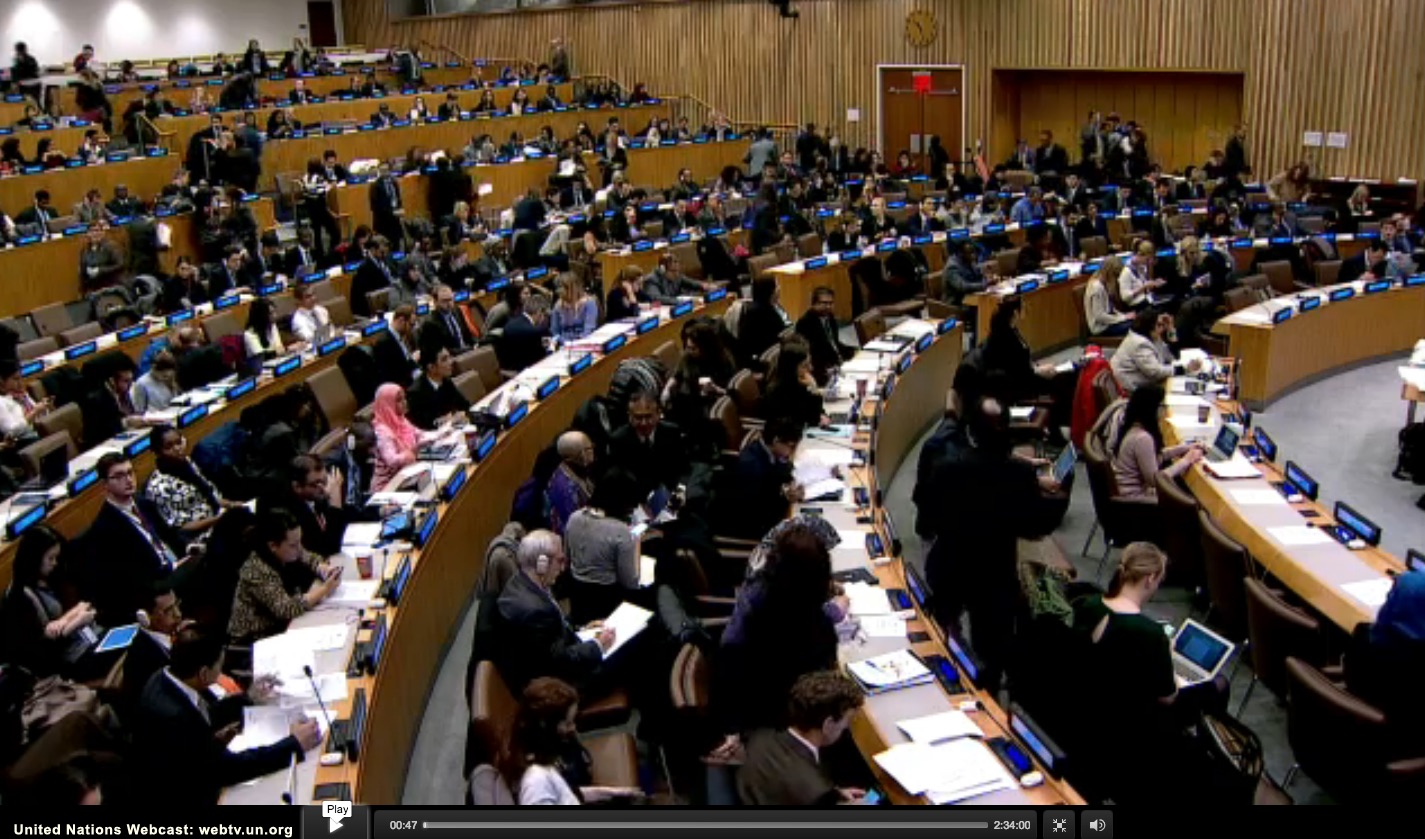
Meeting on May 2 at the United Nations, the ambassadors making up the Intergovernmental Negotiations on Security Council reform clashed on the question of enlarging the Council to include more permanent members. When the UN was founded in the rubble of World War II, the five victors — Britain, China, France, the Soviet Union and the US — assumed for themselves permanent council memberships and veto powers. According to the ambassador, their “special powers are a holdover from 1945 in a world that has dramatically changed with the rise of new powers and the UN itself increasing its membership by nearly three times, from 51 to 193.”

unsc
The chamber of the United Nations Security Council
Click on photo to enlarge

The ambassador from India called for the addition of new permanent members, referring to a negotiating document which is based on a survey of UN members on council reforms. Of the 122 countries that made written submissions for the survey, 113 — or more than 90 percent — supported expanding both categories of council membership, he said. They include the 54 members of the African Union, 42 from the L.69, which is a group supporting reforms, the Caribbean Community (CARICOM) members, the G4 and 21 others, in addition to two permanent members, Brtain and France, he said. He spoke on behalf of India, Brazil, Germany and Japan, the so-called G4 group.

Pakistan objected to the proposal by India that it should be added as a permanent member of the Council, along with Brazil, Germany and Japan, the so-called G4 group.

And the Democratic People’s Republic of Korea strongly opposed permanent membership of Japan – another member of the G4.

A 13-member group known as Uniting for Consensus (UfC), which included Pakistan and is led by Italy, reiterated its opposition to adding any permanent members, the core of its position on the reform process.

(Article continued in the column on the right)

Questions related to this article:

Can the UN help move the world toward a culture of peace?

(Article continued from the column on the left)

Another approach was proposed by the Ambassador from Ireland, as follows:

In relation to today’s topic of “categories of membership”, Ireland is not convinced by arguments for the creation of new permanent members of the Council. Democratic accountability is a watchword for almost every global institution. The Security Council should be no different. To create new permanent seats – which would not be subject to periodic election by the membership – would risk compounding many of the problems of the present dispensation.

At the same time, we fully recognise that there are countries which, due to their ability to contribute significantly to the maintenance of international peace and security, should be able to play a stronger role on the Council than allowed by the current arrangements. For this reason, although we are open to considering various models for expansion, we are positively disposed towards the creation of a new category of seats with an 8 year term. Ireland believes there should be 6 seats in this category, with 2 each from the African and Asia-Pacific group, and 1 each from WEOG and GRULAC.

We also believe an expansion of the current category of 2 year seats is warranted, including to ensure that smaller states can continue to serve regularly on the Council. These should increase by 5 to 15, with the African group taking 2 of the new seats, and the Eastern European group, the AsiaPacific group and GRULAC taking 1 each.

It would be for further consideration whether seats in either of these categories would be eligible for immediate re-election. The overall regional breakdown of seats under the model outlined above would result in 7 Council members from Africa, 6 members from WEOG, 6 from Asia Pacific, 4 from GRULAC, and 3 from Eastern Europe.

This would result in a Council of 26 seats, which would, in our view, be a good balance between representativeness and efficiency. As previously outlined, we continue to favour eventual abolition of the veto, and, as we would do not favour creating any new permanent members of the Council, the extension of the veto to any new member does not arise.

UN chief candidates pressed on how to tackle global challenges

FREE FLOW OF INFORMATION

An article by Gu Zhenqiu for Xinhuanet

The first public interviews with the current nine candidates vying to be next UN secretary-general and a three-day event which is first of its kind in the 70-year history of the world body, concluded here [at the United Nations] Thursday [April 14] with 193 UN member states judging their performance and answers to the questions from the globe.

unsecgen
This combination photo shows the candidates for the next United Nations Secretary-General. Upper row from left to right: Igor Luksic, Montenegro’s deputy prime minister and foreign minister, Danilo Turk, former president of Slovenia, Antonio Guterres, former prime minister of Portugal and former UN High Commissioner for Refugees. Middle row from left to right: Vesna Pusic, former Croatian foreign minister, Irina Bokova, director-general of United Nations Educational, Scientific and Cultural Organization (UNESCO), Natalia Gherman, former minister of foreign affairs and European integration of Moldova. Bottom row from left to right: Srgjan Kerim, President of the 62th session of the United Nations General Assembly, and former minister of foreign affairs of Macedonia, Helen Clark, former Prime Minister of New Zealand and Administrator of the United Nations Development Programme (UNDP), Vuk Jeremic, President of the 67th session of the United Nations General Assembly, and former Foreign Minister of the Republic of Serbia. (Xinhua/Li Muzi)
Click on photo to enlarge

The questions – which also came from members of civil society – to the five men and four women along with their answers were heard via webcast. In fact, the public hearings, also known as “informal dialogues” within the United Nations, rekindled the debate on how to make the global organization more relevant, transparent, efficient and effective in efforts to deal with grave global challenges, such as climate change and terrorism.

The questions, put forward either by a diplomat on the scene or a child through video, were intended to help choose the best person to succeed the current UN Secretary-General Ban Ki-moon, whose tenure is to end on Dec. 31.

The questions were challenging, illustrating high expectations of the international community to see a strong UN chief at the helm of the world’s most universal and authoritative organization.

There were questions that illustrated how different countries have different concerns based on their national interests.

For instance, African and Caribbean countries worry about a lack of access to concessional funds from industrialized nations in their development efforts, while Algeria and other states also voiced concerns at the unbalanced and inequitable composition of UN staff at headquarters in New York in terms of gender and geography.

(Article continued in the column on the right)

Questions related to this article:

Can the UN help move the world toward a culture of peace?

(Article continued from the column on the left)

African and Asian countries asked questions on how the next UN head will strengthen cooperation between the United Nations and regional organizations. Other countries, including Sierra Leone, wondered how the UN would execute its “zero tolerance” policy in a bid to end sexual abuse by peacekeepers in conflict-torn countries such as the Central African Republic.

A representative from Rwanda, who complained that “the conflict” raged in a regular pattern, particularly in Africa,” asked Helen Clark, one of the nine candidates and former prime minister of New Zealand, what measures she would take to reverse the trend.

Riyad Mansour, the permanent observer of Palestine to the United Nations, asked the candidates how they would end the Isareli-Palestinian conflict.

Small island countries, on the other hand, said they have been haunted by the impact of climate change. “What would you do to make sure countries take actions to stop catastrophic climate change?” a child asked via video.

Meanwhile, Brazil, Germany, India and Japan, which form the Group of Four (G4), asked most of the nine candidates about how he or she would reform the UN Security Council, the most powerful body in the UN family. Each of the G4 aspire to become permanent members.

There were also questions related to gender equality, human rights, sustainable development, the UN budget, UN management and UN peacekeeping operations.

Mogens Lykketoft, President of the UN General Assembly, told reporters that the event is just a “starting point” in the process of selecting the next UN secretary-general.

“I am surprised by the large number of countries and members of civil society coming forward to ask questions,” Lykketoft said. “It’s more than I expected.”

At this moment, there is still no public comments either by diplomats or senior UN officials on the performance of the nine candidates. People here at the United Nations are still arguing whether gender or geographical rotation should be the only criteria for the selection of the new top diplomat in the world.

But a key question remains: what impact will the open interviews have on the final decision by the UN Security Council, the 15-nation UN body which has the final say in deciding who will be the next UN chief?

Under the UN Charter, the secretary-general is chosen by the 193-member General Assembly on the recommendation of the 15-member Security Council.

In practice, this has meant that the council’s five permanent members, namely Britain, China, France, the United States and Russia, have veto power over the candidates. That will not change in deciding who succeeds Ban.