Tag Archives: global

CONGO issues statement ahead of United Nations 75th anniversary

FREE FLOW OF INFORMATION

An article from the Conference of Non-Governmental Organizations

President Liberato Bautista of the Conference of Non-Governmental Organizations in Consultative Relationship with the United Nations (CoNGO) will be holding presidential briefings in Geneva, Vienna and New York this December.

The briefings will focus on CoNGO’s Declaration on the 75th anniversary of the United Nations. This thoughtful and challenging document was adopted by the CoNGO Board when it met in Geneva this past October.

The Declaration was a product of intense consultations involving many CoNGO members and leaders of CoNGO Substantive Committees worldwide. 

(continued in right column)

Question(s) related to this article:

What is the United Nations doing for a culture of peace?

(continued from left column)

The Declaration honors the United Nations System as the essential multilateral mechanism that the world needs to mobilize, coordinate and manage solutions to the planet’s ”Problems without Borders”.

CoNGO calls for the 75th Anniversary to be the occasion for the United Nations System to be strengthened, better structured, better used by governments,  and considerably better financed.

CoNGO calls for the UN System to make greater use of the competence and experience of NGOs and the broader Civil Society as essential partners in ensuring a peaceful and just world built upon achieving the Sustainable Development Goals.

President Bautista will hold these Presidential B riefing s to expound upon the Declaration, and to seek further input and participation in conveying the central messages to Civil Society worldwide, to all governments, to all elements and entities of the UN System, and to the people of the planet.

President Bautista will make use of the occasion to discuss CoNGO’s invitation to other NGO and civil society groups with similar initiatives of revisiting the 75 years of the UN and proposing visions of the “world we need”, the world we want” and the UN that is responsive, accountable and well-funded to meet these needs and wants.

Bautista hopes for the development of he calls “CS75 at UN75”. These 75 unities that will be developed through NGO and civil society consultations will be short statements on agreed issues and concerns that shall be conveyed to all entities within the UN System and its member states as the UN approaches its 75th anniversary next year and plan for the years ahead.

The CoNGO Declaration is for use throughout the whole Anniversary Year, and in all UN and Civil Society fora. It is available in EnglishFrench  and Spanish  versions.

Your presence and active participation in any of these three  briefings is most welcome.

Doomsday Clock Moves to 100 Seconds Before Midnight Due to Threats of Nuclear War and Climate Change

DISARMAMENT & SECURITY .

An article by Olivia Rosane in Ecowatch

The Doomsday Clock is now 100 seconds to midnight, partly because of the climate crisis.

That’s the closest the clock has moved to the apocalypse since it was first started in 1947 to warn of the dangers of nuclear war, BBC News reported.


“It is 100 seconds to midnight. We are now expressing how close the world is to catastrophe in seconds – not hours, or even minutes,” President and CEO of the Bulletin of the Atomic Scientists Rachel Bronson said in a press release announcing the time change Thursday. “It is the closest to Doomsday we have ever been in the history of the Doomsday Clock. We now face a true emergency – an absolutely unacceptable state of world affairs that has eliminated any margin for error or further delay.”

The Bulletin of the Atomic Scientists was founded by scientists who worked on the Manhattan Project to develop the first nuclear bomb, according to NPR. It has 13 Nobel laureates on its board, which determines how close humanity is to annihilation each year, using the Doomsday Clock to raise awareness of global threats. This year, they were joined in the decision by the Elders, a group of world leaders founded by Nelson Mandela who work independently for peace and human rights, according to the press release.

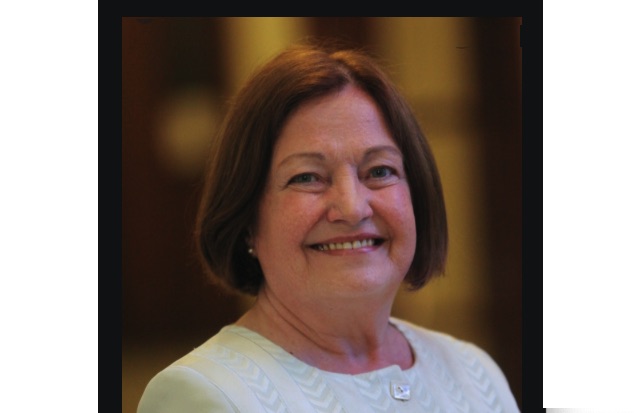
“The Doomsday Clock is a globally recognized indicator of the vulnerability of our existence,” Elder and former Irish President Mary Robinson said at the annual clock-unveiling ceremony, as NPR reported. “It’s a striking metaphor for the precarious state of the world, but most frighteningly, it’s a metaphor backed by rigorous scientific scrutiny.”

(Continued in right column)

Question related to this article:

Can we abolish all nuclear weapons?

(Continued from left column)

The two groups made their decision to move the clock closer to the zero hour based on the two threats of nuclear war and climate change, compounded by the rise of false information online and the refusal of world leaders to act on these critical issues.

“Civilization-ending nuclear war — whether started by design, blunder, or simple miscommunication — is a genuine possibility. Climate change that could devastate the planet is undeniably happening. And for a variety of reasons that include a corrupted and manipulated media environment, democratic governments and other institutions that should be working to address these threats have failed to rise to the challenge,” the bulletin wrote in a statement explaining its decision.

On the nuclear front, the group cited several concerning foreign policy developments. These included increased tensions between the U.S. and Iran, which has continued to stockpile uranium after the U.S. pulled out of a nuclear deal. The group also mentioned the official end of the Intermediate-Range Nuclear Forces (INF) Treaty, which has led the U.S. and Russia to begin developing previously banned weapons.

When speaking of climate change, the group called out the government of the U.S. for withdrawing from the Paris agreement and the government of Brazil for weakening protections for the Amazon rainforest. But it also spoke of the general failures of world leaders to make any significant progress at either September’s UN Climate Action Summit or December’s COP25 in Madrid.

The Doomsday Clock was set to two minutes to midnight in 2018 for the first time since 1953, when both the U.S. and the Soviet Union tested hydrogen bombs. In 2019, the clock stayed at two minutes, but this year the bulletin decided to move it forward even further.

The group did say that there were things world leaders and citizens could do to move the clock backwards again. When it comes to the environment, they recommended that world leaders recommit themselves to the goals of the Paris agreement and that U.S. citizens pressure their government to acknowledge climate change and to act to address it.

“We ask world leaders to join us in 2020 as we work to pull humanity back from the brink,” Robinson said in the press release. “The Doomsday Clock now stands at 100 seconds to midnight, the most dangerous situation that humanity has ever faced. Now is the time to come together – to unite and to act.”

Greta Thunberg Addresses Global Elite at Davos: Our House Is Still on Fire

. . SUSTAINABLE DEVELOPMENT . .

An article from Democracy Now (licensed under a Creative Commons Attribution-Noncommercial-No Derivative Works 3.0 United States License)

The 17-year-old Swedish climate activist Greta Thunberg delivered a speech Tuesday to the world leaders and global elite gathered in Davos, Switzerland, for the World Economic Forum, one year after she first condemned the forum for its inaction on climate change. “We don’t need a ‘low-carbon economy.’ We don’t need to ‘lower emissions.’ Our emissions have to stop,” Thunberg said. “And until we have the technologies that at scale can put our emissions to minus, then we must forget about net zero. We need real zero.”


Video of Thunberg speech

AMY GOODMAN: We end today’s show with the words of a 17-year-old: Swedish climate activist Greta Thunberg. She just turned 17 in the last weeks. She addressed world leaders today at the World Economic Forum in Davos, Switzerland.

GRETA THUNBERG: One year ago, I came to Davos and told you that our house is on fire. I said I wanted you to panic. I’ve been warned that telling people to panic about the climate crisis is a very dangerous thing to do. But don’t worry. It’s fine. Trust me. I’ve done this before. And I can assure you: It doesn’t lead to anything.

(article continued in right column)

Question for this article:

Despite the vested interests of companies and governments, Can we make progress toward sustainable development?

(Article continued from the left column)

And for the record, when we children tell you to panic, we’re not telling you to go on like before. We’re not telling you to rely on technologies that don’t even exist today at scale and that science says perhaps never will. We are not telling you to keep talking about reaching net zero emissions or carbon neutrality by cheating and fiddling around with numbers. We’re not telling you to offset your emissions by just paying someone else to plant trees in places like Africa, while at the same time forests like the Amazon are being slaughtered at an infinitely higher rate. Planting trees is good, of course, but it’s nowhere near enough of what is needed, and it cannot replace real mitigation and rewilding nature.

And let’s be clear: We don’t need a low-carbon economy. We don’t need to lower emissions. Our emissions have to stop, if we are to have a chance to stay below the 1.5-degree target. And until we have the technologies that at scale can put our emissions to minus, then we must forget about net zero. We need real zero, because distant net-zero emission targets will mean absolutely nothing if we just continue to ignore the carbon dioxide budget that applies for today, not distant future dates. If high emissions continue like now even for a few years, that remaining budget will soon be completely used up.

The fact that the U.S.A. is leaving the Paris accord seemed to outrage and worry everyone. And it should. But the fact that we are all about to fail the commitments you signed up for in the Paris Agreement doesn’t seem to bother the people in power even the least. Any plan or policy of yours that doesn’t include radical emission cuts at the source starting today is completely insufficient for meeting the 1.5- or well below 2-degree commitments of the Paris Agreement.

And again, this is not about right or left. We couldn’t care less about your party politics. From a sustainability perspective, the right, the left, as well as the center, have all failed. No political ideology or economic structure has been able to tackle the climate and environmental emergency and create a cohesive and sustainable world, because that world, in case you haven’t noticed, is currently on fire.

AMY GOODMAN: Seventeen-year-old Swedish climate activist Greta Thunberg addressing world leaders at the World Economic Forum in Davos, Switzerland. She spoke just after President Trump spoke at the gathering, touting the economy but not talking about the climate crisis, which is the focus of the World Economic Forum, the World Economic Forum in Davos. That does it for our show. We’ll post her whole speech online.

(Thank you to Phyllis Kotite, the CPNN reporter for this article.)

UNWomen: In lead up to Generation Equality Forum, Action Coalition themes announced

. WOMEN’S EQUALITY .

An article from UN Women

Today, UN Women, together with feminists across the world, and the Governments of Mexico and France, announced the  Action Coalition  themes for the Generation Equality Forum  to be held in Mexico City and Paris this year.


UN Women staff during Generation Equality Private Sector discussions in Kenya. Photo: UN Women/Kennedy Okoth

The Action Coalitions are global, innovative partnerships with governments, civil society, international organizations, and the private sector, to catalyze collective action, drive increased public and private investment, and deliver game-changing results for women and girls everywhere.

The Generation Equality Forum, a civil society-led global gathering convened by UN Women and co-hosted by the Governments of Mexico and France, taking place in Mexico City from 7 to 8 May, and in Paris from 7 to 10 July 2020, will launch the following six catalytic Action Coalitions:

1. Gender-Based Violence
2. Economic justice and rights
3. Bodily autonomy and sexual and reproductive health and rights (SRHR)
4. Feminist action for climate justice
5. Technology and innovation for gender equality
6. Feminist movements and leadership

The six themes were based on data-driven analysis and selected in consultation with international feminist groups, grassroots activist organizations, governments and other partners.

The Generation Equality Forum is taking place in the context of the 25th anniversary of the Beijing Declaration and Platform for Action, the most comprehensive blueprint for achieving gender equality and women’s rights, adopted by 189 countries in 1995.

(continued in right column)

Question for this article

Does the UN advance equality for women?

Prospects for progress in women’s equality, what are the short and long term prospects?

(continued from left column)

Despite some progress, real change has been slow, and no country has achieved gender equality.As the world faces unprecedented challenges, including climate crisis, rising inequality and threat to multilateralism, progress on girls’ and women’s rights is at risk.

The Action Coalitions, backed with financing and impactful partnerships, aim to make accelerated and irreversible progress to advance gender equality.
Each Action Coalition will be led by a group of partners, including: Member States, women’s movements and civil society organizations and the private sector, as well as UN agencies, other international organizations and youth leaders. 
Adolescent girls and young women are at the heart of Generation Equality, lifting up those who have been silenced, stigmatized and shamed far too long, and ensuring that no one is left behind. One of the concrete actions in each Action Coalition theme will specifically target the unique needs of adolescent girls and young women. 

Each Coalition will develop and implement targeted solutions that advance the rights of adolescent girls and young women during the UN Decade of Action  (2020 – 2030) to fulfill the Sustainable Development Goals.

In the coming months, the formation of Action Coalition leadership and membership will be advanced, as well as the development of “Blueprints” accompanying each Action Coalition, which will detail the expected goals, results, budget, a catalogue of commitments and the accountability framework.The upcoming UN Commission on the Status of Women  (9 – 20 March) and the Generation Equality Forum in Mexico (7-8 May) will provide opportunities for partners to come together and further elaborate upon the Action Coalition Blueprints.

The Action Coalitions will be officially launched during the Generation Equality Forum from 7 to10 July in Paris, and further amplified at the UN General Assembly in September 2020. 

For more information on Generation Equality Forum and the Action Coalitions, click here. Get involved and join the global campaign, #GenerationEquality  to make gender equality a reality within our lifetimes.

BlackRock goes green? Investment giant joins Climate Action 100+ amid controversy

. . SUSTAINABLE DEVELOPMENT . .

An article by Toby Hill from Green Biz

BlackRock became the latest signatory to Climate Action 100+, adding the substantial weight of its $6.8 trillion in assets under management to the investor engagement initiative that works to ensure the world’s largest corporate greenhouse gas emitters take action on climate change.

BlackRock joins 370 global investors already signed up to the scheme, bringing total assets under management by those participating to over $41 billion.

As signatories, investors commit to engaging with companies on a range of climate-related fronts. The group typically has called on firms to take bolder steps to reduce greenhouse gas emissions, implement a strong governance framework for managing climate-related risks and opportunities, and provide enhanced corporate disclosure in line with the recommendations of the Task Force on Climate-related Financial Disclosures (TCFD).

“BlackRock is one of the largest and most influential asset managers in the world and will bring even more heft to investor engagement through Climate Action 100+,” said Emily Chew, steering committee chair at Climate Action 100+. “We look forward to working with BlackRock to build on the initiative’s success and work to ensure companies take the urgent and necessary action needed in response to the climate crisis.”

(continued in right column)

Question for this article:

Divestment: is it an effective tool to promote sustainable development?

(continued from left column)

BlackRock’s decision to join the group builds on a series of recent statements on the importance of climate action from the influential investment giant.

CEO Larry Fink has highlighted “climate change” and “environmental risks and opportunities” as key engagement priorities in both his 2018  and 2019 letters to CEOs. The firm also  strengthened its proxy voting guidelines (PDF)  regarding climate change in January 2019.

Joining Climate Action 100+ “is a natural progression of the work our investment stewardship team has done,” BlackRock told Bloomberg in an emailed statement. “We believe evidence of the impact of climate risk on investment portfolios is building rapidly and we are accelerating our engagement with companies on this critical issue,” the firm added.

However, the U.S. investment giant also has faced criticism for sometimes failing to take concrete action on climate change when opportunities have presented themselves. Sustainability non-profit Ceres last year ranked BlackRock 43 among 48 asset managers in a green investment league table, finding it had backed just one in 10 climate-related proposals from shareholders. Indeed, in the past the firm has voted against shareholder proposals brought about by ClimateAction 100+ itself. Such inaction led former U.S. Vice President Al Gore to recently accuse the firm of being “full of greenwash.”

Climate finance experts welcomed BlackRock’s decision to join the group while emphasizing that the company had to work effectively with Climate Action 100+ to encourage more companies to develop ambitious climate strategies.

“Given the immediate need for companies, particularly in the fossil fuel heavy energy sector, to produce Paris-consistent transition plans, Blackrock’s support has just come at the right time,” said Carbon Tracker chairman Mark Campanale. “The challenge now is to see a ‘high bar’ on climate disclosure followed, as well as business alignment by fossil fuel companies such as Exxon, on the goals of the Paris agreement. Blackrock needs to lend its voice to the many involved in CA100+ calling for no new investment in expanding fossil fuel production.”

Book review: Cultural Diplomacy: No Bullet, No Blood

EDUCATION FOR PEACE .

From: Jay Holdings

“Emerging from financial crisis, world faces growing social inequality, mass immigration, diverse populations, extremism, radicalization, and various forms of threats. Disruptive strategies, expansion of technology and digital communication are transforming societies – changing lifestyles and consumer behavior, which is affecting the balance of economic power, stability, and world order. In such changing and volatile environment, the role of culture is more important than ever.” – Mosi Dorbayani, Author


Question for this article:

What are the most important books about the culture of peace?

This publication is a concise researched based material, which shares a multidimensional factual evidence on the influence and effectiveness of the subject matter worldwide. It furnishes its readers with the concept of ‘Cultural Diplomacy’, and it redefines the strategic thinking and applications of arts and culture for public engagement and public diplomacy.

Where to buy the book.

Mainstream media silence on OPCW Douma scandal ‘ridiculous’, says journalist gagged by Newsweek after scandalous leak

FREE FLOW OF INFORMATION

An article from RT news dated 28 December

The refusal of almost every Western media outlet to cover the leaks [published by Wikileaks] implicating the chemical weapons watchdog of doctoring its Syria report has become ridiculous, says a journalist who was barred from reporting it by Newsweek.


A damaged house where OPCW inspectors are believed to have visited in Douma in April 2018. ©REUTERS / Ali Hashisho

The refusal of almost every Western media outlet to cover the leaks [published by Wikileaks] implicating the chemical weapons watchdog of doctoring its Syria report has become ridiculous, says a journalist who was barred from reporting it by Newsweek.

“These documents are very conclusive in what they show,” Tareq Haddad told RT after the latest release of internal emails from the Organization for the Prohibition of Chemical Weapons (OPCW) on Friday. The latest batch indicated an effort by the OPCW management to silence dissenting voices and cover up the very fact that there was evidence contradicting the West-favored narrative about the April 2018 incident in Douma, Syria.

(Article continued in the column on the right)

Question related to this article:
 
Free flow of information, How is it important for a culture of peace?

(Article continued from the column on the left)

The OPCW report stopped short of accusing the government of President Bashar Assad of dropping chemical weapons on the Damascus neighborhood, which was held by jihadists at the time, and killing scores of civilians. It gave a post-factum rationale for airstrikes conducted by the US, the UK and France in the wake of the incident.

He told RT the point when the story could be legitimately reported came several weeks ago, so the continued media obfuscation “has reached the point where it’s a bit ridiculous,” and amounts to abdication of responsibility to inform the public.

“I’m sure there are hundreds if not thousands of well-meaning journalists, who understand what the essence of journalism is. I am sure they want to write this story,” he said. “All I can say is: please, push this story. Even though I have resigned I don’t want the mainstream media to be dismissed as ‘fake news’. I want it to be respected.”

[Editor’s note: As of 31 December, a search in Google reveals many Internet publications have referred to the reports published in Twitter by Wikileaks about the OPCW cover-up. These include publications based in Russia, Iran, Turkey, Lebanon and Portugal, as well as numerous alternative media (but no major commercial media) based in the UK, Canada and USA.]

International Peace Bureau: the ‘carbon boot-print’

. . SUSTAINABLE DEVELOPMENT . .

An information paper by Jessica Fort and Philipp Straub from the International Peace Bureau and a press release from the IPB

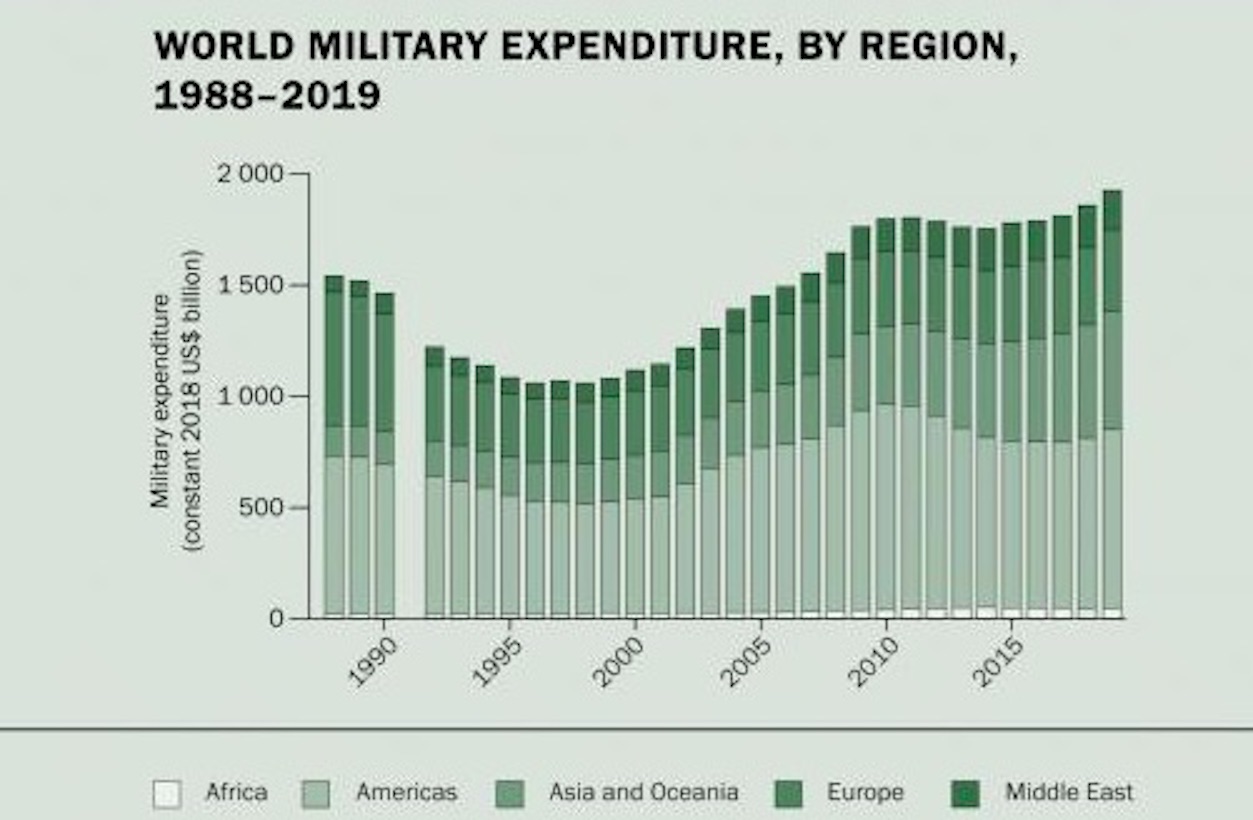
The US military is not only the most funded army in the world, it is also “one of the largest polluters in history, consuming more liquid fuels and emitting more climate-changing gases than most medium-sized countries”. The Department of Defence’s daily consumption alone is greater than the total national consumption of countries like Sweden, Switzerland or Chile. And the US has been continuously at war, or engaged in military actions, since late 2001.

War and militarism, and their associated ‘carbon boot-prints’, are severely accelerating climate change. However, the military’s significant contribution to climate change has still received little attention. It is not only the US army that has a severe impact on climate change, Europe’s military is also running its bases and its various operations and contributing to the rise in carbon emissions. However, obtaining accurate data about any form of military energy consumption is very difficult.

(continued in right column)

Question for this article:

What is the relation between the environment and peace

Despite the vested interests of companies and governments, Can we make progress toward sustainable development?

(continued from left column)

The entire IPB Information Paper by Jessica Fort and Philipp Straub is available here: IPB Information Paper – the carbon boot-print

IPB stresses the COP25 to include the military in its climate action work and to adopt provisions covering military compliance. The COP25 must include military emissions in their calculations and the CO2 emissions laundering has to stop. It should also include a blueprint to reduce military emissions.

IPB urges the State Parties to the Paris Agreement to adjust its provision to military emissions, not leaving decisions up to nation states as to which national sectors should make emissions cuts.

IPB calls for an inclusion of military greenhouse gas emission into climate change regulations. Moreover, countries need to be obliged, without exemption, to cut military emissions and transparently report them.

IPB calls for more academic studies (in line with the study from Brown University report) and an IPCC or equal special report. The report needs to be a common project of academics and the civil society. [Crawford N (2019). Pentagon Fuel Use, Climate Change, and the Costs of War. Brown University, USA ]

UN committee adopts youth resolution on disarmament and non-proliferation

FREE FLOW OF INFORMATION

An article by Marzhan Nurzhan in the Astana Times

The First Committee of the United Nations General Assembly at its recent 74th session adopted the resolution Youth, Disarmament and Non-Proliferation.

The resolution recognises the role of young people as key agents for social change and acknowledges the positive contributions of youth engagement to sustainable peace and security.

There were two resolutions previously adopted by the United Nations Security Council highlighting the importance of engaging youth in processes related to peace and security:  resolution 2250 (2015) on youth, peace and security, and resolution 2419 (2018) on the role of youth in peace negotiations and implementing peace agreements.

Furthermore, Secretary-General Antonio Guterres released a non-paper entitled Securing Our Common Future: An Agenda for Disarmament, where the role of young people as drivers of change was emphasised, along with the need for sustainability and long-term engagement of youth and further investment in disarmament education. Inequalities connected with geographical location of youth coming from developing countries can limit access or create barriers towards representative participation in the international opportunities in the field of disarmament and non-proliferation.

Despite these challenges, young people are open to new experiences, use creativity to generate novel ideas, have enduring energy, pursue high levels of cooperation and regard themselves as world citizens standing up for one planet. They believe in a common future and simultaneously seek opportunity for actions at local and national levels. Young people can be identified as more inclusive, cosmopolitan, with solution-oriented mindsets. They also promote impactful activities that affect the well-being of everyone.

(continued in right column)

Question(s) related to this article:

Youth initiatives for a culture of peace, How can we ensure they get the attention and funding they deserve?

What is the United Nations doing for a culture of peace?

(continued from left column)

Climate change is now included as mandatory subject in formal learning process in Italy. This could serve as an example to follow by incorporating the theme of disarmament and non-proliferation in public education. However, non-formal education and online courses have changed the way we obtain, apply, and disseminate knowledge. These approaches have also altered practice we reach out to young people worldwide, especially in the specific area of disarmament and non-proliferation. It is important to raise awareness about the history of nuclear testing and humanitarian consequences, which is mainly associated with the Cold War. For that reason, fostering intergenerational cooperation and promoting peer-to-peer distribution of information, knowledge and skills are crucial.

Thus, the resolution “stresses the importance of realizing the full potential of young people through education and capacity-building, bearing in mind the ongoing efforts and the need to promote the sustainable entry of young people into the field of disarmament and non-proliferation.”

Therefore, CTBTO Youth Group (CYG) prior to the adoption of the resolution established this network to involve youth in a constructive and inclusive manner, considering regional balance. CYG equips next generation with extra-curricular education, such as e-learning modules  about the CTBT and its verification regime. In addition, CYG portal provides supplementary lists of educational resources  that comprise not only information about nuclear issues but also other weapons of mass destruction. CYG members have opportunity to participate in a meaningful way at the various international events, in particular the Science and Technology conference series and the Science Diplomacy Symposia. At these events, CYG members can enjoy mentorship networks with GEM filling the generational gap in the area of disarmament and non-proliferation.

Empowering youth through education means promoting leadership and courage to build presence and future we want without nuclear tests and explosions. Research and development of innovative initiatives can lead to the transformative changes for global peace and security through science and diplomacy with the direct impact and influence of actions  conducted by young people. With the adoption of the resolution Youth, Disarmament and Non-Proliferation, it re-affirms work and endeavour of the CTBTO Youth Group and serves as an impetus for even more youth engagement to finish what we started.

Full text of the resolution is available at https://undocs.org/en/A/C.1/74/L.48

List of educational resources: https://youthgroup.ctbto.org/node/2237

The author is an intern, External Relations, Protocol and International Cooperation Section, Comprehensive Nuclear-Test-Ban Treaty Organisation (CTBTO). This opinion first appeared at CTBTO Youth Group website here.

[Editor’s note: The resolution was drafted by South Korea.

Global Campaign for Peace Education: Year-end review

… EDUCATION FOR PEACE …

An article from the Global Campaign for Peace Education

Dear reader, Season’s Greetings! As fall turns to winter here in Washington, DC, we are fond of reminiscing on the many changes and experiences we’ve had thus far in 2019.


Amongst the highlights, we held a big celebration to honor the 90th birthday of Betty Reardon, co-founder of the Global Campaign; we helped launch advocacy campaigns in Cameroon and Nigeria; and we kicked-off Peace Knowledge Press, our new publishing house.

To wind down the year, I just returned from Ukraine where I joined colleagues from the Global Partnership for the Prevention of Armed Conflict (GPPAC) Peace Education Working Group to strategize efforts for scaling up peace education from the grassroots to the country level. The Global Campaign will be partnering with GPPAC on an ambitious new project in 2020 to help map the field of peace education – stay tuned for more details!

(Continued in right column)

Question for this article:

Where is peace education taking place?

(Continued from left column)

Be sure to check out and share the many new events and job postings shared below. As always, we welcome you to submit your own news, articles, research, and events to share with other campaign members. You can submit your articles for sharing via our online form.

All-in-all, energy continues to bubble up around the world for mainstreaming peace education. We hope you find the actions of our colleagues contained in this month’s newsletter hopeful, and contagious, and embark on new efforts to develop and grow peace education in your community.

Please don’t forget to help us “spread peace ed” by using the hashtags #SpreadPeaceEd and #PeaceEd, following us on social media, and by sharing and reposting news on your timeline and in your communities. This is one small way each of us can help grow the campaign. You can also follow the Global Campaign on Facebook and Twitter.

In peace & solidarity,

Tony Jenkins

Coordinator, Global Campaign for Peace Education