Tag Archives: global

The Global South refuses pressure to side with the West on Russia

FREE FLOW OF INFORMATION

An article by  by Vijay Prashad in Peoples Dispatch

Europe and the US ignore Africa, Latin America, and Asia’s calls to find a solution that ends the war in Ukraine—and, as Namibia’s prime minister put it, redirect funds spent on weapons toward solving global issues.


Francia Márquez Vice President, Republic of Colombia speaking at the Munich Security Conference next to Namibia’s Prime Minister Saara Kuugongelwa-Amadhila, Enrique Manalo (Secretary of Foreign Affairs, Republic of the Philippines) and Mauro Luiz Iecker Vieira (Minister of Foreign Affairs, Federative Republic of Brazil). Photo: MSC/Baier

At the G20 meeting in Bengaluru, India, the United States arrived with a simple brief. US Treasury Secretary Janet Yellen said at the February 2023 summit that the G20 countries must condemn Russia for its invasion of Ukraine and they must adhere to US sanctions against Russia. However, it became clear that India, the chair of the G20, was not willing to conform to the US agenda. Indian officials said that the G20 is not a political meeting, but a meeting to discuss economic issues. They contested the use of the word “war” to describe the invasion, preferring to describe it as a “crisis” and a “challenge.” France  and Germany  have rejected this draft if it does not condemn Russia.

At the G20 meeting in Bengaluru, India, the United States arrived with a simple brief. US Treasury Secretary Janet Yellen said at the February 2023 summit that the G20 countries must condemn Russia for its invasion of Ukraine and they must adhere to US sanctions against Russia. However, it became clear that India, the chair of the G20, was not willing to conform to the US agenda. Indian officials said that the G20 is not a political meeting, but a meeting to discuss economic issues. They contested the use of the word “war” to describe the invasion, preferring to describe it as a “crisis” and a “challenge.” France and Germany have rejected this draft if it does not condemn Russia.

Just as in Indonesia during the previous year’s summit, the 2023 G20 leaders are once again ignoring the pressure from the West to isolate Russia, with the large developing countries (Brazil, India, Indonesia, Mexico, and South Africa) unwilling to budge from their practical view that isolation of Russia is endangering the world.

The next two G20 summits will be in Brazil (2024) and South Africa (2025), which would indicate to the West that the platform of the G20 will not be easily subordinated to the Western view of world affairs.

Most of the leaders of the G20 countries went to Bengaluru straight from Germany, where they had attended the Munich Security Conference. On the first day of the Munich conference, France’s President Emmanuel Macron said  that he was “shocked by how much credibility we are losing in the Global South.” The “we” in Macron’s statement was the Western states, led by the United States.

What is the evidence for this loss of credibility? Few of the states in the Global South have been willing to participate in the isolation of Russia, including voting  on Western resolutions in the United Nations General Assembly. Not all of the states that have refused to join the West are “anti-Western” in a political sense. Many of them—including the government in India—are driven by practical considerations, such as Russia’s discounted energy prices and the assets being sold at a lowered price by Western companies that are departing from Russia’s lucrative energy sector. Whether they are fed up with being pushed around by the West or they see economic opportunities in their relationship with Russia, increasingly, countries in Africa, Asia, and Latin America have avoided the pressure coming from Washington to break ties with Russia. It is this refusal and avoidance that drove Macron to make his strong statement about being “shocked” by the loss of Western credibility.

(Article continued in the column on the right)

Question related to this article:
 
Free flow of information, How is it important for a culture of peace?

(Article continued from the column on the left)

At a panel discussion  on February 18 at the Munich Security Conference, three leaders from Africa and Asia developed the argument about why they are unhappy with the war in Ukraine and the pressure campaign upon them to break ties with Russia. Brazil’s Foreign Minister Mauro Vieira—who later that day condemned  the Russian invasion of Ukraine in a tweet — called  upon the various parties to the conflict to “build the possibility of a solution. We cannot keep on talking only of war.”

Billions of dollars of arms have been sent by the Western states to Ukraine to prolong a war that needs to be ended before it escalates out of control. The West has blocked  negotiations ever since the possibility of an interim deal between Russia and Ukraine arose in March 2022. The talk of an endless war by Western politicians and the arming of Ukraine have resulted in Russia’s February 21, 2023, withdrawal from the New START treaty, which—with the unilateral withdrawal of the US from the Anti-Ballistic Missile Treaty in 2002 and the Intermediate Nuclear Forces Treaty in 2019—ends the nuclear weapons control regime.

Vieira’s comment about the need to “build the possibility of a solution” is one that is shared across the developing countries, who do not see the endless war as beneficial to the planet. As Colombia’s Vice President Francia Márquez said  on the same panel, “We don’t want to go on discussing who will be the winner or the loser of a war. We are all losers, and, in the end, it is humankind that loses everything.”

The most powerful statement in Munich was made by Namibia’s Prime Minister Saara Kuugongelwa-Amadhila. “We are promoting a peaceful resolution of that conflict” in Ukraine, she said, “so that the entire world and all the resources of the world can be focused on improving the conditions of people around the world instead of being spent on acquiring weapons, killing people, and actually creating hostilities.” When asked why Namibia abstained at the United Nations on the vote regarding the war, Kuugongelwa-Amadhila said, “Our focus is on resolving the problem… not on shifting blame.” The money used to buy weapons, she said, “could be better utilized to promote development in Ukraine, in Africa, in Asia, in other places, in Europe itself, where many people are experiencing hardships.” A Chinese plan for peace in Ukraine—built on the principles of the 1955 Bandung Conference—absorbs the points raised by these Global South leaders.

European leaders have been tone-deaf to the arguments being made by people such as Kuugongelwa-Amadhila. The European Union’s High Representative for Foreign Affairs and Security Policy Josep Borrell had earlier shot himself in the foot with his ugly remarks  in October 2022 that “Europe is a garden. The rest of the world is a jungle. And the jungle could invade the garden… Europeans have to be much more engaged with the rest of the world. Otherwise, the rest of the world will invade us.” In the February 2023 Munich Security Conference, Borrell—who is originally from Spain — said  that he shared “this feeling” of Macron’s that the West had to “preserve or even to rebuild trustful cooperation with many of the so-called Global South.” The countries of the South, Borrell said, are “accusing us of [a] double standard” when it comes to combating imperialism, a position that “we must debunk.”

A series of reports published by leading Western financial houses repeat the anxiety of people such as Borrell. BlackRock notes  that we are entering “a fragmented world with competing blocs,” while Credit Suisse points  to the “deep and persistent fractures” that have opened up in the world order. Credit Suisse’s assessment of these “fractures” describes them accurately: “The global West (Western developed countries and allies) has drifted away from the global East (China, Russia, and allies) in terms of core strategic interests, while the Global South (Brazil, Russia, India, and China and most developing countries) is reorganizing to pursue its own interests.”

This reorganization is now manifesting itself in the refusal by the Global South to bend the knee to Washington.

Vijay Prashad is an Indian historian, editor, and journalist. He is a writing fellow and chief correspondent at Globetrotter. He is an editor of LeftWord Books and the director of Tricontinental: Institute for Social Research. He is a senior non-resident fellow at Chongyang Institute for Financial Studies, Renmin University of China. He has written more than 20 books, including The Darker Nations and The Poorer Nations. His latest books are Struggle Makes Us Human: Learning from Movements for Socialism and (with Noam Chomsky) The Withdrawal: Iraq, Libya, Afghanistan, and the Fragility of US Power.

Nobel Peace Prize 2023: PRIO Director’s Shortlist Announced

…. HUMAN RIGHTS ….

An article from the Peace Research Institute Oslo

The director of the Peace Research Institute Oslo (PRIO), Henrik Urdal, announced his shortlist today for the 2023 Nobel Peace Prize, with human rights activists topping the list. 
The 2023 shortlist comprises of:

1. Narges Mohammadi and Mahbouba Seraj
2. Kyaw Moe Tun and Myanmar’s National Unity Consultative Council
3. The International Court of Justice
4. Victoria Tauli-Corpuz and Juan Carlos Jintiach
5. Human Rights Data Analysis Group


Left to right: Mahbouba Seraj and Narges Mohammadi

“History has shown us that respect for human rights is intrinsically linked to peaceful societies. The non-violent struggle for human rights is therefore a valuable contribution to peace and stability, and an advancement of the ‘fellowship among nations’ as stipulated by Alfred Nobel in his will. As this year marks the 75th anniversary of the Universal Declaration of Human Rights, my Nobel shortlist reflects a timely and worthy focus on human rights defenders and activists,” said Henrik Urdal.

Each year, PRIO’s director presents his own shortlist for the Nobel Peace Prize. He offers his opinion on the most worthy potential laureates, based on his independent assessment. The PRIO director’s view on potential and worthy Nobel Peace Prize laureates is widely recognized and has been offered since 2002. Henrik Urdal presents here his sixth list since taking up the position of director in 2017.

Narges Mohammadi and Mahbouba Seraj

Oppressive regimes in Iran and Afghanistan have drastically reversed women’s rights in the past year, from executing Iranian youths for protesting gender inequality, to banning Afghan women attending university. Research shows that more gender-equal societies are more peaceful. If the Nobel Committee would like to shine a spotlight on the non-violent struggle for human rights as a contribution to peace, Narges Mohammadi and Mahbouba Seraj are highly deserving nominees to share the prize, based on their tireless efforts to improve women’s rights in Iran and Afghanistan.

Narges Mohammadi is a leading Iranian human rights activist and journalist who has campaigned for women’s rights and the abolition of the death penalty. She has spent multiple periods in prison in Iran and is currently serving a long prison sentence for charges including spreading ‘propaganda against the state’. Her imprisonment has been internationally denounced. Mohammadi is deputy head of the Defenders of Human Rights Center, which is led by the 2003 Nobel Peace Prize laureate, Shirin Ebadi. She was also elected President of the Executive Committee of the National Council of Peace in Iran.

Mahbouba Seraj is a prominent Afghan journalist and women’s rights activist. After 26 years in exile, she returned to Afghanistan in 2003, and is now based in Kabul. She is a champion of children’s health, education, fighting corruption and empowering survivors of domestic abuse. She is also the founder of the nonprofit Afghan Women’s Network and the Organization for Research in Peace and Solidarity, and has pushed for women’s participation in the Peace Jirga and the High Peace Council.

Kyaw Moe Tun and Myanmar’s National Unity Consultative Council

Since the coup d’état on 1 February 2021, Myanmar’s military has reportedly killed over 2,800 people and detained more than 17,400. The UN has stated that the military brutality against the population amounts to crimes against humanity and possible war crimes. For their efforts to inclusively work for peace and democracy, and to end the violence by the security forces, Myanmar’s representative to the United Nations, Ambassador Kyaw Moe Tun, and the National Unity Consultative Council (NUCC) would be worthy recipients of the 2023 Nobel Peace Prize.

Ambassador Kyaw Moe Tun denounced the military coup soon after it occurred, calling on states not to recognize or legitimize the junta. Since then, he has represented the people of Myanmar in the UN on behalf of the National Unity Government that was formed by elected members of parliament, representatives of various ethnic groups and civil society leaders. Ambassador Kyaw Moe Tun has used his position to convey the voices of the Myanmar people to the international community.

The NUCC aims to end all forms of dictatorship and to build a federal democratic union in Myanmar that fully guarantees democracy, national equality and self-determination. It is an inclusive body with representatives from elected members of parliament, political parties, civil society organizations, officials from the civil disobedience movement and strike organizations, and ethnic resistance organizations.

(Article continued in the right column)

Question related to this article:

What is the state of human rights in the world today?

Where in the world can we find good leadership today?

How can just one or a few persons contribute to peace and justice?

(Article continued from the left column)

International Court of Justice

Mechanisms for peaceful resolution of conflicts between states are particularly important to maintain and support peace in an increasingly polarized world. The International Court of Justice (ICJ)  promotes peace through international law, akin to promoting peace congresses, another achievement highlighted in Alfred Nobel’s will. The ICJ would be a worthy recipient of the 2023 Peace Prize should the Nobel Committee wish to recognize the importance of multilateral collaboration for peaceful relations.

The ICJ was established in 1945 by the Charter of the UN to settle legal disputes between states and advise on legal questions within the UN. With all 193 UN member states party to the ICJ Statute, the Court has become a globally accepted multilateral mechanism for dispute resolution. While a Nobel Peace Prize to the ICJ would largely be seen as uncontroversial, the Court acted boldly and early on 16 March 2022 by ordering Russia to ‘immediately suspend the military operations’ in Ukraine. The Nobel Committee could emphasize this ruling as an attempt to stop an illegal war of aggression.

Other potential candidates for a prize focused on peace through international law are the International Criminal Court (ICC), or regional bodies such as the European Court for Human Rights or the Inter-American Court of Human Rights.

Victoria Tauli-Corpuz and Juan Carlos Jintiach

Discrimination and injustice against indigenous peoples stokes tensions between communities that can lead to violence and armed conflict. The non-violent struggle to protect and strengthen the rights of indigenous peoples is a laudable rationale for being awarded the Peace Prize. Two worthy campaigners for the rights of indigenous peoples are Victoria Tauli-Corpuz and Juan Carlos Jintiach. This would also be an environmental prize for conservation action and the fight against climate change.

Philippine-born indigenous rights activist Victoria Tauli-Corpuz has worked for many years to advance the rights of indigenous peoples across the world. She served as the Chair of the UN Permanent Forum on Indigenous Issues and as the UN Special Rapporteur on the Rights of Indigenous Peoples. Tauli-Corpuz founded and heads Tebtebba, the Indigenous Peoples’ International Centre for Policy Research and Education. She has also worked extensively with tropical forest conservation and against destructive development projects, climate change, social justice issues and the advancement of indigenous peoples’ and women’s rights.

Similarly, the Ecuadorian indigenous leader Juan Carlos Jintiach has played a key role in elevating the voices of indigenous peoples. He is a democratically elected leader of COICA (the federation representing Indigenous organizations in the Amazon Basin) and an active member of multiple indigenous rights groups. He served as the co-chair of the global indigenous caucus in the international indigenous forum on climate change within the UN Framework Convention on Climate Change. Jintiach has worked to connect the concerns of communities on the ground with global policy arenas, and has served as a consensus-building voice among these actors.

Human Rights Data Analysis Group

Research and knowledge can play an important role in promoting peace. A Nobel Peace Prize for organizations working to mobilize research and education in the service of preventing conflict would highlight the importance of truth-seeking and facts in the face of the propagation of divisive disinformation.

One such organization that would be a worthy recipient of a Nobel Peace Prize is the Human Rights Data Analysis Group (HRDAG). Based in the United States, HRDAG systematically documents and analyses data on human rights abuses. Founded by Patrick Ball, the organization aims to promote accountability for human rights violations through rigorous, non-partisan science.

Other worthy candidates for a prize focused on documenting human rights violations include the research agency Forensic Architecture, and the investigative journalism groups Bellingcat and Lighthouse Reports.


Background on the Nobel Peace Prize

The Nobel Peace Prize is arguably the most prestigious prize in the world. It is awarded annually by the Norwegian Nobel Committee to persons or organizations for their efforts to promote peace. The Norwegian Nobel Committee  bases its decision on valid nominations received by the 31 January deadline. Anyone can be nominated. Indeed, history has presented us with a few rather dubious nominees, including Hitler. The right to nominate  is reserved for members of national assemblies and governments, current and former members of the Committee, Peace Prize laureates, professors of certain disciplines, directors of peace research and foreign policy institutes, and members of international courts.

The five committee members have until their first meeting after the deadline to add nominations of their own. Urdal abstains from using his right to nominate, given his active role in commenting on the prize. He has no association with the Nobel Institute or the Norwegian Nobel Committee. The laureate will be announced in October.

Tourism as a force for Global Peace

. . SUSTAINABLE DEVELOPMENT . .

An article by Ajay Prakash from Peace Tourism

Tourism is a large industry but it is also a complex one since, unlike most other industries, there is not one clear product. It incorporates many aspects, including accommodation, transport, attractions, travel companies, and more. It comprises a broad group of businesses focused on the satisfaction of customers and providing specific experiences for them. It is unique because it’s an industry that is based completely on connecting people across all boundaries of race, religion or nationality and bringing joy to their lives.


 Ajay Prakash, President – Travel Agents Federation of India

India has assumed the Chair of the prestigious G20 and this is the perfect opportunity to emphatically present before the world all that India has to offer. Our traditional values, our Sanskar of universal love and brotherhood, of tolerance and acceptance, of embracing unity in diversity and of welcoming the guest with the expression Atihi Devo Bhava are India’s gift to the world. This is the opportunity to step up what I would term our “Cultural Diplomacy” – to present afresh Indian values, knowledge and leadership to the world through both, government to government and people to people initiatives.

Tourism offers great opportunities for emerging economies and developing countries. It creates jobs, strengthens the local economy and contributes to infrastructure development; it can help to conserve the natural environment, cultural assets and traditions, to reduce poverty and inequality and to heal the wounds of conflict. It is an industry that has a cascading and multiplier effect on many other industries, thereby providing a major boost to the economy.

The economic aspect and effect of tourism has been well documented – It accounts for almost 10% of global GDP and employs 1 in 10 persons (of course these are pre-Covid numbers because the industry took a huge hit in 2020 and 2021) and traditionally the tourism growth curve has always been ahead of the GDP growth curve by a couple of percentage points.

But its impact goes far beyond the economic benefits and it is worthwhile to look at Tourism as a social force as opposed to an industry and how we can use it to establish a Culture of Peace.

Tourism is about connecting people with each other and with the Planet. When you travel with a gentle heart and an open mind, you discover that the differences that seemingly divide us pale into insignificance before all the common needs, aspirations and desires that are universal across nations, races or religions. We all want good homes, a bright future for our children, a healthy environment free from disease, clean water, the support of our communities … and Peace. We all share the same ideals, hopes and aspirations and travel teaches us that diversity is no need for antagonism.

Mark Twain said it very well “Travel is fatal to prejudice, bigotry, and narrow-mindedness, and many of our people need it sorely on these accounts. Broad, wholesome, charitable views of men and things cannot be acquired by vegetating in one little corner of the earth all one’s lifetime.”

It’s obvious to everyone that Peace is a prerequisite for the success of tourism, but the converse is equally true and Tourism can also be a powerful force to foster Peace. But first, let us redefine Peace. Peace has to be marked by a presence, not an absence – it is not simply the absence of war or conflict; it is the presence of tolerance, of acceptance of love and understanding.

The Dalai Lama said “Peace does not mean an absence of conflicts; differences will always be there. Peace means solving these differences through peaceful means; through dialogue, education, knowledge and through humane ways.”
37 years ago, in 1986, a visionary man called Louis D’Amore established the International Institute for Peace through Tourism or IIPT. It was established with a vision that tourism, one of the largest industries, could become the first global Peace industry and the firm belief that every traveller is potentially an Ambassador of Peace.

(continued in right column)

Question related to this article:

How can tourism promote a culture of peace?

(continued from left column)

IIPT has only one purpose – to spread greater awareness of the power of Tourism as a vehicle for Peace. The aim of “Peace through Tourism” is to eliminate, or at least reduce, the conditions which lead us to a perception that violence is necessary.

So how do we do this?

The first step is to understand that we can make a difference, that we matter! Tourism is a huge industry; if we account for 10% of global GDP surely we are an industry that can make its voice heard and we are an industry that can influence global events. But for that we have to come together and we have to realize that we have the power. Like other industries, we too need to lobby the government so as to make an impact at the policy level.

The effects of climate change are all around us. What we term natural disasters are often the result of unchecked human activity – glaciers melting, sea levels rising, unseasonal floods and uncontrollable fires, toxic air and contaminated water. Is this the world we wish to leave for our children?

Along with 190 countries India has signed the COP 15 pledge of 30 by 30 – a pledge to preserve at least 30% of global biodiversity by 2030. That is a step in the right direction. Many such steps are needed for the sustainability of the Earth – still the only home for human beings in this vast universe.

We have to prepare our travellers and ourselves to make the change. As stakeholders in the industry we have to build sustainability and responsibility into our core business practices. It can be as small as keeping the air conditioning at 25 degrees, switching off lights when they’re not needed, avoiding single use plastics or the compulsive printing of every document. It could be as large as converting your entire fleet to electric vehicles. Once you start on the path of conservation, the opportunities will keep coming. The magic mantra is “Refuse, Reduce, Recycle.”

Never underestimate the power of one. A river starts as a drop, a few more drops join and it becomes a trickle, the trickle becomes a stream and finally it’s a mighty river that sustains life until it goes and meets the sea. That is how movements are born, too. Let us today resolve to work for a more responsible, peace-sensitive tourism.

Another area where the tourism industry can make a big difference is in promoting gender equality. Almost 65 – 70% of the workforce in tourism is female, but only 12 – 13% of them are in responsible or managerial positions. Women comprise almost half the world’s population, but they have never got an equal chance. The “Beti padhao, beti bachao” is a great initiative but then they also need to be given the opportunity to put that education to use. Numerous studies have proved that empowering women is not only socially or politically correct, but that it actually leads to a healthier bottom line.

The next step is to educate our travellers, to awaken them to the higher paradigm of tourism. If they are travelling to a new place, we need to sensitise them to the social and cultural differences, we need to create experiences and situations where they can interact positively with the local host community, we need to encourage them to buy local products, try local food. Many times this push will come from the travellers themselves.

Today’s travellers are much more tech savvy, they’re more aware, they’re more discerning and the younger generation is much more conscious of the ecological footprint of any activity. So if that’s the segment you want to connect with, now is the time to rework your business strategy.

The IIPT has a global Peace Parks program and has dedicated over 450 Peace Parks across the world. We need to create such symbols to reassert that Peace is a fundamental global right and that India is willing and able to lead the way.

In conclusion, I present the IIPT Credo of the Peaceful Traveller as a first step on the path to use tourism to foster a Culture of Peace.

IIPT Credo of the Peaceful Traveller©

Grateful for the opportunity to travel and experience the world and because peace begins with the individual, I affirm my personal responsibility and commitment to:
* Journey with an open mind and gentle heart
* Accept with grace and gratitude the diversity I encounter
* Revere and protect the natural environment which sustains all life
* Appreciate all cultures I discover
* Respect and thank my hosts for their welcome
* Offer my hand in friendship to everyone I meet
* Support travel services that share these views and act upon them and,
* By my spirit, words and actions, encourage others to travel the world in peace.
 

United Nation General Assembly divides over Ukraine resolution and Belarus amendment

FREE FLOW OF INFORMATION

Analysis by CPNN

The United States and its allies claimed victory at the United Nations with the vote on a resolution condemning the Russian invasion of the Ukraine. The final vote was 141 for, 7 against and 32 abstentions.

But a thorough analysis suggests that the victory was not so one-sided. If one considers the votes on the Belarus amendment to condemn arms shipments to the Ukraine, the General Assembly was divided with more than half (101 countries) failing to follow the American line regarding the vote on this amendment.

Of the 91 votes that defeated the Belarus amendment, 45 were cast by Europe and the US/Canada while 46 by all the rest of the world.


Voting on Belarus resolution condemning arms shipments to Ukraine

Here are the operative paragraphs of the two resolutions and the voting details.

Principles of the Charter of the United Nations underlying a comprehensive, just and lasting peace in Ukraine Draft resolution A/ES-11/L.7

1. Underscores the need to reach, as soon as possible, a comprehensive, just and lasting peace in Ukraine in line with the principles of the Charter of the United Nations;

2. Welcomes and expresses strong support for the efforts of the SecretaryGeneral and Member States to promote a comprehensive, just and lasting peace in Ukraine, consistent with the Charter, including the principles of sovereign equality and territorial integrity of States;

3. Calls upon Member States and international organizations to redouble support for diplomatic efforts to achieve a comprehensive, just and lasting peace in Ukraine, consistent with the Charter;

4. Reaffirms its commitment to the sovereignty, independence, unity and territorial integrity of Ukraine within its internationally recognized borders, extending to its territorial waters;

5. Reiterates its demand that the Russian Federation immediately, completely and unconditionally withdraw all of its military forces from the territory of Ukraine within its internationally recognized borders, and calls for a cessation of hostilities;

6. Demands that the treatment by the parties to the armed conflict of all prisoners of war be in accordance with the provisions of the Geneva Convention relative to the Treatment of Prisoners of War of 12 August 1949 2 and Additional Protocol I to the Geneva Conventions of 1949, 3 and calls for the complete exchange of prisoners of war, the release of all unlawfully detained persons and the return of all internees and of civilians forcibly transferred and deported, including children;

7. Calls for full adherence by the parties to the armed conflict to their obligations under international humanitarian law to take constant care to spare the civilian population and civilian objects, to ensure safe and unhindered humanitarian access to those in need, and to refrain from attacking, destroying, removing or rendering useless objects indispensable to the survival of the civilian population;

8. Also calls for an immediate cessation of the attacks on the critical infrastructure of Ukraine and any deliberate attacks on civilian objects, including those that are residences, schools and hospitals;

9. Emphasizes the need to ensure accountability for the most serious crimes under international law committed on the territory of Ukraine through appropriate, fair and independent investigations and prosecutions at the national or international level, and ensure justice for all victims and the prevention of future crimes;

10. Urges all Member States to cooperate in the spirit of solidarity to address the global impacts of the war on food security, energy, finance, the environment and nuclear security and safety, underscores that arrangements for a comprehensive, just and lasting peace in Ukraine should take into account these factors, and calls upon Member States to support the Secretary-General in his efforts to address these impacts;

11. Decides to adjourn the eleventh emergency special session of the General Assembly temporarily and to authorize the President of the General Assembly to resume its meetings upon request from Member States.

Belarus: A/ES-11/L.9 – amendment to draft resolution A/ES-11/L.7

1 ; After the eighth preambular paragraph, insert a new preambular paragraph reading: Noting with concern the continuing supply of weapons by third parties to the zone of conflict that obstructs the prospects for sustainable peace,

2. After operative paragraph 5, insert a new operative paragraph reading: Calls for the start of peace negotiations;

3. After existing operative paragraph 10, insert a new operative paragraph reading: Calls upon Member States to address the root causes of the conflict in and around Ukraine, including legitimate security concerns of Member States;

4. After existing operative paragraph 10, insert a new operative paragraph reading: Also calls upon Member States to refrain from sending weapons to the zone of conflict.

(Article continued in the column on the right)

Question related to this article:
 
Free flow of information, How is it important for a culture of peace?

(Article continued from the column on the left)

Here are the voting details of the 101 countries that did not follow the American line regarding the vote on the Belarus amendment.

15 countries voted for the Belarus amendment

Angola
Belarus
China
Cuba
North Korea
Egypt
Eritrea
Ethiopia
Honduras
Iran
Mali
Nicaragua
Russia
Syria
Zimbabwe

52 countries abstained on the Belarus amendment

Afghanistan
Algeria
Bahrain
Bangladesh
Bhutan
Bolivia
Botswana
Brazil
Brunei Daresalam
Burundi
Colombia
Congo
Djibouti
El Salvador
Gabon
Ghana
Guinea
Guyana
India
Indonesia
Iraq
Jordan
Kenya
Kyrgyzstan
Laos
Lesotho
Libya
Malaysia
Mexico
Mongolia
Mozambique
Namibia
Nauru
Nepal
Nigeria
Oman
Pakistan
Philippines
Saint Vincent
Saudi Arabia
South Africa
South Sudan
Sri Lanka
Sudan
Tajikistan
Thailand
Togo
Tunisia
Uganda
United Arab Emirates
Uwbekistan
Yemen

17 countries did not vote on the Belarus amendment although they voted for the final resolution

Cambodia
Chad
Comoros
DR Congo
Kiribati
Madagascar
Mauritania
Mauritius
Morocco
Niger
Rwanda
Saint Lucia
Serbia
Seychelles
Solomon Islands
Somalia
Timor Leste

4 countries did not vote on the Belarus resolution while they abstained on the final resolution

Armenia
Central African Republic
Kazakhstan
Vietnam

13 countries did not vote on the Belarus or the final resolution

Azerbaijan
Burkina Faso
Cameroun
Dominica
Equatorial Africa
Eswatini
Grenada
Guinea Bissau
Lebanon
Senegal
Turkmenistan
UR Tanzania
Venezuela

Note 1: The fact that a country does not vote on a resolution is not always a political statement. However, in this case, 21 countries did not vote on the Belarus amendment but voted or abstained on the final resolution while no country did the opposite, voting or abstaining only on the Belarus amendment. The other 13 that failed to vote on either the amendment or the resolution tend to be aligned with other countries that abstained rather than being aligned with the US, NATO and their allies. Thus it seems likely that in most cases the absence of a vote was a political statement, and it has been counted as such here.

Note 2: The representative of Mexico voiced his regret that the last-minute amendments by Belarus had not been tabled in sufficient time for their full consideration.

World Radio Day: Celebrating radio as a tool for feminist peace

. . WOMEN’S EQUALITY . .

An article from the Women’s International League for Peace and Freedom

What role does radio play in advancing social movements, including feminism and the peace movement? This World Radio Day, we’re exploring the answer to this question — and taking a look at how radio is used by WILPF members around the world today to broadcast messages of peace, justice, and equality for all.


Image credit: UN Photo/Michael Ali

From the time modern radio became popular as a means of broadcasting news and entertainment in the early 1920s, it has played an important role in disseminating messages of peace — including those shared by women.

In recognition of the unique relationship between radio and efforts for peace, this year’s World Radio Day theme  is “Radio and Peace” — a reflection of the medium’s powerful contributions to peacebuilding, conflict prevention, knowledge sharing, democracy, and activism. 

At WILPF, our movement has evolved alongside the advent of radio since our earliest days. Founded in 1915 in the midst of the First World War, generations of WILPF leaders and members across the globe have used radio as a critical tool for raising awareness of our cause and for bringing the voices of women to airwaves around the world.

Today, WILPF Sections and Groups continue to explore the possibilities of radio to advance movement building, dialogue, education, and action toward a future of feminist peace. Today, we’re glad and honoured to share just a few examples of how radio and peace go hand-in-hand through the work of WILPF members around the world. 

WILPF Sections in Burundi, Cameroon, Côte d’Ivoire, Nigeria, and Togo 

In Africa, radio is the primary mode of mass communication, with broad geographic reach and large audiences across all demographics. 

During the COVID-19 pandemic, WILPF Sections throughout Africa made use of radio to share critical messages of peace and safety. WILPF Burundi, WILPF Côte d’Ivoire, and WILPF Togo broadcast important information about COVID-19 prevention techniques, while WILPF Nigeria raised awareness about the rise in instances of domestic violence during COVID-19 lockdowns. And in conjunction with the 33rd International Congress, WILPF Cameroon joined Radio Audace  to talk about WILPF’s International Programme 2022-2025.

(Article continued in right column)

Questions related to this article:

Do women have a special role to play in the peace movement?

How can peace be promoted by radio?

(Article continued from left column)

WILPF Argentina: Radio is essential for the people 

In April 2021, WILPF Argentina — with support from WILPF — partnered together with other organisations working for peace to develop a radio programme called “I’ll Give You My Voice, Sister.” 

Broadcast on Radio Rebelde 740AM, the radio spot has provided space for the partners to interview women politicians, popular militants, trade unionists, activists, deputies, senators, and other officials. Following a brief break, the half-hour show will resume this March with a broadcast every Wednesday morning. 

“Our humble task is to make other voices heard, the voices of the protagonists, without filters that add more confusion to the existing ones,” says María de los Ángeles Pagano of WILPF Argentina. “No matter how small the audience is for a radio programme, it will always be heard. We know that it is very useful for our work with WILPF.” 

WILPF Germany: A space for dialogue and knowledge sharing 

On the first Monday of every other month, members of WILPF Germany can be heard on Radio Lora’s Radio International programme

During the one-hour live broadcast, the team reports on their activities, shares their opinions on current events, discusses critical issues impacting women and peace, and educates listeners about all things WILPF: its history, its feminist approach to peace, its focus areas, and much more. Listen online now

WILPF Italy: Making ourselves known to the public 

For years, WILPF Italy has engaged with Radio Radicale  to speak about human rights, nuclear disarmament, and the arms trade. In 2019, the radio station even recorded and broadcast an entire conference organised by the Section. 

WILPF Italy has also partnered with local radio stations to record and broadcast live protests and sit-ins, co-organised with the “Disarmisti Esigenti”, or “Demanding Disarmament,” which are broadcast on Florence’s Nuova Resistenza radio. 

“Undoubtedly, radio helps us make ourselves and our work known to the public,” says Patrizia Sterpetti of WILPF Italy. 

From radio to podcasting: The future of listening  

In recent years, podcasting has joined radio as an exciting new means of sharing news and stories, engaging in dialogue, and elevating voices through the power of audio. 

At WILPF, we have leaned into this new mode of communication with the creation of a number of new podcasts, including Think & ResistCaesura, and Political is Personal. Each takes a different approach to showcasing the work of the activists leading the feminist peace movement and shedding light on some of the most critical issues impacting peace and human security today. 

Interview with Helen Caldicott: “We’ve never been closer to nuclear catastrophe”

DISARMAMENT & SECURITY .

An article produced by Earth | Food | Life, a project of the Independent Media Institute and pubished by the Asia Times.

The following interview took place on January 25, 2023, one day after the Bulletin of the Atomic Scientists advanced  the hands of the Doomsday Clock to 90 seconds before midnight – in large part because of developments in Ukraine.

Helen Caldicott (above), an Australian peace activist and environmentalist, discussed the extreme and imminent threat of a nuclear holocaust due to a proxy war between the US and Russia in Ukraine. She also addressed the announcement by the US Department of Energy of a controlled nuclear reaction and outlines the relationship between the nuclear power industry and nuclear weapons.

Caldicott is the author of numerous books and is a recipient of at least 12 honorary doctorates. She was nominated for the Nobel Prize by physicist Linus Pauling and named by the Smithsonian Institution as one of the most influential women of the 20th century. Her public talks describing the horrors of nuclear war from a medical perspective raised the consciousness of a generation.

Caldicott believes that the reality of destroying all of life on the planet has receded from public consciousness, making doomsday more likely. As the title of her recent book  states, we are “sleepwalking to Armageddon.”

Steve Taylor: What is the Doomsday Clock, and why is it now set to 90 seconds to midnight?

Helen Caldicott: For the last year, it’s been at 100 seconds to midnight, which is the closest it’s ever been. Each year they reset the clock according to international problems, nuclear problems. Ninety seconds to midnight – I don’t think that is close enough; it’s closer than that. I would put it at 20 seconds to midnight.

I think we’re in an extremely invidious position where nuclear war could occur tonight, by accident or by design. It’s very clear to me, actually, that the United States is going to war with Russia. And that means, almost certainly, nuclear war – and that means the end of almost all life on Earth.

ST: Do you see similarities with the 1962 Cuban missile crisis?

HC: Yes. I got to know John F Kennedy’s secretary of defense, Robert McNamara, later in his life. He was in the Oval Office at the time of the Cuban missile crisis. He once told me, “Helen, we came so close to nuclear war – three minutes.” Three minutes. We’re in a similar situation now.

ST: So back then, though, famously, the world held its breath during the missile crisis.

HC: Oh, we were terrified. Terrified, absolutely terrified.

ST: That doesn’t seem to be the case today.

HC: Today, the public and policymakers are not being informed adequately about what this really means – that the consequences would be so bizarre and so horrifying.

It’s very funny; New York City  put out a video  as a hypothetical [public service announcement] in July 2022 showing a woman in the street, and it says the bombs are coming, and it’s going to be a nuclear war. It says that what you do is go inside, you don’t stand by the windows, you stand in the center of the room, and you’ll be all right. I mean, it’s absolutely absurd.

ST: That is what you were fighting against back in the ’70s and ’80s – this notion that a nuclear war is survivable.

HC: Yes. There was a US defense official called T K Jones who reportedly said, don’t worry; “if there are enough shovels to go around,” we’ll make it. And his plan was if the bombs are coming and they take half an hour to come, you get out the trusty shovel. You dig a hole. You get in the hole. Someone puts two doors on top and then piles on dirt.

(Continued in right column)

Question related to this article:
 
Where in the world can we find good leadership today?

(Continued from left column)

I mean, they had plans. But the thing about it is that evolution will be destroyed. We may be the only life in the universe. And if you’ve ever looked at the structure of a single cell, or the beauty of the birds or a rose, I mean, what responsibility do we have?

ST: During the Cuban missile crisis, the US did not want missiles pointed at it from Cuba, and the Soviet Union did not want missiles pointed at it from Turkey. Do you see any similarities with the conflict in Ukraine?

HC: Oh, sure. The United States has nuclear weapons in European countries, all ready to go and land on Russia. How do you think Russia feels – a little bit paranoid?

Imagine if the Warsaw Pact moved into Canada, all along the northern border of the US, and put missiles all along the northern border. What would the US do? She’d probably blow up the planet as she nearly did with the Cuban missile crisis. I mean, it’s so extraordinarily unilateral in the thinking, not putting ourselves in the minds of the Russian people.

ST: Do you feel we’re more at risk of nuclear war now than we were during the Cold War?

HC: Yes. We’re closer to nuclear war than we’ve ever been. And that’s what the Bulletin of the Atomic Scientists indicated by moving the clock to 90 seconds to midnight.

ST: Does it seem like political leaders are more cavalier about nuclear exchange now?

HC: Yes, because they haven’t taken in what nuclear war would really mean. And the Pentagon is run by these cavalier folks who are making millions out of selling weapons. Almost the whole of the US budget goes to killing and murder, rather than to health care and education and the children in Yemen, who are, millions of them, starving.

I mean, we’ve got the money to fix everything on Earth, and also to power the world with renewable energy. The money is there. It’s going into killing and murder instead of life.

ST: You mentioned energy. The US Department of Energy has announced  a so-called fusion breakthrough. What do you think about the claims that fusion may be our energy future?

HC: The technology wasn’t part of an energy experiment. It was part of a nuclear weapons experiment  called the Stockpile Stewardship Program. It is inappropriate; it produced an enormous amount of radioactive waste and very little energy. It will never be used to fuel global energy needs for humankind.

ST: Could you tell us a little bit about the history of Lawrence Livermore National Laboratory in California, where scientists developed this fusion technology?

HC: The Lawrence Livermore Laboratory was where the first hydrogen bombs were developed. It was set up in 1952, by Edward Teller, a wicked man.

ST: There is this promotion of nuclear energy as a green alternative. Is the nuclear-energy industry tied to nuclear weapons?

HC: Of course. In the ’60s, when people were scared stiff of nuclear weapons, there was a Pentagon psychologist who said, look, if we have peaceful nuclear energy, that will alleviate the people’s fear.

ST: At the end of your 1992 book If You Love This Planet, you wrote, “Hope for the Earth lies not with leaders, but in your own heart and soul. If you decide to save the Earth, it will be saved. Each person can be as powerful as the most powerful person who ever lived – and that is you, if you love this planet.” Do you stand by that?

HC: If we acknowledge the horrifying reality that there is an extreme and imminent threat of nuclear war, it’s like being told that as a planet, we have a terminal disease. If we’re scared enough, every one of us can save the planet. But we have to be very powerful and determined.

– – – – –

This interview has been edited for clarity and length. A video of the description of nuclear war from the interview can be viewed on Vimeo. Listen to the entire interview, available for streaming on Breaking Green’s website  or wherever you get your podcasts. Breaking Green  is produced by the Global Justice Ecology Project.

Havana Declaration Outlines Vision for Building Just World Economy

. . SUSTAINABLE DEVELOPMENT . .

An article by Kenny Stancil in Common Dreams

Delegates to the Havana Congress on the New International Economic Order—a gathering organized  by the Progressive International and attended by more than 50 scholars and policymakers from 26 countries across all six inhabited continents—agreed over the weekend on a declaration that outlines a “common vision” for building an egalitarian and sustainable society out of the wreckage of five decades of neoliberal capitalism.


(Click on photo to enlarge)

“The crisis of the existing world system can either entrench inequalities,” the declaration asserts, or it can “embolden” popular movements throughout the Global South to “reclaim” their role as protagonists “in the construction of a new world order based on justice, equity, and peace.”

Delegates resolved to focus their initial efforts on strengthening the development and dissemination of lifesaving technologies in low-income nations.

This decision comes one year after Cuban officials announced, at a press conference convened by the Progressive International (PI), their plan to deliver 200 million homegrown  Covid-19 vaccine doses to impoverished countries abandoned by their wealthy counterparts and Big Pharma—along with tools to enable domestic production and expert support to improve distribution.

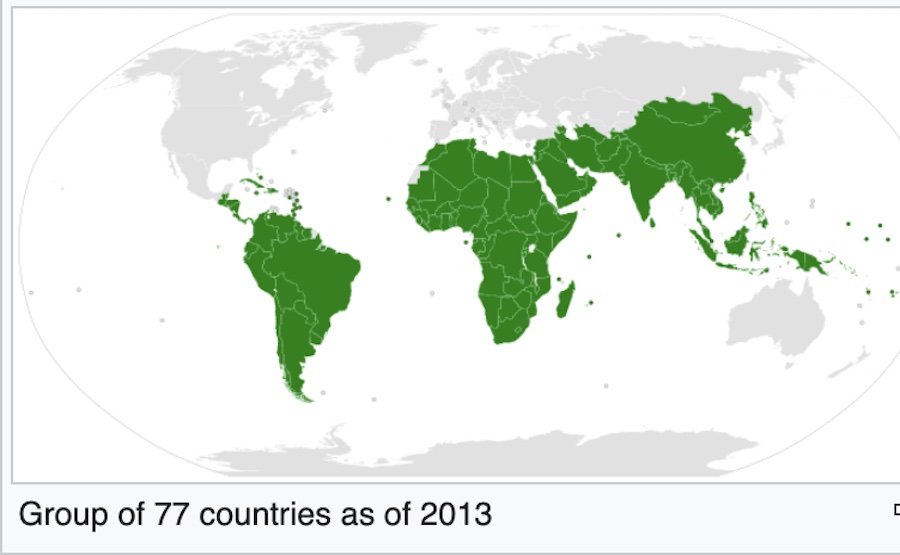
It also comes as Cuba assumes the presidency of the Group of 77 (G77), a bloc of 134 developing countries in Africa, Asia, and Latin America where “the combined crises of food, energy, and environment” are escalating, PI noted.

“What is the common vision to guide the Global South out of this crisis?” the coalition asked. “What is the plan to win it? What is the New International Economic Order for the 21st century?”

“After two days of detailed discussions about how to transform our shared world, delegates agreed that a key priority must be to secure science and technology sovereignty,” PI general coordinator David Adler said  Sunday at the conclusion of the Havana Congress. “From pharmaceuticals to green tech, from digital currencies to microchips, too much of humanity is locked out of both benefiting from scientific advances and contributing to new ones. We will, as today’s declaration calls for, work to build ‘a planetary bloc led by the South and reinforced by the solidarities of the North’ to liberate knowledge and peoples.”

Speaking at the January 12 ceremony  during which Cuba ascended to the G77 presidency, Cuban Foreign Minister Bruno Rodríguez Parrilla emphasized the need for coordinated action across the Global South on science and tech, arguing that “scientific-technical development is today monopolized by a club of countries that monopolize most of the patents, technologies, research centers, and promote the drain of talent from our countries.”

The G77 Summit on Science, Technology, and Innovation, scheduled for September in Havana, seeks to “unite, complement each other, integrate our national capacities so as not to be relegated to future pandemics,” said Parrilla.

During his speech  on the first day of the Havana Congress, meanwhile, former Greek Finance Minister Yanis Varoufakis called for a new non-aligned movement to “end the legalized robbery of people and Earth fueling climate catastrophe.”

(Article continued in the column on the right)

(Click here for the original Spanish version of the article)

Questions related to this article:

How can ensure that development is equitable?

Where in the world can we find good leadership today?

(Article continued from the column on the left)

Read the full Havana Declaration on the New International Economic Order:

The Havana Congress,

Recalling the role of the Cuban Revolution in the struggle to unite the Southern nations of the world, and the spirit of the 1966 Havana Tricontinental Conference that convened peoples from Asia, Africa, and Latin America to chart a path to collective liberation in the face of severe global crises and sustained imperial subjugation;

Hearing the echoes of that history today, as crises of hunger, disease, and war once again overwhelm the world, compounded by a rapidly changing climate and the droughts, floods, and hurricanes that not only threaten to inflame conflicts between peoples, but also risk the extinction of humanity at large;

Celebrating the legacy of the anti-colonial struggle, and the victories won by combining a program of sovereign development at home, solidarity for national liberation abroad, and a strong Southern bloc to force concessions to its interests, culminating in the adoption of the U.N. Declaration on the Establishment of a New International Economic Order (NIEO);

Acknowledging that the project of decolonization remains incomplete, disrupted by concerted attacks on the unity of the South in the form of wars, coups, sanctions, structural adjustment, and the false promise that sovereign development might be won through integration into a hierarchical world system;

Emphasizing that the result has been the sustained divergence between North and South, characterized by the same dynamics that defined the international economic order five decades prior: the extraction of natural resources, the enclosure of ‘intellectual property,’ the plunder of structural adjustment, and the exclusion of the multilateral system;

Recognizing that despite these setbacks, the flame of Southern resistance did not die; that the pursuit of sovereign development has yielded unprecedented achievements—from mass literacy and universal healthcare to poverty alleviation and medical innovation—that enable a renewed campaign of Southern cooperation today;

Stressing that this potential for Southern unity is perceived as a threat to Northern powers, which seek once again to preserve their position in the hierarchy of the world system through mechanisms of economic exclusion, political coercion, and military aggression;

Seizing the opportunity of the present historical juncture, when the crisis of the existing world system can either entrench inequalities or embolden the call to reclaim Southern protagonism in the construction of a new world order based on justice, equity, and peace;

The Havana Congress calls to:

* Renew the Non-Aligned Movement: In the face of increasing geopolitical tensions born from a decisive shift in the global balance of power, the Congress calls to resist the siren song of the new Cold War and to renew the project of non-alignment, grounded in the principles of sovereignty, peace, and cooperation articulated at the 1955 Bandung Conference, 1961 Non-Aligned Conference, 1966 Tricontinental Conference, and beyond.


* Renovate the NIEO: To accompany the renewed non-aligned movement, the Congress calls to renovate the vision for a New International Economic Order fit for the 21st century; a vision that must draw inspiration from the original Declaration, but also account for the key issues—from digital technology to environmental breakdown—that define the present conditions for sovereign development; and to enshrine this vision in a new U.N. Declaration on the occasion of its 50th anniversary.


* Assert Southern Power: The Congress recognizes that economic liberation will not be granted, but must be seized. As the original call for a New International Economic Order was won through the exercise of collective power in the coordinated production of petroleum, so our vision today can only be realized through the collective action of the South and the formation of new and alternative institutions to share critical technology, tackle sovereign debt, drive development finance, face future pandemics together, as well as coordinate positions on international climate action and the protection of national sovereignty over the extraction of natural resources.


* Accompany Cuba in the G77: The Congress recognizes the critical opportunity afforded by Cuba’s presidency of the Group of 77 plus China to lead the South out of the present crisis and channel the lessons of its Revolution toward concrete proposals and ambitious initiatives to transform the broader international system.


* Build a Planetary Bloc: The Congress calls on all peoples and nations of the world to join in this struggle to definitively achieve the New International Economic Order; to build a planetary bloc led by the South and reinforced by the solidarities of the North, whose peoples recognize their obligation to resist the crimes committed in their names; and to bring the spirit of this Havana Congress into the communities that we call home.

What Steps Can the US Take to Foster Peace Talks in Ukraine?

DISARMAMENT & SECURITY .

An article by Medea Benjamin and Nicholas Davies in Common Dreams

The Bulletin of the Atomic Scientists has just issued its 2023 Doomsday Clock statement, calling this “a time of unprecedented danger.” It has advanced the hands of the clock to 90 seconds to midnight, meaning that the world is closer to global catastrophe than ever before, mainly because the conflict in Ukraine has gravely increased the risk of nuclear war. This scientific assessment should wake up the world’s leaders to the urgent necessity of bringing the parties involved in the Ukraine war to the peace table.

So far, the debate about peace talks to resolve the conflict has revolved mostly around what Ukraine and Russia should be prepared to bring to the table in order to end the war and restore peace. However, given that this war is not just between Russia and Ukraine but is part of a “New Cold War” between Russia and the United States, it is not just Russia and Ukraine that must consider what they can bring to the table to end it. The United States must also consider what steps it can take to resolve its underlying conflict with Russia that led to this war in the first place.

The geopolitical crisis that set the stage for the war in Ukraine began with NATO’s broken promises not to expand into Eastern Europe, and was exacerbated by its declaration in 2008 that Ukraine would eventually join this primarily anti-Russian military alliance.

Then, in 2014, a U.S.-backed coup against Ukraine’s elected government caused the disintegration of Ukraine. Only 51% of Ukrainians surveyed told a Gallup poll that they recognized the legitimacy of the post-coup government, and large majorities in Crimea and in Donetsk and Luhansk provinces voted to secede from Ukraine. Crimea rejoined Russia, and the new Ukrainian government launched a civil war against the self-declared “People’s Republics” of Donetsk and Luhansk.

The civil war killed an estimated 14,000 people, but the Minsk II accord in 2015 established a ceasefire and a buffer zone along the line of control, with 1,300 international OSCE ceasefire monitors and staff. The ceasefire line largely held for seven years, and casualties declined substantially from year to year. But the Ukrainian government never resolved the underlying political crisis by granting Donetsk and Luhansk the autonomous status it promised them in the Minsk II agreement.

Now former German Chancellor Angela Merkel and French President Francois Hollande have admitted that Western leaders only agreed to the Minsk II accord to buy time, so that they could build up Ukraine’s armed forces to eventually recover Donetsk and Luhansk by force.

In March 2022, the month after the Russian invasion, ceasefire negotiations were held in Turkey. Russia and Ukraine drew up a 15-point “neutrality agreement,” which President Zelenskyy publicly presented and explained to his people in a national TV broadcast on March 27th. Russia agreed to withdraw from the territories it had occupied since the invasion in February in exchange for a Ukrainian commitment not to join NATO or host foreign military bases. That framework also included proposals for resolving the future of Crimea and Donbas.

But in April, Ukraine’s Western allies—the United States and United Kingdom in particular—refused to support the neutrality agreement and persuaded Ukraine to abandon its negotiations with Russia. U.S. and British officials said at the time that they saw a chance to “press” and “weaken” Russia, and that they wanted to make the most of that opportunity.

The U.S. and British governments’ unfortunate decision to torpedo Ukraine’s neutrality agreement in the second month of the war has led to a prolonged and devastating conflict with hundreds of thousands of casualties. Neither side can decisively defeat the other, and every new escalation increases the danger of “a major war between NATO and Russia,” as NATO Secretary General Jens Stoltenberg recently Questions related to this article:

 
Can the peace movement help stop the war in the Ukraine?

Where in the world can we find good leadership today?

(Continued from left column)

For years, President Putin has complained about the large U.S. military footprint in Eastern and Central Europe. But in the wake of the Russian invasion of Ukraine, the U.S. has actually beefed up its European military presence. It has increased the total deployments of American troops in Europe from 80,000 before February 2022 to roughly 100,000. It has sent warships to Spain, fighter jet squadrons to the United Kingdom, troops to Romania and the Baltics, and air defense systems to Germany and Italy.

Even before the Russian invasion, the U.S. began expanding its presence at a missile base in Romania that Russia has objected to ever since it went into operation in 2016. The U.S. military has also built what The New York Times called “a highly sensitive U.S. military installation” in Poland, just 100 miles from Russian territory. The bases in Poland and Romania have sophisticated radars to track hostile missiles and interceptor missiles to shoot them down.

The Russians worry that these installations can be repurposed to fire offensive or even nuclear missiles, and they are exactly what the 1972 ABM (Anti-Ballistic Missile) Treaty between the U.S. and the Soviet Union prohibited, until President George W. Bush withdrew from it in 2002.

While the Pentagon describes the two sites as defensive and pretends they are not directed at Russia, Putin has insisted that the bases are evidence of the threat posed by NATO’s eastward expansion.

Here are some steps the U.S. could consider putting on the table to start de-escalating these ever-rising tensions and improve the chances for a lasting ceasefire and peace agreement in Ukraine:

* The United States and other Western countries could support Ukrainian neutrality by agreeing to participate in the kind of security guarantees Ukraine and Russia agreed to in March, but which the U.S. and U.K. rejected.

* The U.S. and its NATO allies could let the Russians know at an early stage in negotiations that they are prepared to lift sanctions against Russia as part of a comprehensive peace agreement.

* The U.S. could agree to a significant reduction in the 100,000 troops it now has in Europe, and to removing its missiles from Romania and Poland and handing over those bases to their respective nations.

* The United States could commit to working with Russia on an agreement to resume mutual reductions in their nuclear arsenals, and to suspend both nations’ current plans to build even more dangerous weapons. They could also restore the Treaty on Open Skies, from which the United States withdrew in 2020, so that both sides can verify that the other is removing and dismantling the weapons they agree to eliminate.

* The United States could open a discussion on the removal of its nuclear weapons from the five European countries where they are presently deployed: Germany, Italy, the Netherlands, Belgium, and Turkey.

If the United States is willing to put these policy changes on the table in negotiations with Russia, it will make it easier for Russia and Ukraine to reach a mutually acceptable ceasefire agreement, and help to ensure that the peace they negotiate will be stable and lasting.

De-escalating the Cold War with Russia would give Russia a tangible gain to show its citizens as it retreats from Ukraine. It would also allow the United States to reduce its military spending and enable European countries to take charge of their own security, as most of their people want.

U.S.-Russia negotiations will not be easy, but a genuine commitment to resolve differences will create a new context in which each step can be taken with greater confidence as the peacemaking process builds its own momentum.

Most of the people of the world would breathe a sigh of relief to see progress towards ending the war in Ukraine, and to see the United States and Russia working together to reduce the existential dangers of their militarism and hostility. This should lead to improved international cooperation on other serious crises facing the world in this century—and may even start to turn back the hands of the Doomsday Clock by making the world a safer place for us all.

Authors

Medea Benjamin is co-founder of Global Exchange and CODEPINK: Women for Peace. She is the co-author, with Nicolas J.S. Davies, of War in Ukraine: Making Sense of a Senseless Conflict, available from OR Books in November 2022.

Nicolas J. S. Davies is an independent journalist and a researcher with CODEPINK. He is the co-author, with Medea Benjamin, of War in Ukraine:

The Elders warn urgent action on climate, pandemics, nuclear weapons needed to turn back hands of the Doomsday Clock

DISARMAMENT & SECURITY .

An article from The Elders

The Elders warned today (January 24) that only a crisis mindset from global political leaders can generate the urgent action needed to address the existential threats facing humanity, including the climate crisis, pandemics and nuclear weapons.


Mary Robinson and Elbegdorj Tsakhia join the Bulletin of the Atomic Scientists for the 2023 Doomsday Clock announcement. Photo: Bulletin of the Atomic Scientists

The warning came as former Presidents Mary Robinson and Elbegdorj Tsakhia joined members of the Bulletin of the Atomic Scientists for the unveiling of the Doomsday Clock, which today moved to 90 seconds to midnight – the closest it has been to catastrophe since its creation in 1947.

Russia’s illegal war on Ukraine and President Putin’s reckless nuclear rhetoric have worsened tensions and made nuclear conflict a more real threat than at any time since the height of the Cold War, The Elders warned.

But while Russia alone bears responsibility for its war on Ukraine, for which its leaders must ultimately face justice under international law, all states bear responsibility for the broader failures of governance and leadership that have undermined the multilateral system.

Their failure to take collective action has hampered effective responses to the climate crisis and COVID-19, as well as conflict prevention and resolution efforts from Syria and Yemen to Myanmar and the Sahel.

The Elders underscored that the world faces interlocking crises, each illustrating the unwillingness of leaders to act in the long-term interests of their people, and that dialogue in good faith and multilateral cooperation are indispensable to finding sustainable solutions that meet the needs of all the peoples of the world.

(Continued in right column)

Question related to this article:
 
Can we abolish all nuclear weapons?

Where in the world can we find good leadership today?

(Continued from left column)

Mary Robinson, Chair of The Elders and former UN High Commissioner for Human Rights, said:

“The Doomsday Clock is sounding an alarm for the whole of humanity. We are on the brink of a precipice. But our leaders are not acting at sufficient speed or scale to secure a peaceful and liveable planet. From cutting carbon emissions to strengthening arms control treaties and investing in pandemic preparedness, we know what needs to be done. The science is clear, but the political will is lacking. This must change in 2023 if we are to avert catastrophe. We are facing multiple, existential crises. Leaders need a crisis mindset.”

Ban Ki-moon, Deputy Chair of The Elders and former UN Secretary-General, said:

“Three years ago, I helped unveil the Doomsday Clock when its hands were last moved. Today they are even closer to midnight, showing how much more perilous our world has become in the wake of the COVID-19 pandemic, extreme weather events and Russia’s outrageous war on Ukraine. Leaders did not heed the Doomsday Clock’s warnings in 2020. We all continue to pay the price. In 2023 it is vital for all our sakes that they act.”

Elbegdorj Tsakhia, former President of Mongolia and member of The Elders, added:

“As a former President of a country landlocked between two large powers, I know how important international diplomacy is when it comes to tackling existential threats. Today our world faces multiple crises. A common thread runs through them all: failure of leadership. We need a collective response rooted in the spirit and values of the UN Charter that can put us back on a pathway to peaceful co-existence and sustainable development.”

The Elders

Mary Robinson, former President of Ireland and Chair of The Elders
Ban Ki-moon, former UN Secretary-General and Deputy Chair of The Elders
Graça Machel, founder of the Graça Machel Trust, co-founder and Deputy Chair of The Elders 
Gro Harlem Brundtland, former Prime Minister of Norway and former Director-General of the WHO
Elbegdorj Tsakhia, former President and Prime Minister of Mongolia
Zeid Raad Al Hussein, former UN High Commissioner for Human Rights
Hina Jilani, advocate of the Supreme Court of Pakistan and co-chair of the Taskforce on Justice
Ellen Johnson Sirleaf, former President of Liberia and Nobel Peace Laureate
Ricardo Lagos, former President of Chile
Juan Manuel Santos, former President of Colombia and Nobel Peace Laureate
Ernesto Zedillo, former President of Mexico

Basel Peace Office announces the nine finalists for the 2023 PACEY Youth Award

. TOLERANCE & SOLIDARITY .

An article from the Basel Peace Office

Basel Peace Office is pleased to announce the nine finalists of the 2023 PACEY Youth Award. We invite anyone interested in youth initiatives for a better world to join us for the PACEY Award ceremony on January 21 to vote for the three winners, each of whom will receive a prize of €5000 plus organizational support for their initiatives.

“The PACEY Award supports innovative projects which empower youth to lead transformative actions in the fields of peace, climate security and disarmament”, says Ms Marzhan Nurzhan, Deputy-Director of Basel Peace Office and Co-founder of Youth Fusion, a global youth network for the abolition of nuclear weapons. “We received nominations of over 80 inspiring youth projects and project proposals from around the world. The nine finalists are just a sample of the quality and level of youth action on these important issues for humanity and the planet.”

“Young people in Europe and around the world are standing up to demand policy progress on the climate crisis, nuclear abolition and ending war,” says Prof (em) Andreas Nidecker MD, founder of the PACEY Award. ‘They clearly see the threats to current and future generations and are taking action.”

“Peace and security are the central starting points on the path to sustainable development,” says Dr Lukas Ott (lic. phil.), Head of Canton and Urban Development, Presidential Department of the Canton of Basel-Stadt. “Peace is the foundation that something good can grow out of it. Youth-led projects and activities that promote peace, climate-protection and disarmament are more important now than ever.”

According to Prof Lukas Kundert, Director of the Basel-Stadt Evangelical Reformed Church, the award highlights youth action that connects ethical ways of living with practical approaches to achieving peace. “Righteousness and Peace kiss each other” he says.

The PACEY Award will confer one prize for a project based in Europe and two prizes for projects based outside of Europe.

Finalists

The three finalists in the European project category are:

* Global Perspectives on Corporate Climate Legal Tactics (United Kingdom), a project to examine the unique aspects of climate litigation across the corporate world leading to the production of a toolbox for the effective implementation of climate law. With research from 17 different legal systems, the project will analyse and compare best practices from those jurisdictions and provide recommendations to relevant stakeholders in order to facilitate continuous improvement in the implementation of climate change law.

* Peace in our Schools (Georgia), a project to work with young Ukrainian refugees and Russian immigrants, who have fled the Russia-Ukraine war. The project, founded by Jewish and Muslim peacemakers from Georgia and Afghanistan, aims to provide emotional intelligence and conflict resolution training to Ukrainian and Russian youth, through programs in Georgian schools. The project is managed by the Network of Former Youth Delegates to the United Nations.

(continued in right column)

Question related to this article:
 
Youth initiatives for a culture of peace, How can we ensure they get the attention and funding they deserve?

How can just one or a few persons contribute to peace and justice?

(continued from left column)

* SAFNA Youth Forum Database Project (Switzerland), a project to create a database on nuclear disarmament and arms control, with commentaries on national legislation and jurisprudence. The project, being led by the Swiss Association of Lawyers for Nuclear Disarmament (SAFNA) Youth Forum, is inspired by the ICRC databases on international humanitarian law, and aims to assist, students and professionals in the fields of international law, international politics and international relations.

The six finalists for the Beyond Europe category are;

* Adopt a tree, not a weapon (Democratic Republic of Congo), a project to address the climate crisis and activism of local and foreign armed groups using children as soldiers to commit violence and destroy the biodiversity. The project, run by former child soldiers and other young volunteers from the Amani-Institute, uses a range of innovative approaches including inter-active theatre, to educate and engage other youth.

* Ertis Mektebi school (Kazakhstan), a project to provide mainstreamed education for children with special needs.  The school is being established in Semipalatinsk, where there are over 4000 children with neuropsychological and musculoskeletal disabilities, most of whom are likely to be third and fourth generation victims of Soviet nuclear tests, more than 450 of which were conducted in the Polygon/Semipalatinsk region Kazakhstan from 1949 -1989. The mainstreaming approach is to establish a school where both children with disabilities and children without health problems will study together.

* Nuclear Lives: Uranium Mining on Indigenous Communities of Meghalaya (India), an interview series documenting the testimonies of victims of uranium mining in Meghalaya. The uranium is used for both nuclear weapons and nuclear energy. The project uses a story-telling approach to complement academic research in order to elevate public knowledge and political attention regarding the negative impacts of uranium mining – the widespread acres of forest cleared, water bodies contaminated, soil rendered fruitless, stillborn births and death of local wildlife.

* Silence the Guns (Cameroon), a project led by Children for Peace to educate and engage children, especially girls, in Central Africa in non-violence and peace-building. The project works with  schools, university, mosques, churches & faith-based organizations, refugees, UN agencies and other organization in order to counter violent extremism, armed conflict and the illicit proliferation of weapons.

* Storytelling as a Catalyst of Action for Peace, Love, and Climate Justice in MENA (Middle East and North Africa), a project led by the MENA Youth Network which aims to establish an online media archive of stories and voices of youth in the MENA region most affected by the intersection of conflict and climate change, and run workshops and exhibitions in collaboration with civil society groups in communities across the region. The project will harness the power of storytelling to advance and highlight urgent needs, and empower and unite youth towards establishing peace, love, and climate justice in the region.

* Youth Peace Caravans (Sudan/Uganda), a peacebuilding program initiated and led by a former child soldier from South Sudan in the refugee settlements in northern Uganda to foster peace among the South Sudanese young Refugees. South Sudan is home to 64 tribes with long history of animosity. When the civil war broke out, those who fled the country were forced to live in shared refugee settlement areas where negative assumptions led to clashes, death and injuries. Through youth peace caravans, young people are unlearning the negative assumptions by engaging more with each other through community exchange visits, sharing stories, skills and ideas and doing community service together.

The PACEY (Peace, nuclear Abolition and Climate Engaged Youth Award) was established by Basel Peace Office in 2020 as a €5000 award for a European Youth Project. In 2021, the City of Basel (Switzerland) joined and added a prize of €5000 for Beyond Europe/Global Youth Project. And we are pleased to announce that from 2023, we are joined by the Reformed Evangelical Church of Basel-Stadt with support for another award of €5000 for a second Beyond Europe/Global Youth Project, making three awards in total.

Finalists in each category will present their projects/proposals at the PACEY Awards event which takes place online on January 21, in conjunction with Basel Peace Forum 2023 and the annual Basel Inter-generational Forum on Peace, Disarmament and Climate Action ( hybrid events). Participants at the PACEY Awards event will vote by secret ballot to determine the three winners.