Category Archives: TOLERANCE & SOLIDARITY

The People of Mexico Give the World an Example of Solidarity

TOLERANCE AND SOLIDARITY .

An editorial by Leonardo Boff in Cultura de Paz. Managua, Nicaragua • Volume 23 • N° 73 • September – December, 2017 (translated by CPNN)

On September 19 and 23, Mexico was shaken by two earthquakes, one of magnitude 7.1 and another of 6.1 on the Richter scale, which struck 5 States and dozens of municipalities, including the capital, Mexico City, collapsing hundreds of houses and producing cracks in hundreds of other buildings. Beautiful churches, like that of St. Francis of Assisi in Puebla, saw their towers demolished. Everyone still remembers the terrible earthquake of 1985 that produced more than ten thousand victims. This, although it has been very strong, killed 360 people.


Image from Yucatan Times

Since then, I have been in Mexico and Puebla, invited to give lectures, and I have been able to verify in situ the ravages and the trauma caused to the people.

But what is most remarkable has been the spirit of solidarity and cooperation of the Mexican people. Without anyone to call them, thousands of people, especially youth, began to remove debris to save the buried victims. Groups were spontaneously organized and this spirit of solidarity saved many lives.

Immediately, aid collection centers were created for the victims, with water, food, clothes, blankets and all kinds of important utensils for a house. At the time I write this article (10/13/17) many collection sites are still visible. The cooperation knows no limits.

Here I only narrate two facts that are especially touching. The first: a school building that collapsed slowly with many children inside. A young man, seeing that a kind of channel had formed in the middle of the ruins, penetrated quickly through the hole and took out several children of 5-7 years. He had barely gotten the last one out when another part of the school fell behind him, saving his life by seconds.

(Article continued in right column)

(Click here for Spanish original of this article)

Question for this article

Is there a renewed movement of solidarity by the new generation?

(Article continued from left column)

Second fact: a young lady, about 30 years old, was 34 hours under the rubble. She granted a moving interview on television, narrating the different phases of her tragedy. Imprisoned in the rubble, a concrete slab was fixed within a few inches of her face. For 30 hours she did not hear any voice, or steps, or any noise that meant the approach of someone who could rescue her.

She narrated the different psychological stages, similar to those we know when a patient receives the news of the incurable character of his illness and the proximity of death.

At first, this lady asked: why precisely I must go through this misfortune? Then, almost desperate, she began to cry until she had no tears.  Then she began to pray and to plead with God and all the saints, especially the Virgin of Guadalupe, the one with the greatest devotion of the Mexicans. Finally, she resigned herself to die and confidently surrendered to the mysterious will of God. But she did not lose hope.

Finally, she heard footsteps and then voices. Her hope was strengthened. After 34 hours, literally buried under a mountain of rubble, she could be rescued. And here she was in the interview, happy and whole, accompanied by a psychoanalyst specialized in dealing with psychological traumas
like those caused by a sudden earthquake, and giving testimony of her terrible experience.

Mexico is a region geologically marked by earthquakes, given the configuration of the tectonic plates of its subsoil. The human being has no power over these enormous forces. What you can do is take precautions, learn to build your buildings to resist earthquakes in the way of the Japanese and, above all, get used to coexisting with this indomitable reality. In a similar way, the population of our semi-arid region of the Northeast, who must adapt and learn to coexist with the drought that can last for many years, as is currently the case.

 In the debate after a conference at the Universidad Iberoamericana, in Mexico City, one woman declared: “If our country and if all of humanity lived that spirit of solidarity and cooperation, there would be no poor in the world and we would have rescued a part of the lost paradise “.

I reinforced her statement and told her that it was the cooperation and solidarity of our anthropoid ancestors, who began to eat together, which allowed them to leap from animality to humanity. What was true yesterday must still be true today. Yes, solidarity and, in general, the cooperation of everyone with everyone will be able to rescue the essence of making us fully human. In recent days, the Mexican people have given us a splendid example of this fundamental truth.

(Thank you to Marcos Estrada, the CPNN reporter for this article.)

State Of The City: We’re The Resistance (New Haven, CT, USA)

TOLERANCE AND SOLIDARITY .

A article by by Markeshia Ricks in the New Haven Independent

A week after President Trump delivered his State of the Union Address, Mayor Toni Harp delivered a “state of the city” address that put New Haven squarely in the camp of the anti-Trump “resistance.”

In front of a full aldermanic chamber at City Hall, Harp painted a picture of a city resistant to Trump’s vision for America, resistant to Connecticut’s cities-vs.-suburbs mentality, and resistant to any notion that New Haven isn’t a city on the rise. She borrowed a word — “resistance” — that has become a phrase for local movements across the country formed to oppose the current administration in Washington.


Video of Mayor’s speech

A year ago, Harp said, no one could have predicted that “we would be dealing with such a dramatically altered political, social, and economic landscape.”

“In that context, tonight, I would describe the state of New Haven as resistant to these frightening trends in this nation toward what would be a new normal -–  a Republic, a state, and a civic life so different as to be unrecognizable to most of us,” she said. “New Haven is resistant to these would-be, new standards not for the sake of being contrary, and not because it’s stylish or politically correct to be, but because these new standards are contrary to the best interests of this city, its residents, and its future.”

Harp said that New Haven continues to offer a hand to its residents even though there is “a trend in some government circles to neglect or abandon the aged, the vulnerable, and those who simply can’t keep up.

“Social services for veterans, the elderly, the formerly incarcerated, the homeless, the disabled, the addicted, and the mentally ill seem to fall increasingly on the shoulders of local providers, as federal and state support dwindles,” she said. “Going forward, New Haven must resist the temptation to follow suit: in my opinion, a community is measured by the care it provides for those who cannot provide – or speak up – for themselves. Tonight, I’m pleased to say that in this regard, New Haven continues to measure up.”

Harp said all of the progress that New Haven has made “reflects an undeniable collaboration.”

“In New Haven, elected officials, city workers, residents, volunteers, students, immigrants, and a host of other city partners make this a vibrant, attractive city, committed to its better days ahead. New Haven is resistant – and will continue to resist – a laundry list of frightful trends in America,” she said. “Perhaps most frightening among them is a deliberate attempt by some in this nation to deny benefits of the American dream—safety, security, education, healthcare, opportunity — to any number of Americans for completely arbitrary and unjustifiable reasons.

Harp said New Haven has “resisted” by rallying to the side of displaced Puerto Ricans with ongoing aid and relocation assistance; by partnering with Bridgeport in a long shot but, alas, failed bid for Amazon’s second North American headquarters; and by creating a favorable climate for development that is starting to pay dividends downtown and beyond. She also noted that since she took office New Haven’s unemployment rate has dropped from 10.3 percent to 5.1 percent.

“This city continues to resist any notion that big ideas are too much to handle in challenging times,” she said. “The new Boathouse at Canal Dock, a major redesign for the rest of Long Wharf, and continuing progress on Downtown Crossing reaffirm this. Phase 2 of Downtown Crossing will get started this year, continuing the process of stitching back together parts of town that were unduly separated generations ago.”

“As I complete my assessment of New Haven this year, and as I assess the state of other cities nearby and frankly, across the nation, there isn’t a city I envy, there isn’t a city I’d rather serve as mayor, and there isn’t a community of people I’d rather be with as we tackle a daunting agenda under these current, challenging circumstances,” she concluded.

(Article continued in the right column)

Questions related to this article:

The post-election fightback for human rights, is it gathering force in the USA?

(Article continued from the left column)

Alders Praise Vision, Seek Details

Several alders were getting their first taste of the mayor’s “state of the city” address as a member of the Board of Alders, and they found a lot to like.

Yale Alder Hacibey Catabasoglu said he was happy to hear about the city’s infrastructure and the improvements that have been made, such as the wifi on the Green and efforts to help small businesses. He applauded the city’s efforts to bring in companies like Goldman Sachs to teach small immigrant business owners like his father.

He added that he would have liked for Harp to talk a little bit about youth activism in the city and how their political activism helps New Haven resist.

“The youth are the ones that are going to be the decision makers and I think it would have been nice for her to touch upon that,” he said. “But overall, I thought it was a wonderful speech.”

First-term Newhallville/Prospect Hill Alder Kim Edwards said she found the mayor’s message about the state of the city to be positive and upbeat.
“We sound like a city that’s thriving,” she said. “There are many things we need to work on and we have to make sure all of our population is included in the decisions that we make daily.”

Edwards said while she knows there is much work ahead on the budget, she said she was impressed that the city has managed to cut its unemployment rate nearly in half.

“We need to keep on that trend and we need to make sure that they are living wage jobs,” she said. “We live in a high tax state. So we need to not just use the words living wage. They actually need to be living wage jobs.”

Downtown Alder Abigail Roth said listening to Mayor Harp Monday night reminded her of how proud she is of the Elm City. “I liked her theme of a city that’s resistant, especially with the state of our country today,” said Roth, who attended one of the original “resistance” events, a D.C women’s march coinciding with Trump’s first inauguration weekend. “It feels good to be in a city where people’s values align with mine and the mayor’s values on so many fronts.”

But like Edwards, Roth noted that the upcoming tango with the budget is on the horizon. And Harp didn’t have a lot to say about that in her address aside from mentioning the reduction of overtime in the fire department.

“If you look at the [monthly] budget reports it’s something we have to be concerned about,” Roth said. She noted, for instance,  a recent story in the Independent about a police psych-exam contract problem that is delaying the seating of an academy class and leading to increased overtime costs. She called the issue “a huge concern.” “That’s not to take away from what she said in the speech,” Roth added. “There were a lot of positive things but the city’s budget is a very serious thing that we’re going to have to focus a lot on.”

There will be time for focusing on that soon enough for Morris Cove Alder Sal DeCola, but Monday night the mayor’s speech had him focused on the positive.

“There are a lot of good things that are happening for New Haven,” he said. We’re always hearing the negative and she was talking about all of the positive things. I wish more people would focus on the positive. The bad’s always going to be there. I have this saying, ‘Every flower garden has weeds in it; look at the flowers.’ We know the weeds are there; enjoy the flowers. That’s how I look at it.”

Fair Haven Ernie Santiago saw some flowers when he heard Harp say that a sweep that helped the city assess the needs of Newhallville last year will make its way to his community.

“That was very good news,” he said. “Finally, Fair Haven is going to get its due. Now, we gotta see if it comes to fruition and how much is done because we do need a lot in Fair Haven. We’ve got the worst streets, the worst sidewalks. I feel good about hearing what I heard. She gave a good speech. It’s always good to hear they’re going to work on your ward.”
Freshman Newhallville/Prospect Hill Alder Steve Winter said he appreciated the message of resistance and believed it was needed. He also noted that he’s interested in hearing more about how the digitization of city services and other technology could help the city maintain a high level of service in a tough fiscal environment.

“With values and institutions under assault, it’s important to have our leaders and our colleagues remind us of why we have to do what we do and why you have to keep going,” he said.

Youth Solidarity Fund 2017 Edition: Project Outcomes and Capacity Building Workshop

TOLERANCE AND SOLIDARITY .

Excerpts from the September-December 2017 Newsletter, Issue #10 of the Alliance of Civilizations

The implementation period for the seven projects supported under the Youth Solidarity Fund (YSF) 2017 edition came to an end on 31 October 2017. YSF recipients had five months from June 2017 to complete projects funded with a grant of up to USD 25,000 each.

Projects ranged from encouraging behavioral change for peaceful elections in Liberia, to promoting the social inclusion of migrants through arts-based public events in rural areas of Morocco, and engaging young women in peace clubs and sports to promote diversity in Afghanistan. Other projects focused on the role of the media to prevent violence in South Sudan, trained Pakistani youth to advocate for the localization of Security Council Resolution 2250, used flmmaking to share stories of youth in India, Nepal and Bhutan, and taught peace education to reduce instances of violence towards refugees in Uganda.

By the end of the implementation period, over 11,000 direct beneciaries have been impacted by YSF projects, with 83% of those beneficiaries being youth. Of those direct youth beneficiaries, 57% were women. In total, the seven projects of the Youth Solidarity Fund 2017 edition impacted almost 100,000 individuals, both directly and indirectly.

(Article continued in right column)

Question for this article

Youth initiatives for a culture of peace, How can we ensure they get the attention and funding they deserve?

What is the United Nations doing for a culture of peace?

(Article continued from left column)

During 11-15 December 2017 in Istanbul, Turkey, a closing capacity building workshop was organized for the recipients of the Youth Solidarity Fund (YSF) 2017 edition. The workshop focused on the issue of sustaining their projects following the end of the YSF project implementation period.

In addition to the current recipients, three YSF alumni were also invited to participate. They facilitated sessions for the recipients on solving challenges faced in implementing their projects, as well as best practices on organizational sustainability. Recipients then worked with professional trainers on topics including monitoring and evaluation, fundraising, social media strategies and advocacy.

Participants came from youth-led organizations located in countries such as India, Kenya, Liberia, Morocco, Nepal, Pakistan, South Sudan and Uganda.

On the first day of the workshop, the YSF recipients and alumni took part in a dialogue exchange with representatives of the Turkic Council youth network, in an event commemorating the second anniversary of the United Nations Security Council Resolution 2250.

The Youth Solidarity Fund call for applications is open from 22 January through to 16 February 2018. YSF supports youth-led organizations (led by young people aged 18-35 years) that foster peaceful and inclusive societies by providing seed funding to outstanding projects promoting intercultural and interfaith dialogue. More information on eligibility and selection criteria is available on www.unaoc.org.

Burkina Faso: Inter-religious dialogue for peace: “It is the diversity of religions that gives meaning to religion”

TOLERANCE & SOLIDARITY .

An article by Ibrahima Traoré for Lefaso.net

“Live in peace despite our differences”. This was the theme for an inter-religious conference for peace held Saturday, January 13, 2018 in Dédougou. The activity, initiated by the Ahmadiyya Islamic community in Burkina Faso, saw the participation of traditional chiefs, the Catholic community and the Protestant community, each of whom sent a message of peace.

A religion that does not teach love and live together does not deserve the status of being called religion. This is essentially the message of the various speakers. The aim is, according to the Regional Missionary of the Islamic Ahmadiyya Community, Abdoulaye Ouedraogo, to highlight the fact that religions do not have to fight each other; because they all emanate from one God. For him, religious coexistence in Burkina must be constantly promoted and consolidated by religious leaders and elders in order to inculcate the dynamics in the younger generation. He considers that dialogue and the strengthening of fraternity and solidarity … are essential ingredients to maintain. Hence the relevance of the theme: “Living in peace despite our differences”.

(continued in right column)

(Click here for the original French version of this article)

Question related to this article:
 
How can different faiths work together for understanding and harmony?

(continued from left column)

Several speeches and communications marked this day. The recent attack against gendarmes in the region (Boucle du Mouhoun) also motivates the choice of this theme, according to Abdoulaye Ouedraogo. “We want to give our support to people who have been attacked and who have been bruised in their hearts; We, as an Islamic Ahmadiyya, stand in solidarity with them. What they are doing is not Islam. It is purely barbarism, highway robbery,” he lashed out before calling the youth in particular to remain vigilant not to be caught in ignoble acts, which have nothing to do with Islam. For, he argues, the Koran states in Chapter 2 verse 257 that there is no compulsion in religion.

The Abbot Jean-Baptiste Davou pointed out that the inter-religious conference is important for the culture of peace, for the knowledge of the other. “When we accept to exchange, we get to know each other better, to love each other better, to help each other better. It is the refusal to dialogue, to exchange, which makes for ignorance of the other. And when you do not know something, you do not give it much value, “he said.

The prefect of the department of Dédougou, Emile Hien, also representing the governor, congratulated and encouraged the holding of this conference “of the culture of peace and dialogue”. He offered advice that “Religion must not be a source of division, of violence. It must be an opportunity to strengthen living together “. For Mr. Hien, it is the diversity of religions that gives meaning to religion. Let us all be peacemakers, he said, pledging to support this initiative and ensure its sustainability in the region.

Also satisfied were the traditional chiefs who believe that the inter-religious conference for peace is in line with the founding principle of the city of Dédougou which is peace.

Indeed, argues the elder Pierre Dakuo, we can not have prosperity without peace. And all that goes in this direction has the full support of the traditional chiefs of Dédougou. From the administrators and the speakers to the participants, all wished the durability of the Inter-religious Conference for Peace.

Brazil: Londrina to hold meeting for peace and religious tolerance

TOLERANCE & SOLIDARITY .

An article from Bonde News (translated by CPNN)

The Concha Acústica de Londrina, located in Praça 1º de Maio, will be the stage for the 2nd Londrina Meeting of United Religions for Peace for Religious Tolerance, in celebration of the National Day to Combat Religious Intolerance, celebrated on January 21. The meeting will be next Saturday (20 January), from 8am to 10am. In case of rain, the action can be transferred to the Municipal Public Library Pedro Viriato Parigot de Souza.

(foto: Londrina Pazeando)

(continued in right column)

Question related to this article:
 
How can different faiths work together for understanding and harmony?

(continued from left column)

The event is promoted by the Municipal Council for the Culture of Peace (Compaz), the Commission for the Promotion of Racial Equality and Minorities of the Order of Attorneys of Brazil (OAB) Subsection of Londrina and the Inter Religious Group of Londrina (GDI).
(continued in right column)

This is the third consecutive year that the initiative is held in Londrina. According to Compaz’s secretary, Charleston Luiz da Silva, the goal is to promote culture for peace and respect among religions. “We want people to understand that all religions are united for the same purpose. We invite the entire London community to participate.”

About twenty religious leaders have been invited to speak. In the past, 17 leaders participated. Each will have three to five minutes to talk about the culture of peace in the opening, scheduled to start at 8am. At the end of the event, those present will make a hug for peace.

(Click here for the original Portuguese version of this article)

Canadian Jewish Group Organizes Hanukkah Event to Raise Money for Solar Panels for Palestinians in Gaza

TOLERANCE AND SOLIDARITY .

An article from Canada Talks Israel Palestine

A Jewish group in Vancouver is fundraising Saturday night to provide small, practical, hand-held solar lamps to families trapped in the dark in Gaza. Read more….Roughly 2 million people in Gaza have electricity on average only 3~4 hours per day. Independent Jewish Voices Vancouver is partnering with Rebuilding Alliance, a California-based NGO with 15 years experience on the ground in Gaza to help the people of Gaza face their Israeli induced and PA assisted power shortage.  So far, they’ve shipped 27,000 solar lamps and need funds for more.

On Saturday, December 16th, they are using the Jewish celebration of Hanukkah to raise money for this humanitarian cause.

Event details.

See a video.        

About the lights.

At the event, five candles will be lit and dedicated by five different people engaged in five different ways of bringing light into this world.  It is the fifth night of the eight-night Hanukkah holiday celebrated for more than 2,000 years by Jews around the world.  Candles will be lit beginning 7:30 pm by:

▪  Omar Mansour, a young man from Gaza living in Vancouver who has worked with a number of NGOs in Gaza and whose own family is in the dark every night. 

(Article continued in right column)

Question for this article

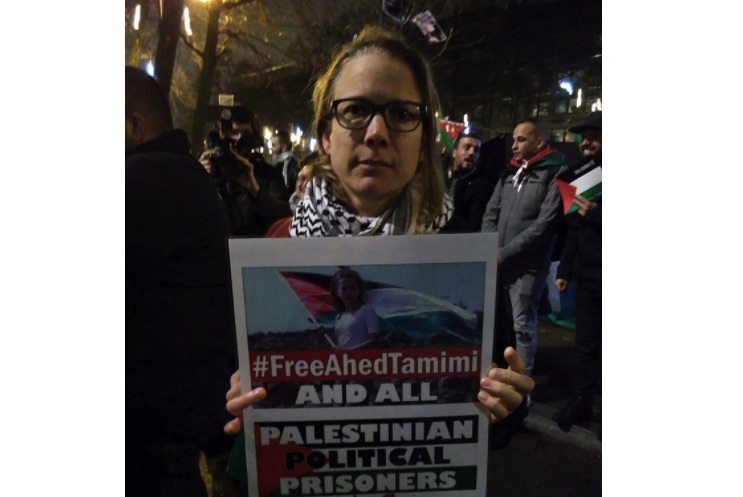
Presenting the Palestinian side of the Middle East; Is it important for a culture of peace?

(Article continued from left column)

▪  Hereditary Chief Phil Lane Jr. of the Ihanktowan Sioux and Chickasaw Nations, who will give the territorial acknowledgement on behalf of the Coastal Salish people.  He will dedicate his candle to indigenous people everywhere who are struggling against foreign domination.

▪  Hilla Kerner of Vancouver Rape Relief and former executive director of the Association of Rape Crisis Centers in Israel.  She will dedicate her candle to the struggle to end sexual violence against women.

▪  Jack Gates, a tenant organizer in the Regent Hotel in Vancouver’s Downtown Eastside supporting struggles to end homelessness and addiction.

▪ Valery and Yvon Raoul, long-time Vancouver activists in the struggle for
environmental and social justice.

“We welcome reporters and camera crews to our fundraising party, December 16, at the Peretz Centre, 6184 Ash Street, in Vancouver,” said organizer Rabbi David Mivisair. 

The visually and aurally rich candle-lighting ceremony will be 7:30 – 8 pm. “After the candle-lighting, at about 8 pm, we’ll sing traditional songs and enjoy traditional Hanukkah foods.  The event is open to everyone,” he said.

More info.

A video of the lights in Gaza.

Donations online

Independent Jewish Voices Vancouver is a chapter of a national human rights organization whose mandate is to promote a just resolution to the conflict in Israel and Palestine through the application of international law and respect for human rights.  More info.

For more information or interview, call Rabbi David Mivasair, at (604) 781-7839.

(Thank you to Janet Hudgins, the CPNN reporter for this article.)
The League of Ulema, Preachers and Imams of the Sahel Countries: Communication to counter extremism

TOLERANCE AND SOLIDARITY .

An article from L’Expression

The ulema, imams and preachers of the Sahel countries must imperatively use modern means of communication to counter the threat of religious and violent extremism. Extremism is changing fast. To counter it, you need a quick adaptation. In other words, the fight against extremist ideologies and violent discourses that currently use the Web and social networks must use the same communication media.

It is to allow the League of Ulema, Preachers and Imams of the Sahel Countries to achieve this goal that the [Algerian] Minister of Communication, Djamel Kaouane, received yesterday its secretary general, Youcef Belmehdi. According to a communiqué from the Ministry of Communication, Djamel Kaouane “listened, during this interview, to a presentation by Youcef Belmehdi on the activities of the League of Ulema Sahel whose principles are the peaceful coexistence with other religions and the rejection of all kinds of extremism”.

(Article continued in the right column)

(Click here for the original French version of this article.)

Question for this article

Islamic extremism, how should it be opposed?

(Article continued from the left column)

The meeting also allowed them to “review the means likely to be implemented by the communication to popularize and promote the message of tolerance and moderation advocated by this association,” says the same source. It must be said that the ulema, imams and preachers of the Sahel countries have an important mission to accomplish, that of fighting through information and sensitization against religious extremism in the region. The latter must therefore use modern means of communication to succeed in their awareness campaign.

In order to realize this preventive mission to counter the threat of religious and violent extremism, and to carry out this struggle upstream, the League has set up a program involving the intervention of imams and preachers on the Web and social networks. This “incursion” of members of the League in the virtual world, will allow to do a work of counter-propaganda blocking the road to dormant cells of extremist groups who indoctrinate and recruit victims on social networks.

The other field on which the League of Ulema, preachers and imams of the Sahel countries, wants to weigh, is that of the universities. It should be recalled that last October, the League in collaboration with the African Center for Studies and Research on Terrorism (CAERT) agreed to develop a training program for African imams and preachers. The program plans to provide Africans with the Algerian experience in preventing violent extremism and terrorism.

The League had previously organized the first training cycle for imams members of the League, which focused on topics such as “optimizing the use of the media” by imams and preachers, “the reform in Islam “and” the role of zakat and wakf in resolving social problems “.

Created in January 2013 in Algiers, the League of Ulema, preachers and imams of the Sahel works to spread the culture of peace and to ban violence and extremism in this region. It brings together ulema, preachers and imams from the region’s member countries of the League, namely Algeria, Mauritania, Mali, Nigeria, Niger, Burkina Faso and Chad, as well as three observer countries under of the Nouakchott Process, namely Côte d’Ivoire, Senegal and Guinea.

Taiwan: The sixth Buddhist-Christian talk in progress

. TOLERANCE & SOLIDARITY .

An article from Radio Vatican

The sixth Buddhist-Christian talk is taking place in Taiwan from Monday to Thursday [November 13-16] on the theme “Christians and Buddhists: Let’s walk together the Way of Nonviolence”.

The four day event is being organized by the Pontifical Council for Interreligious Dialogue (PCID) and is represented by delegates from 18 countries mostly Asians.

The Secretary of PCID, Bishop Miguel Ángel Ayuso Guixot opened the inaugural session illustrating the role of the Dicastery since its founding in 1964. For more than fifty years he recalled, the PCID has been involved in dialogue and collaboration with Buddhists all over the world. The first Buddhist-Christian formal talk was held at the Fokuangshan Monastery in Taiwan in 1995 on the theme “convergences and divergences” between the two religions. The second meeting was held in 1998 at the Asirvanam Benedictine Monastery Bangalore, India on “word and silence”. The third was held in Tokyo, Japan, in 2002 at Rissho Kosei-kai, on “Sangha in Buddhism and Church in Christianity.” The fourth was “Interior Peace, peace among peoples” and was held in Rome in 2013 and the fifth on “Buddhists and Christians together encourage fraternity” was held in Bodh Gaya, India, in 2015.

(continued in right column)

Question related to this article:
 
How can different faiths work together for understanding and harmony?

(continued from left column)

The current theme of the assembly is taken from the traditional message that PCID sends to the Buddhists for the Vesakh festival, which this year emphasized in particular the urgent need to promote a culture of peace and nonviolence.

“Terrorism is on the increase, as well as the number of people killed in terrorist attacks and most victims are women and children” said the Bishop. Moreover, in most cases, conflicts cross the frontiers and especially affect the poor countries, he added. Making a mention of domestic violence especially come across by women the bishop said that the study of violence is not a simple academic exercise but a matter of life and death. Some of us come from conflict-torn societies, some others experience the long-term or short-term effects of past wars. Some are victims or witnesses of unreasonable atrocities. In many of our countries, we daily hear the cry of the victims of violence he observed. Yet he said, uncontrolled nationalism, sexism, racism, caste, ethnic and religious fundamentalism may numb our hearts and blind our eyes to the suffering of so many people, hence the Buddhists and Christians work together to prevent and defeat violence he concluded.

More than 1.3 million people around the world die each year because of violence; and about 1.2 billion, or one fifth of the world’s population, are affected by some form of violence or insecurity.

Cardinal P Jean-Louis Tauran, President of PCID will take part in the concluding session of the assembly on Thursday.

Burkina Faso: A forum talks about peace

. TOLERANCE & SOLIDARITY .

An article by Irmine Kinda for Burkina 24

The first international youth forum on the culture of peace is taking place this Wednesday, November 15, 2017 in Ouagadougou under the sponsorship of Michel Kafando, former President of Burkina Faso. The forum brings together the different religions to discuss, revisit the holy texts, see what these texts say about the peace, and to promote peaceful coexistence in spite of religious differences.

The background of this first forum is the African initiative of education for peace and development through interfaith and intercultural dialogue launched in Cotonou in May 2015 and the historic UN Security Council Resolution 2250 on youth, peace and security. Organizers include the Burkina Faso Interfaith Youth Network (BFIYN) and the JEC (Jeunesse Etudiante Catholique du Burkina Faso).

The forum gathers from November 15 to 18, 2017 young participants of various religions. While recognizing the need for military action in the fight against growing terrorism, they want to bring their touch as sentinels of peace. And to do this, the promoter of the Forum, Henri Kaboré, has retained for this first forum the theme: “Youth committed to a culture of peace through interreligious dialogue”

(continued in right column)

(Click here for the original French version of this article)

Question related to this article:
 
How can different faiths work together for understanding and harmony?

(continued from left column)

For this first edition 120 participants are expected and the coordinator stressed that the focus will be on the representation of young people coming from the various religious denominations including Islam, Christianity and African traditional religion. Young people will have the opportunity to meet, exchange, accept their differences and realize that they are all creatures of God, called to love each other and to protect human life that is sacred.

“Difference is a wealth and not a disadvantage (…). Without peace, there is no development (…). Young people are actors of peace and development “, emphasized the initiator and the coordinator of the Forum, Henri Kaboré.

The forum’s sponsor, Michel Kafando, praised the youth initiative. Indeed, he says, “in a world where youth represents the essential in its number, it is necessary that this youth can truly make its mark in the search for peace. This forum focuses on interreligious dialogue. That means that this youth is aware that our world is disrupted and that our future is youth. By raising the issue and ensuring that through these various meetings, there is a general consciousness so that through exchanges we can find a solution that makes this world more peaceful. I accepted to sponsor this forum because I believe that the youth has a very big role to play “.

The opening of this forum also saw the presence of the deputy Jacob Ouedraogo, president of the commission of laws in the National Assembly and the general secretary of the religion for christ, Dr. Francis Kayena. The two co-chairs of the forum congratulated and encouraged the young people and said they would spare no effort to accompany them in the quest for peace.

Historic peacebuilding program launches in Bosnia and Herzegovina

. TOLERANCE & SOLIDARITY .

An article from the Catholic News Agency

When Pope Francis visited Bosnia and Herzegovina two years ago, he found a country still healing from a devastating conflict two decades earlier. The three-year Bosnian War killed around 100,000 people and displaced a million more. Although ethnic and religious violence tapered off after the peace treaty of 1995-96, deep cultural and religious divides are enduring.

Now, a historic master’s program has been created in Sarajevo that primarily focuses on Interreligious Studies and Peacebuilding, taught by the three major theological seminaries of Catholic, Islamic and Orthodox thought.

“This program represents efforts of the three faculties to work, on a scientific basis, on peace-building and reconciliation in this country,” said Darko Tomasevic, the dean of the Catholic Theological Faculty at the University in Sarajevo.

“Above all, we want to ensure as good a foundation as possible for a better future for Bosnia and Herzegovina, in the capacity that we, as institutions within religious communities and churches, can provide,” Tomasevic said.

The first of its kind in the region, the master’s program was coordinated by Catholic Relief Services, in conjunction with the Faculty of Islamic Sciences, the Catholic Theological Faculty and Orthodox Theological Faculty of St. Basil of Ostrog.

According to Zuhdija Hasanovic, the dean of the Faculty of Islamic Sciences at the University in Sarajevo, the program is an effort to be more intentional about healing the country’s divisions with an attitude of respect.

“Each of the faculties works on developing a sense of respect for ‘others,’ or different ones, but this study program is something special and it will, hopefully, yield results,” he said.

(continued in right column)

Question related to this article:
 

How can different faiths work together for understanding and harmony?

(continued from left column)

The first class began on Oct. 26, and the program will run over the course of the next year. Professors and teachers from all three seminaries will lead the program, which now includes 23 students. The course is aimed at students who are have backgrounds in theology, social sciences and humanities, and are interested in interreligious studies and peacebuilding.

“Joint-study programs like this one offer a unique opportunity to use religious as a catalyst for peace,” stated Marc D’Silva, the CRS country representative in Bosnia and Herzegovina.

“This program will show how religious institutions can train a new generation of religious and civil society leaders to be advocates for a more just and better society,” D’Silva continued.

The master’s program is currently only being offered to local students, but there are hopes of expanding the course to international students. CRS is also promoting scholarships, internships and job opportunities with local government officials and civil society organizations in the country.

The official international humanitarian agency of the Catholic community in the U.S., Catholic Relief Services has had a presence in Bosnia and Herzegovina since 1993, when it began offering emergency relief services to victims of the war in Sarajevo. Post-war, CRS continued to offer aid by helping displaced families return to their homes. The organization has a continued presence in the country today through education, psychological support, rebuilding homes and promoting livelihoods.

Pope Francis’ pastoral visit to Bosnia and Herzegovina in 2015 was seen as an important step in unity, in a nation where religion is closely tied to ethnicity. Forty percent of the country’s 3.8 million population are Muslim/Bosniak and another 40 percent are Orthodox/Serbian. Fifteen percent are Catholic/Croats.

“There is no other foundation on which the culture of peace can be based, but on interreligious dialogue,” stressed Vladislav Topalovic, dean of the Orthodox Theological Faculty “St. Basil of Ostrog” of the University in East Sarajevo.

“It is our only exit, our only path on which we can base that culture of peace, and trust among all of us in Bosnia and Herzegovina.”