Category Archives: WOMEN’S EQUALITY

UN Commission on the Status of Women revamps working methods

. WOMEN’S EQUALITY .

an article by ONU Mujeres

The UN Commission on the Status of Women concluded its 59th annual session today [March 20] with an agreement by UN Member States on steps to boost its efforts to advance gender equality and women’s empowerment.

csw
Click on the photo to enlarge

Governments attending the meeting agreed on new working methods for the Commission to continue setting standards related to the 1995 Beijing Declaration and Platform for Action, and strengthen its role in global policy- making and coordination of actions around implementation.

They affirmed the commission’s central contributions to shaping the landmark post-2015 sustainable development agenda slated for adoption by a global summit of heads of state and government in September.

As the primary UN body for advancing intergovernmental commitments to gender equality and follow-up to the Beijing Platform, the Commission will further align its work to the Economic and Social Council and the new UN High- level Political Forum. This will strengthen efforts to integrate gender equality across all global debates and actions on sustainable development.

Since a large number of government ministers now attend the Commission, Member States agreed to create a ministerial segment starting at the next session in 2016. It is expected to heighten the visibility of current concerns, and offer opportunities to demonstrate high-level political commitment to accelerated progress towards gender equality, empowerment and the full realization of women’s human rights.

Congratulating the Member States, civil society and the UN system for “a forceful, dynamic and forward-looking session”, UN Women Executive Director Phumzile Mlambo- Ngcuka said in her speech, “We are all aware that there are no shortcuts to realizing gender equality, the empowerment of women and the human rights of women and girls. Based on the road we have travelled, we know that there are more challenges ahead of us. We know we must continue to work, systematically and relentlessly, to bring about transformation in our families, societies, economies, and political and public spaces.”

Governments agreed to sharpen focus of the Commission’s annual review theme. Moving forward, case studies will demonstrate lessons learned in implementing commitments made in previous Commission sessions. The Secretary- General will issue a targeted report on progress on the theme, drawing on national data and other inputs. The process will help close gaps between promises made and measurable change, and offer concrete evidence of how international norms can be translated to make a major difference in the lives of women and girls.

The 59th session included a range of high-level roundtables and panels on critical topics ranging from scaled-up financing for gender equality, to responsibilities of men and boys, to improved gender-disaggregated data. Discussions on lessons from the Millennium Development Goals will further shape the post-2015 development agenda.

Learn more about the Commission on the Status of Women.

(Click here for a Spanish version of this article or here for a French version)

Question for this article

Does the UN advance equality for women?

The following article by Lyndal Rowlands in the Inter Press Service, suggests that the UN is not making much progress on its commitments for women’s equality:

2015 marks anniversaries for two significant commitments made to increasing women’s participation at peace tables.

Yet despite the Beijing Platform for Action and the Security Council Resolution 1325 both committing to increasing women’s participation in peace building 20 and 15 years ago, respectively, there has been very little progress to report.

The latest available statistics show that women made up only 9 per cent of negotiators at peace tables between 1992 and 2011. That the most recent data is from 2011 shows that more work is needed even in basic areas such as data collection and reporting of women’s participation in peace building.

IPS summarises here four reasons we should value women’s participation at the peace table more, based on discussions at the 59th Commission on the Status of Women (CSW) over the past week.

Beijing Platform for Action Section E

Women and Armed Conflict Diagnosis

Strategic objective E.1. Increase the participation of women in conflict resolution at decision-making levels and protect women living in situations of armed and other conflicts or under foreign occupation. Actions to be taken.

Strategic objective E.2. Reduce excessive military expenditures and control the availability of armaments. Actions to be taken.

Strategic objective E.3. Promote non-violent forms of conflict resolution and reduce the incidence of human rights abuse in conflict situations. Actions to be taken.

Strategic objective E.4. Promote women’s contribution to fostering a culture of peace. Actions to be taken

Strategic objective E.5. Provide protection, assistance and training to refugee women, other displaced women in need of international protection and internally displaced women. Actions to be taken.

Strategic objective E.6. Provide assistance to the women of the colonies and non-self-governing territories. Actions to be taken.
Women Bring Commitment and Experience to the Peace Table
Often the first people invited to participate in formal peace negotiations are the people holding the guns and the last are women who have expertise in building lasting peace.

Zainab Bangura, Special Representative of the Secretary-General on Sexual Violence in Conflict, told a CSW side event on Tuesday last week, “In the Central African Republic, the only community where they were not killing each other was a community where the Christian women said, ‘These Muslim women are our sisters.’

“Why? Because the women in the community said, ‘We have lived together for the last 100 years’,” Bangura said.

In the Phillipines, Irene Santiago was a member of the government panel that negotiated peace with the Moro Islamic Liberation Front. Santiago came to the table with years of experience working with Christian, Muslim and Indigenous women leaders for peace.

Speaking at a CSW side event at the International Peace Institute (IPI) on Thursday, Santiago said that she knew that her years of experience working with civil society for peace stood her in good stead to make a significant contribution to formal peace negotiations, which she did.

Speaking with IPS, Santiago said women’s voices not only have to be heard, but that they also have to be acted on.

“For women. It’s almost never always about themselves, it’s always about our children, our husbands but also about our communities,” Santiago told IPS.

In Africa, women have fought to be included in peacemaking, even when their contributions have not been recognised.

Bineta Diop, Special Envoy on Women Peace and Security to the African Union, says that mediators need to be held accountable when they only invite the people who hold guns to the peace table and ignore women’s contributions.

“I have been involved in many crises where women were knocking at the door and saying we want to be at the table,” Diop said.

Ambassador Anwarul Chowdhury, known as the father of Security Council Resolution 1325, said that the determination of African women to be involved in peace negotiations should be seen as an inspiration by other countries.

Despite serious difficulties, war and conflict, African women have shown continued determination to hold their countries accountable, Chowdhury said.

Gender Equality in Peace Time Prevents Conflict
Also speaking at the IPI, Valerie Hudson, co-author of ‘Sex and World Peace’, said that her research has shown that the way women are treated within a country is one of the most accurate indicators of the quality of relations that country will have with other countries.

Diop agreed with Hudson, saying that countries that are likely to fall into conflict have higher levels of discrimination and inequality.

“Discrimination against women, especially the non-participation and non-inclusion of women in democracy is … one of the root causes of the conflict,” Diop said.

Ambassador Choudhury agreed with these sentiments, telling IPS, “I believe that no country can claim that their country is not in conflict if women’s rights are denied, if women’s equality is not ensured, if women’s participation at all participation levels is not there.

“I think that if we women are violated, if women’s equality of participation is not there we cannot say that we are at peace, we are in conflict with ourselves. This is a conflict which is happening within ourselves and within the countries. We don’t have to go into the traditional description of conflict, civil conflict or fighting with another country,” Chowdhury added.

Dr. Youssef Mahmoud, Senior Adviser at the International Peace Institute also speaking at the IPI event said, “A world where 51 per cent are ignored is a dangerous world for everyone. I can’t imagine why any men would be indifferent to this.”

Women Are Active In Civil Society
Several discussions at the CSW questioned why militaries were the primary actors in peace building, while non-governmental organisations (NGOs) and civil society’s expertise was not called on.

Related IPS Articles

U.S. Honours 10 “Extraordinary Women” for Courage and Leadership
Meet the 10 Women Who Will Stop at Nothing
Women Walk for Peace in the Korean Peninsula
Santiago told IPS that civil society, especially women, have a lot to contribute to humanise, to concretise, and to make peace negotiations relevant to people’s lives.

Winnie Kodi from the Nuba mountains in Sudan told reporters on Monday that civil society was vital to helping indigenous communities like her own that have been affected by conflict. She said that the main way her people were able to have their voices heard was by working together with NGOs and civil society.

Chowdhury told IPS he is advocating for the U.N. and governments to hold more consultations with civil society, saying that the involvement of women and of civil society is very important.

Santiago also called for renewed focus on the important role of NGOs in the area of women, peace and security,

“Again I see that why are we focusing on the UN as the locus of change,” she said. “To me it is not, it is the means, it is an important audience, but it is not the locus of social change.

“Let us form the global civic networks that we need to bring about the local global and civil change that we need” Santiago said.

Women Challenge The Causes of Conflict
Challenging militarism and militarisation was another theme discussed during the first week of the CSW, particularly by civil society groups at the parallel NGO forum.

Choudhury told IPS that increased militarism and militarisation is slowing down efforts for equality. “Increasing militarism and militarisation has really been effecting women in a very negative way. This is something that women should stand up against, we should all stand up against,” Chowdhury said.

Militarisation is also affecting indigenous women and men. Maribeth Biano, from the Asian Indigenous Women’s Network, told reporters on Monday that Indigenous women are hugely affected by militarisation in Indigenous territories.

U.N. Says Maternal Mortality Rate Has Nearly Halved since 1990

. . WOMEN’S EQUALITY . .

an article by Josh Butler, Inter Press Service (reprinted by permission)

The global rate of maternal deaths is reducing faster than any time in history, according to a new report presented to the United Nations on Tuesday.
mortality
Click on the photo to enlarge.

The ‘Every Woman Every Child’ initiative has saved 2.4 million women and children since its inception in 2010, claims the report Saving Lives, Protecting Futures, presented by U.N. Secretary-General Ban Ki-moon.

The report states maternal mortality has been nearly halved since 1990, and in 2013, 6.4 million fewer children under age five died compared to 1990. Every Woman Every Child states 11 million more women have given birth in a health facility, 8.4 million more women and girls use modern contraception, and post-natal care for women increased 25 percent.

“Our task now is to maintain and build on that momentum, complete the unfinished health MDGs, end the appalling tragedy of preventable deaths and invest in the futures of women, children and adolescents,” Ban wrote in the report’s foreword.

“Yet we can and must do much more to provide access to the health care that women need… we must work to ensure that children are born into a safe environment where they will receive necessary vaccines, nutrition and care. There is still too much needless suffering.”

More than two-thirds of the $60billion pledged to the initiative by partner countries and institutions has been distributed and used. Speaking at the launch of the report, Ban said signs of progress were encouraging.

“More women are giving birth in a health facility, more women and girls are receiving the sexual and reproductive health services they want and need, and more pregnant women are receiving anti-retrovirals to prevent HIV transmission to their babies,” he said.

“Our task now is to maintain and build on that momentum, complete the unfinished health MDGs, end the appalling tragedy of preventable deaths and invest in the futures of women, children and adolescents.”

Every Woman Every Child describes itself as an “unprecedented global movement that mobilizes and intensifies global action to improve the health of women and children around the world.” The programme began in response to Millennium Development Goals (MDGs) four and five, concerning maternal health and child mortality, which were seen as the MDGs “were lagging furthest behind.”

The report urges partner to keep reproductive, maternal, newborn and child health “high on the global agenda in the post-2015 era.” The initiative has set its goal as reducing the global maternal mortality rate to 70 in 100,000 births, and newborn mortality rates to 12 per 1000 births.

[Thank you to Janet Hudgins, the CPNN reporter for this article.]

Question liée à cet article:

Does the UN advance equality for women?

The following article by Lyndal Rowlands in the Inter Press Service, suggests that the UN is not making much progress on its commitments for women’s equality:

2015 marks anniversaries for two significant commitments made to increasing women’s participation at peace tables.

Yet despite the Beijing Platform for Action and the Security Council Resolution 1325 both committing to increasing women’s participation in peace building 20 and 15 years ago, respectively, there has been very little progress to report.

The latest available statistics show that women made up only 9 per cent of negotiators at peace tables between 1992 and 2011. That the most recent data is from 2011 shows that more work is needed even in basic areas such as data collection and reporting of women’s participation in peace building.

IPS summarises here four reasons we should value women’s participation at the peace table more, based on discussions at the 59th Commission on the Status of Women (CSW) over the past week.

Beijing Platform for Action Section E

Women and Armed Conflict Diagnosis

Strategic objective E.1. Increase the participation of women in conflict resolution at decision-making levels and protect women living in situations of armed and other conflicts or under foreign occupation. Actions to be taken.

Strategic objective E.2. Reduce excessive military expenditures and control the availability of armaments. Actions to be taken.

Strategic objective E.3. Promote non-violent forms of conflict resolution and reduce the incidence of human rights abuse in conflict situations. Actions to be taken.

Strategic objective E.4. Promote women’s contribution to fostering a culture of peace. Actions to be taken

Strategic objective E.5. Provide protection, assistance and training to refugee women, other displaced women in need of international protection and internally displaced women. Actions to be taken.

Strategic objective E.6. Provide assistance to the women of the colonies and non-self-governing territories. Actions to be taken.
Women Bring Commitment and Experience to the Peace Table
Often the first people invited to participate in formal peace negotiations are the people holding the guns and the last are women who have expertise in building lasting peace.

Zainab Bangura, Special Representative of the Secretary-General on Sexual Violence in Conflict, told a CSW side event on Tuesday last week, “In the Central African Republic, the only community where they were not killing each other was a community where the Christian women said, ‘These Muslim women are our sisters.’

“Why? Because the women in the community said, ‘We have lived together for the last 100 years’,” Bangura said.

In the Phillipines, Irene Santiago was a member of the government panel that negotiated peace with the Moro Islamic Liberation Front. Santiago came to the table with years of experience working with Christian, Muslim and Indigenous women leaders for peace.

Speaking at a CSW side event at the International Peace Institute (IPI) on Thursday, Santiago said that she knew that her years of experience working with civil society for peace stood her in good stead to make a significant contribution to formal peace negotiations, which she did.

Speaking with IPS, Santiago said women’s voices not only have to be heard, but that they also have to be acted on.

“For women. It’s almost never always about themselves, it’s always about our children, our husbands but also about our communities,” Santiago told IPS.

In Africa, women have fought to be included in peacemaking, even when their contributions have not been recognised.

Bineta Diop, Special Envoy on Women Peace and Security to the African Union, says that mediators need to be held accountable when they only invite the people who hold guns to the peace table and ignore women’s contributions.

“I have been involved in many crises where women were knocking at the door and saying we want to be at the table,” Diop said.

Ambassador Anwarul Chowdhury, known as the father of Security Council Resolution 1325, said that the determination of African women to be involved in peace negotiations should be seen as an inspiration by other countries.

Despite serious difficulties, war and conflict, African women have shown continued determination to hold their countries accountable, Chowdhury said.

Gender Equality in Peace Time Prevents Conflict
Also speaking at the IPI, Valerie Hudson, co-author of ‘Sex and World Peace’, said that her research has shown that the way women are treated within a country is one of the most accurate indicators of the quality of relations that country will have with other countries.

Diop agreed with Hudson, saying that countries that are likely to fall into conflict have higher levels of discrimination and inequality.

“Discrimination against women, especially the non-participation and non-inclusion of women in democracy is … one of the root causes of the conflict,” Diop said.

Ambassador Choudhury agreed with these sentiments, telling IPS, “I believe that no country can claim that their country is not in conflict if women’s rights are denied, if women’s equality is not ensured, if women’s participation at all participation levels is not there.

“I think that if we women are violated, if women’s equality of participation is not there we cannot say that we are at peace, we are in conflict with ourselves. This is a conflict which is happening within ourselves and within the countries. We don’t have to go into the traditional description of conflict, civil conflict or fighting with another country,” Chowdhury added.

Dr. Youssef Mahmoud, Senior Adviser at the International Peace Institute also speaking at the IPI event said, “A world where 51 per cent are ignored is a dangerous world for everyone. I can’t imagine why any men would be indifferent to this.”

Women Are Active In Civil Society
Several discussions at the CSW questioned why militaries were the primary actors in peace building, while non-governmental organisations (NGOs) and civil society’s expertise was not called on.

Related IPS Articles

U.S. Honours 10 “Extraordinary Women” for Courage and Leadership
Meet the 10 Women Who Will Stop at Nothing
Women Walk for Peace in the Korean Peninsula
Santiago told IPS that civil society, especially women, have a lot to contribute to humanise, to concretise, and to make peace negotiations relevant to people’s lives.

Winnie Kodi from the Nuba mountains in Sudan told reporters on Monday that civil society was vital to helping indigenous communities like her own that have been affected by conflict. She said that the main way her people were able to have their voices heard was by working together with NGOs and civil society.

Chowdhury told IPS he is advocating for the U.N. and governments to hold more consultations with civil society, saying that the involvement of women and of civil society is very important.

Santiago also called for renewed focus on the important role of NGOs in the area of women, peace and security,

“Again I see that why are we focusing on the UN as the locus of change,” she said. “To me it is not, it is the means, it is an important audience, but it is not the locus of social change.

“Let us form the global civic networks that we need to bring about the local global and civil change that we need” Santiago said.

Women Challenge The Causes of Conflict
Challenging militarism and militarisation was another theme discussed during the first week of the CSW, particularly by civil society groups at the parallel NGO forum.

Choudhury told IPS that increased militarism and militarisation is slowing down efforts for equality. “Increasing militarism and militarisation has really been effecting women in a very negative way. This is something that women should stand up against, we should all stand up against,” Chowdhury said.

Militarisation is also affecting indigenous women and men. Maribeth Biano, from the Asian Indigenous Women’s Network, told reporters on Monday that Indigenous women are hugely affected by militarisation in Indigenous territories.
Back to top
Profile PM MAIL
Women Leaders Call for Mainstreaming Gender Equality in Post-2015 Agenda

. . WOMEN’S EQUALITY . .

an article by Inter Press Service (reprinted by permission) (abridged)

SANTIAGO, Mar 3 2015 (IPS) – Women leaders from every continent, brought together by U.N. Women and the Chilean government, demanded that gender equality be a cross-cutting target in the post-2015 development agenda. Only that way, they say, can the enormous inequality gap that still affects women and children around the world be closed.

Santiago
Click on the photo to enlarge

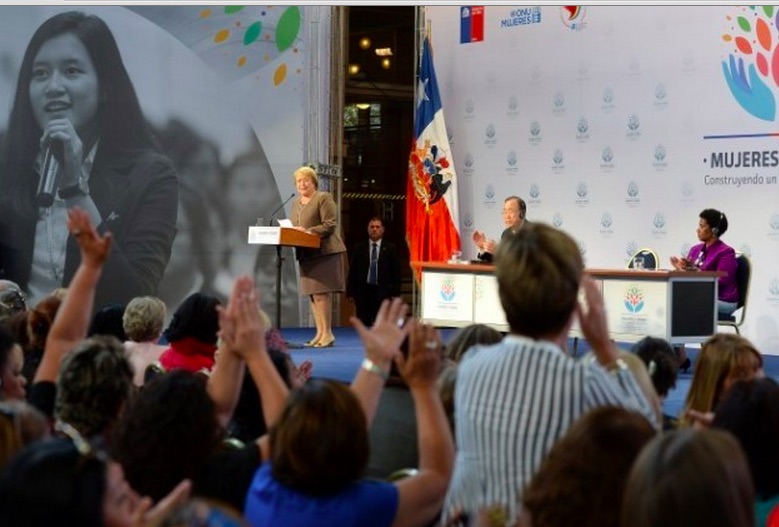
Chilean President Michelle Bachelet during the closing ceremony of the international meeting “Women in power and decision-making: Building a different world”.

“We celebrate that there has been progress in these last twenty years (since the Fourth World Conference on Women in Beijing) in this area…and the evidence is all the people around who came, shared their experiences, the good, the bad, the struggle ahead, the challenges ahead,” U.N. Women Deputy Executive Director Lakshmi Puri told IPS.

And while “some countries have made no progress at all, some countries, some progress, and some countries better progress, no country has reached what we should need to reach,” she added.

“If you’re talking about poverty, you need voice, participation and leadership for women, if you’re talking about economy, you need voice and participation, if you’re talking education, you need women – both education for voice, participation and leadership, capacity-building, and you need them to be leaders in education,” she said.

“Similarly health: you want women leaders in the health sector. Just as they need to have a voice in the design of the health sector and services,” said Puri, from India. “Women in the media is another critical area – you need voice, participation and leadership for women in the media, otherwise you will never get past the inequality and the negative stereotyping of women and their role in the media.”

The high-level event, “Women in power and decision- making: Building a different world”, held Feb.27-28 in the Chilean capital, assessed the advances made towards gender equality in the last 20 years and what still needs to be done.

One example raised at the meeting was the failure to reach the goal on gender balance in leadership positions.

The participants also discussed the route forward, towards the Sustainable Development Goals, for the period 2015- 2030, designed to close gaps, build more resilient societies, and move towards sustainable prosperity for all.

The SDGs will replace the eight Millennium Development Goals (MDGs), which set out the international community’s collective development and anti-poverty targets for the 2000-2015 period.

The women leaders meeting in Santiago demanded that gender equality be mainstreamed into the 17 projected SDGs to prevent the progress from being slow and uneven, as it has been in the last 20 years in the case of the Beijing Platform for Action agreed at the Fourth World Conference on Women in September 1995. . . .

(Click here for a Spanish version of this article)

Question for this article

ICC Judges – Women at the top at the International Criminal Court

. . WOMEN’S EQUALITY . .

an article by Hirondelle News Agency

As the world celebrated International Women’s Day, the International Criminal Court (ICC) this week got its first all- female presidency. ICC judges on Wednesday elected Judge Silvia Fernández de Gurmendi of Argentina as President of the Court for a three-year term with immediate effect, and two other female judges as her Vice- Presidents. A trained diplomat, Gurmendi has been a judge at the ICC since 2010.

ICC women
Click on the photo to enlarge

Judge Silvia Fernández de Gurmendi

Judge Joyce Aluoch of Kenya was elected First Vice- President and Judge Kuniko Ozaki of Japan as Second Vice-President. The outgoing presidency was headed by a man (Judge Sang-Hyung Song of South Korea), who was seconded by one female and one male judge.

This is the first time the ICC has had an all-female leadership. It already has a woman Chief Prosecutor, Fatou Bensouda of the Gambia.

The Presidency – consisting of the President and the two Vice-Presidents – plays a key role in providing strategic leadership to the ICC as a whole. According to the ICC, the Presidency “coordinates with the other organs and seeks the concurrence of the Prosecutor on matters of mutual concern. In accordance with the Rome Statute, the ICC’s governing treaty, the Presidency is responsible for the proper administration of the Court, with the exception of the Office of the Prosecutor.

“The Presidency oversees the activities of the Registry and provides input into a broad range of administrative policies affecting the Court’s overall functioning. Furthermore it conducts judicial review of certain decisions of the Registrar and concludes Court-wide cooperation agreements with States and international organizations.”

On Tuesday, six new ICC judges (all men) were also sworn in: Marc Perrin de Brichambaut (France), Piotr Hofmański (Poland), Antoine Kesia-Mbe Mindua (Democratic Republic of the Congo), Bertram Schmitt (Germany), Péter Kovács (Hungary) and Chang-ho Chung (Republic of Korea). They were elected for nine-year terms during the thirteenth session of the Assembly of States Parties (ASP) to the Rome Statute in December 2014.

(Click here for a Spanish version of this article.)

Question for this article

Do women have a special role to play in the peace movement?

The 30 articles in CPNN linked to this question make it clear that women indeed have a special role to play in the peace movement. See the following for an historical explanation of why this is true.

UN Commission on Status of Women: Implementing the Beijing Platform for Action

. . WOMEN’S EQUALITY . .

an article by UN Women

The year 2015 marks a significant milestone – the 20th anniversary of the Fourth World Conference on Women and adoption of the Beijing Declaration and Platform for Action – which will be the focus of the 59th session of the Commission on the Status of Women CSW59)

Beijing
Click on the photo to enlarge.

At the annual high-level gathering, taking place at the United Nations Headquarters in New York from 9-20 March 2015, global leaders and activists will take stock of progress and remaining challenges for implementing this landmark agreement for gender equality and women’s rights. States drafting the Declaration in 1995, identified 12 critical areas of concern, all of which are still relevant challenges today.

Ahead of the 20th anniversary of the Beijing Platform for Action, UN Women launched a global campaign in 2014 titled “Empowering Women, Empowering Humanity: Picture It“, to reignite the urgency behind the Beijing call and galvanize a new generation to address gender equality issues.

In the lead-up to the session, a record-breaking 166 countries have also undertaken national reviews on the status of women, and rich contributors from civil society have been generated.

These reviews, coupled with the UN Secretary- General’s report on Beijing implementation, will be a central focus of CSW59, where leaders will review progress and formulate concrete recommendations to step up their efforts to ensure gender equality and women’s empowerment touches the lives of all women and girls worldwide.

Every year, CSW attracts thousands of NGO members and hundreds of country representatives from around the world to discuss critical issues for women, galvanize attention and spur action.

Setting a new record this year, more than 1,100 NGOs and a total of 8,600 representatives have registered to participate. There are thousands of stories to tell. Meet some of the heroes, leaders and protagonists who will be there, and find out what the post-Beijing generation thinks is needed to make the Platform for Action a reality. Picture it!

(Click here for a Spanish version of this article or here for a French version)

Question for this article:

Does the UN advance equality for women?

The following article by Lyndal Rowlands in the Inter Press Service, suggests that the UN is not making much progress on its commitments for women’s equality:

2015 marks anniversaries for two significant commitments made to increasing women’s participation at peace tables.

Yet despite the Beijing Platform for Action and the Security Council Resolution 1325 both committing to increasing women’s participation in peace building 20 and 15 years ago, respectively, there has been very little progress to report.

The latest available statistics show that women made up only 9 per cent of negotiators at peace tables between 1992 and 2011. That the most recent data is from 2011 shows that more work is needed even in basic areas such as data collection and reporting of women’s participation in peace building.

IPS summarises here four reasons we should value women’s participation at the peace table more, based on discussions at the 59th Commission on the Status of Women (CSW) over the past week.

Beijing Platform for Action Section E

Women and Armed Conflict Diagnosis

Strategic objective E.1. Increase the participation of women in conflict resolution at decision-making levels and protect women living in situations of armed and other conflicts or under foreign occupation. Actions to be taken.

Strategic objective E.2. Reduce excessive military expenditures and control the availability of armaments. Actions to be taken.

Strategic objective E.3. Promote non-violent forms of conflict resolution and reduce the incidence of human rights abuse in conflict situations. Actions to be taken.

Strategic objective E.4. Promote women’s contribution to fostering a culture of peace. Actions to be taken

Strategic objective E.5. Provide protection, assistance and training to refugee women, other displaced women in need of international protection and internally displaced women. Actions to be taken.

Strategic objective E.6. Provide assistance to the women of the colonies and non-self-governing territories. Actions to be taken.
Women Bring Commitment and Experience to the Peace Table
Often the first people invited to participate in formal peace negotiations are the people holding the guns and the last are women who have expertise in building lasting peace.

Zainab Bangura, Special Representative of the Secretary-General on Sexual Violence in Conflict, told a CSW side event on Tuesday last week, “In the Central African Republic, the only community where they were not killing each other was a community where the Christian women said, ‘These Muslim women are our sisters.’

“Why? Because the women in the community said, ‘We have lived together for the last 100 years’,” Bangura said.

In the Phillipines, Irene Santiago was a member of the government panel that negotiated peace with the Moro Islamic Liberation Front. Santiago came to the table with years of experience working with Christian, Muslim and Indigenous women leaders for peace.

Speaking at a CSW side event at the International Peace Institute (IPI) on Thursday, Santiago said that she knew that her years of experience working with civil society for peace stood her in good stead to make a significant contribution to formal peace negotiations, which she did.

Speaking with IPS, Santiago said women’s voices not only have to be heard, but that they also have to be acted on.

“For women. It’s almost never always about themselves, it’s always about our children, our husbands but also about our communities,” Santiago told IPS.

In Africa, women have fought to be included in peacemaking, even when their contributions have not been recognised.

Bineta Diop, Special Envoy on Women Peace and Security to the African Union, says that mediators need to be held accountable when they only invite the people who hold guns to the peace table and ignore women’s contributions.

“I have been involved in many crises where women were knocking at the door and saying we want to be at the table,” Diop said.

Ambassador Anwarul Chowdhury, known as the father of Security Council Resolution 1325, said that the determination of African women to be involved in peace negotiations should be seen as an inspiration by other countries.

Despite serious difficulties, war and conflict, African women have shown continued determination to hold their countries accountable, Chowdhury said.

Gender Equality in Peace Time Prevents Conflict
Also speaking at the IPI, Valerie Hudson, co-author of ‘Sex and World Peace’, said that her research has shown that the way women are treated within a country is one of the most accurate indicators of the quality of relations that country will have with other countries.

Diop agreed with Hudson, saying that countries that are likely to fall into conflict have higher levels of discrimination and inequality.

“Discrimination against women, especially the non-participation and non-inclusion of women in democracy is … one of the root causes of the conflict,” Diop said.

Ambassador Choudhury agreed with these sentiments, telling IPS, “I believe that no country can claim that their country is not in conflict if women’s rights are denied, if women’s equality is not ensured, if women’s participation at all participation levels is not there.

“I think that if we women are violated, if women’s equality of participation is not there we cannot say that we are at peace, we are in conflict with ourselves. This is a conflict which is happening within ourselves and within the countries. We don’t have to go into the traditional description of conflict, civil conflict or fighting with another country,” Chowdhury added.

Dr. Youssef Mahmoud, Senior Adviser at the International Peace Institute also speaking at the IPI event said, “A world where 51 per cent are ignored is a dangerous world for everyone. I can’t imagine why any men would be indifferent to this.”

Women Are Active In Civil Society
Several discussions at the CSW questioned why militaries were the primary actors in peace building, while non-governmental organisations (NGOs) and civil society’s expertise was not called on.

Related IPS Articles

U.S. Honours 10 “Extraordinary Women” for Courage and Leadership
Meet the 10 Women Who Will Stop at Nothing
Women Walk for Peace in the Korean Peninsula
Santiago told IPS that civil society, especially women, have a lot to contribute to humanise, to concretise, and to make peace negotiations relevant to people’s lives.

Winnie Kodi from the Nuba mountains in Sudan told reporters on Monday that civil society was vital to helping indigenous communities like her own that have been affected by conflict. She said that the main way her people were able to have their voices heard was by working together with NGOs and civil society.

Chowdhury told IPS he is advocating for the U.N. and governments to hold more consultations with civil society, saying that the involvement of women and of civil society is very important.

Santiago also called for renewed focus on the important role of NGOs in the area of women, peace and security,

“Again I see that why are we focusing on the UN as the locus of change,” she said. “To me it is not, it is the means, it is an important audience, but it is not the locus of social change.

“Let us form the global civic networks that we need to bring about the local global and civil change that we need” Santiago said.

Women Challenge The Causes of Conflict
Challenging militarism and militarisation was another theme discussed during the first week of the CSW, particularly by civil society groups at the parallel NGO forum.

Choudhury told IPS that increased militarism and militarisation is slowing down efforts for equality. “Increasing militarism and militarisation has really been effecting women in a very negative way. This is something that women should stand up against, we should all stand up against,” Chowdhury said.

Militarisation is also affecting indigenous women and men. Maribeth Biano, from the Asian Indigenous Women’s Network, told reporters on Monday that Indigenous women are hugely affected by militarisation in Indigenous territories.
Back to top
Profile PM MAIL

Mobile Technology a Lever for Women’s Empowerment

.. WOMEN’S EQUALITY ..


an article by A. D. McKenzie, Inter Press Service News Agency (reprinted by permission and abridged)

Providing women with greater access to mobile technology could increase literacy, advance development and open up much-needed educational and employment opportunities, according to experts at the fourth United Nations’ Mobile Learning Week conference [in Paris].

2039-mobile

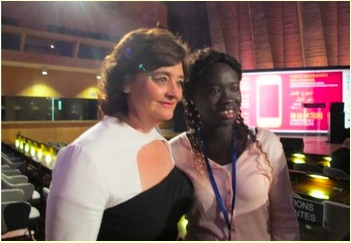
For Cherie Blair (left), founder of the Cherie Blair Foundation for Women and wife of former British Prime Minister Tony Blair, “empowering women and girls to access education isn’t an option, isn’t a nice thing to do, it’s an imperative”. Credit: A.D. McKenzie/IPS

Click here to enlarge photo

“Mobile technology can offer learning where there are no books, no classrooms, even no teachers. This is especially important for women and girls who drop out of school and need second chances,” said Phumzile Mlambo-Ngcuka, Executive Director of UN Women.

The agency, which focuses on gender equality and the empowerment of women, joined forces with its “sister” organisation, the U.N. Educational, Scientific and Cultural Organisation (UNESCO) to host the Feb. 23-27 conference this year.

The aim, UNESCO said, was to give participants a venue “to learn about and discuss technology programmes, initiatives and content that are alleviating gender deficits in education.”

Participants from more than 70 countries shared so-called best practices and presented a range of initiatives to address the issue, including reducing the costs of access to mobile services in some developing countries, and providing training and free laptops to women teachers in countries such as Israel.

“There is still a persistent gender gap in access to mobile technology,” said keynote speaker Cherie Blair, founder of the Cherie Blair Foundation for Women and wife of former British Prime Minister Tony Blair.

In an interview on the side-lines of the conference, she told IPS that “anything that encourages the education of girls is important” and that it was “particularly significant” that UNESCO and UN Women had joined forces to work together in this area to achieve results.

“We need to encourage women to use technology and we also need to involve men to provide support,” Blair said. She cited research showing that a woman in a low- or middle-income country is 21 percent less likely than a man to own a mobile phone. In Africa, the figure is 23 percent less likely, and in the Middle East and South Asia 24 percent and 37 percent respectively.

“The reasons women cite for not owning a mobile phone include the costs of handsets and data plans, lack of need and fear of not being able to master the technology,” Blair said.

Yet, according to the International Telecommunications Union (ITU), mobile phones are the “most pervasive and rapidly adopted technology in history”, with six billion of the world’s seven billion people now having access.

If there existed gender parity in this access, women could benefit from the technology in a number of ways, including getting information about healthcare and other services, experts said. . .

Both UNESCO Director General Irina Bokova and Cherie Blair described education as a “human rights imperative” as well as a development and security imperative.

They stressed that the goal of achieving gender equality in education will continue for the post-2015 development agenda, and that technology has an important role to play. “Empowering women and girls to access education isn’t an option, isn’t a nice thing to do, it’s an imperative,” Blair said.

[Thank you to Janet Hudgins, the CPNN reporter for this article.]

Latest Discussion

Esther Abimiku Ibanga, Founder of The Women Without Walls to receive the Niwano Peace Prize

.. WOMEN’S EQUALITY ..

an article by Niwano Peace Foundation

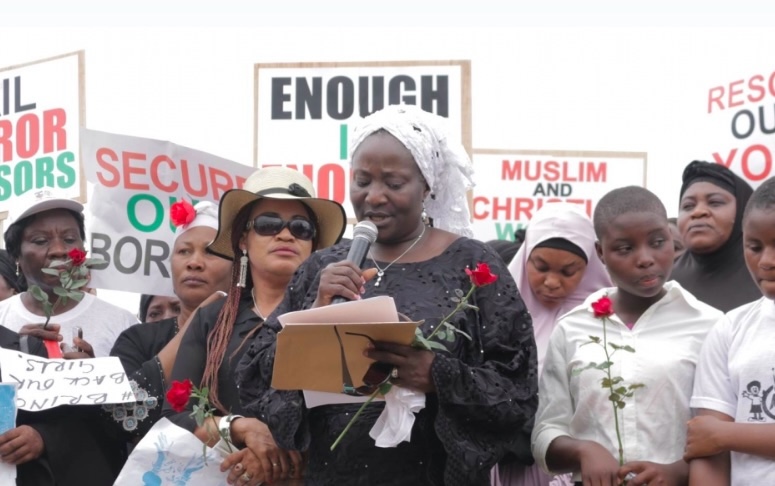
The 32nd Niwano Peace Prize is awarded to Mrs. Esther Abimiku Ibanga of Nigeria, a pastor and an activist. She founded “Women Without Walls Initiative” in March 2010, born out of the desperation to put an end to the violent and senseless killings of women and children in Plateau state Nigeria. Since inception, the organization has become a strong coalition of women groups across religious and ethnic divides. From this platform, women have been placed at an advantageous position of raising their voices in the calls for peace in the troubled regions of Nigeria.

Wowwi has brought to the fore the power of women’s voices and created an opportunity for an organised platform for women to play an active role in peace building. It is on record that Women Without Walls Initiative is the first organization to have on its membership all the tribal women leaders, including Christian and Muslim women leaders. These women act as entry points into the various communities in her city particularly in reaching the youths and all community stakeholders. A courageous and dedicated religious leader, Esther has worked extensively to foster and facilitate reconciliation between conflicting religious and tribal groups.

The presentation ceremony will take place in Tokyo, Japan, on Thursday, May 14th, at 10:30 a.m. In addition to an award certificate, Mrs. Ibanga will receive a medal and twenty million yen.

To avoid undue emphasis on any particular religion or region, every year the Peace Foundation solicits nominations from people of recognized intellectual and religious stature around the world. In the nomination process, some 600 people and organizations, representing 125 countries and many religions, are asked to propose candidates. Nominations are rigorously screened by the Niwano Peace Prize International Selection Committee, which was set up in May of 2003 on the occasion of the 20th Anniversary of the Niwano Peace Prize. The Committee presently consists of eleven religious leaders from various parts of the world, all of whom are involved in movements for peace and inter-religious cooperation.

Here are some comments by members of the committee on the selection of Esther Ibanga for this year’s award:

– A courageous and dedicated religious leader who has worked extensively on fostering co-operation and understanding amongst religious groups. Takes a firm and decisive stand regarding the empowerment of women and has been vocal on the Boko Haram kidnappings.(by N. Walaza)

A female pastor and activist, Esther Ibanga works tirelessly calling government and decision makers to address women issues. Like in most conflicts in Africa women and children are the ones who suffer most the consequences of conflict. Pastor Esther Iyaku Ibanga’s work focuses mainly on promoting and harnessing women’s potential as peace makers. As mothers, women are the first educators of human kind because education starts at home. Her recent strong stand against the kidnapping of school girls by Boko Haram is to be commended.(by S.Mbacke)

Question(s) related to this article:

Can the women of Africa lead the continent to peace?

This question pertains to the following articles:

South Sudanese women take the lead in local peace building
Women take ownership of Great Lakes peace efforts
Les Femmes de Mali S'engagent pour la Paix
The Women of Mali Engage for Peace
Meet the Tanzanian Woman Who Said No to a Forced Marriage
International Women´s Day: Interview With Leymah Gbowee (Liberia)
Announcing: Women of Congo Speak Out!
Samba-Panza’s election represents a bright future for African women in politics
Nobel Women wrap up delegation to eastern Congo
Towards the creation of a network of women for a culture of peace in Africa
Meet Carine Novi Safari, Democratic Republic of Congo
Esther Abimiku Ibanga, Founder and president of The Women Without Walls Initiative to receive the Niwano Peace Prize
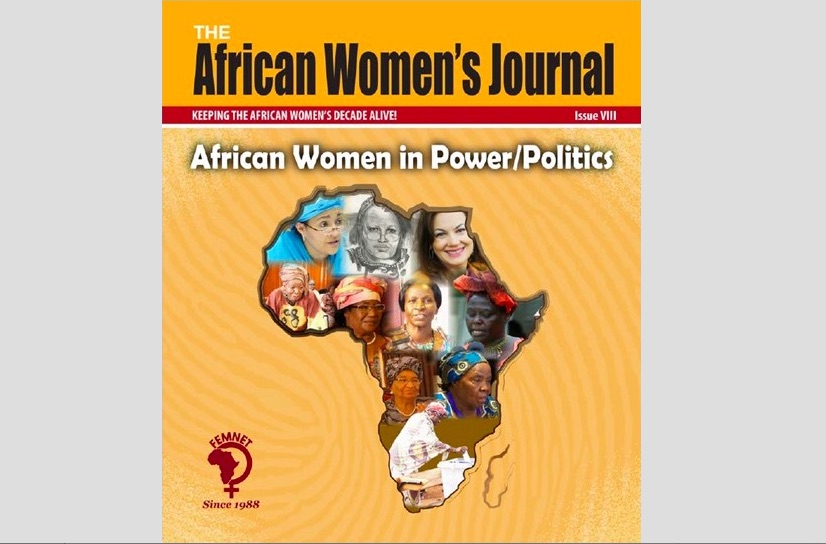
African Women's Journal: African Women in Power/Politics

Women and peace: an incomplete South Asian directory

.. WOMEN’S EQUALITY ..

an article by Vignesh Rajendran, Edited by Mitha Nandagopalan

This project originated in a quest to identify potential partners for peace-related projects. That quest shifted shape, but we kept the kernel of the work and expanded its scope to include all SAARC member countries.

We started with the question, “Which women’s organizations work on peace?” But given that feminists define peace as far more than the cessation of conflict and hostilities, the term was hardly a filter. After all, peace is also empowerment, engaged citizenship, good governance, sustainable development and a free flow of information and expression.

As we identified organizations across a spectrum of activities, we began to tag them with ‘keywords’:
• Peace and conflict transformation
• Women’s rights and empowerment
• Capacity building and community mobilization
• Governance and policy advocacy
• Gender, welfare, relief and sustainable development
• Information and communication

The keywords are simply intended to help in our search to identify resources and partners, not to narrowly define an organization’s work in any way.

The directory is the product of a desk-based Internet search. It is organised into country-specific volumes and a consolidated South Asia volume.

We invite you to email us with names and website addresses for organizations you think should be included. Email us at prajnyatrust@gmail.com.

The Prajnya Trust is a Chennai-based non-profit engaged in research, public education and network- building in areas related to peace, justice and security. This project is located at the intersection of its two initiatives—Politics, Security and Women and Education for Peace.

[Editor’s Note: Interested readers will find on their website extensive information on 175 organizations in Afghanistan (20), Bangladesh (32), Bhutan (3), India (38), Maldives (2), Nepal (29), Pakistan (28) and Sri Lanka (25)].


Question related to this article.

Would your organization like be included in this database?

Press Release from Global Peacebuilders

Building community capacity for peacebuilding worldwide

The Global Peacebuilders project managed by Springboard Opportunities Limited is going live soon. Comprising an innovative online information-sharing portal, unique best practice catalogue and an international conference located in Belfast, Northern Ireland, the Global Peacebuilders project will connect researchers, academics, practitioners and organisations working on peace and reconciliation, conflict resolution and peacebuilding worldwide, and will provide a platform for disseminating achievements and building capacity for the future.

While every conflict across the world is distinct, the underlying causes are often similar, and there is much to be gained by building bridges between practitioners and sharing in the positive work and successes that have taken place. Not only within the context of the island of Ireland, but also beyond, there is a need for a positive place in which all conflict resolution and peacebuilding organisations can come together, share strategy, build momentum and increase their capacity for transforming conflict and creating the conditions for sustainable peace.

The Global Peacebuilders project will help build such a platform for disseminating achievements and sharing strategies for the future. Specifically, a fully-searchable 5-language online database of individuals and organisations working in conflict resolution and peacebuilding will be developed. The database will bring together organisations from across the global north and south, and, stemming from this, a comprehensive catalogue of best practice examples in conflict resolution and peacebuilding from around the world will be produced.

By building new relationships and spanning continental divides, the project will enable organisations to ‘broaden their horizons’, offering inspiration and strategic direction, and affording them a portal through which to share and incorporate innovation and best practice. By offering a solid support network for conflict resolution, reconciliation and peacebuilding, Global Peacebuilders will help organisations to learn from one another, increase confidence, build capacity and ultimately make a more effective contribution towards stable and inclusive societies across the world.

Sign up and circulate

If you, your organisation, or any organisation you know would be interested in joining the online database of peacebuilding and conflict resolution organisations, contributing your best practice examples, or simply learning more about the Global Peacebuilders project, contact Sarah Maitland, the Global Peacbuilders Project Coordinator on +44 (0)28 9031 5111, sarah@springboard-opps.org or www.springboard-opps.org. A spirit of inclusivity, diversity and participation is at the very heart of this project, so we would be delighted to hear from you!

The Global Peacebuilders project is funded by the European Union’s Peace and Reconciliation Programme 2000-2006 under Measure 5.3 Developing Cross Border Reconciliation & Understanding and managed for the Special European Union Programmes Body by the Community Foundation for Northern Ireland.