Category Archives: WOMEN’S EQUALITY

Eight ways 2015 was a momentous year for girls

. WOMEN’S EQUALITY .

An article from Girl Effect

What a year it’s been. From the Sustainable Development Goals and global support for girls’ education to commitments to end harmful practices that hold girls back, 2015 has been momentous. Here are eight developments that show girls are getting the attention they deserve.

girleffect2

1. GIRLS GET GLOBAL RECOGNITION

What started two years ago as the Girl Declaration ended with girls’ needs being put on the global development agenda for the first time ever. The Sustainable Development Goals summit made history by ensuring that girls and women not only got their own dedicated goal, but by also prominently featuring Malala at the opening session they put a teenage girl on equal footing with world leaders. The SDGs will run for 15 years and influence how trillions of dollars of aid money will be spent. It’s a victory for girls and the beginning of a long journey.

2. HARDSHIP LEADS TO LEADERSHIP

The refugee crisis proved impossible to ignore any longer this year, with global headlines showing families fleeing conflict and violence. It shone a light on how refugee girls feel the impact harder than others. Their education gets disrupted, they’re more likely to be forced into early marriage, and there’s an increased risk of trafficking and abuse. The hardship, though, has provided an opportunity for leadership. Step up, Muzoon. She’s the 16-year-old living in a refugee camp in Jordan. When she noticed that girls her age stopped going to school because they were getting married, she set about advocating for refugee girls’ education. The world and Malala took notice and helped fund a girls’ school in Muzoon’s camp. Yep. Girls make great leaders.

3. GIRLS’ EDUCATION BECAME IMPOSSIBLE TO IGNORE

When an 18-year-old girl opens a session at the United Nations and takes centre stage at the Global Citizen Festival in New York City’s Central Park a day later, you know girls have got the world’s attention. While Malala has tirelessly campaigned for girls’ education, this year saw other big names picking up the mantle. The United States launched a global girls’ education initiative, Let Girls Learn, with Michelle Obama leading the charge. The UN’s refugee agency dedicated an award to Aqeela Asifi, who made it her mission to convince a community to send their girls to school. And around the world, girls claimed their right to education in their communities. The benefits of educating girls are indisputable, and now that it’s in the spotlight we expect big things.

4. MORE COMMITMENTS TO END CHILD MARRIAGE

Every minute, 28 girls get married. But efforts to end child marriage have gained momentum. The African Union held its first Girls’ Summit to End Child Marriage, and world leaders committed to stamping out this harmful practice at the SDGs summit. Girls proved, though, that they are best placed to speak out about child marriage, from the Afghan rapper Sonita to Dieynaba, the graffiti artist in Senegal. If this keeps up, the rate of child marriage will fall, especially if we keep the pressure on heads of state to live up to their promises.

(Article continued in right column)

Question for this article

Prospects for progress in women’s equality, what are the short and long term prospects?

Gender equality in education, Is it advancing?

(Article continued from left column)

5. GIRLS BREAK TABOOS AROUND THEIR BODIES

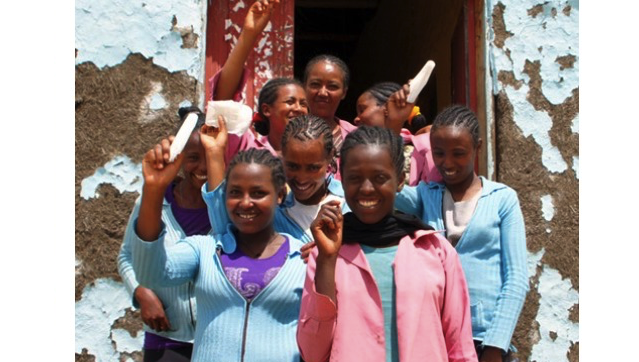
In 2015, periods stopped being a dirty word. We saw the rise on social media of Menstrual Hygiene Day which was marked around the world. In India, girls demanded freedom from the taboos surrounding their bodies by protesting on the streets and online. The Indian media followed suit, representing girls and women in ways that were never seen before in advertising and film. Meanwhile, young women designers came up with an innovative solution that answered girls’ needs for sanitary products in the developing world. And a British woman, Amy Peake, made it her mission to ensure that girls and women in refugee camps get the sanitary pads they need to maintain their dignity. The natural function of girls’ bodies doesn’t have to be shameful any longer.

6. CUTTING OUT FGM

This year saw a record number of people using the #EndFGM hashtag, less than a year after it was first coined. Egypt saw its first conviction and jailing of a doctor over the FGM-related death of a 13-year-old girl. Nigeria and The Gambia banned the practice, and many more countries have developed action plans to tackle FGM or to ensure robust data is collected on the practice. Girls haven’t kept silent themselves. More and more they are demanding a life free from this traditional act of violence. Girls like Naserian, who took part in an alternative rite of passage rather than undergo the cut. And women like Jaha Dukureh, who survived FGM and took her awareness-raising campaigns to a national level. Let’s make sure heads of state don’t forget the pledges they made to enforce bans on FGM.

7. MORE ROBUST DATA ON GIRLS COLLECTED

With the SDGs in place, the next step is to ensure that the right kind of data gets collected. This year, the Clinton Foundation launched the No Ceilings report. This ground-breaking piece of research presents hard evidence of how girls and women are still being held back. Another promising development was the launch of the Data2X, a global partnership to make sure girls and women get counted. The next step in the data revolution will be when the UN decides in March how it will measure its progress against the SDGs. We’ll be watching, and so should you.

8. CONNECTING GIRLS

The fact that there are more mobile phones than toilets is well known. But, despite the widespread use of mobile technology to do everything from socialising to banking to actually speaking on the phone, there’s shockingly little known about how girls and women use it. When it comes to connectivity, women in developing world cities are 50 per cent less likely to access the internet than men. Education and income are determining factors. This doesn’t look good for girls, who are held back on both counts. Some positive steps have been taken, such as the launch of Facebook’s internet.org, of which Girl Effect is a partner. And we’re seeing more apps targeting issues such as gender-based violence including ones in Cambodia and Turkey. With the push for girls’ education firmly on the global agenda, we expect to see more girls becoming connected, learning to code and filling the gender gap in the tech industry. Once this happens, girls can code for girls. We can’t wait.

(Thank you to Janet Hudgins, the CPNN reporter for this article.)

International dialogue on gender equality in the media to be held in Geneva

. WOMEN’S EQUALITY .

An article from UNESCO

From 7 to 10 December, UNESCO and the Global Alliance on Media and Gender (GAMAG) will hold the first International Development Cooperation Meeting on Gender and Media and the first General Assembly of the Global Alliance on Media and Gender (GAMAG), in Geneva, Switzerland.

geneva
Pupils participating in a physical education class at Tutis Primary School in Oromia State of Ethiopia, November 2013. © UNICEF Ethiopia

The events are co-hosted by the Republic of Lebanon and the Hellenic Republic (Greece) and supported by close to 20 UN organizations. Both events will coincide with the International Human Rights Day, December 10.

Women’s participation, their leadership and fair representation in media and technology are way below that of their male counterparts. After four decades of research and development actions, little change can be celebrated.

The world famous actor* Geena Davis observed that at the present rate, it will take another 70 years to achieve gender equality in the media. This is more than four times the number of years agreed upon by the international development community to achieve the new sustainable development goals, by 2030. A dialogue of a different order is needed.

Gender inequalities in the media and technology are rooted in cultures, traditions, stereotypes, beliefs and a lack of awareness of the negative gains of these inequalities on economic and sustainable development. Such social practices are no longer separated by remote geographical boundaries. Dialogue then becomes crucial to bring about a deeper understanding and agreement on a common path to change.

Therefore, the main aim of the high-level events is to initiate a dialogue about global development cooperation framework to achieve gender equality in and through media. The meeting will include various development actors such as UN agencies, funds and programmes, national and regional development organizations, governments, private sector and other international development organizations. Ministers, ambassadors, media, civil society, private sector, and development executives as well as leading experts are invited to attend.

(Article continued in right column)

Question for this article

Does the UN advance equality for women?

(Article continued from left column)

Topics will include ingredients for global development cooperation framework on gender and media, the emerging online media and youth, gender and media as a business and development model, and strategic link between policy and research on gender and media.

To register for these events please click here.

GAMAG is a UNESCO-initiated groundbreaking partnership among over 800 media, civil society, academic, private and governmental organizations. Its purpose is to be the global mechanism through which Section J, gender and media, of the Beijing Declaration and Platform for Action (BDPA) can be systematically implemented and monitored. It is governed by 20 member organizations that form the international steering committee.

Before GAMAG there was no defined global framework for follow up on Section J of the BDPA. The twin events from 7-10 December 2015 will build on the global partnerships started through GAMAG. Yes We Must! Reaching Gender Equality by 2030.

Register now for these events and join GAMAG.

For more information please visit our website.

As the UN Celebrates Empowerment of Women, a New Survey Shows Major Frustrations

. WOMEN’S EQUALITY .

An article by Danielle Goldberg and Mavic Cabrera-Balleza for Pass Blue

Fifteen years ago, the United Nations Security Council unanimously adopted a resolution on women, peace and security, a landmark international law that demands women’s participation in decision-making on international peace and security.

passblue

Though seldom recognized, the fundamental roots of this resolution, known as 1325, came from women’s actual experiences in armed conflict and their struggles for peace, championed by women’s organizations and civil society groups around the world.

As governments, donors and the UN come together this month to renew their commitments to the resolution’s mandate and address constraints and obstacles that keep it from fully being carried out, it is critical that these parties continue to engage civil society organizations as equal partners. After all, we are the ones who are implementing the resolution on the ground.

In this light, the Global Network of Women Peacebuilders, in partnership with Cordaid, the International Civil Society Action Network and the NGO Working Group on Women, Peace and Security, all civil society organizations working hard on this mandate, conducted a survey earlier this year among other civil society organizations to solicit their views on the implementation of 1325.

Findings from the survey fed directly into the recently published global study commissioned by the UN secretary-general, Ban Ki-moon, to highlight “good practice examples, gaps and challenges, as well as emerging trends and priorities for action on UNSCR 1325 implementation.”

What stands out in the survey, featuring 317 responses from a wide range of organizations in 71 countries, is that women’s participation at all levels of decision-making in official peace and conflict negotiations and processes is still far from sufficient. As a result, a majority of respondents identified this as a top priority in the future agenda.

The ability to hold governments and armed groups accountable for grave human-rights violations against women was viewed as a significant achievement of 1325, though many groups qualified this gain.

Despite their leadership in the implementation of the resolution, overall respondents rated 1325 as only “moderately effective” because many of those surveyed think that the transformative potential of the resolution has not been fulfilled across the world. As one civil society group specifically noted, “The resolution is yet to witness groundbreaking achievement for strengthening the status of women in Nepal.”

Among positive reflections on the effectiveness of 1325, respondents said that it has mobilized women around the world and lent credibility and structure to their work. As one group in the Democratic Republic of the Congo said, “It has given us a platform to globalize all issues related to women.”

(Article continued in right column)

Question for this article:

UN Resolution 1325, does it make a difference?

(Article continued from the left column.)

Many respondents believe that the numerous women, peace and security resolutions stemming from 1325 have changed the dominant perception of women as victims to being agents of change and peace-builders.

Nonetheless, widespread concern was messaged in the survey that shifting paradigms on the women, peace and security agenda at the global level have not affected girls and women at the local level enough. In turn, respondents affirmed the need to tailor implementation of the 1325-related resolutions to the local realities of women and girls to ensure that such programming reaches remote areas.

Respondents also made key observations and recommendations regarding the resolution’s main pillars: women’s rights to participation and representation; conflict prevention and women’s protection; justice and accountability; and peace-building and recovery.

Participants in the survey want to see a reprioritization of conflict prevention, disarmament and demilitarization at the core of the 1325 agenda. They urge governments to move beyond a narrow focus of preventing sexual and gender-based violence, for instance, and instead use 1325 to address the causes of conflict, including gender norms — patriarchal cultures, for example — that drive conflict and insecurity.

Respondents reported an increase in women’s engagement in peace-building and recovery. Many also affirmed the importance of embedding “local” solutions into a comprehensive and innovative approach to peace, security and development. As a group in Burundi noted, “Gender must be at the heart of socioeconomic development and peace consolidation.”

Attesting to the lack of sufficient funding for their work, respondents urged donors to invest in programming and establish funding mechanisms that ensure rapid, direct access to resources, particularly for local women’s groups.

The survey also identified such emerging issues as the impact of violent extremism and terrorism on women and girls; the intersection among climate change and natural disasters and violent conflict; the correlation between peace and security and health pandemics; and the effect of mass media and information and communications technologies on the lives of women and girls.

To address these cross-cutting challenges, the survey again showed the importance of conflict prevention and redefining security based on the experiences of women on the ground.

Fifteen years after the adoption of 1325, survey results have made it clear that despite all the challenges, civil society remains highly committed to achieving the transformative potential of this landmark resolution. Moreover, their practical experiences demonstrate that the best solutions remain in the hands of civil society and that the most profound barrier remains political will.

As the Security Council meets this week and activities are held worldwide to commemorate this anniversary, those who carry out the mandate of 1325 must return to its roots by fully engaging civil society and local communities directly affected by violent conflicts. Only then can the promise of 1325 truly become a reality.

United States: Religious Groups Mobilize to Promote Feminism and Faith

. WOMEN’S EQUALITY .

An article by Eleanor J. Bader, Truthout (reprinted by permission)

Several weeks ago, in early October, a host of religious leaders stood in front of the 41-year-old Preterm clinic in Cleveland, Ohio, to thank God for abortion providers and bless their work. Sponsored by the Ohio Religious Coalition for Reproductive Choice (RCRC), the bold ceremony was meant to publicize the fact that in many traditions – including mainline Protestant, Jewish and Muslim – abortion is considered an acceptable, and yes, moral, option.
parenthood
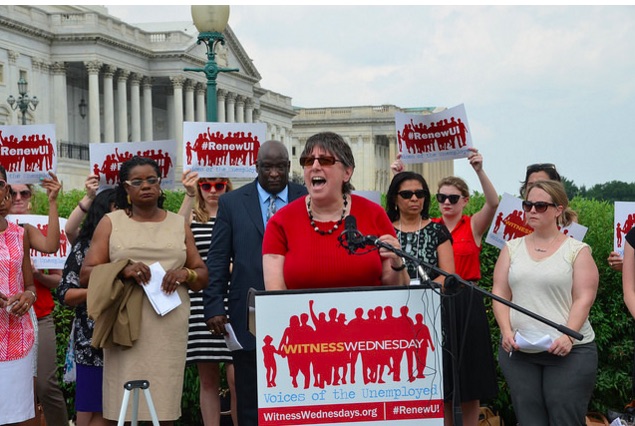
Sammie Moshenberg from the National Council of Jewish Women speaks at an event combating unemployment in Washington, DC, June 18, 2014. (Photo: Center for Effective Government)

“We went to Preterm because anti-abortion legislators have been aggressively working to push abortion out of reach for Ohio women,” Lisa Weiner-Mahfuz, RCRC vice president of programs and fund development, told Truthout. “This includes unnecessary restrictions on abortion care providers, like Preterm, to force them to close. Ohio RCRC believes it’s time for the progressive religious community to stop silently watching women be attacked for their decision to have an abortion and start sharing their beliefs out loud.”

The decision by clergy to move from private, closed-door pastoral counseling sessions into public activities like the clinic blessing was further provoked by recent attempts to defund Planned Parenthood. The threat against the reproductive health organization galvanized faith groups throughout the United States, among them Catholics for Choice, the National Council of Jewish Women, the Muslim Education Center for Creative Academics, the Union for Reform Judaism, the Unitarian Universalist Women’s Federation and the United Church of Christ, prompting them to ramp up their visible support for reproductive rights and gender justice.

They mobilized quickly, among other things, gathering signatures from more than 50 denominational heads and prominent religious leaders on a letter to the Senate affirming widespread religious support for choice. “A world without Planned Parenthood would be disastrous for women and their families,” the missive declared. As part of a massive outcry from Americans in every corner of the country, the effort succeeded: At least for now, Planned Parenthood funding is safe.

Of course, that’s good news, but the progressive faith community is not retreating in the face of the averted crisis. Instead, it’s taking affirmative steps to promote gender equity more broadly. Furthermore, feminists of faith are linking reproductive well-being to efforts to improve sexual health, end rape culture, promote LGBTQ equality and stop domestic violence. They’re also working to protect immigrants, and ameliorate poverty and hunger, placing these issues under the broad rubric of reproductive justice. And although this effort is not wholly new – religious reproductive and social justice groups have existed for decades – the fact that clergy are taking to the streets and entering the halls of Congress is noteworthy.

Carol Hornbeck, a marriage and family therapist who has been involved in faith-based reproductive justice work since the 1980s, sees these moves as imperative and says that without an intersectional analysis of oppression, religious bodies will become irrelevant.

“Many mainline Protestant churches are fighting for their survival,” she said. “At the same time, the church renewal movement is trying to be authentic and bring millennials into organized congregations. Many of the millennial women they hope to attract have had abortions and have been more open and outspoken about this than previous generations. These young women have no patience for the silence of the church on important social issues – whether Black Lives Matter, reproductive justice or LGBTQ inclusion – and are reinventing the institution.”

At the heart of the reinvention, Hornbeck adds, is a willingness to tackle controversial topics, speak truthfully about lived experiences and call out hypocrisy.

This is music to divinity student Abbi Heimach-Snipes’ ears. Now in her final year at Chicago’s McCormick Theological Seminary, she says that when the most recent attacks on Planned Parenthood became public, she and her peers felt “frustrated and upset” but saw the right-wing assault as inseparable from the fight for racial justice, and against homophobia, transphobia, sexism and the violence that disproportionally impacts low-income communities of color.

(Article continued in right column)

Question related to this article:

Protecting women and girls against violence, Is progress being made?

Abortion: is it a human right?

(Article continued from left column)

But how best to use the power of the institutional church – or other established religion bodies – to address these concerns? Although Heimach-Snipes is no stranger to political protests, regularly attending demonstrations and rallies, she said that many congregations can do more to advance a progressive political agenda. She calls the church she attends, Urban Village, a model and describes a recent Sunday gathering that confronted sexual violence.

“One of the pastors there, Rev. Emily McGinley, has organized a sermon series on sexuality,” Heimach-Snipes said. “A few weeks ago she preached on Second Samuel, about the rape of King David’s daughter, Tamar, by her brother Amnon. Tamar’s father and his other sons silenced her and did not hold Amnon accountable. This led to more silence and more terror. Rev. McGinley spoke about power dynamics and tied the story to today’s rape culture. We then looked at ways we can begin to stop the silence.” Heimach-Snipes described the sermon and subsequent discussion as powerful, even profound.

In addition, she added, each Sunday, Urban Village invites congregants to share the issues they’re struggling with. Whether it’s sexual violence, substance abuse, police brutality, landlord-tenant conflicts or something else, the stories become part of what Heimach-Snipes calls “community memory.” This, in turn, serves as a way to publicly address trauma, abuse or injury while simultaneously acknowledging the testifier’s strength and problem-solving abilities. Churches like Urban Village may not be entirely typical, but they’re not anomalous – all over the country congregations are serving as conversational launching pads and are taking action on issues that impact their communities.

On a more policy-driven level, faith-based advocacy groups around the United States are engaged in educational work to promote increased access to services and entitlements. The National Council of Jewish Women, for example, is part of a coalition to support HEAL (Health Equality and Access Under the Law) for Immigrants and Families, a federal bill to extend Medicaid and Child Health Insurance Program benefits to lawful immigrants, and is pushing lawmakers to support the EACH Act, intended to overturn the Hyde Amendment and allow Medicaid recipients to use their coverage to pay for abortions. They’re also urging Congress to pass the Women’s Health Protection Act to make it unlawful for states to single out reproductive health facilities for stricter regulation than other types of medical centers.

What’s more, like other reproductive justice proponents, the National Council of Jewish Women’s advocacy goes beyond abortion and birth control to include improving community health, with goals that involve raising the minimum wage, ending police brutality and promoting gun control.

Still other groups, like the Catholic Network Lobby and the New Sanctuary Movement, are promoting women’s rights by focusing on unfair taxation, immigration reform and opposition to punitive welfare policies.

“Abortion access does not play an active part in our work,” said community organizer Nicole Kligerman of the Philadelphia New Sanctuary Movement. “But other reproductive health-care issues are paramount. We know the importance of prenatal care and early intervention but mothers and babies can’t get nutritional support through the Women, Infant, Children program [WIC] if they’re not citizens. This inequity occurs at the intersection of child welfare, reproductive health and immigrant rights.”

Placing reproductive health into a broad social justice frame holds great significance for feminists of faith who understand that moral and ethical choices have political implications. Do we believe we have the capacity to make thoughtful decisions for ourselves? Does free will give us the right to decide when and whether to become parents? Does it allow us to be who we are and love who we love? Or does it condemn us for anything that deviates from expected norms?

For RCRC’s Lisa Weiner-Mahfuz, promoting reproductive justice requires us to think about the kind of world we wish to live in. “We can’t ignore that abortion is still a trigger in the ways it has always been a trigger,” she said, “but it is tied to a broader agenda that is all about policing Black, Brown, disabled, poor, queer, and immigrant bodies, especially if they’re female.” This is why, she says, RCRC has developed a comprehensive training plan to enable clergy to provide compassionate pastoral care and equip them to be reproductive justice advocates in their congregations and communities.

“We have a large number of multifaith religious leaders, all of whom affirm that reproductive health centers are sacred spaces,” Weiner-Mahfuz said. “They’re working to build visibility so that it is clear that most people of faith support reproductive justice, LGBTQ rights and racial equality. We’re standing up and saying that theology should not be used against women, people of color or families. We’re amplifying the message that God’s love is consistent, and for everyone.”

(Thank you to Janet Hudgins, the CPNN reporter for this article.)
Bolivia: March of University Students to Promote Culture of Peace

. . WOMEN’S EQUALITY . .

An article by Roberto Patiño, El País online (translated by CPNN)

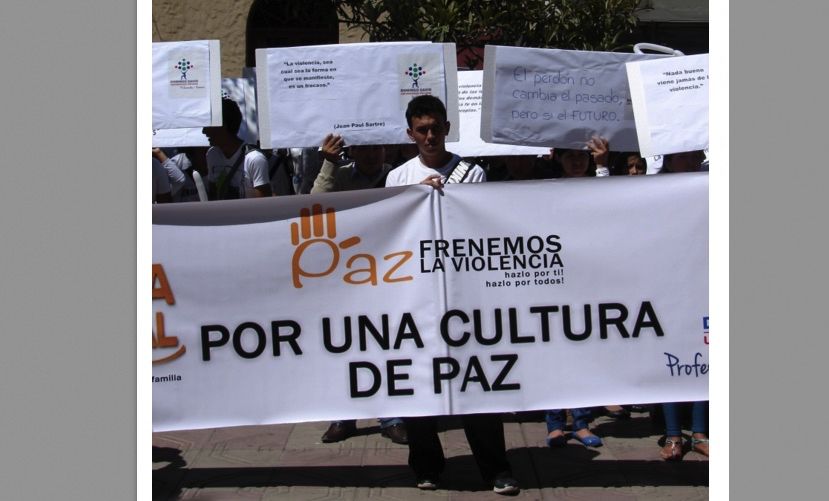
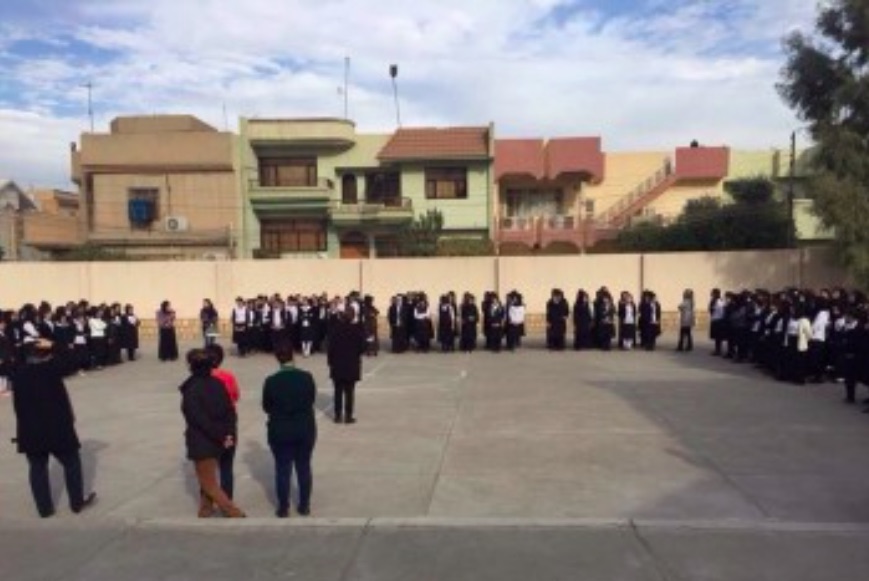
As part of the activities for the International Day against Violence towards Women, the students at Dominic Savio Private University (UDPS) staged a march with signs and banners that carried messages for a Culture of Peace.

bolivia

With T-shirts and white blouses, without firecrackers or thunderous noise, they arrived at the Plaza Luis de Fuentes and held a simple meeting. According to UPDS student, Paola Piotti, it we need to understand that the culture of peace is the only way to overcome violence in the country. She stressed that they did not shout or sing in the march because peace is transmitted through a silence in which everyone can be in communion.

For her part, the Secretary of Women and Family for the Municipal Government of Tarija, Patricia Paputsakis, remarked that these young people have committed themselves to stop the violence and to be agents of transformation in a campaign launched by her office.

She maintained that a “Culture of Peace is a change in attitudes and behavior so that we resolve differences through non-violent practices, through dialogue, conciliation and mediation. It does not involve hitting, insults or psychological violence.” In turn, the rector of UDPS, Mary Virginia Ruiz, said that the phrase Culture of Peace denotes harmony and love. Although problems persist they can always be solved through dialogue, and it is the women who can put a stop to violence.

(click here for the original article in Spanish)

Question related to this article:

Preventing conflict – Transforming justice – Securing the Peace

. . WOMEN’S EQUALITY . .

From a study by UN Women

Foreward by Phumzile Mlambo-Ngcuka, UN Under-Secretary-General and Executive Director of UN Women

Resolution 1325 was one of the crowning achievements of the global women’s movement and one of the most inspired decisions of the United Nations Security Council. The recognition that peace is inextricably linked with gender equality and women’s leadership was a radical step for the highest body tasked with the maintenance of international peace and security. Turning the Security Council’s words into actions and real change has been a central pillar of UN Women’s work since the entity was created, and the driving passion of many other actors since the resolution was adopted as a global norm in 2000.

unwomen

And yet there remains a crippling gap between the ambition of our commitments and actual political and financial support. We struggle to bridge the declared intent of international policymaking and the reality of domestic action in the many corners of the world where resolution 1325 is most needed.

UN Women was privileged to be tasked by the Secretary- General with helping to prepare this Global Study. We are grateful to its independent lead author, Ms. Radhika Coomaraswamy, her advisory board, and all the member States, academics, non-governmental organizations, and UN bodies that supported this effort. The preparation process involved consultations all over the world, the provision of ideas as well as technical inputs and information, and commentary on and review of drafts. We hope that this Study will stimulate discussion and be followed by concrete commitments, resources, political will, policy shifts, and accountability at all levels.

This Study reinforces the Security Council’s original crucial recognition of the power of engaging women in peace with compelling proof. It shows that women’s participation and inclusion makes humanitarian assistance more effective, strengthens the protection efforts of our peacekeepers, contributes to the conclusion of peace talks and the achievement of sustainable peace, accelerates economic recovery, and helps counter violent extremism. This Study, and a growing evidence base, make the implementation of resolution 1325 even more urgent and needed.

(Article continued in right column)

Question related to this article:

UN Resolution 1325, does it make a difference?

(Article continued from left column)

The Study adds two more important elements that will help us push this agenda forward. It compiles multiple examples of good practice that should become the standard requirement for all. In addition, it takes a hard look at implementation and enforcement, and the missing incentives and accountability measures that should nudge all actors into complying with these norms and living up to their promises. What emerges from these ideas is an explicit and ambitious roadmap for the way forward on women, peace and security. We have an enormous responsibility to ensure that the normative framework spurred by resolution 1325 is not just given periodic visibility and attention, but that it lies at the heart of the UN’s work on peace and security.

This year, we celebrate 15 years of resolution 1325 and 20 years since the Fourth World Conference on Women in Beijing. We have a new momentum towards the recognition of gender equality and women’s empowerment at the heart of sustainable progress for all, with the adoption of the 2030 Agenda for Sustainable Development. Many actors are coming to the table with new energy, new ideas, and new commitments, and we have seen other policy reviews, from our development goals to our peace operations and our peacebuilding architecture, emphasize the centrality of gender equality. This is an important opportunity to shape the way in which we address our global challenges in the next decades. Let us make the most of it.

(Thank you to Janet Hudgins, the CPNN reporter for this article.)
UNHCR names Afghan refugee teacher Aqeela Asifi its 2015 Nansen Refugee Award winner

. . WOMEN’S EQUALITY . .

An article by UNHCR. The UN Refugee Agency

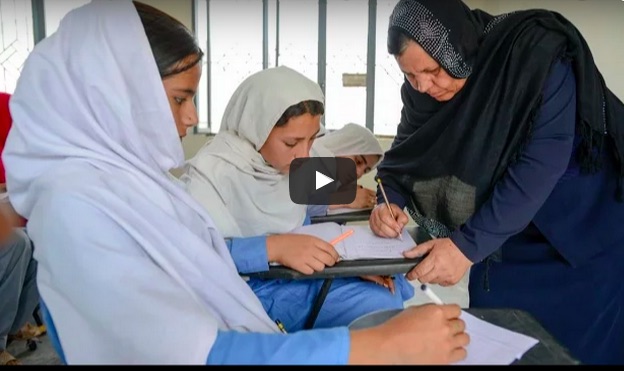
Afghan refugee teacher Aqeela Asifi, who has dedicated her life to bringing education to refugee girls in Pakistan, has won the 2015 UNHCR Nansen Refugee Award. Aqeela Asifi, 49, is being recognised for her brave and tireless dedication to education for Afghan refugee girls in the Kot Chandana refugee village in Mianwali, Pakistan – while herself overcoming the struggles of life in exile. Despite minimal resources and significant cultural challenges, Asifi has guided a thousand refugee girls through their primary education.

Nansen
Profile of Aqeela Asifi, 2015 Nansen Refugee Award winner

Afghanistan is the largest, most protracted refugee crisis in the world. Over 2.6 million Afghans currently live in exile and over half of them are children. Access to education is vital for successful repatriation, resettlement or local integration for refugees. Yet globally it’s estimated that only one in every two refugee children are able to go to primary school and only one in four attend secondary school. And for Afghan refugees in Pakistan this falls further, with approximately 80 per cent of children currently out of school.

UN High Commissioner for Refugees, António Guterres paid tribute to the efforts of the winner of the global humanitarian award: “Access to quality and safe education helps children grow into adults who go on to secure jobs, start businesses and help build their communities – and it makes them less vulnerable to exploitation and abuse. Investing in refugee education will allow children to play a part in breaking the cycle of instability and conflict. People like Aqeela Asifi understand that today’s refugee children will determine the future of their countries, and the future of our world.”

UNHCR has released a contextual report Breaking the cycle: Education and the future for Afghan refugees, to coincide with today’s announcement. The report outlines the challenges that children, especially refugee girls, face in accessing education in Pakistan.

Asifi is a former teacher who fled from Kabul with her family in 1992, finding safety in the remote refugee settlement of Kot Chandana. Asifi was dismayed by the lack of schooling for girls there. Before she arrived, strict cultural traditions kept most girls at home. But she was determined to give these girls a chance to learn. Slowly but surely she convinced the community, and began teaching just a handful of pupils in a makeshift school tent. She copied out worksheets for the students by hand on sheets of paper. Today the tent school is a distant memory and over a thousand children are attending permanent schools in the village thanks to her early example.

(Article continued in right column)

Questions related to this article:

Gender equality in education, Is it advancing?

Is peace possible in Afghanistan?

(Article continued from left column)

She believes that instilling a belief in the power of education for girls in this generation will transform the opportunities of the next. “When you have mothers who are educated, you will almost certainly have future generations who are educated,” she said. “So if you educate girls, you educate generations. I wish for the day when people will remember Afghanistan, not for war, but for its standard of education.”

“Access to education is a basic human right. Yet for millions of refugee children it is a lifeline to a better future which they have been heartbreakingly denied,” said UNHCR Goodwill Ambassador, Khaled Hosseini.

“I have met many young refugees who have been torn from everything that makes them feel safe: their homes, their families, their friends and their schools. Investing in their education is an investment in their future, giving them hope and the chance to one day be a part of rebuilding their broken home countries.

“UNHCR is working to give all refugee children the chance to go to school. Aqeela Asifi has shown us all that with courage change can happen. We must continue her fight.”

Since the fall of the Taliban in 2001 5.7 million Afghans have returned home, yet insecurity still remains. UNHCR has embarked on a strategy to assist remaining Afghan refugees to return home and a key element of this is ensuring they can access quality education. A ministerial level meeting in early October in Geneva will seek to advance this strategy with key regional partners.

UNHCR’s Nansen Refugee Award honours extraordinary service to the forcibly displaced, and names Eleanor Roosevelt, Graça Machel and Luciano Pavarotti among its laureates. The 2015 ceremony will be held on 5 October in Geneva, Switzerland. Speakers and performers at the event will include UNHCR Honorary Lifetime Goodwill Ambassador Barbara Hendricks, UNHCR Goodwill Ambassador Ger Duany, Unicef Goodwill Ambassador and singer Angelique Kidjo and visual artist Cedric Cassimo.

(Thank you to the Good News Agency for bring this to our attention.)

U.N. Highlights Importance of Public Spaces, Safety for Women

. . WOMEN’S EQUALITY . .

An article by Tharanga Yakupitiyage, Inter Press Service (reprinted by permission)

Improving access to public spaces, and making them safe for women and girls, increases equity, combats discrimination and promotes inclusion, said Secretary-General Ban Ki-moon during a High-Level Discussion on “Public Spaces for All.”

safety

The meeting coincided with World Habitat Day, which is observed annually on the first Monday of October.

It brought together top UN officials, private sector representatives, academics, and civil society members to discuss the state of the world’s towns and cities, the right to adequate shelter, and the importance of public spaces.

In Ban’s address, he remarked: “High-quality public spaces encourage people to communicate and collaborate with each other, and to participate in public life.”

“Public spaces can also provide basic services, enhance connectivity, spawn economic activity and raise property values while generating municipal revenue,” he continued.

The Executive Director of the UN Human Settlements Programme (UN-Habitat) Joan Clos echoed the UN Chief’s comments.

“These spaces shape the cultural identity of an area, are part of its unique character and provide a sense of place for local communities,” Clos stated.

Clos also warned that when public spaces are inadequate, poorly designed or privatized, a polarized city with high social tensions, crime and violence will result.

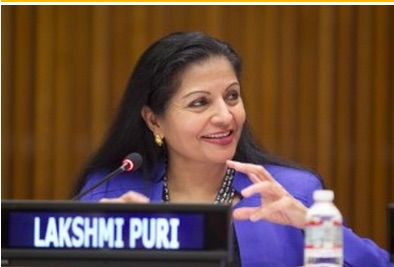
Deputy Executive Director of UN Women Lakshmi Puri particularly pointed to violence against women and girls in public spaces as a major challenge.

“If violence in the private domain is now widely recognized as a human rights violation, violence against women and girls, especially sexual harassment and other forms of sexual violence, in public spaces remains a largely neglected issue, with few laws or policies in place to prevent and address it,” Puri said.

(Article continued in right column)

Question related to this article:

Protecting women and girls against violence, Is progress being made?

(Article continued from left column)

UN Women has found that women in urban areas are twice as likely as men to experience violence, especially in developing countries. Moreover, 25-100 percent of women and girls around the world have experienced some form of sexual violence in public spaces in their lifetime.

Similarly, according to Gallup data from surveys in 143 countries in 2011, men are more likely than women to say they feel safe walking alone at night in their communities.

In Australia, research conducted by the Australia Institute in 2015 found that 87% of women were verbally or physically attacked while walking down the street.

In Ecuador, a study by UN Women in 2011 found that 68% of women had experience some form of sexual harassment and sexual violence in public spaces.

Puri noted how such violence limits women and girls’ movement, participation in education, access to essential services, and negatively impacts their health and well-being.

She highlighted the role of public spaces in promoting and achieving gender equality.

“Urban spaces are the most important theaters for the working out of the gender equality and women’s empowerment project,” Puri remarked.

Ban also noted the importance of deliberate and careful collaboration with local authorities, residents, and other actors to create successful public spaces.

World leaders are set to meet and define a new housing and urban agenda under the post-2015 development framework at Third UN Conference on Housing and Sustainable Urban Development, or Habitat III.

The conference will address the challenges of urbanization and opportunities it offers to implement the sustainable development goals (SDGs) and its targets.

One such target is 11.7 which aims to provide universal access to safe, inclusive and accessible, green and public spaces, particularly for women and children, older persons and persons with disabilities.

However, Puri noted that no target exists to measure safety in public spaces for women and girls in the SDGs.

(Thank you to Janet Hudgins, the CPNN reporter for this article.)
Hundreds of women trade unionists gather for world conference in Vienna

. . WOMEN’S EQUALITY . .

An article from industri-all global union

Some 300 women trade unionists from over 60 countries are gathering in Vienna, Austria for IndustriALL Global Union’s first-ever Women World Conference.

new women

The inaugural event, hosted by Austrian trade union PRO-GE, takes place from 14 to 16 September in the capital.

Austria’s President, Dr. Heinz Fischer, will address the opening ceremony, together with the minister for health, Sabine Oberhauser, the minister for labour, Rudolf Hundstorfer and the secretary of state, Sonja Stessl.

IndustriALL Global Union, which represents 50 million workers in the metal, chemical, energy, mining, textile and related industries, is bringing together women trade unionists from across five continents to address some of the issues most affecting women in the workplace.

“Vienna has opened its arms to our trade union colleagues and we are delighted to welcome so many women to Austria for IndustriALL’s first World Women Conference. It promises to be a lively and informative conference from which we will emerge stronger and better equipped to improve the lives of women through the trade union movement,” said IndustriALL’s assistant general secretary Monika Kemperle.

A key theme of the conference will be unions’ role in preventing violence against women, with a new campaign launched on the occasion. Gender-based violence and discrimination whether at work or not, limits women’s potential at work and is therefore a trade union issue.

Women panelists from countries as diverse as Australia, Colombia, Iraq, Myanmar, the Ukraine and South Africa, will be sharing their experiences and expertise in improving health and safety, increasing maternity protection, preventing HIV/AIDS, building membership, fighting precarious work, ending gender discrimination, and achieving a work/life balance, among other topics.

An Equality Charter advocating women’s rights will be proposed for adoption at the Conference. Trade unions, especially in male-dominated sectors, have not always been inclusive of women or taken their concerns seriously.

Participants will also be examining IndustriALL’s own leadership structures with a motion to increase women’s representation from 30 to 40 per cent.

The event is due to be streamed live on www.industriall-union.org and can be followed on twitter at @IndustriALL_GU and #WWCVienna.

For more information, please contact Leonie Guguen, Communications Officer at IndustriALL Global Union. Email: lguguen@industriall-union.org. Tel: +41 (0)79 137 54 36.

(Thank you to Janet Hudgins, the CPNN reporter for this article.)
(Click here for a Spanish version of this article or here for a French version)

Question for this article:

At the UN: Women, Peace and Security Agenda Still Hitting Glass Ceiling

. WOMEN’S EQUALITY .

Nora Happel, Inter Press Service (reprinted by permission)

This October will mark the 15th anniversary of the adoption of U.N. Security Council Resolution 1325. The landmark resolution on Women, Peace and Security (WPS) recognises not only the disproportionate impact armed conflict has on women, but also the lack of women’s involvement in conflict resolution and peace-making.

1325
Liberian National Police Officer Lois Dolo provides security at the third annual commemoration of the Global Open Day on Women, Peace and Security in Liberia. Credit: UN Photo/Staton Winter

It calls for the full and equal participation of women in conflict prevention, peace negotiations, humanitarian response and post-conflict reconstruction and urges member states to incorporate a gender perspective in all areas of peace-building and to take measures to protect women from sexual violence in armed conflict.

Since its passage, 1325 has been followed by six additional resolutions (1820, 1888, 1889, 1960, 2106 and 2122).

But despite all these commitments on paper, actual implementation of the WPS agenda in the real world continues to lag, according to humanitarian workers and activists.

Data by the U.N. and NATO show that women and girls continue to be disproportionately affected by armed conflict.

Before the Second World War, combatants made up 90 percent of casualties in wars. Today most casualties are civilians, especially women and children. Hence, as formulated in a 2013 NATO review, whereas men wage the war, it is mostly women and children who suffer from it.

Kang Kyung-wha Assistant Secretary-General for Humanitarian Affairs and Deputy Emergency Relief Coordinator at the U.N. Office for the Coordination of Humanitarian Affairs (OCHA), who spoke at a recent lecture series on WPS, cited as example the situation of women and girls on the border between Nigeria and Niger, where the average girl is married by 14 and has two children by age 18.

Secondary education for girls is almost non-existent in this area and risks of violence, sexual abuse, exploitation and trafficking are particularly high, she said.

“Thus marginalised and disempowered, [these women and girls] are unlikely to play any part in building stable communities and participate in the socio-economic development of their societies and countries,” Kang said.

“Despite 1325 and the successor resolutions…women and girls continue to be routinely excluded from decision-making processes in humanitarian responses as well as in peace-negotiations and peace-building initiatives.”

High expectations are placed on the World Humanitarian Summit, scheduled to take place in May 2016 in Istanbul. Activists hope that the summit will help turn the numerous rhetorical commitments into concrete actions.

Marcy Hersh, Senior Advocacy Officer at Women’s Refugee Commission, who also spoke on the panel, told IPS: “Women and girls are gravely implicated in peace and security issues around the world, and therefore, they must be a part of the processes that will lead to their protection.”

(Article continued in right column)

Question for this article:

UN Resolution 1325, does it make a difference?

(Article continued from the left column.)

“The key challenges in protecting women and children in emergencies, and ensuring women are able to participate in these processes, is not related to knowing what needs to happen…We need a commitment to do it. We need to see leadership and accountability in the international community for these issues.”

“If humanitarian leadership, through whatever mechanisms, can finally collectively step up to the plate and provoke the behavioral change necessary to ensure humanitarian action works with and for women and girls, we will have undertaken bold, transformative work.”

Another challenge in making the women, peace and security agenda a reality is linked to psychological resistance and rigid adherence to the traditional status quo. Gender-related issues tend to be handled with kid gloves due to “cultural sensitivity”, according to Kang Kyung-wha.

“But you can’t hide behind culture,” Kang said.

Also, women activists continue to face misogyny and skepticism in their communities and at the national level. Christine Ahn, co-founder of the Korea Policy Institute and former Senior Policy Analyst at the Global Fund for Women, told IPS that often enough the involvement of women in peace-keeping processes seems inconceivable to some of the men in power who hold key positions in international relations and foreign policy.

“They are calling us naive, dupes, fatuitous. Criticism is very veiled of course, we are in the 21st century. But even if it is a very subtle way in which our efforts are discounted, it is, in fact, patriarchy in its fullest form.”

Christine Ahn spoke at the second event of the lecture series at the United Nations. She is one of the 30 women who, in May 2015, participated in the Crossing of the De-Militarised Zone (DMZ) between North and South Korea as part of a one-week long journey with North and South Korean women.

The project aimed at fostering civil society contacts between women in North and South Korea and promoting peace and reconciliation between the countries.

The symbolic act for peace at one of the world’s most militarised borders can be seen as a practical example of Security Council resolution 1325.

Ahn told IPS: “We will use resolution 1325 when we advocate that both of Korean women are able to meet because under each government’s national security laws they are not allowed to meet with the other – as it is considered meeting with the enemy.”

(Thank you to Janet Hudgins, the CPNN reporter for this article.)