All posts by CPNN Coordinator

About CPNN Coordinator

Dr David Adams is the coordinator of the Culture of Peace News Network. He retired in 2001 from UNESCO where he was the Director of the Unit for the International Year for the Culture of Peace, proclaimed for the Year 2000 by the United Nations General Assembly.

James Hansen, father of climate change awareness, calls Paris talks ‘a fraud’

. . SUSTAINABLE DEVELOPMENT . .

An article from The Guardian. (abbreviated, Courtesy of Guardian News & Media Ltd)

Mere mention of the Paris climate talks is enough to make James Hansen grumpy. . . “It’s a fraud really, a fake,” he says, rubbing his head. “It’s just bullshit for them to say: ‘We’ll have a 2C warming target and then try to do a little better every five years.’ It’s just worthless words. There is no action, just promises. As long as fossil fuels appear to be the cheapest fuels out there, they will be continued to be burned.” . . .

Hanson
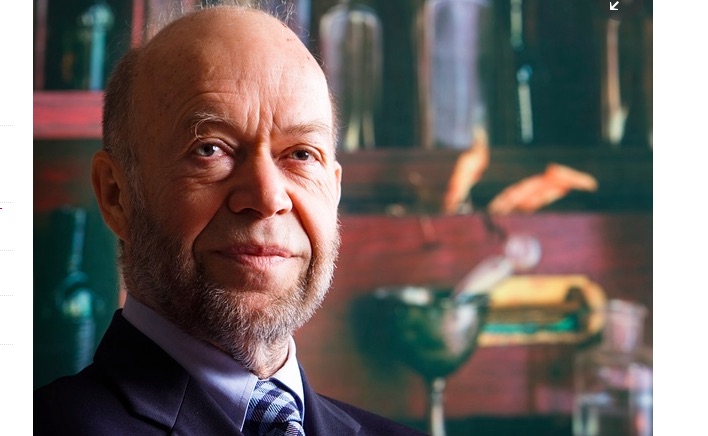
James Hanson. Photograph: Murdo MacLeod for the Guardian

Hansen, 74, has just returned from Paris where he again called for a price to be placed on each tonne of carbon from major emitters (he’s suggested a “fee” – because “taxes scare people off” – of $15 a tonne that would rise $10 a year and bring in $600bn in the US alone). There aren’t many takers, even among “big green” as Hansen labels environment groups.

Hansen has been a nagging yet respected voice on climate change since he shot to prominence in the summer of 1988. The Nasa scientists, who had been analyzing changes in the Earth’s climate since the 1970s, told a congressional committee that something called the “greenhouse effect” where heat-trapped gases are released into the atmosphere was causing global warming with a 99% certainty. . .

From being possibly America’s most celebrated scientist, Hansen is now probably its most prominent climate activist. He’s been arrested several times in protests outside the White House over mining and the controversial Keystone pipeline extension.

He is also an adjunct professor at Columbia University. When he’s in New York, he lives near the campus, surrounded by books piled on groaning shelves. Hansen’s not slowing down – he’s involved in a climate lobbying group and still undertakes the sort of scientific endeavor which helps maintain his gravitas.

One particular paper, released in July, painted a particularly bleak future for just about anyone living near the coast. Hansen and 16 colleagues found that Earth’s huge ice sheets, such as those found in Greenland, are melting faster than expected, meaning that even the 2C warming limit is “highly dangerous”.

The sea level could soon be up to five meters higher than it is today by the latter part of this century, unless greenhouse gases aren’t radically slashed, the paper states. This would inundate many of the world’s cities, including London, New York, Miami and Shanghai.

There is a positive note to end on, however. Global emissions have somewhat stalled and Hansen believes China, the world’s largest emitter, will now step up to provide the leadership lacking from the US. A submerged Fifth Avenue and deadly heatwaves aren’t an inevitability.

“I think we will get there because China is rational,” Hansen says. “Their leaders are mostly trained in engineering and such things, they don’t deny climate change and they have a huge incentive, which is air pollution. It’s so bad in their cities they need to move to clean energies. They realise it’s not a hoax. But they will need co-operation.”

Question for this article:

A reality… UN Security Council Resolution 2250 on Youth, Peace and Security

TOLERANCE AND SOLIDARITY .

Special for CPNN by Romeral Ortiz Quintilla, member of Youth Advocacy Team of UNOY

And now it is a reality. I still remember very well how two years ago, I was on my first mission to UN Headquarters in NYC as part of the Youth Advocacy Team of the United Network of Young Peacebuilders- UNOY.

unscr-voting-big
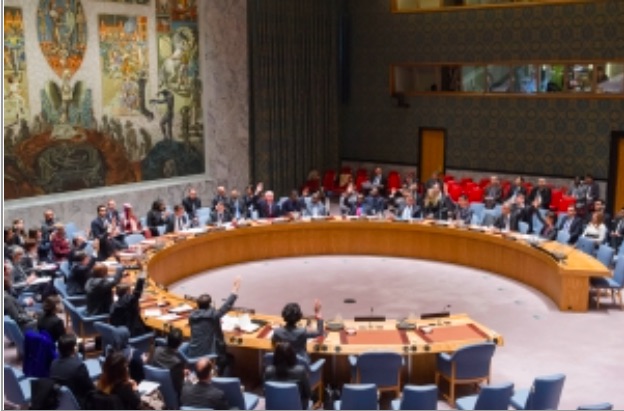
Voting of the UN Security Council of the 2250 Resolution on Youth, Peace and Security

UNOY had put as strategic objective to advocate for the development of a global framework that would recognize and guarantee the role of youth in peacebuilding and violence prevention.

What we had as an ideal goal at that time was to see the UN Security Council Members to adopt a UN Security Council Resolution on youth, peace and security.

In 2013 this was just a dream and around that time very few were the Members States who were supportive or even sensitized on this matter. But nothing could stop us: for the last two years we have been tireless; the efforts were insatiable, the dedication was strong and the commitment was pure. We made researches, wrote reports and knocked on many doors explaining how youth is contributing to peace and justice all around the world and how young women and men had to be taken into consideration ensuring participative and inclusive mechanisms and tools in building peace.

For two years, several missions were held to the UN Headquarters participating to side-events on countering violent extremism, on young women, peace and security, on the World Programme of Action for Youth-WPAY, to UN peace related documents’ review, etc.

It was crucial to be visible and to build strong partnerships with key stakeholders and supporters of our agenda: from the Secretary-General’s Envoy on Youth to the Peacebuilding Support Office, Search for Common Ground, World Vision but also UN agencies such as UNDP or UNFPA to name a few.

In parallel, at local, national and regional levels young people were mobilizing to raise awareness on the topic and to initiative some lobby activities in their own communities and with their own local governments.

(article continued on the right side of the page)

Question for this article

Is there a renewed movement of solidarity by the new generation?

(article continued from the left side of the page)

And then, a key player entered in the game: Jordan. We had been told we needed a champion to support our cause. That champion happened to be the Hashemite Kingdom of Jordan that took very seriously the theme and brought to the UN Security Council the first ever open debate on youth, peace and security this past April, 2015. It was then followed by the first Global Forum on youth, peace and security where more than 600 participants gathered in Amman – youth representatives, donors, UN agencies, governments, academics…- and discussed on how to increase the participation and role of youth in preventing violence, transforming violence and building peace leading. Statements and commitments were translated into the Amman Youth Declaration, precursor of the UN Security Council this past December.

Indeed, the 9th December 2015 is now a date we will not easily forget, the day when the 15 members of the UN Security Council voted unanimously the UN Security Council Resolution 2250 on Youth, Peace and Security led by Jordan.

UNSCR Side event2
Participation of Romeral, on behalf of UNOY as panellist in the side event to the Security Council, High-level review on Resolution 1325 on young women, peace and security.

Exactly two years ago I wrote on this page that “everything seems impossible until it is done”. This is so true. Now that it is done, we count on an historic recognition calling for the acknowledgment on the role of youth in building peace and demanding for further efforts in terms of participation, protection, prevention, partnership and reintegration, the five pillars of the resolution. The first time a Security Council Resolution is fully dedicated to youth and calls on their role in peace under a holistic perspective: positive peace as the presence of all resources needed for human being to enjoy sustainable rights, equality, freedom and justice.

Now, that it is done, we will redouble our efforts, making sure that the resolution is well known, implemented and translated into programs and efforts.

Because peace is not just our goal, it is definitively our path.

Latin America: Pedagogical Movement: new phase, new impetus

… EDUCATION FOR PEACE …

An article from Education International

The third meeting of the Pedagogical Movement renewed the cohesion and agenda for the future of education in Latin America, with a plan to strengthen the influence of the trade union movement on public policies.

pedagogical

The meeting was held in San José, Costa Rica, between 1 and 3 December, and was attended by 500 people from 18 countries and 34 education trade unions in Latin America, as well as international guests from the United States, Norway, France and Sweden.

Hugo Yasky, Chairman of the Regional Committee of Education International for Latin America, indicated that the path that the Pedagogical Movement has to embark on represents a new stage  in which all trade unions have to assess the school experience together with the teaching experience and practice, in step with the social struggle and movements. “We have to advance to include other social sectors in the practice, move forward and seek a common cause with representatives from sectors involved in the grass-roots movement of the peoples of Latin America. This construction of alliances is key,” Yasky argued.

The declaration which resulted from the meeting cited the Pedagogical Movement as a platform for meeting and collective construction, determined to embody a contrasting vision of society in the field of education to that which is imposed by the dominant force, by the economic, media, financial and military power.

(This article is continued in the column on the right.)

(click here for the French version of this article or here for the Spanish version)

Question for this article:

What is the relation between peace and education?

(Article continued from left column)

Against the commercialisation and privatisation of education

One of the key themes of the meeting that the affiliated organisations of EI debated concerned the strategies used by multinationals to privatise education. Thus, Antonio Olmedo, researcher at the University of Roehampton in the UK, illustrated the topic with his lecture “The Education privatisation and commercialisation process.” He analysed the approach of large companies to impose their mercantile proposals on governments, thereby contributing to insecurity about the quality of education and teaching. “We have to think of other solutions, because neoliberalism is like a chameleon and is more regulated than the public sector itself,” he reassured.

Similarly, Professor Luiz Fernandes Dourado, of the Federal University of Goiás, Brazil, underscored that privatisation is a sophisticated process and, as a result, leads to the weakening of the trade union movement and breaks with democratic management in schools. This runs counter to the vision of the Latin American Educational Movement, which sees education as a social right.

Inspiration behind the international campaign

David Edwards, Deputy General Secretary of Education International, pointed out that the new worldwide campaign conducted by his organisation against the business of education promoted by multinational corporations and multilateral organisations drew inspiration from Latin America. The campaign is a new tool to defend public education and to show the real intentions behind privatisation.

“At the Ottawa Congress, we were instructed to launch a campaign against the privatisation of education and to unmask those behind it. We started the campaign to analyse what is happening in other parts of the world. In education, the world market amounts to more than 3 billion and the governments in certain countries are facilitating access to this ‘booty’ for private groups. We are trying to show citizens what these multinationals are really doing,” Mr Edwards said. 

(Thank you to Janet Hudgins, the CPNN reporter for this article.)

América Latina: Movimiento Pedagógico: nueva fase, nuevo impulso

. . EDUCACIÓN PARA LA PAZ . .

Un artículo del Internacional de la Educación

El tercer encuentro del Movimiento Pedagógico ha renovado la cohesión y la agenda para el futuro de la educación en América Latina, con un plan de refuerzo de la influencia del movimiento sindical sobre las políticas públicas.

pedagogical

El Encuentro se llevó a cabo en San José de Costa Rica entre el 1 y el 3 de diciembre. En la reunión participaron más de 500 personas procedentes de 18 países y 34 sindicatos de la educación de Latinoamérica, así como invitados internacionales de Estados Unidos, Noruega, Francia y Suecia.

Hugo Yasky, Presidente del Comité Regional de la Internacional de la Educación de América Latina señaló que el camino por el que debe enrumbarse el movimiento pedagógico representa una nueva etapa en la que los sindicatos deben evaluar la experiencia de la escuela junto con la experiencia y la práctica docente, poniéndola en sintonía con la lucha y los movimientos sociales. “Tenemos que avanzar para incorporar en la práctica a otros sectores sociales, trascender y buscar la articulación solidaria con los representantes de los sectores que están involucrados en la causa popular de los pueblos de América Latina. Esa construcción de alianzas es clave”, sostuvo Yasky.

La declaración que resultó del encuentro subraya el Movimiento Pedagógico como espacio de encuentro y construcción colectiva, resuelto a encarnar en el ámbito de la educación una visión de sociedad contrapuesta a la que se impone de la mano del bloque dominante, el poder económico, mediático, financiero y militar.

(El artículo continúa en el lado derecho de la página.)

( Clickear aquí para la version francês o aquí para la version inglês.)

Question for this article:

What is the relation between peace and education?

(Artículo continúa de la parte izquierda de la página)

Contra la comercialización y la privatización de la educación

Como uno de los temas centrales del encuentro, las organizaciones afiliadas a la IE debatieron las estrategias que utilizan empresas multinacionales para privatizar la educación. Así, Antonio Olmedo, investigador de la Universidad de Roehampton del Reino Unido, ilustró el tema con su conferencia “El proceso de privatización y comercialización de la educación”. Analizó el planteamiento de grandes empresas para imponer a los gobiernos sus propuestas mercantilistas, contribuyendo así a la inseguridad de la calidad de la educación y la docencia. “Tenemos que pensar en otras soluciones, porque el neoliberalismo es como un camaleón y se encuentra más regulado que el mismo sector público” aseguró.

También el profesor Luiz Fernandes Dourado, de la Universidad Federal de Goiás, Brasil, subrayó que el proceso de privatización es un proceso sofisticado que, como consecuencia, lleva al debilitamiento del movimiento sindical y rompe con la gestión democrática en las escuelas. Esto se contrapone con la visión del Movimiento Pedagógico Latinoamericano, que entiende la educación como un derecho social.

Inspiró la campaña internacional

David Edwards, secretario general adjunto de la Internacional de la Educación (IE), señaló que la nueva campaña mundial que realiza su organización frente al comercio educativo, que promueven empresas transnacionales y organismos multilaterales está inspirada en América Latina. La campaña es la nueva herramienta para defender la educación pública y dejar en evidencia la intención real tras la privatización.

“En el Congreso de Ottawa recibimos el mandato de lanzar una campaña contra la privatización de la educación y desenmascarar a quienes están detrás. Comenzamos la campaña para analizar lo que sucede en otras partes del mundo. En educación el mercado mundial asciende a más de 3 mil millones y los gobiernos en algunos países le están facilitando el acceso a este ‘botín’ a grupos privados. Estamos tratando de mostrar a los ciudadanos lo que realmente hacen esas multinacionales”, señaló Edwards.

Amerique Latine: Mouvement pédagogique: nouvelle phase, nouvel élan

. . EDUCATION POUR LA PAIX . .

Un article de l’Internationale de l’Education

La troisième réunion du Mouvement pédagogique a permis de renouveler la cohésion et le programme pour l’avenir de l’éducation en Amérique latine, grâce à un plan visant à renforcer l’influence du mouvement syndical sur les politiques publiques.

pedagogical

Organisée du 1er au 3 décembre à San José, au Costa Rica, la réunion a regroupé plus de 500 personnes provenant de 18 pays et 34 syndicats de l’éducation d’Amérique latine, ainsi que des invité(e)s internationaux/ales venu(e)s des Etats-Unis, de France, de Norvège et de Suède.

Selon Hugo Yasky, Président du Comité régional de l’Internationale de l’Education pour l’Amérique latine, le chemin que doit emprunter le mouvement pédagogique constitue une nouvelle étape au cours de laquelle les syndicats doivent évaluer non seulement l’expérience de l’école, mais également l’expérience et les pratiques du personnel enseignant, tout en l’alignant sur la lutte et les mouvements sociaux. « Nous devons tout mettre en œuvre afin d’intégrer concrètement d’autres secteurs sociaux et de chercher à établir une relation solidaire avec les représentants des secteurs impliqués dans la cause des peuples d’Amérique latine. Nouer de telles alliances est capital », a affirmé Hugo Yasky.

La déclaration adoptée à l’issue de cette réunion présente le Mouvement pédagogique comme un espace de rencontre et de construction collective, qui vise à incarner, dans le monde de l’éducation, une vision de la société opposée au pouvoir économique, médiatique, financier et militaire.

(Voir suite sur colonne de droite.)

(cliquez ici pour la version anglaise de cet article ou ici pour la version espagnole.)

Question pour cet article:

What is the relation between peace and education?

(. . suite)

Contre la commercialisation et la privatisation de l’éducation

Parmi les principaux thèmes abordés dans le cadre de cette réunion, les affiliés de l’IE ont débattu des stratégies adoptées par les multinationales en vue de privatiser l’éducation. Pour illustrer ce thème, Antonio Olmedo, chercheur à l’Université de Roehampton au Royaume-Uni, a donné une conférence sur « Le processus de privatisation et de commercialisation de l’éducation », dans laquelle il a analysé les stratégies adoptées par les grandes entreprises pour imposer aux gouvernements leurs politiques mercantiles, lesquelles contribuent à nuire à la qualité de l’éducation et de l’enseignement. « Nous devons envisager d’autres solutions, car, tel un caméléon, le néolibéralisme est davantage réglementé que le secteur public lui-même », a expliqué Antonio Olmedo.

En outre, le professeur Luiz Fernandes Dourado, de l’Université fédérale de Goiás, au Brésil, a souligné que le processus de privatisation est un processus complexe qui affaiblit le mouvement syndical et tourne le dos à une gestion démocratique des écoles. Cette approche entre en contradiction avec la vision du Mouvement pédagogique latino-américain qui considère l’éducation comme un droit social.

Origine de la campagne internationale

D’après David Edwards, Secrétaire général adjoint de l’Internationale de l’Education (IE), la nouvelle campagne mondiale menée par son organisation contre le commerce de l’éducation – ce dernier étant prôné par les multinationales et les organismes multilatéraux – a pris naissance en Amérique latine. Cette campagne vise à défendre l’éducation publique et à mettre en lumière les véritables desseins de la privatisation.

« Lors du Congrès d’Ottawa, nous avons reçu le mandat de lancer une campagne contre la privatisation de l’éducation et d’en démasquer les principaux instigateurs. Nous avons tout d’abord analysé la situation dans d’autres régions du monde. Le marché mondial du secteur de l’éducation représente plus de 3 milliards de dollars américains, et les gouvernements de certains pays permettent à des groupes privés d’accéder à ce ʺbutinʺ. Nous tentons de révéler aux citoyens les agissements de ces multinationales », a déclaré Edwards.

(Merci à Janet Hudgins, le reporter pour cet article.)

Eight ways 2015 was a momentous year for girls

. WOMEN’S EQUALITY .

An article from Girl Effect

What a year it’s been. From the Sustainable Development Goals and global support for girls’ education to commitments to end harmful practices that hold girls back, 2015 has been momentous. Here are eight developments that show girls are getting the attention they deserve.

girleffect2

1. GIRLS GET GLOBAL RECOGNITION

What started two years ago as the Girl Declaration ended with girls’ needs being put on the global development agenda for the first time ever. The Sustainable Development Goals summit made history by ensuring that girls and women not only got their own dedicated goal, but by also prominently featuring Malala at the opening session they put a teenage girl on equal footing with world leaders. The SDGs will run for 15 years and influence how trillions of dollars of aid money will be spent. It’s a victory for girls and the beginning of a long journey.

2. HARDSHIP LEADS TO LEADERSHIP

The refugee crisis proved impossible to ignore any longer this year, with global headlines showing families fleeing conflict and violence. It shone a light on how refugee girls feel the impact harder than others. Their education gets disrupted, they’re more likely to be forced into early marriage, and there’s an increased risk of trafficking and abuse. The hardship, though, has provided an opportunity for leadership. Step up, Muzoon. She’s the 16-year-old living in a refugee camp in Jordan. When she noticed that girls her age stopped going to school because they were getting married, she set about advocating for refugee girls’ education. The world and Malala took notice and helped fund a girls’ school in Muzoon’s camp. Yep. Girls make great leaders.

3. GIRLS’ EDUCATION BECAME IMPOSSIBLE TO IGNORE

When an 18-year-old girl opens a session at the United Nations and takes centre stage at the Global Citizen Festival in New York City’s Central Park a day later, you know girls have got the world’s attention. While Malala has tirelessly campaigned for girls’ education, this year saw other big names picking up the mantle. The United States launched a global girls’ education initiative, Let Girls Learn, with Michelle Obama leading the charge. The UN’s refugee agency dedicated an award to Aqeela Asifi, who made it her mission to convince a community to send their girls to school. And around the world, girls claimed their right to education in their communities. The benefits of educating girls are indisputable, and now that it’s in the spotlight we expect big things.

4. MORE COMMITMENTS TO END CHILD MARRIAGE

Every minute, 28 girls get married. But efforts to end child marriage have gained momentum. The African Union held its first Girls’ Summit to End Child Marriage, and world leaders committed to stamping out this harmful practice at the SDGs summit. Girls proved, though, that they are best placed to speak out about child marriage, from the Afghan rapper Sonita to Dieynaba, the graffiti artist in Senegal. If this keeps up, the rate of child marriage will fall, especially if we keep the pressure on heads of state to live up to their promises.

(Article continued in right column)

Question for this article

Prospects for progress in women’s equality, what are the short and long term prospects?

Gender equality in education, Is it advancing?

(Article continued from left column)

5. GIRLS BREAK TABOOS AROUND THEIR BODIES

In 2015, periods stopped being a dirty word. We saw the rise on social media of Menstrual Hygiene Day which was marked around the world. In India, girls demanded freedom from the taboos surrounding their bodies by protesting on the streets and online. The Indian media followed suit, representing girls and women in ways that were never seen before in advertising and film. Meanwhile, young women designers came up with an innovative solution that answered girls’ needs for sanitary products in the developing world. And a British woman, Amy Peake, made it her mission to ensure that girls and women in refugee camps get the sanitary pads they need to maintain their dignity. The natural function of girls’ bodies doesn’t have to be shameful any longer.

6. CUTTING OUT FGM

This year saw a record number of people using the #EndFGM hashtag, less than a year after it was first coined. Egypt saw its first conviction and jailing of a doctor over the FGM-related death of a 13-year-old girl. Nigeria and The Gambia banned the practice, and many more countries have developed action plans to tackle FGM or to ensure robust data is collected on the practice. Girls haven’t kept silent themselves. More and more they are demanding a life free from this traditional act of violence. Girls like Naserian, who took part in an alternative rite of passage rather than undergo the cut. And women like Jaha Dukureh, who survived FGM and took her awareness-raising campaigns to a national level. Let’s make sure heads of state don’t forget the pledges they made to enforce bans on FGM.

7. MORE ROBUST DATA ON GIRLS COLLECTED

With the SDGs in place, the next step is to ensure that the right kind of data gets collected. This year, the Clinton Foundation launched the No Ceilings report. This ground-breaking piece of research presents hard evidence of how girls and women are still being held back. Another promising development was the launch of the Data2X, a global partnership to make sure girls and women get counted. The next step in the data revolution will be when the UN decides in March how it will measure its progress against the SDGs. We’ll be watching, and so should you.

8. CONNECTING GIRLS

The fact that there are more mobile phones than toilets is well known. But, despite the widespread use of mobile technology to do everything from socialising to banking to actually speaking on the phone, there’s shockingly little known about how girls and women use it. When it comes to connectivity, women in developing world cities are 50 per cent less likely to access the internet than men. Education and income are determining factors. This doesn’t look good for girls, who are held back on both counts. Some positive steps have been taken, such as the launch of Facebook’s internet.org, of which Girl Effect is a partner. And we’re seeing more apps targeting issues such as gender-based violence including ones in Cambodia and Turkey. With the push for girls’ education firmly on the global agenda, we expect to see more girls becoming connected, learning to code and filling the gender gap in the tech industry. Once this happens, girls can code for girls. We can’t wait.

(Thank you to Janet Hudgins, the CPNN reporter for this article.)

Reconciling Canada: Hard truths, big opportunity

…. HUMAN RIGHTS ….

An article by Ry Moran, Director of the National Centre for Truth and Reconciliation, published in rabble.ca

Yesterday [December 15] the Commissioners of the Truth and Reconciliation released their final report. Six years. Seven volumes. Thousands of pages.

Tens of thousands of tears.

canada

The materials contained within the reports will resonate for years to come but it will be up to us, collectively as Canadians, to determine whether the Calls to Action are implemented; whether the truth is fully acknowledged; whether reconciliation is achieved.

Through the work of the Commission I have witnessed thousands, sometimes tens of thousands, join together in collective actions of reconciliation and with the brave voices of Survivors leading the way, I have seen things change, both at home and abroad.

Last week I had the opportunity to visit the Organization of American States (OAS) located in Washington D.C.

I was part of a multi-person panel that included members of the Royal Winnipeg Ballet, former MP and well-known film producer Tina Keeper and Canada’s ambassador to the OAS. Two elders from Manitoba gave meaningful words of prayer and traditional perspective to open the day. Two dancers from the Royal Winnipeg Ballet performed an eight-minute version of the Going Home Star ballet which yet again left me moved and in awe of the power of the arts to convey emotion, truth and beauty all at once.

For me, the invitation was a call for deep reflection. What would I say to an international audience about this history we are trying to come to terms with?

For the past six years, much of my own work has focused on documenting Canada at its worst. The work of statement gathering and document collection for the Truth and Reconciliation Commission placed me in front of thousands of survivors — most of whom recounted terrible stories of abuse, neglect, pain and suffering. The documentary history we collected revealed long-standing knowledge that the residential school system was broken, mismanaged, misguided and deeply unethical.

Yet the residential school system endured for over 160 years.

We, as a country, are just now starting to come to terms with the sobering realization that the systematic destruction of indigenous cultures, languages, family structures, lands and ceremonies amounted to cultural genocide.

(Article continued in right column)


Question related to this article:

Truth Commissions, Do they improve human rights?

(Article continued from left column)

The cold hard truth is that Canada has failed indigenous peoples miserably.

Instead of protecting Indigenous rights, for many years our country eroded, attacked and beat those very rights out of Indigenous peoples. My own nation — the Metis nation — had guns turned against it when they sought to protect their way of life. Other nations have suffered the same. And we need remember that the attack on indigenous peoples through the residential schools attacked the most sacred of all bonds that exists in this world — that between parent and child.

What was I to say to an international audience with these historical realities of genocide and mass human rights abuse so deeply enmeshed in who we are as a nation?

I said that I remained proud to be a Canadian.

I remain proud to be a Canadian not because of who we were, but because I see us growing and embracing the calls for reconciliation that are now ringing out across the country.

Through the leadership of visionaries like Phil Fontaine, Paul Martin and Frank Iacobucci, massive achievements such as the Indian Residential Schools Settlement Agreement were made possible. The TRC Commissioners have brought us further down the path and additional truths will emerge from the critically important inquiry into missing and murdered Indigenous women and girls.

Yesterday we heard a tearful prime minister state that Survivors of the schools would never be forgotten and that a total renewal of the relationship between Canada and Indigenous peoples is needed.

Through words like these and the powerful leadership of the Truth and Reconciliation Commission, I sincerely believe we are reaching a tipping point where we as a nation are really beginning to take that long hard look in the mirror with new eyes.

Across the country, educators are rallying to the cry to incorporate a more accurate and fuller picture of the contributions of indigenous peoples in Canadian history. Universities are embracing indigenous achievement and inclusion, the courts are recognizing Indigenous rights time after time, and we now have a government actively listening to Indigenous peoples. We are transforming reconciliation from the leadership of a few to the collective will of the many.

Our nation’s treatment of Indigenous peoples should not and can not be a source of pride for us as a country. We need to address this and the work ahead of us is great.

But change is possible. We can change, we are changing, and I am very hopeful that this momentum we have collectively generated will continue.

I am excited about the future that lies ahead of us and I am proud to be part of this country that is embracing this cry for change and reconciliation.

(Thank you to Janet Hudgins, the CPNN reporter for this article.)

Kumi Naidoo: let the youth be our climate leaders!

. . SUSTAINABLE DEVELOPMENT . .

An interview with Kumi Naidoo, Director of Greenpeace, by Pavlos Georgiadis of the Ecologist (abridged)

With COP21 out of the way there is absolutely no time to lose, Greenpeace director Kumi Naidoo told Pavlos Georgiadis: ‘Because by tomorrow, there might be no tomorrow.’ We need substantial, structural, systemic change – and this change can only be led by the youth, who are not infected by the political pollution of the past. And whose future is it anyway? . . .
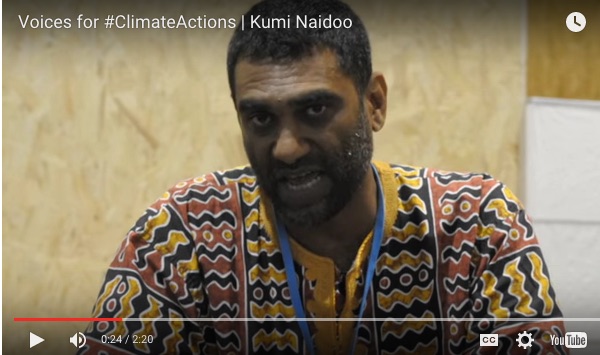
kumi Naidoo
Video with Kumi Naidoo

“The good thing about COP21 is that for the first time we have a great multilateral agreement to address climate change. This is the first time such a large number of countries agree on something, since the adoption of the Universal Declaration of Human Rights (UDHR) in 1948, again in Paris.

“The sad thing about it, is that for 21 years, we knew about the need to address climate change. But our political leaders have been in denial about how serious the problem is.”

For Kumi, governments dragged their feet in these talks. “The Paris Agreement is only one step on a long road, and there are parts of it that frustrate and disappoint me, but it is progress. This deal alone won’t dig us out the hole we’re in, but it makes the sides less steep.”

In his view, the most crucial work begins now, and is important to see what types of action will emerge in the next weeks and months after Paris.

Despite delays and conflicting opinions, at the end governments came up with the $100 billion support towards climate action. “They fudged the language here and there, but they had no other choice. If developed countries did not deliver on that, poor countries would not sign on to anything unless they got a guarantee that they are going to have predictable and transparent sources of funding.

But if you divide these $100 billion by the number of beneficiary countries, then you realise that is not any close to what is needed. When we are talking about climate finance poor countries are not really asking from rich countries to give them a donation or charity. They are telling them that since they have built their economies on the basis of carbon, they should now recognise their climate debt.”

“We now face the challenge of not allowing our governments to let us down, and that civil society – especially in developing countries- is part of the process that ensures this money is spent properly.”

It took 20 years for the world to reach this agreement, because of a reality that Kumi calls a “climate apartheid”, that showed its teeth in the Paris negotiations too:

“Most of the people in the countries that emitted the most carbon are white. Most of the people in the countries who are paying the first and highest price are people of colour. So, there is no question in my mind, that there is this subliminal racism at play in this discourse. And that is putting it kindly.”

(Interview continued in the right side of the page)

Question for this article:

Despite the vested interests of companies and governments, Can we make progress toward sustainable development?

(Interview continued from the left side of the page)

The challenge of financing climate action after Paris is immense. Naidoo believes that the aid system is a very messed up broken system, to start with:

“For every one dollar that is given to Africa, eight dollars are going out in capital flight. Therefore, it is important that the Green Climate Fund is set up in a way that takes that injustice into consideration. We cannot allow the current messed up banking system consume the world’s most vulnerable countries, that need funds to protect themselves from catastrophic climate change.

“A country like Kiribati, for example, that has contributed almost nothing in terms of carbon emissions, has very high possibilities that parts of it will disappear in the coming decades. Lending institutions will say that if Kiribati wants to borrow money in the international markets, it must pay higher interest rates, because the country’s ‘vulnerability’ is a threat to the credit system.”

“This exact case, highlights the big injustice existing in climate finance right now, where loans could leave all these countries back in a deep, unplayable debt situation. “But, why go to Kiribati, when there is Greece, a country you could get from Paris on a bicycle, to see it for yourself.

“We have to be very careful whether the mechanisms agreed in Paris will put poor countries in a kind of a terrible debt situation. Otherwise, they could be enslaved to financial institutions for many decades to come.”

Kumi Naidoo believes that the COP21 is just the beginning of a long road. “It sometimes seems that the countries of the United Nations can unite on nothing, but nearly two hundred countries have come together and agreed a deal. The human race has just joined in a common cause, but it’s what happens from now on that really matters.”

“Our political and business leaders must realise that nature does not negotiate. They have to realise that the agreement that was just signed is about their children and their children’s children’s futures. And for that reason, we cannot but recognise that in the moment of history that we live in, this is an one-way all of us. Especially young people need to stand up and say ‘this is about our future!'”

“The world is now on its feet and more determined than ever, continuing the fight and pushing the transition from an economy that is driven by dirty fossil fuels, to an economy that is driven by clean energy. As humans, we cannot afford this transition to be slow and wait until tomorrow. Because by tomorrow, there might be no tomorrow.”

In his words, climate change presents us with a very powerful opportunity. “For far too long, we lived in a world divided between rich and poor, north and south, east and west, developed and developing.

“What we need right now is not just baby steps in the right direction, given how much time we have already lost. We need substantial, structural, systemic change. And this change can only be led by the youth, who are not infected by the political pollution of the past.

“Either we secure a future for all our children and grandchildren, or we can get it wrong. Poor countries, that have contributed least to the problem, will pay the first and most brutal price. But, ultimately, everybody will get impacted.”
Naomi Klein: We are going backwards, COP21 is the opposite of progress

. . SUSTAINABLE DEVELOPMENT . .

An interview with Naomi Klein in New Internationalist Magazine (abbreviated)

Naomi Klein speaks with Frank Barat about the limits of the Paris climate talks and how climate change is an accelerator that makes pre-existing problems worse. This interview was originally published in the French publication Ballast.

Naomi Klein
People’s climate march in Prague, 29 November 2015. Friends of the Earth International under a Creative Commons Licence

. . . [what] is unfolding in Paris during the climate summit is really exposing the subjectivity of what gets declared a crisis and what does not. We are here to discuss an existential crisis for humanity and it has never received crisis treatment from elites. They give loads of wonderful speeches but they do not change laws. It is exposing the double standards in a very naked way. In the name of security, they would do almost anything, but in the name of human security, of protecting life on earth, there are loads of talk but no serious regulations of polluters and even the deal themselves they want not to be legally binding. So we are actually moving backwards. The Kyoto protocol was legally binding and now we are moving towards more volunteer, meaningless, non-regulations.

Question: Why would a climate deal be our best hope for peace?

N.K: The first part of it is simply that climate change is already driving conflict. So is the quest for fossil fuels. In terms of the Middle East, our thirst from fossil fuels is a major driver for illegal wars. Do we think Iraq would have been invaded if their major export had been asparagus [as journalist Robert Fisk once asked]? Probably not. We wanted that prize in the west, Iraq’s oil. We wanted this on the world’s market. It was certainly Dick Cheney’s agenda. This destabilized the whole region, which was not particularly stable to begin with because of earlier oil wars and coups and support for dictatorships. This is also a region that is one of the most vulnerable to climate change. Large parts of the Middle East would become unliveable on the emission trajectory that we are on. Syria has experienced the worst drought of its history in the run up to the outbreak of civil war. It is one of the factors that destabilized the country. There is no possibility for peace without very strong actions on climate. What drew me to this issue was understanding that if we are going to take climate change seriously it is going to require a redistribution of wealth, of opportunities and technologies. In this book I begin quoting Angelica Navarro who is a Bolivian trade and climate negotiator, talking about how climate change called for a Marshall Plan for planet earth. For countries that have their resources systematically plundered, like Bolivia and are on the front lines of dealing with the impact of climate change, it requires kind of a writing past wrongs, the transfer of wealth and turning the world right side up that I think are pre-conditions for a more peaceful world.

Question: How do you put to the masses of people that to change course, we have to deconstruct capitalism? I think that for most people it is too difficult a change to imagine?

(Interview continued in the right side of the page)

( Click here for the French version of this article.)

Question for this article:

Sustainable Development Summits of States, What are the results?

Despite the vested interests of companies and governments, Can we make progress toward sustainable development?

(Interview continued from the left side of the page)

N.K: In Canada we did this exercise of trying to use climate change and the fact that it puts us on a deadline. Not only do we have to change but we have to change now and if we do not make the most of this remaining decade, it will indeed be too late. What does this mean for healthcare, education, indigenous rights, inequality, what would it look like for refugee rights to take climate change seriously? Our team hosted a meeting of 60 movement leaders and we drafted a document called The Leap. We are really hoping that it would help break through this problem. We found in Canada that the only way to break through is to do it. To get together and act. Everybody is working on such urgent issues. If you are an anti poverty activist or a refugee rights activist, you do not have any spare time. It is only when climate change does not distract from your issue and in fact brings another layer of urgency and a really powerful tool and argument and brings you new allies as well, then people have that space to go, ‘oh yeah, ok, this is actually hopeful, this is not a distraction.’

There are a couple of things we did in Canada. One, we organized a march under the banner ‘jobs, justice, climate’. It was not a theoretical exercise but really an organizing one. How do we talk to people in trade unions about climate in a way that really resonates, how do you talk to people who are just fighting for basic services, for housing, and transit, what would it mean for the Black Lives Matter movement, what are the messages that are different? It really helped. Then we drafted and launched the LEAP manifesto. Not that it is perfect, but it is a start. To me it is shocking the extent to which the anti-austerity movement and the climate movement in Europe do not seem to talk to one another. You could have [Greek Prime Minister Alexander] Tsipras suddenly talking about climate change this week, for the first time from what I can tell since he took office.

Climate change is the best argument against austerity that you are ever going to have. If you are negotiating with Germany, a government that claims to take climate change very seriously and that has some of the most ambitious energy policies in the world, why wouldn’t you talk about climate change in every meetings and say that we cannot have austerity because we have an existential crisis, we have to act. And yet Syriza, Podemos, you almost never hear them talking about climate change. I spoke at a blockcupy rally in Frankfurt a few months ago and climate change was not mentioned. When I talked about the connections, people understood instantly, it is not abstract. If you are dealing with the endless of budget crisis and this false sense of public scarcity, of course governments are going to cut their support for renewables, of course they are going to increase fares for public transit, of course they are going to privatize the rail system as they are doing in Belgium, of course they are going to say that we have to drill for oil and gas to get ourselves out of debt.

These issues are the same stories, so why is it that it seems far off, right? I do not think it is a hard argument to make. I think that people are creatures of habit. There is a lot of fear around talking about climate change. It has been so bureaucratized. A little bit like trade used to be. When we first started talking about free trade deals there was all of this talk about having a degree in international law to understand it as it was so bureaucratic. It was designed to repel public participation. But somehow people started to educate themselves and found ways to talk about it and really understood how it impacted their lives and the things that they understood. They realised they had a right to participate in this conversation. I think that why climate change people are afraid of making mistakes about the science. You have got three levels of bureaucratic language. The scientific, the policy and the UN language. It is very difficult to understand. The UN one is a nightmare. Look at the schedule for the Cop21! It is not in any language anybody could recognize. All of that is part of the reason why even though it is obvious to connect climate to austerity somehow it is not done. . . .

Governments are fighting for those paltry targets to not be legally binding. It is the opposite of progress – we are going backward. Kyoto was legally binding. This is headed towards not being binding. The target in Copenhagen was 2 degrees, which was already too high, and here we are headed towards 3. This is basic laws of physics. It is not forward.

COP21 vue par Naomi Klein : « Le changement climatique génère des conflits »

. . DEVELOPPEMENT DURABLE . .

Un article par Naomi Klein dans la revue Ballast (abrégé)

Tandis que les dirigeants du monde se réunissent pour « remédier » au problème du changement climatique à la Conférence de Paris, dite COP21, nous retrouvons l’essayiste canadienne Naomi Klein, auteure des ouvrages phares No Logo et La Stratégie du choc, dans les bureaux de l’un de ses éditeurs. . . .

Naomi Klein
People’s climate march in Prague, 29 November 2015. Friends of the Earth International under a Creative Commons Licence

Tout cela [qui] arrive ici, à Paris, au moment du sommet international sur le climat, nous éclaire également sur ce que les gouvernants décident de qualifier de crise ou pas : nous voyons aujourd’hui que cela est très subjectif. Nous sommes ici pour débattre de la crise climatique, une crise majeure pour l’humanité, mais qui n’a jamais été traitée comme telle par les élites. Nos dirigeants font tous de très beaux discours mais ne changent jamais les lois. Il y a clairement deux poids, deux mesures. Pour des raisons sécuritaires, ils feraient n’importe quoi, mais quand il s’agit de la sécurité de l’humanité, de protéger la vie sur Terre, c’est beaucoup de paroles et très peu d’actes. Ils n’ont jamais mis en place aucune mesure de régulation sérieuse pour les pollueurs, par exemple, et ils ne veulent pas que les accords qu’ils passent entrent eux soient juridiquement contraignants. Le protocole de Kyoto l’était. Mais voilà que nous faisons marche arrière.

Pourquoi est-ce qu’un accord sur le climat est notre principale chance pour la paix ?

Tout d’abord parce que le changement climatique génère déjà des conflits. Comme la quête aux énergies fossiles. Si on prend le Moyen-Orient, par exemple, notre course à l’énergie fossile est l’une des raisons principales de nombreuses guerres illégales. Est-ce que l’Irak aurait été envahi s’il avait principalement exporté des asperges (comme l’a fait remarquer Robert Fisk) ? Probablement pas. Ce que l’Occident voulait, c’était le pétrole irakien, afin de le mettre en vente sur le marché mondial. Voilà ce qu’était le projet de Dick Cheney. Cela a déstabilisé toute la région — qui n’était déjà pas très stable, à cause des précédentes guerres pour le pétrole et des nombreux coups d’États et des dictateurs installés et soutenus par les puissances occidentales. Il faut également savoir que cette région est une des plus vulnérables face au changement climatique, à cause duquel de très larges parties du Moyen-Orient sont devenues invivables. La Syrie a connu la pire sécheresse de son histoire juste avant que la guerre civile n’éclate. Ce fut l’un des facteurs de déstabilisation du pays. La paix ne sera pas possible tant que des mesures fortes ne seront pas prises pour le climat. Je me suis intéressée de plus près à cette problématique quand j’ai compris que si nous voulons vraiment prendre le changement climatique au sérieux, il faudra en passer par une redistribution des richesses, des opportunités et des technologies. Dans mon dernier livre, je cite Angelica Navarro, négociatrice bolivienne pour le commerce et le climat, qui dit que le changement climatique a engendré l’obligation d’un plan Marshall pour la planète.

Vous dites que pour inverser cette tendance, il nous faut déconstruire le capitalisme. Comment faire passer cette idée qui peut être difficile à imaginer, pour la plupart des gens ?

(Voir suite sur colonne de droite. . . )

( Clickez ici pour la version anglaise .)

Question for this article:

Despite the vested interests of companies and governments, Can we make progress toward sustainable development?

(. . . suite)

Au Canada, nous avons essayé de travailler en partant du postulat que le changement climatique nous impose un ultimatum. Il ne faut pas seulement changer les choses, il faut les changer maintenant ; et si nous ne le faisons pas dans les dix prochaines années, il sera trop tard. Qu’est-ce que cela entraîne dans le domaine de la santé, de l’éducation, des droits des indigènes, de l’inégalité ? Quel serait l’impact sur les droits des réfugiés si nous prenions le changement climatique au sérieux ? Nous avons réuni les leaders de soixante organisations et rédigé un document, intitulé « The Leap Manifesto », qui, nous l’espérons, permettra de trouver une solution. Nous avons pensé que le meilleur moyen de parvenir à régler ce problème était de nous réunir et d’agir. Ça n’a pas été facile de réunir toutes ces organisations, car toutes travaillent sur des problématiques très importantes. Si vous travaillez contre la pauvreté, vous n’avez pas le temps de faire autre chose. Mais lorsque le changement climatique devient une cause de ce contre quoi vous luttez, quand il devient un outil pour poursuivre votre combat, quand il vous permet de trouver de nouveaux partenaires, de nouveaux alliés, alors il n’est plus une distraction mais un moteur. On a également mené quelques actions. Nous avons, entre autres, organisé un rassemblement sur le thème « Travail, Justice, Climat ». Ce n’était pas un exercice théorique mais une vraie réflexion sur comment s’organiser : comment aborder le sujet du climat avec les syndicats pour que cela ait un impact, avec les personnes qui luttent pour les services de base, le logement, les mouvements de population ? Quels messages faire passer, de quelle manière ? Ça a été très riche en enseignements, donc très utile. Ensuite, nous avons rédigé et lancé le manifeste « The Leap », qui n’est probablement ni parfait ni suffisant, mais c’est un bon début…

Je suis vraiment choquée de voir à quel point les mouvements anti-austérité et ceux pour le climat ne semblent pas du tout communiquer en Europe. J’ai entendu Tsipras soudainement évoquer le changement climatique cette semaine — et je crois que c’est la première fois, depuis qu’il a pris ses fonctions. Le changement climatique est le meilleur argument contre l’austérité. Pourquoi ne pas utiliser ce levier dans les négociations avec l’Allemagne, à qui ce sujet tient apparemment énormément à cœur et qui a une des politiques énergétiques les plus ambitieuses du monde ? Pourquoi ne pas utiliser cet argument dans chaque réunion, et dire que l’austérité est impensable parce que nous sommes devant une crise majeure pour l’humanité et que nous devons agir ? Et, pourtant, nous n’entendons quasiment jamais Podemos ou Syriza parler du changement climatique. J’ai donné une conférence pendant un rassemblement « Blockupy » à Francfort, il y a quelques mois, et le sujet n’a jamais été abordé. Quand j’ai évoqué les connexions entre le changement climatique et les autres mouvements, tout le monde a compris ; c’est très concret. Si on reste uniquement sur le terrain de la crise économique, les gouvernements vont évidemment couper leurs aides aux renouvelables, augmenter les tarifs des transports publics, privatiser les chemins de fer, comme ils le font en Belgique, dire qu’il faut forer pour se procurer du pétrole et du gaz et nous sortir de la dette.

Mais tout est lié ! Alors pourquoi la problématique du changement climatique semble-t-elle si lointaine ? Il n’est pas difficile du tout d’utiliser cet argument, mais le changement climatique a tellement été bureaucratisé que les gens ont peur d’en parler. Un peu comme ils avaient peur de parler du commerce, à l’époque où on a commencé à évoquer les accords de libre-échange, parce que c’était tellement bureaucratique qu’ils pensaient qu’il fallait avoir un diplôme de droit international pour comprendre. Tout cela a été pensé pour que la population ne veuille pas en parler, ne participe pas. Et puis, malgré tout, les gens se sont éduqués, ont trouvé des manières d’en parler et compris quel impact cela avait sur leur vie. Ils ont réalisé qu’ils avaient le droit de prendre part à cette conversation. Pour ce qui concerne le changement climatique, je pense que les gens ont peur de faire des erreurs scientifiques. Il y a trois niveaux de langage bureaucratique : le niveau scientifique, le niveau politique et le niveau des Nations unies. C’est très compliqué à comprendre, en particulier le langage de ces dernières, qui est un cauchemar. Il suffit de jeter un œil au programme de la COP21 ! C’est écrit dans une langue que personne ne comprend. Tout cela fait partie de la raison pour laquelle, même s’il est évident de mettre en lien le changement climatique et l’austérité, ce n’est jamais fait. . . .

Les gouvernements se battent pour que ces cibles dérisoires ne soient pas légalement contraignantes. C’est l’inverse du progrès: nous reculons : Kyoto était légalement contraignant ; là, on se dirige vers des accords non contraignants. L’objectif à Copenhagen était 2 degrés, ce qui était déjà trop, et là nous allons vers 3. C’est de la physique basique. On n’avance pas.