Tag Archives: global

US Kills Nuclear-Free Mideast Conference, Citing Israel

DISARMAMENT AND SECURITY .

an article by Jason Ditz, Anti-War

Four weeks of UN efforts to get together a conference on a nuclear weapons ban in the Middle East ended in failure today, with the US spurning the deal on the conference, citing Israel.

npt

Though the US initially backed the nuclear-free Middle East effort, they later realized Israel is the only nation in the region with such arms, and has since criticized the effort as unfair.

Though US officials have been to Israel in recent days to try to get them to sign off on some vague notion of an eventual nuclear-free Middle East, there was no progress, as Israel won’t even publicly affirm their arsenal.

After failing to get Israel to okay the deal, the US angrily blamed Egypt for the whole thing, saying they’d “cynically manipulated” the process by bringing up Israel’s arsenal at all.

(Question for this article: Can we abolish all nuclear weapons? )


Readers’ comments are invited on this article and question. See below.

6 simple tools to protect your online privacy (and help you fight back against mass surveillance)

FREE FLOW OF INFORMATION

An article by Tanya O’Carroll, Amnesty International

As intelligence agencies hoover up more and more of our online communications, we’ve compiled a list of some simple apps and tools to help protect your privacy and make your calls, emails, texts and chats more secure.

privacy

Faced with the enormous power of agencies such as the NSA and GCHQ, it can feel like there is little we can do to fight back. However, there are some great ways you can take control of your private communications online.

The six tools below, which have been designed with security in mind, are alternatives to the regular apps and software you use. They can give you more confidence that your digital communications will stay private.

Note: No tool or means of communication is 100% secure, and there are many ways that governments are intercepting and collecting our communications. If you’re an activist or journalist, you should use these tools as part of a comprehensive security plan, rather than on their own. Additionally, this list is by no means comprehensive – we recommend checking out Security-in-a-Box (from Tactical Technology Collective and Front Line Defenders) and Surveillance Self-Defense (from the Electronic Frontier Foundation) too.

1. TextSecure – for text messages

TextSecure is an easy-to-use, free app for Android (iPhones have a compatible app called Signal). It looks a lot like WhatsApp and encrypts your texts, pictures, video and audio files. The app is open-source and provides end-to-end encryption. That means only you and the person you are sending to will be able to read the messages. (See below for an explanation of technical terms.)

2. Redphone – for voice calls

Redphone is another free, open-source app for Android (for iPhones it’s the same Signal app, which combines voice calls and messaging) which encrypts your voice calls end-to-end. All calls are over the internet, so you only pay for wifi or data rather than using your phone’s credit.

3. meet.jit.si – for video calls and instant messaging

meet.jit.si is a free and open-source service to secure your voice calls, video calls, video conferences, instant messages and file transfers. It runs directly in your browser with no need to download anything and allows you to invite multiple people to join a video call. It’s a bit like Google hangouts, but your calls and chats are encrypted end-to-end. There is also a desktop version called Jitsi which you can download for Windows, Linux, Mac OS X and Android.

4. miniLock – for file sharing

This free and open-source plug-in for your web browser lets you encrypt files – including video, email attachments and photos – and share them with friends really easily. You can upload and send your file to selected contacts by using their unique miniLock id, meaning your file can only be downloaded by the person you share it with.

(Article continued on right side of page)

(Click here for a version in French of this article or here for a version in Spanish.)

Question related to this article:

How can we protect our online privacy?

(Article continued from left side of page)

5. Mailvelope – for more secure email

This is a free add-on for your web browser which provides end-to-end encryption for your emails. It can be configured to work with almost any web-based email provider, including Gmail, Yahoo and Outlook. It’s open source and uses OpenPGP encryption.

6. SpiderOak – for cloud sharing and storage

This service helps you back-up your files, sync between multiple devices and share files privately with people you trust. It fully encrypts your data end-to-end which means that, unlike other cloud sharing and storage services such as Dropbox, even the company itself cannot see your documents on its servers. SpiderOak charges $12 each month for a personal account. It’s not yet open-source.

Quick guide to technical terms

Encryption: This is a way of coding something that disguises the original form. Today’s modern encryption, when well implemented, can be virtually unbreakable. When encrypting and decrypting content, a complex password – known as a key – is used for authentication. Very often this key is held by the company that provides services such as email or website hosting. That means that the company has full access to your data. Governments can compel the company to hand over this information or can try to hack into a company’s server to get direct access.

End-to-end encryption: With end-to-end encryption, the key is only known to you and never leaves your device. This means your communications stay between you and your correspondents only. To the company transmitting your communication – or anybody else who tries to intercept it – your messages will look like a long string of random numbers and letters. They can know who you communicated with but will not be able to access the contents.

Open-source: Very often the code that makes up computer software is proprietary, meaning that whoever developed it has sole access to it. Open-source code is available for anyone to see and analyse. While it might seem counter-intuitive, this is widely considered to be the best way to make software secure. It helps ensure it doesn’t do anything nasty, like providing a ‘back door’ for intelligence agencies, and that any security weaknesses can be discovered and patched up.

Women in Parliament: 20 years in review

. DEMOCRATIC PARTICIPATION .

From a report by Inter-Parliamentary Union (excerpts)

The past 20 years have witnessed an impressive rise in the share of women in national parliaments around the world, with the global average nearly doubling during that time – and all regions making substantial progress towards the goal of 30 per cent women in decision making.

parliamentarians

In 1995, delegates to the United Nations (UN) Fourth World Conference on Women unanimously signed the Beijing Platform for Action. Described as a “new agenda for women’s empowerment,” its mission statement called for the removal of all “obstacles to women’s active participation in all spheres of public and private life”. The Platform set a 30 per cent target for women in decision-making, to be achieved through a wide range of strategies, including positive action, public debate, and training and mentoring for women as leaders.

Over the last 20 years, countries around the world have made substantial progress towards this 30 per cent goal. The global average of women in national parliaments has nearly doubled, from 11.3 per cent in 1995 to 22.1 per cent in 2015 (+10.8 points). 2014, however, saw little progress in the percentage of women in national parliaments worldwide, with the global average rising only by 0.3 points, begging the question: have we reached the glass ceiling?

Global highlights

• Worldwide, women’s average share of parliamentary membership nearly doubled between 1995 and 2015, from 11.3 per cent in 1995 to 22.1 per cent in 2015. Their share gained ground in almost 90 per cent of the 174 countries for which 1995 and 2015 data are available.

• Over the same period, the number of single and lower houses with more than 30 per cent women parliamentarians grew from five to 42, and those with more than 40 per cent from one to 13. By 2015, four houses of parliament surpassed the 50 per cent threshold, one moving beyond 60 per cent women parliamentarians.

• The world’s highest ranking countries have become more diverse: the top 10, dominated by eight European countries in 1995, now include four in Sub-Saharan Africa and three each in the Americas and Europe.

• Far fewer single and lower houses elect less than 10 per cent women, dropping from 109 in 1995 to 38 in 2015. The number of all-male single and lower houses fell from 10 to five.

• In addition to shifting political circumstances, a crucial factor driving these changes has been the adoption of electoral gender quotas, which have spread from a small number of States in 1995 to more than 120 in 2015.

• After notable increases in recent years, growth in women’s average share of parliaments worldwide levelled off in 2014, rising only 0.3 points to 22.1 per cent. Women won 2147 of the 10,265 seats up for election or renewal in 2014. .

The impact of women in parliament

Scholarly studies, supported by interviews with male and female parliamentarians in the IPU Equality in Politics survey, indicate that women’s presence has changed parliaments around the world in tangible ways. New issues like violence against women or women’s health concerns, which might not otherwise have received the attention they deserve, are making it onto the political agenda. Women in parliament also contribute, at least in some contexts, to a more collaborative political environment, both within and across parties. Their presence emboldens more women citizens to contact their representatives, enhancing democratic communication and accountability.

(Click here for a french version of this article.)

Latest Discussion

Women in parliaments. Do they enhance democratic communication and accountability?

Editor’s comment: The latest statistics on percentages of women in parliaments have been posted by IPU on their website. Here are the top fifteen:
Rwanda 63.8%
Bolivia 53.1%
Cuba 48.9%
Seychelles 43.8%
Sweden 43.6%
Senegal 42.7%
South Africa 41.9%
Ecuador 41.6%
Finland 41.5%
Iceland 41.3%
Namibia 41.3%
Nicaragua 41.3%
Spain 41.1%
Mozambique 39.6%
Norway 39.6%

The permanent members of the Security Council are far down the list:

36: United Kingdom 29.4%
44: France 26.2%
54: China 23.6%
71: United States 19.4%
95: Russian Federation 13.6%

Readers’ comments are invited on this question.

5 brave ways activists are fighting for LGBTI rights worldwide

… HUMAN RIGHTS …

An article by Azmina Dhrodia, Amnesty International (abridged)

Around the world, people face violent attacks and threats simply because of who they are or who they have sex with. But some brave activists are still standing up for their rights. To mark the International Day against Homophobia, Transphobia and Biphobia (IDAHOT) on 17 May, we celebrate the courageous activism of lesbian, gay, bisexual, transgender and intersex (LGBTI) people worldwide.

lgbt
click on photo to enlarge

1. Pushing to end hate crimes in Greece

. . . On this international day of action, activists from Greece and around the world are using the hashtag #KostasZabi to send support to the couple on social media, and to tell the Greek government to end hate crimes and stand against homophobia and racism. Greek activists, including Kostas and Zabi, will organize a ‘kiss-in’ in front of Parliament to highlight their case and the situation for LGBTI people in the country.

2. Ending homophobic violence in Cameroon

In Cameroon same-sex sexual conduct is punishable by up to five years in prison and a fine, and LGBTI people suffer violence, police harassment and even arrest and detention. . .

In 2011, Stéphane, a 36-year old gay man, was dragged away from his house by a group of men, stripped, beaten and tortured for hours. Four years later, the men who attacked him have not faced justice. But that has not stopped Stéphane. “Today my fight is so that my younger brothers or my friends don’t suffer discrimination like this,” he tells us. “I am alive today and I want to be an example, a living example. I will keep telling my story for as long as I can.”

3. Standing up for LGBTI rights in Tajikistan

Across Central Asia, homophobia and transphobia is on the rise. Police blackmail gay men, threatening to ‘out’ them to family and colleagues unless they agree to pay a bribe. Lesbian women face violence and abuse from within their families, and may be forced to marry against their will.

One example is Komil, a gay man from Tajikistan who was kidnapped, tortured, beaten and humiliated by police, and was eventually forced to flee the country. “Can you understand spending your whole life hiding that you are gay just to stay alive?” he tells us. “I am not a politician. I am a simple person who just wants a tiny piece of his own happiness. That is all.” With the help of his friends, he is rebuilding his life, and now speaks out for LGBTI rights in the region.

4. Celebrating EuroPride in Latvia

Latvia will be the first post-Soviet country to host EuroPride – a Europe-wide event dedicated to promoting LGBTI rights. In 2015, the event also celebrates a decade since Riga held its first Pride event: when 70 activists marched for their rights in spite of threats of violence and hostility from several thousand protestors. . . .

5. Campaigning for transgender rights in Norway

John Jeanette Remø Solstad is a 65-year-old transgender Norwegian woman who wants to change her legal gender from ‘male’ to ‘female’. . . .

In April 2015, an expert group appointed by the Norwegian government stated that the current practice is a violation of fundamental human rights, and stressed the need for change. “this is everything I have dreamt of and hoped for,” she told us. “It was worth the fight. It took a long time, but when the results of our work finally came, it felt great.”


Question related to this article:

The struggle against homophobia, Is progress being made in your community?

It would seem from articles on CPNN that progress is being made in some communities. In particular this is true in the United States according to the article by Danny B and in Bulgaria according to the article by Diana Tashkova.

Seed laws that criminalise farmers: resistance and fightback

. . SUSTAINABLE DEVELOPMENT . .

An article from Grain (abridged)

Seeds are under attack everywhere. Under corporate pressure, laws in many countries increasingly put limitations on what farmers can do with their seeds and with the seeds they buy. Seed saving, a thousand-year-old practice which forms the basis of farming, is fast becoming criminalised. What can we do about this? . . .

seedsClick on photo to enlarge
“No to seed privatisation… For a better world!” – Demonstration in Guatemala in defence of biodiversity and against control of seeds by industrial agriculture. (Photo: Raúl Zamora)

Social movements worldwide, especially peasant farmers organisations, have resisted and mobilised to prevent such laws being passed. In many parts of the world, the resistance continues and can even count some victories. To strengthen this movement, it is very important that as many people as possible, especially in the villages and rural communities that are most affected, understand these laws, their impacts and objectives, as well as the capacity of social movements to replace them with laws that protect peasants’ rights.

Today’s seed laws promoted by the industry are characterised by the following:

a) They are constantly evolving and becoming more aggressive. Through new waves of political and economic pressure – especially through so-called free trade agreements, bilateral investment treaties and regional integration initiatives – all the ‘soft’ forms of ownership rights over seeds were hardened and continue to be made more restrictive at a faster pace. Seed laws and plant variety rights are being revised again and again to adapt to the new demands of the seed and biotechnology industry.

b) Laws that grant property rights over seeds have been reinforced by other regulations that are supposed to ensure seed quality, market transparency, prevention of counterfeits, etc. These regulations include seed certification, marketing and sanitary rules. By means of these regulations, it becomes mandatory, for instance, for farmers to purchase or use only commercial seeds tailored for industrial farming. Or the regulations make it a crime to give seeds to your son or exchange them with a neighbour. As a result, seed fairs and exchanges – a growing form of resistance to control over seeds – are becoming illegal in more and more countries.

c) In strengthening privatisation, these laws have been disregarding basic principles of justice and freedom and directly violating the Universal Declaration of Human Rights. These seed laws have imposed the rule that anyone accused of not respecting property rights over seeds is assumed to be guilty, thus violating the principle that people are innocent until proven guilty. In some cases, measures can be taken against accused wrongdoers without their being informed of the charges. These seed laws are even making it an obligation to report alleged transgressors; they are legalising searches and seizures of seeds on grounds of mere suspicion (even without a warrant) and allowing private agencies to conduct such checks.

d) These laws are being drafted in vague, incomprehensible and contradictory language, leaving much room for interpretation. In most cases, the laws are being moved through legislative chambers in secrecy or by means of international agreements that cannot be debated nationally or locally. . .

(Article continued on right side of page)

Question for this article:

What is the relation between movements for food sovereignty and the global movement for a culture of peace?

(Article continued from left side of page)

Experience shows that people do not want these laws, once the misinformation and secrecy used to push the laws through have been countered by information campaigns and mobilisation on the part of social organisations. Most people reject the idea that a company can take ownership of a plant variety and prohibit farmers from reproducing their seeds. They find it completely absurd. People also generally do not agree that the work that farmers do to feed the world should suddenly become a crime. Wherever resistance has been strong enough, the legal plunder embodied in these laws has been stopped. . .

Africa:

Ghana: students and trade unions join farmers to oppose a restrictive seed law

Mozambique: farmers resist by developing local seed systems

Niger: farmers’ victory against the piracy of a local onion

The Americas

Brazil: large-scale development of creole seeds

Chile: victory against the privatisation of seeds

Colombia: mass protests for farmers’ seeds and food sovereignty

Costa Rica: major mobilisations make UPOV a household name

Mexico: people struggle against GM maize

Venezuela: a bottom-up law to defend farmers’ seeds

Asia

India: defending seeds sovereignty

Filipino farmers continue to mobilise and protest, vowing that they will go on opposing the advance of GMOs.

South Korea: women farmers campaign for native seeds

Thailand: resisting free trade agreements in order to protect local seeds

Europe

Austria: fighting for legislation in favour of biodiversity and farmers’ rights

France: Associations and small enterprises working together have enabled several thousand French farmers to stop using industrial seeds for many of their crops. They have initiated ‘peasant seed houses’ where communities select, reproduce, and preserve peasant seeds collectively.

Germany: a victory for the defence of farm-based seeds and a campaign to save the “Linda” potato

Greece: the crisis brings peasant seeds back to the fields

Italy: Farmers are organising in direct production and consumption networks and gardening collectives. One of their goals is not to become dependent on the seed industry. Their seeds are exchanged locally through large yearly exchanges

MITEI Releases Report on The Future of Solar Energy

. . SUSTAINABLE DEVELOPMENT . .

an article by Melissa Abraham, MITEI [Energy Initiative of Massachusetts Institute of Technology]

Solar energy holds the best potential for meeting humanity’s future long-term energy needs while cutting greenhouse gas emissions – but to realize this potential will require increased emphasis on developing lower-cost technologies and more effective deployment policy, says a comprehensive new study on The Future of Solar Energy released by The MIT Energy Initiative (MITEI).

solar
Click on image to enlarge
© Earth Policy Institute/Bloomberg

“Our objective has been to assess solar energy’s current and potential competitive position and to identify changes in US government policies that could more efficiently and effectively support its massive deployment over the long-term, which we view as necessary,” said Robert Armstrong, Director, MITEI.

The study’s chair, Richard Schmalensee, Howard W. Johnson Professor of Economics and Management Emeritus at the MIT Sloan School of Management, added “What the study shows is that our focus needs to shift toward new technologies and policies that have the potential to make solar a compelling economic option.”

The study group is presenting its findings to lawmakers and senior administration officials in Washington, D.C.

The Future of Solar Energy reflects on the technical, commercial and policy dimensions of solar energy today and makes recommendations to policymakers regarding more effective federal and state support for research and development, technology demonstration, and solar deployment.

Among its major themes is the need to prepare our electricity systems, both technically and from a regulatory standpoint, for very large-scale deployment of solar generation – which tends to vary unpredictably throughout the day. To this end, the study emphasizes the need for federal research and development support to advance low-cost, large-scale electricity storage technologies.

The analysis finds that today’s federal and state subsidy programs designed to encourage investment in solar systems should be reconsidered, to increase their cost-effectiveness, with greater emphasis on rewarding production of solar energy.

The group also recommends that state renewable portfolio standards, which are designed to increase generation of electricity from renewable resources, be brought under a unified national program that would reduce the cost of meeting set mandates by allowing unrestricted interstate trading of credits.

The study concludes by pointing to the urgent need for an ambitious and innovative approach to technology development, with federal research and development investment focused on new technologies and systems with the potential to deliver transformative system cost reductions.

The MIT “Future of…” studies are a series of multidisciplinary reports that examine the role various energy sources could play in meeting future energy demand under carbon dioxide emissions constraints. These comprehensive reports are written by multidisciplinary teams of MIT researchers. The research is informed by a distinguished external advisory committee.

For more information or a downloadable copy of The Future of Solar Energy study, click here.

(Thank you to Janet Hudgins, the CPNN reporter for this article.)

Question for this article:

Smallholder farmers in focus as UN Rome agencies event zeroes in on financing

. . SUSTAINABLE DEVELOPMENT . .

An article by The Food and Agriculture Organization of the United Nations

Ending hunger, achieving food security and improved nutrition, and promoting sustainable agriculture – SDG2 [Second Sustainable Development Goal of United Nations] – will require commitment and action at the national level, supported by engagement from the international community. That was the main message from a side event held in New York on 17 April on the margins of the Second drafting session of the Third International Conference on Financing for Development (FfD3).

sdg2

The panel discussion, organised by the Food and Agriculture Organization (FAO), the International Fund for Agricultural Development (IFAD) and the World Food Programme (WFP) – the Rome-based agencies of the United Nations, brought together multiple voices to explore the policies and investments needed to successfully implement SDG2 of the July 2014 proposal of the intergovernmental Open Working Group (OWG) of the UN General Assembly on Sustainable Development Goals (SDGs).

The event took place immediately ahead of a joint session (20-24 April) of the Financing for Development process and UNGA intergovernmental negotiations on the post-2015 development agenda, and less than three months before the FfD summit which takes place in Addis Ababa between 13 and 16 July.

Identifying investments that go beyond business as usual, financing mechanisms from a global partnership perspective and the challenges countries will face in financing SDG2 as an integrated package stood out among lively exchanges between panellists and participants from member states, civil society, the private sector and research institutions in the discussion chaired by Tekeda Alemu, Permanent Representative of Ethiopia to the United Nations.

“With the SDGs we have raised the level of ambition,” said keynote speaker George Wilfred Talbot, Permanent Representative of the Republic of Guyana to the United Nations, beginning his address. “I think it is absolutely imperative that we find the ways and means of addressing this challenge. Why? Because [hunger] is depriving hundreds of millions of people from the opportunity to fulfil their potential and to contribute to the progress of humanity.”

Mr Talbot, who is co-facilitator of the Financing for Development negotiations, said he and his colleague – Geir Pedersen, Permanent Representative of Norway – had flagged the SDG2 area as one requiring “special attention” in the process.

“In addressing the challenge of hunger and food insecurity, we are contributing to the potential for achieving other goals,” he said. “It is critical to poverty, as more than 75 percent of the poor live in rural areas and are heavily dependent on agriculture.

“One of the challenges we face is to transform the agriculture sector to make it viable and sustainable. We need to get youth to see a future in agriculture.”  

The relationship between SDG2 and other goals was picked up on by Susan Eckey, Minister Counsellor of the Permanent Mission of Norway to the United Nations, who focused on biodiversity, resilience, fisheries and gender equality.

“Agricultural biodiversity is critical to ensure the stability, resilience, nutrition and continuing evolution of farming and thus long-term food security and livelihoods for small-scale farmers,” she said.

(Article continued on right side of page)

Question for this article:

Can UN agencies help eradicate poverty in the world?

(Article continued from left side of page)

Guy Evers, Deputy Director of FAO’s Investment Centre, stated that the fight to eliminate poverty and hunger would be won or lost in rural areas.

“Despite significant rural to urban migration, extreme poverty is becoming more concentrated in rural areas, where there are lower levels of public and private investments, poorer infrastructure and fewer services targeted to the most vulnerable,” he said. “Growth in agriculture is more effective in reducing poverty than growth in other sectors. We need more and better investment in agriculture.”

FAO, he revealed, is updating a report that will include calculations of the level of investment needed to support the required expansion in food production for ending hunger by 2030.

While pointing out the importance of scaling up best practices, Josefina Stubbs, IFAD Associate Vice-President, highlighted the value of focusing on smallholders, who represent the biggest investors in agriculture. “Most of the food that people are consuming around the world comes from smallholder farms,” she said. “They are not the problem, but part of the solution. We see the need of smallholder farmers to have access to markets and to have access to credit.”

Amir Abdulla, WFP Deputy Executive Director, outlined the common vision the three Rome-based agencies share in “working together towards eliminating the root causes of hunger, poverty and malnutrition”.

“We stand united in the discussions and consultations that are going on around the means that are necessary to realise the new agenda,” he said before drawing attention to a Think-Piece contribution by the Rome-based agencies entitled Food Security, Nutrition, and Sustainable Agriculture at Centre Stage on the Road to the Addis Ababa Conference that had been circulated among the audience ahead of the event.

The Addis outcome is expected to have a significant bearing on means of implementation for the Post-2015 Development Agenda, which will be adopted at a Summit at Heads of State and Government level between 25 and 27 September 2015.

(Thank you to the Good News Agency for pointing out this article to us.)

Book Review: Seven Surprising Realities Behind The Great Transition to Renewable Energy

. . SUSTAINABLE DEVELOPMENT . .

An article by the Earth Policy Institute (abridged)

The global transition to clean, renewable energy and away from nuclear and fossils is well under way, with remarkable developments happening every day. The Great Transition by Lester Brown, Janet Larsen, Matt Roney, and Emily Adams lays out a tremendous range of these developments – here are seven that may surprise you.

new transition

1. Solar is now so cheap that global adoption appears unstoppable.
• The price of solar photovoltaic panels has declined 99 percent over the last four decades, from $74 a watt in 1972 to less than 70 cents a watt in 2014.
• Between 2009 and 2014, solar panel prices dropped by three fourths, helping global PV installations grow 50 percent per year. . .

2. Wind power adoption is rapidly altering energy portfolios around the world.
• Over the past decade, world wind power capacity grew more than 20 percent a year, its increase driven by its many attractive features, by public policies supporting its expansion, and by falling costs.
• By the end of 2014, global wind generating capacity totaled 369,000 megawatts, enough to power more than 90 million U.S. homes. Wind currently has a big lead on solar PV, which has enough worldwide capacity to power roughly 30 million U.S. homes. . .

3. National and subnational energy policies are promoting renewables, and many geographies are considering a price on carbon.
• Unfortunately, governments worldwide still subsidized the fossil fuel industry with over $600 billion, giving this aging industry five times the subsidy that went to renewables.
• But by the start of 2014, some 70 countries, including many in Europe, were using feed-in tariffs to encourage investment in renewables. . .

4. The financial sector is embracing renewables – and starting to turn against fossils and nuclear.
• The financial services firm Barclays downgraded the entire U.S. electricity sector in 2014, in part because in its view U.S. utilities are generally unprepared for the challenges posed by distributed solar power and battery storage.
• In January 2013, Warren Buffett gave solar energy a huge financial boost when his MidAmerican Energy Holdings Company announced an investment of up to $2.5 billion in California in what is now known as the Solar Star project. At 580 megawatts, it will become the world’s largest PV project when complete in late 2015. MidAmerican had earlier bought the Topaz solar farm in California, now tied with Desert Sunlight, another California project, as the world’s largest at 550 megawatts. As of its completion in late 2014, Topaz can generate enough electricity to power 180,000 California homes. . .

5. Coal use is in decline in the United States and will likely fall at the global level far sooner than once thought possible.
• U.S. coal use is dropping – it fell 21 percent between 2007 and 2014 – and more than one-third of the nation’s coal plants have already closed or announced plans for future closure in the last five years.
• Major U.S. coal producers, such as Peabody Energy and Arch Coal, have seen their market values drop by 61 and 94 percent, respectively, as of September 2014. . .

(Article continued on right side of page)

Questions for this article:

What is the relation between the environment and peace?

Are we making progress in renewable energy?

(This article is continued from the left side of the page)

6. Transportation will move away from oil as electric vehicle fleets expand rapidly and bike- and car-sharing spreads.
• Bike-sharing programs have sprung up worldwide in recent years. More than 800 cities in 56 countries now have fully operational bike-share programs, with over 1 million bikes. In the United States, by the end of 2012 some 21 cities had 8,500 bikes in bike-share racks. By the end of 2016, this is expected to climb to over 70 cities with close to 40,000 bikes.
• The share of carless households increased in 84 out of 100 U.S. urban areas surveyed between 2006 and 2011. And as urbanization increases, this share will only rise. . .

7. Nuclear is on the rocks thanks to rising costs and widespread safety concerns.
• For the world as a whole, nuclear power generation peaked in 2006, and dropped by nearly 14 percent by 2014.
• In the United States, the country with the most reactors, nuclear generation peaked in 2010 and is now also on the decline. . .

Chapter 1 of The Great Transition: Shifting from Fossil Fuels to Solar and Wind Energy is available online at www.earth-policy.org/books/tgt. Supporting data and a PowerPoint summary presentation are also available for free downloading.

(Thank you to Janet Hudgins, the CPNN reporter for this article.)

April 17: Farmers mobilise around the world against Free Trade Agreements and for food sovereignty

. SUSTAINABLE DEVELOPMENT .

an article by La Via Campesina

April 17, 2015: today thousands of women and men farmers of the international peasant movement La Via Campesina mobilize worldwide against Transnational Corporations (TNCs) and Free Trade Agreements (FTAs) which affect peasant and small-scale agriculture and national food sovereignty. Since April 17, 1996 La Via Campesina celebrates this day as a global day of action with allies and friends.

April17

Free Trade Agreements promote TNCs and a capitalist industrialised mode of production heavily reliant on agrochemicals. These have increased the displacement, expulsion, and disappearance of peasants. Free Trade Agreements put profit over all other rights and concerns. Currently, the most significant FTAs in history are being negotiated by the European Union, the United States, and Canada. These agreements, if finalised, will liberalize trade and investment markets in favour of transnational companies (see tv.viacampesina.org/April-17th).

With hundreds of actions at local and global level (see our regularly updated MAP) in all continents, La Via Campesina reasserts the importance of local struggles and at the same time underlines the need of a global resistance and organization between the cities and the rural areas. Actions such as land occupations, seed exchanges, street demonstrations, food sovereignty fairs, cultural events, lobby tours and debates will be carried out until the end of the month as part of these global days of action. This year in Europe, various actions are being organised against Transatlantic Trade and Investment Partnership (TTIP), Comprehensive Trade and Economic Agreement (CETA), Trade in Services Agreement (TiSA) in Germany, Switzerland and Belgium; in Asia, a mass rally to reject the negotiation of Trans-Pacific Partnership (TTP) by Japanese government is being organised in Japan and South Korea; in South America, a big march (over 1,500 people from all continents) is being organised in Argentina during the CLOC-Via Campesina (Latin American Coordination of Rural Organizations) congress in Buenos Aires.

La Via Campesina denounces laws and interests that affect the peasant way of life, an important heritage of the people at the service of humanity. The movement promotes food sovereignty to end hunger in the world and promote social justice.

Instead of a gloomy future based on free trade and big business, La Via Campesina believes the time has come for an economy based on equity that will restore the balance between humanity and nature. Agrarian reform and sustainable agriculture are at the heart of this way of living based on peoples’ Food Sovereignty.

For Interviews please contact:

Ndiakhate Fall, CNCR – Senegal (French): + 221 77 550 89 07

Marina dos Santos, Landless movement, Brasil (Spanish) +54 92615717585

Yudhvir Singh, BKU, India (English) +54 92615717585

(Click here for the French version of this article or here for the Spanish version)

Question for this article:

Education awards go to Iraqi and Filipino leaders

EDUCATION FOR PEACE .

An article by Education International

Education International has named two teacher union leaders from Iraq and the Philippines to be awarded human rights and education prizes for their outstanding commitment, engagement and courage in promoting education for all.

educationinternational

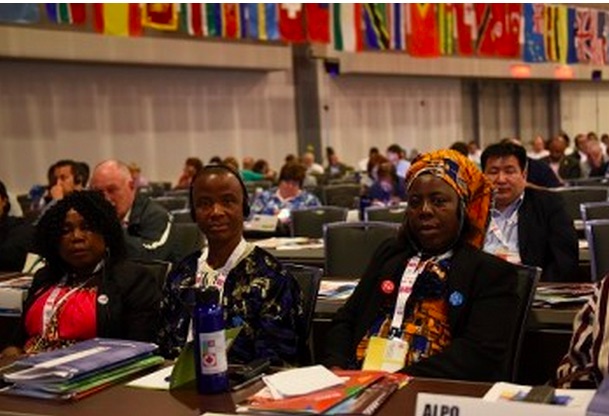
Ms Luisa Bautista-Yu, from the Philippines, and Ahmed Jassam SalihAl-shiblawi, from Iraq, have been selected by Education International (EI)’s Executive Board to receive the Albert Shanker Education Award and the Mary Hatwood Futrell Human and Trade Union Rights Award, respectively. These two international solidarity prizes are given out every four years during EI’s Congress, and have become one of its biggest highlights.

Ms. Bautista-Yu has had a successful career marked by her engagement for the development of education in the Philippines. She has been involved in the education sector for decades, starting as a primary teacher and attaining the position of regional coordinator of Eastern Vinyasas, which she currently holds. Her engagement and courage were decisive during the recovery mission after Typhoon Haiyan hit the Philippines in 2013, devastating infrastructures and leaving thousands of children out of school.

Mr. SalihAl-shiblawi Ahmed Jassim Salih, National President of the technical sector of the Iraqi Teachers Union (ITU), has shown immense courage and determination in the promotion of human and trade union rights in his country. Despite constant threats and attacks on himself, his family and co-workers, he continues to lead the union with skill, expertise and bravery.

The awards will be presented at EI’s 7th World Congress this July in Ottawa, Canada. 

(Thank you to Janet Hudgins, the CPNN reporter for this article.)

(click here for the French version) of this article or here for the Spanish version

Question for this article:

What is the relation between peace and education?

Letter from Mohatma Gandhi to Maria Montessori

To Madame Montessori

Even as you, out of your love for children, are endeavoring to teach children, through your numerous institution, the best that can be brought out of them, even so, I hope that it will be possible not only for the children of the wealthy and the well-to-do, but for the children of paupers to receive training of this nature. You have very truly remarked that if we are to reach real peace in this world and if we are to carry on a real war against war, we shall have to begin with children and if they will grow up in their natural innocence, we won’t have the struggle, we won’t have to pass fruitless idle resolutions, but we shall go from love to love and peace to peace, until at last all the corners of the world are covered with that peace and love for which, consciously or unconsciously, the whole world is hungering.