. WOMEN’S EQUALITY .
An article from United Nations Geneva
The Committee on the Elimination of All Forms of Discrimination Against Women today held a discussion on the rights of Indigenous women and girls.
The first part of the general discussion focused on equality and non-discrimination with a focus on Indigenous women and girls and intersecting forms of discrimination.
In her opening remarks, Gladys Acosta Vargas, Committee Chairperson, said today’s discussion was the first step in the process of elaborating a general recommendation for the rights of Indigenous women and girls, and provided an opportunity for the Committee to receive input in that context. Underlining that rights had individual and collective dimensions, the Chairperson said self-identification determined who was an Indigenous woman or girl.
Paulo David, Chief of the Indigenous Peoples and Minorities Section of the Office of the High Commissioner for Human Rights, said the Committee’s consolidation of its past work and findings in the form of a general recommendation would clarify and reinforce the normative legal framework at a point in time when the rights of Indigenous women and girls remained fragile in several countries. Commending the Committee for its pioneering work on embedding an intersectional approach in the understanding of States’ obligations, he stressed that not all women and girls experienced discrimination in the same way.
Francisco Calí Tzay, Special Rapporteur on the Rights of Indigenous People, recommended that the Convention for the Elimination of Discrimination Against All Women be interpreted in light of the United Nations Declaration on the Rights of Indigenous Peoples.
Victoria Tauli-Corpuz, Executive Director of Tebtebba Foundation, said that a false dichotomy between individual and collective rights had been promoted both in the Indigenous peoples’ movement and the women’s movement; the active participation of Indigenous women in that debate allowed it to be better handled now.
Laila Vars, Chair of the Expert Mechanism on the Rights of Indigenous Peoples, stressed that it would be important for the Committee to highlight the interplay between collective and individual rights in its upcoming general recommendation.
Speaking were: Sweden, Ukraine, Argentina, Denmark, Armenia, Ecuador, and Brazil, UN Women and the Committee on the Rights of Persons with Disabilities.
Also taking the floor were the following national human rights institutions and non-governmental organizations: The National Human Rights Commission of India, The Union of BC Indian Chiefs, Indigenous Girls and Women Collective, Colectiva Ixpop, Canadian Aboriginal AIDS Network, MADRE – Rosa Luxembourg Stiftung, Asia Indigenous Peoples Pact, Organizaci ón Nacional de Mujeres Indígenas Andinas y Amazónicas del Perú, Right Livelihood Award Foundation and Centro por la Justicia y Derechos Humanos de la Costa Atlántica de Nicaragua , and the Centre for Reproductive Rights.
The Committee then turned to the second part of the general discussion, which concerned the effective participation, consultation and consent of Indigenous women and girls in political and public life.
Anne Nuorgam, President of the United Nations Permanent Forum on Indigenous Issues, said Indigenous women were survivors who had an important role to play in peacebuilding and conflict resolution. Patriarchy, racism and discrimination were central factors in Indigenous women’s limited access to political participation.
Tarcila Rivera Zea, President of the Executive Council of the Centro de Culturas Indígenas del Perú, remarked that that since existing instruments did not fully reflect the realities of Indigenous women, it was cause for hope that the Committee was moving toward the adoption of a general recommendation which might do so.
Speaking were Peru, Brazil, Norway, Guatemala, the United Kingdom, and Spain.
Also taking the floor were the following national human rights institutions and non-governmental organizations: State Committee for Family, Women, and Children Affairs of the Republic of Azerbaijan, Consejo Nacional para la Igualdad de Género de Ecuador, Philippines National Commission on Indigenous Peoples, The National Human Rights Commission of India, African Indigenous Women’s Organization, International Indigenous Women’s Forum, Article 19, Colectiva IXPOP, National Indigenous Disabled Women Association Nepal, Canadian Feminist Alliance for International Action, MADRE—Rosa Luxembourg Stiftung, Tebtebba (Indigenous People’s International Centre for Policy Research and Education), Human Rights Council of Greenland, ESCR-Net International Network for Economic, Social and Cultural Rights, Maat for Peace, Development and Human Rights Association, Grupo Santo Domingo Soriano, and another non-governmental organization.
All the documents relating to the Committee’s work, including reports submitted by States parties, can be found on the session’s webpage.
The webcast of the Committee’s public meetings will be available via the following link: http://webtv.un.org/meetings-events/.
The Committee will reconvene on Thursday 1 July to close the seventy-ninth session.
General discussion part 1: “ Equality and non-discrimination with a focus on Indigenous women and girls and intersecting forms of discrimination”
Opening remarks
GLADYS ACOSTA VARGAS, Committee Chairperson, said that the Committee was very pleased with the positive response to its invitation to stakeholders to participate in this day of general discussion. Thanking those who had provided written submissions, she said she had received more than 70. All written and pre-recorded video statements received would be posted on the website of the Office for the High Commissioner for Human Rights.
Today’s discussion was the first step in the process of elaborating a general recommendation for the rights of Indigenous women and girls, and provided an opportunity for the Committee to receive input in that context. Underlining that rights had individual and collective dimensions, the Chairperson said self-identification determined who was an Indigenous woman or girl. Different forms of discrimination were always mixed, intersecting, and mutually reinforcing, she added.
PAULO DAVID, Chief of the Indigenous Peoples and Minorities Section of the Office of the High Commissioner for Human Rights, said giving close and systematic attention to Indigenous women and girls’ rights had made a difference in many States Parties. The Committee’s consolidation of its past work and findings in the form of a general recommendation would clarify and reinforce the normative legal framework at a point in time when the rights of Indigenous women and girls remained fragile in several countries. It was crucial to link the United Nations Declaration on the Rights of Indigenous Peoples to the Committee’s forthcoming general recommendation. The Declaration had been a considerable step forward, and was the result of 30 years of constructive consultation with Member States and Indigenous representatives, he recalled. The Declaration recognized rights that would no doubt feature in the general recommendation.
Commending the Committee for its pioneering work on embedding an intersectional approach in the understanding of States’ obligations, he stressed that not all women and girls experienced discrimination in the same way. This held true for Indigenous women and girls who were not an homogenous group: they spoke different languages, faced different challenges and multiple and overlapping forms of discrimination. Such forms of discrimination could be based on factors such as gender, age, ethnicity, disability, status, poverty or colonialism. Their right to self-determination was linked to their deep connection to ancestral lands and territories, as well as to natural resources. The COVID-19 pandemic had exacerbated racism against Indigenous peoples across all continents, with Indigenous women facing additional risks related to gender-based violence, he added.
Keynote presentations
FRANCISCO CALÍ TZAY, Special Rapporteur on the Rights of Indigenous People, recommended that the Convention for the Elimination of Discrimination Against All Women be interpreted in light of the United Nations Declaration on the Rights of Indigenous Peoples. He invited the Committee to follow the example of the Committee on the Elimination of Racial Discrimination by inviting Indigenous women and girls to consultations as it drafted a general recommandation on Indigenous rights.
VICTORIA TAULI-CORPUZ, Executive Director of Tebtebba Foundation, said that, when examining the rights of Indigenous women and girls, it was vital to consider the unique historical and current experiences of Indigenous communities. A false dichotomy between individual and collective rights had been promoted both in the Indigenous peoples’ movement and the women’s movement; the active participation of Indigenous women in that debate allowed it to be better handled now.
LAILA VARS, Chair of the Expert Mechanism on the Rights of Indigenous Peoples, noted that the United Nations Declaration on the Rights of Indigenous Peoples placed collective rights at the centre of the international human rights framework. She added that it would be important for the Committee to highlight the interplay between collective and individual rights in its upcoming general recommendation. She further urged the Committee to consider including recommendations on the need for investment in leadership of women and girls in Indigenous communities and decision-making structures.
Statements by States
Sweden said Indigenous women who were human rights defenders experienced complex, multidimensional and mutually reinforcing human rights violations and abuses, especially if they challenged traditional gender roles. That had to stop. States had a responsibility to uphold human rights, and ensure a safe and enabling environment for human rights defenders. Sweden would continue to implement its feminist foreign policy.
Ukraine said a draft national law on Indigenous peoples aimed to promote the rights of Indigenous peoples as prescribed by the United Nations Declaration, despite a disinformation campaign aiming to discredit the effort. As many Crimean Tatar men were detained, women had to be breadwinners and “champions for justice” in the face of Islamophobia, sexism and intimidation.
Argentina said that its National Institute of Indigenous Women had a rights-based focus. Nationally, dialogues on gender-based violence against Indigenous women were underway. As for access to sexual and reproductive rights, while there were challenges in empowering women, the State was trying to use different strategies to achieve progress.
Denmark, also speaking on behalf of Greenland, welcomed the Committee’s effort to elaborate a general recommendation on the rights of Indigenous women and girls. Indigenous women faced significant barriers to their sexual and reproductive health and rights, such as a lack of information and services. Support for Indigenous women’s organizations was vital.
Armenia welcomed the Committee’s decision to focus on addressing specific and multifaceted barriers faced by Indigenous women and girls. Against the backdrop of climate change and environmental degradation, the strong connection of Indigenous peoples to natural resources should be nurtured and appreciated. The economic rights and empowerment of Indigenous women were particularly significant in that regard.
Ecuador said its National Council for the Equality of Peoples and Nationalities sought to ensure respect for the right to equality and non-discrimination. Ecuador aimed to have a “culture of peace” that developed human capacity, focusing on equality and non-discrimination. Its equality agenda encompassed fields such as education and health.
Brazil said Indigenous women faced many challenges on a daily basis, such as economic challenges, and challenges in accessing health services. Illiteracy was a barrier to participation in political processes. A lack of economic and social participation of Indigenous women contributed to inequality; however Indigenous women should not be considered as simple victims. More Indigenous women in leadership roles would contribute to addressing structural problems.
Statements by United Nations bodies
UN Women said its regional office for Latin America and the Caribbean was working closely with Indigenous women and girls. The proposed general recommendation should recognize the link between Indigenous women and Mother Earth, water, and the land. Indigenous women’s presence in public life should be strengthened, and the multiple forms of violence suffered by Indigenous women and girls should be eliminated.
The Committee on the Rights of Persons with Disabilities said Indigenous women with disabilities were not identified in statistics, and this prevented their inclusion in public policies. Women and girls with disabilities, including Indigenous peoples living in remote areas, must be empowered; they needed means of communication such as sign language.
(continued in right column)
Questions for this article
Does the UN advance equality for women?
Prospects for progress in women’s equality, what are the short and long term prospects?
(continued from left column)
Statements by civil society organizations and national human rights institutions
The National Human Rights Commission of India said the Indian Government did not recognize Indigenous groups, instead recognizing ethnic groups as “scheduled tribes”. There were currently 705 so-called “scheduled tribes”. Seats had been reserved for those groups on some representative assemblies. Their access to education and other rights was still far behind that of other groups.
The Union of BC Indian Chiefs said that, in 1876, the Indian Act imposed a patriarchal system under which First Nations were robbed of their Indian status upon marriage to non-Indian men, and prevented them from transmitting their status to their children. Within their territories, Indigenous women and girls were on the front lines of the protection of the environment from climate change and the effects of destructive resource extraction.
Indigenous Girls and Women Collective called for the Committee to provide programmes and awareness-raising campaigns on sexual health directed at Indigenous boys, girls, and young people. It was important that the Committee entered into direct dialogue with Indigenous groups.
Colectiva Ixpop said that, in Guatemala, inequality, racism and discrimination were social problems that remained latent. They were experienced by Indigenous women in particular. Racism and patriarchy had established ideas and practices that had been normalized and presented as a natural part of social, political and labour relationships.
Canadian Aboriginal AIDS Network said Canada was known internationally for its severity towards, and criminalization of, people living with HIV/Aids. People were afraid to disclose their status due to punitive measures while fear and stigma drove HIV transmission. Indigenous women involved in sex work could not reach out to police without risking charges themselves. Culturally appropriate programmes and services developed by people with lived experiences must be developed and supported.
The speaker from MADRE – Rosa Luxembourg Stiftung, stating that she was an Indigenous woman with disabilities from a rural region of Nepal, said Indigenous women were a very diverse group, experiencing multiple forms of discrimination, including some based on racism. They wanted to be treated equally, on par with other women, and wanted their collective rights and intersecting identities to be protected and promoted.
Asia Indigenous Peoples Pact said Indigenous women and girls consisted of some of the most diverse yet marginalized groups in Asia. Multiple and overlapping forms of discrimination were perpetuated by the lack of legal recognition. She called on the Committee to emphasize legal recognition of Indigenous peoples as paramount. Gender-based violence against Indigenous women and girls was part of a continuum of structural violence.
Organización Nacional de Mujeres Indígenas Andinas y Amazónicas del Perú welcomed the initiative for a general recommendation. In Peru, the government had passed laws and adopted standards that promoted extraction activities that exacerbated climate change and undermined Indigenous land rights. This had detrimental effects on access to clean water and food.
Right Livelihood Award Foundation and Centro por la Justicia y Derechos Humanos de la Costa Atlántica de Nicaragua said permanent insecurity, harassment, and armed attacks had caused the forced displacement of entire communities, and disproportionately affected Indigenous women, teenagers and girls. There was no guarantee of access to justice for Indigenous women who had been victims of gender-based violence and discrimination.
The speaker for the Centre for Reproductive Rights, stating she was an Indigenous woman, said she and her family had been defending the territory of their ancestors, when, as punishment for her role as a leader, she had been raped. Given the lack of access to sexual and reproductive health care in Honduras, she had been forced to accept motherhood – something she did not want. She asked the Committee to urge States Parties to take measures against violence against Indigenous rural women, and guarantee access to emergency contraceptive pills and safe abortion.
Closing remarks
FRANCISCO CALÍ TZAY, Special Rapporteur on the Rights of Indigenous People, said it was very valuable for the Committee to take into account the issues raised by the speakers. It was important to recall what the United Nations Declaration on Indigenous Peoples said about the participation of, and respect for, Indigenous peoples
GLADYS ACOSTA VARGAS, Committee Chairperson, thanked the keynote speakers as well as all participants in the discussion for participating despite difficulties related to the COVID-19 pandemic. The second segment of the discussion would focus on the effective participation, consultation and consent of Indigenous women and girls in political and public life.
General discussion part 2: “ Effective participation, consultation and consent of Indigenous women and girls in political and public life”
Opening Remarks
GLADYS ACOSTA VARGAS, Committee Chairperson, said the discussion would focus on the effective participation, consultation and consent of Indigenous women and girls in political and public life. The Committee would study all the contributions it had received, which would also be published on its website.
Keynote Speakers
ANNE NUORGAM, President of the United Nations Permanent Forum on Indigenous Issues, said Indigenous women often faced exclusion from social and political life. And yet, they were survivors who had much to contribute to societies and to national and international debates. Stressing that they had an important role to play in peacebuilding and conflict resolution, Ms. Nuorgam said patriarchy, racism and discrimination were central factors in Indigenous women’s limited access to political participation.
TARCILA RIVERA ZEA, President of the Executive Council of the Centro de Culturas Indígenas del Perú, said that since existing instruments did not fully reflect the realities of Indigenous women, it was cause for hope that the Committee was moving toward the adoption of a general recommendation which might do so. Indigenous women were diverse, and their full, representative and effective participation in political, economic, social and cultural life was the gateway to other rights. It was also a fundamental factor in ensuring accountability of States with regards to their obligations.
Statements by States
Peru said it had reached important milestones in the participation of women in its political sphere. Following elections held in April, 37 per cent of Peru’s Parliament was composed of women. There were factors limiting Indigenous women’s participation in public life that
could not solely be explained by the actions of the State.
Brazil said Indigenous women were natural leaders in their communities throughout the Americas. Women, girls and the elderly remained outside of processes pertaining to free, prior and informed consent. It was important that communities and all their members have the opportunity to participate in the entire process of free, prior and informed consent, including mediation with national authorities.
Norway said the right to participate in the development of one’s society as a whole, in one’s own language and community was essential. Indigenous women had the right to full, equal and meaningful participation in public life, and must be consulted before decisions that affected them were taken. The education gap between Indigenous children and the mainstream population remained critical.
Guatemala said that, in the country, there were specialized agencies for education, health, security, justice, and development in Indigenous communities. Through the Ombudsman for Indigenous Women, Guatemala had been providing comprehensive attention to victims of human rights violations. Indigenous women and girls were a group targeted by the national plan for development, as well as Guatemala’s strategic planning on the Sustainable Development Goals.
The United Kingdom recognized that climate change could undermine the enjoyment of human rights, but it should not detract from States’ obligations to uphold the rights of everyone, including Indigenous women and girls. The United Kingdom continued to work with international institutions to improve the situation of Indigenous women and girls. In the panellists’ opinion, what more could States do to uphold sustained and meaningful engagement with Indigenous women throughout policymaking?
Spain said Indigenous populations were overrepresented among people affected by poor living conditions and a lack of access to basic services. High levels of poverty and barriers to participation in the job market were among causes of this phenomenon. Spain upheld a strong commitment to the rights of Indigenous peoples, and in particular those of Indigenous women, by taking an active role in international fora.
Other statements
State Committee for Family, Women, and Children Affairs of the Republic of Azerbaijan said there were many cultural centers and public associations dealing with the issue of Indigenous peoples in Azerbaijan. Over 15 newspapers and magazines were published in the languages of ethnic communities of Azerbaijan. Women of other nationalities were active in the women’s branches of political parties, and their participation was ensured at all levels.
Consejo Nacional para la Igualdad de Género de Ecuador said the process undertaken by the Committee was cause for optimism, because equality for women and girls, particularly those who were Indigenous, was a pending debt. The Indigenous population still suffered from discrimination. It was important to recommend concrete actions that could properly fulfil the needs of those whose rights had been violated because of colonial and patriarchal patterns.
Philippines National Commission on Indigenous Peoples, explaining that it was a State mechanism mandated to respect, recognize, protect and promote Indigenous peoples’ rights, said that the equal enjoyment of opportunities by Indigenous women and men in matters which might affect their rights, lives and destinies, was important.
The National Human Rights Commission of India said the Government of India had taken a stand on the concept of Indigenous peoples, stating that it was not relevant to India. The State instead recognized ethnic groups under the category of “scheduled tribes,” who accounted for 8.6 per cent of the population of India. In tribal communities, the role of women was substantial and crucial.
Statements by civil society organizations
African Indigenous Women’s Organization said that an important issue for Indigenous girls was climate change, as it had led to droughts and increased levels of harmful cultural practices. Indigenous girls lacked awareness of their rights, because educating girls was not seen as a priority in many households. The lack of access to reproductive health care was also a problem. Member States needed to ensure that existing laws were implemented.
International Indigenous Women’s Forum said Indigenous women and girls had traditionally been at the forefront of the struggle for rights. The Committee should center its general recommendation on the Convention, which Member States should ratify and implement. Social and economic rights were the priorities.
Article 19 said Indigenous women and girls around the world were confronting some of the greatest threats to their human rights. Article 19 had worked for the promotion of the right of Indigenous women to access information, and had documented that the violation of that right had implications for other human rights. Political violence continued against Indigenous women when they were in decision-making positions, Article 19 added.
Colectiva IXPOP said Indigenous women and female youth were breaking stereotypes when they claimed their rights. The Committee should request that national and transnational extractive companies withdraw from Indigenous lands, as extractive industries were the principal cause of climate change.
National Indigenous Disabled Women Association Nepal said the number of Indigenous women with disabilities was estimated to reach 28 million across the globe. They faced historical invisibility both within the Indigenous community and in society as large. Indigenous women with disabilities were statistically more likely to have been victims of violence. The Committee should ensure the meaningful participation of Indigenous women with disabilities.
Canadian Feminist Alliance for International Action said that, since 1876, in Canada, the Indian Act had functioned as a tool of assimilation, treating women differently from men and forcing thousands into the non-Indigenous population. The general recommendation should ensure that women’s right to equal enjoyment of their Indigenous culture was understood to encompass equal participation in the institutions and governance of their nations.
MADRE—Rosa Luxembourg Stiftung said the political participation of Indigenous women should be seen from the perspective of Indigenous movements and their involvement in community, local, national, regional, and international life. The Committee should increase the visibility of the experiences, processes, and trajectories of Indigenous women, and help them access information.
Tebtebba (Indigenous People’s International Centre for Policy Research and Education) said there were thousands of undocumented Indigenous people, most of them Indigenous women and girls, who faced discrimination by the mainstream population. That was a hurdle to the collection of data on Indigenous women and girls. The general recommendation should seek to strengthen the institutionalization by States of data disaggregation based on ethnicity.

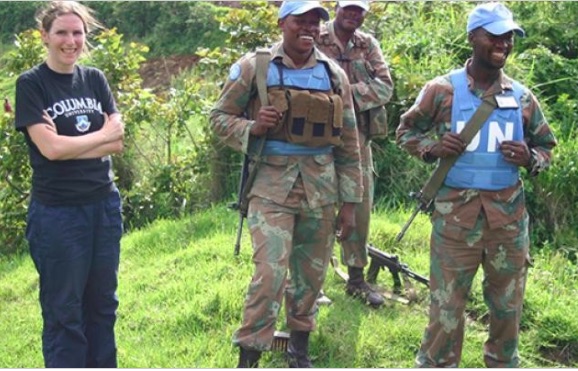 Severine Autesserre with UN peacekeepers