‘Tide Is Turning’: Cheers Erupt for NYC’s Suit Against Fossil Fuel Giants and for Divestment

. . SUSTAINABLE DEVELOPMENT . .

An article by Andrea Germanos for Common Dreams

Climate advocates hailed what they say is a “watershed” moment on Wednesday following two announcements by New York City: that the city would seek to divest its pension funds from fossil fuels within five years, and that it filed suit against five fossil fuel giants for their role in driving the climate crisis.


New York City on Wedensday announced its plans to divest billions of its pension funds from fossil fuel companies and that it filed a suit against five giants in the industry for billions in damages. (Photo: Rae Breaux/FossilFree.org)

“This is a first-in-the-nation step to protect our future and our planet—for this generation and the next,” said Comptroller Scott M. Stringer.

Stringer announced last month that he would soon bring a proposal to the trustees of the pension funds that included divestment. Following through on that promise, a statement from the city released Wednesday says that he and Mayor Bill de Blasio “will submit a joint resolution to pension fund trustees” to begin the steps needed to purge the funds from the dirty industry, which will first entail an analysis on the financial impacts to be carried out by the City Comptroller’s Bureau of Asset Management.

350.org co-founder Bill McKibben said in a tweet responding to the news that it was “One of the biggest days in 30 years of the climate fight.”

The city’s five pension funds hold $189 billion in assets, and roughly $5 billion of that amount are held in the securities of over 190 fossil fuel companies, the city says.

The new lawsuit names BP, Chevron, ConocoPhillips, Exxon Mobil, and Royal Dutch Shell and seeks billions of dollars in damages for harm already inflicted on the city as a result of the climate crisis as well for preparing for effects yet to come, including “imminent threats to its property, its infrastructure, and the health and safety of its residents.”

New York’s lawsuit follows similar suits filed by seven cities and counties in California.

The city’s statement references the industry’s deliberate misinformation campaign to cover up the effects of fossil fuels.

“We’re bringing the fight against climate change straight to the fossil fuel companies that knew about its effects and intentionally misled the public to protect their profits,” de Blasio said in a statement. “As climate change continues to worsen, it’s up to the fossil fuel companies whose greed put us in this position to shoulder the cost of making New York safer and more resilient.”

(continued in right column)

Question for this article:

Divestment: is it an effective tool to promote sustainable development?

(continued from left column)

Daniel Zarrilli, the city’s senior director of Climate Policy and Programs and Chief Resilience Officer, echoed that statement, saying, “Today, after a decades-long pattern of deception and denial by fossil fuel companies, New York City is holding them to account. By seeking damages for the investments necessary to protect New Yorkers from the impacts of climate change, and divesting our pension funds from fossil fuel reserves, we are taking the largest action by any city to confront the growing climate crisis and demonstrate the leadership necessary to win this fight against fossil fuels and the damages they’ve caused.”

Among the state lawmakers praising the city’s action was Democratic Sen. Liz Krueger who said, “Divestment sends the clear message that it is no longer acceptable to support companies whose fundamental business model puts our entire society at risk.”

Climate campaigners heaped praise on the city as well.

McKibben said in a statement, “New York City today becomes a capital of the fight against climate change on this planet.”

“With its communities exceptionally vulnerable to a rising sea, the city is showing the spirit for which it’s famous: it’s not pretending that working with the fossil fuel companies will somehow save the day, but instead standing up to them, in the financial markets and in court,” he added.

The announcements also drew praise from Carroll Muffett, president of Center for International Environmental Law (CIEL), who said they marked “a watershed in corporate accountability for climate change and a wake-up call to investors that the risks facing fossil fuel companies are real, material, and rapidly growing.”

The city’s move also follows New York State’s announcement last month that it was putting forth a “a de-carbonization roadmap” that included divesting from fossil fuels.

With NYC becoming the first major U.S. city to call for divestment—a call over 800 institutions have heeded—and a growing number of municipalities filing suit against the industry, climate activists say it’s clear “the global tide is turning.”

According to Betámia Coronel, U.S. reinvestment coordinator at 350.org, “Divesting our city’s pensions from the dirtiest companies is an enormous hard-won first step; holding companies like Exxon accountable for their role in climate deception is next. Today’s announcement is a rallying signal to cities all over the world that the dawn of a fossil free world has arrived.”

“The signal is clear,” McKibben adds in an op-ed. “The oil industry is not the future, it’s the past. And indeed it will be held responsible for what it’s done in the past: namely, push climate denial when it knew the truth.”

“They should light up the Empire State Building in green tonight — for the money the city is going to save, and for the planet it will help protect in the process,” he concludes.

Washington activists launch ‘Climate Countdown’ to push lawmakers for urgent action

. . SUSTAINABLE DEVELOPMENT . .

An article by Brandon Jordan from Waging Nonviolence

As Washington state senators prepared for the first legislative session of 2018 at the capitol building in Olympia yesterday, their traditional welcome ceremony was disrupted by at least a hundred activists from across the state, who had made their way into the balconies. From there, to the dismay of their elected officials, they delivered a loud message for all in attendance: “We have a climate crisis. You need to act now!”


Climate Countdown activists rallied outside the Washington state capitol building in Olympia on Monday. (Twitter / 350 Seattle / Alexandra Blakely)

The demonstration was part of an effort organizers are calling Climate Countdown, a campaign pressuring Democrats to pass and implement legislation that reduces carbon emissions. With a Democratic majority in both legislative chambers, organizers from a handful of organizations, from local 350.org chapters to indigenous groups, believe this is the perfect — and perhaps the only — opportunity to act.

Since 2013, passing any form of climate-related legislation in Washington was difficult at best. Republicans held a majority in the state Senate and used this advantage to block proposals, such as a cap-and-trade system, from Democrats. Gov. Jay Inslee, considered  the “greenest governor in America” by the League of Conservation Voters, often felt frustrated by Republican opposition to his climate plans.

Yet, on Nov. 8, Democrats succeeded in regaining control of the state Senate with a slim 49-48 majority. Alec Connon, an activist with 350 Seattle, said this victory led to activists discussing a potential plan to ensure lawmakers took responsibility without using Republicans as an excuse.

“It’s about time that the rhetoric we’ve seen from climate leaders in Washington state [translate into] actual meaningful policy,” Connon said.

As part of the campaign, residents are putting forward two demands to lawmakers. First, they want officials to follow a climate test, which are guidelines that determine a project’s approval if it harms the climate. This would reject all fossil fuel proposals.

(continued in right column)

Question for this article:

Despite the vested interests of companies and governments, Can we make progress toward sustainable development?

(continued from left column)

Second, activists want lawmakers to pass a bill that ensures the state switches to 100 percent renewable energy by 2028. All sectors under the government’s jurisdiction would move toward using alternative fuels.

The window to do this is short, as Washington lawmakers will only meet for 60 days this session. As 350 Seattle communications coordinator Emily Johnston explained, every minute is precious. She referred to scientists who warned  world leaders last June that we have only three years to reduce greenhouse gases to a point where the Paris climate agreement target of 1.5 degrees Celsius is still attainable.

“We know what happens beyond that,” she said. “[Climate] acceleration and the disasters we are starting to see become unstoppable.”
Johnston referred the federal government’s refusal to deal with climate change as a major reason for not only Washington, but also other states to focus on the environment.

“If the entire West Coast were to develop laws that were very aggressive on climate then that would have a [massive] impact because the economies of Washington and California are huge,” she said.
Connon used Montgomery County, the largest county in Maryland, as an example of what Washington state could do. Last month, officials there passed a resolution declaring a “climate emergency” and aimed to reduce the county’s greenhouse gas emissions by 80 percent by 2027, and ultimately 100 percent eight years after that.

“The example set by Montgomery County is a commendable example and one we hope Washington state will follow,” Connon said.
Washington does have commitments by law to reduce its greenhouse gases  to 1990 levels by 2020. But Olympic Climate Action member Melanie Greer said Washington will fail to meet that deadline barring a significant policy change.

“I want to see real legislation that matches what scientists say has to be done, as well as demonstrable action — so that the state moves in the right direction,” Greer said.

After the activists in the balconies finished their chant, they were ordered to leave by security guards. Having made their voices heard, they are now planning the next steps of the campaign to ensure officials make climate action a top priority this legislative session.

“The clock is ticking,” Connon said. “We, as a society and as a whole, have to respond to the climate crisis.”

Baltimore, USA: Conference on US foreign military bases

DISARMAMENT & SECURITY .

An article by Elliot Swain for Code Pink

On January 12-14, 2018, a conference in Baltimore on US foreign military bases brought together anti-war voices from all over the world. Speakers identified the many threats posed by United States military presence—from national sovereignty to the environment and public health.


US military outposts in foreign nations are vestiges of a shameful history of US imperialism dating back to the Spanish-American War and subsequent US colonization of the Philippines and Cuba. Many more bases were built during World War II and the Korean War, and still exist today. The closure of these bases could signal the twilight of a long history of bloody, costly foreign wars while affirming the principle of self-determination for all peoples. Voices from Japanese, Korean, African, Australian and Puerto Rican resistance movements came together at the conference to draw these connections and plan a peaceful future.

Fittingly, the conference marked the 16th anniversary of the opening of the prison at Guantanamo Bay, Cuba. Demonstrators gathered outside the White House on January 11 to demand the release of the 41 prisoners still detained without charges in the prison that former President Obama had promised to close. But as co-chair of the National Network on Cuba Cheryl LaBash said, “Guantanamo is more than a prison.” In fact, the Guantanamo military base is the oldest outpost of the United States military on foreign soil, with permanent control ceded in 1901 under the neocolonial Platt Amendment.

The campaign to shutter the illegal and abominable Guantanamo prison coincides with the more protracted fight to return the bay to the people of Cuba. The history of Guantanamo shows how the barbarism of the modern war machine follows the dehumanizing logic of a century of US imperialism. 

(continued in right column)

Question for this article:

The peace movement in the United States, What are its strengths and weaknesses?

(continued from left column)

The conference also devoted a plenary to the abysmal impact of both domestic and foreign military bases on the environment and public health. According to professor of environmental health Patricia Hynes, the majority of global superfund sites—sites the EPA identifies as posing risks to health or environment—are foreign military bases. Pat Elder from the group World Without War demonstrated how the Navy’s Allegheny Ballistic Center in West Virginia regularly leaks trichloroethylene, a known carcinogen, into the groundwater of the Potomac. The Naval War Center in Dahlgren, Virginia has been burning hazardous waste materials for 70 years.

The military’s impunity and recklessness towards public health is cast into sharp relief by the case of Fort Detrick in Maryland. The Army dumped radioactive sludge into the groundwater, which Frederick residents claim is directly linked to a spate of cancer-related deaths in the area. They sued, and the case was dismissed, with the judge citing “sovereign immunity.”

Though those bases are on US soil, “sovereign immunity” is all the more chilling of a verdict for the peoples of foreign nations.. Hynes described Okinawa Island as “the junk heap of the Pacific.” The island has been the dumping ground for extremely toxic defoliants like Agent Orange for several decades. Pollution from the island’s American military bases has caused hundreds of US service members and local Okinawans to become seriously ill.

The people of Okinawa have been tireless in their fight against these deadly bases. While local resistance leader Hiroji Yamashiro awaits trial on trumped-up charges, protesters turn out every single day to oppose the expansion of Marine base Camp Schwab. Indigenous movements like these are the lifeblood of the international opposition to US empire. But fundamentally, it is incumbent upon Americans to rein in the devastating impact of their government’s foreign military presence. 

The conference concluded with a call for an international summit on foreign military bases to be hosted by one of the countries presently fighting against the US military presence on their soil. It also called for the formation of an ongoing international alliance against foreign military bases. For more information and updates, go to www.noforeignbases.org

[Editor’s note: Additional information is available in an earlier CPNN article.

Uruguay’s main trade union center plans massive mobilization to construct a culture of peace

…. HUMAN RIGHTS ….

An article from República

PIT CNT [Uruguay’s main trade union center] is planning a strike for the third week of February, with “massive” mobilization, where all social organizations will be called, not just trade unions, to demand the “construction of peace, tolerance and dialogue,” according to President Fernando Pereira.


Fernando Pereira

Hours before the stoppage in response to the acts of violence experienced in recent days, two femicides in four days of the year, the death of a police officer at the end of 2017, the brutal death of a taxi driver and the murder of a union leader, something that in Uruguay had not happened for a long time, President Fernando Pereira said that the society needs “a day of mourning and reflection. We are not asking others to reflect, we are going to reflect and we are mourning.”

(Continued in right column)

(Click here for a Spanish version of this article.)

Question related to this article:

What is the role of organized labor in the peace movement?

(Continued from left column)

“Given these events, the trade union movement decided to call for reflection and mourning as an immediate response,” he said. “We called for it immediately so no one could say we were trying to stretch a long weekend. The solution was to act immediately and to postpone the other proposals that are on the table “.

Among the measures to be taken, the first one is to convene the Extended National Representative Board of the Union in the first week of February, in order to plan a mobilization for the third week of that month.

“We hope to have organizations linked to human rights, to feminism, to different religious beliefs, to all the members of society that want to participate in a massive call to build a culture of peace, tolerance and dialogue, rather than settling conflict through violence,” said the president of the union.

He recalled that there were 33,000 complaints from women about violence, “which marks a problem we have as a society. We can not look with indifference at the things that are happening, when a teacher is being beaten by a mother, or when rural workers commit acts of violence towards workers who claim their rights.”

At the beginning of the general strike called by the PIT CNT, at the door of the company Viana Trasporte, where the trade unionist of the SUTCRA, Marcelo Silvera was assassinated in front of his partner and his son, dozens of people approached the facilities to make an escrache demonstration .

In front of the march, colleagues of the union carried a banner with an image of the victim, with the caption: “Marcelo Silvera Presente” and below the signature of the transport coordinator. The murderer of Silvera is serving a pre-trial detention while the trial against him is being prepared. Because it is an aggravated homicide, the person who fired the shots could receive a maximum penalty of 30 years in prison.

Brazil: Londrina to hold meeting for peace and religious tolerance

TOLERANCE & SOLIDARITY .

An article from Bonde News (translated by CPNN)

The Concha Acústica de Londrina, located in Praça 1º de Maio, will be the stage for the 2nd Londrina Meeting of United Religions for Peace for Religious Tolerance, in celebration of the National Day to Combat Religious Intolerance, celebrated on January 21. The meeting will be next Saturday (20 January), from 8am to 10am. In case of rain, the action can be transferred to the Municipal Public Library Pedro Viriato Parigot de Souza.

(foto: Londrina Pazeando)

(continued in right column)

Question related to this article:
 
How can different faiths work together for understanding and harmony?

(continued from left column)

The event is promoted by the Municipal Council for the Culture of Peace (Compaz), the Commission for the Promotion of Racial Equality and Minorities of the Order of Attorneys of Brazil (OAB) Subsection of Londrina and the Inter Religious Group of Londrina (GDI).
(continued in right column)

This is the third consecutive year that the initiative is held in Londrina. According to Compaz’s secretary, Charleston Luiz da Silva, the goal is to promote culture for peace and respect among religions. “We want people to understand that all religions are united for the same purpose. We invite the entire London community to participate.”

About twenty religious leaders have been invited to speak. In the past, 17 leaders participated. Each will have three to five minutes to talk about the culture of peace in the opening, scheduled to start at 8am. At the end of the event, those present will make a hug for peace.

(Click here for the original Portuguese version of this article)

UNAMID supports demobilization of former combatants in North Darfur

DISARMAMENT & SECURITY .

An article from Relief Web

The demobilization of some 500 ex-combatants — part of ongoing efforts supported by UNAMID [African Union – United Nations Mission in Darfur] and partners to reintegrate former combatants into the community — concluded on 10 January in El Fasher.


© Amin Ismail, UNAMID

The fifth demobilization exercise, which started on 26 December 2017, was supported by the Sudan Disarmament Demobilization and Reintegration Commission (SDDRC), in partnership with UNAMID’s Governance and Community Stabilization Section (GCSS), the UN Development Programme (UNDP) and the World Food Programme (WFP).

The ex-combatants — among them 85 women and 12 disabled persons — were drawn from armed movements that signed the 2006 Darfur Peace Agreement and the 2011 Doha Document for Peace in Darfur.

Participants went through a verification process which was conducted by members of the Ceasefire Commission, the SDDRC and UNAMID’s GCSS. Additionally, participants received an administrative and reintegration briefing, medical checks, and were registered with the SDDRC database. Each ex-combatant was provided a reinsertion package from WFP which included dry rations for three months.

(Continued in right column)

Question related to this article:

What is the United Nations doing for a culture of peace?

(Continued from left column)

One of the participants, a former member of an armed group in her early 30s, explained that her future plans concerning reintegration into society include investing in agriculture and animal resource projects. She said that she planned to help promote a culture of peace among local communities in Darfur.

Another former combatant from the same group called on all parties to the conflict to address the root causes of the conflict in order to achieve lasting peace in Darfur. Mr. Mohammed urged all the ex-combatants not to return to war and actively participate in the stability and development projects in the region.

Mohamed Ahmed, Commissioner of the North Darfur SDDRC, said that the demobilization exercise will encourage more combatants to disarm, and benefit from economic and social stability projects.

“We will focus on community stabilization through the provision of service projects in the areas affected by the conflict”, said Mr. Ahmed.

Mr. Ahmed commended UNAMID for its continued commitment, coordination and support to ensure successful demobilization. He indicated that donor community support for the reintegration process contributes to achieving peace in Darfur.

Major Abdul Jaleel Fadol Hamza, Commander of the 5th Demobilization camp in North Darfur, highlighted the importance of the demobilization process for peace, security and stability in North Darfur. He expressed a readiness to receive more combatants who are willing to join the peace process and reintegrate in local communities.

Ezzedin Adam Mohammed, a UNAMID DDR Officer, said that demobilization represented the first step for ex-combatants to reintegrate into the community and return to civilian life.
UNAMID provided technical and logistical support to the demobilization. In addition, the Mission provided a financial package of 1,500 Sudanese Pounds for each ex-combatant prior to their final reintegration projects with UNDP. UNAMID has supported similar demobilization exercises that have taken place in the other four states of Darfur since 2011.

Martin Luther King Jr.’s Poor People’s Campaign Reborn

…. HUMAN RIGHTS ….

An article by Amy Goodman & Denis Moynihan in Democracy Now

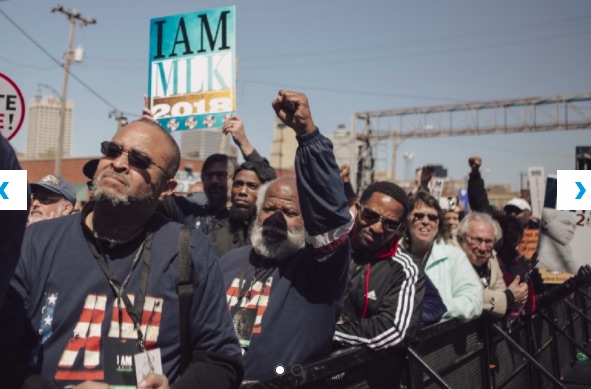
Martin Luther King Jr. would have turned 89 years old this Jan. 15. Assassinated at the age of 39 on April 4, 1968, his much-too-short life forever changed America. Among the landmarks of his activism are the 1955 Montgomery bus boycott, ending segregation in public transportation; leading the 1963 March on Washington, where he delivered his famous “I Have a Dream” speech; the passage of the 1964 Civil Rights Act and the 1965 Voting Rights Act; and marching with sanitation workers in Memphis, where he declared in his last speech, delivered on the eve of his death, “I’ve been to the mountaintop.” Often overlooked are the increasingly radical policy positions King took in his last years, from speaking out against the Vietnam War to forging a multiracial Poor People’s Campaign that sought, as King said, “a radical redistribution of economic and political power.” Now, 50 years later, a coalition has formed anew to organize poor people in the United States into what King called “a new and unsettling force” to fight poverty and forge meaningful change.


Illustration from Nation of Change

This renewal, called “The Poor People’s Campaign: A National Call for Moral Revival,” has an audacious agenda: “to challenge the evils of systemic racism, poverty, the war economy, ecological devastation and the nation’s distorted morality.” At the forefront is the Rev. Dr. William J. Barber II. Born just two days after the famous March on Washington, Barber grew up in the civil-rights movement. For over 10 years he served as president of the North Carolina NAACP, stepping down to lead this new campaign.

Back in 1968, King described the need for the Poor People’s Campaign, saying: “Millions of young people grow up in the sunlight of opportunity. But there is another America. And this other America has a daily ugliness about it that transforms ebulliency of hope into the fatigue of despair.”

(Article continued in the right side of the page)

Question for this article:

What’s the message to us today from Martin Luther King, Jr.?

(Article continued from the left side of the page)

Speaking this week on the “Democracy Now!” news hour, Rev. Barber reflected on how little has truly changed since King’s time: “Fifty years later, we have nearly 100 million poor and working poor people in this country, 14 million poor children. … Fifty years later, we have less voting rights protection than we had on August 6, 1965,” he said. “[Republicans] have filibustered fixing the Voting Rights Act now for over four years, over 1,700 days.”

“Every state where there’s high voter suppression,” Barber continued, “also has high poverty, denial of health care, denial of living wages, denial of labor union rights, attacks on immigrants, attacks on women.”

Barber says the answer is fusion politics: “We have black, we have white, we have brown, young, old, gay, straight, Jewish, Muslim, Christians, people of faith, people not of faith, who are coming together,” creating what he calls the “Third Reconstruction.” Part of this fusion includes reaching out to traditionally conservative Christians, like Minister Jonathan Wilson-Hartgrove. From a devout, white evangelical family, as a teen he served as a congressional page under South Carolina Republican Sen. Strom Thurmond, one of the fiercest segregationists of the modern era.

Wilson-Hartgrove heard William Barber preach, and has been a follower and a colleague ever since. The renewed Poor People’s Campaign is responding to poor, white evangelicals, Wilson-Hartgrove says: “These people who say, ‘Vote for me because I’m a good Christian leader’ are not serving your interests. You don’t have health care, you don’t have a living wage, because the same people who say they’re standing up for God and righteousness are, when they’re voting, voting against the interests of poor people, whether you’re black, white, brown or whatever.”

Barber sees transformation of the Deep South on the near horizon, but doesn’t claim it will be easy. Recent court victories against both racial and political gerrymandering in North Carolina will further empower African-Americans and other traditionally marginalized groups. But the real work will be done not in the courts, but in the streets.

Barber and Wilson-Hartgrove, along with the Rev. Liz Theoharis, co-director of the New York City-based Kairos Center for Religions, Rights, and Social Justice and co-chair of the modern-day Poor People’s Campaign, traveled to 15 states around the country in recent months, recruiting, organizing and training over 1,000 people. Barber said: “Our first action will be on the Monday after Mother’s Day. We’re going after 25,000 people engaging in civil disobedience over six weeks to launch a movement.” Their target: the U.S. Capitol and statehouses across the country.

Martin Luther King Jr. was robbed of life by a sniper’s bullet 50 years ago. But on this anniversary of his birth, this national holiday that people fought decades for, his vital work to empower the poor, lives on.

‘World’s First Solar Highway’ Opens in China for Testing

.. SUSTAINABLE DEVELOPMENT ..

An article by Lorraine Chow from Ecowatch

Jinan, the capital city of China’s Shandong province, opened on Thursday a kilometer-long stretch of solar expressway for testing, joining France and the Netherlands that have tapped into the nascent technology.


Frame from video

China’s new solar road consists of an insulating layer on the bottom, photovoltaic panels in the middle, and transparent concrete on top.

The solar panels cover 5,875 square meters and can generate 1 million kilowatt-hours of power in a year, or enough to meet the energy demands of about 800 homes, Qilu Transportation Development Group, the project developer, claimed.

(Continued in right column)

Question for this article:

Are we making progress in renewable energy?

(Continued from left column)

If the technology proves effective, the electricity generated by the panels could power everything from street lights to signboards, and even a snow-melting system on the road. Excess energy can get sent to state grid.

“The project will save the space for building solar farms and shorten the transmission distance,” said Xu Chunfu, the group’s chairman.

But this special road—which China has hailed as the “world’s first photovoltaic highway“—is designed to do a lot more than just harness the sun’s rays for electricity and allow cars to get from A to B.

The site also serves as a clean energy lab to test other technologies, including wireless charging for electric vehicles and providing internet connection.

As intriguing as the project sounds, solar roads have been dismissed by critics as too expensive for practical use. China’s road costs about $458 per square meter, which is much more expensive than, say, traditional asphalt.

Still, this project showcases China’s multibillion dollar plow into renewable energy. By 2020, the country is aiming to build 54.5GW of large-scale solar projects.

“With the development of solar power in China, the cost can be further reduced,” Xu said.

World Social Forums, Advancing the Global Movement for a Culture of Peace?

Here are the CPNN articles about the World Social Forum:

World Social Forum Heads to Benin: A Comeback for African Civil Society?

World Social Forum 2022 in Mexico: First two days

World Social Forum 2021

Brazil: World Social Forum concludes in Salvador

World Social Forum opens in Salvador de Bahia

On the way to the World Social Forum in Bahia

Brazil: Open Letter convenes World Social Forum 2018 in Salvador

Changing the system to address injustices: discussing with Mamadou Goita on the World Social Forum

Canada: World Social Forum: a success despite the low turnout

Canada: Forum social mondial : un succès malgré la faible participation

The city of Montreal hosts the 12th World Social Forum

La ville de Montréal à l’heure du 12ème Forum Social Mondial

Porto Alegre, Brazil: Fifteenth anniversary of the World Social Forum

Brasil: Evento fará balanço de ações dos últimos 15 anos do Fórum Social Mundial

World Social Forum in Tunis: Another world is possible, without the 1%

– – – – Links for the following articles published prior to 2015 do not work because they were made by a version of PERL programming that is no longer supported. With three easy steps, you can find the article by its number. First, click on it before returning to this page. Your browser will say that the article is not available but in the address listed you can see that it was located at ViewArticle=xxxx where xxxx is the number of the article. Returning to this page, then click here for the listing of all years. Then click on the year that contains the number for the article you seek. It will send you to the page where you can easily search for the article by its title. – – – –

Tunisia: The World Social Forum 2013 is underway

Tunisie: Le Forum social mondial 2013 s’est ouvert mardi

World Social Forum, Tunisia, 2013

Forum Social Mondial 2013 en Tunisie

Culture of Peace at the World Social Forum in Tunisia

World Social Forum in Belem, Brazil

Impressions from the Boston Social Forum

The courage of Mordecai Vanunu and other whistle-blowers, How can we emulate it in our lives?

Whistle-blowers may be considered as very important actors for a culture of peace.  As described on the CPNN page for values, attitudes and actions for a culture of peace, the culture of war is characterized by propaganda, secrecy, government control of media, militaristic language and censorship while the culture of peace is characterized by the free flow and sharing of information.  Whistle-blowers break the back of secrecy directly and dramatically.

Mordecai Vanunu’s courage continues the tradition of Daniel Ellsberg, who made known the Pentagon Papers during the Vietnam War and Karen Silkwood, who exposed nuclear pollution in the United States.  Ellsberg was persecuted by President Nixon and Karen Silkwood was murdered, as described some years ago in a very fine film starring Meryl Streep.

As the amount of government secrecy continues to increase, we may expect that the number of whistle-blowers will also tend to increase in the years to come.

Here are the CPNN articles on this subject:

Daniel Ellsberg Has Passed Away. He Left Us a Message.

Moscow TV protester plays ‘Russian roulette’ with risky comeback

US: Why Daniel Hale Deserves Gratitude, Not Prison

Glen Greenwald : My New Book on Journalism, Exposing Corruption, and the Resulting Risks, Dangers and Societal Changes

Following Chelsea Manning’s commutation, UN expert urges pardons for other whistleblowers

LuxLeaks: L’affaire et l’actu en Luxembourg

LuxLeaks: The case and the latest news from Luxembourg

Film: Truth, Deception and the Spirit of I.F. Stone

– – – – Links for the following articles published prior to 2015 do not work because they were made by a version of PERL programming that is no longer supported. With three easy steps, you can find the article by its number. First, click on it before returning to this page. Your browser will say that the article is not available but in the address listed you can see that it was located at ViewArticle=xxxx where xxxx is the number of the article. Returning to this page, then click here for the listing of all years. Then click on the year that contains the number for the article you seek. It will send you to the page where you can easily search for the article by its title. – – – –

An Easter letter about Mordecai Vanunu

Another Pulitzer for reporting classified info

‘Snowden did it for all of us’

International Peace Bureau awards the Sean MacBride Peace Prize to US whistleblower Bradley Manning

Interview with Edward Snowden:  The Latest Whistleblower

Ethiopian journalist Reeyot Alemu wins 2013 UNESCO-Guillermo Cano World Press Freedom Prize

La periodista etíope Reeyot Alemu gana el premio UNESCO-Guillermo Cano de Libertad de Prensa 2013

La journaliste éthiopienne Reeyot Alemu lauréate du Prix mondial de la liberté de la presse UNESCO/Guillermo Cano 2013

Whistleblowers Recognized for Courage, Sacrifice