Algérie: Séminaire sur l’islam et le rejet de la violence les 12 et 13 août à Laghouat

. . TOLÉRANCE & SOLIDARITÉ . .

Un article del Algérie Presse Service

L’Islam et le rejet de la violence, est le thème du 10ème séminaire Abdeldjebbar Tidjani, prévu les 12 et 13 août au siège de la zaouia Tidjania à Ain-Madhi (Laghouat), a-t-on appris jeudi des responsables de cette zaouia.

algerie

La rencontre, à laquelle prendront part plusieurs chouyoukh et professeurs de différentes régions du pays, sera consacrée à la voie de l’Islam dans le rejet de la violence et le remède à ses causes, a-t-on indiqué.

Les participants à cette manifestation religieuse traiteront de plusieurs sujets dont “la violence : phénomène et signification”, “le choc des civilisations et la violence”, “le discours religieux modéré et la sensibilisation”, ainsi que “les média et leur rôle dans la sensibilisation et la propagation de la culture de la paix et de la tolérance”, ont précisé les organisateurs.

Le thème retenu pour cette édition du séminaire Abdeldjebbar Tidjani est motivé par les proportions “inquiétantes et préoccupantes” prises par ce phénomène “étranger à la société musulmane”, d’où la nécessité d’alerter et de mettre en garde contre sa propagation et son infiltration dans la société, ont-ils fait remarquer.

L’objectif de ce séminaire, depuis son institution, est “d’éveiller les consciences et de propager la culture et le savoir au sein de la société”, selon les organisateurs.

Ce séminaire porte le nom d’Abdeldjebbar Tidjani, 10ème Calife général de la Tarîqa (confrérie) Tidjania sur la période 1991-2005, décédé à l’âge de 85 ans.

La Tarîqa Tidjania a été fondée en 1781 à Boussemghoune par Sidi Ahmed Tidjani (1737-1815), et compte des millions d’adeptes à travers le monde.

(Clickez ici pour une traduction anglaise.

Question for this article

Algeria: Seminar on Islam and rejection of violence on 12 and 13 August in Laghouat

TOLERANCE AND SOLIDARITY .

An article from the Algérie Press Service

Islam and rejection of violence, is the theme of the 10th seminar Abdeldjebbar Tidjani, scheduled for August 12 and 13 at the headquarters of zaouia Tidjania in Ain-Madhi (Laghouat). This was announced Thursday by officials of the zaouia. They indicated that the meeting will be attended by Shuyukh and teachers from different regions of the country, and it will be devoted to the path of Islam in the rejection of violence and the remedy of its causes.

algerie

The participants in this religious event will address several issues, including “violence: the phenomenon and its meaning”, “the clash of civilizations and violence”, “moderate religious discourse and awareness”, and “the media and their role in awareness and spreading the culture of peace and tolerance “, said the organizers.

The theme for this year’s Tidjani Abdeldjebbar seminar is motivated by the “alarming and disturbing proportion” taken by this phenomenon which is “alien to Muslim society.” Hence the need to alert and warn against its spread and infiltration in society, they said.

The objective of this seminar since its inception has been to “raise awareness and spread culture and knowledge in society,” according to organizers.

This seminar is named after Abdeldjebbar Tidjani, the 10th General Caliph of the tariqa (brotherhood) Tidjania over the period 1991 to 2005, who died at the age of 85.

Tariqa Tidjania was founded in 1781 in Boussemghoune by Sidi Ahmed Tijani (1737-1815), and it has millions of followers worldwide.

(Click here for the original French version of this article.)

Question for this article

Côte d’Ivoire: Le REPSFECO-CI invite les acteurs à un processus électoral apaisé

. PARTICIPATION DEMOCRATIQUE .

Un article de News Ivoire

Le REPSFECO-CI, Réseau Paix et Sécurité pour les Femmes de l’Espace CEDEAO Section Côte d’Ivoire veut contribuer à l’éducation citoyenne et à la culture de la paix. Cette organisation a initié, le mercredi 5 août 2015 à Abidjan, la 1ere édition des Rendez-vous du REPSFECO-CI sous le thème « Elections apaisées : responsabilités des partis politiques, et des 0SC [organizations de la société civile] ».

Cote d'Ivoire

« Les Rendez-vous du REPSFECO-CI » s’adresse aux organisations de la société civile et aux partis politiques. Il s’agit d’impliquer chaque acteur dans le processus démocratique en vue de préparer sereinement des élections futures apaisées, gage de stabilité et paix durable, selon Me Diallo Géneviève, présidente du REPSFECO-CI. La Côte d’Ivoire a besoin de la paix pour son développement. Les élections à venir constituent un test. La communauté internationale veut voir si notre pays est rentré vraiment dans un état démocratique. Nous pensons que ce sont les partis politiques qui font le jeu. Ils ont leur partisans et militants. Donc il est important que les partis politiques s’impliquent dans ces élections-là pour donner un autre discours aux populations car les populations sont fatiguées elles ont besoin d’être rassurées. Et que plus jamais ça en Côte d’Ivoire », nous a confié Me Diallo Géneviève, faisant allusion à la crise post électorale de 2010 émaillée de violence.

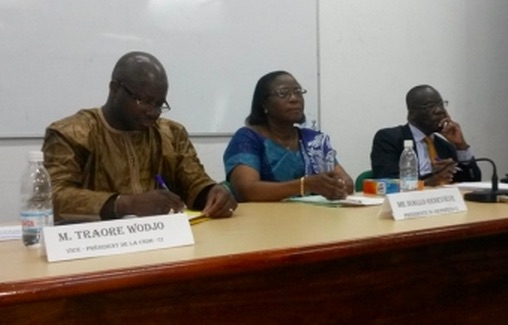
Le temps fort des « Rendez-vous du REPSFECO-CI », c’est une conférence-débat animée respectivement par M.Traoré Wodjo, vice-président de la Commission Nationale des Droits de l’Homme de Côte d’Ivoire(CNDH-CI) et Fernand-Julien Gauze, président de l’Ong Agir pour la Démocratie, la Justice et la Liberté en Côte d’Ivoire (ADJLCI) et membre du Réseau des organisations de la société civile de Côte d’Ivoire (ROSCI-CCAP).

La communication du premier nommé a mis l’accent sur les responsabilités des partis politiques dans la promotion d’un climat électoral apaisé et une participation effective au processus électoral. M.Traoré Wodjo a relevé que les élections en Afrique sont souvent sources de véritables tensions sociales. En témoigne le cas de la Côte d’Ivoire en 2010.C’est pourquoi les élections de 2015 constituent un défi de la démocratie pour les Ivoiriens. D’où la recommandation aux partis politiques à mettre un point d’honneur à la formation et la sensibilisation de leur partisans et surtout à poser des actions qui favorisent un climat apaisé tout au long du processus électoral. « Nous voulons une élection civilisée en Côte d’Ivoire », a-t-il martelé. « Des partis politiques consciencieux et des hommes politiques matures ayant un sens élevé de la démocratie sont le garant d’un processus électoral apaisé », a indiqué M.Traoré.

La contribution des OSC pour des élections apaisées a été l’affaire de Gauze Julien Fernand, président de l’ADJLCI.

Il a développé le thème : « Actions des OSC dans le monitoring objectif du processus électoral et la consolidation de la paix pré et post électorale ». Le monitoring électoral est un anglicisme qui donne en français surveillance électorale indiquant tout simplement le fait de surveiller le processus de l’élection par des organisations citoyennes, des citoyens, des partis politiques, les medias, des groupements professionnels, des groupes lobbies etc. Cela, en vue de donner l’alerte. L’expert en monitoring électoral a relevé l’importance cruciale du monitoring dans les processus électoraux en Côte d’Ivoire vu qu’il permet de renseigner sur les violences et les incidents qui émaillent une élection. Et ce, via les TIC : les réseaux sociaux et les SMS. « Le monitoring de la violence est une activité citoyenne incontournable dans les processus électoraux des pays en sortie de crise », a-t-il conclu.

(Clickez ici pour une traduction anglaise. )

Question related to this article:

How should elections be organized in a true democracy?

CPNN receives more and more articles from Africa about initiatives that contest the European model of “winner-takes-all” elections, and demand that elections should only be part of a broader democratic process that seeks consensus and compromise.

This fits with the pre-colonial systems of justice in Africa, when there was no monotheism and no single supreme god, no single supreme law, no single “truth” provided by divine intervention, but rather a compromise among many different “gods,” perspectives and “truths” arrived at through a process of mediation, for example, the “palabra.”

Here are some of the articles:

Ghana Youth Coalition wants politicians to commit to peace in 2012

Women’s World in Nationwide Sensitization [Sierra Leone]

Varsities vouch for peace ahead of general elections (Kenya)

Zimbabwe: Christian denominations launch peace initiative

Rethinking Post-Election Peacebuilding in Africa

Nigeria: Why we facilitated Abuja peace accord —Ben Obi

Uganda: Government to Set Up Election Conflict Resolution Body

Côte d’Ivoire: Le REPSFECO-CI invite les acteurs à un processus électoral apaisé

Côte d’Ivoire: REPSFECO-CI promotes a peaceful electoral process

Côte d’Ivoire: REPSFECO-CI promotes a peaceful electoral process

. DEMOCRATIC PARTICIPATION .

An article from News Ivoire

The REPSFECO-CI, Peace and Security Network for Women of ECOWAS – Ivory Coast Section – wants to contribute to civic education and culture of peace. This organization initiated, Wednesday, August 5, 2015 in Abidjan, the first edition of the “Rendez-vous du REPSFECO-CI” under the theme “Peaceful elections: responsibilities of political parties and organizations of the civil society”.

Cote d'Ivoire

The “Rendez-vous du REPSFECO-CI” is designed for organizations of civil society and political parties. Every actor involved in the democratic process should calmly prepare for future elections that guarantee stability and lasting peace, according to Mr. Diallo Géneviève, president of REPSFECO-CI. Côte d’Ivoire needs peace for its development. The upcoming elections are a test. The international community wants to see if our country really got into a democratic state. We think it is the political parties that determine the game. They have their supporters and activists. So it is important that political parties involved in these elections should speak in a different way because people are tired and they need to be reassured. We must not repeat the violent post-election crisis in 2010.

The highlight of “Rendezvous REPSFECO-CI” is a panel discussion moderated by M.Traoré Wodjo, vice president of the National Commission of Human Rights of Côte d’Ivoire (CNDH- CI) and Fernand-Julien Gauze, president of the NGO Action for Democracy, Justice and Freedom in Ivory Coast (ADJLCI) and member of the Network of organizations of civil society in Côte d’Ivoire (CCAP-Rosci ).

The communication of by M.Traoré Wodjo emphasized the responsibilities of political parties in promoting a peaceful electoral climate and effective participation in the electoral process. He noted that elections in Africa are often sources of serious social tensions. Witness the case of Côte d’Ivoire in 2010. That’s why the 2015 elections are a challenge to democracy for Ivorians. Hence the recommendation to the political parties to put a point of honor to the training and education of their supporters and especially to ask actions that promote a peaceful climate throughout the electoral process. “We want a civilized election in Ivory Coast,” he stressed. “Political parties that are conscientious and mature politicians with a high sense of democracy are the guarantee of a peaceful electoral process,” M.Traoré said.

Civil Society for peaceful elections was the theme of Fernand Julien Gauze, president of the ADJLCI, “Actions of CSOs in the objective monitoring of the electoral process and the consolidation of pre- and post-electoral peace” “Election monitoring” is an English expression which translates into French as “surveillance électorale” simply indicating the need to monitor the process of the election by civil organizations, citizens, political parties, media, trade associations, lobby groups etc. The purpose is to raise the alert. The expert in election monitoring has identified the crucial importance of monitoring in electoral processes in Côte d’Ivoire since it calls attention to the violence and incidents that may take place during an election. And, through informatics, the social networks and SMS. “The monitoring of violence is an essential civic activity in the electoral processes of countries that have experienced crises,” he concluded.

(Click here for the original version of this article in French.)

Question related to this article:

How should elections be organized in a true democracy?

CPNN receives more and more articles from Africa about initiatives that contest the European model of “winner-takes-all” elections, and demand that elections should only be part of a broader democratic process that seeks consensus and compromise.

This fits with the pre-colonial systems of justice in Africa, when there was no monotheism and no single supreme god, no single supreme law, no single “truth” provided by divine intervention, but rather a compromise among many different “gods,” perspectives and “truths” arrived at through a process of mediation, for example, the “palabra.”

Here are some of the articles:

Ghana Youth Coalition wants politicians to commit to peace in 2012

Women’s World in Nationwide Sensitization [Sierra Leone]

Varsities vouch for peace ahead of general elections (Kenya)

Zimbabwe: Christian denominations launch peace initiative

Rethinking Post-Election Peacebuilding in Africa

Nigeria: Why we facilitated Abuja peace accord —Ben Obi

Uganda: Government to Set Up Election Conflict Resolution Body

Côte d’Ivoire: Le REPSFECO-CI invite les acteurs à un processus électoral apaisé

Côte d’Ivoire: REPSFECO-CI promotes a peaceful electoral process

UN: Consensus Reached on New Sustainable Development Agenda to be adopted by World Leaders in September

. . SUSTAINABLE DEVELOPMENT . .

An article by the United Nations Development Program

The 193 Member States of the United Nations reached agreement today [August 2 ]on the outcome document that will constitute the new sustainable development agenda that will be adopted this September by world leaders at the Sustainable Development Summit in New York.

UNDP

Concluding a negotiating process that has spanned more than two years and has featured the unprecedented participation of civil society, countries agreed to an ambitious agenda that features 17 new sustainable development goals that aim to end poverty, promote prosperity and people’s well-being while protecting the environment by 2030.

UN Secretary-General Ban Ki-moon welcomed the agreement, saying it “encompasses a universal, transformative and integrated agenda that heralds an historic turning point for our world.”

“This is the People’s Agenda, a plan of action for ending poverty in all its dimensions, irreversibly, everywhere, and leaving no one behind. It seeks to ensure peace and prosperity, and forge partnerships with people and planet at the core. The integrated, interlinked and indivisible 17 Sustainable Development Goals are the people’s goals and demonstrate the scale, universality and ambition of this new Agenda.”

Mr. Ban said the September Summit, where the new agenda will be adopted, “will chart a new era of Sustainable Development in which poverty will be eradicated, prosperity shared and the core drivers of climate change tackled.”

He added that the UN System stands ready to support the implementation of the new agenda, which builds on the successful outcome of the Third International Conference on Financing for Development in Addis Ababa, and which, he said, will also contribute to achieve a meaningful agreement in the COP21 in Paris in December.
UNDP Administrator Helen Clark said “This agreement marks an important milestone in putting our world on an inclusive and sustainable course. If we all work together, we have a chance of meeting citizens’ aspirations for peace, prosperity, and wellbeing, and to preserve our planet.”

More than 150 world leaders are expected to attend the Sustainable Development Summit at the UN headquarters in New York between 25 to 27 September to formally adopt the outcome document of the new sustainable agenda.

The new sustainable development agenda builds on the success of the Millennium Development Goals, which helped more than 700 million people escape poverty. The eight Millennium Development Goals, adopted in 2000, aimed at an array of issues that included slashing poverty, hunger, disease, gender inequality, and access to water and sanitation by 2015.

The new sustainable development goals, and the broader sustainablity agenda, go much further, addressing the root causes of poverty and the universal need for development that works for all people.

The preamble of the 29-page text, “Transforming Our World: The 2030 Agenda for Sustainable Development,” states, “We are resolved to free the human race from the tyranny of poverty and want and to heal and secure our planet.” It continues, “We are determined to take the bold and transformative steps which are urgently needed to shift the world onto a sustainable and resilient path. As we embark on this collective journey, we pledge that no one will be left behind.”

Rio+20 and the intergovernmental process

At the Rio+20 Conference of 2012, Member States agreed to launch a process to develop a set of sustainable development goals, which will build upon the Millennium Development Goals. The Millennium Development Goals have proven that goal-setting can lift millions out of poverty, improve well-being and provide vast new opportunities for better lives. It was agreed that the new goals would be global in nature and universally applicable to all countries while taking into account different national realities, capacities and levels of development and respecting national policies and priorities.

(Article continued in the right side of the page)

( Click here for the French version of this article or here for the Spanish version.)

Question for this article:

Can UN agencies help eradicate poverty in the world?

(Article continued from the left side of the page)

The negotiations were co-facilitated by the UN Permanent Representative of Ireland, Ambassador David Donohue, and the UN Permanent Representative of Kenya, Ambassador Macharia Kamau, over two years. The inclusive and transparent consultations by Member States, with the strong engagement of civil society and other stakeholders, have served as a basis for the conclusion of the intergovernmental negotiations on the emerging universal and people-centred agenda.

Core elements of the agreed outcome document

The outcome document highlights poverty eradication as the overarching goal of the new development agenda and has at its core the integration of the economic, social and environmental dimensions of sustainable development. The emerging development agenda is unique in that it calls for action by all countries, poor, rich and middle-income. Member States pledge that as they embark on this collective journey, no one will be left behind. The ‘five Ps’—people, planet, prosperity, peace, and partnership—capture the broad scope of the agenda.

The 17 sustainable goals and 169 targets aim at tackling key systemic barriers to sustainable development such as inequality, unsustainable consumption and production patterns, inadequate infrastructure and lack of decent jobs. The environmental dimension of sustainable development is covered in the goals on oceans and marine resources and on ecosystems and biodiversity, bringing core issues into the goal and target framework.

The means of implementation outlined in the outcome document match its ambitious goals and focus on finance, technology and capacity development. In addition to a stand-alone goal on the means of implementation for the new agenda, specific means are tailored to each of the sustainable development goals.

Member States stressed that the desired transformations will require a departure from “business as usual” and that intensified international cooperation on many fronts will be required. The agenda calls for a revitalized, global partnership for sustainable development, including for multi-stakeholder partnerships. The agenda also calls for increased capacity-building and better data and statistics to measure sustainable development.

An effective follow-up and review architecture – a core element of the outcome document – will be critical to support the implementation of the new agenda. The High Level Political Forum on sustainable development, set up after the Rio+20 Conference, will serve as the apex forum for follow up and review and will thus play a central role. The General Assembly, the Economic and Social Council and specialized agencies will also be engaged in reviewing progress in specific areas.

Based on the outcome document, the agenda will include a Technology Facilitation Mechanism to support the new goals, based on multi-stakeholder collaboration between Member States, civil society, business, the scientific community, and the UN system of agencies. The Mechanism, which was agreed at the Addis Conference in July, will have an inter-agency task team, a forum on science, technology and innovation, and an on-line platform for collaboration.

The successful outcome of the Addis Conference gave important positive momentum to the last stretch of negotiations on the post-2015 development agenda. It is expected that the consensus reached on the outcome document will provide momentum for the negotiations on a new binding climate change treaty to culminate at the Climate Change Conference in Paris from 30 November to 11 December 2015.

The draft agreement can be found here.

Les Etats membres de l’ONU s’accordent sur le nouveau programme de développement

. . DEVELOPPEMENT DURABLE . .

Un article de Programme des Nations Unies pour le développement

Les Etats membres des Nations Unies sont parvenus dimanche soir (02 août) à un consensus concernant le projet de document final du programme de développement pour l’après 2015 censé être adopté fin septembre à New York par les dirigeants mondiaux, lors du Sommet spécial sur le développement durable.

UNDP

A l’issue d’un important processus de négociation qui a duré plus de deux ans et s’est traduit par une participation sans précédent de la société civile, les 193 Etats membres de l’Assemblée générale de l’ONU se sont mis d’accord sur un programme ambitieux, comportant 17 nouveaux objectifs de développement durable. Ces objectifs auront pour but, d’ci l’année 2030, d’éradiquer l’extrême pauvreté et de promouvoir la prospérité et le bien-être des peuples, tout en protégeant l’environnement.

L’accord ainsi obtenu sur le contenu du nouveau programme de développement « annonce un tournant historique » pour la planète, s’est quant à lui félicité le Secrétaire général de l’ONU, Ban Ki-moon.

Le Secrétaire général a noté que le consensus auquel sont parvenus les Etats est la résultante d’un processus véritablement ouvert, inclusif et transparent.

« Il s’agit bien là du programme des peuples, un plan d’action pour mettre fin à la pauvreté sous toutes ses formes, de manière irréversible, en tout lieu et en ne laissant personne de côté », a poursuivi le chef de l’ONU, tout en soulignant que le programme vise également à garantir la paix et la prospérité, ainsi qu’à forger des partenariats avec pour principale préoccupation les gens et la planète.

Plus de 150 dirigeants du monde entier devraient prendre part au Sommet du développement durable qui aura lieu au siège de l’ONU à New York, du 25 au 27 septembre 2015, afin d’adopter formellement le document final dont le contenu a été arrêté ce week-end.

Ce programme prendra appui sur les précédents succès des 8 Objectifs du Millénaire pour le développement adoptés en 2000, grâce auxquels plus de 700 millions de personnes ont été en mesure d’échapper à la pauvreté au cours des 15 dernières années. Ces derniers visaient à résoudre un large éventail de problèmes, allant de la faim, à la maladie, en passant par l’inégalité entre les sexes et l’accès à l’eau et à l’assainissement d’ci à 2015.

(Voir suite sur colonne de droite. . . )

( Clickez ici pour la version anglaise de cet article ou ici pour la version espagnole.)

Question for this article:

Can UN agencies help eradicate poverty in the world?

(. . . suite)

Les Objectifs de développement durable établis dans le cadre du nouveau programme pour l’après 2015 entendent aller encore plus loin, en s’attaquant aux causes profondes de la pauvreté et au besoin universel de développement durable pour tous les peuples.

« Nous sommes déterminés à prendre les mesures audacieuses et transformatives dont nous avons besoin de toute urgence pour mettre le monde sur une voie durable et résiliente. Alors que nous nous embarquons dans cette aventure collective, nous nous engageons à ce que personne ne soit laissé de côté », ajoutent les Etats membres dans le projet de document final.

Qualifiant l’éradication de la pauvreté d’objectif primordial du nouveau programme de développement, le texte intègre pleinement les dimensions économiques, sociales et environnementales du développement durable et appelle à une action de tous les pays, qu’ils soient pauvres, riches ou à revenu intermédiaire.

Les 17 objectifs de développement durable et 169 cibles que comporte le nouveau programme auront pour but de lutter contre les obstacles systémiques majeurs au développement durable, tels que l’inégalité, la consommation et les modes de production non durables, l’insuffisance des infrastructures et le manque d’emplois décents. La dimension environnementale du développement durable est également prise en compte dans les objectifs portant sur les océans et les ressources marines ainsi que sur les écosystèmes et la biodiversité.

Les Etats membres soulignent par ailleurs dans ce projet de document final que pour réaliser les transformations souhaitées, il conviendra de mettre fin au statu quo et de renforcer la coopération internationale dans de nombreux domaines. Le programme appelle en effet à un partenariat mondial renouvelé en faveur du développement durable, y compris via l’établissement de partenariats entre acteurs de natures diverses, et au renforcement des données statistiques pour mesurer le développement durable.

A ce titre, le nouveau programme prévoit notamment la mise en place d’un instrument efficace de suivi et de revue ainsi que d’un Mécanisme visant à faciliter le transfert technologique à l’appui des nouveaux objectifs, fondé sur une collaboration multipartite entre les Etats membres, la société civile, les entreprises, la communauté scientifique et le système onusien. Convenu lors de la troisième Conférence internationale sur le financement du développement, qui a eu lieu en juillet dernier à Addis-Abeba, ce Mécanisme disposera notamment d’une équipe inter-agence, d’un forum sur la science, la technologie et l’innovation, et d’une plate-forme de collaboration en ligne.

ONU: Líderes mundiales logran consenso sobre la nueva Agenda para el Desarrollo Sostenible

. . DESAROLLO SUSTENTABLE . .

Un artículo de Programa de las Naciones Unidas para el Desarrollo

“Podemos ser la primera generación en acabar con la pobreza”. Con estas palabras resumió el secretario general de la ONU, Ban Ki-moon, el éxito alcanzado ayer (01 de agosto) por los 193 Estados Miembros de las Naciones Unidas que llegaron a un acuerdo sobre el proyecto de documento final que constituirá el nuevo programa de desarrollo sostenible que los líderes mundiales adoptarán en septiembre en la Cumbre de Desarrollo Sostenible en Nueva York.

UNDP

Al concluir un proceso de negociación que ha durado más de dos años y ha contado con la participación sin precedentes de la sociedad civil, los países acordaron un programa ambicioso que cuenta con 17 nuevos objetivos de desarrollo sostenible que tienen como objetivo acabar con la pobreza, promover la prosperidad y el bienestar de las personas, mientras que la protección de la medio ambiente para el año 2030.

El Secretario General de la ONU, Ban Ki-moon, acogió con beneplácito el acuerdo, diciendo que “abarca una agenda universal, transformadora e integrada que anuncia un punto de inflexión histórico para nuestro mundo.”

“Esta es la Agenda del Pueblo, un plan de acción para acabar con la pobreza en todas sus dimensiones, de manera irreversible, en todas partes, y sin dejar a nadie atrás. Se trata de garantizar la paz y la prosperidad, y forjar alianzas con la gente y el planeta. Los integrados, interrelacionados e indivisibles 17 Objetivos de Desarrollo Sostenible son las metas de la gente y demuestran la escala, la universalidad y la ambición de esta nueva agenda”.

Ban dijo que la Cumbre de septiembre, en la que se adoptará la nueva agenda “trazará una nueva era de desarrollo sostenible en la que se erradicará la pobreza, se compartirá la prosperidad y se abordarán las cuestiones principales del cambio climático.”

Añadió que el sistema de la ONU está dispuesto a apoyar la implementación de la nueva agenda, que se basa en el éxito de la Tercera Conferencia Internacional sobre la Financiación para el Desarrollo en Addis Abeba, y que, según dijo, también contribuirá a lograr un acuerdo significativo en la COP21 en París en diciembre.

Se espera que más de 150 líderes del mundo asistan a la Cumbre de Desarrollo Sostenible en la sede de la ONU en Nueva York entre 25 y 27 de septiembre para adoptar formalmente el documento final de la nueva agenda sostenible.

El nuevo programa de desarrollo sostenible se basa en el éxito de los Objetivos de Desarrollo del Milenio, que ayudaron a más de 700 millones de personas salir de la pobreza. Los ocho Objetivos de Desarrollo del Milenio, aprobados en el 2000, estaban dirigidos a una gran variedad de temas que incluyen disminución de la pobrez, el hambre, las enfermedades, la desigualdad de género y mejorar el acceso al agua y saneamiento para el año 2015.

Los nuevos objetivos de desarrollo sostenible y la agenda más amplia de sostenibilidad, van mucho más allá, haciendo frente a las causas fundamentales de la pobreza y la necesidad universal de desarrollo que funcione para todas las personas.

En el preámbulo del texto de 29 páginas, “La transformación de nuestro mundo: la Agenda para el Desarrollo Sostenible al 2030”, afirma, “Estamos decididos a liberar a la raza humana dentro de esta generación de la tiranía de la pobreza así como sanar y asegurar nuestro planeta para el presente y para las generaciones futuras.” El documento continúa: “Estamos decididos a tomar las medidas audaces y transformadoras que se necesitan con urgencia para cambiar el mundo hacia una senda sostenible y resistente. Al embarcarnos en este viaje colectivo, prometemos que nadie se quede atrás”.

Los elementos centrales del proyecto de documento final

En el documento final se destaca la erradicación de la pobreza como el objetivo general de la nueva agenda de desarrollo y tiene en su núcleo la integración de las dimensiones económicas, sociales y ambientales del desarrollo sostenible. La agenda de desarrollo emergente es única, ya que llama a la acción de todos los países, pobres, ricos y de ingresos medios. Los Estados miembros se comprometen que a medida que se embarcan en este viaje colectivo, nadie se quedará atrás. La agenda está centrada en las personas, el planeta, la prosperidad, la paz y las alianzas.

(El artículo continúa en el lado derecho de la página)

( Clickear aquí para la version inglês o aquí para la version francês)

Question for this article:

Can UN agencies help eradicate poverty in the world?

(Artículo continúa desde la parte izquierda de la página)

Los 17 objetivos y 169 metas sostenibles tienen por objeto hacer frente a las barreras sistémicas clave para el desarrollo sostenible como la desigualdad, los patrones de producción y el consumo insostenible, infraestructura inadecuada y la falta de empleos decentes. La dimensión ambiental del desarrollo sostenible se cubre en los objetivos sobre los océanos y los recursos marinos y en los ecosistemas y la biodiversidad, con lo que las cuestiones fundamentales en el marco de la meta y objetivo.

Los medios de ejecución indicados en el documento final se ajustan a sus objetivos ambiciosos y se centran en las finanzas, la tecnología y el desarrollo de capacidades. Además de un objetivo independiente sobre los medios de implementación para el nuevo programa, medios específicos están adaptados a cada uno de los objetivos de desarrollo sostenible.

Estados miembros destacaron que las transformaciones deseadas requerirán una salida de “business as usual”, y que se requerirá intensificar la cooperación internacional en muchos frentes. El programa requiere una revitalizada asociación mundial para el desarrollo sostenible, incluyendo las alianzas de múltiples partes interesadas. La agenda también requiere aumentar la creación de capacidades, mejores datos y estadísticas para medir el desarrollo sostenible.

Una eficaz arquitectura de seguimiento y revisión – un elemento central del documento final – será fundamental para apoyar la implementación de la nueva agenda. El Foro de Alto Nivel de Política sobre el desarrollo sostenible, establecido después de la Conferencia Río + 20, servirá como foro para el seguimiento y la revisión y por lo tanto tendrá un papel central. La Asamblea General, el Consejo Económico y Social y los organismos especializados también se dedicarán a la revisión de los avances en áreas específicas.

Con base en el documento final, el programa incluirá un Mecanismo de Facilitación de la Tecnología para apoyar a los nuevos objetivos, basados en la colaboración de múltiples partes interesadas entre los Estados Miembros, la sociedad civil, las empresas, la comunidad científica, y el sistema de las agencias de la ONU. El Mecanismo, que se acordó en la Conferencia de Addis en julio, tendrá un equipo interinstitucional de tareas, un foro sobre la ciencia, la tecnología y la innovación, y una plataforma en línea de colaboración.

El éxito de la Conferencia de Addis dio importante impulso positivo para el último tramo de las negociaciones sobre la agenda de desarrollo post-2015. Se espera que el consenso alcanzado en el documento final proporcionará impulso a las negociaciones de un nuevo tratado vinculante sobre el cambio climático en la Conferencia de Cambio Climático en París del 30 noviembre-11 diciembre, 2015.

Río + 20 y el proceso intergubernamental

En la Conferencia Río+20 de 2012, los Estados miembros acordaron poner en marcha un proceso para desarrollar un conjunto de objetivos de desarrollo sostenible, que se basara en los objetivos de desarrollo del Milenio. Los Objetivos de Desarrollo del Milenio han demostrado que la fijación de objetivos puede sacar a millones de la pobreza, mejorar el bienestar y proporcionar nuevas y enormes oportunidades para una vida mejor. Se acordó que los nuevos objetivos serían de naturaleza global y universalmente aplicable a todos los países, teniendo en cuenta las diferentes realidades, capacidades y niveles de desarrollo nacionales y respetando las políticas y prioridades nacionales.

Las negociaciones duraron más de dos años y fueron co-facilitadas por el Representante Permanente ante la ONU de Irlanda, el Embajador David Donohue, y el Representante Permanente ante la ONU de Kenia, Embajador Macharia Kamau. Las consultas incluyentes y transparentes por los Estados miembros, con el firme compromiso de la sociedad civil y otras partes interesadas, han servido de base para la conclusión de las negociaciones intergubernamentales sobre la agenda universal y centrado en las personas emergente.

El proyecto del acuerdo se puede encontrar aquí

Argentina: Program announced for the Film Festival “Nueva Mirada”

EDUCATION FOR PEACE .

An article from Escribiendo Cine

Organised by the Nueva Mirada Association, under the slogan “Buentrato: For a culture of peace”, the Festival, unique in its subject in the country, has been declared to be of interest fr Cultural and National Education by the Chamber of Deputies, the Senate of the Nation, the Legislature of the Autonomous City of Buenos Aires, the Ministry of Culture and the Ministry of National Education.

cine

The festival will officially open on Thursday August 27 in Room INCAA Km.0 at 14 pm with the screening of the animated feature Shaun, the lamb. The film is based on the television series of the same name and was written and directed by Richard Starzak and Mark Burton.

As in past festivals, Nueva Mirada present high quality films that have been made by recognized professionals, but that have not been distributed in the commercial film and television circuits. Films will be shown from several countries, including Germany, Italy, Brazil, Sweden, Denmark, Spain, Cuba, UK, Netherlands, Switzerland, Iran and Mexico. In addition, the Festival will feature prominent guests, such as Jan-Willem Bult from the Netherlands, who will participate as an Official in the Jury and who will conduct the Television Production Workshop with children. The short films in this workshop will be exhibited at the close of the Festival and will be disseminated through the Internet and other circuits.

The “Panoramic” section (fiction) of the Official Competition for Feature Films will include: Life According to Nino, by Simone van Dusseldorp; Shana, the Swiss Nino by Jacusso; Lola, the German by Thomas Heinemann; The bike of my father and I, by Fayaz Mousavi; Teaching how to live, by Giuseppe Piccioni; and beautiful horizon by Stefan Jäger.

Among the films confirmed to compete in the animation section are: Pim and Pom, the great adventure, by Gioia Smid; The legend of the mummies of Guanajuato, by Alberto Rodriguez; Pinky finger, by Ernesto Pradón; Worms, by Paolo Conti;, and Beyond the beyond, by Esben Toft Jacobsen. Various other animated short films and fiction, selected for the viewer’s age ,will also be shown.

In addition, a Retrospective Tribute will take place for Juan Pablo Zaramella, one of Argentina’s most creative independent filmmakers of animation. His films have won the Silver Condor Best Short Film three times, while all his short films have won awards worldwide. In 2010, the International Animation Festival of Annecy presented a retrospective of his work. His latest short film, Luminaris, was shortlisted for an Oscar category of Best Animated Short Films, and he has already received over 300 international awards, including the Audience Award and the FIPRESCI International Critics Prize at Annecy in 2011.

The venues of the Festival New Look, confirmed so far are Space INCAA Km 0 -Gaumont- Rivadavia Av 1635, Leonardo Favio (Library of Congress), Alsina 1835..; Bicentennial National House, Riobamba 985; Bernasconi Institute, Catullus Castillo 2750; Julian Centeya Cultural Center, San Juan 3255; Casa de la Cultura Villa 21, 3500 Iriarte Av.; Cultural Space Carlos Gardel, Olleros 3640.

(The article is continued on the right side of the page)

(Click here for the original Spanish version.)

Question for this article:

Film festivals that Promote a culture of peace, Do you know of others?

(Article continued from the left side of the page)

Among the parallel activities, on 28 and 29 August: the International Seminar “critical eye. Audiovisual, Transmediality and Education in the XXI century “in the headquarters of the OEI (Organization of Ibero-American States), Jorge Cavodeassi Falgari Auditorium, located in Paraguay 1583, 2nd floor, with leading domestic and foreign experts. Also in this space, the transmedia game “Kitchen Project” on Monday September 1, with the participation of entertainers, musicians, filmmakers, video game producers, and renowned specialists and representatives of TV channels of Latin America. Admission is free, as in all activities of Nueva Mirada, with registration at: Info@nuevamirada.com

Argentina: Anuncian la programación del Festival Internacional de Cine “Nueva Mirada”

. . EDUCACIÓN PARA LA PAZ . .

Un artículo de Escribiendo Cine

Organizado por la Asociación Nueva Mirada, bajo el lema “Buentrato. Por una cultura de paz”, el Festival, único en su temática en el país, ha sido declarado de Interés Cultural y Educativo Nacional por la H. Cámara de Diputados, el H. Senado de la Nación, la Legislatura de la Ciudad Autónoma de Buenos Aires, el Ministerio de Cultura y el Ministerio de Educación de la Nación.

cine

El jueves 27 de Agosto, en la Sala INCAA Km.0 a las 14 hs., se abrirá oficialmente el 14° Festival Internacional de Cine Nueva Mirada para la Infancia y la Juventud, con la proyección del largometraje de animación Shaun, el cordero: la película, basado en la serie de televisión homónima y fue escrito y dirigido por Richard Starzak y Mark Burton.

Como en cada edición, Nueva Mirada presentará películas de gran calidad realizadas por reconocidos profesionales, que los circuitos comerciales de cine y televisión del país no suelen difundir. Participarán films de varios países, entre ellos: Alemania, Italia, Brasil, Suecia, Dinamarca, España, Cuba, Reino Unido, Países Bajos, Suiza, Irán y México. Asimismo, el Festival contará con la presencia de destacados invitados, como Jan-Willem Bult de Países Bajos, quien participará como Jurado Oficial y dictará el Taller de Realización de Televisión con Niños. Los cortos que se produzcan en este taller se exhibirán en el cierre del Festival y se difundirán por Internet y otros circuitos.

En la sección “Panorámica” (ficción) de la Competencia Oficial de Largometrajes se proyectarán: La vida según Nino, de Simone van Dusseldorp; Shana, del suizo Nino Jacusso; Lola, del alemán Thomas Heinemann; La bicicleta de mi padre y yo, de Fayaz Mousavi; Enseñando a vivir, de Giuseppe Piccioni; y Hermoso horizonte, de Stefan Jäger.

Entre otros títulos de largometrajes, ya se han confirmado para competir en la sección de animación Dulces Sueños: Pim y Pom, la gran aventura, de Gioia Smid; La leyenda de las momias de Guanajato, de Alberto Rodriguez; Meñique, de Ernesto Pradón; Lombrices, de Paolo Conti; y Más allá del más allá, de Esben Toft Jacobsen. También se proyectarán variados cortometrajes de animación y ficción, seleccionados por edad.

Además, se realizará una Retrospectiva-Homenaje a Juan Pablo Zaramella, uno de los directores de cine de animación independiente más creativos de la Argentina. Sus películas han obtenido el Cóndor de Plata al Mejor Cortometraje en tres oportunidades, mientras que todos sus cortos fueron premiados alrededor del mundo. En 2010, el Festival Internacional de Animación de Annecy presentó una retrospectiva con su obra. Su último cortometraje, Luminaris, fue preseleccionado al Oscar en la terna Mejor Corto Animado, y ya ha recibido más de 300 galardones internacionales, incluyendo el Premio del Público y el Premio Fipresci de la Crítica Internacional, en Annecy 2011.

Las sedes del Festival Nueva Mirada, confirmadas hasta el momento, son Espacio INCAA Km. 0 –Gaumont- Av. Rivadavia 1635, Leonardo Favio (Biblioteca del Congreso), Alsina 1835; Casa Nacional del Bicentenario, Riobamba 985; Instituto Bernasconi, Cátulo Castillo 2750; Centro Cultural Julián Centeya, San Juan 3255; Casa de la Cultura Villa 21, Av. Iriarte 3500; Espacio Cultural Carlos Gardel, Olleros 3640.

(El artículo continúa en el lado derecho de la página)

( Clickear aquí para la traducción inglês.)

Question for this article:

Film festivals that promote a culture of peace, Do you know of others?

(Artículo continúa desde la parte izquierda de la página)

Entre las actividades paralelas, los días 28 y 29 de Agosto, tendrá lugar el Seminario Internacional “La mirada crítica. Audiovisual, Transmedialidad y Educación en el siglo XXI”, en la sede de la OEI (Organización de Estados Iberoamericanos para la Educación, la Ciencia y la Cultura), Auditorio Jorge Cavodeassi Falgari, ubicado en Paraguay 1583, 2º piso, donde expondrán destacados especialistas nacionales y extranjeros. En este espacio, también se realizará el encuentro transmedia “Cocina de Proyectos”, el lunes 1 de septiembre, en el que participarán animadores, músicos, realizadores audiovisuales y de videojuegos, productores, especialistas de reconocida trayectoria y representantes de canales de televisión de América Latina. La entrada es libre y gratuita, como en todas las actividades de Nueva Mirada, y las inscripciones pueden realizarse en: Info@nuevamirada.com

Uganda: Government to Set Up Election Conflict Resolution Body

. DEMOCRATIC PARTICIPATION .

An article by Stephen Wandera, All Africa

Plans are underway to set up a Conflict Resolution Authority with the mandate of settling post 2016 election disputes. The authority, compiled jointly by government and the Uganda Joint Christian Council (UJCC), is contained in the Uganda National Conflict Prevention and Peace-building Policy draft expected to be officially endorsed by government before the end of the year.

uganda
The Executive Secretary of Uganda Joint Christian council, Rev Silvester Arinaitwe Rwomukubwe, (L) with as Archbishop Stanley Ntagali (R) PHOTO BY ABUBAKER LUBOWA

“The policy aims at promoting a culture of peace among all Ugandans in successive generations,” UJCC executive secretary Sylvester Arinaitwe said, while addressing various stakeholders at a consultative meeting in Nsambya, Kampala, yesterday.

“The policy will be used to identify, prevent, manage and transform conflict and comprehensively for sustainable and equitable development and harmonious co-existence,” Fr Arinaitwe added.

“This honourable job will be executed by an authority either a council or commission depending what will be agreed upon.”

He said the document compiled jointly by government and the UJCC will act as a tool of reference for conflict resolution.

“We want to offer Ugandans a peace gift on the International Peace Day scheduled for September 21 by launching the policy,” Fr Arinaitwe.

“However, it will have to be endorsed by Cabinet before being tabled to Parliament as a Bill for consideration into law.” The draft is being advocated for by UJCC and the Office of the Prime Minister.

Ms Mary Adhiambo Mbeo, a programme specialist on Gender issues in the UN, backed the establishment of the authority, saying unresolved election conflict results into war, something that Uganda should avoid.

“I had first-hand experience during the Darfur war and I would not like such an incident to happen here in Uganda,” she said.

Question related to this article:

How should elections be organized in a true democracy?

CPNN receives more and more articles from Africa about initiatives that contest the European model of “winner-takes-all” elections, and demand that elections should only be part of a broader democratic process that seeks consensus and compromise.

This fits with the pre-colonial systems of justice in Africa, when there was no monotheism and no single supreme god, no single supreme law, no single “truth” provided by divine intervention, but rather a compromise among many different “gods,” perspectives and “truths” arrived at through a process of mediation, for example, the “palabra.”

Here are some of the articles:

Ghana Youth Coalition wants politicians to commit to peace in 2012

Women’s World in Nationwide Sensitization [Sierra Leone]

Varsities vouch for peace ahead of general elections (Kenya)

Zimbabwe: Christian denominations launch peace initiative

Rethinking Post-Election Peacebuilding in Africa

Nigeria: Why we facilitated Abuja peace accord —Ben Obi

Uganda: Government to Set Up Election Conflict Resolution Body