The Peace Gong E-book on promoting peace through inter-cultural dialogue and respect for diversity

EDUCATION FOR PEACE .

by Syeda Rumana Mehdi and Kanupriya Gupta

Inviting young people below 21 years of age to share short stories, poems, posters and paintings for the Peace Gong E-book.

new peace gong

“Tolerance, inter-cultural dialogue and respect for diversity are more essential than ever in a world where people are becoming more and more closely interconnected.”- Kofi Annan

The former UN Secretary General has rightly underlined the centrality of tolerance, promotion of inter-cultural dialogue and mutual respect for global peace. At a time when various parts of the world is hungering for peace and the phenomenon of racism, xenophobia, extremism and various other forms of violence are stirring the very edifice of a peaceful global society, all efforts needs to be made to promote voices of compassion and love.

All cultures of the world inherently promote the ethereal values of compassion, respect, tolerance and mutual understanding. It is only when negative elements try to exploit situations leading to self-destruction and conflicts. This is the challenge the whole humanity faces.

Promoting dialogues amongst different cultures, sharing unique stories of respect for diversity and nonviolence, bringing out the transient nature of peace in every culture will go a long way in challenging divisive forces. As Kofi Annan says people are becoming more and more closely interconnected, we need to share these stories so that we can promote mutual understanding.

In this context, The Peace Gong plans to bring together an E-book comprising of short stories, poems, posters and paintings which draws how different cultures promote the values of mutual respect, tolerance, dialogues and humanism. As the book would be aimed at youth, it can be a unique melting pot of stories and poems by young people from different cultures on peace and nonviolence.

Those below 21 years of age can send their entries. The entries can be sent to thepeacegong@gmail.com

Short stories should not be more than 1000 words in length.
Paintings and posters should be in jpg format.

A small undertaking should be sent by the writers/poets/painters that their work is original and not plagiarized.

Contributors should also send a few lines about themselves and their education along with their email and a photograph.

We plan to put together this E-book by October 2, 2015 the International Day of Nonviolence.

(Article continued in right column.)

Question for this article:

Peace-building Stories, literacy development with peace-building

(article continued from left column.)

The Peace Gong is a children’s newspaper brought out from India aiming to promote voices of young people from different cultures.

The Guiding Principles are: “Let every dream become Martin Luther King’s dream, let every step towards peace become Mahatma Gandhi’s Salt March and let every obstacle in your path become Nelson Mandela’s painful twenty-seven years in prison. Promise yourself that you will contribute your best to make the phenomenon of violence outdated, promise yourself that you will try to motivate your friends to walk on the path of nonviolence.”

Mayors at Vatican: Cities play ‘very vital role’ in addressing climate, poverty

. . SUSTAINABLE DEVELOPMENT . .

An article by Brian Roewe , National Catholic Reporter

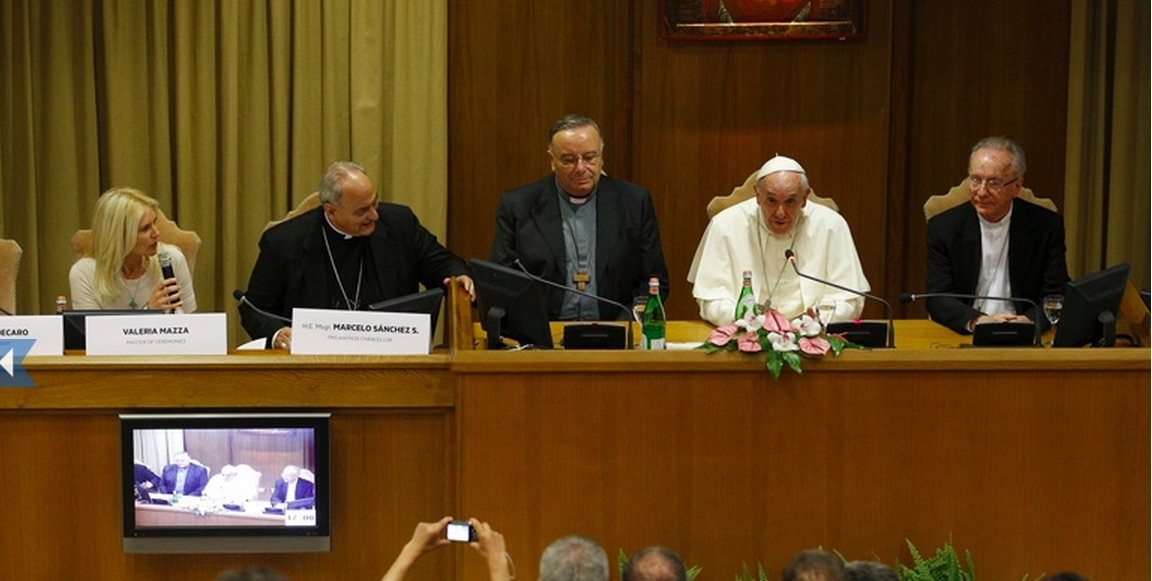
Mayors from around the world meeting at the Vatican this week issued a manifesto that recognized the reality of human-induced climate change and underscored the “moral imperative” for action, both in within their cities and the global community. The two-day summit was held Tuesday and Wednesday [July 21-22] and hosted by the Pontifical Academies of Sciences and Social Sciences. In their joint declaration issued Tuesday, 64 mayors and government officials said they came together in the context of Pope Francis’ encyclical, “Laudato Si’: on Care for Our Common Home,” to discuss issues related to “two dramatic and interconnected emergencies: human-induced climate change and social exclusion in the extreme forms of radical poverty, modern slavery and human trafficking.”

pope
(Photo from Catholic News Service/Paul Haring)

Earlier that day, Francis emphasized to the assembly that his encyclical is not merely a “green” document, but rather “it is a social encyclical.”

“It is true that everything revolves around … this culture of care for the environment. But this ‘green’ culture — and I say that in a positive sense — is much more than that. Caring for the environment means an attitude of human ecology. In other words, we cannot say: the person and Creation, the environment, are two separate entities. Ecology is total, it is human … you cannot separate humanity from the rest; there is a relationship of mutual impact, and also the rebound effect when the environment is abused,” Francis said.

Those attending the Vatican summit presented a cross-section of the globe, with 31 countries represented: among them Argentina, Brazil, Costa Rica, Indonesia, Iran, Ivory Coast, Botswana, Gabon, Italy, Jamaica, Germany, Poland, Sweden, and France — which in Paris will host the U.N. climate summit (COP 21) in December.

Ten U.S. mayors also participated, hailing from Boston, Boulder, Colo.; Birmingham, Ala., Minneapolis, New Orleans, New York City, Portland, Ore., San Francisco, San Jose and Seattle. California Gov. Jerry Brown was also a participant.

In their declaration, the mayors, who joined the pope in signing it, said their cultural traditions each affirmed the beauty of the natural world and the “moral duty to steward rather than ravage” the planet, and committed to developing more sustainable cities that better protect their most vulnerable residents.

Among the declaration’s highlights:

“Human-induced climate change is a scientific reality, and its effective control is a moral imperative for humanity.”

“Today humanity has the technological instruments, the financial resources and the know-how to
reverse climate change while also ending extreme poverty, through the application of sustainable development solutions, including the adoption of low-carbon energy systems supported by information and communications technologies.”

“The financing of sustainable development, including the effective control of human-induced climate change, should be bolstered through new incentives for the transition towards low-carbon and renewable energy, and through the relentless pursuit of peace, which also will enable a shift of public financing from military spending to urgent investments for sustainable development.”

(Article continued in right column.)

Question for this article:

Despite the vested interests of companies and governments, Can we make progress toward sustainable development?

(Article continued from the left column)

The Paris climate talks “may be the last effective opportunity” to negotiate a global agreement to limit human-induced warming below 2 degrees Celsius, and “Political leaders of all UN member States have a special responsibility to agree at COP21 to a bold climate agreement that confines global warming to a limit safe for humanity.”

“The high-income countries should help to finance the costs of climate-change mitigation in low-income countries as the high-income countries have promised to do.

“As mayors we commit ourselves to building, in our cities and urban settlements, the resilience of the poor and those in vulnerable situations and reducing their exposure to climate-related extreme events and other economic, social and environmental shocks and disasters, which foster human trafficking and dangerous forced migration.

“At the same time, we commit ourselves to ending abuse, exploitation, trafficking and all forms of modern slavery, which are crimes against humanity, including forced labor and prostitution, organ trafficking, and domestic servitude; and to developing national resettlement and reintegration programs that avoid the involuntary repatriation of trafficked persons.”

In addition to the declaration, several mayors used the Vatican summit as occasion to announce local plans of action. De Blasio said New York City has committed to reducing its greenhouse gas emissions by 40 percent by 2030 along its way to achieving 80 percent reductions by 2050, a goal he announced in September.

But the purpose of the gathering wasn’t to congratulate one another on their progress, he said, but “to take Laudato Si’ and give it life.”

“Our hope is that each of us — and thousands more like us all over the world — will act boldly, and in doing so, will jolt our national paradigms and the collective global paradigm,” de Blasio said.

Portland Mayor Charlie Hales told NBC News that there was excitement in his city for his Vatican trip, particularly among the young people.

“They say, ‘He’s our pope.’ He’s the ‘Portland pope,’ because his values about the environment and about social justice so closely match the young people who’ve moved to Portland … And they read this document, maybe the first encyclical they’ve ever read, and say, ‘He’s one of us,’” Hales said.

At the summit’s second day, the mayors turned their attention toward city planning that simultaneously promotes economic growth, equality and environmental protection. According to Catholic News Service, many of the mayors discussed the growing number of poor people in their cities and the increasing wealth gap.

“We live in one valley, but two worlds,” said Sam Liccardo, mayor of San Jose, Calif., which sits in the tech capital Silicon Valley, but has witnessed a growing homeless population.

CNS reported that De Blasio asked his fellow mayors why they remained committed to outdated economic growth models when that “model of development is slowly killing us.” He challenged them to create sustainable cities that address poverty while reducing pollution, even when such work becomes uncomfortable.

“By setting the high goal, we actually force ourselves day by day to take action related to it,” de Blasio said.

Women in Israel Fasting to Mark Gaza Anniversary

. . WOMEN’S EQUALITY . .

An article by Rochelle G. Saidel and Sonja M. Hedgepeth, Womens E-News

A group of women from the Women Wage Peace movement in Israel have been holding a vigil outside the prime minister’s residence in Jerusalem since last week, part of their 50-day fast to mark the anniversary of last summer’s Operation Protective Edge in Gaza.

israel-small
Hadar Kluger at the Women Wage Peace tent near the prime minister’s residence in Jerusalem. Credit: Sonja M. Hedgepeth

The group of Israeli Jewish and Arab women are calling upon the government of Israel to return to the negotiating table and initiate a resumption of the peace talks with Israel’s neighbors as the only way to ensure a safe and secure future for today and future generations.

Most of the women are wearing the organization’s white T-shirts with the turquoise and black “Women Wage Peace” logo in Hebrew, Arabic and English.

The women are taking turns fasting, and those who do so are also wearing small turquoise signs around their necks that say “I am fasting.” Every day at 11 a.m. the women ending their fasting period give these tags to the next group of fasting women.

The group’s numbers are hard to know since the fasters come and go. There are at least a couple of dozen and they could number as many as 60.

The movement, which is much larger than those staging this fast, was founded after last summer’s Gaza operation when thousands of Israeli women rose up and said “No more!” They state that their symbolic action is not a protest, but a sign of the support for a creative initiative towards a political self-sustaining agreement.

One participant, Hadar Kluger, told us: “Arab-Israeli women are part of this movement from all over the country and we share a common understanding. We should create an understanding between left, right and center that keeping negotiations and going back to the table is a shared goal. This is the first level. Most people want peace and quiet and this can increase hope.”

The group’s mission statement says its main goals are to influence politicians and opinion makers to work vigilantly towards achieving a political agreement, as well as to give women leadership roles in planning, decision-making and the negotiating process.

Rochelle G. Saidel is founder and executive director of Remember the Women Institute and was named a Women’s eNews 21 Leaders for the 21st Century in 2015. Sonja M. Hedgepeth is a professor at Middle Tennessee State University.

Question for this article

Book review: Voices against Violence

. . WOMEN’S EQUALITY . .

A book review from UN Women

“Voices against Violence” is a co-educational curriculum developed by the World Association of Girl Guides and Girl Scouts (WAGGGS) and UN Women, with inputs from young people. Designed for various age groups ranging from 5 to 25 years, it provides young people with tools and expertise to understand the root causes of violence in their communities, to educate and involve their peers and communities to prevent such violence, and to learn about where to access support if violence is experienced.

WAGGS-ENGLISH

The curriculum includes a handbook for peer educators that will help them deliver age-appropriate sessions, as well as age-appropriate non-formal educational activities. The youngest groups may start out with storytelling and games that prompt them to think about gender bias and stereotypes, while older age groups can organize poster competitions, visit and volunteer with local shelters, or develop local community-based campaigns and projects to address specific forms of violence against girls and women.

“Voices against Violence” is a tool for young people around the world. It can be adapted to national contexts, translated into local languages, and rolled out in schools and communities in partnership with youth organizations, UN partners and governments.

For more information on the curriculum and how to deliver it among children and young people, please visit: Our solutions.

View online/download

Handbook

How to deliver [ en | es | fr ]

Sample activities 

(Thank you to Janet Hudgins, the CPNN reporter for this article.)

(click here for the original article in Spanish)

Question related to this article:

Libro: “Voces contra la Violencia”

. IGUALDAD HOMBRES/MUJERES .

Un libro del ONU Mujeres

“Voces contra la Violencia” es un currículo educativo desarrollado por la Asociación Mundial de las Guías Scouts (AMGS) y ONU Mujeres, con insumos de jóvenes. Es un programa mixto diseñado para distintos grupos de edad que abarcan desde los 5 hasta los 25 años de edad. Brinda a las personas jóvenes herramientas y experiencia para entender las causas profundas de la violencia en sus comunidades, educar e implicar a sus iguales y a las comunidades para prevenir esta clase de violencia, y saber adónde acudir en busca de ayuda en caso de sufrir violencia. 

WAGGS-SPANISH

El programa incluye un Manual para educadores de pares que les ayudará a impartir actividades de educación no formal y sesiones educativas adecuadas a la edad. Los grupos más jóvenes pueden empezar con la narración de historias y juegos que les inciten a pensar sobre los prejuicios y estereotipos de género, mientras que los grupos de mayor edad pueden organizar concursos de carteles, realizar visitas a refugios locales y ofrecerse como voluntarias o voluntarios, o crear campañas y proyectos comunitarios locales para abordar formas específicas de violencia contra las mujeres y niñas.

“Voces contra la Violencia” es una herramienta para personas jóvenes de todo el mundo. Se puede adaptar al contexto nacional, traducir a idiomas locales e implementarse en escuelas y comunidades en colaboración con organizaciones de jóvenes, socios de las Naciones Unidas y gobiernos.

Para obtener más información sobre el currículo y la manera de distribuirlo entre las niñas, los niños y jóvenes, visite: Nuestras soluciones.

Ver en línea/descargar

Manual (en inglés)

Formas de entrega  [ en | es | fr ]

Actividades (en inglés)

( Clickear aquí para la version inglês.)

Question related to this article:

Malala marks 18th birthday by opening school for girl refugees in Lebanon

EDUCATION FOR PEACE .

An article by the United Nations High Commissioner for Refugees

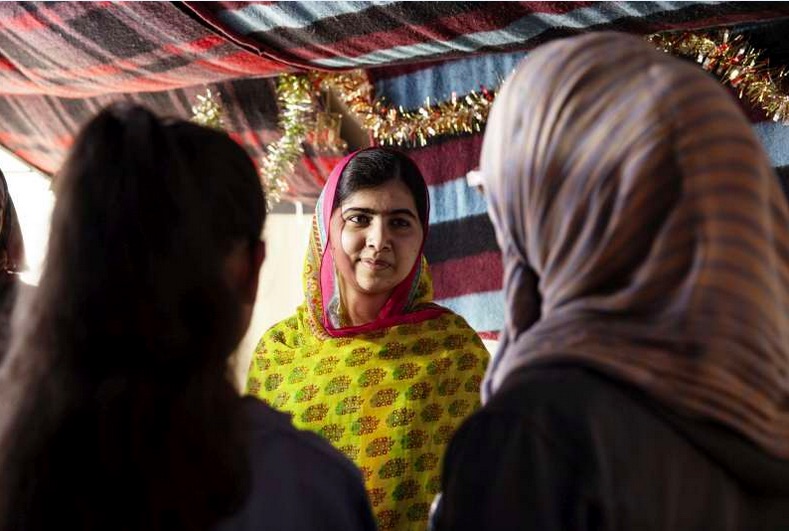
Human Rights Activist and Nobel Laureate Malala Yousafzai has marked her 18th birthday with a renewed commitment to refugees and education by inaugurating a school for more than 200 Syrian girls living in refugee camps in Lebanon’s Bekaa Valley.

Malala
Education activist and Nobel Peace Prize Laureate Malala Yousafzai celebrates her 18th birthday in Lebanon with Syrian refugees. Malala opened a new school in the Bekaa Valley funded by the Malala Fund, the non-profit she co-founded with her father Ziauddin.
©HUMAN for the Malala Fund/M. Fezehai

Opening The Malala Yousafzai All-Girls School on Sunday (July 12), she said: “I am honoured to mark my 18th birthday with the brave and inspiring girls of Syria. I am here on behalf of the 28 million children who are kept from the classroom because of armed conflict. Their courage and dedication to continue their schooling in difficult conditions inspires people around the world and it is our duty to stand by them.”

The UN High Commissioner for Refugees António Guterres welcomed the initiative.
“We are really heartened by Malala’s ardent support for the education of refugee girls whose aspirations have already been so cruelly cut short by war. These children are the future of Syria; we must not jeopardise that by denying them the basic right to education while they are in exile,” he said.

Malala, who was awarded the Nobel Peace Prize in 2014, was attacked in her native Pakistan in 2012 because of her campaign for girls’ rights and education. The new school will offer education and skills training to girl refugees aged 14 to 18.

“Whenever I ask a Syrian refugee child what they would most like to do, the overwhelming response is ‘I want to go to school.’,” Guterres added. “In Malala, we could not have a better advocate for refugee education and are very grateful for her solidarity and support.”

Yousafzai added that she believed world leaders were failing Syria’s children.

“On this day, I have a message for the leaders of this country, this region and the world: ‘you are failing the Syrian people, especially Syria’s children’. This is a heart-breaking tragedy — the world’s worst refugee crisis in decades.”

Lebanon is hosting nearly 1.2 million registered Syrian refugees, though the total number in the country may be even higher.

The influx has placed strains on Lebanon, which has just four million citizens.

UNHCR itself has been awarded the Nobel Peace Prize on two occasions, the last time in 1981.

(Thank you to Janet Hudgins, the CPNN reporter for this article.)

Question for this article:

Bolivia: Mediators are formed in culture of peace

EDUCATION FOR PEACE .

An article by Henry A. Aira Gutiérrez, Correo del Sur (translation by CPNN)

Culture of peace and conflict resolution are new phrases that Bolivians can use to avoid going to court. With the implementation of the new moral codes as of August 6, it is also the expression of the mediators, whose job is to reduce the caseload in the courts for civil and commercial matters. After selection by the Judicial Council, the mediators train for a period of 20 days.

Bolivia
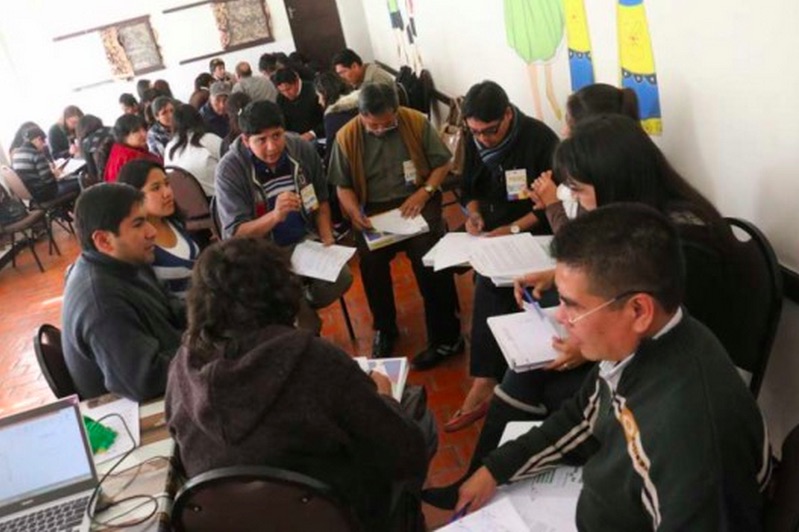
Courses in which mediators learn how to solve conflicts.

In four classrooms at Casa Tréveris, over 150 mediators receive theoretical training and practice in the functions that will serve beginning next month.

“The intensive course is organized into four modules: the first related to justice and human rights, the second dedicated to the culture of peace, conflict theory as a basis for negotiation and conciliation; the third communication and conciliation; and the fourth refers to the process of reconciliation taking into account the principles, models and phases of the facilitative model,” according to Antonio Aramayo, executive director of the UNIR Foundation, the institution in charge of the mediation training.

The new officers are trained in the instruments that will need to apply when they are to reconcile conflicts when the new Codes Morales take effect in August.

The Judiciary Act indicates that the mediation is “the means of conflict resolution and immediate direct access to justice as well as the first procedural action”. In other words, the judicial mediation aims not only to expand access to justice but to introduce the culture of peace and peaceful methods of settling conflicts to shared solutions.

“The culture of peace is a breakthrough in the country and now we are implementing the new codes in practice for the resolution of disputes through conciliation. This is good, creating a culture of peace and a country not of confrontation, but of rapid resolution of conflicts,” said Patricia Yufra, from the mediation district of Quillacollo (Cochabamba).

“We are learning how to reconcile, to look beyond the law, to analyze problems so that they (people in conflict) can resolve their conflicts and disputes peacefully and maintain their human relationships,” said Erick Suarez, Santa Cruz conciliator.

These two professional lawyers are, like many others, being trained and expected to return to their districts on August 7 to start their work.

(click here for the French version) of this article or here for the Spanish version

Question for this article:

Bolivia: Los conciliadores se forman a contrarreloj en cultura de paz

. . EDUCACIÓN PARA LA PAZ . .

Un artículo de Henry A. Aira Gutiérrez, Correo del Sur

Cultura de paz y resolución de conflictos son frases a las que tendrán que acostumbrarse los bolivianos para no llegar a los tribunales. Dentro de la implementación de los nuevos Códigos Morales, a partir de este 6 de agosto, está también la figura de los conciliadores, que tienen por objeto reducir la carga procesal en materia civil y comercial. Tras su selección por el Consejo de la Magistratura, corre su capacitación por el lapso de 20 días.

Bolivia
Conciliadores reciben insumos de docentes para solucionar conflictos.

En cuatro aulas de la Casa Tréveris, los más de 150 conciliadores reciben capacitación teórico práctica en la función que cumplirán desde el siguiente mes.

“El curso intensivo está organizado en cuatro módulos: el primero relacionado con la justicia y derechos humanos, el segundo dedicado a la cultura de paz, teoría del conflicto y negociación como base de la conciliación; el tercero de comunicación y conciliación; y el cuarto referido al proceso de la conciliación tomando en cuenta sus principios, modelos y fases del modelo facilitativo”, explicó Antonio Aramayo, director ejecutivo de la Fundación UNIR, institución a cargo de la formación de los conciliadores.

Los nuevos funcionarios se capacitan en instrumentos que tendrán que aplicar cuando les corresponda conciliar las controversias de las personas, esto desde el mes de agosto, cuando la que entrarán en vigencia los nuevos Códigos Morales.

La Ley del Órgano Judicial indica que la conciliación es “el medio de solución inmediata de conflictos y de acceso directo a la justicia, así como la primera actuación procesal”. Es decir, la conciliación judicial tiene como finalidad no sólo ampliar el acceso a la justicia sino introducir la cultura de paz, métodos pacíficos de arreglo de conflictos para soluciones compartidas.

“La cultura de paz es un avance en el país y ahora lo estamos implementando con los nuevos códigos que en la práctica es la resolución de las controversias a través de la conciliación, esto es bueno, crear la cultura de paz y no ser un país de enfrentamiento, sino de resolución rápida”, manifestó Patricia Yufra, conciliadora del distrito de Quillacollo (Cochabamba).

“Estamos aprendiendo a conciliar, ver más allá de la ley, que analicemos sus problemas y que ellos mismos (personas en conflicto) resuelvan sus conflictos y controversias en paz y mantener las relaciones humanas”, acotó Erick Suárez, conciliador por Santa Cruz.

Así como estos dos profesionales abogados, muchos son capacitados y esperan volver a sus distritos el 7 de agosto para comenzar su trabajo.

( Clickear aquí para la version francês o aquí para la version inglês.)

Question for this article:

Bolivie: Les médiateurs sont formées dans la culture de la paix

. . EDUCATION POUR LA PAIX . .

Un article de Henry Aira A. Gutierrez, Correo del Sur

Culture de la paix et la résolution des conflits sont des phrases que les Boliviens devons utiliser à ne pas atteindre les tribunaux. Dans la mise en œuvre des nouveaux codes moraux de cette Août 6, il est aussi la figure des médiateurs, qui visent à réduire la charge de travail des courts de justice en matière civile et commerciale. Après sélection par le Conseil de la magistrature, Ils prennent une formation pour une période de 20 jours.

Bolivia
Les animateurs reçoivent l’instruction d’enseignants pour résoudre les conflits.

Dans quatre salles de classe à la Casa Tréveris, plus de 150 médiateurs reçoivent une formation pratique et théorique dans la fonction qu’ils vont utiliser dès le mois prochain.

“Le cours intensif est organisé en quatre modules: le premier se concerne la justice et les droits de l’Homme, la seconde est dédiée à la culture de la paix, la théorie du conflit comme une base de négociation et de médiation; la troisième, communication et médiation; et le quatrième se réfère au processus de réconciliation en tenant compte des principes, des modèles et des phases du modèle de facilitation », a déclaré Antonio Aramayo, directeur exécutif de la Fondation UNIR, une institution chargée de la formation des médiateurs.

Les nouveaux agents sont formés dans des instruments qu’ils doivent appliquer aux controverses de personnes, à partir de Août, quand ils entreront en vigueur les nouveaux codes Morales.

La loi sur la magistrature indique que la médiation est «le moyen de résolution des conflits et l’accès direct et immédiat à la justice ainsi que la première action de procédure”. Autrement dit, la médiation judiciaire vise non seulement à élargir l’accès à la justice, mais d’introduire la culture de la paix, les méthodes pacifiques de règlement des conflits à des solutions partagées.

“La culture de la paix est une percée dans le pays et maintenant nous mettons en œuvre les nouveaux codes en pratique pour la résolution des différends par voie de médiation, ce qui est bon, de créer une culture de paix et un pays qui n’est pas de confrontation, mais de la résolution rapide», a déclaré Patricia Yufra, district conciliante Quillacollo (Cochabamba).

“Nous apprenons à concilier, à regarder au-delà de la loi, d’analyser leurs problèmes pour qu’ils (les gens en conflit) pouvoir résoudre leurs conflits et différends pacifiquement et maintenir des relations humaines”, a dit Erick Suarez, médiateur de Santa Cruz.

Comme ces deux avocats professionnels, beaucoup sont formés et devraient retourner à leurs quartiers le 7 Août pour commencer leur travail.

(cliquez ici pour la version anglaise de cet article ou ici pour la version espagnole.)

Question pour cet article:

What are the methodologies for a culture of peace?

Journée Nelson Mandela : l’ONU appelle à prendre ‘Madiba’ en exemple pour bâtir un monde meilleur

. PARTICIPATION DÉMOCRATIQUE .

Un article par le Centre d’Activités de l’ONU

A l’occasion de la Journée internationale consacrée à Nelson Mandela [18 juillet], le Secrétaire général des Nations Unies, Ban Ki-moon, a appelé les gens du monde entier à prendre exemple sur la foi inébranlable en la justice dont a fait preuve, tout au long de sa vie, le leader sud-africain décédé en 2013, pour tenter de construire un monde meilleur pour tous.
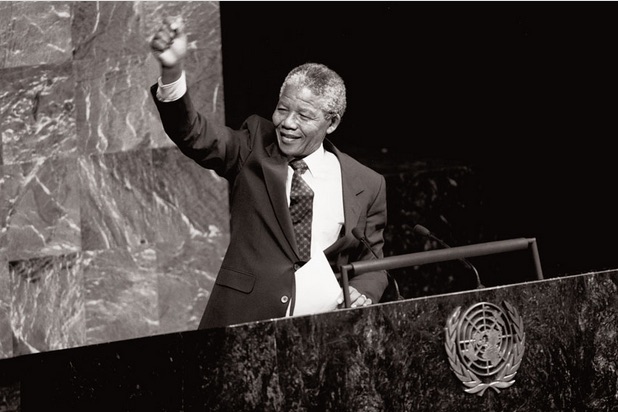
mandela
Photo ONU/Pernaca Sudhakaran

« La Journée internationale Nelson Mandela est chaque année l’occasion d’encourager chacun, partout dans le monde, à influer sur le cours des choses dans sa collectivité en prenant le temps de servir les autres », a déclaré le chef de l’ONU dans un message.

Le thème retenu pour cette journée, ‘Agissez ! Incarnez le changement’, rappelle à quel point il importe de travailler tous ensemble pour bâtir un monde paisible, viable et équitable, a poursuivi le Secrétaire général.

Pendant 67 ans, Nelson Mandela a mis sa vie au service de l’humanité, en tant qu’avocat spécialiste des droits de l’homme, prisonnier de conscience, architecte international de la paix et premier Président démocratiquement élu d’une Afrique du Sud libre.

En novembre 2009, l’Assemblée générale des Nations Unies a proclamé le 18 juillet Journée internationale Nelson Mandela, en l’honneur de la contribution apportée par l’ex-Président sud-africain à la culture de la paix et de la liberté.

« Nelson Mandela a consacré 67 années de sa vie à la lutte pour les droits de l’homme et la justice sociale. Les Nations Unies se joignent à la Fondation Nelson Mandela pour demander aux personnes du monde entier de consacrer au moins 67 minutes de leur temps à une activité d’intérêt général le 18 juillet, date de la naissance de Madiba », a appelé M. Ban.

Le Secrétaire général a souligné que le soixante-dixième anniversaire de l’ONU, cette année, offre le moment le plus opportun pour réfléchir à la vie et à l’œuvre de M. Mandela, qui a incarné « les plus hautes valeurs de l’Organisation ».

Aussi, pour cette édition 2015, les Nations Unies décerneront le tout premier Prix Nelson Rolihlahla Mandela, institué par l’Assemblée générale en 2014. Cette distinction honorifique sera accordée tous les cinq ans à deux personnes, un homme et une femme, qui, par leur dévouement, leurs efforts et leur compassion, ont poursuivi la voie tracée par le leader sud-africain.

« Nelson Mandela disait qu”il vous appartient de bâtir un monde meilleur pour tous ceux qui l’habitent’. Continuons donc à nous inspirer chaque jour de l’exemple que ce meneur d’hommes, motivé par une foi inébranlable en la justice et l’égalité pour tous, a donné tout au long de sa vie, et de son appel à toujours nous efforcer de bâtir un monde meilleur pour tous », a déclaré M. Ban.

La cérémonie de remise du Prix des Nations Unies Nelson Rolihlahla Mandela aura lieu le 24 juillet, parallèlement à l’évènement annuel commémorant la Journée, dans la Salle du Conseil de tutelle au siège des Nations Unies à New York.

(Cliquez ici pour l’article en anglais ou ici pour l’article en espagnol. )

Latest Discussion

What is the legacy of Nelson Mandela for us today?

Comment by Rama Singh posted: Dec. 31 2013

ON MANDELA’S LASTING LEGACY

In death, as in his life, Nelson Mandela has captured the imagination of the world. Mourning mixed with celebration has electrified crowds all over South Africa and elsewhere. His life’s achievements and his lasting legacy are the topics of discussions. He has been described as a great warrior, a great liberator, the last giant in the fight against colonialism, forgiver, peace maker, and in many other ways.

All this week, Mandela’s lasting legacy has been on my mind. We tend to capture the legacies of great men and women in a word or two. A scientist becomes famous for an important discovery, a writer for a famous book, a musician for a great composition, and so on.

People like Mandela fall in a different category. He is in the category of Mahatma Gandhi and Dr. Martin Luther King. They are known for their fights on behalf of oppressed people; they are known for their personal sacrifice, and for their moral authority. If we are to look for words to associate with these men, it will be “nonviolence” for Gandhi and “love’ (beloved community) for Dr. King. But what about Mandela- how will we describe his legacy?

What were the important transformational changes in Mandela’s life?

Mandela the great warrior: Mandela has been described as a great warrior, but he was no ordinary warrior. All legendary warriors, mythical or real, are known for the destruction of their enemies. Mandela was different; he did not seek annihilation of his enemy; he transformed his enemy into his collaborator.

Mandela the resilient sufferer: I know of no other person living or dead who was forcefully made to disappear from the scene for this long (incarceration for 27 years) and who survived and made his triumphatic return. Gandhi said there is no other way to show your love for the suffering of your loved ones than to suffer yourself with them, for them. Mandela suffered the longest because his work was the hardest.

Mandela the great liberator: Colonial rulers are known for their ruthless treatment and putting down of citizens but South Africa was not a typical colonial rule. The rulers were Afrikaners, citizen of South Africa. I know of no other country, outside of the United States, where the blacks were so harshly treated by another segment of their own country. It was a true liberation. Thanks to Mandela, sad songs of seeking freedom through death were transformed into freedom in life.
Mandela the magnanimous forgiver: Gandhi’s nonviolence is a complete philosophy of life and it includes love of your enemy and forgiveness. Nonviolence had to be tested to show that it works and that it’s not just a philosophy. Dr. King tested nonviolence with his own suffering and love for his people. His passion for his “beloved community” became the brand of his civil rights struggle for which he paid with his own life. As Gandhi said, the only two places of non-action for such fighters are prison or death. Mandela went to prison, suffered longer, and tested his resolve to forgive his “enemy”. We can only imagine the blood bath had he not done that.

Mandela the peace maker: Gandhi, Dr. King and Mandela, together, constitute a shining trinity of peace and their contributions, respectively, nonviolence, love, and forgiveness provide a prescription for peace if the humankind needs to survive. Truth and Reconciliation will remain one of Mandela’s brilliant and innovative contributions for healing wounds between warring people, warring nations. Gandhi, King and Mandela, all tested nonviolence in their own way and they all came out with the same result: The path of peace and liberation goes through love, suffering, and forgiveness.
Mandela the spiritual father: We go through life with two sets of parents. Our own parents, of course, who brought us in this world, whom we owe our life, body and brain, whom we remain eternally grateful for their sacrifice and care to help us grow and to teach us how to live.

There are another set of parents, for a lack of a better word we can call them our “spiritual parents”. These are men and women whom the whole humanity owes gratitude because it is their discoveries, contributions and, teachings that we like fill our brain with, they make us human- kinder, gentler, and humane.

We call ourselves human because we made a pledge with destiny that we will become humane. It has been a long and arduous journey. With his love, suffering and forgiveness, Mandela has brought us further on the path and has warned we still have a long way to go.

Gandhi-King-Mandela, or Mohan, Martin and Matiba, are angels of peace. We are their descendents, the keepers of their dreams.

Rama Singh, is a professor in the department of biology, and member, Coordinating Council, Centre for Peace Studies, McMaster University.

This appreciation was originally published in the Hamilton Spectator in Canada.