Category Archives: global

Strong outcome of 1st Review Conference of Convention on Cluster Munitions 

DISARMAMENT AND SECURITY ..

An article from Artistes pour la Paix

The 1st Review Conference of the Convention on Cluster Munitions is wrapping up in Dubrovnik, Croatia. For the most part, this meeting has been full of good news. Colombia ratified the Convention, Cuba issued a surprise announcement that it is working towards joining the treaty as well and a number of states announced that they have finished destroying their stockpiled cluster munitions. These successes show that the treaty is working and the norm against cluster munitions is growing.

minesaction

Amidst all this success, Canada joined the United Kingdom and Australia in an attempt to weaken the norm against cluster munitions by objecting to the Dubrovnik Declaration‘s condemnation of all use of cluster munitions. For these three states, the idea that they would have to condemn all use of cluster munitions was not acceptable despite being states parties to a treaty banning cluster munitions. Mines Action Canada staff and campaigners from around the world in partnership with friendly governments lobbied hard for the declaration to stay strong. In the high level discussion state after state took the floor in support of a strong declaration condemning all use of cluster munitions.

Again and again states passionately defended the Declaration as it was and to reaffirm that any use of cluster munitions by any actor was unacceptable. In the end, the Declaration was adopted without amendment. We were thrilled to see our hard work pay off. The norm against use remains strong and so does the Convention on Cluster Munitions.

We were able to prevent Canada, the UK and Australia from weakening the declaration this time but we need your support to ensure that we will be ready next time someone threatens the norm against these inhumane weapons.

Mines Action Canada [info@minesactioncanada.org] would appreciate your support

Their site contains the following crucial information:

151 financial institutions worldwide invested US$27 billion [27 milliards de $!] in companies producing cluster munitions from 2011 to 2014, according to a report launched by Dutch peace organization PAX. The report, “Worldwide Investments in Cluster Munitions: a shared responsibility,” details the scale of investment in companies producing this banned weapon by banks, pension funds and other financial institutions around the world. Two Canadian financial institutions were singled out for their investment in cluster munition production in the report’s Hall of Shame.

While Canada and the majority of states have banned cluster munitions due to the humanitarian risk to civilian populations, production of the weapon continues in a limited number of countries yet to join the 2008 Convention on Cluster Munitions.

(Article continued in right column)

Question related to this article:

Can cluster bombs be abolished?

(Article continued from left column)

“Cluster munitions are currently killing civilians in Syria and eastern Ukraine and they continue to claim lives in Laos fifty years after they were used. Yet financial institutions have invested US$27 billion—more than twice the GDP of Laos—in producers of this inhumane weapon. Canada has banned cluster munitions and during the lengthy discussions about the legislation government officials and parliamentarians frequently stated that investment in cluster munition producers is in fact considered aiding in their production and is illegal,” said Paul Hannon, Executive Director.

The new report from PAX shows which financial institutions have invested in cluster munition producers between June 2011 and September 2014. The report’s “Hall of Shame” shows the majority of investments come from financial institutions in states that have not yet joined the Convention on Cluster Munitions. Yet financial institutions from countries like Canada that have joined the treaty are also still involved.

Royal Bank of Canada and Sun Life Financial appear on the “Hall of Shame” list for their investments in cluster munition producers. These investments are falling foul of the treaty’s prohibition on assistance in the production of the weapon and of the recently passed legislation implementing the Convention in Canada which criminalizes aiding and abetting cluster munition production.

“Cluster munitions are banned by international law; a majority of the countries in the world has recognised that this weapon is unacceptable. And yet cluster munition producers are still able to fund their activities. Financial institutions should introduce robust policies to ensure they are not supporting companies involved in the production of this banned weapon,” said Suzanne Oosterwijk, co-author of the PAX report.

While the number of financial institutions investing in companies producing cluster munitions remains high, the report shows an increase in financial institutions with policies to prohibit this practice. Seventy-six financial institutions are listed in the 2014 report as having cluster munition policies in place.

Recent use of cluster munitions in Syria and eastern Ukraine further demonstrates the urgent need to eradicate this weapon. Last month Cluster Munition Coalition member Human Rights Watch documented widespread use of cluster munitions in eastern Ukraine, in fighting between government forces and pro-Russian rebels. In Syria, civilians account for 97% of recorded deaths where cluster munitions have been used over the past two and a half years.

This report follows a similar report released by PAX on investment in nuclear weapons. The Don’t Bank on the Bomb report found that numerous Canadian financial institutions are investing in nuclear weapons production [La Financière Sun Life en tête]. Mines Action Canada calls on all Canadian financial institutions to adopt strong policies prohibiting investment in banned and indiscriminate weapons.

(Thank you to Janet Hudgins, the CPNN reporter for this article)

Third Regional Conference “Latin America on the quest for sustainable peace: tools and contributions”

.. EDUCATION  FOR PEACE ..

Convocation from Congress blogspot (translated by CPNN)

The Latin American Council for Peace Research (CLAIP), the Latin American Faculty of Social Sciences (FLACSO), and the Association against trafficking of children and women (ECPAT / Guatemala) announce the Third Regional Conference “Latin America on the quest for sustainable peace: tools and contributions” to be held in the Academic headquarters of FLACSO in Guatemala City from 26 to 28 October 2015.

CLAIP

Objective: To reflect on building a sustainable peace in Latin America, even in contexts of conflict and generalized violence, exchange new approaches to peacebuilding and the challenges we must overcome to achieve it.

Target audience: teachers, researchers, students, professionals and scholars from multiple disciplines who are interested in research and / or work on these issues in the region.

THEMES:
1. Peace and Education
2. Peace and Environment
3. Peace instead of urban violence
4. Human and gender security, development and peace
5. Democracy, Public Policy and Citizenship Building

The themes of Dialogue, Peaceful Conflict Resolution, Gender, Equity and Intercultural issues are transverse to the preceding 5 themes.

METHODOLOGY OF THE CONFERENCE:

Keynote speakers: members of CLAIP FLACSO and ECPAT.

Thematic tables: The participants will present papers approved in the relevant thematic working groups, which will be coordinated by specialists of CLAIP-ECPAT-FLACSO.

Mail Contact: claip.congreso2015@gmail.com

NOTES:

Congress languages: Castilian and Portuguese, no translation

Lodging: each must manage and make their own reservations. FLACSO is in Zone 10 of the city and it is advisable to stay in that same area. More information.

As in previous years, we plan to publish a new book by CLAIP with selected papers at the Conference. More details will be published later.

For further information consult the Congress blog or our Facebook page.

(Click here for a Spanish version of this article)

Question related to this article:

Hundreds of women trade unionists gather for world conference in Vienna

. . WOMEN’S EQUALITY . .

An article from industri-all global union

Some 300 women trade unionists from over 60 countries are gathering in Vienna, Austria for IndustriALL Global Union’s first-ever Women World Conference.

new women

The inaugural event, hosted by Austrian trade union PRO-GE, takes place from 14 to 16 September in the capital.

Austria’s President, Dr. Heinz Fischer, will address the opening ceremony, together with the minister for health, Sabine Oberhauser, the minister for labour, Rudolf Hundstorfer and the secretary of state, Sonja Stessl.

IndustriALL Global Union, which represents 50 million workers in the metal, chemical, energy, mining, textile and related industries, is bringing together women trade unionists from across five continents to address some of the issues most affecting women in the workplace.

“Vienna has opened its arms to our trade union colleagues and we are delighted to welcome so many women to Austria for IndustriALL’s first World Women Conference. It promises to be a lively and informative conference from which we will emerge stronger and better equipped to improve the lives of women through the trade union movement,” said IndustriALL’s assistant general secretary Monika Kemperle.

A key theme of the conference will be unions’ role in preventing violence against women, with a new campaign launched on the occasion. Gender-based violence and discrimination whether at work or not, limits women’s potential at work and is therefore a trade union issue.

Women panelists from countries as diverse as Australia, Colombia, Iraq, Myanmar, the Ukraine and South Africa, will be sharing their experiences and expertise in improving health and safety, increasing maternity protection, preventing HIV/AIDS, building membership, fighting precarious work, ending gender discrimination, and achieving a work/life balance, among other topics.

An Equality Charter advocating women’s rights will be proposed for adoption at the Conference. Trade unions, especially in male-dominated sectors, have not always been inclusive of women or taken their concerns seriously.

Participants will also be examining IndustriALL’s own leadership structures with a motion to increase women’s representation from 30 to 40 per cent.

The event is due to be streamed live on www.industriall-union.org and can be followed on twitter at @IndustriALL_GU and #WWCVienna.

For more information, please contact Leonie Guguen, Communications Officer at IndustriALL Global Union. Email: lguguen@industriall-union.org. Tel: +41 (0)79 137 54 36.

(Thank you to Janet Hudgins, the CPNN reporter for this article.)
(Click here for a Spanish version of this article or here for a French version)

Question for this article:

Peace ‘a distant dream’ without development, UN high-level forum told

FREE FLOW OF INFORMATION

An article from The UN News Centre

United Nations officials today [9 September] shared a common message that building a culture of peace means not just ending conflict but building inclusive societies that are able to develop and thrive in the absence of discrimination.

unforum
Ambassador Einar Gunnarsson of Iceland. UN Photo/Mark Garten

“Today’s discussion is an opportunity to focus on what we need to do on our pathway to a new and prosperous future for all,” said Ambassador Einar Gunnarsson of Iceland, speaking on behalf of the President of the General Assembly, at the High-level Forum on a Culture of Peace.

“Experience has shown us that peace is not simply the absence of conflict,” he stated. “Peace requires equitable societies, inclusive education and tangible actions on the ground.

“More importantly, peace is a distant dream without development. This is part of the core challenge in promoting a culture of peace and ensuring peaceful societies.”

Mr. Gunnarsson also spoke of the need to create a national community to promote dialogue, enhance respect for religious and cultural diversity, and eliminate all forms of discrimination and intolerance, while developing policies to promote peace, security, the rule of law and democratic decision-making.

Today’s event was designed to highlight the importance of implementation of the Declaration and Programme of Action on a Culture of Peace that the Assembly adopted in September 1999 and the need to further strengthen global movements to promote a culture of peace.

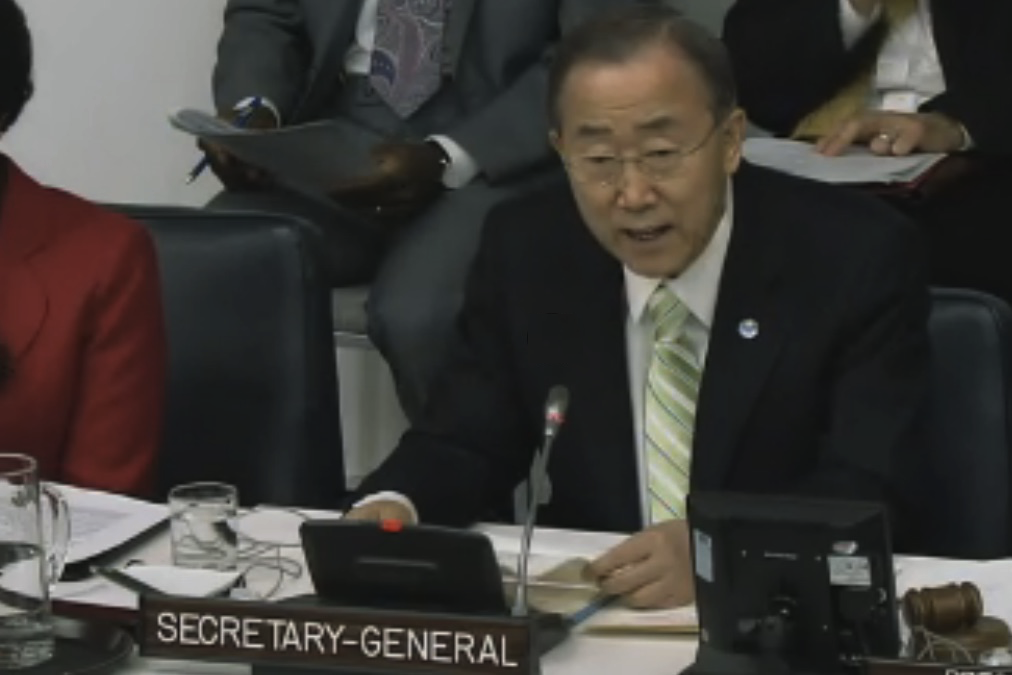
Secretary-General Ban Ki-moon shared his thoughts on how to bring about a culture of peace, highlighting humanitarian crises around the world and violations of international human rights laws.

“Today’s meeting is about the very hard truths in our world,” he said, “where people are suffering and dying from violence and atrocity crimes.”

“Syria is the world’s worst humanitarian crisis today,” he said. “I have condemned the parties – especially the Government – for reported grave violations of human rights and international humanitarian law that may amount to war crimes and crimes against humanity.”

As well as speaking about war-torn regions, Mr. Ban noted: “Even in mostly peaceful, democratic societies, minorities are attacked for their race, sexual orientation or some other difference – when they should be embraced for our common humanity.”

He also paid tribute to those countries, communities and people who had shown compassion, rather than xenophobia and discrimination.

“We cannot build a culture of peace without an active campaign against division and injustice,” said Mr. Ban. “To be more than just soothing words, the culture of peace demands courageous practice.”

Arun Gandhi, a grandson of the late Mahatma Gandhi, delivered the keynote address at the meeting, and shared some of the knowledge he said he had gathered from one of the great leaders of the Indian independence movement.

“What I learned from grandfather is that each one of us contributes to violence all the time. Many times in ways we don’t even know and recognize,” he said. “Unless we individually transform ourselves and accept a non-violent way of life, we cannot create peace in the world today.”

He said that, in the words of his grandfather, “we must become the change we wish to see in the world,” adding that “unless we change ourselves and our attitudes, we are not going to be able to change the world at all.”
for the world we want.

(Click here for a version of this article in French

Question related to this article:


Can the UN help move the world toward a culture of peace?

The following comes from the CPNN Coordinator’s blog of October 2012

The United Nations and the Culture of Peace

My ten years working in the United Nations system left me with a sweet and sour taste: the sweet side was the universality of the UN, both its staff and mandate, and its great significance for raising the consciousness of the peoples of the world; the sour side was the jealousy of the Member States who make sure that the UN does not encroach on their freedom to rule over their own citizens, as well as people in other countries that they may dominate through neo-colonial relations. This became crystal-clear to me when the United States delegate, during the informal meetings of the UN General Assembly in 1999, opposed the Declaration and Programme of Action on a Culture of Peace, saying that it would make it more difficult for them to start a war. In fact, throughout history, war (call it “defense” if you prefer) has always been the most fundamental “right” of the state

With this in mind, I have been pleasantly surprised by the extent to which the UN system has once again taken up the culture of peace as a priority, as shown in this month’s CPNN bulletin, just as it was a priority in the Year 2000 when I was the director of the UN International Year for the Culture of Peace

Of course, this does not happen by chance, and great credit belongs to two men who played key roles for the Year 2000, Federico Mayor Zaragoza, who made the culture of peace a priority of UNESCO, and Anwarul Chowdhury, who played the role of midwife at the UN General Assembly, guiding the culture of peace resolution through nine months of opposition by the powerful states. Once again, this last month, these two men motivated and spoke eloquently at the High Level Forum on a Culture of Peace at the UN

As always it was the countries of the South who supported the initiative (see the CPNN article of September 24 and its discussion), but at least this month it was not blocked by the powerful states

In fact, it is my impression that the powerful states pay less and less attention to the United Nations. When there was a financial crisis a few years ago, the powerful states did not turn to the UN agencies , the World Bank and the International Monetary Fund, but set up their own temporary system of finance ministers, and when it came time for the review of nuclear non-proliferation, President Obama held his own meeting with heads of state in Washington and ignored the UN conference where the only head of state to speak was that of Iran. And the US has pulled out of UNESCO entirely, forcing drastic cuts in its budget

In fact, the lack of attention by the powerful states may provide the UN system with an opportunity to push the agenda of the culture of peace without their opposition – let us hope that the UN can take advantage of this

Of course, in the long run, the UN, or any other institution, cannot mandate a culture of peace; instead, the culture of peace can only grow from the consciousness, both understanding and action, of the peoples of the world (see last month’s blog below). That’s why the role of the UN for consciousnes-raising is ultimately its greatest contribution!

Islamic Declaration Turns Up Heat Ahead of Paris Climate Talks

. . SUSTAINABLE DEVELOPMENT . .

An article by Kitty Stapp, Inter Press Service (reprinted by permission)

Following in the footsteps of Pope Francis, who has taken a vocal stance on climate change, Muslim leaders and scholars from 20 countries issued a joint declaration Tuesday [August 18] underlining the severity of the problem and urging governments to commit to 100 percent renewable energy or a zero emissions strategy.

islamic
Mohammed Rashid Qabbani, the Grand Mufti of Lebanon, was one of the signers of the Islamic Declaration on Climate. Credit: kateeb.org

Notably, it calls on oil-rich, wealthy Muslim countries to lead the charge in phasing out fossil fuels “no later than the middle of the century.”

The call to action, which draws on Islamic teachings, was adopted at an International Islamic Climate Change Symposium in Istanbul.

“Our species, though selected to be a caretaker or steward (khalifah) on the earth, has been the cause of such corruption and devastation on it that we are in danger ending life as we know it on our planet,” the Islamic Declaration on Climate statement says.

“This current rate of climate change cannot be sustained, and the earth’s fine equilibrium (mīzān) may soon be lost…We call on all groups to join us in collaboration, co-operation and friendly competition in this endeavor and we welcome the significant contributions taken by other faiths, as we can all be winners in this race.”

The symposium’s goal was to reach “broad unity and ownership from the Islamic community around the Declaration.”

Welcoming the declaration, UNFCCC Executive Secretary Christiana Figueres said, “A clean energy, sustainable future for everyone ultimately rests on a fundamental shift in the understanding of how we value the environment and each other.

“Islam’s teachings, which emphasize the duty of humans as stewards of the Earth and the teacher’s role as an appointed guide to correct behavior, provide guidance to take the right action on climate change.”

Supporters of the Islamic Declaration included the grand muftis of Uganda and Lebanon and government representatives from Turkey and Morocco.

The UNFCCC notes that religious leaders of all faiths have been stepping up the pressure on governments to drastically cut carbon dioxide emissions and help poorer countries adapt to the challenges of climate change, with a key international climate treaty set to be negotiated in Paris this December.

In June, Pope Francis released a papal encyclical letter, in which he called on the world’s 1.2 billion Catholics to join the fight against climate change.

The Church of England’s General Synod recently urged world leaders to agree on a roadmap to a low carbon future, and is among a number of Christian groups promising to redirect their resources into clean energy.

Hindu leaders will release their own statement later this year, and the Buddhist community plans to step up engagement this year building on a Buddhist Declaration on climate change. Hundreds of rabbis released a Rabbinic Letter on the Climate Crisis.

The Dalai Lama has also frequently spoken of the need for action on climate change, linking it to the need for reforms to the global economic system.

Interfaith groups have been cooperating throughout the year. The Vatican convened a Religions for Peace conference in the Vatican in April, and initiatives such as our Our Voices network are building coalitions in the run-up to Paris.

Reacting to the Islamic Declaration, the World Wildlife Fund’s Global Climate and Energy Initiative Head of Low Carbon Frameworks, Tasneem Essop, said, “The message from the Islamic leaders and scholars boosts the moral aspects of the global climate debate and marks another significant display of climate leadership by faith-based groups.

“Climate change is no longer just a scientific issue; it is increasingly a moral and ethical one. It affects the lives, livelihoods and rights of everyone, especially the poor, marginalised and most vulnerable communities.”

(Thank you to Janet Hudgins, the CPNN reporter for this article.)
Question for this article:

Global Feast for Peace, held annually during Peace Week, Sept. 15-21

DISARMAMENT & SECURITY .

An article from the International Cities of Peace

International Day of Peace, September 21st of each year, was created by a United Nations Resolution in the 1980s and has grown to become a day of global celebration, education, and reflection on peace in local communities and throughout the world. During Peace Week, Sept. 15-21, families, friends, organizations, as well as cities, towns, and villages across the world gather and break bread together in a Global Feast for Peace.

Arment

ADD YOUR CITY TO THE MAP OF CITIES HAVING A FEAST FOR PEACE!

Sharing food together in celebration of friendship and common interest is a tradition as old as the human family. The Global Feast for Peace is part of the U.N. sponsored International Day of Peace, celebrated around the world on September 21st each year. Whether it’s a small family celebration or a large community gathering, the Feast for Peace is a simple and profound expression of peace that everyone, no matter how humble or blessed their circumstances, can connect with and enliven the global celebration. Feast for peace!

Who can participate?

• Families, neighborhoods, communities, and cities
• Organizations, including faith-based, interfaith and secular
• Businesses, both for-profit and not-for-profit
• Schools from nursery schools to higher education
• Anyone who wishes to express their wish for peace

What to do?

Join together during International Day of Peace or during Peace Week. The gathering can be a formal lunch or a group potluck where people bring a dish and share. Other events can be planned before, during, and/or after the Global Feast, including bell ringing, speakers, musical events, meditations and prayers, moments of silence and other activities that foster a culture of peace.

When to celebrate and plan?
Each year, there are thousands of celebrations around the world. Planning for the Global Feast should begin weeks or, better, several months ahead in order to involve as many people as possible.

Where to have the Feast?
The place for the Feast can be as small as a family dining room or as large as an amphitheater. One person can even Feast for Peace at home!

Why plan a Global Feast?
To come together as members of the human family; to honor those who have worked and who are working today for a more peaceful world; to encourage the next generation of peacebuilders. The Global Feast for Peace is a thanksgiving of the peace we have and to inspire actions to foster a culture of peace during the coming year.

To Register Your Event:
Send info to: story@internationalcitiesofpeace.org
Join our Facebook Page: https://www.facebook.com/pages/Global-Feast-for-Peace/490665730993992

Initiated by members of the Peace Cities Subcommittee of the IDP NGO for United Nations International Day of Peace.

Question for this article:

Curitiba, Brazil: Military police discuss culture of peace

DISARMAMENT & SECURITY .

Un article from the Instituto Mundo Melhor (translation by CPNN)

On 25 August, the Instituto Mundo Melhor (IMM) brought together police officers from Curitiba to discuss the culture of peace. The activities put an emphasis on values ​​education and pedagogy of coexistence. The project involved about 30 professionals from the 12th and 13th Battalions of the Paraná Military Police and trained police officers from the Units of Paraná Seguro.

curitiba

The President of the IMM, Jeroslau Pauliki, commented on the pilot experience of working with public outside the areas of education, welfare and health in which they already have expertise. “This pioneering initiative brings us to an important reflection. Even if their professions are diametrically opposed, the work environment, their conflicts and challenges are similar in many ways and this contributes to an open discussion and development for all,” he said.
 
The initiative is evaluated favorably by the commander of the 12th Battalion, Colonel Antonio Zanatta Neto. “It is an excellent opportunity to integrate the military police in society and to seek new knowledge. Our expectations are good, because I know the platform crafted by the IMM. The contents have been adapted to the military police and we are the pioneers. We want to break paradigms and further advance community policing and citizen services, “he added.
 
The next meeting of Education for Peace by the IMM with the 12th Military Police Battalion will take place on September 16. In all, there will be four meetings. The contents will be taught by the Center for Studies and Teacher Training in Education for Peace and Coexistence of the Ponta Grossa State University.

(Click here for the original version in Portuguese)

Questions for this article:

The Elders urge world leaders to take bold and decisive action on climate in 2015

. . SUSTAINABLE DEVELOPMENT . .

A press release from The Elders

Ahead of the UN Sustainable Development Goals summit, The Elders call on world leaders to agree on a common approach that yields a “radical and sustainable” plan to tackle climate change.

elders

In a letter to heads of state and government attending the launch of the new UN Sustainable Development Goals in New York on 26 September, The Elders told leaders:

“2015 is the year in which the community of nations will conclude two of the most important international processes of our times […] You have a decisive role to play in charting the course of history.”

The Sustainable Development Goals are the successors to the UN’s Millennium Development Goals which ran from 2000 to 2015. The COP 21 summit in Paris in December is seen by scientists as the last opportunity to commit to meaningful action to prevent a future climate catastrophe.

The Elders warned:

“If action is not taken immediately to stop and reverse current climate trends, we shall face a world with average global temperatures several degrees higher than when we were children.”
Specifically, they urged leaders attending the launch of the SDGs to:

– Inject a new sense of urgency into the Paris negotiations to secure an international binding agreement that would limit the increase in average global temperature to less than two degrees Celsius;

Establish a goal for all nations to reach carbon neutrality by 2050 and agree a timetable to phase out fossil fuel subsidies, with early action on coal;

– Commit to mechanisms within the Paris agreement that can assess progress and ratchet up the commitment of all signatories on climate mitigation and adaptation efforts every five years;

– Approve a financial package that increases investment in clean energy and supports climate adaptation by poor countries.

Even at this late stage, The Elders believe that transformative leadership can yield radical and sustainable results, telling heads of state and government:

“You can prove to be an historic generation of leaders who will have a profound and positive impact that echoes throughout the century […] the courage and conviction you show will be remembered for decades to come.”

(Thank you to Janet Hudgins, the CPNN reporter for this article.)
Question for this article:

Colombia: Highlights of the 39th Cycle of Peace Talks in Havana

FREE FLOW OF INFORMATION

A blog from Virginia Bouvier, US Institute of Peace (abridged)

As the Colombian government and the FARC prepare to return to the peace table in Havana tomorrow, August 20th, for the 40th cycle of talks, I offer here a brief recap and analysis of the flurry of activities since my last post on the peace process in mid-July.

bouvier

The Interlude between Sessions

When the 38th cycle closed on July 12, following the most violent period seen since the beginning of peace talks in 2012, the Colombian government and the FARC peace delegations issued a joint statement committing themselves to a new dual strategy that would hasten a final peace accord in Havana on the one hand,  and de-escalate the conflict in Colombia on the other.  (See joint statement here.)

The first part of the strategy includes “technical, continuous and simultaneous work on the key points of the Agenda while the accords are being crafted at the table.”  In particular, the parties agreed to move forward on establishing the terms for a bilateral ceasefire and the setting aside of arms.  To this effect, they invited the UN Secretary General and the UNASUR president (currently Uruguay) to delegate representatives to serve on the Technical Subcommission on Ending the Conflict in Havana in order to help them design relevant systems for monitoring and verification.

Complementing this intensification of technical work, In relation to the second part of the strategy, the FARC extended the unilateral ceasefire it had announced on July 8 from one month to four months, and the government said it would undertake de-escalation and confidence-building measures, as yet to be defined, in tandem with the FARC’s ability to maintain the unilateral suspension of “all offensive actions.”  (See Santos’s statement here.) . . .

Mood Shifts for 39th Cycle of Talks 

During the 39th round of talks that began on July 23 and ended on August 2, there seemed to be a renewal of confidence in the peace process, spawned by the parties’  expressed willingness to accelerate the pace in Havana and to de-escalate the violence in Colombia.  The unilateral ceasefire and the suspension of the bombings, FARC lead negotiator Iván Márquez noted, “unleashed this new ambience of confidence that has allowed the talks to speed up and to advance new consensuses.” (See Márquez’s statement here.)

(Article continued in right column)

Question(s) related to this article:

What is happening in Colombia, Is peace possible?

(Article continued from left column)

There were a number of additional advances during the 39th round:

▪ The parties produced a report on the joint de-mining project underway in Antioquia with the Colombian Army and the FARC (View the report here.);

▪ Peace delegation members in Havana were reinforced with new team members and advisors;

▪ Discussions moved forward on preliminary agreements for an integrated approach to truth, justice, reparations and non-repetition; and

▪ Work of the technical subcommission for ending the conflict continued to refine strategies for a final bilateral ceasefire and cessation of hostilities. . .

Victims and Transitional Justice

During the 39th cycle, the parties continued to work on the issue of victims, including the related issues of truth, justice, reparations, and guarantees of non-repetition.  According to lead negotiator Iván Márquez, the parties are designing an “unprecedented and innovative” integrated system to put these different aspects of victims’ rights at the center of the process.  (See more here.)

Civil Society Demands Inclusion 

While Havana negotiators have debated the details of the agenda in relative isolation, civil society has continued to make known its desire to be more regularly engaged in the process, including at the peace tables themselves.  On August 12, Todd Howland, Colombia representative of the UN High Commissioner of Human Rights, called on the parties to invite authorities of the indigenous and Afro-Colombian communities to the peace table in order to guarantee the vision and collective rights of these communities. (See more here.)

Inputs in the form of letters, conferences, publications, recommendations continue to be generated and express the particular interests and concerns of different sectors and regions of Colombia.  Victims’ groups, obviously, are particularly interested in ensuring that their rights are not slighted at the table.  On July 30, family members of victims of disappearance and kidnapping that form part of the NGO Fundación País Libre sent a letter to the government and FARC negotiators with some new inputs and a caution that if their needs are not met, they will not hesitate to seek remedies in international arenas.  (Read their letter here.) The victims called for a transitional justice process that guarantees victims’ rights and called on the parties to strengthen the institutional structures that provide human rights protections. . . .

 Church Goes to Havana, Explores Potential Role at the Peace Table

In early August, Msr. Luis Augusto Castro, the head of the Colombian Bishops’ Conference, announced that members of the church leadership would travel to Havana to assess the support that the Pope and the Vatican might provide to the peace process.  The upcoming visit of Pope Francisco to Cuba on September 19-22 on his way to the United States offers a potential opportunity for direct engagement with the parties at the peace table.  Pope Francis will be the third pope to visit Cuba and his trip is a primarily seen as a way to  recognize the improved U.S. – Cuba relationship–and the role that the Vatican and the pope played in the 18 months of secret negotiations that contributed to that improvement.  (See the phenomenal story by Peter Kornbluh and William LeoGrande here.)  Nonetheless, many Colombians are hoping that the Pope’s visit to Cuba will also offer an opportunity for the Pope to give support to the peace process.  In this regard, members of the Colombian church, lead by the head of the Colombian Bishops’ Conference  Msr. Augusto Castro, traveled to Havana in mid-August to meet with the parties and discuss whether it would be advantageous for the Pope to meet with the parties or to send a delegate to participate in the peace talks. (Read more here.) . . .

ICRC re Arms Trade Treaty: We must stop irresponsible arms trade or transfers

DISARMAMENT & SECURITY .

A declaration by the International Committee of the Red Cross

First Conference of the States Parties to the Arms Trade Treaty, Cancun, Mexico, 24-27 August 2015. Statement delivered by Peter Maurer, President of the ICRC, as a video address at the Conference.

icrc-english-french
ICRC Video

I am honored to be addressing you today on this historic occasion of the First Conference of the States Parties to the Arms Trade Treaty (ATT), a treaty that promises to reduce the tremendous human suffering caused by the widespread and poorly regulated availability of conventional weapons.

The ATT establishes a global norm for responsible arms transfers. By requiring States Parties to consider respect for international humanitarian law and human rights law in their arms transfer decisions and to take measures to prevent the diversion of weapons, this Treaty will help to ensure that arms do not end up in the hands of those who would use them to commit war crimes, serious violations of human rights and other serious crimes.

In adopting the ATT, States have recognized that arms and ammunition can no longer be regarded as just another form of commercial goods. They have recognized that arms transfers require particular caution because of the devastating and irreparable harm that is caused when weapons fall into the wrong hands. And they have explicitly recognized that cooperation, transparency and information sharing underpin the responsible arms trade, and are critical to building confidence among States and therefore to the Treaty’s effectiveness.

The ATT’s aim to increase responsibility and transparency in the international trade in conventional arms will depend not only on the implementation of the Treaty’s requirements by States Parties, but also on the openness and transparency of the forums set up under the Treaty to review its implementation and operation, notably of the Conference of the States Parties. A strong level of transparency, notably in the initial and annual reports required under the Treaty, and in the review of the operation of the Treaty by the Conference of the States Parties will facilitate cooperation and build the confidence necessary for the Treaty’s success. The ICRC urges States Parties to keep this in mind in the decisions that they will take this week, notably on the rules of procedure and on the reporting mechanism.

(Article continued on the right column)

(Click here for a version of this article in French or here for a version in Spanish.)

Question for this article:

Do you think handguns should be banned?, Why or why not?

(Article continued from the left column)

The significance of the ATT, and the milestone that this First Conference of the States Parties represents, cannot be overstated. If we have reached this point today, it is thanks to all those who have worked tirelessly over the last decade and a half to make this Treaty a reality: the States that drove the process leading to the ATT’s adoption; the United Nations and the International Red Cross and Red Crescent Movement, which each drew attention to the high human costs of poorly controlled arms transfers; and, of course, the non-governmental organizations which first called for an arms trade treaty some fifteen years ago. In this respect, the crucial role played by the “Control Arms” coalition of NGOs in bringing about the ATT, and the invaluable expertise and assistance that they are now providing to universalization and implementation efforts, must be recognized.

The concerted efforts of States, international organizations, NGOs and the ICRC must be sustained and hopefully increased in the Treaty’s implementation phase, of which this First Conference of the States Parties is the starting point. Our work has only just begun. Not only must we strive to achieve the broadest possible adherence to the Treaty, notably by States involved in the arms trade, but also crucially we must ensure that the Treaty’s core obligations are faithfully implemented, notably through the establishment of robust national control systems.

In this regard, I remain concerned about the gap that subsists between the duty to ensure respect for international humanitarian law in arms transfers, and the actual transfer practices of too many States. The ICRC is directly confronted with this gap, in many countries where we witness the appalling consequences for civilians of the widespread availability and misuse of weapons, which facilitate violations of international humanitarian law, endanger vital medical and humanitarian assistance, provoke displacement and prolong armed conflicts. As weapons continue to flow, either through overt or covert transfers or through diversion, to some of the most brutal armed conflicts such as those seen in parts of the Middle East and of Africa today, there is an urgent need to close the gap between law and practice.

The true measure of success of the ATT is the extent to which this gap will be filled and the Treaty changes people’s lives in the years to come. If States were to join the Treaty but continue to transfer arms to belligerents with a record of committing war crimes or serious violations of human rights, this would severely undermine the ATT’s humanitarian purpose and its credibility.