Category Archives: global

National Encounter for Peace Education in Colombia

FREE FLOW OF INFORMATION

by David Adams, CPNN

I was privileged to be invited as an international participant in the National Encounter for Peace Education, along with almost a thousand Colombians, as the country prepares for the peace agreement to be signed between the government and the FARC guerilla movement. The Encounter took place in Bogota and was sponsored by a wide range of civil society, governmental and international organizations, including the national and local ministries of education as well as UNICEF and the the UN Development Program. It was very well directed by Amada Benavides and her organization the Fundacion Escuelas de Paz.


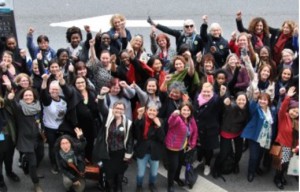
encuentroScene from video of National Meeting for Education for Peace

The Encounter was full of the energy and hope of the Colombia people, because after more than forty years of civil war, they can begin to make a culture of peace in their country.

I was very impressed by the youthfulness of the Encounter. A majority of the participants were young people, and in some of the roundtables the questions were posed by the youth representatives as we sat in circles and everyone participated.

It was also impressive that the participants understood very well the distinction between peace and culture of peace as defined by the United Nations, and they want to work for the culture of peace that includes not only disarmament and education for peace, but also humans rights, equality of women and men, democratic participation, tolerance and solidarity, free flow of information and sustainable development. Perhaps this should not be surprising since during the International Year for the Culture of Peace in 2000, the Manifesto 2000 was signed by 40% of the population of the country.

Everyone recognized that the future of the peace process will depend on education, both formal and informal. In this regard, there were lively discussions between representatives from the ministry of education and from the civil society, with demands that the needs of women, youth and handicapped should be given priority, and that education should be reformed with participation of the people rather than determined by government bureaucrats.

“How can education promote a culture of peace” was at the top of the agenda, and as a result of the Encounter, an Agenda for Education for a Culture of Peace is being prepared and will be submitted to the country’s education authorities.

There was an important contribution from the many universities in Colombia, and it was announced that the education for peace process will be aided by a network of universities for peace.

The international representatives invited to the Encounter were given a place of honor, as it was expected that the process of Colombia should learn from and contribute to peace processes around in the world. In addition to us, invitees included Alicia Cabezudo, Vice-President of the International Peace Bureau, Marina Caireta from the School for a Culture of Peace in Barcelona, Janet Gerson from the International Institute for Peace Education in the United States and Mario Lopez and Carlos Martinez from the University Minuto de Dios in Colombia.

(For an article on Spanish concerning this event, click here.)

Question for this article:

United Nations: Whistleblowers Need Protection

FREE FLOW OF INFORMATION

An article by Elizabeth “Liz” Hempowicz, Public Policy Associate, POGO (Project on Government Oversight

Daniel Kaye, the United Nations’ Special Rapporteur for Freedom of Expression, recently submitted a report to the General Assembly on the protection of whistleblowers and sources. The report highlights key elements of protections for whistleblowers, and is based in part on participation by 28 States as well as individuals and non-governmental organizations (NGOs). Among a host of best-practice protections featured in the report, the Special Rapporteur focuses particular attention on national security whistleblowers and sources, those whistleblowers who are often subject to criminal prosecution for exposing serious problems.

Whistleblowers
Image: Adapted from Jared Rodriquez / Truthout

Notably, the report recommended a public interest balancing test for disclosures in the national security field that could be used to claim protection from retaliation or as a defense when facing prosecution. This balancing test would promote disclosures where the public interest in the information outweighs any identifiable harm to a legitimate national security interest, and requires that the whistleblower disclose no more information than reasonably necessary to expose wrongdoing. A defense for blowing the whistle in the national security field would be a welcome one, as these whistleblowers often face prosecution under the Espionage Act, which could mean years of costly litigation for simply trying to expose practices that make us less secure. This balancing test is similar to one proposed last year by Yochai Benkler, a law professor and co-founder of the Berkman Center for Internet and Society, and supported by the Project On Government Oversight.

The full report contains many best-practice recommendations that our Congress should consider to strengthen whistleblower protections domestically.

(Thank you to Janet Hudgins, the CPNN reporter for this article.)

Question(s) related to this article:

Free flow of information, How is it important for a culture of peace?

Here is a response to the question from David Adams

Perhaps the simplest way to illustrate the essential importance of free flow of information for a culture of peace is to discuss the importance of the control of information for the culture of war.

Here are excerpts from an Washington Post investigation two years ago entitled Top Secret America: A hidden world, growing beyond control. To read the original, click here.

“* Some 1,271 government organizations and 1,931 private companies work on programs related to counterterrorism, homeland security and intelligence in about 10,000 locations across the United States.

* An estimated 854,000 people, nearly 1.5 times as many people as live in Washington, D.C., hold top-secret security clearances.

* In Washington and the surrounding area, 33 building complexes for top-secret intelligence work are under construction or have been built since September 2001. Together they occupy the equivalent of almost three Pentagons or 22 U.S. Capitol buildings – about 17 million square feet of space.

* Many security and intelligence agencies do the same work, creating redundancy and waste. For example, 51 federal organizations and military commands, operating in 15 U.S. cities, track the flow of money to and from terrorist networks.

* Analysts who make sense of documents and conversations obtained by foreign and domestic spying share their judgment by publishing 50,000 intelligence reports each year – a volume so large that many are routinely ignored.” . . .

“Every day across the United States, 854,000 civil servants, military personnel and private contractors with top-secret security clearances are scanned into offices protected by electromagnetic locks, retinal cameras and fortified walls that eavesdropping equipment cannot penetrate. . .

Much of the information about this mission is classified. That is the reason it is so difficult to gauge the success and identify the problems of Top Secret America, including whether money is being spent wisely. The U.S. intelligence budget is vast, publicly announced last year as $75 billion, 21/2 times the size it was on Sept. 10, 2001. But the figure doesn’t include many military activities or domestic counterterrorism programs.”

As we said in the draft Declaration and Programme of Action on a Culture of Peace that we sent from UNESCO to the UN General Assembly in 1998:

“98. It is vital to promote transparency in governance and economic decision-making and to look into the proliferation of secrecy justified in terms of ‘national security’, ‘financial security’, and ‘economic competitiveness’. The question is to what extent this secrecy is compatible with the access to information necessary for democratic practice and social justice and whether, in some cases, instead of contributing to long-term security, it may conceal information about processes (ecological, financial, military, etc.) which are a potential threat to everyone and which need therefore to be addressed collectively.”

Healing Memories: An Exchange With Peacemaker Mohamed Sahnoun

FREE FLOW OF INFORMATION

Excerpts from an article by Katherine Marshall, Huffington Post (reprinted according to fair use)

Venerable Algerian and United Nations diplomat Mohamed Sahnoun worries that neither world leaders nor the United Nations and national governments are facing up to the unprecedented problems the world confronts. What is sorely needed, he argues passionately, is a new, integrated, and bold approach that he terms “human security.” In a series of recent interviews, he reflected on what that means in practice, what he hopes will come next, and why spirituality, which underpins an ethical approach, belongs at the heart of global efforts. . .

sahnoun

Your determination created the five year Human Security Forum that meets each year at Caux, Switzerland. What did you want to accomplish?

We face deep insecurities in today’s world, but also great opportunities. Notwithstanding countless setbacks, I truly believe we are moving towards a greater sense of common purpose and solidarity as a world community. People in all walks of life know far more about what is happening and thus can be mobilized. Autocratic leaders are losing their grip. But we miss opportunities constantly, partly because attention is deflected by conflicts and crises. I feel urgently that we are at a unique point in history and simply must act with far more energy and cohesion. We must go to the root causes of the fears and apprehensions that give birth to insecurity.

Dialogue can be dismissed as simply talk yet you have dedicated much of your life to promoting and engaging in dialogue. How did you start?

When I was very young, tensions were everywhere in Algeria, my home. Even children in different neighborhoods fought over territory. Some instinct and drive made me a peacemaker then and ever since. I refuse to be a hostage to insecurity. I experienced insecurity personally: torture and prison, and that deepened my conviction that only by talking to one another can we have lasting solutions. From the 1960s when my job was to help sort out boundary disputes among Africa’s newly independent countries to today, there is simply no alternative to dialogue. . .

What has the Caux Forum achieved since its launch in 2008?

The Forum has produced a deep analysis of the diverse and complex dimensions of human insecurity. There are five pillars, five priorities: Healing Memory, thus overcoming the mistrust created by the wounds of history; Just Governance, to work for integrity, transparency and justice worldwide; Living Sustainably, which calls us to move towards greener economies and lifestyles; Inclusive Economics, to create a global economy that benefits everyone and Intercultural Dialogue, that works for peace and physical security. Such a joint intellectual and practical appreciation is what has been missing.

(Article continued in the column on the right)

Question(s) related to this article:

Where in the world can we find good leadership today?

(Article continued from the column on the left)

Interreligious dialogue is well and deeply established at Caux. It is a place where Muslims, Christians, Jews and people of other religions can come together and negotiate. It offers a safe place where people can build trust in one another. It offers the chance to understand what human security really means. Security is often equated purely with physical security, especially in America. The language of security is a language of power and polarization. Our central purposes is to change that language. We want instead a language of human values, a language of ethics.

I emphasize especially healing wounded memories, because they play such an important role in conflicts. For example, in Algeria and Northern Ireland feelings, the product of long conflicts and pain and violence, run so deep that special efforts are needed to heal. That is true in many places: the Balkans, Japan, Korea and Africa. We need more and better ideas.

Linking governance and security takes the Forum into new territory. What should be done?

Bad governance often causes conflict. In some areas, the way to improve governance is obvious. But what is needed most of all is more ethics. Suddenly, for example in the Arab Spring, there seems to be an emerging awareness that we need an ethical culture. The problems of endemic poverty, violations of human rights, and injustice, cry out for a deeper and more consciously ethical approach. Civil society is helping to enhance that awareness, demanding harder work and less selfishness. The past tendency was to defend one’s city, one’s nation, one’s tribe or congregation. In the Cold War where ideologies seemed clear, there were sharply defined sides. But today, with our globalized world, we need a global solidarity that includes everyone. That is truly a new demand.

What about the economic challenges that face the world?

Economics can be very divisive, as divisive as bad governance. The reality and the perception that global affairs are managed by an oligarchy, a small group of powerful people, are corrosive. Spending on the military is a scandal — USD 1.5 trillion, an unimaginable sum, while less than U.S. $100 billion is spent on development. We spend 15 times more to kill each other than to heal. We must correct that. The sources of tension are obvious in trade patterns, again where oligarchies dominate. The U.S. subsidies for cotton are just one example of what are evident and very visible injustices.

The infamous “clash of civilizations” that Samuel Huntington spoke about is often misread, in Washington, as a clash of religions. It is not one religion, or language, or ethnic group or class against another. It is a clash of ethics. In Somalia, the clash is not about religion — the people share a common religion, language and ethnicity, yet they are plagued by conflict, as clans and families fight one another.

There can be no ethical culture without a clear and strong notion of justice. All people feel injustice. The principles of justice apply to all the issues and dimensions that we are trying to address at the Caux Forum.

To shift to an ethical culture, a true dialogue of civilizations, we need to work much more and more effectively with the media, to combat images, prejudices, and painful memories. We need to do more with Parliamentarians. And we need to bring spiritual leaders into the discussions. Windows perhaps are open to all three, but we need to pry open the doors.

Preventing conflict – Transforming justice – Securing the Peace

. . WOMEN’S EQUALITY . .

From a study by UN Women

Foreward by Phumzile Mlambo-Ngcuka, UN Under-Secretary-General and Executive Director of UN Women

Resolution 1325 was one of the crowning achievements of the global women’s movement and one of the most inspired decisions of the United Nations Security Council. The recognition that peace is inextricably linked with gender equality and women’s leadership was a radical step for the highest body tasked with the maintenance of international peace and security. Turning the Security Council’s words into actions and real change has been a central pillar of UN Women’s work since the entity was created, and the driving passion of many other actors since the resolution was adopted as a global norm in 2000.

unwomen

And yet there remains a crippling gap between the ambition of our commitments and actual political and financial support. We struggle to bridge the declared intent of international policymaking and the reality of domestic action in the many corners of the world where resolution 1325 is most needed.

UN Women was privileged to be tasked by the Secretary- General with helping to prepare this Global Study. We are grateful to its independent lead author, Ms. Radhika Coomaraswamy, her advisory board, and all the member States, academics, non-governmental organizations, and UN bodies that supported this effort. The preparation process involved consultations all over the world, the provision of ideas as well as technical inputs and information, and commentary on and review of drafts. We hope that this Study will stimulate discussion and be followed by concrete commitments, resources, political will, policy shifts, and accountability at all levels.

This Study reinforces the Security Council’s original crucial recognition of the power of engaging women in peace with compelling proof. It shows that women’s participation and inclusion makes humanitarian assistance more effective, strengthens the protection efforts of our peacekeepers, contributes to the conclusion of peace talks and the achievement of sustainable peace, accelerates economic recovery, and helps counter violent extremism. This Study, and a growing evidence base, make the implementation of resolution 1325 even more urgent and needed.

(Article continued in right column)

Question related to this article:

UN Resolution 1325, does it make a difference?

(Article continued from left column)

The Study adds two more important elements that will help us push this agenda forward. It compiles multiple examples of good practice that should become the standard requirement for all. In addition, it takes a hard look at implementation and enforcement, and the missing incentives and accountability measures that should nudge all actors into complying with these norms and living up to their promises. What emerges from these ideas is an explicit and ambitious roadmap for the way forward on women, peace and security. We have an enormous responsibility to ensure that the normative framework spurred by resolution 1325 is not just given periodic visibility and attention, but that it lies at the heart of the UN’s work on peace and security.

This year, we celebrate 15 years of resolution 1325 and 20 years since the Fourth World Conference on Women in Beijing. We have a new momentum towards the recognition of gender equality and women’s empowerment at the heart of sustainable progress for all, with the adoption of the 2030 Agenda for Sustainable Development. Many actors are coming to the table with new energy, new ideas, and new commitments, and we have seen other policy reviews, from our development goals to our peace operations and our peacebuilding architecture, emphasize the centrality of gender equality. This is an important opportunity to shape the way in which we address our global challenges in the next decades. Let us make the most of it.

(Thank you to Janet Hudgins, the CPNN reporter for this article.)

U.N. Highlights Importance of Public Spaces, Safety for Women

. . WOMEN’S EQUALITY . .

An article by Tharanga Yakupitiyage, Inter Press Service (reprinted by permission)

Improving access to public spaces, and making them safe for women and girls, increases equity, combats discrimination and promotes inclusion, said Secretary-General Ban Ki-moon during a High-Level Discussion on “Public Spaces for All.”

safety

The meeting coincided with World Habitat Day, which is observed annually on the first Monday of October.

It brought together top UN officials, private sector representatives, academics, and civil society members to discuss the state of the world’s towns and cities, the right to adequate shelter, and the importance of public spaces.

In Ban’s address, he remarked: “High-quality public spaces encourage people to communicate and collaborate with each other, and to participate in public life.”

“Public spaces can also provide basic services, enhance connectivity, spawn economic activity and raise property values while generating municipal revenue,” he continued.

The Executive Director of the UN Human Settlements Programme (UN-Habitat) Joan Clos echoed the UN Chief’s comments.

“These spaces shape the cultural identity of an area, are part of its unique character and provide a sense of place for local communities,” Clos stated.

Clos also warned that when public spaces are inadequate, poorly designed or privatized, a polarized city with high social tensions, crime and violence will result.

Deputy Executive Director of UN Women Lakshmi Puri particularly pointed to violence against women and girls in public spaces as a major challenge.

“If violence in the private domain is now widely recognized as a human rights violation, violence against women and girls, especially sexual harassment and other forms of sexual violence, in public spaces remains a largely neglected issue, with few laws or policies in place to prevent and address it,” Puri said.

(Article continued in right column)

Question related to this article:

Protecting women and girls against violence, Is progress being made?

(Article continued from left column)

UN Women has found that women in urban areas are twice as likely as men to experience violence, especially in developing countries. Moreover, 25-100 percent of women and girls around the world have experienced some form of sexual violence in public spaces in their lifetime.

Similarly, according to Gallup data from surveys in 143 countries in 2011, men are more likely than women to say they feel safe walking alone at night in their communities.

In Australia, research conducted by the Australia Institute in 2015 found that 87% of women were verbally or physically attacked while walking down the street.

In Ecuador, a study by UN Women in 2011 found that 68% of women had experience some form of sexual harassment and sexual violence in public spaces.

Puri noted how such violence limits women and girls’ movement, participation in education, access to essential services, and negatively impacts their health and well-being.

She highlighted the role of public spaces in promoting and achieving gender equality.

“Urban spaces are the most important theaters for the working out of the gender equality and women’s empowerment project,” Puri remarked.

Ban also noted the importance of deliberate and careful collaboration with local authorities, residents, and other actors to create successful public spaces.

World leaders are set to meet and define a new housing and urban agenda under the post-2015 development framework at Third UN Conference on Housing and Sustainable Urban Development, or Habitat III.

The conference will address the challenges of urbanization and opportunities it offers to implement the sustainable development goals (SDGs) and its targets.

One such target is 11.7 which aims to provide universal access to safe, inclusive and accessible, green and public spaces, particularly for women and children, older persons and persons with disabilities.

However, Puri noted that no target exists to measure safety in public spaces for women and girls in the SDGs.

(Thank you to Janet Hudgins, the CPNN reporter for this article.)

Video: Edward Snowden, Glenn Greenwald & David Miranda Call for Global Privacy Treaty

FREE FLOW OF INFORMATION

A video and transcript from Democracy Now (reprinted according to terms of Creative Commons) (abridged)

NSA whistleblower Edward Snowden, Pulitzer Prize-winning journalist Glenn Greenwald, Brazilian privacy activist David Miranda and others have launched a new campaign to establish global privacy standards. The proposed International Treaty on the Right to Privacy, Protection Against Improper Surveillance and Protection of Whistleblowers would require states to ban mass data collection and implement public oversight of national security programs. The treaty would also require states to offer asylum to whistleblowers. It is being dubbed the “Snowden Treaty.” At a launch event last week, Edward Snowden spoke about the need for the treaty via teleconference from Russia. “This is not a problem exclusive to the United States or the National Security Agency or the FBI or the Department of Justice or any agency of government anywhere. This is a global problem that affects all of us,” Snowden said.

snowden
Video of Snowden, Greenwald and Miranda

TRANSCRIPT

EDWARD SNOWDEN: We’ve already changed culture. We can discuss things now that five years back, if you had brought them up in a serious conversation, would have gotten you sort of labelled as a conspiracy theorist or someone who really was a—was not really thinking about what governments reasonably are likely to do. Now, the danger of this is that we’re always living in a circumstance where governments go a little bit further than what any public would approve of if we knew the full details of government.

Now that we’ve established at least the bare facts of what’s going on in the arena of our basic liberties, what happens as we transit through a city, as we talk to our friends, as we we engage with family, as we browse books online, all of these things are being tracked, they’re being intercepted, they’re being recorded. They’re being indexed into a sort of surveillance time machine that allows institutions that hold great powers, whether they are public institutions, whether they’re private institutions, such as corporations—they’re empowering themselves at the expense of the public.

Now, we’re beginning to shift from that cultural, necessary change, where we brought awareness of what’s really happening, into a point where we need to think about what the actual proposals that we’re going to put forth are going to be. We need to change not just the facts that we’re aware of, but the facts of the policies that we’re going to live under. And some people would be encouraged, saying we’ve made improvements. There have been the first and most important legal reforms in the surveillance arena domestically within the United States passed in nearly 40 years. But if you ask anyone who studies the actual legislation, they’ll agree that they’re a first step. They don’t go anywhere near far enough.

And as was just mentioned, we see that in many countries around the world governments are aggressively pressing for more power, more authority, more surveillance rather than less. And this is not just in foreign states. This is not just in what we would consider traditional adversary states such as, you know, Iran, China, Russia, North Korea, whoever you’re really afraid of. It’s not just people who are different from us. This has happened in Australia, where they now have mandatory retention of everyone’s data without regard to whether they’re involved in any sort of criminal activity or if they’ve even fallen under any sort of criminal suspicion. We see the same proposals put forth and adopted in Canada. We see the same thing occurring in the United Kingdom. We’ve seen the same thing pass in France.

(article continued in right column)

Question(s) related to this article:

Free flow of information, How is it important for a culture of peace?

(article continued from left column)

And what’s extraordinary about this is that, in every case, these policy proposals that work against the public are being billed as public safety programs. But when we look at the facts, for example, in the United States, even if you’re not aware of or you don’t believe the reports that have been shown in the newspaper based on classified documents that show governments are engaging in the broad, massive and indiscriminate collection of data on every citizen’s lives, you can see that governments have confirmed things, they’ve declassified them through their own documents, and they’ve done investigations to discover: Are these programs, now that they’ve been declassified, now that we can discuss them, are they really valuable? Do they really keep us safe?

And despite two independent investigations appointed by the White House, that are, again, allies of these institutions and have every incentive to sort of whitewash these programs and say they’re wonderful, have in fact said that upon—upon reviewing all available evidence, even classified evidence, after interviewing the directors of the National Security Agency and so on and so forth, they’ve seen that these programs actually don’t save lives. Mass surveillance, by their own quotes, has never made a concrete difference in a single terrorism investigation in the United States.

There was one case where the mass surveillance of everyone’s phone records in the United States of America showed that there was a single cab driver in California wiring money back to his clan in Somalia that did have some ties to terrorism, but even in that case, the government said they could have achieved—and they would have achieved—the same evidentiary gain through traditional targeted means of investigation. They said they were already closing in on this individual.

And so, this raises the question: Why are programs being billed as public safety programs when they have no corresponding public safety benefit? And the unfortunate reality is that while these programs do have value—you know, the government is not doing this for absolutely no reason—the value that they have is based on intelligence collection. It’s based on adversarial competition between states that’s happening secretly. It’s happening without any form of robust oversight. It’s happening without the involvement of real open courts with an adversarial process.

And increasingly, we’re seeing that even if these programs are instituted with the best of intentions—to keep citizens safe, to assist in war zone operations, in the intervention of terrorism in certain spaces around the United States and throughout the world—inevitably they come back to impact us here at home. The same programs that the National Security Agency and Central Intelligence Agency collaborated on in areas like Yemen are now being used by the United States Marshals Service in the United States against common criminals, people who do not represent any real threat to public safety in a manner that would justify in any way the intrusion into and the violation of millions and millions of citizens’ rights—and noncitizens.

And unfortunately, this trend is continuing. If you open The Washington Post just today, you’ll see that the Obama administration was secretly exploring new ways to bypass the technological protections of our privacy in the devices that surround us every day. Now, this is what we confront today. This is not a problem exclusive to the United States or the National Security Agency or the FBI or the Department of Justice or any agency of government anywhere. This is a global problem that affects all of us. What’s happening here happens in France, it happens in the U.K., it happens in every country, in every place, to every person. And what we have to do is we have to have a discussion. We have to come forward with proposals, to go, “How do we assert what our rights are, traditionally and digitally, and ensure that we not just can enjoy them, but we can protect them, we can rely upon them, and we can count on our representatives of government to defend these rights rather than working against them?”

And with that, I’ll turn it over to David Miranda. Thank you very much for the invitation to speak.

For transcript of Miranda and Greenwald, click here.

UN SDG’s: The ‘Meta-Goal,’ Bringing 193 Nations Together

. . SUSTAINABLE DEVELOPMENT . .

An article in the Huffington Post by Achim Steiner, UNEP Executive Director and Under-Secretary-General of the United Nations

Having two parties agree on a common goal can be a challenge. Having 193 parties agree to 17 of them is, to understate it, uncommon. So when the Sustainable Development Goals are adopted this week by 193 UN Member States, it’s fair to say we will be witnessing something historic.

steiner

Having all nations concur on a path forward for the entire planet and its peoples is unprecedented, and indeed, an accomplishment in and of itself.

But despite the enormity of the task, setting the goals was the easy part. Achieving them is where the hard work begins in earnest. With 17 goals that integrate all aspects of our economies, societies and the environment, the challenge is formidable. That these goals apply to all nations — developed and developing — means that the challenge is a universal one.

The cross-cutting, global nature of the goals necessitates a degree of cooperation as unprecedented as the goals themselves.

Nations of the world recognized this fact as the goals were being developed. To help enable the coordination needed to achieve them, member states included what might be called a meta-goal: SDG 17. The intent of Goal 17 is to advance the notion of partnerships, from local to global, that will be fundamental to achieving the other 16 SDGs.

We have seen the power of partnerships and cooperation in the 193-nation consensus on a sustainable future. That power must now be harnessed to take us there.

Having all countries of the world on board is only the beginning. Sustainable development will need participation and cooperation between governments, the private sector and civil society.

Why is this so? Aside from the fact that the SDGs are shared goals for all humanity, it comes down to an unyielding reality: no single institution possesses the resources and competencies needed to achieve these goals alone.

Investment on a massive scale will be required in sectors such as energy, infrastructure, transport and information technology to support sustainable-development objectives.

Technology, policy coherence and governance will also need to be aligned with the goals of sustainable development.

(Article continued in right column.)

Question for this article:

Despite the vested interests of companies and governments, Can we make progress toward sustainable development?

(Article continued from the left column)

When it comes to financing, according to the United Nations Conference on Trade and Development, some $5-7 trillion will be needed annually to achieve the SDGs.

Public finance can only contribute so much.

Consider the investments required to adapt to climate change over the coming decades. Climate resilience will be a critical component of sustainable development. According to UNEP’s first Adaptation Gap Report, the global investment required for adaptation to climate change is likely to hit $300 billion per year until 2050 — possibly rising as high as $500 billion.

In 2013, the total amount of public climate finance was $137 billion.

Making up the difference seems like a daunting task.

This is where potential of global partnerships comes into play. In 2013, private climate financing totaled $193 billion.

This is still short of what is needed for climate finance, let alone the trillions more required to support sustainability across all sectors over the coming decades. But it is a point on a trend that shows an increase in sustainable investments over time from both public and private sectors.

These investments are already resulting in remarkable changes. Take renewable energy as an example, in 2014, about half of all energy-generating capacity built in the previous year was renewable. The Africa Renewable Energy Initiative is working to mobilize billions of dollars in public and private financing to achieve 10,000 MW of installed renewables capacity on the continent by 2020.

These remarkable statistics speak to two shifts that will need to continue in order to achieve the SDGs. The first is increased alignment of public-policy and private-sector initiatives. The second is the ability of public finance to catalyze private investment.

On technology, policy and governance, we have already seen the potential of partnerships to change the world.

Thirty years ago, the international community came together to tackle the challenge of the growing hole in the ozone layer. The result was the Montreal Protocol and the phasing out of ozone-destroying cholorfluorocarbons (CFCs). Now, the ozone layer is on track to heal by mid-century.

The UNEP-supported Partnership for Clean Fuel and Vehicles played an important convening role in phasing out lead in fuel, which has resulted in a dramatic reduction of lead-exposure health problems.

And currently, the 100-member Climate and Clean Air Coalition, which UNEP hosts, is actively working to reduce air pollution.

Cooperation engenders success. That’s why partnerships like these are at the core of the goals of sustainable development. No one government — and not even 193 of them — will be able to realize sustainable development without working together.

(Thank you to Janet Hudgins, the CPNN reporter for this article.)

Trying to Survey Events around the World for the International Day of Peace

DISARMAMENT & SECURITY .

by David Adams, CPNN Coordinator

There are several websites that invite readers to enter their events for the International Day of Peace (IDP), but it is difficult to get an overall view of what is happening.

idp survey

Let’s start with regular websites? The website http://internationaldayofpeace.org/ has a map of the world with symbols for different kinds of events. After considerable trial and error, since there is no explanation on the page, I was able to separate most of the entries for marches, music, meditation and multiple as of September 21.

Here is what I found, separated by region of the world.

Marches: North America 20; Europe 7; Latin America 4; South Asia 4; East Asia 3; Africa 2; Middle East 1

Music: North America 23; Europe 15; East Asia 4; Middle East 3; Latin America 2; Africa 2

Meditation: North America 55; Europe 53; Africa 14; East Asia 10; South Asia 4; Middle East 5

Multiple: North America 35; Europe 30; Latin America 15; East Asia 10; South Asia 3; Africa 3; Middle East 1

This adds up to 328, while website gives a figure of 1369 events.

In many cases one can obtain information about the event by clicking on the symbol.

How about Facebook? As of September 21 the Facebook page #PeaceDay has dozens of entries every day beginning on September 10, but most of the entries do not indicate the country concerned. One of the entries #iplayforchange carries a map of 295 events in 51 countries. By clicking on the map you find photos from musicians around the world, but no detailed listing of the events. Another facebook page is https://www.facebook.com/events/461780550660626/, where today (September 21) one finds entries listed from Lebanon, Brazil, Canada, Australia, Korea, Philippines, Indonesia, United Kingdom, Argentina, Turkey, Libya, Luxembourg, etc., etc.

I get the feeling from “surfing the internet” that the IDP is being celebrated around the world to a far greater extent than we can measure. Is it increasing from one year to another? Does it mark a growing anti-war consciousness? Unfortunately, I see no way to measure this from the available data.

Question for this article:

Greenpeace honouring courage and compassion: Peace Day 2015

TOLERANCE AND SOLIDARITY .

An article by Dr Kumi Naidoo, Executive Director of Greenpeace International

I was 22 years old when I had to leave my homeland, South Africa. I had no choice. I was living underground for a year by then, to avoid being arrested. This was 1987, in the midst of one of the most bloody and violent periods in the history of Apartheid South Africa. The green peaceful streets of Oxford, where I was lucky enough to end up, seemed like a cartoon to me. They seemed unreal, while the violence I left behind felt very real and near. I stayed awake at night thinking of friends and relatives left behind.

greenpeace

I remember these feelings now every time I look at the heartbreaking images of people fleeing devastation – whether floods in Bangladesh or war in Syria. The images of desperate parents holding on to their children, trying to get them through barbed wired fences, or off small inflatable boats. I see them and I think about my own daughter. How would I feel if I was one of these parents? When I fled, I had only myself to care for.

‘No one leaves home’ writes Kenyan born Somali poet Warsan Shire, ‘unless home is the mouth of a shark’. ‘No one puts their children in a boat unless the water is safer than the land’.

21st September marks the International Day of Peace. And this year, again, there is not much peace around to celebrate.

In Syria alone – according to some estimates one of two Syrians has died or fled home since the war began. According to the UN 7.6 million are internally displaced. 4.1 million refugees are abroad. Most of them in countries surrounding Syria. Some are turning to Europe as a safe haven.

(article continued on the right side of the page)

Question for this article

The refugee crisis, Who is responsible?

Readers’ comments are invited on this question and article. See below for comments box.

(article continued from the left side of the page)

There are times when drawing borders between countries, people, between politics and the environment must stop. There comes a time when all that matters is humanity and solidarity. This is such a time. The acts of courage and compassion shown by so many individuals and communities across Europe I find deeply inspiring.

Many of my colleagues in Greenpeace are also trying to reach out and support refugees. In Hungary and Croatia, volunteers have joined the humanitarian effort, including practical things like setting up a solar charging station in hot spots so that people can recharge their phones and access WiFi. In Greece, our office is in close contact with international relief NGOs ​to support their efforts ​and is working with local groups to collect and send relief packages to the Islands where many refugees are stranded.

I want to personally thank all who are reaching out to help. In this moving ocean of solidarity, every drop matters. We must all join together and say loud and clear: #Refugeeswelcome!

Tomorrow I travel to New York to attend the UN Summit on Sustainable Development Goals. My trip will be an easy one, but I will remember those times when my journeys, too, were journeys of fear. I will think of those facing days, months and years of relentless, life threatening journeys, with no guaranteed safety at the end of the road.

As fellow human beings we owe it to them to raise our voices, to stand in solidarity and to address the root causes of global insecurity. We need to insist on finding real solutions – including getting off fossil fuels. Conflicts are always complex. But looking at current conflicts from Iraq, Ukraine, Sudan, the South China Sea to Nigeria it is clear that the access, the transport and thus the dependence on fossil fuels do play a role.

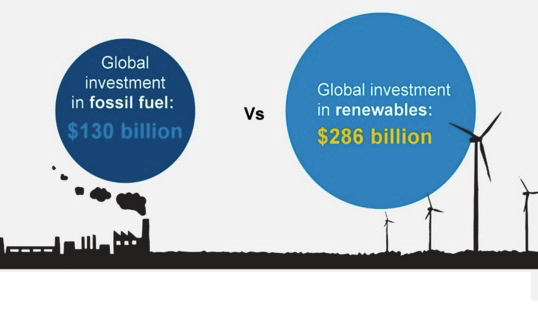
“Resource wars” are not new. But today we can overcome them. In New York, I will argue for a world powered by 100% renewables for all by 2050. This world is in our grasp, our latest Energy Revolution scenario shows that without doubt. It is also the world we must choose if we want peace. Wind turbines, photovoltaic systems, insulation materials or double glazed windows are the “weapons” we must deploy to help create a safer world.

I was lucky enough to see Apartheid ended by people power and international solidarity a few years after I was forced to leave South Africa. Apartheid was abolished, and I am now free to return. Will those displaced now ever have that privilege? I do not know. But we must work for the peaceful, safe world for all, that would make this possible.

Ahead of International Day of Peace, UN chief appeals for cease-fire on 21 September

DISARMAMENT & SECURITY .

An article from the United Nations News Centre

Secretary-General Ban Ki-moon is calling for the laying down of arms and a 24-hour cease-fire on 21 September, which is observed around the world each year as the International Day of Peace.

un-idp

The United Nations General Assembly established the International Day of Peace in 1981 as an opportunity for people around the world to promote the resolution of conflict and to observe a cessation of hostilities.

“On this day, in the lead-up to the Day of Peace, I am asking all partners to lend their voices to this call for a laying down of arms, and to work non-stop in the days to come to bring about a 24-hour cease-fire on September 21st,” Mr. Ban said in a statement issued on Thursday.

“Let’s make this International Day of Peace a day without violence, and a day of forgiveness. If, for one day, we can live in a world without aggression and hostility, we can imagine how much more is possible,” he added.

The theme of this year’s commemoration is “Partnerships for Peace – Dignity for All,” which aims to highlight the importance of all segments of society to work together to strive for peace.

The work of the UN would not be possible without the thousands of partnerships each year between governments, civil society, the private sector, faith-based groups and other non-governmental organizations that are needed to support the Organization in achieving its goals.

Celebrations for the International Day of Peace will include a Peace Bell Ceremony at UN Headquarters in New York, featuring senior UN officials and Messengers of Peace, as well as a student videoconference. UN offices worldwide, including peacekeeping operations, will also be holding events with local communities.

(Click here for a version of this article in French or here for a version in Spanish.)

Question for this article: