Category Archives: global

Renewable Energy Investments: Major Milestones Reached, New World Record Set

.. SUSTAINABLE DEVELOPMENT ..

An article by the United Nations Environment Program

Coal and gas-fired electricity generation last year drew less than half the record investment made in solar, wind and other renewables capacity – one of several important firsts for green energy announced today in a UN-backed report. Global Trends in Renewable Energy Investment 2016, the 10th edition of the UN Environment Programme’s (UNEP’s) annual publication, launched today by the Frankfurt School-UNEP Collaborating Centre for Climate & Sustainable Energy Finance and Bloomberg New Energy Finance (BNEF), says the annual global investment in new renewables capacity, at $266 billion, was more than double the estimated $130 billion invested in coal and gas power stations in 2015.

renewables
Data source: Frankfurt School-UNEP Centre / BNEF Global Trends in Renewable Energy Investment 2016

All investments in renewables, including early-stage technology and research and development as well as spending on new capacity, totalled $286 billion in 2015, some 3 per cent higher than the previous record in 2011. Since 2004, the world has invested $2.3 trillion in renewable energy (unadjusted for inflation).

(All figures for renewables in this release include wind, solar, biomass and waste-to-energy, biofuels, geothermal, marine and small hydro, but exclude large hydro-electric projects of more than 50 megawatts).

Just as significantly, developing world investments in renewables topped those of developed nations for the first time in 2015.

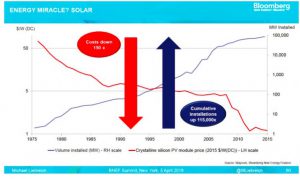
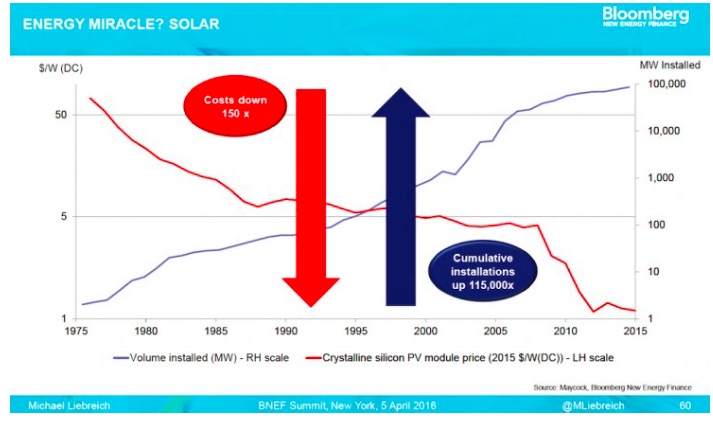
Helped by further falls in generating costs per megawatt-hour, particularly in solar photovoltaics, renewables excluding large hydro made up 54 per cent of added gigawatt capacity of all technologies last year. It marks the first time new installed renewables have topped the capacity added from all conventional technologies.

The 134 gigawatts (GW) of renewable power added worldwide in 2015 compares to 106GW in 2014 and 87GW in 2013.

Were it not for renewables excluding large hydro, annual global CO2emissions would have been an estimated 1.5 gigatonnes higher in 2015.

UNEP Executive Director Achim Steiner said, “Renewables are becoming ever more central to our low-carbon lifestyles, and the record-setting investments in 2015 are further proof of this trend. Importantly, for the first time in 2015, renewables in investments were higher in developing countries than developed.”

“Access to clean, modern energy is of enormous value for all societies, but especially so in regions where reliable energy can offer profound improvements in quality of life, economic development and environmental sustainability. Continued and increased investment in renewables is not only good for people and planet, but will be a key element in achieving international targets on climate change and sustainable development.”

“By adopting the Sustainable Development Goals last year, the world pledged to end poverty, promote sustainable development, and to ensure healthier lives and access to affordable, sustainable, clean energy for all. Continued and increased investment in renewables will be a significant part of delivering on that promise.”

Said Michael Liebreich, Chairman of the Advisory Board at BNEF: “Global investment in renewables capacity hit a new record in 2015, far outpacing that in fossil fuel generating capacity despite falling oil, gas and coal prices. It has broadened out to a wider and wider array of developing countries, helped by sharply reduced costs and by the benefits of local power production over reliance on imported commodities.”

(Continued on right side of page)

Question for this article:

Are we making progress in renewable energy?

(Article continued from left side of page)

As in previous years, the report shows the 2015 renewable energy market was dominated by solar photovoltaics and wind, which together added 118GW in generating capacity, far above the previous record of 94GW set in 2014. Wind added 62GW and photovoltaics 56GW. More modest amounts were provided by biomass and waste-to-power, geothermal, solar thermal and small hydro.

In 2015, more attention was drawn to battery storage as an adjunct to solar and wind projects and to small-scale PV systems. Energy storage is of significant importance as it is one way of providing fast-responding balancing to the grid, whether to deal with demand spikes or variable renewable power generation from wind and solar. Last year, some 250MW of utility-scale electricity storage (excluding pumped hydro and lead-acid batteries) was installed worldwide, up from 160MW in 2014.

Developing countries on the rise led by China and India

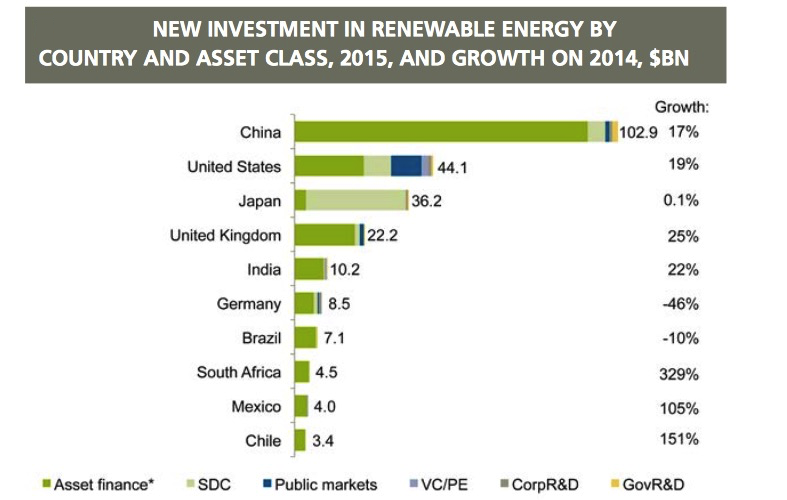
In 2015, for the first time, investments in renewable energy in developing and emerging economy nations ($156 billion, up 19 per cent compared to 2014) surpassed those in developed countries ($130 billion, down 8 per cent from 2014).

Much of these record-breaking developing world investments took place in China (up 17 per cent to $102.9 billion, or 36 per cent of the world total).

Other developing countries showing increased investment included India (up 22 per cent to $10.2 billion), South Africa (up 329 per cent to $4.5 billion), Mexico (up 105 per cent to $4 billion) and Chile (up 151 per cent to $3.4 billion).

Morocco, Turkey and Uruguay all joined the list of countries investing more than $1 billion.

Overall developing country investments last year were 17-times higher than in 2004.

Among developed countries, investment in Europe was down 21 per cent, from $62 billion in 2014 to $48.8 billion in 2015, the continent’s lowest figure for nine years despite record investments in offshore wind projects.

The United States was up 19 per cent to $44.1 billion, and in Japan investment was much the same as the previous year at $36.2 billion.

The shift in investment towards developing countries and away from developed economies may be attributed to several factors: China’s dash for wind and solar, fast-rising electricity demand in emerging countries, the reduced cost of choosing renewables to meet that demand, sluggish economic growth in the developed world and cutbacks in subsidy support in Europe.

Still a long way to go

That the power generation capacity added by renewables exceeded new capacity added from conventional sources in 2015 shows that structural change is under way.

Renewables, excluding large hydro, still represent a small minority of the world’s total installed power capacity (about one-sixth, or 16.2 per cent) but that figure continues to climb (up from 15.2 per cent in 2014). Meanwhile actual electricity generated by those renewables was 10.3 per cent of global generation in 2015 (up from 9.1 per cent in 2014).

“Despite the ambitious signals from COP 21 in Paris and the growing capacity of new installed renewable energy, there is still a long way to go,” said Prof. Dr. Udo Steffens, President of the Frankfurt School of Finance & Management.

“Coal-fired power stations and other conventional power plants have long lifetimes. Without further policy interventions, climate altering emissions of carbon dioxide will increase for at least another decade.”

The recent big fall in coal, oil and gas prices makes conventional electricity generation more attractive, Dr. Steffens added. “However, the commitments made by all nations at the Paris climate summit in December, echoing statements from last-year’s G7 summit, require a very low- or no-carbon electricity system.”

(Thank you to the Good News Agency for sending us this article.)

On Earth Day, Commit To The Great Turning

. . SUSTAINABLE DEVELOPMENT . .

An article by Rivera Sun, Peace Voice (reprinted according to Creative Commons)

Viewing the destruction of the planet and our natural systems as a form of violence, Campaign Nonviolence – a long-term movement to build a culture of nonviolence – engages people across the country in working toward sustainability, renewable energy, lowering meat consumption, supporting local food, and many other practices of living nonviolently on this beautiful Earth.

earthday

As we commemorate Earth Day on April 22, we are called upon to recommit to protecting our planet to ensure that the human species and our fellow beings will have a long-term future. Founded in 1970, Earth Day is an internationally celebrated day, honoring the natural systems of the planet, and a day of action in support of climate protection. The commemoration was first proposed by two different people, peace activist John McConnell, who created the iconic Earth Flag, and Senator Gaylord Nelson.

In an era of climate crisis, Earth Day reminds us of the urgency and importance of transforming our way of life . . . today! One resource for this is to reimagine these times as an epochal period of great change, one that many people are calling the Great Turning.

The Great Turning is a phrase popularized by many people including Joanna Macy and David Korten that describes our current time period as a massive shift from the industrial growth society to a life-sustaining civilization. We may not make this transition in time to prevent catastrophic climate change . . . but billions of people around the globe are engaged in the three types of actions that support the Great Turning.

These three types of actions are:

Holding actions to slow the destruction of human-based systems on the Earth and other beings. These activities include all the political, legislative, and legal work required to reduce the destruction, as well as direct actions–blockades, boycotts, civil disobedience, and other forms of noncooperation and nonviolent intervention.

These are important to stop the worst of the destruction, but they are not enough on their own; they must be supported by . . .

Creating new systems that support a life-affirming society, including local agriculture, reducing meat consumption, switching to renewable energy, creating mass transit systems, watershed protection and restoration, cooperative housing and eco-villages. And, to support the movement toward these visionary goals, it is also necessary to engage in a . . .

Shifting beliefs away from old concepts of domination, separateness, greed and destruction. We must move towards new understandings of interconnection, general and living systems theory, deep ecology, cooperation, and collaboration.

The three dimensions of the Great Turning are equally vital. Look around your community and notice how many people are engaged in one or several aspects of this work! Question your own participation – how do you contribute? What more could you engage in? What excites and intrigues you? For the Great Turning to be successful, we need all hands on deck! How will you be a part of this historic moment?

Question for this article:

Nonviolence Charter: Progress Report #8 (April 2016)

EDUCATION FOR PEACE .

An article by Robert J. Burrowes, Anita McKone and Anahata Giri in the TRANSCEND Media Service (abbreviated)

Here is the latest six-monthly report on progress in relation to ‘The People’s Charter to Create a Nonviolent World’ and a sample of news about Charter signatories. Building a worldwide consensus against the use of violence in all contexts is quite a challenge but we are making solid progress!

charter

Since our last report on 14 October 2015 –which Antonio C. S. Rosa kindly published in the TRANSCEND Media Service Weekly Digest—

–we have gained our first signatories in another four countries – Argentina, Costa Rica, Kazakhstan and West Papua – a total of 93 countries now. We also have 104 organisations from 33 countries, the latest of which is the Associação Internacional de Poetas based in Brazil. If you wish, you can see the list of organisational endorsements on the Charter website.

If you wish to see individual signatories, click on the ‘View signatures’ item in the sidebar. You can use the search facility if you want to look for a specific name.

The latest progress report article ‘Ending Human Violence is a Task for Each of Us’ was recently distributed to many progressive news websites and mainstream newspapers: it was published by a number of progressive outlets in fourteen countries, thanks to very supportive editors–several of whom are Charter signatories. . .

You may remember that in the last Charter progress report we repeated our promise to report on those of you about whom we knew less by asking you to send us some information about yourself and the reminder that you don’t have to be world famous to be valued here. Well, the good news is that a number of people responded and, in addition, we did some more research ourselves. However, as we continue to find, extraordinary people seem to invariably consider themselves ‘ordinary’. So, irrespective of how you consider yourself, we would love to hear about you for the next report!

(Editor’s note: The news of charter signatories is too long to be printed here, so reader’s are encouraged to see them here in the full report.

Question for this article:

It’s Campaign Season for UN Secretary General…And It Is Pretty Radical

FREE FLOW OF INFORMATION

An article by Mark Leon Goldberg, UN Dispatch

The race to become the next UN Secretary General just got slightly more crowded yesterday [April 5] when Helen Clark, former New Zealand prime minister and the current head of the UN Development Program, tossed her hat in the ring. Clark is one of the higher profile of the eight declared candidates. She is the fourth woman in the field and the only non-European to enter the race so far.

secgen

What makes her entry into the race particularly interesting is this straightforward video of her announcing her candidacy. It is the latest manifestation of just how radically new this process is to select a UN secretary general.

For the first time ever there will be a public campaign in the race to become the next UN Secretary General.

In the 70 years of United Nations, each of the eight Secretaries General were selected behind closed doors. Those doing the selecting were the five permanent members of the Security Council: the USA, Russia, the UK, France and China. Those countries would select a man to represent the United Nations and then the General Assembly, which is made up of all UN member states, would rubber stamp the pick.

This time around is wholly different. First, to be considered for the job, each candidate must first be nominated by their country. The process for doing so is straightforward: the country sends the nominating letter to the President of the General Assembly, who posts the candidates’ nominating letters and resumes to this website.

Now, for the first time in 70 years the general public knows exactly who is in the running for UN Secretary General. This counts as radical: even that modest amount of transparency was never really in the cards before.

The declared candidates as of April 4 (minus Helen Clark) and the dates they entered the race.

Dr. Srgjan Kerim, 30 December 2015
Prof. Dr. sc. Vesna Pusic, 14 January 2016
Dr. Igor Luksic, 15 January 2016
Dr. Danilo Turk, 9 February 2016
Ms. Irina Bokova, 11 February 2016
Ms. Natalia German, 19 February 2016
Mr. Antonio Guterres, 29 Febuary 2016

Because the process is open, there is a degree of public campaigning that has never existed. Candidates will be forced to go on the record with their positions on various key global issues. Their performance as communicators, diplomats and politicians will be evaluated by the press, the public, and all UN member states.

(Article continued in right column)

(Click here for the original Spanish of this aricle.)

Question(s) related to this article:

Can the UN help move the world toward a culture of peace?

(Article continued from left column)

On April 12, 13, and 14 each candidate will submit to two hours of questioning from the General Assembly. The President of the General Assembly, Mogens Lykketoft of Denmark, is presiding over the affair. For two hours, each candidate will be put on the spot by member states. Not only will their answers be judged on the merits, but their effectiveness as communicators will be tested as well.

And because this has never been done before, no one really knows what kinds of questions will be asked. Will groups of countries, like the EU, band together to ask the same questions to each candidate? Will it result in high minded discussions of the future of the UN? Will individual countries use their moment at the mic to score petty domestic political points? The answer is that we have absolutely no clue. That’s what makes this moment so interesting for UN watchers–the theater is not only in the answers given, but the questions asked. Also, questions will not only come from member states, but also from the NGO community and civil society, which has been invited to participate in this vetting.

Then, later in the week, the Guardian is holding town-hall style debate in New York in which journalists and the public can pose questions to the candidates. (Questions from the public are being solicited here.) Later in the Spring, a similar event will take place in London.

The Security Council is expected to begin its deliberations in July. To be sure, as in year’s past the candidate must find favor (or at least not be vetoed) by each of the five permanent members. The Security’s Council’s selection is then passed along to the General Assembly for a final vote.

But unlike year’s past, each member of the General Assembly — and the public at large — will have had the opportunity to vet the candidates. The candidate will need to prove her or his worth well before the final selection this summer.

(Thank you to Janet Hudgins, the CPNN reporter for this article.)
Nonviolent Peaceforce: A paradigm shift?

EDUCATION FOR PEACE .

An article from the Nonviolent Peaceforce

As violent chaos overwhelms all existing approaches to civilian protection, unarmed civilian protection is gaining attention. Over the past three months, NP has given high-level presentations in Europe, the Middle East and the US.

paradigm

On February 1, Rolf Carriere, NP board member and senior advisor, spoke at a Brussels forum on Civil Society Perspectives on European Union Implementation of the 2015 UN Reviews. In noting that unarmed civilian protection (UCP) was prominently cited in two UN reviews, Mr. Carriere asserted, “UCP is ready for scaling up. There is almost no conflict where it would not be suitable for these unarmed strategies to be used, especially if the engagement is early on in the conflict cycle, more preventative.”

NP board chair Mukesh Kapila and Tiffany Easthom, NP director for the Middle East, spoke on a panel at the World Bank’s Fragility Forum in Washington DC., March 1-3, where they noted that the sum of the various efforts by international actors is clearly not adequate to today’s needs of rising toll of humanitarian disasters and violence against civilians. They stressed the need to be guided by the local communities, to utilize unarmed approaches and to challenge institutional norms.

Two weeks later, Dr. Rachel Julian of Leeds Beckett University in the UK joined Easthom in Berlin to testify before a subcommittee of the Bundestag. Based on evaluations, case studies and interviews of those involved with nine organizations providing unarmed civilian protection, Dr. Julian has found that UCP changes the behavior of armed actors, helps communities stay at home and saves lives. Ms. Easthom was impressed by the parliamentarians’ high level of knowledge and keen interest to scale up UCP. Mel Duncan followed up with a delegation of German parliamentarians when the visited New York in early April.

(Article continued in the right column)

Question for this article:

Can peace be guaranteed through nonviolent means?

(Article continued from the left column)

Chris Holt and Shannon Radsky of NP’s team in South Sudan spent a week in mid-March speaking at parallel events for the UN’s Commission on the Status of Women as well as meeting with UN officials in New York. While affirming the findings of the March 10th UN High Commissioner on Human Rights Report of extreme violence in South Sudan, they went on to detail ways that women are not only victims but also effective agents of civilian protection.

On the religious front, Easthom participated in a retreat sponsored by the World Council of Churches in Beirut where they adopted a strong theme of nonviolent approaches. And Mel will take part in a conference on nonviolence at the Vatican in mid April.

So what does this all mean? Merely a dizzying array of junkets? Or will this advocacy translate into a meaningful increase in the protection of civilians? Dr. Julian observes that a paradigm shift is underway, “One of the most dramatic shifts will have taken place when everyone realizes that, the assumption that an armed actor will not yield to anything except a weapon has been proven to be untrue.”

Together we are proving that point from the bush of South Sudan and bringing the messages to places like Bundestag of Germany.

(Thank you to Janet Hudgins, the CPNN reporter for this article.)
Landmark Vatican conference rejects just war theory, asks for encyclical on nonviolence

TOLERANCE AND SOLIDARITY .

An article by Joshua J. McElwee for the National Catholic Reporter

The participants of a first-of-its-kind Vatican conference have bluntly rejected the Catholic church’s long-held teachings on just war theory, saying they have too often been used to justify violent conflicts and the global church must reconsider Jesus’ teachings on nonviolence.
Members of a three-day event co-hosted by the Pontifical Council for Justice and Peace and the international Catholic peace organization Pax Christi have also strongly called on Pope Francis to consider writing an encyclical letter, or some other “major teaching document,” reorienting the church’s teachings on violence.

vatican

There is no ‘just war,'” the some 80 participants of the conference state in an appeal they released Thursday morning.

“Too often the ‘just war theory’ has been used to endorse rather than prevent or limit war,” they continue. “Suggesting that a ‘just war’ is possible also undermines the moral imperative to develop tools and capacities for nonviolent transformation of conflict.”

“We need a new framework that is consistent with Gospel nonviolence,” say the participants, noting that Francis and his four predecessors have all spoken out against war often. “We propose that the Catholic Church develop and consider shifting to a Just Peace approach based on Gospel nonviolence.”

NCR’s sister publication Celebration offers a FREE resource guide on Pope Francis’ The Face of Mercy. Get it here.
FaceofMercy_coverSMALL.jpg
Just war theory is a tradition that uses a series of criteria to evaluate whether use of violence can be considered morally justifiable. First referred to by fourth-century bishop St. Augustine of Hippo, it was later articulated in depth by 13th-century theologian St. Thomas Aquinas and is today outlined by four conditions in the formal Catechism of the Catholic Church.

The Rome conference, held Monday through Wednesday [April 10-13], brought experts engaged in global nonviolent struggles to reconsider the theory for the first time under the aegis of the Vatican.

It comes after a number of theologians have criticized continued use of the theory in modern times, saying that both the powerful capabilities of modern weapons and evidence of the effectiveness of nonviolent campaigns make it outdated.

At a press event launching the conference’s final appeal document — given the title “An Appeal to the Catholic Church to Re-Commit to the Centrality of Gospel Nonviolence” — several of the event’s participants said the church should simply no longer teach the just war theory.

“I came a long distance for this conference, with a very clear mind that violence is outlived,” said Archbishop John Baptist Odama of Gulu, Uganda. “It is out of date for our world of today.”

“We have to sound this with a strong voice,” said the archbishop. “Any war is a destruction. There is no justice in destruction. … It is outdated.”

The Catechism currently outlines as one criteria for moral justification of war that “the use of arms must not produce evils and disorders graver than the evil to be eliminated” and notes that “the power of modern means of destruction weighs very heavily in evaluating this condition.”

Odama, who also leads Uganda’s bishops’ conference, said the conditions in the Catechism “are only given to say in reality there should be no war.”

“This is where the group was very strong,” he said, referring to the conference. “We should not give now, at this moment, reasons for war. Let us block them and promote relationships of harmony, of brother and sisterhood, rather than going for war.”

Marie Dennis, an American who serves as a co-president of Pax Christi International, said she and the conference group “believe that it is time for the church to speak another word into the global reality.”

(article continued on the right side of the page)

Question for this article

Where in the world can we find good leadership today?

Readers’ comments are invited on this question and article. See below for comments box.

(article continued from the left side of the page)

“When we look at the reality of war, when we look at the teachings of Jesus, we’re asking what is the responsibility of the church,” she said. “And it is, we believe, a responsibility to promote nonviolence.”

Dennis also said she understands that people may raise concerns in rejecting the just war theory over needing to stop unjust aggressors. Her group, she said, agrees that violent aggressors have to be stopped.

“The question is how,” said Dennis. “Our belief would be that as long as we keep saying we can do it with military force, we will not invest the creative energy, the deep thinking, the financial and human resources in creating or identifying the alternatives that actually could make a difference.”

“As long as we say that dropping bombs will solve the problem we won’t find other solutions and I think that’s feeling more and more clear to us,” he said.

The April conference on just war theory had been discussed for months and was the first cohosted by the Vatican’s pontifical council and Pax Christi, an international Catholic coalition akin to Amnesty International that maintains separate national groups in many countries.

The conference was organized around four sessions allowing participants to dialogue and share experiences with one another. The only scheduled talk at the event was given by Cardinal Peter Turkson, the head of the pontifical council, who also read a letter sent to the participants by Francis.

Among other participants were bishops from Nigeria and Japan, and leaders of the Rome-based umbrella groups for men and women religious around the world. Also taking part were a senior policy fellow at the U.S. Institute of Peace, several noted theologians, and Irish Nobel Peace Prize winner Mairead Maguire.

The group’s final appeal states succinctly: “The time has come for our Church to be a living witness and to invest far greater human and financial resources in promoting a spirituality and practice of active nonviolence.”

“In all of this, Jesus is our inspiration and model,” they state. “Neither passive nor weak, Jesus’ nonviolence was the power of love in action.”

Odama said Jesus “always asked his followers not to resort to violence in solving problems, including in his last stage of life.”

“On the cross, [Jesus] said, ‘Father forgive them because they don’t know what they’re doing,'” said the archbishop. “In this statement, he united the whole of humanity under one father.”

“He does not take violent words and violent actions,” said Odama. “That is the greatest act of teaching as to how we should handle our situations. Not violence.”

Dennis said that part of the goal in organizing the conference “was to ultimately lead to an encyclical or a process that would produce major Catholic teaching on nonviolence.”

“We haven’t run into a roadblock yet,” she said. “There are no promises.”

“What we really hope will happen is a process that will engage the Vatican and the Catholic communities around the world in exactly these questions,” said Dennis. “What can we know better about the role that nonviolence can play in shifting our world to a better place?”

Ken Butigan, a lecturer at DePaul University in Chicago and executive director of the non-profit group Pace e Bene, said: “We have gotten a green light for months that this is something that Pope Francis is excited about moving forward on.”

“We are determined to support that momentum at this historical moment,” he said. “We know Pope Francis has a vision and we’re here to support that vision.”

(Thank you to Janet Hudgins, the CPNN reporter for this article.)
Progress in Participatory Budgeting

. .DEMOCRATIC PARTICIPATION. .

Based on information on the website of the Participatory Budgeting Project

Participatory budgeting (PB) is a different way to manage public money, and to engage people in government. It is a democratic process in which community members directly decide how to spend part of a public budget. The process was first developed in Brazil in 1989, and there are now over 1,500 participatory budgets around the world. Most of these are at the city level, for the municipal budget.

participative budgeting
Video: Real money, real power: participatory budgeting

Though each experience is different, most follow a similar basic process: residents brainstorm spending ideas, volunteer budget delegates develop proposals based on these ideas, residents vote on proposals, and the government implements the top projects. For example, if community members identify recreation spaces as a priority, their delegates might develop a proposal for basketball court renovations. The residents would then vote on this and other proposals, and if they approve the basketball court, the city pays to renovate it.

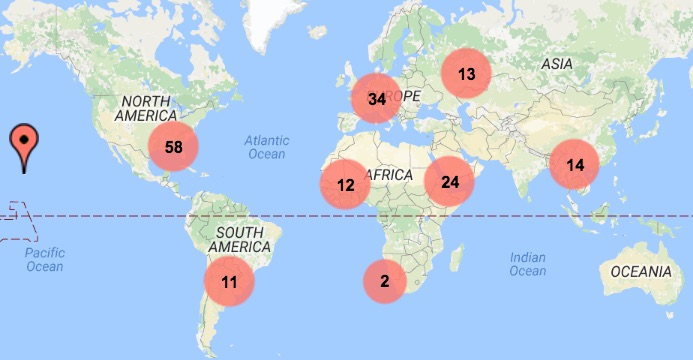
There are so many cities and institutions implementing Participatory Budgeting that it is almost impossible to keep track of them all. However, the Participatory Budgeting Project presents a map showing twenty of the most developed and interesting PB processes in North America, Latin America and Europe that illustrate the diversity of PB models. Readers can click on the markers or view the tables underneath the map to see basic information about each process.

Here are seven of the twenty examples.

Brazil: Porto Alegre, with nearly 1.5 million residents, was the first city to launch a full PB process, in 1989. Since then, up to 50,000 residents have turned out each year to decide how to spend as much as 20% of the city’s annual budget. Participants attend a series of local assemblies, and after months of discussions budget delegates deliver a participatory budget to the city for implementation.

(Article continued in right column)

Questions for this article:

Participatory budgeting, How does it work?

(Article continued from left column)

Brazil: Belo Horizonte, population 2.5 million, has had a district-level PB since 1993, a Housing PB since 1996, and a digital PB (e-PB) since 2006. Through both local assemblies and online voting, residents allocate over $50 million per year.

Argentina: Rosario’s PB consists of an annual cycle in which over 87,000 city residents decide how to allocate around $9 million of the city budget. In this city of 1 million people, residents discuss spending ideas at neighborhood assemblies, elected delegates develop full budget proposals, and then residents vote on the proposals at another round of voting assemblies. The funds can be spent on both capital projects and services or programs.

USA: In 2009, PBP and Chicago alderman Joe Moore launched the first PB process in the U.S., in the city’s 49th Ward. In the current process, residents of three Wards decide each year how to spend $3 million of taxpayer money.

USA: New York City is host to the largest PB in the U.S. in terms of participants and budget amount. First introduced in 4 council districts in 2011, the annual PBNYC process now spans 24 Council Districts and lets residents directly decided how to spend $25 million in capital discretionary funds. 

Canada: Since 2001, Toronto’s public housing authority has engaged tenants in allocating $5 to $9 million of capital funding per year. Tenants identify local infrastructure priorities in building meetings, then budget delegates from each building meet to vote for which priorities receive funding.

Spain: Seville (pop. 700,000) is the largest European city to implement PB. From 2004-2013, residents decided on roughly 50% of local spending for their city districts, for capital projects and programs. They submitted project proposals online or in neighborhood assemblies, and after a series of meetings, locally elected budget delegates delivered the participatory budget to city hall for implementation.

Kofi Annan, Foreign Ministers Pledge Support for a Mine-Free World by 2025

DISARMAMENT & SECURITY .

An article from the International Campaign to Ban Land Mines

Former Secretary-General of the United Nations Kofi Annan joined Foreign Ministers from Canada, Chile and Colombia in a packed room of Geneva’s Palais des Nations on 2 March 2016, pledging support for the Mine Ban Treaty as states embark on the “final stretch” towards a mine-free world. More than 35 donor states and states with landmine contamination, as well as mine clearance experts and UN bodies, explained how they will work towards this goal.

landmines

Other eminent personalities lending their support during the high-level panel opening the First International Pledging Conference for the Implementation of the Anti-Personnel Mine Ban Convention included the President of the International Committee of the Red Cross, the Director of the United Nations Office in Geneva, the Head of Danish Demining Group, and the Campaign Manager of the International Campaign to Ban Landmines.

The half-day conference highlighted the need for sustained financial resources and political support to meet the goals of the Mine Ban Treaty to the fullest extent possible by 2025, an aspirational deadline embraced by States Parties to the treaty during an international meeting in Maputo in 2014. It also aimed at ensuring sufficient resources for the treaty’s Implementation Support Unit.

Chile hosted the event, as current President of the Mine Ban Treaty, announcing that “Much remains to be done but the end is in sight. We are now in the last stretch towards a mine-free world!”

Sri Lanka surprised the audience with the announcement that the Cabinet had approved accession to the Mine Ban Treaty, a major development in South Asia where only three states (India, Nepal and Pakistan) will remain outside the treaty after Sri Lanka formally accedes.

1 March 2016 marked 17 years since the entry into force of the Mine Ban Treaty, a historical instrument of disarmament and humanitarian law. Under the treaty, states have stopped using, producing and selling antipersonnel mines, they have destroyed some 49 million stockpiled mines, cleared vast tracts of land, and taken steps to provide assistance to victims of the weapon. With 162 States Parties, the Mine Ban Treaty is one of the most universally accepted treaties.

More about the Pledging Conference:

Highlights from the conference storified by Michael P. Moore from Landmines in Africa

Canada Recommits to a Mine-Free World while Sri Lanka Approves Accession to Ottawa Treaty, Mines Action Canada

A Mine-Free World Is Possible, Danish Refugee Council / Danish Demining Group

(Thank you to the Good News Agency for calling this to our attention.)

Question for this article:

Education International and other Global Union Federation delegations begin their work at the 60th Session of the UN Commission on the Status of Women

. WOMEN’S EQUALITY .

An article from Education International

The full labour delegation present in New York, USA, is made up of an unprecedented 150 women union leaders from 34 countries. The Education International (EI) delegation to the 60th session of the UN Commission on the Status of Women (CSW60) has joined the other Global Union Federations (GUFs) delegations for the first week of the Commission’s deliberations (March 14th-18th).

csw unionists
Click on the photo to enlarge

The EI delegation got to work already on Sunday 13th, in conversation with Nora Fyles, Head of Secretariat of the UN Girl’s Education Initiative (UNGEI). Fyles gave a short presentation on ‘Policy Advocacy: UNGEI Speaking Out for Girls’ Education’, which was followed by a conversation with the EI delegates about their respective unions’ advocacy around girls’ education, and other gender and education issues.

Later in the day, EI delegates joined the full labour delegation for a briefing session, in which seasoned and new delegates alike were given information about the first week of CSW60, and the events planned by the GUFs, the ILO and key allies among the thousands of women’s rights organisations that are currently in New York for CSW60.

The CSW60 priority theme is Women’s Empowerment and its Link to Sustainable Development; and the review theme is The Elimination and Prevention of all Forms of Violence against Women and Girls (the Agreed Conclusions from CSW57). The priority theme is auspicious because CSW60 is the first major UN event to take place since the 2030 agenda for sustainable development was agreed, and the new sustainable development goals (SDGs) were adopted in September 2015. CSW60, therefore, presents a unique opportunity to bring the gender and education community for dialogue around the interlinkages between SDG 4 on education, and SDG 5 on gender equality.

On Wednesday March 16th, together with the Mission of Norway to the UN and UNGEI, EI will jointly host a side event entitled ‘Financing for Education: A Key to Empowering Women and Girls’. The EI President, Susan Hopgood, will speak on the panel, as will Ms Tone Skogen, Deputy Minister of Foreign Affairs, Norway, Ms Geeta Rao Gupta, Deputy Executive Director, UNICEF, Ms Meighan Stone, President, Malala Fund and Mr Justin van Fleet, Director, International Commission on Financing Global Education Opportunity. The event will be moderated by Mr Yannick Glemarec, Deputy Executive Director Policy & Programmes, UN Women, and introductory remarks will be offered by Ms Alice Albright, CEO, Global Partnership for Education.

Read the joint official GUF CSW60 statement, and keep up to date with what the labour delegates are up to here.

Follow the GUF delegation at the UNCSW on Twitter: https://twitter.com/unioncsw

(Thank you to Janet Hudgins, the CPNN reporter for this article)

(Click here for a French version of this article)

Question for this article

Does the UN advance equality for women?

The following article by Lyndal Rowlands in the Inter Press Service, suggests that the UN is not making much progress on its commitments for women’s equality:

2015 marks anniversaries for two significant commitments made to increasing women’s participation at peace tables.

Yet despite the Beijing Platform for Action and the Security Council Resolution 1325 both committing to increasing women’s participation in peace building 20 and 15 years ago, respectively, there has been very little progress to report.

The latest available statistics show that women made up only 9 per cent of negotiators at peace tables between 1992 and 2011. That the most recent data is from 2011 shows that more work is needed even in basic areas such as data collection and reporting of women’s participation in peace building.

IPS summarises here four reasons we should value women’s participation at the peace table more, based on discussions at the 59th Commission on the Status of Women (CSW) over the past week.

Beijing Platform for Action Section E

Women and Armed Conflict Diagnosis

Strategic objective E.1. Increase the participation of women in conflict resolution at decision-making levels and protect women living in situations of armed and other conflicts or under foreign occupation. Actions to be taken.

Strategic objective E.2. Reduce excessive military expenditures and control the availability of armaments. Actions to be taken.

Strategic objective E.3. Promote non-violent forms of conflict resolution and reduce the incidence of human rights abuse in conflict situations. Actions to be taken.

Strategic objective E.4. Promote women’s contribution to fostering a culture of peace. Actions to be taken

Strategic objective E.5. Provide protection, assistance and training to refugee women, other displaced women in need of international protection and internally displaced women. Actions to be taken.

Strategic objective E.6. Provide assistance to the women of the colonies and non-self-governing territories. Actions to be taken.
Women Bring Commitment and Experience to the Peace Table
Often the first people invited to participate in formal peace negotiations are the people holding the guns and the last are women who have expertise in building lasting peace.

Zainab Bangura, Special Representative of the Secretary-General on Sexual Violence in Conflict, told a CSW side event on Tuesday last week, “In the Central African Republic, the only community where they were not killing each other was a community where the Christian women said, ‘These Muslim women are our sisters.’

“Why? Because the women in the community said, ‘We have lived together for the last 100 years’,” Bangura said.

In the Phillipines, Irene Santiago was a member of the government panel that negotiated peace with the Moro Islamic Liberation Front. Santiago came to the table with years of experience working with Christian, Muslim and Indigenous women leaders for peace.

Speaking at a CSW side event at the International Peace Institute (IPI) on Thursday, Santiago said that she knew that her years of experience working with civil society for peace stood her in good stead to make a significant contribution to formal peace negotiations, which she did.

Speaking with IPS, Santiago said women’s voices not only have to be heard, but that they also have to be acted on.

“For women. It’s almost never always about themselves, it’s always about our children, our husbands but also about our communities,” Santiago told IPS.

In Africa, women have fought to be included in peacemaking, even when their contributions have not been recognised.

Bineta Diop, Special Envoy on Women Peace and Security to the African Union, says that mediators need to be held accountable when they only invite the people who hold guns to the peace table and ignore women’s contributions.

“I have been involved in many crises where women were knocking at the door and saying we want to be at the table,” Diop said.

Ambassador Anwarul Chowdhury, known as the father of Security Council Resolution 1325, said that the determination of African women to be involved in peace negotiations should be seen as an inspiration by other countries.

Despite serious difficulties, war and conflict, African women have shown continued determination to hold their countries accountable, Chowdhury said.

Gender Equality in Peace Time Prevents Conflict
Also speaking at the IPI, Valerie Hudson, co-author of ‘Sex and World Peace’, said that her research has shown that the way women are treated within a country is one of the most accurate indicators of the quality of relations that country will have with other countries.

Diop agreed with Hudson, saying that countries that are likely to fall into conflict have higher levels of discrimination and inequality.

“Discrimination against women, especially the non-participation and non-inclusion of women in democracy is … one of the root causes of the conflict,” Diop said.

Ambassador Choudhury agreed with these sentiments, telling IPS, “I believe that no country can claim that their country is not in conflict if women’s rights are denied, if women’s equality is not ensured, if women’s participation at all participation levels is not there.

“I think that if we women are violated, if women’s equality of participation is not there we cannot say that we are at peace, we are in conflict with ourselves. This is a conflict which is happening within ourselves and within the countries. We don’t have to go into the traditional description of conflict, civil conflict or fighting with another country,” Chowdhury added.

Dr. Youssef Mahmoud, Senior Adviser at the International Peace Institute also speaking at the IPI event said, “A world where 51 per cent are ignored is a dangerous world for everyone. I can’t imagine why any men would be indifferent to this.”

Women Are Active In Civil Society
Several discussions at the CSW questioned why militaries were the primary actors in peace building, while non-governmental organisations (NGOs) and civil society’s expertise was not called on.

Related IPS Articles

U.S. Honours 10 “Extraordinary Women” for Courage and Leadership
Meet the 10 Women Who Will Stop at Nothing
Women Walk for Peace in the Korean Peninsula
Santiago told IPS that civil society, especially women, have a lot to contribute to humanise, to concretise, and to make peace negotiations relevant to people’s lives.

Winnie Kodi from the Nuba mountains in Sudan told reporters on Monday that civil society was vital to helping indigenous communities like her own that have been affected by conflict. She said that the main way her people were able to have their voices heard was by working together with NGOs and civil society.

Chowdhury told IPS he is advocating for the U.N. and governments to hold more consultations with civil society, saying that the involvement of women and of civil society is very important.

Santiago also called for renewed focus on the important role of NGOs in the area of women, peace and security,

“Again I see that why are we focusing on the UN as the locus of change,” she said. “To me it is not, it is the means, it is an important audience, but it is not the locus of social change.

“Let us form the global civic networks that we need to bring about the local global and civil change that we need” Santiago said.

Women Challenge The Causes of Conflict
Challenging militarism and militarisation was another theme discussed during the first week of the CSW, particularly by civil society groups at the parallel NGO forum.

Choudhury told IPS that increased militarism and militarisation is slowing down efforts for equality. “Increasing militarism and militarisation has really been effecting women in a very negative way. This is something that women should stand up against, we should all stand up against,” Chowdhury said.

Militarisation is also affecting indigenous women and men. Maribeth Biano, from the Asian Indigenous Women’s Network, told reporters on Monday that Indigenous women are hugely affected by militarisation in Indigenous territories.

New Alliance: Compassionate Cities and International Cities of Peace Join Efforts!

.. DEMOCRATIC PARTICIPATION ..

Excerpts from the websites of International Peace Cities and Charter for Compassion

    A compassionate city is an uncomfortable city! A city that is uncomfortable when anyone is homeless or hungry. Uncomfortable if every child isn’t loved and given rich opportunities to grow and thrive. Uncomfortable when as a community we don’t treat our neighbors as we would wish to be treated.”
    ~Karen Armstrong, Founder of the global movement, The Charter for Compassion

Charter for Compassion International and International Cities of Peace are now working together. In coordination, the organizations wil help you self-define and get to work in making your neighborhood, city, or state a more compassionate place for all citizens to thrive.

compassion
Video: Charter of Compassion Toolbox

The Compassionate network has an amazing Tool Box to help you get a baseline of needs, then create an action plan for progress. Every Compassionate City, due to their current work, will be added to our City of Peace network upon request. Every City of Peace can have direct access to the Charter for Compassion’s director, Marilyn Turkovich, and their Tool Box. Get in touch and start the good work of compassion. For details, send an email to info@internationalcitiesofpeace.org

The Charter TOOL BOX is a four-part model or framework for building a Compassionate Community. Every city of peace would benefit from this: How to Assess, Commit, Launch, and Sustain your compassionate action plan.

The text of the Charter for Compassion:

The principle of compassion lies at the heart of all religious, ethical and spiritual traditions, calling us always to treat all others as we wish to be treated ourselves. Compassion impels us to work tirelessly to alleviate the suffering of our fellow creatures, to dethrone ourselves from the centre of our world and put another there, and to honour the inviolable sanctity of every single human being, treating everybody, without exception, with absolute justice, equity and respect.

(Continued in right column)

Questions for this article:

How can culture of peace be developed at the municipal level?

(Continued from left column)

It is also necessary in both public and private life to refrain consistently and empathically from inflicting pain. To act or speak violently out of spite, chauvinism, or self-interest, to impoverish, exploit or deny basic rights to anybody, and to incite hatred by denigrating others—even our enemies—is a denial of our common humanity. We acknowledge that we have failed to live compassionately and that some have even increased the sum of human misery in the name of religion.

We therefore call upon all men and women to restore compassion to the centre of morality and religion ~ to return to the ancient principle that any interpretation of scripture that breeds violence, hatred or disdain is illegitimate ~ to ensure that youth are given accurate and respectful information about other traditions, religions and cultures ~ to encourage a positive appreciation of cultural and religious diversity ~ to cultivate an informed empathy with the suffering of all human beings—even those regarded as enemies.

We urgently need to make compassion a clear, luminous and dynamic force in our polarized world. Rooted in a principled determination to transcend selfishness, compassion can break down political, dogmatic, ideological and religious boundaries. Born of our deep interdependence, compassion is essential to human relationships and to a fulfilled humanity. It is the path to enlightenment, and indispensable to the creation of a just economy and a peaceful global community.

Participating cities

Almost 70 cities [in 45 countries] globally have affirmed the Charter for Compassion through city, community councils or other govenment entities. Affirming the Charter means that a community has identified issues on which they are working, and committed to a multi-year action plan.

Click here for list of participating countries and cities