Category Archives: EDUCATION FOR PEACE

South Korea: Busan Film Festival and creation of world culture

EDUCATION FOR PEACE .

An article by Park Sang-seek published by the Korea Herald (reprinted by permission of the author and the publisher)

I attended as an invited guest the opening ceremony of the 22nd Busan International Film Festival on Oct. 12. I immensely enjoyed the whole ceremony and the reception. It reminded me of the 10th Singapore International Film Festival in April 1997 I attended when I served as Korean ambassador to Singapore.


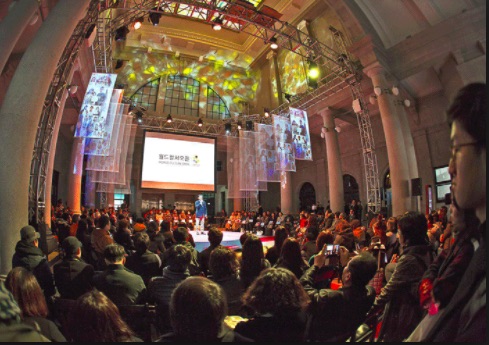
Photo from the 2016 Busan festival.

After the event in Singapore I wrote an article on the SIFF in the Strait Times in which I emphasized that nations can cope with deepening racial, ethnic and cultural conflicts through cultural exchange and cooperation despite, and because of, rapid economic and social globalization.

BIFF has made me reconfirm my belief. It is ironic that economic and social globalization has actually resuscitated racial, ethnic and cultural conflicts. The reason is that the more people contact each other, the less they understand each other.

When different races develop different cultures, they become divided into different ethnic groups. Different ethnic groups form their own states (nation-states). There are also multiethnic states, but they are in general more conflict-ridden than homogeneous nation-states.

Cultural exchanges in general are more likely to promote peace among states than any other exchanges, because economic exchanges rather strengthen nationalism, while social exchange can increase immigration and migration, which in turn create racial, ethnic and cultural conflicts within a state. We are eyewitnesses to such conflicts in multiracial, multiethnic and multireligious states in both the West and non-West.

Why can cultural exchanges promote mutual understanding and empathy better among different racial, ethnic and religious peoples?

My answer is that culture is more likely to activate empathy in the human heart than any other human activity. Empathy is the main source of peace. Some scholars believe that reason is the strongest source, but empathy is more prevalent and stronger than reason in the average human.

How would an average person react to foreign cultures? She may dislike or like them. But art performances transform them into emotional panaceas and invoke empathy in audiences. Among all art forms, film is the best to build empathy because it is an integrated art form (an amalgamation of novel, poetry, music, dancing, drama, sculpture and painting) and can affect every sensual organ of the human.

Whenever I see movies, my racial, national, ethnic, educational, family and ideological backgrounds suddenly disappear and I become a primordial human being and begin to empathize with any other kind of human being.

(continued in right column)

Question for this article:

Film festivals that promote a culture of peace, Do you know of others?

(continued from left column)

When I watched the Iranian movie “Gabbeh,” I thought I was living with a tribe in Iran and experienced the love of mankind. I had the same experience as I had at SIFF when I saw the “Glass Garden” (a profound anatomy of human nature) showcased at BIFF. When I watched a physically handicapped girl, my psyche became instantly connected to hers, my mind melded into hers and I shared my life with her.

Film is one of the most effective and inexpensive means of promoting empathy among all humans and consequently to create a culture of peace. According to the preamble of the UNESCO constitution, “since wars begin in the minds of men, it is in the minds of men that the defenses of peace must be constructed.”

UNESCO believes a culture of peace can be built through education, interstate cultural exchanges and the preservation of national cultural heritage and diversity. But it has been proven that member states have been using UNESCO for the preservation of their own cultures, not for the creation of a universal culture. I personally observed this during my tenure as South Korean ambassador to UNESCO in the early 1990s.

Since UNESCO which was created to promote world culture has been unable to fulfill its objective, some other international organizations and activities have to undertake this role. BIFF and other similar organizations worldwide are most well-suited for it. I have become more convinced of this after I attended the activities of BIFF this year. BIFF may make small contributions to the creation of world culture, but its small step will lead to a giant step for humankind toward the ultimate goal.

However, it will be practically impossible to build the foundation of world culture without going through an intermediate stage: a regional stage to provide a bridge to a world culture.

Therefore, each region should establish its own regional organization for cultural cooperation. I had this in mind when I proposed a Pacific Cultural and Information Organization at a conference hosted by the Korean Commission for UNESCO in the mid-1980s. Nation-states create a regional culture in their respective regions first and work toward the creation of a global culture next. It is encouraging to note that regional film festivals are also held in all regions.

The freedom of filmmaking is one of the most important human rights. It is not surprising that dictatorships take filmmaking under state control.

BIFF can contribute to the creation of peace and global culture while promoting human exchanges better than any other cultural organization, activity or diplomacy.

After I attended the festival, I thought the programs of BIFF could be improved.

One important shortcoming of the festival is that some programs are not well internationalized. For a lack of funds, the organizer uses many university students as volunteer workers and guides, interpreters or desk workers. But they are not quite familiar with Western culture and protocol. International conferences and events are held according to Western protocol and rules of conduct and therefore BIFF should also be held according to them.

I also believe BIFF should be completely depoliticized. Otherwise, the very purpose of BIFF, the creation of a culture of peace, will never be realized.

[Publisher’s note: The author, Park Sang-seek, is a former rector at the Graduate Institute of Peace Studies at Kyung Hee University and the author of “Globalized Korea and Localized Globe.”]
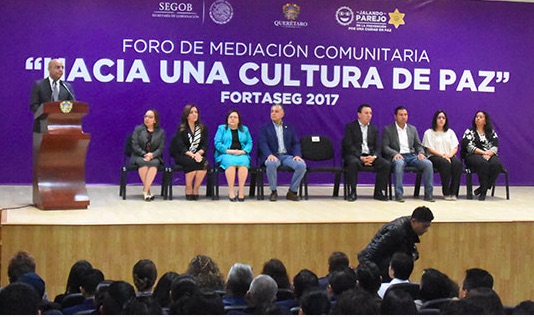
Colombia: Envigado inaugurates mediation center for the community

… EDUCATION FOR PEACE …

An article from 360 Radio (translated by CPNN)

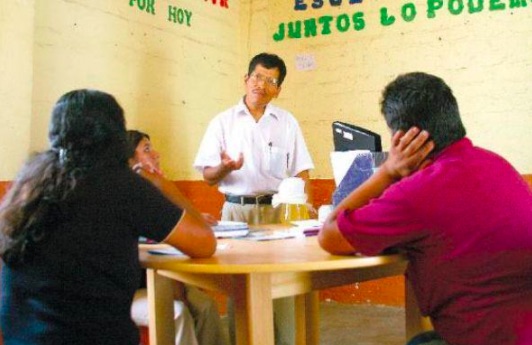
The Personería Municipal [municipal ombudsman] of Envigado, headed by Virginia López Flórez, inaugurated the new mediation center for the community, with which they will seek to provide greater solutions when resolving conflicts between citizens.

“The Center contributes to a culture of peace and tolerance, so that people settle their disputes in a peaceful and respectful way, returning to dialogue and dignified treatment with the help of an impartial third-person mediator. We seek to serve people from strata 1 and 2 who do not have the resources to pay a mediator in a private center,” according to a municipal representative.

The Mayor of Envigado, Raúl Cardona, who supported the initiative, was also present at the inauguration. “Now, the Envigadeños have another place to reconcile which is totally free. Obviously this will greatly improve relations and coexistence and make it easier to solve problems,” the Mayor told 360 Radio.

“We are the second municipality in the Aburrá Valley that has such a center and one of 8 at a national level. This helps ensure that small conflicts do not go to the judicial system and delay it. Whether we like the peace process or not, the country has to start to change and prevent conflicts from escalating into violence,” said Jorge Correa, president of the Envigado Council.

(click here for the original Spanish version)

Question for this article:

Challenge in Colombia: Peace displacing violence as inspiration for the arts

EDUCATION FOR PEACE .

An article By Camila Pinzón Mendoza for Huffington Post (translated by CPNN and reprinted according to the principles of “fair use”)

Colombian artists, filmmakers, musicians, playwrights and writers have a new challenge: to create peace instead of violence. At least if the agreements between the government and the guerrillas are complied with and respected. This is an interval of time without precedient for the Colombians for which they are not only witnesses but also creators. Two centuries of violence have defined their ways of feeling, thinking, living and inspired some of their best works of art, but today is a new time, the time of post-agreement .


Scene from the official trailer at El Fin de la Guerra

Living in a country without war brings to Colombians new ways of thinking, of narrating and of living. It’s a paradigm shift since the signing of the peace agreement with the FARC, on November 24, 2016, a transit scenario. This will be explored and reflected in the Neiva Cinexcusa Film Festival between the 23rd and 27th of October. It is the most important cinematographic and cultural meeting of the department of Huila and southern Colombia, a multidisciplinary event that involves literature, music, journalism and social sciences.

“We came from an overdose of film about drug trafficking and characters built in molds and clichés,” says Luis Eduardo Manrique Rivas, director of Cinexcusa. “Maybe,” he adds, “this is the time to tell stories with more real and current characters in more intimate environments that generate identification.” In this direction, the film Pariente, which will premiere at the Festival, will represent Colombia at the Oscars of 2018. The film talks about the enemies of peace. It tells the story of Willington’s love for Mariana while the rumor of a thief in the streets and a series of violent deaths bring back the memories of fear through “rural characters who are complex, contradictory and in dispute about the lack of love and of course, violence.”

“The territory of literature exists between history and myth,” reflects Daniel Ferreira (Colombia, 1981), a guest writer at the Festival. For the writer, “the torn opening of reality allows the past to become central, ordering the past and its contradictions with another sense in a distanced way that provides clairvoyance for the future”. Ferreira is the author of the novel, Viaje al interior de un gota de sangre (Alfaguara, 2017), recently published, in which he reconstructs a massacre through the voices of the victims and for whom “there are no collective, only individual truths”.

(continued in right column)

(Click here for the original Spanish version of this article.)

Question for this article:

Film festivals that promote a culture of peace, Do you know of others?

What is happening in Colombia, Is peace possible?

(continued from left column)

For twelve years now, Cinexcusa has addressed through the arts, the social and political problems of Colombia and the world, such as mistreatment of women, Nazism and the armed conflict of the country. Through Cinexcusa have passed authors like the Colombian Alfredo Molano, who has dedicated his life to narrate the history of violence in Colombia in books such as “Los años del tropel: relatos de la violencia,” “Trochas y fusiles,” and his most recent, “A lomo de mula.” Last year, the Argentinean Andrés Neuman, was invited and he brought the individual and collective experiences that he explores in”Una vez Argentina”. Two years ago the guest was the Argentine chronicler Josefina Licitra, who has narrated the memory of the devastated of the tragedy of Epecué in his book, “El agua mala, un episodio similar al ocurrido en Armero”. Other participating authors have included Manuel Rivas, Lucrecia Martel and Leila Guerriero.

During these five days there will be more than 30 activities, with 28 guests and 22 films, including feature films and short films, in 12 public settings in Neiva. Neiva, a city in the south of the country on the banks of the Magdalena River, has been an unavoidable place of passage, a strategic enclave for the support of the armies: a place of war. Now it is celebrated as an encounter of art, culture, peace.

The central theme of the projections of this 12th edition is the post-agreement. Thirteen films on this theme make up the bulk of the program, which also includes participation by the directors themselves or experts who open the debate, such as the director of Pariente, Iván Gaona, the well-known actor Álvaro Rodríguez and the film critic Augusto Bernal. With the purpose of providing a panorama of the national filmography, there is also the section of “Colombian Cinema”, a space to talk with the creators about their creation processes and experiences during the shooting. There is also a sample of short films, which has become a national contest, to disseminate and stimulate audiovisual projects, and a sample of films that are screened in several schools in the city, called “Cinema on the board”, which seeks to bring the cinema to the classrooms.

You are invited to look at some of the films that will be screened at Cinexcusa, a light on the contexts of war and post-conflict. Click here and scroll down for film trailers.

Brazil: Senac promotes debate on culture of peace in the educational system

… EDUCATION FOR PEACE …

An article from ABCdoABC (translated by CPNN)

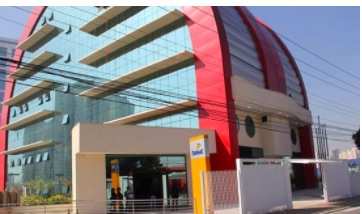
On October 21, Saturday, Senac São Bernardo do Campo will hold a conference on the Culture of Peace – sharing practices and integrating knowledge, as part of the program of the Education Expo. This action by Senac of São Paulo seeks to foster reflection on issues in the area of ​​education, with the aim of contributing to the process of teacher training and encouraging them in their mission as generators of knowledge and social development.


The debate will be mediated by Andrea dos Santos Pereira Nunes, a graduate in social communication, postgraduate in project management and coordinator of the Senac Culture of Peace Program. The theme is how to put into practice in the educational environment values ​​and attitudes based on respect life and practice of non-violence, through a participatory process for the promotion of dialogue, resolving conflicts at the root of their causes, in a spirit of understanding and cooperation.

(Article continued in right column)

(Click here for the article in Portuguese)

Questions for this article:

What is the relation between peace and education?

(Article continued from left column)

In 2017, the central theme of the Education Expo, which takes place at different stages throughout the network of Senac São Paulo, is “Innovation in education: what transformations do we need to make?” The general programming highlights a series of discussions and lectures on the importance of investing in innovative methods in the education process, as well as discussing the challenges for promoting learning that takes into account the capacities of the students and that harnesses the resources offered by the new technologies.

The activities of the Education Expo are all free and open to the general public, and especially suited to educational professionals. To know more about the event or about the courses offered in the unit, please access the Senac Portal: www.sp.senac.br/sbcampo.

Expertise in education

The Senac São Bernardo do Campo also offers courses for educators to develop and improve their professional practice. In the portfolio, there are several courses that help teachers bring important concepts such as inclusion, active methodologies, structuring of learning, etc. into their practice in the classroom.

More information about courses and registrations are available at the Portal Senac, www.sp.senac.br/sbcampo.

International Day of Non-Violence celebrations held in Nairobi, Kenya

EDUCATION FOR PEACE .

An article from the University of Nairobi

The United Nations International Day of Non-Violence celebrations were held at the University of Nairobi (UoN). The day which coincides with the birthday of Mahatma Gandhi, leader of the Indian independence movement and pioneer of the philosophy and strategy of non-violence is celebrated every 3rd October.


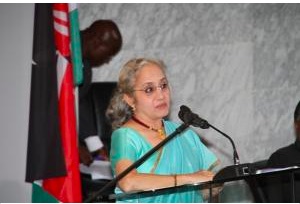
Ms. Rajni Bakshi, an eminent Gandhi scholar presents the keynote speech.

The keynote address ‘Celebrating Ahimsa: Advances in Non-violence’ was delivered by Ms. Rajni Bakshi, an eminent Gandhi scholar and member of Executive Committee of the Gandhi Smriti and Darshan Samiti (GSDS) of India.

Ms. Bakshi called upon Kenyans and the world to uphold non-violence saying that one does not have to be a great soul in order to cultivate non-violence.

“Mahatma Gandhi once said that ‘non-violence is as old as the hills.’ This simply means that in history, non-violence existed,” she said. “Every day, the media reports news of violence in different parts of the world. One thing we need to understand is that violence will never get you power. This is a truth that cannot be overemphasized. To Gandhi, non-violence is simply a science…knowing what works and what does not work.”

Ms. Bakshi cited historical events and great quotes by Mahatma Gandhi that the world could embrace.

“A world with no violence can exist,” she said. “It is up to you to embrace each other and co-exist. We do not need guns to pass a point across. Let us emulate the life of Mahatma Gandhi because his life is his message.”

(Article continued in the right column)

Question for this article:

Can peace be guaranteed through nonviolent means?

(Article continued from the left column)

Amb. Tom Amolo, from the Ministry of Foreign Affairs, said that everyone can be involved in creating a culture of peace.

“We should start preaching peace to the youngest of minds,” he said. “We need to embrace non-violence in resolving conflict and embrace co-existence.”

He was speaking on behalf of the Cabinet, Ministry of Foreign Affairs, Amb. Amina Mohamed.

The Vice-Chancellor, Prof. Peter Mbithi in his remarks said that Mahatma Gandhi was an intensely active personality who unendingly inspires many people around the world.

“As a university, I urge you to uphold the universal purpose of non violence by promoting culture of peace, tolerance, understanding and integrity to our institution of learning,” he said. “It is therefore incumbent upon us to resist the pressure to think and conduct ourselves in a formatted manner. We must resist the temptation to give in to popular beliefs and choices without questioning and objectively investigating their real value to society.”

The Indian High Commissioner to Kenya, Madam Sanduchitra Durai, urged all to embrace the wise teachings of Mahatma Gandhi.

“His life history is his message to us,” she said. “We have so much to learn from him and that is why the UN marked this day as an international celebrations day.”

The Director-General, UNON, Ms Sahle-Work Zewde, said that the teachings of Mahatma Gandhi are relevant to Kenya given the current political situation.

“Let us uphold Mahatma Gandhi’s philosophy of non-violence even as we approach October 26, 2017 for the repeat presidential polls,” she said. “As Kenyans it is important for each one of us to embrace a culture tolerance.”

The event was organized by UoN, the United Nations Office in Nairobi, the Indian High Commission in Kenya and Kenya-India Friends Association (KIFA).

Maine, USA: Reclaiming a Culture of Peace and Non-Violence

… EDUCATION FOR PEACE …

An article from the University of Maine

University of Maine Peace and Reconciliation Studies Fall Conference and the 14th annualESTIA conference present “Reclaiming a Culture of Peace and Non-Violence”

Monday, October 16, 10:00am-5:00pm, Buchanan Alumni House

10:00am-12:00pm — ESTIA Presenters

ESTIA (Eco-peace, Sustainability, Training, International Affiliations), the International EcoPeace Community, is a Maine-based nonprofit founded in 2004. ESTIA promotes and facilitates sustainability and peace through education, and has been instrumental in organizing conferences and permaculture training sessions over the course of the past 14 years. ESTIA has an long-standing af liation with UMaine, and several board members are part of the Peace and Reconciliation faculty.

Darren Ranco — George J. Mitchell Center for Environmental and Watershed Research and Native American Programs, Member of the Penobscot Indian Nation

Hawk Henries — Member, Chaubunagungamaug band of Nipmuck

(Article continued in right column)


Question related to this article:

University campus peace centers, What is happening on your campus?

(Article continued from left column)

Noon — Light lunch served

1:00-5:00pm — Peace and Reconciliation Studies Presenters

Religion and the Conflict in Northern Ireland — Part of the Problem or Part of the Solution?
Gladys Ganiel, Research Fellow, Sen. George J. Mitchell Institute for Global Peace, Security and Justice Queen’s University, Belfast, Ireland

Peace, Conflict and War: The Role of Language and Languages – Timothy G. Reagan, Dean, College of Education and Human Development University of Maine

A Buddhist & Celtic Interpretation of Animal Ethics – Hugh Curran, Peace and Reconciliation Studies University of Maine

How Mahatma Ghandi Challenges Us to Rethink our Approach to Nonviolence, Peace and Reconciliation – Douglas Allen, Department of Philosophy University of Maine

Mentioning the Unmentionable: Talking About -isms in the Classroom – Judith Josiah-Martin and Alison Smith Mitchell, School of Social Work University of Maine

Waging Peace Through Music—A Look at Historical Highlights – Laura Artesani, Associate Professor in Music Education, School of Performing Arts University of Maine

It’s Mine! Promoting Conflict Negotiation with Young Children – Susan Bennett-Armistead, Associate Professor in Literacy, College of Education and Human Development University of Maine

Mauritania: Festival Nouakchott Jazz Plus: 18th to 23rd of September 2017

… EDUCATION FOR PEACE …

An article from Le Reflet (translated by CPNN)

In order to better know the jazz music in Mauritania, the association “Les Echos du Sahel” has organized this year the jazz festival in collaboration with the Ministry of Culture and Crafts, the French Institute (IfM) , the Embassy of France, the Embassy of Spain and the Embassy of the United States, also with the support of other associations and economic institutions.

This festival is intended to be “a great meeting of intercultural exchanges between Mauritanian musicians and those of the sub-region, Europe and the United States. It is part of the promotion of jazz music as a vector of peace, freedom of expression and unity: It carries a message of tolerance and openness to others, for a perfect social cohesion . ”

The challenge is also to “create and develop time and space for exchange between cultures through discovery workshops, sharing experiences with professional musicians from Mauritania and abroad. To introduce Mauritian musicians and young people to the practice of jazz, to promote the culture of peace and tolerance in the subregion, in the countries of the Sahel and in the world through the jazz festival and to perpetuate the jazz festival in Mauritania” according to Babi Sarr, secretary general of the” Echos du Sahel “and initiator of the festival of jazz in Mauritania.

(Article continued in right column)

(Click here for a French version of this article)


Question related to this article:

What place does music have in the peace movement?

(Article continued from left column)

The program includes: Concerts by Mauritanian and foreign artists, educational workshops between foreign and Mauritanian musicians, an exhibition, lectures and debates, screenings of jazz films and a vibrant tribute to the late Saidou Bâ Banbaado, traditional guitarist, by his son Cheikhou Bâ and the musician Steve Shehan from France.

Among those invited to this cultural event: Kahil El’Zabar and David Murray (USA), Samy Thiébault (France), Steve Shehan (France), Jerez – Texas (Spain), Noura Seymaly (Mauritania), Walfadjiri Orchestra (Mauritania).

As a reminder, the launch of this edition is scheduled for September 18 at 8 pm at the Echos du Sahel. A press conference of the Nouakchott Jazz PLUS Festival 2017 will take place Tuesday, September 19 at 10 am at the Hotel Monotel.

The event will be marked in particular by a concert by Samy Thiebault, on September 19th at the IfM (1,000um / 500 um for the members) at 8 pm, on 21 September a concert at the Ifm at 8 pm with Noura Seymali, Dental Orchestra (Mauritania), Jerez Texas, David Murray and Kahil El’Zabar (USA) (free entry). A dinner concert is scheduled on Friday, September 22 at the Hotel Monotel at 8 pm entrance 10,000 um.

A restitution of the educational workshops with David Murray & Kahil El’Zabar and Mauritanian trainee musicians will be offered on Saturday 23rd September at 8pm at the Echos du Sahel (free admission), the public will also vibrate during this evening to the rhythm of the duo Steve Shehan and Cheikhou Ba to the Echoes of the Sahel.

Brazil: Mahatma Gandhi monologue will bring the Culture of Peace to the Municipal Theater of Barueri

… EDUCATION FOR PEACE …

An announcement by Barueri na Rede (translated by CPNN)

On Thursday, September 9, with two presentations, at 3 PM and 8 PM, the Municipal Theater of Barueri will feature the free monologue of Mahatma Gandhi, The Change We Want to See, performed by the actor and journalist João Signorelli. The purpose of the show is ‘to spread a culture of peace and to replace the culture of war and domination of the other by a culture of respect and acceptance of cultural diversity’.


During the 50-minute presentation, Signorelli shows the public the trajectory of Gandhi as leader and his task of sowing solidarity among peoples. Throughout the day there will be a program focused on the theme Culture of Peace and Nonviolence, a thinking for peace – that begins at 1:00 pm with the exhibition Occupation for Peace, followed at 2:00 pm by a children’s talk and a sample of research on the theme done by students of the municipal network.

The first presentation of Gandhi’s monologue will be at 3 o’clock. The program extends to 19 hours with poems recited by students of municipal schools and ends at 20 hours, with another presentation of the show Mahatma Gandhi – The Change We Want to See.

In 2000, the manifesto For a Culture of Peace and Non-Violence was launched by Unesco with six basic principles: respect for life; reject violence; be generous; listen to understand; preserve the planet; rediscover solidarity.

For those who want to check out the monologue presentations, free tickets are already available at the TMB box office, located at Rua Ministro Raphael de Barros Monteiro, 255, in Jardim dos Camargos.

(Click here for the original Portuguese version)

Mexico: Tlalnepantla initiates program of Youth for a Culture of Peace

EDUCATION FOR PEACE .

An article by Huellas de Mexico (translated by CPNN)

Mayor Denisse Ugalde Alegría has launched the program “Youth for a Culture of Peace”, which provides for the painting of murals with different messages in more than 120 public spaces to raise public awareness of the importance of promoting a healthy coexistence through positive actions.


A mural in Tlalnepantla

Speaking to more than 100 young people who gathered in the municipal esplanade, Denise Ugalde stressed that their participation is fundamental for the development of this municipality, as they represent 30 percent of the population.

She announced that starting on September 29 the city will implement the program “Drive for life, Drive for peace”, aimed at reducing the number of car accidents due to alcohol.

She said that according to statistics of the Pan American Health Organization, Mexico ranks seventh in the world in deaths from road accidents involving young people between 15 and 29 years of age, hence the challenge of the 2016-2018 administration is to raise public awareness about this problem.

(continued in right column)

(Click here for the original Spanish version of this article.)

Question for this article:

Do the arts create a basis for a culture of peace?, What is, or should be, their role in our movement?

(continued from left column)

Alejandra Rangel Díaz, director of the Municipal Institute for Youth, explained that the program “Youth for a Culture of Peace” was born from a project of several areas of the administration that seek to spread healthy coexistence between people through different activities.

She explained that on the instructions of the municipal president, the murals should carry short messages and images that promote a culture of peace, such as respect for people, animals and care for the environment.

She added that with the support of the Social Communication Coordination, to date 60 murals have been painted throughout the municipal territory, in which young people can freely express themselves, thus contributing to crime prevention.

She stressed that private initiatives have also joined in this project, providing their respective fences so that the people of Tlalnepantlenses can express themselves and thereby prevent them from falling into misconduct.

The municipal official said that this program is in addition to the nearly 100 events that were held on the occasion of the Youth Month, including a speech contest, a forum on human rights, sexual diversity talks, gender equity and participation youth policy.

In this event, attended by Eunice Santos, coordinator of Social Communication; Rubén Omar Herosa, representative of the Regional Red Cross; and Alejandra Rizo, president of Santa Monica Scouts; the artist, Antonio García Mendoza “AKO”, indicated that all the murals contain elements that besides promoting peace, convey a sense of identity and belonging.

It should be noted that as part of the program,”Youth for a Culture of Peace”, it is contemplated to give a new image to outdoor theaters, among them, the Algarabía, which soon will have a mural that will be selected through a contest.

Iceland: Spirit of Humanity Forum promotes love, transformation and humanity

… EDUCATION FOR PEACE …

An article by Myrian Castello, Fábrica dos Sonhos (the Dream Factory)

Every two years the Spirit of Humanity Forum (www.sohforum.org) brings together leaders from around the world to talk about love, peace and humanity, to empower people and encourage a lasting transformation in the world.


This year the forum took place in Reykjavik, Iceland, and I was fortunate to be one of the invited guests. The Forum featured a one-day pre-event focused on education in which we talked about the possibilities of building an education based on multiple values ​​such as love, empathy, hope and courage. Some of the questions were “What is the purpose of education?” And “Where do we begin to change?”

(Article continued in right column)

(Article continued from left column)

In the following days we heard the speech of the President of Iceland, which was full of humanity, telling about the history of his life in a very welcoming way. He shared with us the changes needed in the world beginning with each person, including himself and he ended with a poem written by him. We then heard panels with people sharing their stories and took part in various workshops geared toward love, transformation and culture of peace.

In response to one of the questions, “How should we be so that there is peace?” we talked about the power of relationships and how we need to understand relationships at different levels (intrapersonal, interpersonal, nature, planetary), the importance of the energy you bring to a conversation and how it is possible even sitting in an auditorium for a speaker to transform the stage into a circle of viewers by leading the conversation and sharing the journey.

What remained was “We are created by life as we have created it” and the importance of establishing connections and giving support to people and relationships. Coexistence, understanding what makes us human and connection are certainly important themes for being, becoming and making peace.

(Click here for the article in Portuguese)