Category Archives: DEMOCRATIC PARTICIPATION

UN-AUSC Youth Forum: The Role of Young People in the 13Th African Games

.. DEMOCRATIC PARTICIPATION ..

Excerpts from an announcement from the United Nations Alliance of Civilizations

DRAFT CONCEPT NOTE

BACKGROUND

. . . The United Nations acknowledges the value of the youth in peacebuilding through the development of United Nations Security Council Resolutions (UNSCR) 2250 (2015), 2419 (2018), and 2535 (2020) on Youth, Peace, and Security that called upon the United Nations (UN) entities and Member States to improve capacity-building by integrating the Youth, Peace, and Security agenda into their technical assistance plans. Also, the African Youth Charter recognizes that “youth are partners, assets and prerequisite for sustainable peace and prosperity of Africa with a unique contribution to make to the present and future development.”

Through unique engagement, such as sports, the youth have led and sustained peacebuilding and development conversations across societies. Sports have historically played a significant role in disseminating positive values worldwide and across civilizations and cultures, thus making it a powerful vector for developing efforts to promote peace and prevent and counter violent extremism. . . .

PROPOSAL

The Global Sports Programme will organize a Youth Forum on the role of young people in the upcoming 13th Edition of the African Games (Accra, Ghana, set to commence in March 2024) in partnership with the AUSC, which oversees the coordination and organization of the African Games—building on the power of sport to promote increased youth participation in the organization of major sporting events. Other partners are the 13th African Games Local Organising Committee (LOC) which comprises key Ghanaian stakeholders, the Ghana National Peace Council which is responsible for implementing the National PVE Strategy, and the UN Country Team.

OBJECTIVES

Raise awareness of integrating youth in major sporting events, particularly from an African perspective.

Establish a dialogue between youth and decision-makers about the power of sports and major sporting events to prevent violent extremism, showcasing unique youth approaches, including those targeting the vulnerable youth population.

(continued in right column)

Questions for this article:

How can sports promote peace?

(continued from left column)

● Encourage more investment and support towards youth-led sport-based PVE initiatives and increased youth participation in major sporting events.

● Concrete guidelines on the greater inclusion of young people in PVE-based activities within the context of a major sporting event.

TIME AND PLACE

• 21-22 November 2023 (2 days) in Accra, Ghana

FORMAT

● We count on the participation of approx. 15 African civil society leaders between 18 and 35 years old and involved in major sporting events, decision-making, and/or sport for PVE. ● This Forum will feature ‘safe and brave spaces,’ working groups, presentations, etc.

● The young people will have the opportunity to go into dialogue with the organizers of the upcoming 13th African Games, including the AUSC and the LOC, as well as other PVE-through-sport/sport for peace stakeholders, including civil society organizations and the UN.

EXPECTED OUTCOMES

● Raised awareness of the role and significance of sport in PVE. ● Inclusion of strategies for PVE interventions while organizing major sporting events and its integration into NAPs.

● Compiled recommendations on integrating young people in organizing major sporting events and related sport-for-PVE initiatives.

SELECTION OF PARTICIPANTS

● Due to limited slots, participants will be subjected to a selection process that will consider the relevance of their application, their experience, the motivation and interest demonstrated, as well as their potential contribution to the discussions. To the extent possible, the selection committee will balance age, gender, and diversity of backgrounds (cultural, educational, professional) among selected participants.

ELIGIBILITY CRITERIA

● Age: 18-35 years of age

● Region: African Union Member States

● Interest in themes: the applicant demonstrates some experience and knowledge (or a great interest in getting involved) in issues related to PVE (through sport), the organization of major sporting events, sport for development and peace, and/or meaningful youth engagement.

● Future impact and follow-up: the applicant expresses a strong commitment to further engage on the topics and has the ability to consult with and reach a wider group of young people, audiences, or networks, including leading initiatives at the grassroots and community levels.

● Experience and potential: experience in the development of policies and guidelines and advocacy in PVE.

From Trauma to Healing: New Book Series from International Cities of Peace

. . DEMOCRATIC PARTICIPATION . .

An announcement from International Cities of Peace

Announcing a Book Series on International Cities of Peace just published in China in Chinese and English. The Series is edited by Professor Liu Cheng, UNESCO Chair of Peace Studies in China and Board Member of Cities of Peace, a nonprofit U.S.-based association of nearly 400 global Cities of Peace. The Series already includes books on many cities that have experienced major trauma from war: Dresden, Nanjing, Warsaw, Coventry, and Hiroshima.

(article continued in right column)

Question related to this article:
 
How can culture of peace be developed at the municipal level?

(article continued from left column)

“When the traumatic memory of a city is transformed into a common human memory,” the books begin, “we can understand the past disasters in a new way beyond stereotyped political memory. Only this can enable the traumatic history to be linked to the future peace, which can promote the reconciliation between the former hostile parties, and boost hope to the establishment of a community with a shared future for mankind.”

This book series on International Cities of Peace is a tremendous step forward in recognizing the horror of war and understanding the need to move our communities from simply memorializing the trauma toward cultural and personal healing. Great thanks to Professor Liu Cheng who is leading a surge of peacebuilding dialogues and Peace Studies programs in Asia. International Cities of Peace is a platform that can take the world beyond the traumas of the past into a new age of community engagement and healing.

(Thank you to Fred Arment, for sending this announcement to CPNN.)

PAYNCOP Gabon Trained Youth and Women in Political Leadership in the City of Oyem

. . DEMOCRATIC PARTICIPATION . .

Special for CPNN by Jerry Bibang

Thanks to the support of the International Organization of La Francophonie (OIF) the Pan-African Youth Network for the Culture of Peace, Gabon section (PAYNCOP Gabon) trained, over the past weekend, around thirty youth and female candidates from the commune of Oyem for political leadership.

The town hall hosted the training workshop which brought together nearly forty participants, from the political parties of the majority and the opposition as well as independent candidates.

Long before the training workshop, an intergenerational dialogue was organized between the local authorities and the participants. This dialogue allowed participants to exchange freely with local authorities in order to strengthen collaboration between the two parties, in an inclusive management approach that gives young people the opportunity to participate in public affairs.

“We cannot all be mayors, municipal or departmental councillors. However, it is possible to participate in the management of public affairs when there is genuine collaboration between the local authorities and the citizens united in associations. This is the meaning of this intergenerational dialogue,” explained Jerry Bibang, the Project Coordinator.

(continued in right column)

(Click here for the original French version of this article)

Question related to this article:
 
Youth initiatives for a culture of peace, How can we ensure they get the attention and funding they deserve?

How should elections be organized in a true democracy?

(continued from left column)

“The representation of young people and women remains very low in political decision-making bodies, although they are the most numerous activists in the political parties of the majority and the opposition. This is why we want to accompany them during these various elections in order to improve this representativeness,” he added.

For the Secretary General of the prefecture, Cyprien Meboune M’Esso, “the project is in line with the country’s public policies, in particular the National Youth Policy (partnership contract for responsible youth) which recommends associating young people in the management of public affairs. It is also part of the political will of the highest authorities, a will materialized by several measures, in particular “the youth seven-year term” and “the women’s decade”.

The training, provided by the geopolitical expert and international consultant Francis Sima Mba, was intended to be very practical, essentially concerned elements relating to the electoral campaign, including political strategy, development of a political program, political marketing as well as public speaking tips.

“It was very instructive for us. We learned a lot about the actions to take before, during and after the vote. I also learned about managing a campaign team and even how to behave during the campaign,” said Junior Franck Nkou-Nkou, young candidate for the Forum pourla République Gabonaise (FRG) political party.

“The seminar was very fruitful for us because we learned how to run an effective campaign with limited resources,” added Mengue Arlette, young candidate for the Mon Destin en Main (MDM) party.

In addition to training, the project provides logistical support for young and female candidates who meet the defined criteria.

United Cities and Local Governments of Africa (UCLG Africa) and the African Centre for the Constructive Resolution of Disputes (ACCORD) Center are joining efforts to build a Culture of Peace in Africa, through Training Trainers on Conflict Management

. . DEMOCRATIC PARTICIPATION . .

An article from African Business

The UCLG Africa’s (www.UCLGA.org) Local Governments Academy (ALGA) and the African Centre for the Constructive Resolution of Disputes (ACCORD) based in Durban, South Africa, will kick off their first Training-of-Trainers (ToT) Programme on Conflict Management Capacity this month with the first Workshop planned to take place from July 16th  to 22nd 2023, in Al Akhawayn University, Ifrane, Kingdom of Morocco.  


This Workshop is the first step of an important Conflict Management ToT Programme that will end with the graduation Ceremony and awarding of Certificates in 2025. 

Given the scope and challenges of conflicts faced by African Local and Regional Governments, the training, empowerment and capacity building of a first Cohort group within UCLG Africa Constituency will help in the promotion and anchoring of a culture of Peace at the Subnational level. 

This activity is part of the implementation of the Strategic and Sound Partnership signed between UCLG Africa and ACCORD in 2021.  

A group of 15 Representatives of African Local and Regional Governments will benefit from this rich and promising Program.

This first Seminar will be delivered and animated by Key Peacebuilding Experts and Practitioners of ACCORD, namely: 

* Mr. Philip Visser, ACCORD’s Manager of Applied Knowledge and Learning, 

* Mrs. René Ngwenya, ACCORD’s Consultant Trainer and Conflict Analyst.  

This first in-person ToT event will focus on peacebuilding, dialogue, negotiations and mediation with the goal of building a Network of competent and capacitated Trainers within UCLG Africa, who will be able to design, facilitate, disseminate, and evaluate peacebuilding and conflict management training in their own local contexts, and conduct conflict management workshops for Local and Regional Governments, Political leaders and Territorial Managers. The objective is also to encourage the production of contextual knowledge products and Peer Learning. 

Distributed by APO Group on behalf of United Cities and Local Governments of Africa (UCLG Africa).

Press contact:
lbensmain@uclga.org
+212641884326 

About UCLG Africa:  


United Cities and Local Governments of Africa (UCLG Africa) is the umbrella organization of local authorities in Africa whose founding congress took place in 2005 in the city of Tshwane, South Africa. UCLG Africa stems from the unification of three continental groupings of local governments following the official language inherited from the colonial period, namely: the African Union of Local Authorities (AULA), mainly English-speaking; the Union of African Cities (UVA), essentially French-speaking; and the Africa chapter of the União das Cidades e Capitais Lusófonas Africanas, Americanas e Asiáticas (UCCLA), mainly Portuguese-speaking.  

(Article continued in right column)

Question related to this article:

How can we develop the institutional framework for a culture of peace?

(Article continued from left column)

UCLG Africa currently brings together the 51 national associations of local governments operating in Africa as well as 2,000 cities and territories with more than 100,000 inhabitants. Through its members, UCLG Africa represents more than 350 million African citizens. Founding member of the world organization of United Cities and Local Governments (UCLG), UCLG Africa is its regional chapter for Africa.  

The general secretariat of the organization is established in Rabat, capital of the Kingdom of Morocco, where UCLG Africa enjoys diplomatic status as an International Pan-African organization. UCLG Africa is also represented in the five regions of Africa through regional offices. based: in Cairo, Egypt, for the North Africa Region; in Accra, Ghana, for the West Africa Region; in Libreville, Gabon, for the Central Africa Region; in Nairobi, Kenya, for the Eastern Africa Region; and in Pretoria, South Africa, for the Southern Africa Region. www.UCLGA.org 

About ALGA of UCLG Africa: 


At the origin: a “Moroccan Initiative for an African Vision”. The African Local Governments Academy (ALGA) was created based on the Resolution adopted by the Hon. Members of UCLG Africa, the Hon. Ministers of Decentralization and their Partners, at the end of the Summit V of Africities, organized in the Kingdom of Morocco, in Marrakech in 2009.   

«The promotion of the territorial dimension of development in Africa cannot be fully effective without the support of trained Human Resources that are involved in implementing it. This is why the African Ministers and Mayors who attended the Marrakech Meeting subscribed to Morocco’s Proposal to create a « Support Centre for the reinforcement of Local Authorities’ managerial and technical capacities ». The goal is to build up, share and spread best experiences and practices in Africa. This recommendation gave rise to the plan to create an African Academy of Local Authorities». (Source: Report of Africities Summit V, Local Africa moves Africa. Marrakech 16-20 December 2019, pp. 32-33).  

After several feasibility studies, including a mapping of the Training Institutes targeting the Local Governance, organized with the support of the Ministry of the Interior of Morocco, ALGA of UCLG Africa became operational since 2016. 

About ACCORD:  


The African Centre for the Constructive Resolution of Disputes (ACCORD) is a conflict management institution based in Durban, South Africa, that seeks to encourage and promote the constructive resolution of disputes, by the peoples of Africa, and so assist in achieving political stability and socio-economic recovery, within just and democratic societies, towards peaceful co-existence.

ACCORD works to bring conflict resolution, dialogue and institutional development to the forefront as a preferred approach to deal with protracted conflict and escalation to violence and armed combat. ACCORD builds capacity and skills through training, policy development and research, and recognizes the important role of the stakeholders at the local and national level, such as local governments and civil society organizations. 

Within ACCORD, its Applied Knowledge and Learning cluster/unit is responsible for the design and implementation of strategic training and learning to position ACCORD as the continent’s leading peacebuilding capacity development organization. https://www.ACCORD.org.za/

France: FSU course on building peace, fighting without violence: a revolutionary idea!

. . DEMOCRATIC PARTICIPATION . .

An announcement from Syndicat National Unitaire des Instituteurs – 35

Every year the trade union federation, FSU Bretagne, organizes a large federal training course at regional level. This year we are returning to the two-day colloquium formula as for the 2019 internship on Food in Guitté.

Our course will be held at the youth hostel in St Malo (35) on Wednesday 18 and Thursday 19 October. The theme of these two days will focus on peace and the need to develop a culture of peace and non-violence, in conjunction with the activists of the Mouvement de la Paix Bretagne.

In addition to the theme of educating young people for peace, which is dear to us, we will give a large place to the issue of multilateralism and social and climate justice in international relations. Our work will also focus on the issue of violence in social and political relations in our societies. This second part of the internship is of particular urgency in our current situation marked by the government’s repression of social movements in the name of “republican order”, their fight against “ecoterrorism”, and their plans to force youth to be obedient.

(article continued in right column)

(click here for the original French version)

Question related to this article:
 
What is the contribution of trade unions to the culture of peace?

(article continued from left column)

The program for these two days is not yet completely fixed and the FSU is currently continuing contacts with the prospective speakers. The following have already given, among others, their agreement to participate in these two days:

– David Adams of the Seville Statement on Violence and Unesco Culture of Peace,

– Bertrand Badie, specialists in international relations, professor emeritus at Sciences -Po Paris and CERI,

– Alain Bergerat, historian, author of the History of France through songs, Jacques Fath, author of Putin, NATO and war,

– Amélie Hart-Hutasse, teacher, head of the history-geography group at SNES which follows the ‘Universal National Service’ file,

– Venance Journé, physicist, representative of the Climate Action Network at the ESEC, author of Weapons of Terror Ridding the world of nuclear, biological and chemical weapons,

– Frédéric Mathieu, parliamentarian, member of the commission of Defense at the National Assembly,

– Sebastian Roché, director of research at the CNRS, specialist in relations between the police and the population, author of De la police en democratie,

– Laura Lema Silva, specialist in social movements in Colombia, head of studies at the Institute for Peace and associate member of the LCE laboratory of Lyon-2,

– Nathalie Tehio lawyer, member of the national office of the LDH and of the Paris Observatory of public freedoms, author of a report on the BRAV-M units.. .

You can register now online by following this link: https://framaforms.org/construire-la-paix-lutter-sans-violence-une-idee-revolutionnaire-1681734847 or by means of the registration form below. Registration confirmations with the precise program and organizational arrangements for these two days will be sent to registrants at the end of September.

Don’t wait to register and to submit your request for leave of absence to your school (strict deadline of 1 month, i.e. a deadline for submission on Friday 09/15/2023).

Register early and spread the word – the course is open to FSU union members and non-union members alike.

The registration form can be sent by post to the address indicated or sent by email to aetj.le-bourg@wanadoo.fr Online registration can also be done via the website https://bretagne.fsu.fr

Argentina: Conference on culture of peace and coexistence in diversity for the community of the City of Rio Primero

.. DEMOCRATIC PARTICIPATION ..

An article from the Universidad Provincial de Córdoba (translation by CPNN)

Last Wednesday, June 14, the Open Chair for the Right to Peace and Coexistence in Diversity, of the Provincial University of Córdoba, held a conference on culture of peace and coexistence in diversity for the community of the City of Rio Primero.

Questions for this article:

How can culture of peace be developed at the municipal level?

This initiative was proposed by the mayor of the city, Cristina Cravero, and planned by the Coordinator of the University Chair, Maria Alba Navarro.

Members of the Río Primero community participated in the event: primary and secondary level teachers; firefighters, health professionals, justices of the peace, members of the municipal management team, among others.

The meeting and training space was proposed to address concepts related to the culture of peace and peaceful coexistence, ending with the creation of proposals aimed at improving coexistence in the community.

In addition, this initiative allowed the Municipality of Rio Primero to join REDIPAZ (Inter-institutional Network and People for Peace), to begin working in a coordinated manner with the various institutions and actors that make up the Network.

These activities allow the Provincial University of Córdoba to continue contributing to the construction of a Culture of Peace and more just, peaceful and inclusive societies.

(Click here for the Spanish original of this article)

Spain: The Forum for a Culture of National Security approves the proposal to create a Culture of Peace Group led by Crue

. . DEMOCRATIC PARTICIPATION . .

An article from Crue Universidades Españolas  (translation by CPNN)

The Forum for a Culture of National Security approved on May 30 the five proposals of the working groups of the entities, institutions and organizations that are part of this body. Among the projects submitted to consensus was the creation of the “Culture of Peace” working group, which will be led by Crue Universidades Españolas, co-led by the Ministry of Social Rights and which will have the collaboration of the Coexistence Pact, an entity which is part of Crue.

(Editor’s Note: Crue Universidades Españolas, established in 1994, is a non-profit association of 76 Spanish universities: 50 public and 26 private.)

The Crue delegate for European Affairs, José María Sanz, was in charge of presenting the general lines of a working group that seeks to promote compliance with SDG 16 (promote just, peaceful and inclusive societies) and target 7 of SDG 4 (promotion of a culture of peace and non-violence, global citizenship and appreciation of cultural diversity and the contribution of culture to sustainable development).

(Article continued in right column)

(Click here for the original Spanish version of this article.)

Question related to this article:

How can we develop the institutional framework for a culture of peace?

(Article continued from left column)

Crue’s proposal contemplates two main activities: carrying out a diagnosis in universities on social sustainability and prevention and response to violence –for which a panel of social sustainability indicators will be defined that will help to carry out a diagnostic report– and the promotion among universities of the International Day of Coexistence in Peace (May 16).

The other working groups approved were:

* Human Security through non-formal education, led by the Youth Council in Spain and co-led by the Youth Institute;

* The culture of local security: Self-protection, led by the Spanish Federation of Municipalities and Provinces (FEMP) and co-led by the Association of Professional Specialists in Civil Protection and Emergencies (ANEPPE);

* Culture of belonging within a more egalitarian society, led by the Spanish Confederation of Student Parents’ Associations (CEAPA) and co-led by the Spanish Observatory on Racism and Xenophobia;

* The incidence of transversal professional criteria in the field of preventive action and as a means for resolving action, led by the Professional Union and co-led by the Ministry of Labor and Social Economy.

The Forum was established on 26 November and is made up of an equal number of people representing the General State Administration and the public sector, and designated people representing civil society organizations, academia, associations and non-profit entities. The main lines of action of the Forum are, first, to promote in the educational system and in training courses the values of education and a culture for peace, democratic values, non-violence, tolerance, solidarity, equality and justice. ; and second, to articulate and transfer a message of equal treatment and opportunities, of non-discrimination, of development of a democratic, participatory culture and of rejection of any type of violent radicalism.

Caravan of peace in Senegal: The kings of Oussouye and Sine spread the good word

. . DEMOCRATIC PARTICIPATION . .

An article by Alioune Badara in Le Quotidien

The Diola and Serer communities want to put culture and joking cousinhood at the service of peace. To implement this vision, Maa Sinig Niokhobaye Diouf Fatou Diène, the King of Sine, visited Maan Sibiloumbaye Diédhiou, the King of Oussouye. As part of the strengthening of ties of brotherhood and cohabitation, the kings of Oussouye and Sine initiated a caravan for peace. Diolas and Sérères took advantage of this visit to deepen the bonds of cousinhood, which constitute a social cement.


This is a trip for a good cause. The Serer and Diola communities want to support the State in promoting the culture of peace in Senegal. Following the establishment of a joint committee in November 2022 in Fimela, located in the Fatick region, to prepare for the visit of the King of Sine to the King of Oussouye, in order to strengthen the ties between the two, a cultural caravan for peace was organized. At the head of the caravan is Maa Sinig Niokhobaye Diouf Fatou Diène, the king of Sine, accompanied by Jaraaf and other members of the royal institution of Sine. They left Diakhao to visit Maan Sibiloumbaye Diedhiou, the King of Oussouye.

(article continued in right column)

(Click here for the French original of this article)

Question related to this article:


Can traditional leaders serve a culture of peace?

(article continued from left column)

The caravan was officially started in Fatick before the Governance by the authorities of the region. The royal institution of Sine specifieD that, “The Maa Sinig-Bu Badjum Ayi Cultural Peace Caravan provides an opportunity to harness the vast potential of Senegambia’s cultural and natural heritage, to strengthen social cohesion and the fight against poverty, and to promote sustainable development. at the base. This cultural caravan for peace, designed to benefit the entire Nation, aims to facilitate the synergy between state decisions, local initiatives and community actions, for the achievement of development objectives on a democratic and consensual basis.”

After a warm welcome in Oussouye, the kings of Sine and Oussouye invited the two communities to perpetuate these meetings, but also to look into the future of their communities, the role they can play in the development of the country. . Moreover, in his speech during the official ceremony held at the royal court of Oussouye, Maa Sinig Niokhobaye Diouf Fatou Diène, the king of Sine, returned to the very strong moments with their Diola cousins. “We communed together. It is an old tradition that we have perpetuated between the members of the two communities who are cousins. We found this relationship well maintained by our grandfathers, we have continued to maintain these links today.”

Echoing these words, the King of Oussouye confirmed the words of his peer. He also praised the centuries-old relationship that exists between the two communities. This caravan was also an opportunity for the two communities to show their multiple cultural facets. Through a cultural evening in the public square of Oussouye, Sérères and Diolas unveiled an artistic program that was also a traditional show.

In Diola and Serer mythology, Aguène and Diambogne were two sisters who once took a canoe to cross the Gambia River. But, their boat split in two, causing their separation. According to some historians, this legend begins in Ndakhonga, where the boat left for the high seas before it broke in two. One took the direction of the South, Aguène, the mother of the Diolas. And the other, that of the North, Diambogne, the mother of the Serers. This legend is today the foundation of the pleasant cousinage between Diolas and Sérères, cement of a peaceful cohabitation between the two communities.

United States: Workers Rising in the South

. . DEMOCRATIC PARTICIPATION . .

A blog from the United Steel Workers

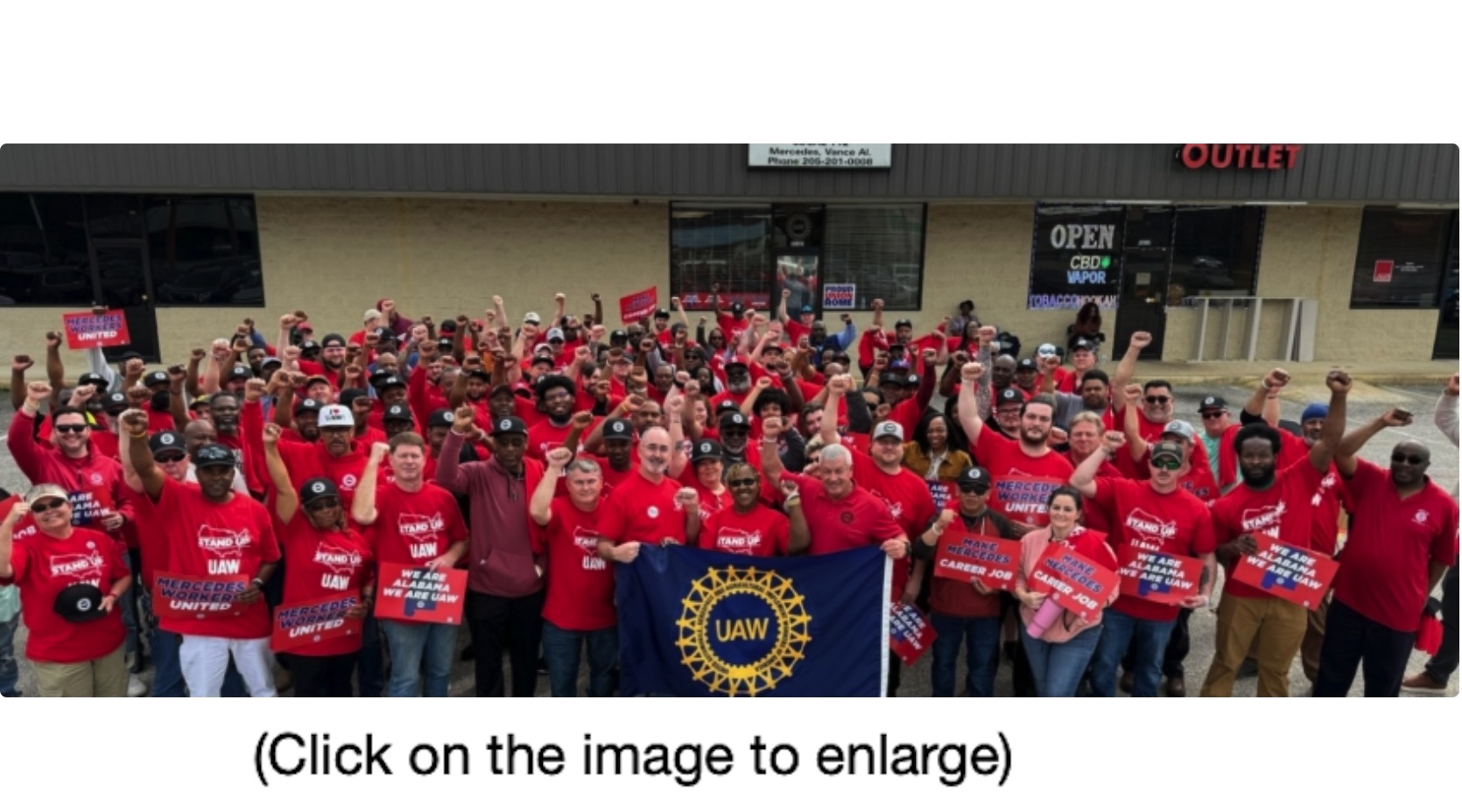
Workers at Blue Bird Corp. in Fort Valley, Ga., launched a union drive to secure better wages, work-life balance and a voice on the job.

The company resisted them. History defied them. Geography worked against them.

But they stood together, believed in themselves and achieved an historic victory that’s reverberating throughout the South.

About 1,400 workers at the electric bus manufacturer voted overwhelmingly this month to join the United Steelworkers (USW), reflecting the rise of collective power in a part of the country where bosses and right-wing politicians long contrived to foil it.


“It’s just time for a change,” explained Rinardo Cooper, a member of USW Local 572 and a paper machine operator at Graphic Packaging in Macon, Ga.

Cooper, who assisted the workers at Blue Bird with their union drive, expects more Southerners to follow suit even if they face their own uphill battles.

Given the South’s pro-corporate environment, it’s no surprise that Georgia has one of the nation’s lowest union membership rates, 4.4 percent. North Carolina’s rate is even lower, 2.8 percent. And South Carolina’s is 1.7 percent.
Many corporations actually choose to locate in the South because the low union density enables them to pay poor wages, skimp on safety and perpetuate the system of oppression.

In a 2019 study, “The Double Standard at Work,” the AFL-CIO found that even European-based companies with good records in their home countries take advantage of workers they employ in America’s South.

They’ve “interfered with freedom of association, launched aggressive campaigns against employees’ organizing attempts and failed to bargain in good faith when workers choose union representation,” noted the report, citing, among other abuses, Volkswagen’s union-busting efforts at a Tennessee plant.

“They keep stuffing their pockets and paying pennies on the dollar,” Cooper said of companies cashing in at workers’ expense.

The consequences are dire.

States with low union membership have significantly higher poverty, according to a 2021 study by researchers at the University of Minnesota and the University of California, Riverside. Georgia’s 14 percent poverty rate, for example, is among the worst in the country.

However, the tide is turning as workers increasingly see union membership as a clear path forward, observed Cooper, who left his own job at Blue Bird several months ago because the grueling schedule left him little time to spend with family.

(article continued in right column)

Question related to this article:
 
What is the contribution of trade unions to the culture of peace?

The right to form and join trade unions, Is it being respected?

(article continued from left column)

Now, as a union paper worker, he not only makes higher wages than he did at Blue Bird but also benefits from safer working conditions and a voice on the job. And with the USW holding the company accountable, he’s free to take the vacation and other time off he earns.  

Cooper’s story helped to inspire the bus company workers’ quest for better lives. But they also resolved to fight for their fair share as Blue Bird increasingly leans on their knowledge, skills and dedication in coming years.

The company stands to land tens of millions in subsidies from President Joe Biden’s Infrastructure Investment and Jobs Act and other federal programs aimed at putting more electric vehicles on the roads, supercharging the manufacturing economy and supporting good jobs.

These goals are inextricably linked, as Biden made clear in a statement congratulating the bus company workers on their USW vote. “The fact is: The middle class built America,” he said. “And unions built the middle class.”

Worker power is spreading not only in manufacturing but across numerous industries in the South.

About 500 ramp agents, truck drivers and other workers at Charlotte Douglas International Airport in North Carolina just voted to form a union. Workers in Knoxville, Tenn., last year unionized the first Starbucks in the South.

And first responders in Virginia and utility workers in Georgia and Kentucky also formed unions in recent months, while workers at Lowe’s in Louisiana launched groundbreaking efforts to unionize the home-improvement giant.

“I wouldn’t hesitate to tell any worker at any manufacturing place here that the route you need to take is the union. That’s the only fairness you’re going to get,” declared Anthony Ploof, who helped to lead dozens of co-workers at Carfair into the USW earlier this year.

Workers at the Anniston, Ala., company make fiberglass-reinforced polymer components for vehicles, including hybrid and electric buses. Like all workers, they decided to unionize to gain a seat at the table and a means of holding their employer accountable.

Instead of fighting the union effort, as many companies do, Carfair remained neutral so the workers could exercise their will. In the end, 98 percent voted to join the USW, showing that workers overwhelmingly want unions when they’re free to choose without bullying, threats or retaliation.

“It didn’t take much here,” said Ploof, noting workers had little experience with unions but educated themselves about the benefits and quickly came to a consensus on joining the USW.

“It’s reaching out from Carfair,” he added, noting workers at other companies in the area have approached him to ask, “How is that working out? How do we organize?”

As his new union brothers and sisters at Blue Bird prepare to negotiate their first contract, Cooper hopes to get involved in other organizing drives, lift up more workers and continue changing the trajectory of the South.

“We just really need to keep putting the message out there, letting people know that there is a better way than what the employers are wanting you to believe,” he said.

(Thank you to Nation of Change for calling our attention to this article.)

United States: Labor’s Uptick Isn’t Just Hype

. . DEMOCRATIC PARTICIPATION . .

An article by Eric Blanc in Labor Politics (reprinted by permission)

Is the current labor uptick just more hype than reality? Numerous articles have recently made this   case, pointing to the continued decline in union density in 2022. This skepticism also appears to be the prevailing view among most national union leaders. Though rarely stated publicly, labor’s continued routinism suggests that few people up top see our moment as particularly novel or urgent.


Fortune 500 Companies Targeted by Unionization, 2021-2022

But contrary to these skeptics, there is compelling data indicating that things really are changing — and, therefore, that unions should immediately make a major turn to new organizing.

Consider, for instance, the statewide 2018 educators’ strikes, which were largely begun over viral rank-and-file Facebook groups. These were the first US strike wave since the 1970s, impacting millions of students and involving hundreds of thousands of school workers. Strike activity in 2018 rose to its highest peak since the mid-1980s and it remained high in 2019 as the wave spread to blue cities like Los Angeles and Chicago. The qualitative shift was even more significant: unlike in the Reagan era, the red state revolt consisted of work stoppages that were mostly illegal, statewide in scope, offensive in their demands, and generally victorious in their outcomes. 

Union membership numbers present a grimmer picture.
According to the Bureau of Labor Statistics, 273,000 workers joined unions last year. Yet because total employment rose at a faster rate, union density fell from 10.3 to 10.1 percent from 2021 to 2022. Clearly, we are not currently in an upsurge analogous to the 1930s. As exciting as recent campaigns may be, we should be sober about their very real limitations. 

Dwelling only on the continued decline of union density, however, misses the forest for the trees. One of the reasons why recent worker-driven campaigns are so qualitatively important is that they have won union elections at some of the largest corporations in the world. Amazon’s 1.1 million employees, for example, constitutes the country’s second largest workforce and Starbucks’ workforce is the eighth largest. 

Winning elections at these types of firms is a major development that is not captured by membership rolls alone. National unions have for decades generally avoided pushing for union elections at such large companies, believing not unreasonably that they were simply too powerful to defeat — at least under our current, threadbare and barely-enforced, labor laws. As such, the vast majority of years since the Fortune 500 was established in 1955 have witnessed zero, or at most one, union drives at the non-union companies on the list. In contrast, 2021 saw three such drives and 2022 saw eight. 

Given labor’s overall risk-aversion, it is not surprising that a majority of those organizing efforts were instances of what I call DIY Unionism — strikes and union drives that are initiated by self-organized workers and/or in which workers take on key responsibilities traditionally reserved for union staff.

(article continued in right column)

Question related to this article:
 

What is the contribution of trade unions to the culture of peace?

The right to form and join trade unions, Is it being respected?

(article continued from left column)

Labor’s opponents are well aware of this increase in worker-to-worker organizing. In a 2022 report, the notorious union-busting firm Littler Mendelson sounded the alarm:
“There has been a shift in how people are organizing together to petition for representation. What was once a top-down approach, whereby the union would seek out a group of individuals, has flipped entirely. Now, individuals are banding together to form grassroots organizing movements where individual employees are the ones to invite the labor organization to assist them in their pursuit to be represented.”

To be sure, workers at Amazon, Starbucks, Apple, Google, and other mega-corporations are still a long way away from winning a first contract. That will likely take many years, more intervention from state actors, and greater resources from established unions towards boosting, and defending, new organizing. But it is a major historical development that unionizing the US private sector’s biggest players no longer seems like a distant fantasy. 

The fact that these recent drives have won elections against such economic heavyweights helps explain why news coverage of unions shot up in 2022 — as does the fact that media outlets have become one of labor’s most dynamic growth areas.

Increased publicity about David versus Goliath workplace organizing, and negative publicity about union busting, is bad news for corporate America. Stories of ordinary workers taking on billionaire CEOs tend to spur copycat attempts. And coverage of illegal (or morally reprehensible) union busting tarnishes company brands, while increasing pressure on elected officials to defend and enforce labor law. 

When it comes to fomenting today’s pro-union zeitgeist, the growth of pro-union sentiment over social media is no less significant. To cite just a few examples: Antiwork — a misleadingly named Reddit group focused on exposing bad working conditions and promoting unionization — shot up from 80,000 members in early 2020 to 2.3 million members by late 2022. The labor-focused media outlet More Perfect Union has received 150 million views on its YouTube and TikTok videos. And videos of Starbucks workers walking out in response to illegal firings now regularly go viral, racking up millions of views and exposing the hypocrisy of a nominally progressive corporation. Starbucks’ Vice President of Partner Resources thus recently admitted that she had to turn off social media because it “has been very disheartening. And yet perception is reality in some way shape or form.”

Media attention on its own will not turn things around for unions, but it is nevertheless critical for keeping up momentum and bringing “the labor question” back to the center of US politics. Millions of workers are finally beginning to see that non-union jobs can become union jobs — and that they personally could play a role in making that happen.

No less important, coverage of recent union drives among white-collar and (largely female) pink-collar care workers has undercut the still-common myth that unions are just for white men in hard industry. Multiple worker organizer interviewees explained to me that the first thing they had to do was disabuse themselves and their colleagues of the assumption, to quote a New York Times tech worker named Vicki, that “unions are just for coal miners or something — not for us.”

Google analytics allows us to measure the increase in search queries last year asking the question: “How do I form a union?” The following graph captures a surge in bottom-up unionization interest, particularly in the wake of the highly publicized union win at Amazon’s JFK8 warehouse on Staten Island. Today’s active interest in unionization constitutes a major contextual difference from the 1990s and 2000s when labor’s halting turn to new organizing stumbled over the high staff resources required to spark workers to unionize.

Qualitative data also indicates that there has been an increase in individual workers directly reaching out to unions asking them to organize them — what unions usually call “hot shops.” To quote a cannabis industry worker turned Teamsters organizer in Illinois, “these workers are reaching out to us for help, so that’s unusual. It used to be we were seeking them out and now they’re coming to us. Our phones are ringing constantly with workers who want protection, higher wages, better benefits and accountability from these companies.” 

Put simply: despite the immense power of the forces arrayed against them, rank-and-file organizers today are continuing to take big risks to win power and democracy at work. Unions should follow their lead.