Category Archives: DEMOCRATIC PARTICIPATION

Global Parliament of Mayors: Virtual Parliament at the World Urban Forum

.. DEMOCRATIC PARTICIPATION ..

An article from the Global Parliament of Mayors

For the first time ever, the Global Parliament of Mayors was officially represented at a World Urban Forum. The World Urban Forum, organised by UN-Habitat, is the world’s premiere international conference on all aspects of urban policy. The World Urban Forum 10 in Abu Dhabi, UAE, in February 2020 brought together 12.000 politicians and city experts from 168 nations.

The GPM, together with the City of Mannheim, hosted a networking event on the topic “The Global Parliament of Mayors (GPM) Virtual Parliament – the solution to accelerate digital democracy.” The event was moderated by Juliana Kerr, Director Global Cities at the Chicago Council on Global Affairs and brought together GPM-Mayors and affiliated Mayors from Katowice (Poland), Banjul (Gambia), Dortmund (Germany), Quelimane (Mozambique), Bulawayo (Zimbabwe), Duhok (Iraq).

(Continued in right column)

Questions for this article:

How can culture of peace be developed at the municipal level?

(Continued from left column)

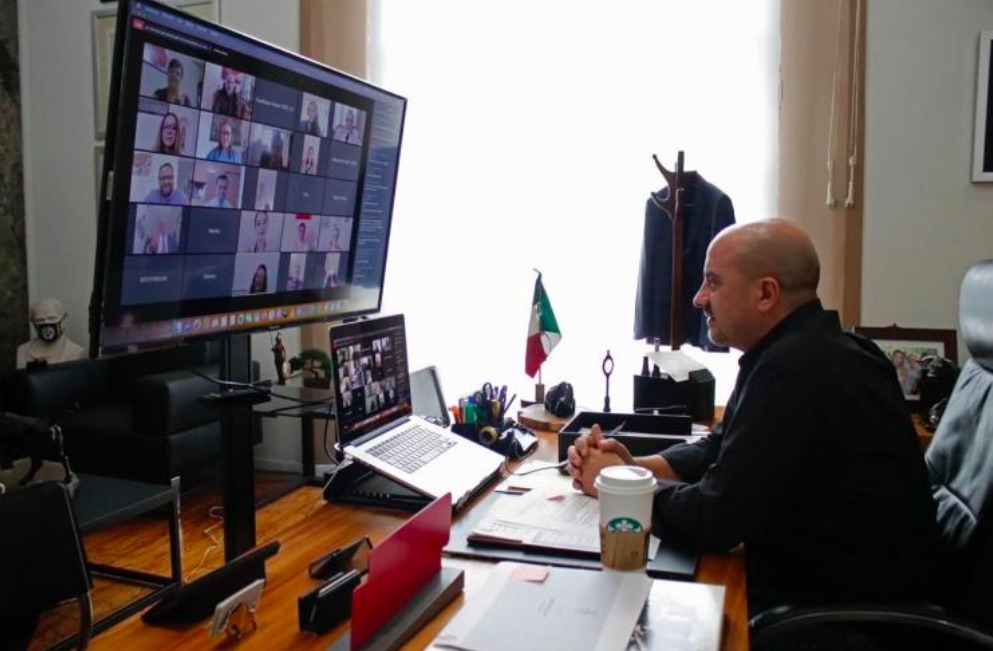
Mayor of Mannheim and GPM Chair, Dr Peter Kurz, whose city administration successfully applied for the GPM networking event with UN-Habitat, gave an opening speech, explaining the idea and rationale of GPM. The major planetary challenges, such as global warming, migration, and the globalisation of the economy, are dealt with through a complicated system of global governance. Within this system, Cities and their representatives are there mainly as observers. That is what the Global Parliament of Mayors project wants to change. The global governance has to be opened to cities and their representatives. “Cities are not primarily a subject for discussion; they are a level of governance” explained Mayor Dr Peter Kurz. “The GPM offers Mayors all around the world, especially from middle sized cities and the global south a unique opportunity to exchange and make their voices heard on the international level.

Mayor Peter Kurz furthermore presented the GPM’s Virtual Parliament (VP) to the interested audience. The VP is an online tool to connect with Mayors around the world, to debate and vote on political issues and to exchange experiences. It was launched during the 2018 GPM summit in Bristol. The first worldwide online voting session for mayors was organised one year later. As a result, a resolution was agreed on, which was presented during the First UN-Habitat Assembly in May 2019. As additional examples for the working procedure of the VP, Mayor Kurz mentioned the survey for Mayors on the roadmap of the Mayors Migration Council and the support of an action of the US congress of Mayors against gun violence.

World Urban Forum ends with call for united action to ensure sustainable future for cities and towns

.. DEMOCRATIC PARTICIPATION ..

An article from the United Nations News Service

The premier international gathering on the future of cities wrapped up on Thursday [February 13] in Abu Dhabi with delegates urging action on all aspects of rapid urbanization, recognizing that an increasingly urbanized world is a ‘transformative force’ that can be harnessed and steered to boost sustainable development.


video of Forum

The Tenth World Urban Forum (WUF 10), which attracted over 13,000 attendees taking part in more than 540 official events, focused on the theme ‘Cities of Opportunities: Connecting Culture and Innovation,’ and called for united action to ensure a better future for cities and towns. 

The outcome, known as the Abu Dhabi Declared Actions, includes commitments from international organizations, national, local and regional governments, the private sector, civil society, academia and others for the next two years and beyond to support the achievement of the Sustainable Development Goals  (SDGs) agreed by world leaders in 2015.  

“All three ingredients – culture, innovation and cities – are co-dependent and co-creating. Human settlements exist and excel on the dynamic mixture of cultures.” @MaimunahSharif UNHabitat Executive Director puts into context the theme of #WUF10 at the closing ceremony

Alongside their declared actions, the participants hailed cities as centres of creativity and innovation, as well as places with valuable cultural heritage and identity. And they were convinced that ‘culture is an integral part of the solution to the challenges of urbanization and achieving the New Urban Agenda.’  

(Continued in right column)

Questions for this article:

How can culture of peace be developed at the municipal level?

(Continued from left column)

Adopted in Quito, Ecuador, in 2015 at the UN conference known as Habitat lll, the Agenda represents a shared vision for a better and more sustainable future – one in which all people have equal rights and access to the benefits and opportunities that cities can offer, and in which the international community reconsiders the urban systems and physical form of urban spaces to achieve this. 

On Thursday, Maimunah Mohd Sharif, the Executive Director of UN-Habitat, the UN agency that convenes the WUF, told  the Closing Ceremony that during six-day meeting, delegates from all walks of life had insisted on the importance of a common goal of leaving a legacy of a better world for future generations.  

All the SDGS came together in ‘urban’ goal SDG 11  aimed at achieving inclusive, safe, resilient and sustainable cities and human settlements, said Ms. Sharif, stressing that: “Through the Abu Dhabi Declared Actions, we now have the what, how and when components as well.”  

The UN-Habitat  Assembly President and Under-Secretary of Multilateral Affairs and Human Rights of Mexico, Martha Delgado, who co-chaired the Advisory Group which put together the WUF10 Abu Dhabi Declared Actions, said they had listened to participants thoughts, wishes and aspirations. 

The Executive Director of Strategic Affairs at Abu Dhabi’s Department of Municipalities and Transport and General Coordinator of WUF10, Mohamed Al Khadar Al Ahmed, said their job with UN-Habitat was “not to only masterplan our cities we want to masterpiece our cities and that’s a big difference.” 

Other speakers at the Closing Ceremony included Mukhisa Kituyi, the Secretary-General of the UN Conference on Trade and Development (UNCTAD), who stressed the importance of bringing all sectors together to think afresh on overcoming challenges.  

In addition, Fabrizio Hochschild Drummond, the Special Advisor to the Secretary-General on Preparations for the 75th anniversary of the United Nations (UN75), said it was inspirational to see the mixture of idealism, practical reflection, lessons learnt and suggestions for action. 

In a video message, UN General Assembly  President Tijjani Muhammad-Bande  referred to the WUF10 theme, saying: “We must take urgent action to utilize culture and innovation as an accelerator of SDG implementation if we are to create a better world for all.” 

Mexico: The World Forum on Cities and Territories of Peace 

.. DEMOCRATIC PARTICIPATION ..

Information compiled by CPNN

Metropolis , the metropolitan section of the World Organisation of United Cities and Local Governments (UCLG) has announced on their website, the The World Forum on Cities and Territories of Peace to take place in Mexico City 5-7 October, 2020.


Foto from the Madrid Forum of 2018

According to the website, the forum is conceived “as a multi-faceted and multi-level meeting place for local leaders, international organizations and networks, NGDOs, academia, and civil society, aimed at opening dialogue, reflection and the construction of solutions that promote urban environments capable of eliminating expressions of violence.”

(Continued in right column)

Questions for this article:

How can culture of peace be developed at the municipal level?

(Continued from left column)

This initiative follows previous forums to combat urban violence that took place in Madrid in 2017 and 2018 as a joint initiative of the mayors of Madrid and Paris (see CPNN from April 2017 and from November 2018).

At the time the mayors of Madrid and Paris were both women. An interview with Madrid mayor Manuela Carmena, quoted her as saying “I have insisted repeatedly on the fact that women’s culture is more closely linked to daily, practical affairs. It is the culture of life. . . . . [peace education] starts at school. We want children to learn the value of dialogue and mediation, and for them to learn to solve their own problems among themselves.”

At the second Madrid forum it was pointed out that “All have agreed on the importance of talking about education, changing the conception of masculinity and giving more economic autonomy to women to ensure that future generations really live in cities of peace.”

In this regard it is significant that the mayor of Mexico City is now a woman, Claudia Sheinbaum, the first woman elected by popular vote to govern Mexico City. At her inauguration, she stated that “I am going to lead an honest, open, democratic, austere, inclusive government that acts with, for and for the citizenship, without distinction of party, religion or socioeconomic level, but putting all our effort to make of this, a city of rights, with justice and that diminishes the still serious social inequalities.”

Mayor Sheinbaum is a member of the Board of Directors of Metropolis.

UK: Oxford City Council says “no” to nuclear weapons

DISARMAMENT & SECURITY .

An article by Rachel Cordery from Cherwell

Oxford City Council has called on the British Government to sign the International Treaty to Prohibit Nuclear Weapons (TPNW). The resolution, proposed by Councillor John Tanner, was agreed “overwhelmingly” by the City Council on Monday [January 27].

Before backing the Treaty, the City Council want the UK government to renounce its use of nuclear weapons and end the renewal of Trident.

Cllr Tanner said: “Replacing Trident missiles is costing Britain a huge £205 billion, twice the cost of the high-speed rail line, HS2.

“Nuclear weapons are costly, outdated and ineffective. Most countries, including Ireland, Germany and Japan, manage perfectly well without them.”

“I’m thrilled that Oxford is backing this treaty to begin scrapping these weapons of mass-destruction. If there was ever a nuclear war the world would be plunged into perpetual winter and the survivors would all starve to death,” he added after the meeting.

(Continued in right column)

Question related to this article:

Can we abolish all nuclear weapons?

How can culture of peace be developed at the municipal level?

(Continued from left column)

Cllr Maryn Rush, who seconded the resolution, said: “I am concerned about the huge cost to the taxpayers of nuclear weapons, the risk posed by the regular transport of nuclear weapons on Oxfordshire’s roads and the continuing threat of nuclear war.”

Britain has four nuclear-armed submarines, each with eight missiles, each of which carries five independent nuclear warheads. Each warhead is eight times more destructive than the bombs that were dropped on Hiroshima and Nagasaki in 1945.

Mr Nigel Day, representing Oxford’s Campaign for Nuclear Disarmament (CND), spoke to councillors before the resolution was debated. He said: “Trident warhead convoys regularly travel past Oxford on the A34, supporting the UK nuclear weapons system. We are that close to nuclear weapons.”

The resolution, which had been proposed in September 2019, focused on the City Council’s long-standing commitment to disarmament. It reads: “Oxford City Council has been a long-standing member of the Nuclear Free Local Authorities (NFLA) which has been working for over three decades to promote multilateral nuclear disarmament.

“Oxford City Council is particularly concerned about the huge cost to the taxpayer of nuclear weapons, the risk posed by the regular transport of nuclear weapons on Oxfordshire’s roads and the continuing threat of nuclear war.

“NFLA has worked with Mayors for Peace and the International Campaign to Abolish Nuclear Weapons (ICAN) to promote the International Treaty to Prohibit Nuclear Weapons (TPNW). Over two thirds (122) of United Nations member states have agreed the TPNW.

“Council regrets that the Governments of the existing nuclear-weapon states, including the UK, refuse to support the Treaty. Council fully supports the TPNW as one of the most effective ways to bring about long-term and verifiable multilateral nuclear disarmament.”

With 122 nations supporting the treaty, Paris, Berlin, Sydney and Los Angeles are among the other cities supporting the TPNW. More locally, Manchester, Edinburgh and Norwich have passed similar resolutions to Oxford.

ICAN cities appeal : Support from Mayors for Peace

DISARMAMENT & SECURITY .

excerpts from the websites of ICAN cities and Don’t Bank on the Bomb

The ICAN cities appeal has received the support of Mayors for Peace, a network of 7675 cities in 163 countries around the world that support the solidarity of cities towards the total abolition of Nuclear Weapons, and ICAN partner organisation.


Cities that have adopted the appeal (click on image to enlarge)

Since August of last year, Mayors for Peace have been working in various ways to encourage all States to ratify the Nuclear Ban Treaty, and their efforts largely inspired the ICAN Cities Appeal. And while Mayors for Peace deferred to the judgement of each individual member on what approach is most effective in its country or region to reach our common goal, Mayors for Peace representatives were instrumental in achieving the endorsements of the Cities Appeal in both Fremantle and Granollers. We are grateful for their support and eager to see what further collaboration will bring.

(Continued in right column)

Question related to this article:

Can we abolish all nuclear weapons?

How can culture of peace be developed at the municipal level?

(Continued from left column)

Cities across the planet are speaking up against nuclear weapons and calling on their governments to join the UN Treaty on the Prohibition of Nuclear Weapons.

Nuclear weapons put all our cities – and everything we love in them – at risk. A nuclear bomb detonated in a city would immediately kill tens of thousands of people, and tens of thousands more would suffer horrific injuries and later die from radiation exposure. And according to the International Committee for the Red Cross, no state or organization would be equipped to deal with the catastrophic consequences of a nuclear bomb.

Is your city not on the list and would you like to see them step up and speak out against nuclear weapons? Then ask them to! The process is different in each city, but it all comes down to getting in touch with your local authorities or elected representatives and urge them to endorse the Cities Appeal. You can also get social! All over the world, people are supporting the campaign by sharing pictures and stories of the places they love in their cities. Join them using #ICanSave.

The appeal states:

“Our city/town is deeply concerned about the grave threat that nuclear weapons pose to communities throughout the world. We firmly believe that our residents have the right to live in a world free from this Threat. Any use of nuclear weapons, whether deliberate or accidental, would have catastrophic, far-reaching and long-lasting consequences for people and the environment. Therefore, we warmly welcome the adoption of the Treaty on the Prohibition of Nuclear Weapons by the United Nations in 2017, and we call on our national government to join it.”

Youth representatives speak out for Nuclear Disarmament at the NY City Hall

DISARMAMENT & SECURITY .

An article from Peace Boat

On January 28, 2020, Peace Boat US attended the NY City Council hearing at the City Hall to support two legislations about nuclear disarmament. Held by the Committee on Governmental Operations, the hearing focused on two legislations that were sponsored by City Council member Daniel Dromm. RES0976-2019 will encourage council members to divest the New York City pension funds from industries that support nuclear weapons technologies and development and INT 1621-2019 which will make New York City a nuclear-weapon-free zone. Passing these legislations would not only be a city-wide decision but will also serve as a role model for a nuclear-free world.


Peace Boat US interns holding the Nobel Peace Prize 2017 won by ICAN, along with SDGs and signs for a nuclear free world on the steps of New York City Hall.

Many organizations and activists gathered on the stairs in front of the New York City Hall for a press conference to raise awareness for nuclear disarmament. ICAN representative Ray Acheson displayed the Nobel Peace Prize, a sign of hope and motivation for the activists, while calling for the city to step against nuclear weapons. She voiced support for a City Council resolution urging Comptroller Scott Stringer to divest pension funds from companies involved in nukes. Acheson is a member of the International Campaign to Abolish Nuclear Weapons (ICAN), which won the Nobel Peace Prize in 2017.

Acheson and other community leaders decried investments detailed in a 2019 report from the International Disarmament Institute at Pace University, which found the city’s retirement funds have put $475 million in 19 “nuclear weapon producers.” The sum includes more than $180 million invested in Boeing and about $67 million in Honeywell International.

(Continued in right column)

Question related to this article:

Can we abolish all nuclear weapons?

How can culture of peace be developed at the municipal level?

(Continued from left column)

More than 60 people testified at the public hearing, including Peace Boat US Director Emilie McGlone and our youth delegation from Hollins University, sharing the testimonies of the survivors from Hiroshima and Nagasaki, encouraging Council Member Fernando Cabrera to announce his support for divestment from nuclear weapons producing companies. 

Participants at the hearing expressed their love of the city and strong unwillingness to see New York, or any other place on the Earth, to be exposed to the threat of irreversible destruction that nuclear weapons poses. Nuclear weapons not only eliminate the capacity of human self-defense and mutual aid, but they also create a genocidal level of injury. But so far, an outrageous amount of money is being invested in nuclear weapons instead of more immediate and pressing issues like poverty, health care, and climate change. Nuclear disarmament is a local, national and international issue and thus, in order to rid the world of nuclear weapons, we need actions from all levels, not just words. “It is the will of conscience of humanity,” to educate of truth and create real security that nuclear weapons are incapable of. 

Director Emilie McGlone spoke on behalf of Peace Boat US and shared information about the nuclear disarmament initiatives that Peace Boat has been organizing onboard and in the ports of call. Since 2008, Peace Boat has invited Hibakusha (atomic bomb survivors) of Hiroshima and Nagasaki to participate in the “Global Voyage for a Nuclear-Free World: Peace Boat Hibakusha Project.” This project is held annually onboard Peace Boat’s global voyages. As the average age of the Hibakusha is now more than 76 years old, the time remaining for them to directly share their experience and insights is very limited. 

The interns read testimonies on behalf of Hibakusha Shigeko Sasamori, Satsuko Thurlow, and Yasuaki Yamashita as well as activist Linda Chapman. The atomic bomb survivors’ testimonies described their personal experience and trauma suffered from Hiroshima and Nagasaki and urged the New York city council and committee members to support the total abolition of nuclear weapons and its development. The interns felt honored to deliver this important message to the hearing at the City Hall. It was an insightful experience for them to be part of this powerful and pivotal process. 

This post was created and published by Chin Wai Wong, Irina Conc, Leena Gurung, and Sajila Kanwal.

New York City hearings pave the way for nuclear weapons divestment

DISARMAMENT & SECURITY .

An article from Move the Nuclear Weapons Money

On Tuesday last week (January 28), New York City Council held public hearings on two measures (draft Resolution 0976 and Initiative 1621) which if adopted would oblige the city to divest its city pension funds from the nuclear weapons industry and establish an advisory committee to develop city action to further implement its status as a nuclear-weapon-free zone.


Video of hearing

The draft measures were introduced to the council in June 2019 by Council members Daniel Dromm, Helen Rosenthal and Ben Kallos. Since then, New York peace, climate and disarmament activists have been campaigning to build endorsement from enough council members for the adoption of these two measures.

They have been supported by Move the Nuclear Weapons Money, a global campaign to cut nuclear weapons budgets, end investments in the nuclear weapons and fossil fuel industries and reallocate these budgets and investments to support peace, climate and sustainable development. (Click here for the written testimony of Move the Nuclear Weapons Money).

The campaign has included directed research, lobbying of councillors, public events & actions, and open letters in support such as the Move the Nuclear Weapons Money Open letter to New York City Council endorsed by representatives of over 20 New York peace, disarmament and climate action organizations.

‘City of New York pension funds should not be used to support any aspect of nuclear weapons production, plain and simple,’ Councillor Helen Rosenthal told a support action organised by the Move the Nuclear Weapons Money campaign in front of City Hall in October 2019.

‘Helping to fund nuclear proliferation (whether directly via investments in weapons manufacturers, or indirectly via Citibank and other financial institutions with ties to weapons makers) runs contrary to what this city and our 300,000+ municipal workers stand for. Our teachers, fire fighters, social workers, and so many other public sector workers have devoted their careers to making life better for their fellow New Yorkers. We cannot in good conscience assist in underwriting the catastrophic loss of life and environmental ruin that would result from a nuclear conflict.’

Impact of NYC nuclear weapons divestment

New York City pensions have approximately $480 million invested in the nuclear weapons industry. The divestment of this amount would probably not make any financial impact on the weapons manufacturers.

However, it would serve as a positive example of an action that can be taken by cities and other investors to align their investments with their ethical values. And it would give support to federal initiatives to cut nuclear weapons budgets, such as the SANE Act introduced into the U.S. Senate by PNND Co-President Ed Markey and the Nuclear Weapons Abolition and Economic and Energy Conversion Act, introduced into the U.S. House of Representatives by PNND Member Eleanor Holmes-Norton.

The Hearings

The public hearings on Thursday were run jointly by Council member Daniel Dromm and Council member Fernando Cabrera, chair of the NYC Committee on Governmental Operations. They included testimony from a wide range of New Yorkers and civil society organisations, including from labour, education, academia, finance, health, religious and law sectors and from communities impacted by the production, testing and use of nuclear weapons. Witnesses stretched in age from 19-90. Click here for a video of the testimonies.

(Continued in right column)

Question related to this article:

Can we abolish all nuclear weapons?

How can culture of peace be developed at the municipal level?

(Continued from left column)

As the public hearings opened on Thursday, the two measures were one-vote short of a veto-proof majority. By the end of the hearings, Council Member Fernando Cabrera had affirmed his support thus ensuring the required votes for adoption. As such, it looks fairly certain that the measures will be adopted.

New York Administration resistance addressed by Move the Nuclear Weapons Money

One unresolved issue from the hearings is which city department would oversee the implementation of the two measures. Another issue is what resources, including budget, would be required for implementation and from where these would come.

The New York City administration was represented by Ms Penny Abeywardena, New York City’s Commissioner for International Affairs, who argued that her department (the Mayor’s Office for International Affairs) had neither the resources nor the mandate to implement the measures if they were adopted. She argued that her department was responsible for building good working relations between NY City and the United Nations, educating youth about the United Nations, and reporting to the UN on NYC’s implementation of the Sustainable Development Goals, but not to engage in national security policy or international disarmament which was the mandate for the Federal government – not the city.

Mr Jonathan Granoff, representing Move the Nuclear Weapons Money, responded in his oral testimony that the remit from these resolutions was not that the City engage in advocacy at the United Nations, but rather to implement obligations arising from the UN that are applicable to cities as well as to federal governments. This is exactly what her department is doing with respect to SDGs, and is what they have a mandate to do for nuclear disarmament.

‘The very first resolution of the United Nations, which was adopted by consensus, affirmed a universal commitment to abolish atomic weapons and other weapons of mass destruction, and this is further affirmed as an obligation in the Non-Proliferation Treaty ,’ said Mr Granoff, who is also President of Global Security Institute and an internationally respected lawyer.

Ms Abeywardena, in outlining her department’s commitment to the UN Sustainable Development Goals, seems to be unaware that SDG 16 includes the obligation to implement such international law at all levels of government, including at city level. As such, the Commission on International Affairs does indeed have the mandate to implement these measures if and when they are adopted.’

With regard to the human resources required to implement the measures, Mr Granoff agreed with Ms Abeywardena that her commission and the City Council did not have much expertise on nuclear weapons. ‘This is exactly why an advisory committee is required – to provide that expertise, and that expertise is here in this room, and you can have our expertise for free. The only resource standing in the way of getting rid of nuclear weapons is emotional, spiritual and political will.’

Click here for the oral testimony of Mr Granoff.

Click here for the written testimony of Move the Nuclear Weapons Money, which includes experience of nuclear weapons divestment by cities, pension funds, sovereign wealth funds and other investors from around the world.

New York City and Mayors for Peace

The written testimony of Move the Nuclear Weapons Money included a proposal that a key action New York City should take in implementing the resolutions once adopted would be for them to join Mayors for Peace.
Jackie Cabassso, North America Representative for Mayors for Peace, in her oral testimony outlined some of the actions of Mayors for Peace – including introduction of nuclear disarmament resolutions that were adopted by the U.S. Conference of Mayors. Ms Cabasso reminded the City Council of the invitation from Mayors for Peace to New York to join, and urged she that they do so.

Pocheon, Republic of Korea – International Cities of Peace

. .DISARMAMENT & SECURITY. .

A post by Fred Arment on the facebook page of International Cities of Peace.

Question for this article:

Can Korea be reunified in peace?

How can culture of peace be developed at the municipal level?
 
Great News! The first City of Peace on the Korean peninsula was established today [February 5] near the Demilitarized Zone (DMZ) in Pocheon. A major celebration was held at City Hall where Mayor Park signed a Proclamation as a crowd of media, dignitaries, and over 100 citizens packed the hall. The Mayor spoke of the City re-envisioning Pocheon as travel destination, a prosperous economic area, and a culture and arts center. I was humbled to speak at the Official Ceremony on the importance of Pocheon as a leading force in making the dream of Reunification of South and North Korea come true in order to benefit citizens of both countries. No doubt, “Citycraft” is at work in this historic peace building effort and progress has already been made. Please congratulate the citizens of Pocheon!

Mali: consolidating peace between communities through cultural heritage

. . DEMOCRATIC PARTICIPATION . .

An article from Bamada

At the festival of living together, the opening solemnity under the chairmanship of the Minister of Social Cohesion and Reconciliation Lassine Bouaré took place on January 17 and continues until January 22, 2020 in Timbuktu on the site of the monument of the flame of peace in Abaradjou.

The theme of this 4th edition is the “usefulness of heritage for the consolidation of peace”. It is a moment not only for reunion but also for cultural activities in the region of Timbuktu and culture of peace as a whole. It was born under the initiative of Salaha Maïga and funded by Munisma alone in 2016 and is hailed and supported by the authorities and the people of Timbuktu.

(article continued in right column)

(Click here for the French version of this article)

Question related to this article:


Can festivals help create peace at the community level?

(article continued from left column)

According to the governor of the Timbuktu region Ahmed Kouena the festival promotes respect for dialogue, exchange between young people in the region and those from elsewhere in view of creating links between them friendship, fraternity, strengthening unity and social cohesion, while preserving our cultural identity. The organization of this event gives hope to all ethnic groups.

This 4th edition according to Salaha Maïga has been a great challenge. On the one hand, the city itself was abandoned and served as a dumping ground; on the other hand, this locality of the region, named Abaradjou is considered as “red zone” a regular attack zone. It has been a success because all the challenges have been met.

Salaha is requesting help from the state and goodwill and sponsors for the next few occasions. Hee said that so far we have no official sponsor. ” He thanked the youth and the local, national and international authorities, armed groups and the people of Timbuktu who took it to heart to honor this noble initiative.

The initiative is conceived because the local populations and lives have been decimated by deadly attacks and inter-community conflicts, and it aims to promote respect, cohesion, reconciliation and peace between individuals, communities, regions and the country.

Côte d’Ivoire: For peaceful elections in 2020, three Ivorian artists will walk from Abidjan to Korhogo

. . DEMOCRATIC PARTICIPATION . .

An article from linfodrome

The citizen movement of artists called “The Peace Walkers” announced Tuesday, January 28, 2020, at the Maison de la presse in Abidjan-Plateau, the project “700 km of sporting march by Ivorian artists for peaceful elections in Côte d’Ivoire ”. On March 9, three artists, Famian Jay’rico, president of the NGO Côte d’Ivoire la belle, Boklay le Bobognard, leader of “actions caritatives’’” and Paul Mady’s, member of the UNESCO chair, will leave from Abidjan, on foot, from the district hotel, in the Plateau, to Korhogo where their journey should end at the town hall, on April 09, 2020. their slogan: “Yes to my voice, no to my life.”


The citizen movement of artists called ’The Peace Walkers’ in action for non-violent elections in 2020 (photo: AC)

“This march is a contribution to the prevention of electoral violence and promotion of the culture of peace for peaceful elections”, explained Atsé Christian, the project leader.

“On the threshold of this year 2020, the year of the presidential elections where the populations remain already frightened by the specter of a possible crisis … maintained by speeches marked by verbal violence and other aggressive remarks made by politicians as well as certain media, we artists from the Republic of Côte d’Ivoire, committed voluntarily and socially, have decided to make our contribution to building this fragile thing that is peace and social cohesion, through an initiative called: “700 km to prevent electoral violence, 700 km to promote a culture of peace and social cohesion, 700 km for peaceful elections in Côte d’Ivoire in 2020,” said Atsé.

(Article continued in right column)

(Click here for the original French version of this article.)

Question related to this article:

How should elections be organized in a true democracy?

(Article continued from left column)

The singer songwriter Boklay le Bobognard explained that they are demonstrating through this march, a will for peace and peaceful elections. “We will give our bodies and our souls to get our message across,” he said. And he added: “The message that we want to send to the people and to all the political actors is that we have one country, one homeland. Do everything to preserve peace because without peace, there can be no concerts”.

Paul Mady’s stressed that this march must be considered as “a symbol because in 2002, the crisis started from the north of the Ivory Coast. So it’s as if we were to resume this same crisis in the south, to bring it out in the north. We don’t want to see this repeated,” he insisted.

Famian Jay’Rico Jay One noted that the march is “apolitical.” “We are addressing the Ivorian citizen, whoever he is, wherever he comes from. We decided to sacrifice ourselves physically for the Ivory Coast because we have to work together so that this country regains its identity,” he clarified.

The organizers of this walk have several objectives. Among other things, share with the population the concept of peaceful elections in view of the upcoming electoral deadlines, raise awareness among Ivorians and the authorities on the prevention of electoral violence, and advocate for inclusive elections. From Abidjan to Korhogo, the three artists and their staff will make stops in Yamoussoukro, Tiébissou, Djebonoua, Bouaké, Katiola, Tafiré and Ferkessedougou.