Category Archives: DISARMAMENT & SECURITY

A global call from Palestine Action for the Planet

DISARMAMENT & SECURITY .

 An blog by Mazin Qumsiyeh in the Popular Resistance Blogspot

More and more people realize that the current global political and economic structures are unable to deal with global climate crisis, the endless conflicts, proliferation of WMD, and the increased frequency of pandemics. This is no longer just a question of morality and rights but a question of our survival as a civilization and as a planet facing mass extinction. erg,” he said.

World War II transformed our planet in ways not foreseen before, including creating instruments like the United Nations ostensibly to stop wars and conflict and encourage cooperation across borders. Yet we have had many wars and economic blockades and inequality that have killed tens of millions of people since 1945. A large part of this had to do with the flawed system created: the dominance of five nations at the UN, the presumption that challenges in 1945 would be the same as our challenges decades later, and the hegemony of the United States, then thought to be more benevolent than others as a policeman of the world. This hegemony includes the use of the US dollar in global trade and as a reserve currency even after the US dropped the Bretton Woods agreement in 1971. The IMF and World Bank instruments also drifted to become tools of hegemony and control.

This system, whether one thinks it worked for a while or not, is clearly unsustainable in the 2020s and beyond – an era of global challenges such as climate change and pandemics. The COVID-19 crisis shows clearly that we cannot continue in this system of supposed “growth” in certain national economies via rampant uncontrolled capitalism and hegemony of rich individuals and corporations who can and do usurp democracy, including via mass media. The rich thus got richer and the poor poorer even in supposedly rich countries. 

We humans of all backgrounds, living across this planet must work together to create new paradigms and systems. We collectively make this urgent call to restructure: not just to face this COVID-19 crisis, but to face climate change and future global challenges.

Boldly, we demand and will work towards these objectives:

1)  The institutions created following World War II were dominated by the five victors and now must be democratized and transformed to serve all people of this planet particularly the impoverished people. This can be done via votes proportional to populations and via ensuring collective global security.  A new program for a healthier global system can and must be developed with the widest participation of professionals and the general public. It will build on the excellent UN Sustainable Development Goals and other conventions such as the Universal Declaration of Human Rights. Building on those is with the aim of sustainability and survival of our species and our fragile ecosystems. But communities and countries can also start such programs without waiting for change in the UN system.

(continued in right column)

Question related to this article:
 
How can we work together to overcome this medical and economic crisis?

(continued from left column).

2) Measuring development by GDP or the averaged PPP (GDP per person averaged at a national level) is a misleading approach and ignores human needs. We demand that governments do not burden future generations with debt and an illusion of growth that is profiting few at the expense of the many. The earth has plenty of resources and production to keep all of us healthy and well-fed when we reset our priorities towards: social services (the elderly and others in need), agriculture (especially permaculture), health, education, and research (technological advances that help sustainability).

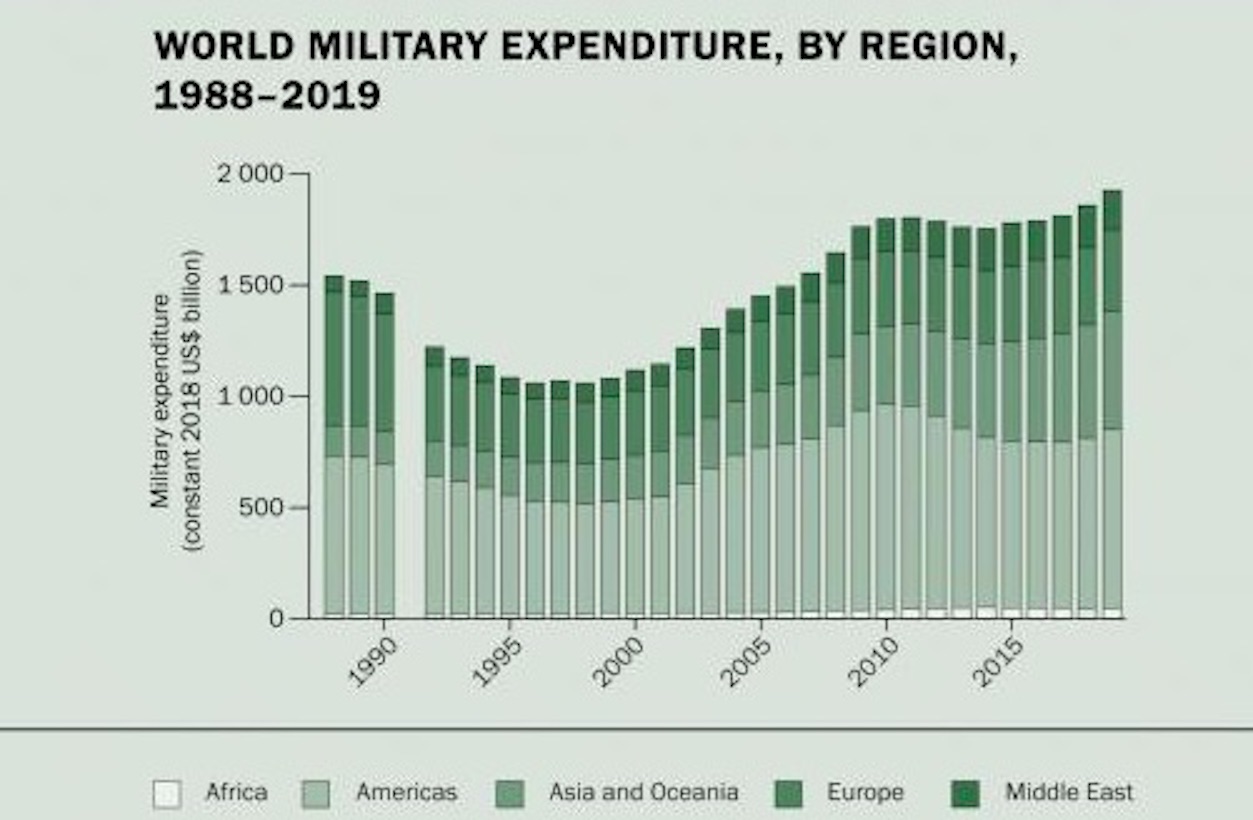
3) Drastically reduce military spending (increasingly militarized police) and redirect to serve rather than kill and exploit people. Even a small fraction of the 1.8 trillion spent on the military annually would be enough to end hunger and cure pandemics.

4) We can choose to respond to crises without giving-up on our liberties. History has shown that national authorities remove our liberties in crises and then rarely return them in full. To address this, citizens must vote directly on certain issues and all measures must expire and be renewed, if need be, within a reasonable timeframe via a vote by citizens

5) Nationalism as a political organizational structure has run its course and like other systems before it (city-states, kingdoms, and empires) must now evolve into a new system to face new realities of global threats. The nature of a new system needs significant thinking, but it is clear that to respond to an increasingly global crisis (climate change and pandemics), we have to have both local empowerment and global systems of joint struggle and solidarity. A corollary of this is that certain natural resources such as the Amazon rainforest and oceans must be protected as a planetary resource, and not left to the whims of national systems that can shift quickly for greed and imperialism. Thus, we must strengthen local communities, particularly native people. Another corollary is that we must limit national authority and create new systems that challenge colonialism, racism, sexism, and exploitation.

6) We must abandon our consumerist ways by living simply and humbly and reducing our footprints on this earth. We aim for zero-waste, for using renewable energy, for growing our own food in our own communities, and for cleaner, and healthier environment for all of us (humans, fauna, flora).  Reduce, Recycle, Refuse Refuse. Reduce our use of water (e.g. via compost toilets, proper water management, etc.) and of material and supplies (living humbly). Reduce solid wastes, plastics, and fossil fuels (towards final elimination). Recycle what cannot be eliminated. But most significantly refuse the urge to shop (consumerism).

7) Decrease building of massive and much unneeded infrastructure like stadiums and dams and increase vegetation preferably with native trees and bushes.

8)   Reconnect to nature and learn from it. Ecosystem balance must be restored. We humans must recognize ourselves as part of nature and live in harmony with it.

Gorbachev: Time to Revise the Entire Global Agenda

DISARMAMENT & SECURITY .

An interview of Mikhail Gorbachev by World Beyond War

Q: How did you take the news of the pandemic?

A: I think I took it the way most people did. Initially, there was hope that it could be controlled, localized. But things took a very different turn and the epidemic spread far and wide. Unprecedented measures and decisions became necessary. Leaders, citizens and international organizations found themselves in an extremely difficult situation. All of this will have to be thoroughly analyzed, but the priority now is to take things in hand and defeat this new, vicious enemy.


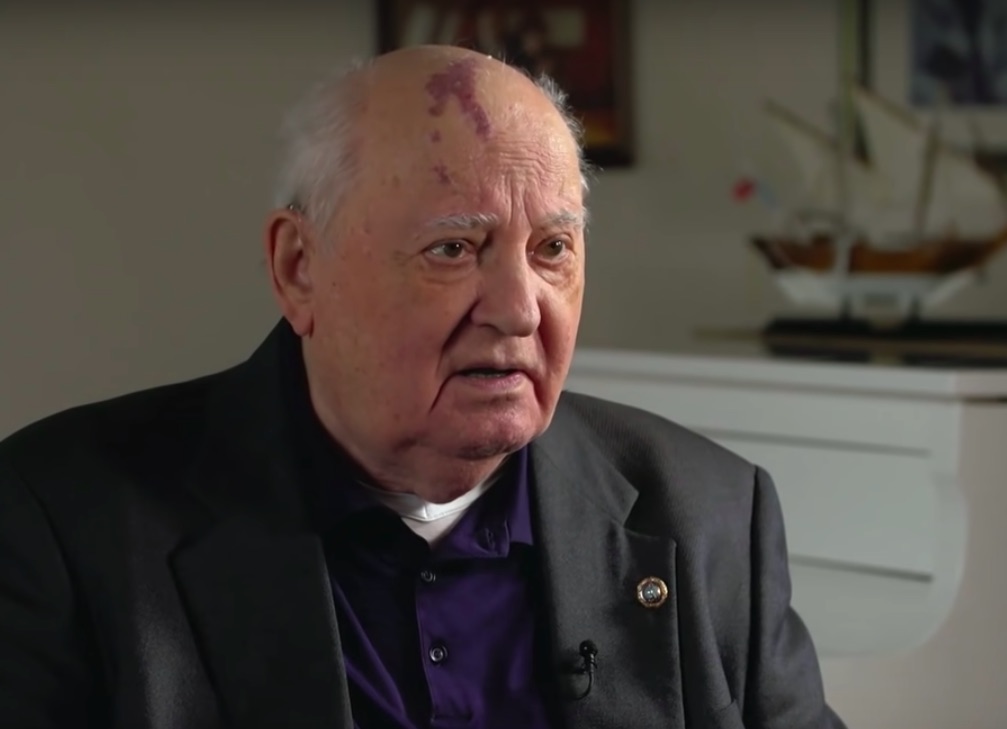
Image of Mikhail Gorbachev from recent BBC interview

Q: How do you assess the measures now being taken?


A: The main concern must be people’s security and saving people’s lives. I assume that the steps now being taken are based on science and the advice of the most competent experts. Right now they are practically unanimous that lockdown is necessary. This is something both the authorities and the people must accept. A lot depends on people’s behavior. Utmost responsibility and discipline is of the essence. Then we may hope that the worst could be avoided.

Q: Is it time yet for lessons learned? Do you agree that the world will never be the same?


A: That depends precisely on what lessons will be learned. I recall recent history of how we addressed the nuclear threat. We understood that it is our common enemy, a threat to all of us, and the leaders of two nations, the Soviet Union and the United States declared that a nuclear war cannot be won and must never be fought. Then came Reykjavik and the first treaties eliminating nuclear weapons. By now, 85% of those arsenals have been eliminated. We must continue along this path but we now see new challenges. Together with my friends in the Forum of Nobel Peace Laureates we have for years been calling for a radical rethinking of international politics. Let me quote from out appeal adopted back in 2005:

(continued in right column)

Question related to this article:
 
How can we work together to overcome this medical and economic crisis?

(continued from left column).

“Focusing on meeting human needs and having a reverence for life are the foundation of human security. Excessive military expenditures actually breeds insecurity. Two areas where funds need to be channeled by the international community are education and health, particularly regarding the scourges of AIDS, malaria and tuberculosis through both protection and prevention.” What could one add to this? Just the name of the new dreadful disease.

Over the past five years all we’ve been hearing is talk about weapons, missiles and airstrikes. But is it not clear by now that wars and the arms race cannot solve today’s global problems? War is a defeat, a failure of politics! This common tragedy has reminded us of the futility of trying to go into hiding and sit it out, ignoring the threats that we face. In today’s world, no one can hope to go into hiding!

And so I’ll never tire of repeating: We need to demilitarize world affairs, international politics and political thinking and reallocate funds from military purposes to the purposes serving human security. We need to rethink the very concept of security. Above all else, security should mean providing food, water, which is already in short supply, a clean environment and, as top priority, caring for people’s health.

To achieve human security we need to develop strategies, make preparations, plan and create reserves. This should be the responsibility of national leaders and leaders at all levels.

I believe that preparations should start now for an Emergency Session of the United Nations General Assembly, to be held as soon as the situation is stabilized. It should be about nothing less than revising the entire global agenda.

Q: Could I ask how things have changed for you and for the Gorbachev Foundation?


A: Of course we are complying with all requirements and we have had to start working from home. I am communicating with colleagues by phone and we have created a discussion platform on the web. We’ll be adapting to the new circumstances. I’ve been asked to write an additional chapter for the English edition of my book What Is At Stake Now, to account for the new developments. I have agreed and will work on it.

Thanks to Pavel Palazhchenko and Metta Spencer.

USA: A Department of Actual Defense in a Time of Coronavirus

DISARMAMENT & SECURITY .

An article by David Swanson in Pressenza (licensed under a Creative Commons Attribution 4.0 International license)

When a few thousand people were murdered on September 11, 2001, I was actually stupid enough – I kid you not – to imagine that the general public would conclude that because massive military forces, nuclear arsenals, and foreign bases had done nothing to prevent and much to provoke those crimes, the U.S. government would need to start scaling back its single biggest expense. By September 12th it was clear that the opposite course would be followed.


Louisiana National Guard Soldiers and Airmen test first responders for COVID-19 infections at Louis Armstrong Park, New Orleans, Louisiana, March 20, 2020. The testing site is one of three across New Orleans and Jefferson Parishes and will soon open to the general public. (Image by Staff Sgt. Josiah Pugh)

Since 2001, we have seen the U.S. government dump over a trillion dollars a year into militarism, and push the rest of the world to expend another trillion dollars a year, much of it on U.S.-made weapons. We’ve seen the creation of permawars, and the normalization of long-distance, push-button murder with drone wars. All of this has generated more terrorism in the name of fighting it. And it has come at the expense of actual defense.

A government agency aimed at actually defending people from actual dangers would cease activities that are counter-productive, that cause major environmental and climate destruction, and that consume resources that could be put to good use. Militarism meets all of those criteria.

Coronavirus will kill many more than a few thousand people, even just in the United States. The death toll there may fall between 200,000 and 2,200,000. That high figure would be 0.6% of the U.S. population, which compares with 0.3% of the U.S. population killed by World War II, or 5.0% of the Iraqi population killed in the war begun in 2003. The low figure of 200,000 would be 67 times the death count from 9-11. Should we expect to see the U.S. government expending $67 trillion a year on health and wellness? Even one sixty-seventh of that, even a mere trillion a year spent where it’s actually useful could work wonders.

The microscopic little virus, just like the men with boxcutters on airplanes, is simply not addressed by military spending. On the contrary, the environmental destruction of militarism and of the dominant global culture as a whole very likely contributes to the mutation and spread of such viruses. Factory farming and carnivorism likely contribute as well. And at least some diseases, such as Lyme and Anthrax, have been spread by military labs doing openly offensive or supposedly defensive work on bioweapons.

A Department of Actual Defense, as opposed to a Department of War renamed Defense, would be looking very hard at the twin dangers of nuclear and climate apocalypse, and the accompanying spin-offs like coronavirus. I don’t mean looking at them with an eye to militarizing borders, getting more oil out of the arctic as the ice melts, demonizing immigrants to sell more weapons, or developing “smaller” and “more usable” nukes. We have all of that sociopathy already. I mean looking at these threats in order to actually defend against them.

The biggest dangers include:

* poor health, and poor diets and lifestyles that contribute to poor health,

* particular diseases and ecosystem destruction that contributes to them,

(Article continued on the right column)

Question for this article:

Does military spending lead to economic decline and collapse?

How can we work together to overcome this medical and economic crisis?

(Article continued from the left column)

* poverty and financial insecurity that lead to poor health and to the inability to take necessary steps against a disease like coronavirus,

* suicide, and the unhappy lives and mental illness and access to guns that contribute,

* accidents, and the transportation and workplace policies that contribute,

* War is a top cause of death where there are wars. Foreign terrorism is nowhere remotely near a top cause of death in nations that wage distant wars.

The disastrous response that we are seeing from the U.S. and other governments to the current disaster should put to rest once and for all the notion that people will automatically become better and wiser once things get bad enough.

Those proclaiming empire over and capitalism dead should get a grip on themselves. Capitalism is thriving, as is empire. A culture that has spent decades preparing to act badly when the COVID-19 hits the fan cannot be made to be acting wisely simply by declaring it so.

But acting disastrously is not inevitable. It’s a choice, albeit a difficult one to change quickly. It’s popular to predict that climate collapse will cause war, but climate collapse can’t cause a war in a culture that doesn’t use war. What causes war, or insider trading and pandemic profiteering, or negligent mass homicide is the preparation of systems designed for those things and for nothing else.

We could prepare a society and a government for positive steps instead. A Department of Actual Defense would need to be global, not national, but a national government could do a cheap imitation of parts of it that would be wild improvements over what we’re seeing now. Such a department might encompass what’s been conceived of as a Department of Peace, an agency aimed at moving from violence to nonviolence. But a Department of Actual Defense would also be dedicated to preventing all major harm.

Imagine if everyone on earth right now had financial security and top medical care. We would all be better off in many ways. That task may sound dreamy or visionary, but it is actually radically smaller than the task of building the militaries that have been built in recent years.

Imagine if climate collapse were being treated like the urgent emergency that coronavirus is now understood to be. Climate collapse should have been treated that way many years ago. The sooner it is, the easier things will be. The later, the harder. Why choose the harder road?

Imagine if the nuclear doomsday clock being closer to midnight than ever before were addressed appropriately, with some hint of interest from human governments in human survival. That’s a project that costs nothing and saves billions — so, feel free to mock it, but not to scream howyagonnapayforit. Nobody screams that for military-sized corporate bailouts anyway.

A Department of Actual Defense would not be a military attacking a different enemy. The problem of disease or illness is one to be addressed as much by improved environment, lifestyle, and diet as by medicine, and by an approach to medicine that attempts all solutions whether or not they resemble “attacking” the “enemy” virus.

A Department of Actual Defense would train pro-environment workers, disaster-relief workers, and suicide-prevention workers in the tasks of protecting the environment, relieving disasters, and preventing suicide, as opposed to training and arming them all to kill large number of people with weapons but then assigning them to other tasks. We don’t need a military redirected but disbanded.

What humanity needs is not a better militarism, but a better humanity.

Discuss this on this webinar on April 7.

Time to Change America: seven suggestions

DISARMAMENT & SECURITY .

An article by W. J. Astore in Bracing Views

In my latest article for  TomDispatch.com, I argue that the coronavirus crisis provides an opportunity to reimagine America.  Please read the entire article  at TomDispatch; what follows is an extended excerpt.  Thanks!


There’s only one Spaceship Earth

This should be a time for a genuinely new approach, one fit for a world of rising disruption and disaster, one that would define a new, more democratic, less bellicose America. To that end, here are seven suggestions, focusing — since I’m a retired military officer — mainly on the U.S. military, a subject that continues to preoccupy me, especially since, at present, that military and the rest of the national security state swallow up roughly 60% of federal discretionary spending:

1. If ever there was a time to reduce our massive and wasteful military spending, this is it. There was never, for example, any sense in investing up to $1.7 trillion over the next 30 years to “modernize” America’s nuclear arsenal. (Why are new weapons needed to exterminate humanity when the “old” ones still work just fine?) Hundreds of stealth fighters and bombers — it’s estimated that Lockheed Martin’s disappointing F-35 jet fighter alone will cost $1.5 trillion over its life span — do nothing to secure us from pandemics, the devastating effects of climate change, or other all-too-pressing threats. Such weaponry only emboldens a militaristic and chauvinistic foreign policy that will facilitate yet more wars and blowback problems of every sort. And speaking of wars, isn’t it finally time to end U.S. involvement in Iraq and Afghanistan? More than $6 trillion has already been wasted on those wars and, in this time of global peril, even more is being wasted on this country’s forever conflicts across the Greater Middle East and Africa. (Roughly $4 billion a month continues to be spent on Afghanistan alone, despite all the talk about “peace” there.)

2. Along with ending profligate weapons programs and quagmire wars, isn’t it time for the U.S. to begin dramatically reducing its military “footprint” on this planet? Roughly 800 U.S. military bases circle the globe in a historically unprecedented fashion at a yearly cost somewhere north of $100 billion. Cutting such numbers in half over the next decade would be a more than achievable goal. Permanently cutting provocative “war games” in South Korea, Europe, and elsewhere would be no less sensible. Are North Korea and Russia truly deterred by such dramatic displays of destructive military might?

3. Come to think of it, why does the U.S. need the immediate military capacity to fight two major foreign wars simultaneously, as the Pentagon continues to insist we do and plan for, in the name of “defending” our country? Here’s a radical proposal: if you add 70,000 Special Operations forces to 186,000 Marine Corps personnel, the U.S. already possesses a potent quick-strike force of roughly 250,000 troops. Now, add in the Army’s 82nd and 101st Airborne divisions and the 10th Mountain Division. What you have is more than enough military power to provide for America’s actual national security. All other Army divisions could be reduced to cadres, expandable only if our borders are directly threatened by war.

(Article continued on the right column)

Question for this article:

Does military spending lead to economic decline and collapse?

How can we work together to overcome this medical and economic crisis?

(Article continued from the left column)

Similarly, restructure the Air Force and Navy to de-emphasize the present “global strike” vision of those services, while getting rid of Donald Trump’s newest service, the Space Force, and the absurdist idea of taking war into low earth orbit. Doesn’t America already have enough war here on this small planet of ours?

4. Bring back the draft, just not for military purposes. Make it part of a national service program for improving America. It’s time for a new Civilian Conservation Corps focused on fostering a Green New Deal. It’s time for a new Works Progress Administration to rebuild America’s infrastructure and reinvigorate our culture, as that organization did in the Great Depression years. It’s time to engage young people in service to this country. Tackling COVID-19 or future pandemics would be far easier if there were quickly trained medical aides who could help free doctors and nurses to focus on the more difficult cases. Tackling climate change will likely require more young men and women fighting forest fires on the west coast, as my dad did while in the CCC — and in a climate-changing world there will be no shortage of other necessary projects to save our planet. Isn’t it time America’s youth answered a call to service? Better yet, isn’t it time we offered them the opportunity to truly put America, rather than themselves, first?

5. And speaking of “America First,” that eternal Trumpian catch-phrase, isn’t it time for all Americans to recognize that global pandemics and climate change make a mockery of walls and go-it-alone nationalism, not to speak of politics that divide, distract, and keep so many down? President Dwight D. Eisenhower once said that only Americans can truly hurt America, but there’s a corollary to that: only Americans can truly save America — by uniting, focusing on our common problems, and uplifting one another. To do so, it’s vitally necessary to put an end to fear-mongering (and warmongering). As President Roosevelt famously said in his first inaugural address in the depths of the Great Depression, “The only thing we have to fear is fear itself.” Fear inhibits our ability to think clearly, to cooperate fully, to change things radically as a community.

6. To cite Yoda, the Jedi master, we must unlearn what we have learned. For example, America’s real heroes shouldn’t be “warriors” who kill or sports stars who throw footballs and dunk basketballs. We’re witnessing our true heroes in action right now: our doctors, nurses, and other medical personnel, together with our first responders, and those workers who stay in grocery stores, pharmacies, and the like and continue to serve us all despite the danger of contracting the coronavirus from customers. They are all selflessly resisting a threat too many of us either didn’t foresee or refused to treat seriously, most notably, of course, President Donald Trump: a pandemic that transcends borders and boundaries. But can Americans transcend the increasingly harsh and divisive borders and boundaries of our own minds? Can we come to work selflessly to save and improve the lives of others? Can we become, in a sense, lovers of humanity?

7. Finally, we must extend our love to encompass nature, our planet. For if we keep treating our lands, our waters, and our skies like a set of trash cans and garbage bins, our children and their children will inherit far harder times than the present moment, hard as it may be.

What these seven suggestions really amount to is rejecting a militarized mindset of aggression and a corporate mindset of exploitation for one that sees humanity and this planet more holistically. Isn’t it time to regain that vision of the earth we shared collectively during the Apollo moon missions: a fragile blue sanctuary floating in the velvety darkness of space, an irreplaceable home to be cared for and respected since there’s no other place for us to go? . . .

(Note: William Astore is a retired lieutenant colonel (USAF) and professor of history.)

(Thank you to Peter Veres who called this to our attention.)

Former UK Royal Navy Commanders call for nuclear cuts to help address Covid-19 pandemic

DISARMAMENT & SECURITY .

An article from Move the Nuclear Weapons Money

Three former UK Royal Navy Commanders sent a letter to all UK parliamentarians on April 1 questioning the policy of maintaining a continuous at sea nuclear deterrent.

The commanders note that the £2 billion a year cost of maintaining this nuclear posture and readiness for war appear to be unjustifiable, especially as the economic costs of the coronavirus pandemic are mounting, and while there appears to be no threat of a ‘bolt from the blue’ nuclear attack against the UK, for which the policy is intended to counter.

In addition, the letter questions the decision by parliament to invest even more substantial resources in building new nuclear warheads and the submarines to carry them.

“It is completely unacceptable that the UK continues to spend billions of pounds on deploying and modernising the Trident Nuclear Weapon System when faced with the threats to health, climate change and world economies that Coronavirus poses,” said Commander Robert Forsyth RN (Ret’d), a former nuclear submariner, signatory to the letter and supporter of the Move the Nuclear Weapons Money campaign.

The letter was organised by the Bertrand Russell Peace Foundation and sent to all members of the UK House of Commons, UK House of Lords, Scottish Parliament, National Assembly for Wales, and Northern Ireland Assembly.

(continued in right column)

Question related to this article:
 
Does military spending lead to economic decline and collapse?

How can we work together to overcome this medical and economic crisis?

(continued from left column).

“This pandemic, and the inability of the British government to either prepare for or effectively respond to such an immediate threat to life, demonstrates the twisted priorities at the heart of nuclear weapons spending,’ said Tom Unterrainer, Director of the Bertrand Russell Peace Foundation. “Rather than work to guarantee real security this government prioritises the acquisition and deployment of weapons of mass murder.”

The signatories to the letter hope that their efforts to question the nuclear ‘Continuous At Sea Deterrent’ will encourage politicians and the wider public to begin to question the morality and the feasibility of nuclear weaponry.

According to Commander Robert Green RN (Ret’d), former nuclear-armed aircraft bombardier-navigator and one of the other co-signers of the letter, ‘Nuclear deterrence is no more than a repulsive, unlawful protection racket used as a counterfeit currency of power, and hugely profitable to the corporate arms industry.’ (Commander Green is also a supporter of the Move the Nuclear Weapons Money campaign).

The letter was supported by a number of UK parliamentarians including Rt Hon Ian Blackford MP (SNP Westminster Group Leader), Lord Green of Deddington, Baroness Sue Miller of Chilthorne Domer and Bill Kidd (Member, Scottish Parliament). Baroness Miller and Mr Kidd are the UK Co-Presidents of Parliamentarians for Nuclear Non-proliferation and Disarmament (PNND).

“Covid-19 is showing us that humanity’s worst threats- pandemics and climate change are shared globally,’ said Baroness Sue Miller. ‘We should not waste resources on renewing nuclear weapons as we should be using all resources we can in tackling these all too real issues.’

All of the nuclear weapons powers, and those states which are supportive of them, are wasting precious resources on the likes of Trident against the wishes of their peoples, when they should be addressing the real and deadly enemy in the form of COVID19,’ said Bill Kidd MSP, who also serves as the Convenor of the Cross-Party Group in the Scottish Parliament on Nuclear Disarmament.

“With human beings and national economies under genuine threat, it is the duty of governments and parliamentarians to pull back from nuclear war planning and preparation, and to instead cooperate internationally on facing down this deadly pandemic,” concluded Mr Kidd.

IPB Statement: Call to the G20 to Invest in Healthcare Instead of Militarization

DISARMAMENT & SECURITY .

A press release from the International Peace Bureau

The world’s oldest peace NGO, the Nobel Prize-winning IPB [International Peace Bureau] has called on G20 world leaders who are gathering via virtual means this coming week to send a message of peace and solidarity to the world as they address the global health emergency.

This is a time to open a new page in global relations to put geopolitical tensions to one side, to end proxy wars, for a ceasefire in those many conflicts around the world all of which stand to hamper a global solidarity effort.

We have to lift the shadow of war and military brinkmanship which has blighted global cooperation in recent years and work to ensure that a spirit of peace and solidarity prevails.

The IPB has long drawn the world’s attention to the increasing velocity of the global arms race.

Our communities are paying a high price for an arms race that has diverted resources from the basic health and welfare needs of the people.

We are all paying a heavy price for failed leadership and misplaced market-driven practices that have weakened our means to address this emergency, which has hit the weakest hardest.

Healthcare Stress

We are now seeing the consequences of underinvesting in healthcare infrastructure, hospitals, and staff.

Hospitals are overburdened, nurses are exhausted, materials are scarce, and life and death decisions are made on who can and cannot have access to the scarce number of ventilators available. Doctors and nurses are handicapped by the irresponsibility of past political and economic decision making.

All over the world, health systems are reaching the limits of their strength and heroic front-line staff are under massive pressure.

The coronavirus emergency shows what a weakened state our societies find themselves in to protect the people: a world driven by financialization, shareholder value and austerity have weakened our ability to defend the common good and placed human life in danger on a global scale.

Employees fearful of job and income loss are tempted to go to work sick. Older people are vulnerable and need help. The virus hits the weakest hardest.

Privatization, austerity measures, the neoliberal system have brought the local, regional and national health services to the brink of collapse.

In the last two decades the number of doctors working in the healthcare system has been reduced by a third in Western European countries.

In Italy, the healthcare budget has been cut by 37 billion euros in recent years.

The WHO warns that we are facing a shortage of 18 million healthcare workers by 2030.

Municipalities urgently need support in order to increase numbers of available staff. And now these policies are taking their toll, especially where hospitals have been closed on a massive scale in recent years (or privatized for the benefit of the rich), and in some (particularly rural) regions this has restricted basic care.

We can already draw lessons for the future:

Health is a human right for the young and old, for all people in all parts in the world.

Healthcare and nursing care must never be slashed or subordinated in the pursuit of profit through privatization.

The importance of decent work for all healthcare staff and continued investment in their education and training.

(continued in right column)

(click here for the press release in French and click here for Spanish.)

Question related to this article:
 
How can we work together to overcome this medical and economic crisis?

(continued from left column).

Time for a Global Social Contract

As each hour passes, the full scale of the crisis becomes clearer.

This week the ILO reported on the labour market consequences:

A potential loss of 25 million jobs, which is more than those lost during the 2008 financial crisis.

Working poverty is expected to increase significantly, where up to 35 million additional people could be impacted.

Income losses for workers could reach 3.4 trillion dollars.

We support the efforts of the trade union movement globally, regionally and nationally, in their call for a new social contract.

We support their call for economic measures and resources to protect jobs, incomes, public services, and the welfare of people.

This requires a commitment from the business community to keep people in work and the support they are promised to receive from their governments must be conditional on their adhering to the social contract for job security and incomes.

G20: Priority to Disarmament

The world spends 1.8 trillion dollars on military expenditure every year and is scheduled to spend 1 trillion dollars on new nuclear weapons in the next 20 years.

World military exercises cost more than 1 billion dollars each year, and arms production and arms exports are on the increase in the world’s leading economies.

The G20 cannot sweep these facts under the carpet. Military spending is 50 per cent higher today than at the end of the Cold War. It stands at a staggering 1,8 trillion US dollars a year, while NATO is demanding further increases from its members.

The G20 are responsible for 82 per cent of global military spending, account for almost all arms exports, and hold 98 per cent of the world’s nuclear bombs on their collective territory. The G20 is a shared platform that brings together the interests of the main players in the global arms race.

In addition, billions are spent on military research, money which would be better invested in health and human needs and research to help the fight against global climate change.

Militarization is the wrong path for the world to take; it fuels tensions and raises the potential for war and conflict and aggravates already heightened nuclear tensions.

Even so, the policy architecture that was put in place to control nuclear expansion and disarmament is ignored or even weakened.

The Bulletin of the Atomic Scientists’ 2020 Doomsday Clock published in February stood at 100 seconds to midnight – the closest it has been to midnight in its 70-year history – and this global pandemic has pushed the second hand even closer.

World leaders must put disarmament and peace back in the center of policy making.

Global leaders have to develop a new agenda for disarmament and that includes the banning of nuclear weapons. We call once again for governments to sign on to the TPNW.

Without it, we are handicapping our fight against future health pandemics, to eradicate poverty, hunger, to provide education and healthcare for all, as well as the realization of the SDG 2030 goals.

Disarmament is one of the keys to the great transformation of our economies, to ensure that human beings and not profit are most valued; economies in which ecological challenges – above all the crisis of climate change – will be solved and global social justice will be pursued.

With disarmament the implementation of the SDGs, a global social contract, and a new global green peace deal, we can address the challenges of the coronavirus pandemic.

We know from the history of our own organization and many of our member organizations that in such crises, democracy must be defended above all else, and it must be defended against increasingly authoritarian states.

We are calling for a culture of peace. A peaceful path means that we need a global strategy, a global social contract, and global cooperation to ensure planet-wide support for people. This will be the human solidarity of the 21st century – for and with the people.

IPB is willing and able to work on establishing this peaceful path – in collaboration with partners all over the world.
That is why we say that an initiative from the G20 to move away from a culture of militarization towards a culture of peace is both urgent and necessary.

UN Secretary-General calls for global ceasefire

FREE FLOW OF INFORMATION

Transcript of virtual press conference March 23 by the Secretary-General of the United Nations

Our world faces a common enemy: COVID-19.
 
The virus does not care about nationality or ethnicity, faction or faith.  It attacks all, relentlessly.
 
Meanwhile, armed conflict rages on around the world. 


UN Secretary-General Antonio Guterres

The most vulnerable — women and children, people with disabilities, the marginalized and the displaced — pay the highest price.
 
They are also at the highest risk of suffering devastating losses from COVID-19.
 
Let’s not forget that in war-ravaged countries, health systems have collapsed.
 
Health professionals, already few in number, have often been targeted.
 
Refugees and others displaced by violent conflict are doubly vulnerable.
 
The fury of the virus illustrates the folly of war.

(continued in right column)

Question(s) related to this article:

What is the United Nations doing for a culture of peace?

How can we work together to overcome this medical and economic crisis?

(continued from left column)

That is why today, I am calling for an immediate global ceasefire in all corners of the world.
 
It is time to put armed conflict on lockdown and focus together on the true fight of our lives.
 
To warring parties, I say:
 
Pull back from hostilities. 
 
Put aside mistrust and animosity.
 
Silence the guns; stop the artillery; end the airstrikes.
 
This is crucial…
 
To help create corridors for life-saving aid.
 
To open precious windows for diplomacy.
 
To bring hope to places among the most vulnerable to COVID-19.
 
Let us take inspiration from coalitions and dialogue slowly taking shape among rival parties in some parts to enable joint approaches to COVID-19.  But we need much more.
 
End the sickness of war and fight the disease that is ravaging our world.
 
It starts by stopping the fighting everywhere. Now.
 
That is what our human family needs, now more than ever.

(Note: The call by Guterres for a ceasefire has been applauded by the belligerents in the Yemen war which gives hope for a ceasefire there.)
 

Coronavirus: Ministers urged to divert military spending to tackle pandemic

DISARMAMENT & SECURITY .

An article from the Peace Pledge Union

Boris Johnson is facing calls to reallocate “defence” budgets towarsd the NHS, social care and community support for people affected coronavirus and isolation.

The Peace Pledge Union  (PPU) said that bombs and guns cannot defend people from a pandemic.

The PPU has repeatedly accused UK governments of endangering the public by wasting money on preparations for war while doing little to prepare for real threats such as climate change or possible pandemics.

The UK government maintains the seventh highest military budget in the world.

The government’s own National Security Capability Review in 2018 listed major outbreaks of disease as one of the most likely threats facing the UK. The threat of pandemics was also identified by the government’s Strategic Defence and Security Reviews in 2010 and 2015.

While some troops  may be involved with tasks such as food distribution, the PPU pointed out that many other UK troops are about to take part in a large-scale NATO training exercise across Europe, which is one of the few major events not to be cancelled due to the coronavirus outbreak.

The PPU insisted that the NATO exercise should be immediately cancelled and the costs and people involved reallocated to helping to tackle the pandemic.

(Article continued on the right column)

Question for this article:
 
Does military spending lead to economic decline and collapse?

How can we work together to overcome this medical and economic crisis?

(Article continued from the left column)

The Peace Pledge Union said that money diverted from military budgets could contribute towards NHS and social care costs as well as initiatives to assist people who are losing their jobs or struggling to pay the rent owing to the coronavirus outbreak, or to support people whose mental health is affected by isolation.

The PPU added that this should mark the beginning of a permanent shift of funding away from armed force and towards measures that really make people safe, tackling problems such as ill-health, poverty and climate change.

Ceri Dare, a Public Health Researcher and member of the Peace Pledge Union (PPU), said:

“We could be facing this crisis, which the government’s own assessments told us was coming, with the weapons we truly needed to win: a resilient NHS, local councils funded to fulfil their responsibilities in Public Health, Social Care for disabled and older people. We could have had a society where the people who make our lives possible, the cleaners, the shelf-stackers, the waste collectors, the social care workers, the delivery drivers, were paid and respected for the vital work they do.

“Instead of this, we are armed only with the useless weapons of war. We cannot battle our way out of an pandemic with bombs and guns. The lies of ‘defence’ ring hollow now. We need what we have always needed, to love and care for one another, to work together as neighbours, as communities, as nations, and we need that more than we ever have before.”

Symon Hill, Campaigns Manager of the Peace Pledge Union (PPU), added:

“In this crisis, everyone needs support from others, some especially so. This costs money. The government can still divert funds away from multi-million pound weapons and NATO training exercises. Let’s fund things that will really help to make us safe. You can’t nuke a virus.”

(Thank you to Joe Yannielli, the CPNN reporter for this article.)

A crucial moment for women’s rights in Afghanistan

. WOMEN’S EQUALITY .

An article by Heather Barr in Human Rights Watch

This is a moment of both fear and hope for Afghan women — and an urgent time for the world to support their hard-won rights. The Feb. 29 deal between the US and the Taliban could pave the way for a peace that Afghans desperately seek. But there are huge risks for women’s rights in this process.


Women walk along a street in the old part of Kabul on February 29, 2020. Women across the country are nervous about losing their hard-won freedoms in the pursuit of peace.  © 2020 WAKIL KOHSAR/AFP via Getty Images

Women have suffered deeply during Afghanistan’s 40 years of war, and they desperately long for peace. They have also fought ferociously for equality in the years since the fall of the Taliban government and have made great progress. Today there are women ministers and governors and judges and police and soldiers, and Afghanistan’s parliament has a higher percentage of women than does the US Congress.

But Afghan women’s rights activists have faced resistance from the Afghan government — and lack of support from international donors — as they fought for their rightful place at the negotiating table for peace talks. This exclusion, combined with the Taliban’s relentless discrimination against women and girls, increases fears that women’s rights could easily be a casualty of this process.

The US-Taliban deal is focused on foreign troop withdrawal and preventing Taliban support for international terrorism attacks. It also triggers “intra-Afghan” talks between the Taliban, the Afghan government, and other factions, which are slated to start March 10. But women’s rights were not included in the Feb. 29 deal. Zalmay Khalilzad, the lead US envoy to the talks, repeatedly said that women’s rights — and other issues relating to human rights, political structures and power sharing — should be resolved through the subsequent intra-Afghan talks. This has been a source of frustration to activists.

The Taliban remain deeply misogynistic. Their 1996 to 2001 regime was notorious for denying women and girls access to education, employment, freedom of movement and health care, and subjecting them to violence including public lashing or execution by stoning. Taliban rhetoric and conduct has moderated somewhat in subsequent years, with some Taliban commanders permitting girls to attend primary schools, typically in response to community pressure. But the Taliban also continue to carry out violent attacks against girls’ schools and block women and girls from exercising many of their basic rights, and remain deeply opposed to gender equality.

(Article continued in right column)

Question for this article

Prospects for progress in women’s equality, what are the short and long term prospects?

Is peace possible in Afghanistan?

(Article continued from left column)

In February, a Taliban leader wrote, “[W]e together will find a way to build an Islamic system in which all Afghans have equal rights, where the rights of women that are granted by Islam — from the right to education to the right to work — are protected.” Skeptics noted the comma separating women from equal rights, and that from 1996 to 2001 the Taliban also argued that women were enjoying all rights “granted by Islam.”

The Afghan government has been an unreliable supporter — and sometimes even an enemy — of women’s rights. The administrations of both Afghan President Hamid Karzai and Ashraf Ghani have frequently brushed aside women’s rights. Both have mostly rebuffed activists’ demands for women to have full participation in the peace process, as provided under United Nations Security Council Resolution 1325. Foreign donors have been more willing to engage in photo ops and grant agreements than to expend political capital to press for Afghan women to be in the room, at the table, during negotiations.

Lack of clarity about the intra-Afghan talks and the designated negotiators has further heightened fears about the implications for women’s rights. Political infighting following the disputed Afghan presidential election has delayed the appointment of the government negotiation team. Pressure to divvy up these roles among power brokers threatens to squeeze women out. The absence of clear information about what country will host the talks and who will facilitate them prevents women’s rights activists from lobbying for including women.

A fight over whether a release of prisoners will move ahead is muddying the waters further and calling into question the timeline for the intra-Afghan talks. Meanwhile, violence, reduced ahead of the deal’s signing, threatens to escalate again.

Several years back it was common to hear Afghan feminists argue that there should be no negotiations with the Taliban — a group that refused to recognize women’s full humanity. Today those calls are all but gone. Even the staunchest women’s rights activists have mostly accepted that there is no path to peace in Afghanistan but through negotiations with the Taliban.

But protecting women’s rights needs to be one of the key objectives of this process, and for that to happen, women need to be at the negotiating table. Governments increasingly recognize that the role of women in peace processes is not just an afterthought, but critical to sustainable and implementable peace accords. The Afghan government and all its international partners need to back Afghan women, who are in the fight of their lives.

The 2nd World March in Latin America with its message of Peace and Nonviolence

DISARMAMENT & SECURITY .

An article by Silvia Swinden from Pressenza (licensed under a Creative Commons Attribution 4.0 International license.)

Whilst the world has been bursting with bad news (Trump’s failed impeachment, Bolsonaro’s assault on Brazil’s human rights and the Amazon, pipelines, climate change and failure of climate discussions in Madrid, Australian fires, the Brexit debacle, Bolivia coup and descent into tyranny, the coronavirus, etc) the Second World March for Peace and Nonviolence has continued its determined journey through the planet promoting a new culture of peace, human solidarity, freedom from oppression and meaning, all based on the methodology of nonviolence.. .

After leaving Africa https://www.pressenza.com/2019/10/the-2nd-world-march-for-peace-and-nonviolence-from-marrakesh-to-tenerife/  via Senegal (On October 27 and 28, the 2 World March was hosted in the city of Thies, Senegal), arriving in Saint-Louis, then visiting the villages of N’diadiane, in the region of M’bour – Thiès and Bandoulou, in the Kaolack region. On November 1 and 2, the West Africa stage of the 2 World ending in the Dakar area, with activities on the Island of Gorea and Pikine) the March entered Latin America via Mexico.

At the same the Genoa to Barcelona “Mediterranean Sea of Peace” initiative of the World March met the Peace Boat of the Hibakushas, Japanese survivors of the Hiroshima and Nagasaki Bombs, The Peace Boat in Barcelona.

Mexico: Mexico City, San Cristobal and Guadalajara between the 8 and the November 15.

The stay in Mexico came to an end and continued to the next country. The Marchers went to the border with, Guatemala: different departments of the West paying tribute to the victims of the so-called ”War of Soccer“ between Honduras and El Salvador.

Given the serious circumstances that occurred in Bolivia, a call was made from the World March for the UN to intervene against the wave of racist violence in progress following the coup d’etat.

In Ecuador, a great Cavalcade for Peace was prepared and the Montubia de Guayas, Manabí and Los Ríos Integration Committees prepared for this great event. The Cedhu joined the March, organising events for December.

From El Salvador the Base Team continued on the American continent. From El Salvador it went to Honduras, from there to Cota Rica. Then, to Panama.

Honduras: on 25 / 11, International Day for the Elimination of Violence against Women, activists of the World March participated in the demonstrations of San José and Santa Cruz, Costa Rica.

Panama: at the Museum of Freedom, interviews in the media, at the Soka Gakkai International Panama Association (SGI).

On October 27 and 28, a forum was held in Costa Rica with the motto “THE GREAT TURN OF HUMANITY IS IN OUR HANDS”.

Students from three schools with a student from the Faculty of the UN came together in the Municipal Pavilion.

Four messengers of peace went to Ecuador representing the 2nd World March.

The World March Base Team visited Loja, their first activity was at the Gerald Coelho Convention Center.

32 national and foreign artists participated in this event for Peace and Nonviolence.

From there the March went to Colombia and Peru.

On December 1, the World March was present at the 13th Migrant March in Sao Paolo, Brazil.

(continued in right column)

Question for this article:

The World March for Peace and Nonviolence: What is its history and its effects?

How can we be sure to get news about peace demonstrations?

(continued from left column)

On December 26 and 27, the International Base Team participated in different activities in Córdoba, Argentina.

This December 28, the Base Team of the 2nd World March arrived in Mendoza, Argentina, being received at the Municipality. On December 29, the members of the World March Base Team arrived at the Punta de de Vacas Park, at the foot of Mount Aconcagua, in their last stage in Argentina after passing through Iguazu, Buenos Aires, Lomas de Zamora, Parque la Reja , Tucumán, Córdoba and Mendoza.

“Ten years ago in this same place, the Punta de Vacas Park, culminated the 1ª World March  which started in Wellington and after touring 97 countries for 93 days promoting peace and nonviolence as a methodology of action.

Today we are here after these ten years to pay tribute to the figure of Silo who inspired that 1st World March.

He supported an open and inclusive march that accommodated all the sensibilities of peace and nonviolence.

On that occasion the first objective of the World March was nuclear disarmament. Today we have to celebrate that we are closer to getting it. It is almost certain that in the coming months we can celebrate the “beginning of the end of nuclear weapons”.

From here we call on all citizens to promote this action because it affects us all.

Especially convincing the unbelievers, undecided and discouraged to support this just cause in favor of the human species: the end of nuclear weapons.

Silo pointed them out as the greatest threat to humanity.

At the moment there are important mobilizations in several countries of the world, and especially in Latin America.

Some result in social convulsions with tragic balances of violence.

Now it is necessary to remember the message that Silo gave from this place proposing the “overcoming of pain and suffering.”

Overcoming pain – he said – has to do with improving the living conditions of citizens without any exclusion. This is a great task pending.

He also spoke of overcoming suffering. This had to do with having coherence and finding meaning in life.

To do this what we think, feel and do must converge.

He also indicated the importance of dealing with others. He said it was necessary to learn to treat others as one would like to be treated.

He pointed to nonviolence as the only way to advance socially and personally. He pointed to active nonviolence as the most effective tool to open the future.

In this same place Silo recalled other great souls, prophets of nonviolence, which we will also remember when passing through their countries.

Make visible the methodology and proposals of Nonviolence

We hope that this World March will make visible the methodology and proposals of nonviolence.

May its echo travel through all corners and towns of this America.

That it touches its women and its men, but especially it is destined to its young people, to together design an America of the future and that it is the common house for all its inhabitants.

Thank you Silo for your teaching and for your example of life!”

The event culminated with a shared lunch where the Municipal Choir accompanied with delightful with beautiful songs.

Promoters of the March in Chile participated in the actions of civil disobedience and non-violent actions.

Extracts and pictures from the World March blog by Antonio Gancedo