Category Archives: DISARMAMENT & SECURITY

Lula meets the Pope, talks world peace

DISARMAMENT & SECURITY .

An article from Prensa Latina

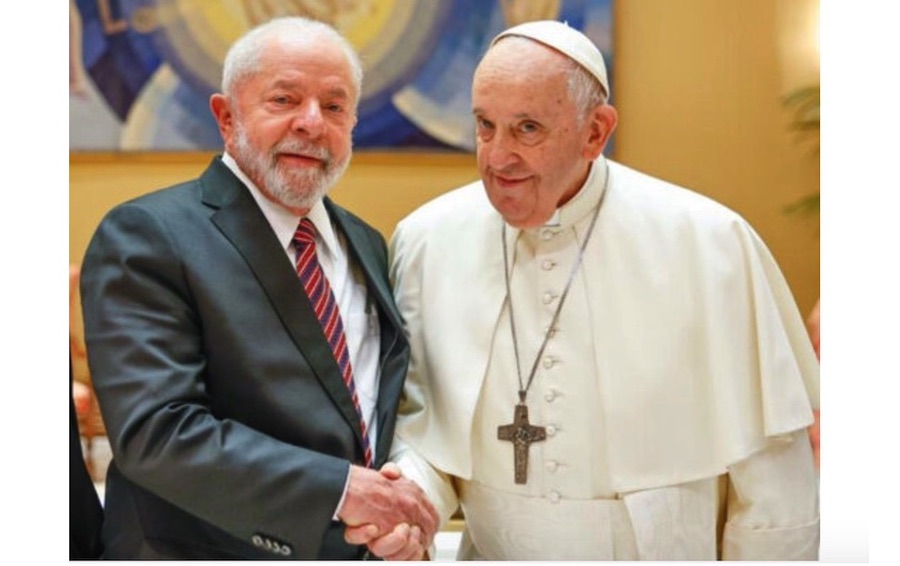
Brazilian President Luiz Inacio Lula da Silva on Wednesday (June 21) met Pope Francis in the Vatican for 45 minutes and the two discussed world peace, along with other matters.

The Brazilian leader thanked the Pope on social media for the audience and for the “good conversation about peace in the world.”

The behind-doors meeting took place in the Vatican close to the residence of the Pope, who recently underwent surgery for hernia.

The meeting was followed by the Brazilian delegation meeting the Pope and the traditional exchange of gifts.

(Continued in right column)

Questions related to this article:
 
Can the peace movement help stop the war in the Ukraine?

(Continued from left column)

Lula, who had received a letter from the Argentine-origin Pope while in prison, gifted him a print of the painting Sagrada Familia by Pernambuco-based artist JF Borges.

On his part, Francis presented Lula with his 2023 Message of Peace, the document on human brotherhood and the book on Statio Orbis from Mar. 27, 2020, when he had prayed for the end of the pandemic at a deserted St Peter’s Square.

Lula invited the pontiff to make another visit to Brazil – as his first international visit as Pope had been to Rio de Janeiro in July 2013 – and attend the festival honoring Our Lady of Nazareth in October.

The Brazilian president’s office had already announced that he intended to discuss the fight against hunger with the Pope along with other issues such as his initiative to end the Ukraine war.

Lula has proposed forming a group of countries to mediate in possible negotiations between Kyiv and Moscow, although his proposal has elicited little response from the international community.

The Brazilian leader arrived in the Vatican in a convoy of around 15 official cars along with the first lady, and was received at the doors of the Paul VI audience hall by the Pope’s aide, Leonardo Sapienza.

After his Vatican visit, Lula is set to meet Italian Prime Minister Giorgia Meloni on Wednesday evening at her official residence and seat of power, the Chigi Palace in Rome.

He will also meet Rome’s mayor Roberto Gualtieri, an old friend who had met Lula in prison while he was behind bars on corruption charges that were later revoked by the judiciary. On Thursday, the Brazilian president will fly to Paris for the next stop of his Europe tour.

2023 United Nations Resolution on the Culture of Peace

DISARMAMENT AND SECURITY .

Data from UN document of A/77/L.74 and Meeting coverage of 79th Meeting of GA 77th Session

The UN General Assembly adopted without a vote this year’s resolution for the culture of peace, presented as usual by the delegation of Bangladesh.

The resolution was sponsored by the following countries: Angola, Argentina, Armenia, Austria, Azerbaijan, Bahrain, Bangladesh, Belarus, Bosnia and Herzegovina, Brunei Darussalam, Cambodia, Canada, China, Dominican Republic, Equatorial Guinea, Gambia, Germany, Honduras, Hungary, India, Jordan, Kazakhstan, Kiribati, Mauritania, Morocco, Nepal, Nicaragua, Pakistan, Qatar, Russian Federation, Singapore, Slovenia, Spain, Sri Lanka, Thailand, Tunisia, Turkmenistan, United Republic of Tanzania, Vanuatu and Venezuela.


Photo from BNN

Following 40 preambular paragraphs which among other things recognized “the importance of the Declaration and Programme of Action on a Culture of Peace, adopted by the General Assembly on 13 September 1999,” the resolution included the following 21 operative paragraphs:

1. Reiterates that the objective of the effective implementation of the Programme of Action on a Culture of Peace is to strengthen further the global movement for a culture of peace, and calls upon all concerned to renew their attention to this objective;

2. Invites Member States to continue to place greater emphasis on and expand their activities promoting a culture of peace at the national, regional and international levels and to ensure that peace and non-violence are fostered at all levels;

3. Invites the entities of the United Nations system, within their existing mandates, to integrate, as appropriate, the eight action areas of the Programme of Action into their programmes of activities, focusing on promoting a culture of peace and non-violence at the national, regional and international levels;

4. Commends the United Nations Educational, Scientific and Cultural Organization for strengthening efforts to mobilize all relevant stakeholders within and outside the United Nations system in support of a culture of peace, and invites the Organization to continue to enhance communication and outreach, including through the culture of peace website;

5. Commends the practical initiatives and actions by relevant United Nations bodies, including the United Nations Children’s Fund, the United Nations Entity for Gender Equality and the Empowerment of Women (UN-Women) and the University for Peace, as well as their activities in further promoting a culture of peace and non-violence, in particular the promotion of peace education and activities related to specific areas identified in the Programme of Action, and encourages them to continue and further strengthen and expand their efforts;

6. Stresses the importance of addressing the underlying drivers of violence and conflict to promote a culture of peace;

7. Encourages Member States, United Nations entities and other relevant actors to adopt a holistic approach to the cross-cutting dimensions of peace, development, humanitarian action and human rights in order to prevent the recurrence of conflict and build lasting peace;

8. Underlines that early childhood development contributes to the development of more peaceful societies through advancing equality, tolerance, human development and promoting human rights, and calls for investment in early childhood education, including through effective policies and practices, towards promoting a culture of peace;

(Article continued in right column)

(Click here for a version of this article in Spanish or click here for a version in French)

Question for this article:

What is the United Nations doing for a culture of peace?

(Article continued from left column)

9. Encourages Member States, United Nations entities, regional and subregional organizations and relevant actors to consider instituting mechanisms to involve youth in the promotion of a culture of peace, tolerance and intercultural and interreligious dialogue and develop, as appropriate, an understanding of respect for human dignity, pluralism and diversity, including, as appropriate, through education programmes, that could discourage their participation in acts of terrorism, violent extremism as and when conducive to terrorism, violence, xenophobia and all forms of discrimination;

10. Encourages the United Nations Alliance of Civilizations to increase its activities that focus on peace education and global citizenship education in order to enhance an understanding among young people of values such as peace, tolerance, openness, inclusion and mutual respect, which are essential in developing a culture of peace;

11. Encourages the United Nations peacebuilding architecture to continue to promote peacebuilding and sustaining peace activities, as outlined in its resolutions 72/276 and 75/201, and to advance a culture of peace and non-violence in postconflict peacebuilding efforts at the country level, and recognizes the important role of the Peacebuilding Commission in this regard;

12. Emphasizes the critical importance of an inclusive, resilient and sustainable recovery from the COVID-19 pandemic, and in this regard calls upon States to promote the values of a culture of peace, inter alia, in countering rising inequalities, discrimination, exclusion, hate crimes and violence;

13. Urges the appropriate authorities to provide age-appropriate education in children’s schools that builds a culture of peace and non-violence, including lessons in mutual understanding, respect, tolerance, active and global citizenship and human rights;

14. Encourages the involvement of media, especially the mass media, in promoting a culture of peace and non-violence, with particular regard to children and young people;

15. Commends civil society, non-governmental organizations and young people for their activities in further promoting a culture of peace and non-violence, including through their campaign to raise awareness on a culture of peace and the peaceful settlement of disputes;

16. Encourages civil society and non-governmental organizations to further strengthen their efforts to promote a culture of peace, inter alia, by adopting their own programme of activities to complement the initiatives of Member States, the United Nations system and other international and regional organizations, in line with the Declaration and Programme of Action;

17. Invites Member States, all entities of the United Nations system and civil society organizations to accord increasing attention to their observance of the International Day of Peace on 21 September each year as a day of global ceasefire and non-violence, in accordance with its resolution 55/282 of 7 September 2001, and of the International Day of Non-Violence on 2 October, in accordance with its resolution 61/271 of 15 June 2007;

18. Requests the President of the General Assembly to consider convening a high-level forum, as appropriate and within existing resources, devoted to the implementation of the Programme of Action on the occasion of the anniversary of its adoption, on or around 13 September, and requests the Secretariat to provide required logistical support for its effective organization within their respective mandates and existing resources;

19. Invites the Secretary-General, within existing resources, in consultation with the Member States and taking into account the observations of civil society organizations, to explore mechanisms and strategies, in particular strategies in the sphere of information and communications technology, for the implementation of the Declaration and Programme of Action and to initiate outreach efforts to increase global awareness of the Programme of Action and its eight areas of action aimed at their implementation, including through public information activities by the Department of Global Communications of the Secretariat;

20. Requests the Secretary-General to submit to the General Assembly at its seventy-ninth session a report, within existing resources, on actions taken by Member States, on the basis of information provided by them, and those taken system-wide by all concerned entities of the United Nations to implement the present resolution;

21. Decides to include in the provisional agenda of its seventy-eighth session the item entitled “Culture of peace”.

Following the presentation by Bangladesh, the resolution was welcomed by Brunei Darussalam, speaking for the Association of Southeast Asian Nations (ASEAN), by Venezuela, speaking on behalf of the Group of Friends in Defence of the Charter of the United Nations, by Barbados, speaking on behalf of the Caribbean Community (CARICOM). Other speakers were from Syria, Malaysia, Morocco, United Arab Emirates, Equatorial Guinea and Iran, and an exchange of criticisms between Armenia and Azerbaijan.

Vienna’s International Summit for Peace in Ukraine Issues a Global Call for Action

DISARMAMENT & SECURITY .

An article by Medea Benjamin published by Code Pink

During the  weekend of June 10-11 in Vienna, Austria, over 300 people representing peace organizations from 32 countries came together for the first time since the Russian invasion of Ukraine to demand an end to the fighting. In a formal conference declaration, participants declared, “We are a broad and politically diverse coalition that represents peace movements and civil society. We are firmly united in our belief that war is a crime against humanity and there is no military solution to the current crisis.” (See CPNN June 12 for full text.)

To amplify their call for a ceasefire, Summit participants committed themselves to organizing Global Weeks of Action–protests, street vigils and political lobbying–during the days of September 30-October 8.

Summit organizers chose Austria as the location of the peace conference because  Austria is one of only a few neutral non-NATO states left in Europe. Ireland, Switzerland and Malta are a mere handful of neutral European states, now that previously neutral states Finland has joined NATO and Sweden is next in line. Austria’s capital, Vienna, is known as “UN City,” and is also home to the Secretariat of the OSCE (the Organization for Security and Cooperation in Europe), which monitored the ceasefire in the Donbas from the signing of the Minsk II agreement in 2015 until the Russian invasion of Ukraine in 2022. 

Surprisingly, neutral Austria turned out to be quite hostile to the Peace Summit. The union federation caved in to pressure from the Ukrainian Ambassador to Austria and other detractors, who smeared the events as a fifth column for the Russian invaders. The ambassador had objected to some of the speakers, including world-renowned economist Jeffrey Sachs and European Union Parliament member Clare Daly. (See CPNN June 9 for details.)

Even the press club, where the final press conference was scheduled, canceled at the last minute. The Austrian liberal/left newspaper Der Standard piled on, panning the conference both beforehand, during and afterwards, alleging that the speakers were too pro-Russian. Undaunted, local organizers quickly found other locations.The conference took place in a lovely concert center, and the press conference in a local cafe. 

The most moving panel of the conference was the one with representatives from Ukraine, Russia and Belarus, who risked their lives to participate in the Summit. Yurii Sheliazhenko, secretary treasurer of the Ukrainian Pacifist Movement, is unable to leave the country and therefore spoke to attendees from Kyiv via Zoom. 

“Like many Ukrainians, I am a victim of aggression of Russian army, which bombs my city, and a victim of human rights violations by the Ukrainian army, which tries to drag me to the meat grinder, denying my right to refuse to kill, to leave the country for my studies in University of Münster … Think about it: all men from 18 to 60 are prohibited from leaving the country, they are hunted on the streets and forcibly abducted to the army’s serfdom.” 

(Continued in right column)

Questions related to this article:
 
Can the peace movement help stop the war in the Ukraine?

(Continued from left column)

Sheliazhenko told the Summit that the Armed Forces of Ukraine had tried to deny conscientious objector status to Ukrainian war resisters, but relented when international pressure demanded that the Ukrainian military recognize rights secured under the European Convention on Human Rights.

Several groups at the Summit pledged to provide support for conscientious objectors from Ukraine, Russia and Belarus, and also took up a collection for Ukrainian families lacking access to clean water following the recent destruction of the Kakhovka dam. 

Highlights of the Summit also included remarks by representatives from the Global South, who came from China, Cameroon, Ghana, Mexico and Bolivia. Bolivia’s Vice President  David Choquehuanca inspired the crowd as he spoke of the need to heed the wisdom of indigenous cultures and their mediation practices. 

Many speakers said the real impetus to end this war will come from the Global South, where politicians can see the widespread hunger and inflation that this conflict is causing, and are taking leading roles in offering their services as mediators.

Almost all of Europe was represented, including dozens from Italy, the country  mobilizing the continent’s largest peace demonstrations, with over 100,000 protesters. Unlike in the United States, where the demonstrations have been small, Italian organizers have successfully built coalitions that include trade unions and the religious community, as well as traditional peace groups. Their advice to others was to narrow and simplify their demands in order to broaden their appeal and build a mass anti-war movement.

The eight-person U.S. delegation included representatives from CODEPINK, Peace in Ukraine, the Fellowship of Reconciliation and Veterans for Peace. U.S. retired colonel and diplomat Ann Wright was a featured speaker, along with former Congressman Dennis Kucinich, who joined remotely.

Despite the uniform bottom line of the participants, which was a call for peace talks, there were plenty of disagreements, especially in the workshops. Some people believed that we should continue to send weapons while pushing for talks; others called for an immediate end to weapons transfers. Some insisted on calling for the immediate withdrawal of Russian troops, while others believed that should be the result of negotiations, not a pre-condition. Some put more blame on the role of NATO expansion and the interference of the U.S. in Ukraine’s internal affairs, while others said the blame belongs exclusively at the doorstep of the Russian invaders. 

Some of these differences were reflected in discussions surrounding the final declaration, where there was plenty of back and forth about what should and should not be mentioned. There were strong calls to condemn NATO provocations and the role of the U.S./UK in sabotaging early attempts at mediation. These sentiments, along with others condemning the West, were left out of the final document, which some criticized as too bland. References to NATO provocations that led to the Russian invasion were deleted and replaced with the following language:

“The institutions established to ensure peace and security in Europe fell short, and the failure of diplomacy led to war. Now diplomacy is urgently needed to end the war before it destroys Ukraine and endangers humanity.”

But the most important segment of the final document and the gathering itself was the call for further actions.

“This weekend should be seen as just the start,” said organizer Reiner Braun. “We need more days of action, more gatherings, more outreach to students and environmentalists, more educational events. But this was a great beginning of global coordination.”

Putin tells Africans: Russia doesn’t reject negotiations with Ukraine

DISARMAMENT & SECURITY .

An article by EFE published in Prensa Latina

Russia remains open to negotiations on a resolution to the conflict that began with its invasion of Ukraine, President Vladimir Putin said Saturday (June 17) in a meeting with officials of seven African nations on a peace mission.

“My dear friends, not we, but the leadership of Ukraine, announced that it would not conduct any negotiations. Moreover the president of Ukraine signed a decree prohibiting these negotiations,” the Russian head of state said in St. Petersburg

“We are ready to consider any of your proposals without preconditions,” Putin told Presidents Cyril Ramaphosa of South Africa, Azali Assoumani of the Comoros, Macky Sall of Senegal, and Hakainde Hichilema of Zambia.

The delegation, which also includes Egyptian Prime Minister Mostafa Madbouly and envoys representing the presidents of the Republic of the Congo and Uganda, met Friday in Kyiv with Ukrainian President Volodymyr Zelenskyy.

(Continued in right column)

Questions related to this article:
 
Can the peace movement help stop the war in the Ukraine?

(Continued from left column)

The purpose of what Ramaphosa described as a “historic” mission was to present to the Ukrainian and Russian governments a 10-point peace plan drawn up by African countries.

“We welcome the balanced approach of African friends to the Ukraine crisis,” Putin told the visitors. “We’re open to constructive dialogue with all those who want peace based on the principles of respect for each other’s interests, as well as justice.”

“This war has to have an end. It must be settled through negotiations and through diplomatic means,” Ramaphosa said during the meeting at Konstantinovsky Palace.

“This war is having a negative impact on the African continent and indeed, on many other countries around the world,” the South African said.

Putin took the opportunity to show the delegation what he said was a draft peace agreement from March 2022.

“I would like to draw your attention to the fact that with (Turkish) President (Recep Tayyip) Erdogan’s assistance, as you know, a string of talks between Russia and Ukraine took place in Turkey so as to work out both the confidence-building measures you mentioned, and to draw up the text of the agreement,” Putin said.

“We did not discuss with the Ukrainian side that this treaty would be classified, but we have never presented it, nor commented on it. This draft agreement was initialed by the head of the Kyiv negotiation team. He put his signature there. Here it is,” the Russian president, holding up a piece of paper.

“It was called treaty of permanent neutrality and security guarantees of Ukraine,” Putin said, adding that the document included 18 articles pertaining to Ukraine’s security.

“Well, after we – as promised – withdrew troops from Kyiv, Kyiv authorities … threw it all away,” the Russian president said.

International civil society from Vienna: “We need negotiations that can strengthen the logic of Peace instead of the illogic of war.”

DISARMAMENT & SECURITY .

An article from Pressenza

After two intense days of work and discussion, the Final Declaration of International Civil Society has been circulated by the Promoters of the Vienna Peace Summit, and it will be sent to political leaders around the world, calling on them to act in support of a ceasefire and negotiations in Ukraine.

An important achievement – to which, among the summit organizers, the Italian entities of the “Europe for Peace” coalition contributed – that will enable the international peace movement to work jointly in the coming months on paths toward a just and possible Peace; a path to Peace that must be based on the principles of common security, international respect for human rights and self-determination of all communities. And with an upcoming date already defined: in fact, the Summit’s Final Declaration includes an invitation to civil society in all countries to join together in the implementation of “a week of global mobilization (from Saturday, September 30 to Sunday, October 8, 2023) for an immediate ceasefire and for Peace negotiations to end this war.”

The two days of debate [were used to] build a political alternative to a war that continues to upset the entire World with its evil and its capacity to destroy lives and the environment. Plenary speeches and working groups addressed from different perspectives what determines this war in terms of suffering, disasters, crises, and risks of nuclear accident or war. They also addressed, of course, how to be able to concretely solidarize with the Ukrainian people [who have been] under siege and bombardment for 16 months. Because saving lives is the priority, and war is certainly not the answer.

“We listened, moved, to the testimonies of Yuri, Olga, Oleg, Karina, and Nina who conveyed to us what it means to live under bombs or in exile, to have to decide in a matter of seconds where to go, whether to flee one’s own country or to hide so as not to end up in jail on terrorism charges. Those who participated in the Vienna Summit measure themselves against this reality, seeking paths of dialogue to rebuild mutual trust, to reaffirm solidarity. The path we call for must be taken by all civil society movements in order to make the alternative to war possible,” stresses Sergio Bassoli of the Peace Disarmament Network and one of the coordinators of “Europe For Peace.”

In the Final Declaration, the organizations of the broad coalition present highlight that they are “firmly united in their conviction that war is a crime against humanity and that there is no military solution to the current crisis,” expressing alarm over the ongoing war.

Condemnation for Russia’s illegal invasion of Ukraine is explicitly reiterated, stressing that “the institutions created to ensure Peace and Security in Europe have failed, and the failure of diplomacy has led to war. Diplomacy is now urgently needed to end the armed conflict before it destroys Ukraine and endangers humanity.”

The work of all civil society organizations involved will converge on this shared demand: “negotiations that can strengthen the logic of Peace instead of the illogic of war.”

(Continued in right column)

Questions related to this article:
 
Can the peace movement help stop the war in the Ukraine?

(Continued from left column)

Below is the text of the “Vienna Declaration for Peace” drafted by the organizations participating in the summit:

Peace by peaceful means. Ceasefire and negotiations now!

We, the organizers of the International Summit for Peace in Ukraine, call on the leaders of all countries to act in support of an immediate ceasefire and negotiations to end the war in Ukraine.

We are a broad and politically diverse coalition representing Peace movements civil society, including believers, in many countries. We are firmly united in our belief that war is a crime against humanity and that there is no military solution to the current crisis.

We are deeply alarmed and saddened by the war. Hundreds of thousands of people have been killed and injured, and millions are displaced and traumatized. Towns and villages throughout Ukraine, as well as the natural environment, have been destroyed.

Far greater death and suffering could still occur if the conflict escalates to the use of nuclear weapons, a risk that is higher today than at any time since the Cuban Missile Crisis.

We condemn Russia’s illegal invasion of Ukraine. The institutions created to ensure Peace and Security in Europe have failed, and the failure of diplomacy has led to war. Diplomacy is now urgently needed to end the armed conflict before it destroys Ukraine and endangers humanity.

The path to Peace must be based on the principles of common security, international respect for human rights, and self-determination of all communities.

We support all negotiations that can strengthen the logic of Peace instead of the illogic of war.

We affirm our support for Ukrainian civil society defending its rights. We pledge to strengthen dialogue with those in Russia and Belarus who put their lives at risk to oppose war and protect democracy.

We call on civil society in all countries to join us in a week of global mobilization (Saturday, September 30 to Sunday, October 8, 2023) for an immediate ceasefire and for Peace negotiations to end this war.

Vienna, June 11, 2023

(Editor’s note: Some participants, according to Medea Benjamin regretted that the final declaration failed to condemn NATO for provocations that led to the war and sabotage of early attempts at mediation.)

Can Pope Francis bring peace to Ukraine?

TOLERANCE AND SOLIDARITY .

An article by Thomas Reese in the National Catholic Reporter

Pope Francis has launched a peace mission aimed at finding a settlement of the Russia-Ukraine war, upsetting Ukraine’s allies with his refusal to insist that Russia leave Ukraine as a starting point for negotiations. For their part, the Russians simply ignore the pope.

Western supporters of Ukraine accuse the pope of moral equivalency, treating both sides as equal. This is nonsense.

Just four weeks into the war, the pope condemned  the “the violent aggression against Ukraine” and the “senseless massacre where every day there is a repetition of slaughter and atrocities,” in his Sunday Angelus in March 2022. “There is no justification for this!”


Photo of meeting between the Pope and Ukrainian President Zelensky on May 13 (EFE)

The Vatican has always said that it wants a “just peace.” When America Media’s Gerard O’Connell  asked Archbishop Paul Gallagher, the Vatican’s foreign minister, what a just peace meant for the Vatican, Gallagher said it meant a withdrawal of Russian troops from Ukrainian territory.

This is not to say the pope holds the West blameless. In June of last year Francis told La Civilta Cattolica, a Jesuit publication, that a couple of months before the war an unnamed “wise” diplomat had expressed concern to him about NATO. “They are barking at the gates of Russia,” the diplomat said. “And they don’t understand that the Russians are imperial, and they will not allow any foreign power to approach them. The situation could lead to war,” concluded the diplomat.

While Francis made clear that this was the diplomat’s opinion, it is hard not to conclude that Francis agreed with him. He seems to believe, as many in the Global South do, that NATO somehow either provoked or failed to prevent the war.

Francis has also noted “the interest in testing and selling weapons” to combatants in the war. There is no question that the American military-industrial complex is profiting in Ukraine, financially as well as strategically: The Russian war machine is being severely degraded without the loss of a single American life.

(Continued in right column)

Questions related to this article:
 
Religion: a barrier or a way to peace?, What makes it one or the other?

Can the peace movement help stop the war in the Ukraine?

(Continued from left column).

But responding to those who accuse him of being pro-Putin, Francis told La Civilta Cattolica: “No, I am not. It would be simplistic and erroneous to say such a thing. I am simply against turning a complex situation into a distinction between good guys and bad guys, without considering the roots and self-interests, which are very complex.”

The pope acknowledged “the brutality and ferocity with which this war is being carried out” by the Russian side. “While we witness the ferocity and cruelty of Russian troops,” he said in the La Civilta Cattolica interview, “we should not forget the problems, and seek to solve them.”

The pope is not cheering on either side in this war, which is an essential quality needed in a mediator. The pope has appointed Cardinal Matteo Zuppi  as a special envoy for peace in Ukraine. Both sides have used the Vatican for facilitating exchanges of prisoners, which is a good sign.

With Ukraine unwilling to give up any of its territory — including Crimea, which Russia annexed in 2014 — is there something else that would appease Russia and allow Putin to save face in defeat? I think there is: nuclear weapons.

The West has always feared the Red Army sweeping into Europe — indeed, it’s the reason NATO exists. Because the U.S. and Europe were unwilling to pay for enough conventional weapons to stop what they considered a formidable force, they relied on tactical nuclear weapons as a deterrent to the Red Army’s invasion.

We now see that the Russian army is a Potemkin army, more show than substance. If Ukraine all by itself can hold off the Russians and score victories, NATO would wipe the floor with them without using tactical nuclear weapons.

This military reality calls for a rethinking of NATO’s nuclear policy. As part of settling the Ukraine-Russia war, NATO and the U.S. should do two things: First, swear off the first use of nuclear weapons in Europe. Second, negotiate the elimination or at least reduction of tactical nuclear weapons in Europe.

Ukraine will have to agree to not “officially” join NATO. The war has already made Ukraine part of NATO unofficially. Ukraine would continue to receive weapons, but no NATO troops can be deployed on Ukrainian soil.

Putin, as an authoritarian autocrat, can continue this war indefinitely. We must give him something to get him to stop. He could save face by telling his people that the war succeeded in forcing NATO into this deal.

There is a temptation to let the war go on as long as Russia is stymied and suffering huge military losses in the speculative hope that it will bring down Putin. But Ukraine is also suffering both military and civilian losses.

The pope reminds us to look at “the human side of the war,” the impact on people’s lives, the deaths, the refugees, the widows and orphans. The war cannot be examined only in terms of “geopolitical calculations.” Too many people are dying. The pope is right in calling for peace. Unnecessary tactical nuclear weapons in Europe would be a cheap price to pay for it.

A united civil society push for Spain to join the TPNW

DISARMAMENT & SECURITY .

An article from The International Campaign to Abolish Nuclear Weapons

Forty-five civil society organisations in Spain have come together to form a coalition with a single mission: to persuade the Spanish government to adhere to the 2017 Treaty on the Prohibition of Nuclear Weapons (TPNW). The Alianza por el Desarme Nuclear  (Alliance for Nuclear Disarmament), which has the backing of ICAN, was launched in Madrid on 23 May. It will work to raise public awareness of the treaty’s importance and lobby decision-makers to endorse it.

Speaking at the launch event, the alliance’s coordinator, Maribel Hernández, urged the Spanish prime minister, Pedro Sánchez, to “take a courageous step forward” and sign the TPNW “as a symbol of our country’s commitment to peace”. She stressed the danger of “normalising the existence of nuclear weapons” and promoting a security model based on the possession of such weapons. As a NATO member, Spain has repeatedly endorsed the notion that US nuclear weapons offer it “protection” and could, in certain circumstances, be used on its behalf.

Carlos Umaña, a co-president of International Physicians for the Prevention of Nuclear War  and member of ICAN’s international steering group, recalled that Sánchez committed in 2018 to sign the TPNW, but this promise “remains unfulfilled”. It was part of a deal  struck with the leader of the Podemos political party, Pablo Iglesias. Umaña also noted that a majority of Spaniards – 89 per cent, according to a YouGov poll  in 2020 – want the government to sign the TPNW. “We are at the most worrying moment in history in terms of the risk of a possible large-scale nuclear war from which there would be no going back,” he warned.

(Continued in right column)

Question related to this article:
 
Can we abolish all nuclear weapons?

(Continued from left column)

A broad coalition of organisations

The Alliance for Nuclear Disarmament comprises  a diverse range of organisations and other entities working in the fields of peace and disarmament, human rights, the environment, and social justice, including Centre Delás d’Estudis per la Pau, the Spanish section of the Women’s International League for Peace and Freedom, AIPAZ (Spanish Association for Peace Research), FundiPau, Fundación Cultura de Paz, Greenpeace, Desarma Madrid, Ecologistas en Acción, General Commission for Justice and Peace, Mayors for Peace, Gernika Gogoratuz, Women in Black Madrid, Pressenza and MOC (Movement for Conscientious Objection). Since its launch, many more groups and individuals have expressed an interest in joining the alliance.

The groups are asking local municipalities  and regional parliaments to appeal to the Spanish government to join the TPNW. Barcelona and dozens of other cities and towns have already pledged their support, as has the autonomous community of Navarre. Pending Spain’s accession to the TPNW, the alliance believes that the government should observe the official meetings of states parties to the treaty, held roughly every two years. The NATO members Belgium, Germany, the Netherlands, and Norway observed the first  such meeting, held in Vienna last June. The second meeting will take place in New York this November.

Spain and the TPNW

The TPNW was negotiated at the United Nations in New York in 2017 and adopted with the support of 122 states. Spain opted not to participate in the process and has not yet taken any steps towards becoming a state party. Ahead of the treaty’s adoption, the foreign affairs committee of the Spanish congress of deputies passed a resolution  calling on the government to support the approval of the new treaty – but it was not heeded. In 2020, the same committee welcomed  the TPNW “as an effort to move towards peace, security, and disarmament”.

Three former Spanish foreign ministers – Ana Palacio, Javier Solana, and Carlos Westendorp – signed an open letter  in 2020 with dignitaries from other NATO states and Japan calling on current leaders to “show courage and boldness – and join the [TPNW]”. Solana is also a former NATO secretary-general. They noted in their letter that the TPNW does not prevent its parties from remaining in alliances with nuclear-armed states, such as NATO, “but we would be legally bound never under any circumstances to assist or encourage our allies to use, threaten to use, or possess nuclear weapons”.

Uk: A Win for Peace: UCU Opposes the War in Ukraine

DISARMAMENT & SECURITY .

An article from Stop the War Coalition

Stop the War Coalition congratulates delegates at the University and College Union who voted through a resolution at their congress this weekend calling for peace in Ukraine. The resolution condemns the Russian invasion and points out that NATO’s escalation in response has turned Ukraine into a battleground between the great powers. It is the Ukrainian people who are the main victims.

(Editor’s note: The University and College Union (UCU) is a British trade union in further and higher education representing over 120,000 academics and support staff.)

The success of the resolution has sparked a debate within the union which we welcome as there is so little discussion allowed in this country on the war in Ukraine. We condemn attacks on the union by pro-war figures and the use of UCU social media accounts to criticise the vote. The democracy of the trade union movement should be defended by all.

Trade unions have a long history of opposing government involvement in foreign wars and campaigning against militarisation and increased arms spending. This tradition is especially important in the midst of a cost-of-living crisis.

We urge trade unionists across the movement to put similar resolutions to their branches. We are happy to provide speakers for any meeting.

The resolution passed at the UCU is as follows:

Stop the War in Ukraine – Peace Now. City and Islington College Camden Road, University of Brighton, Grand Parade

(Continued in right column)

Questions related to this article:
 
Can the peace movement help stop the war in the Ukraine?

(Continued from left column).

Congress notes:

1. One year after the brutal invasion, Ukraine has become a battleground for Russian and US imperialism.

2. It is estimated that 150,000 Ukrainian soldiers and civilians and 200,000 Russian soldiers have died since invasion.

3. Putin has threatened the use of nuclear weapons and unleashed war crimes.

4. The 2022 NATO summit committed to a US military base in Poland, a brigade in Romania, air missile systems in Italy and Germany and two additional F-35 squadrons in Britain.

5. Volodymyr Zelensky says he wants Ukraine to become a “big Israel”—an armed, illiberal outpost of US imperialism.

Congress believes:

a. Wars are fought by the poor and unemployed of one country killing and maiming the poor and unemployed of another.

b. We should say, “Russian troops out, no to NATO escalation and expansion.”

c. We should stand in solidarity with ordinary Ukrainians and demand an immediate withdrawal of Russian troops.

d. NATO is not a progressive force: escalation risks widening war in the region.

e. Only through a peaceful resolution can lives be saved.

Resolves:

i. UCU to call upon Russian to withdraw its troops and for government to stop arming Ukraine.

ii. UCU to call for a peaceful resolution to the war.

iii. Congress resolves to support protests called by Stop The War, CND and other anti-war organisations.

Peace by Peaceful Means: International Summit for Peace in Ukraine

DISARMAMENT & SECURITY .

An announcement from Peace in Ukraine

We are calling for an international civil society gathering in Vienna, Austria on June 10/11*

The goal of the Peace Summit is to publish an Urgent Global Appeal, called the Vienna Declaration for Peace, calling on political leaders to act in support of a ceasefire and  negotiations in Ukraine.

Inviting Organizations: International Peace Bureau, CODEPINK, Assembly of the World  Social Forum, Transform Europe, IPPNW (D,AT,CH) (tbc), Europe4Peace, WILPF  International (tbc), International Fellowship of Reconciliation, Peace in Ukraine coalition

Local Organizers and Supporters: AbFaNG (Action Alliance for Peace, active Neutrality  and Non-violence), Institute for Intercultural Research and Cooperation (IIRC), Austrian  Center for Peace (ACP) in Stadtschlaining, Herbert C. Kelman Institute for Interactive  Conflict Transformation, ÖGB – Österreichischer Gewerkschaftsbund, WILPF Austria (tbc), Internationaler Versöhnungsbund – österreichischer Zweig

The summit will have different parts:

A conference to discuss the controversial questions related to the Russian-Ukrainian war, to hear the voices of civil society representatives of the various NATO countries, as well as  representatives from Russia and Ukraine who support the aims of the Peace Summit.  Participants from the Global South will share the dramatic consequences this war has had  for the people in their countries and emphasize how they can contribute to peace. The  Conference will focus not only on critics and analysis, but also on creative solutions and  ways to end the war and how to prepare negotiations. This is not only the task of states and  diplomats but nowadays more and more also of global society.

The conference will include a combination of lectures, working groups, expert groups, and  dialogues.

After the summit a march in Vienna to the various NATO-country embassies, as well as  the embassies of Russia and Ukraine and international organizations located in Vienna will  take place to meet with embassy representatives and deliver the Vienna Declaration for  Peace from people around the world;

*The 9th of June is the 180th Birthday of the Austrian Nobel Peace Prize laureate Bertha von Suttner, the first female Nobel Peace Prize laureate ever.

(Continued in right column)

Questions related to this article:
 
Can the peace movement help stop the war in the Ukraine?

(Continued from left column)

The summit will also be supported by a send-off for delegations to visit the capitals of  various European countries with the purpose of meeting with government officials and  international organizations. Also further events for late 2023 will be developed.

A call for peace 

We condemn the illegal Russian invasion in Ukraine. The war has caused death and injuries  of civilians and soldiers and created untold suffering for the Ukrainian people, destroying the  country’s environment and infrastructure, causing rising food and energy prices around the  world, exacerbating poverty and hunger – especially in the global South – and threatening the  entire world with a nuclear war.

It is time for the weapons to fall silent and for diplomacy to begin to resolve the conflict. We  must counter the logic of war with the logic of peace.

Let us gather to discuss the state and the wider context of the Russian-Ukrainian conflict, the  positions of our various governments, the efforts, obstacles, and opportunities of the various  peace movements and most importantly, how we can work more effectively to promote a  ceasefire and negotiations, and peaceful solutions as the alternative to war.

Peace is not only the task of states and diplomats but nowadays more and more also of the  global civil society. What is urgently needed now is a global movement demanding that all  parties stop fighting and start talking. The international support garnered by the International  Peace Bureau’s Christmas ceasefire appeal, the appeals at the UN General Assembly and by  many governments, even comments from some political leaders of Russia and Ukraine show  that a window of opportunity may be opening.

Why Vienna? 

Austria is a neutral country. It is a “UN City” and the home to the Secretariat of the OSCE (the Organization for Security and Cooperation in Europe), which had been monitoring the  situation in the Donbas since the signing of the Minsk II agreement.

Join the Peace Summit! 

It is the responsibility of peace movements all around the world and of all peace-loving  peoples to strengthen these efforts. The Vienna Summit for Peace in Ukraine can be a  powerful sign of hope and a catalyst for more and stronger peace actions globally. The future of humanity hangs in the balance; we must seize the moment before it’s too late.

Contact: International Peace Bureau, Marienstraße 19-20, 10117 Berlin,  viennaconference@ipb-office.berlin

There will be also an opportunity to join the conference virtually. RSVP for more details!

 WHEN

June 10, 2023 at 9:00am – June 11, 2023 (GMT+2)

Zone of Peace, Trust and Cooperation of Central Asia

DISARMAMENT AND SECURITY .

Excerpts from United Nations Press Release

The UN General Assembly held a debate on the declaration of Central Asia as a zone of peace, trust and cooperation (for background, see Press Release GA/12437).  Many speakers commended that declaration, with some offering recommendations alongside their encouragement, as Central Asian countries showcased regional and national efforts. . . .

AKSOLTAN ATAEVA (Turkmenistan), expressing her gratitude to the General Assembly for its unanimous support in adopting a historic resolution for Central Asia by declaring it a zone of peace, trust and cooperation, pointed out that the concept of such zones enables the international community to create long-term security guarantees.  Among other things, she spotlighted similar such initiatives in other regions; showcased the Central Asia region’s efforts on strengthening peace and stability, such as the United Nations Regional Centre for Preventive Diplomacy for Central Asia and its project; and highlighted its regional sustainable development projects, including on transport, logistics and infrastructure.  The success of the Central Asian countries in maintaining a further strengthening of stable and lasting peace in the region notably depends on the support of the international community, she underscored, calling on all to cooperate to that end.

AKAN RAKHMETULLIN (Kazakhstan) said to coordinate its joint national efforts and those of the United Nations, his country will establish the United Nations Regional Centre for the Sustainable Development Goals for Central Asia and Afghanistan in Almaty.  The hub will streamline the Organization’s inter-agency regional and interregional coordination and management to transform Central Asia into a zone of peace, security and sustainable development, with a spillover effect into Afghanistan.

Speaking as the Kazakhstan Chairmanship representative to the Conference on Interaction and Confidence Building Measures in Asia, he said the Conference considers the establishment of confidence-building measures, peace and dialogue as the primary basis for broad cooperation.  It will achieve the goals of sustainable development and socioeconomic well-being on the vast Asian continent.  The Central Asian region is facing unprecedented new and emerging challenges and the forum includes 28 States, with eight observers.  The region’s entire perimeter is surrounded exclusively by Conference on Interaction and Confidence Building Measures in Asia member States.  The Conference is a platform that gives Central Asia an outreach to other parts of the Asian continent and neighbouring subregions.  Central Asia tends to gain considerably from the Conference’s multifaceted, multidimensional portfolios.

MARÍA DEL CARMEN SQUEFF (Argentina), underlining the international community’s recognition that the establishment of zones of peace can contribute to the strengthening of economic development and peace, highlighted her country’s experience as an active participant of the zone of peace and cooperation of the South Atlantic.  This zone is notably not only one of peace and cooperation but is also a nuclear-weapon-free zone.  She commended the efforts of Central Asian countries to promote confidence and cooperation at a time when it is more vital than ever.  The success of this initiative, however, will depend on the joint work and determination of the zone’s member States as well as the support of the international community.  In that regard, the current Assembly debate is a sign of that commitment and a promising signal, she said.

MUNIR AKRAM (Pakistan) said his country has made consistent efforts to promote peace and cooperation in its own and adjacent regions.  The Government actively advocated for the creation of a nuclear-weapon-free zone in South Asia for more than two decades.  This was thwarted by the nuclear explosions initiated by its neighbour.  Pakistan has also supported the creation of a zone of peace in the Indian Ocean, as declared by the Assembly in resolution 2832.  His delegation is concerned that the Indian Ocean is being drawn into a geostrategic construct that implies the renewal of rivalries and the emergence of new military alliances.  With these efforts to escalate military and political competition, it is even more vital to preserve Central Asia as a zone of peace.  A peaceful Central Asia can be a bulwark against the extension of conflicts from Europe to Asia and serve as a bridge of peace across the Eurasian landmass.

JONIBEK ISMOIL HIKMAT (Tajikistan) stressed that the Central Asian countries have demonstrated constructive and predictable inter-State relations at a time when the world is experiencing simultaneous crises in security, health, economics, politics and climate change.  In recognizing the significance of economic and social development for its people and the region’s prosperity, his Government has focused on infrastructure development, energy projects and economic diversification; seeks to harness its water potential to drive economic growth and employment; and is open to cooperation to that end.  Mitigating climate change, addressing waste and water pollution and ensuring environmental sustainability are pressing global issues, he continued, spotlighting several of Dushanbe’s initiatives to that end. Regarding its efforts on addressing shared security threats such as terrorism, its financing and drug trafficking, he reiterated his President’s call to build a security belt around Afghanistan while strengthening regional cooperation and coordination.

JOONKOOK HWANG (Republic of Korea) said it is highly commendable that these countries are aligning themselves with the principles of the Charter of the United Nations.  The resolution addresses the importance of preventive diplomacy and the active role of women.  To address the complex transboundary challenges, such as terrorism and climate change, an integrated approach is crucial.  His delegation appreciates the role being played by the United Nations Regional Centre for Preventive Diplomacy for Central Asia, established in 2007.  The Centre has led to initiatives to empower women and youth.  His delegation supports the Center’s proactive role in addressing the challenges in Afghanistan, which affects peace and stability in the region and beyond.  Climate issues are another crucial challenge facing the Central Asian countries and he welcomed efforts to reach solutions to the region’s water challenges.  Many issues, such as land degradation, require the international community’s consistent attention.  Noting the Republic of Korea’s expanding trade volume with the Central Asian region, he said the Government will continue to expand future economic partnerships with the region, including in digital transformation and health infrastructure.

GERARDO PEÑALVER PORTAL (Cuba) stressed that, to make headway towards a world of peace, the diversity of different political, economic, social, cultural and religious systems must be respected as must the principles and aspirations of the Charter of the United Nations alongside international law.  Noting that the planet is now facing a crisis which began with the COVID-19 pandemic, he pointed out that the world has yet to learn from its mistakes — it continues to waste money by modernizing weapons, billions of dollars which could otherwise be used to achieve peace, sustainable development and a decent life. As such, he urged the international community to focus on eradicating poverty, hunger, disease, ignorance and colonialism’s consequences.  It must also, among other things, address the unjust economic order that reproduces the privileges of rich countries while perpetuating the “lackings” of the poorest. There can be no peace without development, justice and equity, he underscored, spotlighting the United States’ embargo on his country.

SEDAT ÖNAL (Türkiye) said the international community is facing entwined, multi-faceted contemporary challenges, such as international peace and security, sustainable development and human rights.  These challenges cannot be dealt with in isolation from each other.  Greater international cooperation is crucial and each Member State must take action.  Regional cooperation and ownership are essential and Türkiye has contributed to regional efforts to resolve conflicts and address disruptions in the food and energy supply chains.  For example, the country participates in the Organization of the Black Sea Economic Cooperation.  Central Asia is key to the region’s stability and this resolution is an important step that shows the collective political will of countries to bolster a culture of cooperation in managing energy resources, trade and transportation initiatives.

AIDA KASYMALIEVA (Kyrgyzstan) pointed out that consultative meetings among the region’s heads of State serve as an important platform for cooperation by ensuring peace and trust.  The fourth such meeting in July 2022 notably confirmed the commitment of Central Asian countries to a constructive and mutually beneficial dialogue and resulted in a treaty on friendship, good-neighbourliness and cooperation for the region’s development. Highlighting a number of issues of importance, including the “Central Asia plus” format and the Regional Centre, she invited Member States and international organizations to further enhance their support of the Five Years of Action for the Development of Mountain Regions.  She also announced that her country aims to reduce its greenhouse gas emissions by 44 per cent by 2030 and achieve carbon neutrality by 2050 through the development of hydropower.  She then spotlighted her Government’s cooperation with Uzbekistan on delimiting their border as an example of dialogue and the search for mutually acceptable solutions.

(Article continued in right column)

Question for this article:

Where in the world are zones of peace?

(Article continued from left column)

JAIME HERMIDA CASTILLO (Nicaragua) said the Charter of the United Nations asks all Member States to maintain international peace and security and settle their disputes through peaceful means.  The international community recognizes that the creation of zones of peace can help contribute to peace and stability in the specific areas and beyond.  The creation of a zone of peace in Central Asia will help promote cooperation between peoples, countries and cultures.  It is important to maintain territorial integrity and sovereignty as an important part of this work.  Trade and economic openness is important.  The Community of Latin American and Caribbean States (CELAC) created a zone of peace in 2014.  Its people are committed to engage in friendly relations despite their differences.  His delegation supports multilateralism.  Yet there are still countries that do not apply a culture of peace and impose unilateral coercive measures.  He rejected these measures, which are called sanctions, as unfair.  He called for the repeal of these measures.

ANTJE LEENDERTSE (Germany) — noting that Central Asia faces serious challenges which include climate change, water scarcity, geopolitical tensions and the threat of terrorism — stressed that stronger regional cooperation will further promote prosperity by deepening intraregional trade and expanding the use of renewable energy and the protection of natural resources.  The zone of peace in particular can create positive momentum to deepen ties and foster regional cooperation as a strong foundation for maintaining peace and security, bringing forward sustainable and green development and promoting human rights.  For its part, Germany is supporting the Green Central Asia initiative, which focuses on joint regional projects in the fight against the climate crisis; cooperating with all Central Asian States to strengthen comprehensive security within the Organization for Security and Co-operation in Europe (OSCE); and funding multiple OSCE projects to foster long-term stability, resilience and prosperity for Central Asia’s young people.

BAKHTIYOR IBRAGIMOV (Uzbekistan) said Central Asian countries have great potential for cooperation and development as they share a common spiritual and cultural-historical heritage, common transport-communication networks and economies that complement one another.  Tashkent strongly believes in strengthening practical cooperation with its neighbours to confront traditional threats of terrorism, organized crime and drug-trafficking, as well as new challenges such as illegal Internet activity.  A long-term peace in Afghanistan can play an important role in connecting Central and South Asia.  His delegation is ready to work with interested Member States to involve Afghanistan in regional economic processes, expand humanitarian assistance to the Afghan people, and promote important social and infrastructure projects.  He recalled Tashkent’s initiative to establish, under United Nations auspices, an international high-level negotiating group.  This group would develop and agree with the de facto government of Afghanistan on a road map of gradual implementation of obligations of the parties.

YOSHINO KOHEI (Japan) noted that 2022 marked the thirtieth anniversary of the establishment of his Government’s diplomatic relations with the five Central Asian countries.  Tokyo also established its cooperation mechanism with the region in 2004 — the Central Asia plus Japan dialogue — when no other countries had such a framework of cooperation.  His Government has notably worked with Central Asian countries on tackling a variety of challenges they face, including by providing $4.1 million in grant assistance to empower youth and strengthen social cohesion across the region and by cooperating with the United Nations Office on Drugs and Crime (UNODC) and the United Nations Development Programme (UNDP).  Building on these achievements, Japan will continue to support peace, sustainability and sustainable development in the region, he pledged.

ROBERT A. WOOD (United States) said his delegation commends the creation of this zone as it creates a foundation for greater cooperation in the region and reinforces the integrated pillars needed for a peaceful society.  The creation of a zone helps strengthen the security of States within the region.  Yet he was disappointed that some delegations fought to prevent the resolution from reaffirming the importance of human rights and international law in sustaining peace.  The resolution should note that human rights and international law are enshrined in the preamble of the Charter of the United Nations.  His delegation was delighted that the role of women in maintaining peace was included.  Women must always participate in the peaceful settlement of disputes at all levels of decision-making.  His delegation is committed to supporting democratic goals in Central Asia.

JAMES KARIUKI (United Kingdom) stressed that cooperation and mutual support between Central Asian countries and their partners is critical given the security challenges facing the region, be it the deteriorating situation in Afghanistan or the economic uncertainty caused by the Russian Federation’s illegal invasion of Ukraine.  In encouraging Central Asian States to continue their work with the Peacebuilding Commission and the Peacebuilding Fund, he underscored that political stability, long-lasting reform and sustainable economic development are necessary for those nations to fulfil their potential.  For its part, the United Kingdom is supporting long-term reform and stability by strengthening its trade links with those countries and working with the region bilaterally and through its regional programming.  He then pointed out that temperatures in the region are expected to rise faster than the global average; observed that this is already driving water scarcity and food insecurity; and called for sustainable solutions.

DAI BING (China) said his delegation supports the establishment of this zone in Central Asia as the world faces many complex challenges and solidarity and trust must be promoted.  China has always supported cooperation that includes mutual benefits.  The upcoming China-Central Asia Summit, which will be held on 18 and 19 May in China, will gather heads of State and will build a closer community and open a new chapter in regional relations.  China will work with these countries to defend the principles of the Charter of the United Nations and build a zone of peace in Central Asia.  China firmly supports the sovereignty, independence and territorial integrity of these countries.  China opposes the interference of external forces in the internal affairs of Central Asian countries under any pretext.  This would make the region a battleground for geopolitical gains.  He supported efforts to combat terrorism, cybercrime and organized crime.

JOAQUÍN ALBERTO PÉREZ AYESTARÁN (Venezuela), welcoming Central Asian countries’ efforts to promote conflict prevention mechanisms and consolidate regional peace, security and stability, spotlighted his region’s zone of peace and its contributions towards strengthening peace and trust among the Organization’s Member States.  Unfortunately, many of the goals and aspirations within the Charter of the United Nations continue to escape the world’s peoples who yearn for more peace and prosperity.  In that vein, he called on all responsible States to end the ongoing use of inflammatory rhetoric; the use of zero-sum games; punitive, divisive and confrontational approaches; reckless, provocative and unilateral actions; double standards; and the further imposition of agendas of a dubious nature.  Such actions in no way contribute to the aspirations of achieving a lasting peace or preventing the emergence of new conflicts or crises, he underscored, before renewing his Government’s firm determination to defend the Charter.

VASSILY A. NEBENZIA (Russian Federation) said his delegation is a long-standing and reliable partner of the Central Asian nations.  For many years, it has consistently supported the region in its aim for gradual development and this resolution on the zone of peace is an example.  The Russian Federation is also supporting the region by participating in summits.  For example, the first Russian-Central Asian Summit was held in Astana on 14 November 2022.  The region is of major geopolitical significance for the Russian Federation and good relations are essential to maintain its security and stability.  Anti-terrorist activities are important.  The Russian Federation is a key trading partner for the region and a major consumer of Central Asian goods.  Maintenance of the transportation corridors is important to economic development.  The Russian language is prominent in the region, making the Russian Federation an essential part of the region’s labour markets.  He noted that Western parties are seeking to undermine stability through the use of sanctions and imposing their world view on this region.  His delegation is committed to good neighbourly relations.

YASHAR T. ALIYEV (Azerbaijan) said that the zone of peace, trust and cooperation is a shining example of multilateralism and diplomacy which reinforces the three pillars of the United Nations.  It notably contributes to the strengthening of international peace and security while promoting the purposes and principles of the Charter of the United Nations, he added. The region’s countries in particular play an important role in ensuring peace, stability and sustainable development as well as in promoting regional and international cooperation in areas such as science and technology, education, environment, trade, transport, culture and others.  His Government notably enjoys friendly relations and constructive cooperation with these countries and has engaged closely in transport, logistics, energy, agriculture and tourism, to name but a few areas.  As such, Baku attaches high importance to further enhancing cooperation by focusing on greater connectivity and communication.

(Editor’s note: The countries of Central Asia do not obey the NATO demand to boycott Russia. The leaders of all Central Asia countries went to Moscow on May 9 to take part in the annual ceremony celebrating the end of World War II.)