Category Archives: FREE FLOW OF INFORMATION

Colombia: The Schools Embrace the Truth

. . HUMAN RIGHTS . .

Special to CPNN from Amada Benevides

On June 9, more than 1,300 educational institutions throughout Colombia commemorated the first anniversary of the delivery of the Final Report of the Truth Commission. In the company of civil society organizations and education secretariats, the schools organized to live a special day with their educational communities, opening a path of dialogue and reflection on the value of truth in coexistence and the history of the Colombian armed conflict.

On June 28, 2022, after more than 3 years of work, the Commission for the Clarification of Truth, Coexistence, and Non-repetition delivered its Final Report to society. The Truth Commission (CEV), together with the Special Jurisdiction for Peace (JEP) and the Unit for the Search for Disappeared Persons in the framework of the Armed Conflict (UBPD), are part of the Comprehensive System of Truth, Justice, Reparation and Non-repetition (SVJR). The SVJR arising from the Agreement between the FARC-EP and the Colombian Government to end the armed conflict that lasted more than 60 years.

(continued in right column)

(click here for the article in Spanish.).)

Question related to this article:

Truth Commissions, Do they improve human rights?

What is happening in Colombia, Is peace possible?

(continued from left column)

The Commission’s report is made up of 11 chapters that are designed in multiple formats so that they can be addressed by diverse communities and populations. The Commission’s Final Report is a public good. Its recommendations arise from an in-depth analysis of what happened during years of violence from more than 1,000 reports delivered by civil society, nearly 30,000 people interviewed and heard about what is necessary for non-repetition. Not all the recommendations are addressed to the Government or the State; there are several that fall on the rest of civil society and that is why their dissemination with the formal and non-formal education sectors is so important. Girls, boys, adolescents and young people, as well as the entire educational community, have the right to know the truth about what happened in the context of the armed conflict and the commitment to work on actions so that this does not happen again.

To commemorate the date of the launch of the report, the organizations allied with the Commission invite the educational institutions to develop three special days of deliberation and action. The aim of these journeys are to promote spaces for reflection with the educational community on the most important aspects of the report and how these processes contribute to the construction of peace from the clarification of the truth and the recommendations for the construction of coexistence that the CEV developed in its three years of work.

The allied organizations of the Commission, including Fundación Escuelas de Paz – civil society organizations, universities, Secretaries of Education and the Ministry of National Education – are aware that the contribution to Peace must be a continuous process. We unite in order to propose the development of a commemorative agenda with three milestone dates that motivate reflection on the work that is carried out from the Comprehensive System for Peace and keep the Legacy of the Commission alive.

These sessions will be:

June 9: The School Embraces the Truth.

August 30: The School embraces empathy.

October 2: The school embraces justice and restoration.

Comments on the Project for a National Program on Culture of Peace in Colombia

FREE FLOW OF INFORMATION . .

Comments by Catalina Ceballos* in Cambio Colombia (translation by CPNN)

Last week there was a meeting at the University of the Arts (Public University) in Guayaquil on culture and economy. for several days it was discussed how culture serves to understand violence and conflict, particularly now, when it is necessary to confront the violence that arises from drug trafficking. The issue caught my attention because I have always said that culture should be seated on the Ecopetrol board of directors and at the dialogue tables with the ELN. It is not a question of thinking about culture as defined by García Márquez, as the social use of knowledge, I prefer to think of the definition of Néstor García Canclini: “The set of interventions carried out by the State, civil institutions, and community groups organized through order to guide symbolic development, satisfy cultural needs, and obtain consensus for a type of order or social transformation. And what social transformation is more important than the peace we seek!

In fact, since 1998 at the UNESCO Yamoussoukro Congress, the culture of peace has been promoted to promote values, actions and projects to avoid violence and find peaceful solutions to conflicts. From there arose the Declaration and Program of Action on a Culture of Peace that has been incorporated into the constitutions of Ecuador and Bolivia.

Add to this the time dedicated by the Truth Commission in its art and culture component, the work that Commissioner Lucía González did with the legacy, a rational and emotional device with tools to understand conflict and to move towards coexistence. and reconciliation. It is worth remembering the words of Father Francisco de Roux: “Through culture, conditions are created so that human dignity can be fully lived.”

(continued on right column)

(Click here for the Spanish version of this article.)

Questions related to this article:

What is happening in Colombia, Is peace possible?

(continued from left column)

Peace through culture includes understanding conflict from the loss of indigenous reservations, understanding the economic transitions when one goes from cultivating potatoes to coca, understanding the ancestral dimension of a river through which in addition to the navigation of boats, have been rivers of blood. Understanding the role of the Maroon Guard in the historical processes of resistance. It is about seeing Guadalupe from the Fifties of the Teatro La Candelaria over and over again. Listening to the Girl singing La Sentada “they stuffed the war to the bottom of our trachea” reading aloud Los Ejércitos by Evelio Rosero, or simply dancing cumbia until dawn to forget the pain that seeps into our bones from this interminable and absurd war.

Well, precisely, in Medellín, a few days ago, the vice-minister in charge of heritage and regional development, of the Ministry of Culture, Adriana Molano, presented the draft program on culture of peace in which, as a principle, it is assumed that local knowledge, the various expressions arts, cultural heritage and citizen participation are essential elements in the construction of peace and territorial development. Those who work in this sector know that cultural public policies result from a co-creation effort between civil society, institutions and the cultural movement. This is the origin of transversal, sectoral and territorial policies. Working in deliberative participation roundtables on issues related to peace is just enough, regarding the year that marks the delivery of the Final Report of the Truth Commission.

The program will strengthen artistic and cultural experiences aimed at triggering reflection processes on the causes and effects of the armed conflict and the different forms of violence, as well as the ways in which conflicts are addressed in our society. The program seems to have resources, in my view, the most important thing is that it remain as a public policy document, that it goes through the memory and reconstruction of the conflict. May its transversal axes be human rights and a healthy democracy. I hope it contributes to the creation of fairer and less violent communities, that the creators who participate have aesthetic and ethical intentions and that sensitivity is a path and a place of arrival.

* Catalina Ceballos is an anthropologist specializing in International Resource Management. She has more than 23 years of experience in the strategic design of cultural and media projects. She has been Deputy Manager of RTVC Radio, manager of Canal Trece, director of the Master’s Degree in Cultural Management at Universidad Ean, consultant in public policy, media and cultural and artistic projects, and Communications consultant for the Truth Commission.

Burkina Faso: Peace and social cohesion at the heart of the book “The problem tree and other news” by Lacina Téguéra

EDUCATION FOR PEACE .

An article by Mamadou Zongo in Le Faso

A teacher and journalist, Lacina Téguéra presented his book entitled “The problem tree and other news”, this Saturday, June 17, 2023 at the headquarters of Editions Plum’Afrik, in Ouagadougou, in the presence of the godfather Jean Marie Kafando.


Burkina Faso is experiencing an unprecedented security crisis marked by terrorist attacks. In addition to the efforts made by the political and military authorities for the reconquest of the entire national territory, each citizen, according to his skills, contributes in his own way to this fight against the terrorist Hydra. It is in this sense that Lacina Téguéra has given himself the mission of promoting the values of peace and social cohesion through its collection of short stories “The problem tree and other news”.

Drawing inspiration from his daily experience, the author addresses themes such as social cohesion, living together, literacy, education, respect for tradition, youth employment, the condition of African women, leadership issues, etc. “It’s to tell the Burkinabè population to come back again to social cohesion and living together, because these are small quarrels that slowly become wars between populations”, explains the author.

(Article continued in right column)

(Click here for the original French version of this article.)
Question for this article:

Do the arts create a basis for a culture of peace?, What is, or should be, their role in our movement?

(Article continued from left column)

It is for Lacina Téguéra to make its share of contribution to the training and education of the new generation, in a world in perpetual change. “In this difficult context that our country and some countries in the sub-region are going through, it is more than necessary, through books, to promote the culture of peace, living together, tolerance and to instil certain values such as honesty, the value of tradition, respect for elders, the spirit of solidarity and family. This book is also another proof of resilience. The context is certainly difficult, but we will not abdicate and Burkina Faso will remain standing,” he said.

For Lacina Téguéra, his work is written in a simple style, accessible to everyone. It therefore invites readers to make it their own, to read it and to recommend it to loved ones. “One thing is to write, one thing is to be read. I therefore invite readers to purchase the work or to recommend it to friends and colleagues. That’s why I write in simple French, accessible to all with a certain dose of humor… This document is to be read with handkerchiefs to wipe away the tears of laughter or crying,” he said.

Jean Marie Kafando, entrepreneur, sponsor of this dedication ceremony, congratulated the author for the quality of his work and for this big step in the world of writers, by extension of entrepreneurship. “I initially agreed to be his godfather because it is a long friendship, an acquaintance of twenty years. It is a very beautiful work which aims to be educational and which speaks of the problems that Burkina Faso is experiencing today. So it’s my way of bringing my stone to the construction of living together,” he said.

A teacher by training, Lacina Téguéra is currently attached to school and university administration in the Human Resources Management Service of the Provincial Directorate of Preschool, Primary and Non-Formal Education of Bazèga. He is also the correspondent for RTB/Radio and the newspaper Le Pays in the province of Bazèga. The book is available at the unit price of 3,000 F CFA.

Luanda to host third Pan-African Forum for the Culture of Peace

FREE FLOW OF INFORMATION

An article from Mundo ao Minuto (translation by CPNN)

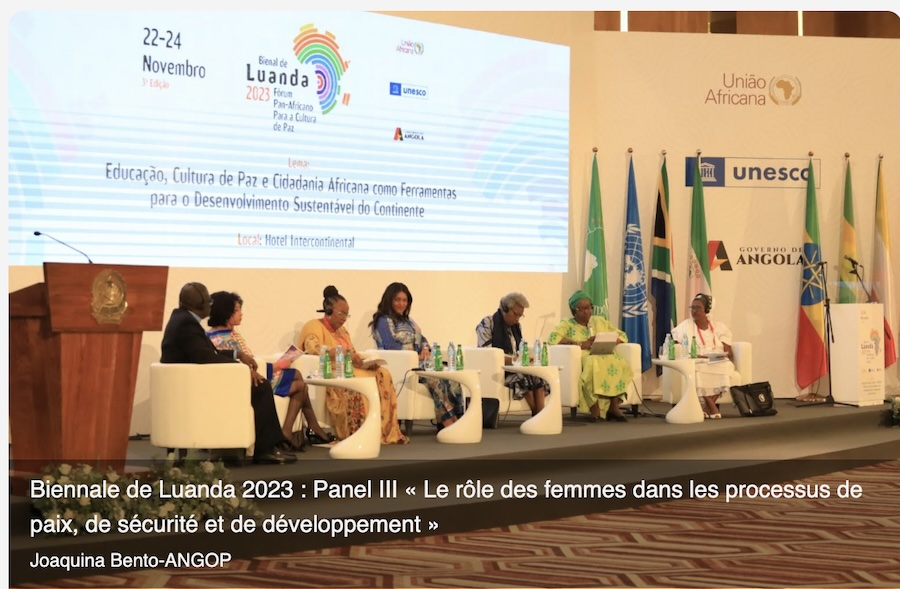
Angola will host the 3rd Luanda Biennale – Pan-African Forum for a Culture of Peace and Non-Violence – on the 22nd, 23rd and 24th of November, to address the continent’s themes on violence prevention, it was announced today.

An intersectoral commission, coordinated by the Minister of State for the Social Area, Dalva Ringote, is already preparing the meeting that should take place under the motto “Education, Culture of Peace and African Citizenship as Tools for the Sustainable Development of the Continent”.

(Continued in right column)

(click here for the original Portuguese version of this article.)

Question related to this article:

The Luanda Biennale: What is its contribution to a culture of peace in Africa?

(Continued from left column)

The Biennale of Luanda, a meeting resulting from a decision of the 24th Session of the Assembly of Heads of State and Government of the African Union in 2015, will bring together heads of State and Government from the continent and the world, young leaders and international organizations.

The Angolan Government, in a statement, invited financial institutions, the private sector, civil society, scientific, artistic and sports communities to participate in the meeting to address crucial issues on the continent and promote the prevention of violence.

A memorandum of understanding signed on June 20, 2023 between the Angolan Government, through the Luanda Biennale, and the Organization of African, Caribbean and Pacific States (OEACP) was also under analysis at the level of the preparatory body.
The memorandum ensures the active participation of the OEACP and the Member States of the six regions of the organization, supporting the mobilization of resources from partners and actors and identifying joint initiatives that can be integrated into the Bienal de Luanda program.

The previous Bienalle de Luanda took place between 27 and 30 November 2021 (see CPNN December 2021.

Media Organizations From Global South Discuss Solidarity and Standing Up to Sanctions

FREE FLOW OF INFORMATION

An article by Mauro Ramos in Peoples Dispatch

At an event in Shanghai (May 8), representatives of media organizations from Asia, Africa, and Latin America highlighted the need for learning from and working with each other and building infrastructure to resist western hegemony


(Photo: Research Institute of International Communication at East China Normal University)

“The conflict imposed by the United States [on China] is partly due to the decline of Western control over science and technology. Gradually, neocolonial control over finance, resources, and science and technology has been exhausted, but the neocolonial structure remains with respect to Western control over weapons and information systems,” said Vijay Prashad, director of the Tricontinental: Institute for Social Research and Chief Correspondent of Globetrotter, at the opening of the “Communication as Solidarity” conference, organized by the School of Communication at East China Normal University along with several other Chinese entities in Shanghai. 

Besides representatives from Press TV,TeleSUR, RT and CGTN, the event also included members of progressive media organizations such as Pan African TV, ArgMedios, and Brasil de Fato, and over 100 researchers and media professionals from China, Ghana, Zambia, South Africa, Brazil, and Russia.  

Prashad said that Western powers have almost absolute control over information systems. “This control is exercised through Western domination of infrastructure, such as fiber optic cables, and human networks of information production, and through the ideological power of Western media established during colonial times.” 

One of the hosts of the meeting, Lu Xinyu, of the newly formed International Communication Research Institute at East China Normal University, said that the movement for a new order in the 1970s tried to solve the problem of the unbalanced global media structure, but failed. “So today we hope to have a new understanding of this issue: One aspect is the domination of the media by the West. That requires that we, the media and media organizations of the global South, work together.” 

Targets of sanctions and censorship by the Global North

The conference was attended by representatives of media organizations that have faced the brunt of censorship.

In 2010, US State Department documents leaked by WikiLeaks revealed that the UK Foreign and Commonwealth Office had told the US embassy that the British government was “exploring ways to limit the operations of the IRIB’s Press TV service.” (IRIB = Islamic Republic of Iran Broadcasting)

In the document, the British chancellery stated that national and international law did not permit the withdrawal of Press TV’s license, but that a possibility could be open if more sanctions were imposed on Iran. 

Finally, in 2013, the Iranian state channel’s license was revoked in the UK for allegedly violating the country’s Communications Act. In the following years, the media outlet suffered several blocks on its YouTube and Gmail accounts, was banned from Facebook, had its website https://presstv.com/ confiscated, and late last year, the French satellite operator Eutelsat decided to take the channel off the air.

At different levels, many of the media organizations present at the meeting have been facing censorship, blockades, and sanctions imposed by the United States and Europe or right-wing governments, as in the case of TeleSUR. 

(Article continued in the column on the right)

Question related to this article:
 
How can media from the Global South break the media hegemony of the Global North?

Free flow of information, How is it important for a culture of peace?

(Article continued from the column on the left)

The multi-state-owned platform has already been removed from the programming of the National Telecommunications Corporation, a state-owned channel in Ecuador in 2018 under Lenín Moreno. After the coup against Evo Morales in Bolivia in 2019, the state-owned Entel under the de facto government of Jeanine Áñez, suspended the broadcast of the channel founded by Hugo Chávez.

In 2021, the UK withdrew CGTN‘s license on the grounds that it is directly controlled by a political party, which is not allowed in the country. RT, on the other hand, has been banned from all European territory and from platforms such as YouTube. The Spanish version of the channel on that platform had six million followers until it was taken down.   

In a debate about the search for sovereignty for the Global South media, the president of TeleSUR, Patricia Villegas, defended the need that the countries to develop their own platforms, such as satellites, servers, and social networks. “The content we’ve been building relies on borrowed highways that are owned by others who define and change the rules, block you whenever they want, according to the interests that they defend. So, if we want to continue to tell what really happens in each of these territories, we have to fight to build our own highways.”

For the director of Brasil de Fato, Nina Fideles, the conference was significant “by the very fact of bringing together, over two days, people and media outlets from different countries, who could share experiences and ideas about communication from the Global South.”

“Besides the fact that we had the opportunity to learn more about the Chinese experience in relation to communication, we also learned about the economic and social model here and the country’s role reorienting the global geopolitical situation,” added Fideles.

The founder of the Post in Zambia, Fred M’membe, said that the meeting between the different media outlets was trailblazing. He also commented that media like TeleSUR, RT, and CGTN, among others, have a great responsibility to use the knowledge and resources they have to help create a new kind of media, a new way of communication. “Our adversaries, those who want to continue with the ideas of exploitation and humiliation of others, are investing billions of dollars around the world to consolidate their ideas of dominating the world,” said M’membe, who is also president of the Socialist Party of Zambia.

Progressive media and Pan-Africanism

Another axis of debate at the conference was the media scenario on the African continent, as well as the Pan-African agenda. Kambale Musavuli, director of Pan-African TV, said that Pan-Africanism has been taking root in the African continent and that the role of progressive media is essential to the project. 

“We have achieved Pan-Africanism at the political level by bringing the countries of the African Union together, but now we need the Pan-Africanism among the people. Where are the people? They are in the rural communities, and to reach them you need the media, radio, television, and newspapers. We are using the media, especially TV, to reach the people in remote areas. So, using community radio stations, using television stations run by progressive organizations, it will be possible to spread this vision of a united Africa under Pan-Africanism,” Musavuli explained.  

Kwesi Pratt Jr., founder of the channel, said that Africa’s image and history are permanently distorted by the hegemonic media. “There is a hysteria all over the world that prevents us from choosing our own friends and deciding our own destiny. The African reality today is: Those who colonized and enslaved us are exploiting and stealing our resources to maximize the profits of multinational corporations instead of developing Africa. This is the story we need to tell and we need to tell it in our own way, using our own instruments,” he said.

The conference saw the official inauguration of the International Communication Research Institute of East China Normal University, which will have Lu Xinyu as dean. 

This new institution seeks to contribute to the development of multi-level and multi-channel international communication platforms and networks for the countries and regions in the Global South.
 
(Thank you to the United National Antiwar Coalition for calling our attention to this article.)

Daniel Ellsberg Has Passed Away. He Left Us a Message.

FREE FLOW OF INFORMATION .

An article by Norman Solomon in Common Dreams (republished according to Creative Commons CC BY-NC-ND 3.0)

When  Daniel Ellsberg died on Friday, (June 16) the world lost a transcendent whistleblower with a powerful ethos of compassion and resolve.


Daniel Ellsberg giving the peace sign in front of the White House during a 2011 demonstration calling for the end of the war in Afghanistan.
(Photo credit should read Karen Bleier/AFP via Getty Images)

Ellsberg’s renown for openly challenging the mentalities of militarism began on June 23, 1971, when he appeared on CBS Evening News ten days after news broke about the Pentagon Papers that he’d provided to journalists. Ellsberg pointedly said that in the 7,000 pages of top-secret documents, “I don’t think there is a line in them that contains an estimate of the likely impact of our policy on the overall casualties among Vietnamese or the refugees to be caused, the effects of defoliation in an ecological sense. There’s neither an estimate nor a calculation of past effects, ever.”

And he added: “The documents simply reflect the internal concerns of our officials. That says nothing more nor less than that our officials never did concern themselves with the effect of our policies on the Vietnamese.”

Ellsberg told  anchor Walter Cronkite: “I think we cannot let the officials of the Executive Branch determine for us what it is that the public needs to know about how well and how they are discharging their functions.”

The functions of overseeing the war on Vietnam had become repugnant to Ellsberg as an insider. Many other government officials and top-level consultants with security clearances also had access to documents that showed how mendacious four administrations had been as the U.S. role in Vietnam expanded and then escalated into wholesale slaughter.

Unlike the others, he finally broke free and provided the Pentagon Papers to news media. As he said in the CBS interview, “The fact is that secrets can be held by men in the government whose careers have been spent learning how to keep their mouths shut. I was one of those.”

(Article continued in the column on the right)

Questions related to this article:

Where in the world can we find good leadership today?

The courage of Mordecai Vanunu and other whistle-blowers, How can we emulate it in our lives?

How can we carry forward the work of the great peace and justice activists who went before us?

(Article continued from the column on the left)

Ellsberg’s mouth, and heart, never stayed shut again. For the 52 full years that followed his release of the Pentagon Papers, he devoted himself to speaking, writing, and protesting. When the war on Vietnam finally ended, Ellsberg mainly returned to his earlier preoccupation—how to help prevent nuclear war.

This spring, during the three months after diagnosis of pancreatic cancer, Ellsberg made the most of every day, spending time with loved ones and speaking out about the all-too-real dangers of nuclear annihilation. He left behind two brilliant, monumental books published in this century—“Secrets: A Memoir of Vietnam and the Pentagon Papers” (2002) and “The Doomsday Machine: Confessions of a Nuclear War Planner” (2017). They illuminate in sharp ghastly light the patterns of official lies and secrecy about military matters, and the ultimate foreseeable result—nuclear holocaust.

Ellsberg was deeply determined to do all he could to help prevent omnicide. As he said in an interview  when “The Doomsday Machine” came out, scientific research has concluded that nuclear war “would loft into the stratosphere many millions of tons of soot and black smoke from the burning cities. It wouldn’t be rained out in the stratosphere. It would go around the globe very quickly and reduce sunlight by as much as 70 percent, causing temperatures like that of the Little Ice Age, killing harvests worldwide and starving to death nearly everyone on earth. It probably wouldn’t cause extinction. We’re so adaptable. Maybe 1 percent of our current population of 7.4 billion could survive, but 98 or 99 percent would not.”

During the profuse interviews that he engaged in during the last few months, what clearly preoccupied Ellsberg was not his own fate but the fate of the Earth’s inhabitants.

He was acutely aware that while admiration for brave whistleblowers might sometimes be widespread, actual emulation is scarce. Ellsberg often heard that he was inspiring, but he was always far more interested in what people would be inspired to actually do—in a world of war and on the precipice of inconceivable nuclear catastrophe.

During the last decades of his life, standard assumptions and efforts  by mainstream media and the political establishment aimed to consign Ellsberg to the era of the Vietnam War. But in real-time, Dan Ellsberg continually inspired so many of us to be more than merely inspired. We loved him not only for what he had done but also for what he kept doing, for who he was, luminously, ongoing. The power of his vibrant example spurred us to become better than we were.

In a recent series of short illustrated podcasts  created by filmmaker Judith Ehrlich—who co-directed the documentary  “The Most Dangerous Man in America: Daniel Ellsberg and the Pentagon Papers”—Ellsberg speaks about the growing dangers of global apocalypse, saying that nuclear war planners “have written plans to kill billions of people,” preparations that amount to “a conspiracy to commit omnicide, near omnicide, the death of everyone.” And he adds: “Can humanity survive the nuclear era? We don’t know. I choose to act as if we have a chance.”

Government-ELN agreements, a milestone this week in Colombia

FREE FLOW OF INFORMATION . .

An article from Prensa Latina (translation from Prensa Latina English – first five paragraphs – and by CPNN – rest of article)

The agreements between the Colombian Government and the National Liberation Army (ELN) in the third cycle of dialogues in Havana became a significant issue this week for the country and Latin America.

This Friday (June 9), at noon from Havana, Cuba, the parties formalized the bilateral ceasefire agreement, which will last 180 days (six months).

This new pact expands prohibited actions and provides for a robust UN monitoring and verification mechanism, with the accompaniment of the Catholic Church and social oversight, as well as the participation of the guarantor and accompanying countries.

This ceasefire will also allow the territories to have the conditions of tranquility required by the people and communities in the process of participation of society in the construction of peace that has been agreed upon during this cycle.

For the first time, the State and the ELN reached an agreement that implies the block treatment of the first three points of the Mexico Agreement, where the second cycle of talks took place; the participation of society in the construction of peace, democracy for peace and transformations for peace, Senator Iván Cepeda said.

– – –

The agreed cessation has progressive phases. The first, enlistment, is immediate. Then, on July 6, the end of offensive operations begins until reaching full validity, of 180 days, as of August 3, while monitoring and verification will begin soon.

(continued on right column)

(Click here for the Spanish version of this article.)
Questions related to this article:

What is happening in Colombia, Is peace possible?

(continued from left column)

A National Participation Committee will also be created, which will have the participation of 30 sectors of society to contribute to the transformation of the country and the achievement of Peace.

“We reached a partial agreement with the ELN like never before, which will be progressive until the final agreement in May 2025,” said President Petro.

The priority will be to achieve the protection of the civilian population in the conflict areas, starting with children, he added.

The head of state assured that human rights and international humanitarian law guide the agreement. He stressed that the participation of society will be fundamental, as well as the proposal for a great National Agreement that his government supports.

The parties thanked Cuba for its role as guarantor and for facilitating its territory to reach these agreements that will alleviate the communities affected by the internal conflict.

“The main effort in this process we owe to Cuba. Without that effort it would be impossible to be here,” said ELN commander Antonio García, at the closing of the Third Cycle of the Dialogue Table.

Likewise, Pablo Beltrán (the ELN negotiator) assured that the inclusion of Cuba on the US list of countries sponsoring terrorism is an injustice, while he thanked the Cuban government and people for their vocation for peace.

President Petro also described the inclusion of Cuba on that list as a profound injustice.

“I was telling President (Joe) Biden that if there has been an act of profound diplomatic injustice… a stab in the back… it was that Cuba ended up in that abject designation. From here I tell President Biden that this act of injustice must be amended, “he stressed.

Prior to this agreement, considered a milestone in Colombia, and one of the most significant achievements within the Total Peace policy of the Government of Gustavo Petro and Francia Márquez, a forceful mobilization of the people took place in support of the mandate of both leaders and their change proposals.

Austrian Censorship of Peace Conference Is An Outrage

FREE FLOW OF INFORMATION

An article by By David Swanson, Kathy Kelly, John Reuwern and Brad Wolf from World Beyond War

Forty-eight hours before a global peace conference in Vienna, Austria, was to begin, the venue host abruptly cancelled. Peace, it seems, cannot be discussed, especially peace in Ukraine.

This news is a disturbing step in a growing trend.

Owners of the venue which was to host the Summit for Peace in Ukraine, announced on Wednesday, 7 June, 2023, their decision to cancel the agreement holding the summit on their premises. Fortunately, a new location was secured in Vienna (and anyone on Earth can sign up to take part online), but not before a smear campaign against the summit had been launched.

The venue owners reportedly explained: “We have decided to comply with the wishes of Ukraine and its embassy operating in Austria and have cancelled the rental of all rooms in the ÖGB catamaran for the event ‘International Summit for Peace in Ukraine’ next weekend.”

This was not just one venue taking this position. “On Wednesday, the Press Club Concordia also refused to make its premises in a central location in downtown Vienna available for a press conference of the ‘summit’.”

Supporters of the summit note the chilling innuendo caused by the abrupt cancellation of the summit. Speakers widely regarded for their moral and intellectual guidance have been undermined in statements intended to justify objections to the summit.

This is not an isolated incident. Western liberal ideals have long asserted that the best answer to mistaken speech was wiser speech and more of it. We now have a rapidly growing liberal consensus in favor, instead, of censoring media outlets, canceling speaking events, and forbidding people with unwanted points of view from even gathering together. Powers are being granted to governments, social media platforms, and other tech corporations that believers in democratic self-governance spent centuries claiming nobody should have.

Those who turn against free speech are often groups afraid they cannot win an honest debate. And so, they take up censorship. The movement for peace in Ukraine can take this as a compliment. Governments fear such a discussion of peace and instead smear this peace summit and the speakers.

An Austrian press report announced on Thursday that the venue (ÖGB Catamaran) had been withdrawn because the event was “under suspicion of propaganda.” What sort of propaganda? Well: “According to its own statements, the ‘International Summit for Peace in Ukraine’ wanted to show ways out of the war.” Under international law, propaganda for war is illegal and must be banned. Not a single nation on Earth complies with that requirement, raising up the value of free speech as trumping the rule of law. But speaking in favor of bringing a war to an end has now acquired the status of forbidden propaganda.

Moreover, the report explains, “some announced participants have no current fear of contact with the media of the aggressor.” In other words, if talk of negotiating peace is shut out of the media controlled by only one side of a war, speaking to media controlled by the other side — even to say exactly what one would have said to any other media outlet — is grounds for not only censorship but a ban on meeting and strategizing.

(Article continued in the column on the right)

Question related to this article:
 
Free flow of information, How is it important for a culture of peace?

Can the peace movement help stop the war in the Ukraine?

How can we be sure to get news about peace demonstrations?

(Article continued from the column on the left)

The report gives some specifics: “The internationally prominent U.S. economist Jeffrey Sachs, for example, as well as Anuradha Chenoy, ex-dean of India’s Jawarharlal Nehru University and an important representative of global civil society networking, have given interviews to the TV station Russia Today (RT). The channel has been blocked across the Union for Russian war propaganda in the wake of EU sanctions. Sachs also answered questions from Russian TV host and war advocate Vladimir Solovyov in December 2022. Solovyov has often called for attacking Germany and Great Britain as well.”

The “Press Club Concordia” also explained that the problem was that Jeffrey Sachs might do an interview on Russian media.

Not only is diplomacy shunned, but speaking to members of the media with whom one disagrees is equated with advocating whatever those journalists have advocated. This can only contribute to distrust, enmity, and war without end.

Not only did the venue say it was doing the wishes of the Ukrainian embassy, but the Ukrainian ambassador to Austria tweeted that peace activists were the fifth column and henchmen of the Russian government.

And who created the idea that the whole world must obey the wishes of the government of Ukraine? The government of the United States — a country where little time passes these days without news of some event cancelled to fulfill the wishes of the government of Israel.

Further, “Noam Chomsky, who will speak at the summit via video, for example, believes that NATO has ‘marginalized’ Russia for too long.” Whether that fact is in dispute, or merely the acceptability of stating it out loud, was not explained.

“Also physically present in Vienna, according to the program, should be Clare Daly, an Irishwoman and member of the EU Parliament and the parliamentary group Die Linke. Daly also spoke repeatedly to RT about the West’s ‘complicity’ in the war in Ukraine. She believes the sanctions are wrong: they would not harm Russia and would not help Ukraine. In the EU Parliament in early 2023 voted against a resolution holding Russia legally responsible for the war. Daly said she does support those parts of the text that condemn Russia for the invasion and call on the government in Moscow to immediately cease all military action and withdraw from Ukraine. However, she said she opposes providing weapons to Ukraine and expanding NATO’s presence in the region.”

So, opposing both sides of a war is just as unacceptable as opposing one side, in the view of these censors.

This is where we have arrived. Proposing to negotiate peace — without even suggesting what those negotiations should arrive at — is so unacceptable to proponents of war, that it cannot be discussed — not in any large gathering. And yet, despite the wars being waged in the name of “democracy” it is not clear how such censorship is driven by democracy or in align with democratic values. Nor is it clear how many steps, if any, remain between the varieties of censorship we have now and hardcopy book burnings of the past.

(Editor’s note: We were informed on June 13 that “the websites for the International Peace Bureau and the Peace in Ukraine summit were hacked the day after the conference but should be up and running soon.”)

China Culture: Xi calls for protection of Chinese civilization, culture and heritage

FREE FLOW OF INFORMATION .

President Xi Jinping has called for the protection of the country’s rich cultural heritage. Cen Ziyuan spoke with experts from the Chinese Academy of History, where he made the call in a speech on Friday.


frame from news video

CEN ZIYUAN Beijing “President Xi said a deep and comprehensive understanding of the Chinese past will allow the nation to draw upon its traditional culture to meet current challenges. The Chinese leader described Chinese civilization as unique, cohesive, innovative, uniform and peaceful. He said the nation is not afraid of facing up to challenges and stressed the need for creativity and innovation.”

LI GUOQIANG Deputy Director-General, Chinese Academy of History “The pursuit of peace and harmony is the foundation of the Chinese spirit. It is in the gene of Chinese civilization. In the 5,000-year history, our ideal world is of great unity. We value a culture of peace and unity.”

(Article continued in the column on the right)

Questions related to this article:

Does China promote a culture of peace?

(Article continued from the column on the left)

Chinese President Xi Jinping made his remark after visits to the China National Archives of Publications and Culture and the Academy.

He reaffirmed that China does not aim to impose its own values and system on others, and that Beijing will continue to contribute to world peace and international order.

LI GUOQIANG Deputy Director-General, Chinese Academy of History “In such a cultural value, we do not support hegemony. We do not colonize others or occupy them. We continue to be open and embracive about foreign cultures.”

President Xi stressed the unity of the country is China’s core interest.

He said the country is at a historic turning point and he called on experts working in the field of culture to continue preserving and innovating the riches of Chinese civilization.

LIU JIAN Deputy Head, Institute of World History Chinese Academy of History “The continuity of Chinese civilization is developed under a uniform area of land and supported by pluralism. The condition to sustain the continuity is to uphold the traditions and innovate. We embrace culture from abroad.”

Experts say the continuity of Chinese civilization is a reference and promotes dialogues and exchanges of world cultures.

LIU JIAN Deputy Head, Institute of World History Chinese Academy of History “But now we also put emphasis on peace. This is the foundation of connectivity. This is also China’s contribution to world civilization.”

The Chinese civilization has always been ready to interact with different others. Engaging with the Chinese culture is key to understanding the nation better while its people are mutually willing to share their stories with the world.

In memoriam: Walid Slaïby, co-founder Academic University College for Non-Violence & Human Rights (Lebanon)

FREE FLOW OF INFORMATION .

An article from the Global Campaign for Peace Education (translated by The Global Campaign for Peace Education from the original French version by Anne-Marie El-HAGE in L’Orient Le Jour , May 8, 2023)

He was one of those followers of non-violence who made Lebanese society and the Arab world better. A thought that he developed during the civil war, in the same way as secularism, in reaction to the destructive consequences of the Lebanese intercommunity conflict on the social fabric. Walid Slaïby is no more. He died on Wednesday, May 3 at the age of 68, overcome by a cancer that had been eating away at him for more than 20 years. His name, inseparable from that of his companion in life and struggle, the sociologist Ogarit Younan, will forever be linked to activism for the right to life within the framework of the fight for the abolition of the death penalty. Civil rights will also be at the heart of his fight for a Lebanese personal status law. Along with workers’ rights and social justice, from the early 1980s.


Walid Slaïby, follower of non-violence and death penalty abolitionist, died on May 3 at the age of 68. (Photo courtesy of Aunohr Media Services)
(Click on photo to enlarge)


An immense legacy

From his commitment to the service of Lebanon, he will leave an immense legacy. A multitude of books, publications, translations, bills, associations, tangible progress on the ground, always with Ogarit Younan. With the crowning achievement in 2015 of the Academic University College for Non-Violence & Human Rights (Aunohr), an educational institution dedicated to non-violence that continues to train generations of students, activists, trade unionists ready to take over. This course will see the duo rewarded several times, in particular by the Human Rights Prize of the French Republic in 2005, the Fondation Chirac Prize in 2019 and the Gandhi Prize for Peace awarded in 2022 by the Indian foundation Jamnalal Bajaj, named after the disciple of Mahatma Gandhi.

It is in his fight against the death penalty that Walid Slaïby initiated the most tangible progress. “He was a silent soldier against capital punishment. But his work was very important,” says Wadih Asmar, president of the Lebanese Center for Human Rights (CLDH). After federating several associations around the National Campaign for the Abolition of the Death Penalty, the activist rallied part of the political and judicial class to the cause, during shock events that were highly publicized. In 1998, when two burglars, one of whom had committed a double murder, were hanged in Tabarja in the public square, he openly proclaimed during a nocturnal sit-in “mourning for the victims of the crime and for those of capital punishment “. As a result, the last executions date back to 2004 in Lebanon, even if justice continues to pronounce the death sentence. “Lebanon is now classified as a de facto abolitionist country. In 2020, for the first time in its history, it spoke out for a moratorium at the UN General Assembly, alongside 122 other states. A position recently reiterated”, welcomes former minister Ibrahim Najjar, a committed abolitionist. The lawyer did not personally know the deceased, but he said he was “respectful and admiring of the courage of Walid Slaïby and his companion Ogarit Younan, who behaved as convinced abolitionists”. “Because the fight is not easy. It is so easy to confuse revenge with capital punishment,” he points out. for the first time in its history, it came out in favor of a moratorium at the UN General Assembly, alongside 122 other states. 

(Article continued in the column on the right)

(Click here for the original version in French)

Questions related to this article:

Where in the world can we find good leadership today?

How can we carry forward the work of the great peace and justice activists who went before us?

(Article continued from the column on the left)

A position recently reiterated”, welcomes former minister Ibrahim Najjar, a committed abolitionist. The lawyer did not personally know the deceased, but he said he was “respectful and admiring of the courage of Walid Slaïby and his companion Ogarit Younan, who behaved as convinced abolitionists”. “Because the fight is not easy. It is so easy to confuse revenge with capital punishment,” he points out. for the first time in its history, it came out in favor of a moratorium at the UN General Assembly, alongside 122 other states. A position recently reiterated”, welcomes former minister Ibrahim Najjar, a committed abolitionist. The lawyer did not personally know the deceased, but he said he was “respectful and admiring of the courage of Walid Slaïby and his companion Ogarit Younan, who behaved as convinced abolitionists”. “Because the fight is not easy. It is so easy to confuse revenge with capital punishment,” he points out. but he says he is “respectful and admiring of the courage of Walid Slaïby and his companion Ogarit Younan, who behaved as convinced abolitionists”. “Because the fight is not easy. It is so easy to confuse revenge with capital punishment,” he points out. but he says he is “respectful and admiring of the courage of Walid Slaïby and his companion Ogarit Younan, who behaved as convinced abolitionists”. “Because the fight is not easy. It is so easy to confuse revenge with capital punishment,” he points out.

For a Lebanese Personal Status Law

The personality of Walid Slaïby is no stranger to his great popularity. “Walid was a man of dialogue, attentive to his friends. It is through debate and acceptance of the other that he succeeded in laying the foundations of the culture of human rights in Lebanon, and in particular of non-violence”, affirms Ziad Abdel Samad, friend of the couple, engineer and teacher in political science. “Despite the divisions of Lebanese society, he managed to go beyond the militias and the borders to lead an avant-garde struggle and achieve remarkable progress”, he observes, referring to the efforts of the deceased to raise awareness among young people and bring closer Lebanese of different faiths and backgrounds. It is also in the institutionalization of the fight that Walid Slaïby drew his strength. “When I met him in the early nineties, he organized human rights training against religious discrimination, remembers activist Rima Ibrahim. Despite his illness, he never stopped dreaming of changing Lebanese society, to the point of institutionalizing the fight.

Several associations were then created, linked to the Lebanese Association for Civil Rights (LACR), notably Chamel and Bilad. In 2011, the militant couple launched their campaign to demand a Lebanese law on personal status which advocates, among other things, civil marriage. In Lebanon, family laws are governed by religious communities. They discourage inter-religious unions and discriminate against women. “For the occasion, we organized a sit-in and set up a tent for 10 months, place Riad el-Solh, in downtown Beirut. We have also prepared a bill,” recalls Rafic Zakharia, lawyer, teacher and member of the association. Signed by MP Marwan Farès, the text is presented to Parliament and transferred to the joint commissions. “The law has not been adopted. But our mobilization has never weakened”, assures the activist, whose “life has changed” since he met Walid Slaïby. “Non-violent thinking has become a way of life for me, not just a fight,” observes this death penalty specialist.

The happiness of having given hope to the Lebanese

The militant, the thinker, the humanist endowed with superior intelligence and a good dose of humor left with modesty and elegance, as he has always lived. “Walid Slaïby was both a great humanist and a man of science. Very solid in his convictions, he was flexible when it came to discussing. Never giving lessons, he was not a man to show off, but on the contrary was very discreet, ”describes the lawyer and former minister Ziyad Baroud, member of the board of directors of Aunhor, who knows him. for over 25 years. Multi-graduate, the disappeared was indeed a civil engineer (ESIB), a graduate in physics (UL) and in economics (AUB). Studies he completed with a DEA in social sciences (UL),

He will be missed by human rights defenders, starting with abolitionists around the world who pay tribute to him and his companion. “It was a star of light and reason in a world of shadow and madness”, sums up Raphaël Chenuil-Hazan, director general of the international association ECPM (Together against the death penalty). “With Ogarit, they formed this incredible duo who have devoted their lives for more than 40 years for a modern Lebanon”, he continues, congratulating himself on having had “the chance to send him love before his death of the abolitionist community around the world. Walid Slaïby will especially be missed by his alter ego, his soul mate, Ogarit Younan, with whom he was to celebrate 40 years of love and activism. “We were expecting the weather to improve a bit. We wanted a nice party. We didn’t think he was so close to death. He loved life so much. He had so much humor,” she regrets sadly. And if the disease occupied a good half of their life together, he will at least have had “the happiness of serving his country and giving hope to the Lebanese”. “Lebanon must be happy, we have served it, consoles Ogarit Younan. But if Walid had not fallen ill, without a doubt, Lebanon would have been different…”