Category Archives: TOLERANCE & SOLIDARITY

Kalemie, DRC: 200 young Twa and Bantu trained as actors of peace

. TOLERANCE & SOLIDARITY .

An article from Radio Okapi

Two hundred young Twa and Bantu have been trained as actors of peace within the framework of the Tusikilizane Joint Project initiated in Tanganyika by UNFPA, FAO and UNESCO. This project consisted in training in the culture of peace young people and women from two communities previously in conflict. Provincial authorities say they support the project.


A view of the commercial district in Manono, 450 km southwest of Kalemie (Katanga / DRC).

(Click here for the original French version of this article)

(continued in right column)

Question related to this article:
 
Youth initiatives for a culture of peace, How can we ensure they get the attention and funding they deserve?

(continued from left column)

It was the Twa-Bantu conflict, which raged in five of the six territories of Tanganyika province, that motivated the three agencies of the United Nations system (UNFPA, FAO and UNESCO) to plan the Tusikilizane Joint Project. Since 2018, Tusikilizane has targeted 200 young people from two communities previously torn apart by bloody conflicts.

This project has just ended its activities in the territories of Kabalo, Kalemie and Nyunzu, after having trained for two years the nucleus of two hundred young people as actors of peace.

UNESCO Country Representative in the DRC, Jean-Pierre Ilboudo, explains:

“Their role is therefore a relay role, which will make that from 200, we will go to 2000, to 2 million to 20 million, to 200 million later. ”

Fifty other women from two communities also benefited from numerous sessions, tools and other capacity-building workshops to involve them in peacebuilding and social cohesion in the region.

“Now that they understand, they would rather work for the welfare of the country and not be manipulated by adventurers. The government is there to support them ”, assured the provincial Minister of Youth and representative of the provincial governor, Radjabu Ali Lugogo Raligo.

Culture of peace: Oyem, Gabon, to host the cross-border project “young weavers of peace in Central Africa”

. TOLERANCE & SOLIDARITY .

An article from Gabon Media Time

Following an exploration mission in Woleu-Ntem province recently led by Salah Kaled, Unesco Regional Director for Central Africa and Representative of the Unesco Office in Gabon ad interim, Oyem was chosen to accommodate the future headquarters of the project entitled “young people, weavers of peace in the cross-border regions of Gabon, Cameroon and Chad”. The project is intended to counter insecurity and growing crime on the borders of the three countries.


Governorate of the province of Woleu-Ntem © D.R.

(Click here for the original French version of this article)

(continued in right column)

Question related to this article:
 
Youth initiatives for a culture of peace, How can we ensure they get the attention and funding they deserve?

(continued from left column)

During his mission, the UNESCO representative made a point to present to Jules Djéki, Governor of the province, the challenges of this project which plans to mobilize nearly 1,800 young peace weavers aged 15 to 35 for conflict prevention and peacebuilding in the cross-border regions of the three countries.

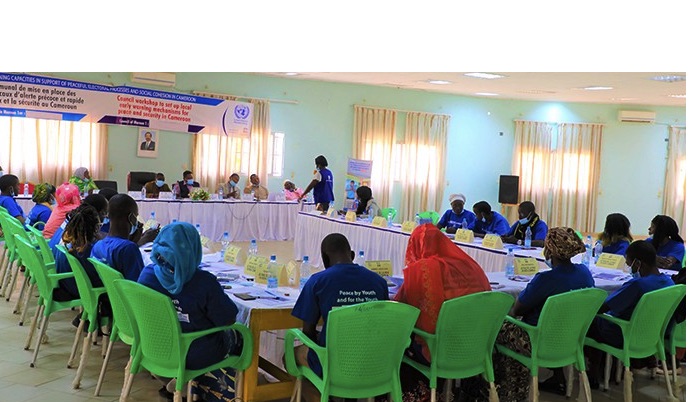
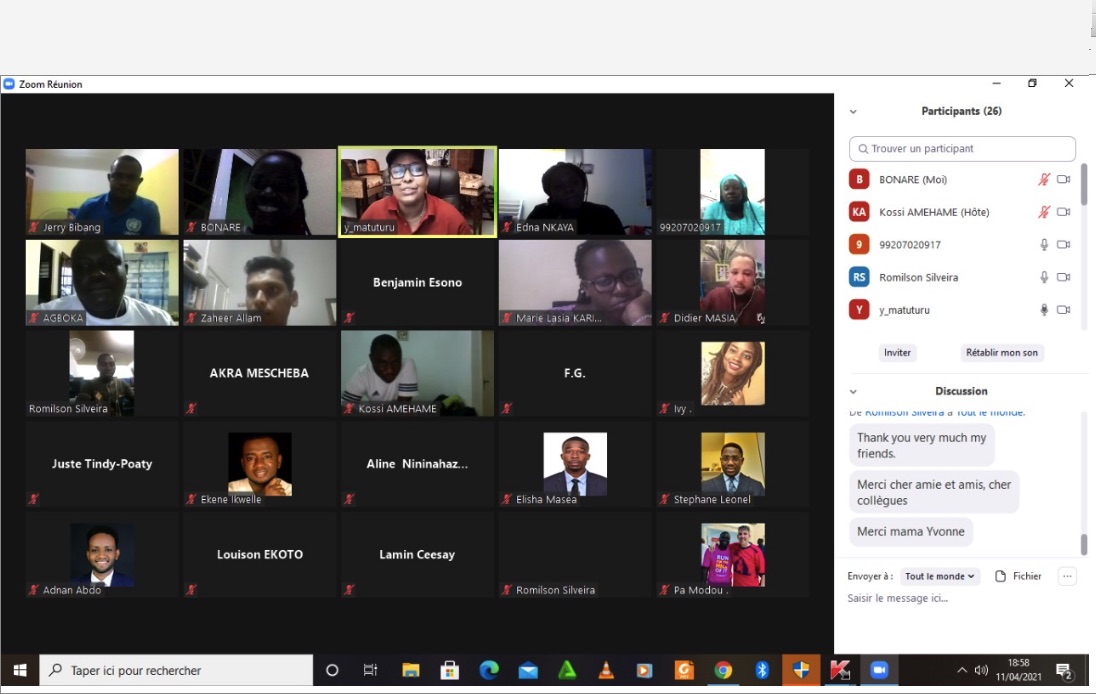
Note that this project also aims to achieve 4 major results. According to Juste-Joris Tindy-Poaty, in charge of the Human and Social Sciences program, we can cite, among others:

– the strengthening of the Central African Early Warning Mechanism (MARAC) of ECCAS in the prevention of conflicts and violence with the participation of young people in each of the border areas;

– the involvement of young people in the trafficking of wildlife, natural resources and other forms of crime,

– improvement of national coordination and monitoring mechanisms by local authorities, in order to provide a more effective and more balanced response to the challenges posed by cross-border crime and the risks of insecurity ”.

1st Assembly on Women, Faith, and Diplomacy

TOLERANCE & SOLIDARITY .

An article from the Parliament of Religions

From 10-13 November 2020,  thousands of representatives from the world’s religions gathered virtually with government, civil society, and multilateral institution leaders for the 1st Assembly on Women, Faith, and Diplomacy hosted by Religions for Peace  and Ring for Peace.

(continued in right column)

Question related to this article:
 
How can different faiths work together for understanding and harmony?

(continued from left column).

On Tuesday, November 10th the Assembly opened with special remarks from Dr. Angela Merkel, Federal Chancellor, Federal Republic of Germany; H.E. António Guterres, Secretary-General of the United Nations; Prof. Azza Karam, Secretary-General of Religions for Peace; and His Eminence Metropolitan Emmanuel of France. What followed were a series of inspiring plenaries, prayers and meditations, virtual coffee breaks, and interactive breakout sessions. Explore the full program here!

This historic Assembly featured global leaders as part of plenaries on Redefining Leadership, Advancing Gender Equality – Women in Diplomacy, Combatting Hate Speech as Cornerstone of Conflict Prevention, Values-Inspired Education,  and Keeping Faith by Nurturing a Sustainable Environment: The role of Religious Leaders to protect the Earth. The last plenary featured the participation of Parliament Chair, Audrey Kitagawa, and Climate Action Task Force Member, Maru-Evelyn Tucker. Watch the full program here.

Morocco: Combating the radicalization of young people via the Internet

TOLERANCE AND SOLIDARITY .

An article by LesEco (translation by CPNN)

La Rabita Mohammedia des Oulémas has just launched a project to fight against the radicalization of young people online. Objective: fight against hate speech and make young people aware of the dangers that the Internet and social networks can present. Funded by the Government of Japan, in partnership with the United Nations Development Program, the implementation agreement for this project was signed by Takashi Shinozuka, Japanese Ambassador to Morocco, Edward Christow, UNDP Resident Representative in Morocco, and Ahmed Abbadi, secretary general of the Rabita Mohammedia des Ulemas.

According to Ahmed Abbadi, this project aims to protect adolescents and young people from the scourges of violent extremism, whether on the ground or in their digital dimension. It also aims to immunize them against hate speech by supporting them to become influential on the Internet in order to prevent and inspire their interlocutors. He added that the project was long-term in order to help young people acquire the tools and skills necessary to fight extremism of all kinds. The success of this project depends mainly on the preparation of attractive and catchy content for young people, says Ahmed Abbadi. La Rabita has launched several interactive Internet games with the aim of promoting the culture of peace and moderation, as well as the rejection of violence and extremism.

(Article continued in the right column)

(Click here for the original French version of this article.)

Question for this article

Islamic extremism, how should it be opposed?

(Article continued from the left column)

According to the same source, the Rabita is preparing a virtual influencer guide to help young people acquire the skills to become effective influencers on the Internet. The same source specifies that Japan and the UNDP, much more than donors, will also be partners in this project.

In this regard, the Japanese Ambassador to Morocco declared: “We believe that this project is also a response to a concern for the immunization of Moroccan society against the cybernetic threats which threaten the youth.” He added that the religious radicalism leading to violence is a universal problem. Takashi Shinozuka also indicates that this funding supports Morocco in its fight against the risks of online radicalization of young people, in particular by preventing and informing about the dangers that social networks can represent.

For his part, Edward Christow affirmed that this project was the fruit of several months of joint work between the Rabita Mohammedia of the Ulemas, the Embassy of Japan and the UNDP, adding that the three partners will continue their collaboration for the implementation of this project. He also said that this project, which aims to support the production and publication of video footage on social media, will depend on Rabita’s experience in this area. It will ensure an online presence through the social networks of the Rabita and the UNDP. In this context, a group of Rabita experts will be able to meet Japanese experts working in the field of conflict prevention and peace promotion, and organize an international workshop in Morocco on best practices in this field.

Funding for this project amounts to 454,545 USD, or more than 4 million MDH. It revolves around 4 main objectives, including carrying out a diagnosis of the risks associated with online radicalization content targeting young people, and supporting national stakeholders in the use of information and communication technologies and media to prevent violent extremism and hate speech. It is also about sensitizing young Moroccans through social networks on the importance of promoting an alternative discourse, the spirit of cooperation and the sharing of experiences in the prevention of violent extremism online. Spanning a period of one year, this project will have a major impact on young people and on Moroccan society as a whole, concludes Edward Christow.

Amnesty International : US State Department’s attack on the BDS movement violates freedom of expression and endangers human rights protection

… . HUMAN RIGHTS … .

An article from Amnesty International

Responding to the United States Department of State announcement designating the Boycott, Divestment, and Sanctions (BDS) movement as antisemitic and planning to identify organizations supporting BDS with a view to reviewing and halting their funding, Bob Goodfellow, the Interim Executive Director of Amnesty International USA, issued the below statement:

“The Department of State’s targeting of groups advocating for using peaceful means, such as boycotts, to end human rights violations against Palestinians as antisemitic violates freedom of expression and is a gift to those who seek to silence, harass, intimidate and oppress those standing up for human rights around the world. This is simply the latest attack from a US government determined to undermine the universality of human rights and the global fight against racism and discrimination, including antisemitism.

(Article continued in right column)


Question related to this article:

Presenting the Palestinian side of the Middle East, Is it important for a culture of peace?

(Article continued from left column)

“Advocating for boycotts, divestment and sanctions is a form of non-violent advocacy and of free expression that must be protected. Advocates of boycotts should be allowed to express their views freely and take forward their campaigns without harassment, threats of prosecution or criminalization, or other measures that violate the right to freedom of expression. Instead of attacking and restricting BDS activities the US should end such measures and instead ensure that BDS advocates are free to express their views and take forward their campaigns without harassment or threats of prosecution.”

“The US administration is following Israeli government’s approach in using false and politically motivated accusations of antisemitism to harm peaceful activists, including human rights defenders, and shield from accountability those responsible for illegal actions that harm people in Israel, in the Occupied Palestinian Territories, and here at home. The process comes across as particularly hypocritical and deceitful coming from an administration that has emboldened neo-Nazis, white supremacists and other groups who advocate violence and discrimination, shown a callous disregard for international law, and favored Israeli policies that result in institutionalized discrimination and systematic human rights violations against millions of Palestinians.

“This process also hurts Jewish people by equating Israel with Judaism and likening criticism of Israeli government policies and practices to antisemitism. It undermines our work in the Middle East and other regions to protect the rights of religious and other minorities.

“We will continue to support our Israeli and Palestinian colleagues, including BDS activists, who like human rights defenders around the world, speak up when justice, freedom, truth, and dignity are denied.”

France: Youth in Normandy Mobilize for Human Rights and the Freedom Prize

. TOLERANCE & SOLIDARITY .

Special to CPNN from Gwenaëlle Beauvais, Territorial Director, UNIS CITE Normandie (translation by CPNN)

For more than 20 years, the Unis Cité association has mobilized young people, in teams and in diversity, to carry out missions of general interest. The goal of these young people: is to find meaning by making themselves useful to others, to find their place in their relations with different people and opinions, to train and gain self-confidence.

(continued in right column)

Question related to this article:
 
Youth initiatives for a culture of peace, How can we ensure they get the attention and funding they deserve?

(continued from left column)

This year, in Normandy, 48 volunteers are mobilizing to meet with high school students across the region to raise awareness about Human Rights and Freedom. They are trained by the Institute of Human Rights and supported by the Regional Council to initiate debates with the pupils, to make them think and to support their engagement within the framework of the initiative Freedom Prize.

This program allows young people to speak freely and, thanks to the exchange between peers, to promote the initiative and expression of high school students in the region. It is part of a unique system , the Freedom Prize, which invites young people aged 15 to 25 from Normandy, other regions of France and internationally, to nominate each year a person or an organization engaged in a recent fight and exemplary in favor of freedom.

Recent winners of the Freedom Prize have been :
— 2019: Greta Thunberg, Swedish environmental activist committed to the fight against global warming
— 2020: Loujain Al Hathloul, Saudi women’s rights activist

(Click here for the original French version of this article)

Abortion Without Borders: Standing with Polish Women

TOLERANCE & SOLIDARITY .

An article by: Merle Hoffman in We-news

Have you seen those extraordinary photos? The women of Poland, thousands and thousands of them, pouring into the streets, disrupting business as usual and denouncing the government’s new ban on abortion. They carried symbols of red thunderbolts, umbrellas and wire coal hangers – hangers! A universal symbol of dangerous, illegal abortions which they refused to accept.

I immediately flashed back to the action I had led decades earlier in front of St. Patrick’s Cathedral in NYC in 1989, surging across Fifth Avenue with hundreds more to the Cathedral steps. I held high a six-foot replica of a wire hanger, chanting with the many others, “Not the Church, not the State, Women will Decide our Fate!” Two of our crew stood before the massive bronze doors and held up a huge Proclamation which began, “On behalf of the women of New York City and their sisters throughout the country and out of love for the truth and the desire to bring it to light, we stand here today…”

This action was inspired by then Cardinal O’Connor’s active support for anti-abortion blockades of clinics. It was the first pro-choice civil disobedience action, an historic event that could not be ignored by the media. The New York Times quoted me as saying, “Women’s rights are in a state of emergency,” and the Philadelphia Enquirer stated the action marked “an important strategic change in the movement.” Oh, how I want to be there in Poland with these fearless and inspiring women, storming into the streets and challenging government and religious institutions. Marching and chanting, full of revolutionary rectitude!

Unfortunately, it wasn’t possible to travel to Poland directly due to the Coronavirus, but I needed to do something. I contacted a feminist academic and writer in Warsaw involved in the protests. I was asked to write a letter of support from American Feminists that could be widely disseminated and published in a major newspaper. So I did, and Phyllis Chesler, Gloria Steinem, Frances Kissling, Naomi Wolf and others soon signed on. (See the letter, below.) It was published earlier this week in both Polish and English in the women’s extra to Poland’s largest daily news outlet, GAZETA WYBORCZA and was shared widely on social media by The Women’s Strike (the leading organization behind the demonstrations) as well as by local women’s groups. (Read article here.)

[Editor’s note. Another letter of support for the struggle of Polish women was written by Amnesty International, Human Rights Watch and the Center for Reproductive Rights.]

Just as I am now inspired by the courage of the Polish women, so was I inspired to travel to Russia and assist in developing women’s health services there when I heard the story of one woman who came to Choices Women’s Medical Center for her 36th abortion. I was also inspired by attacks on women’s clinics to organize the St. Patrick’s action, and I have been inspired to carry on this work at Choices – with my wonderful staff – by the memory of holding the hand of the first patient who stepped through our doors nearly 50 years ago. It’s always the women’s stories, the women’s needs and women’s bravery.

The good news from Poland today is that the courage and persistence of Polish women have forced the government to pause and step back from implementing its all but total, viciously cruel ban, even forbidding abortions where the fetus has severe abnormalities. The fight is not over, but we are confident the women of Poland will continue to inspire the rest of us.

Question related to this article:

Solidarity across national borders, What are some good examples?>

Abortion: is it a human right?

Letter of Support: November 4th, 2020

To the Great Women of Poland,

The world is in awe of your principled activism and is filled with admiration for your courage and commitment. American Feminists stand with you. We salute and support you with love and pride.

You have marched by the thousands in response to the October 22nd Tribunal ruling which denied abortion even in cases of fetal abnormality in what has been called the largest demonstration in the country since the fall of communism.

Ignoring threats of prosecution, violence from the Right, and the dangers posed by a surging Coronavirus, while displaying symbols of Red Thunderbolts, Hangers and Umbrellas, your resistance intensifies daily. You have challenged formerly “untouchable” institutions and are a stellar example of what people everywhere need to do in the fight against oppression and for women’s freedom.

Julia Przylebska, President of the Tribunal, has stated that allowing abortions in cases of fetal abnormality legalizes “eugenics” and because the Polish Constitution guarantees a right to life, terminating a pregnancy based on the health of the fetus amounts to “a directly forbidden form of discrimination.” This latest ruling imposes a near total ban in Poland that already has some of the strictest abortion laws in Europe.

You have had the courage to say no to this egregious diminishment of women’s humanity and moral agency.

Legal abortion is an integral core of women’s health and is the necessary condition for women’s freedom. We all know that nothing stops abortion – no law, no government, no religious authority. Making abortion illegal only makes it dangerous and deadly.

You demand legalization of abortion in the name of all your daughters, mothers, sisters, and grandmothers who alone and in pain lost their lives in back alleys or on dirty kitchen tables for their right to choose.

Women of Poland-We stand with you and attest that Women’s Rights are Human Rights.

Women are full moral agents with the right and ability to choose when and whether or not they will be mothers.

Abortion is a choice made by each individual for profound personal reasons that no man nor state should judge or control.

The right to make reproductive choices is women’s legacy throughout history and belongs to every woman regardless of age, class, race, religion, ethnicity, or sexual preference.

Abortion is a life-affirming act chosen within the context of women’s realities, women’s lives, and women’s sexuality.
Abortion is often the most moral choice in a world that frequently denies healthcare, housing, education, and economic survival to women.

Women’s rights remain in a state of emergency. If not now, when? If not you–then who?

We stand with you in solidarity

(click here for list of signatories)

Yamoussoukro, Côte d’Ivoire : Young Christian and Muslim leaders take action for peace

. TOLERANCE & SOLIDARITY .

An article in Abidjan.net (translation by CPNN)

Young Christian and Muslim leaders took part in a training for peace on Saturday, October 10, 2020 at the initiative of the Fondation Félix Houphouët-Boigny pour la recherche de la paix,. Following the training they began working to promote peace and social cohesion with an operational action plan for before, during and after the elections.

(continued in right column)

Question related to this article:
 
Youth initiatives for a culture of peace, How can we ensure they get the attention and funding they deserve?

The Houghouët-Boigny Foundation of Yamoussoukro: what is its contribution to the culture of peace?

(continued from left column)

This commitment is in line with the goals of the foundation, to equip young people with adequate tools to prevent or effectively manage possible community conflicts and to actively involve them in the preservation of peace in Côte d’Ivoire.

During the training, the young people were encouraged to appropriate the values ​​of the culture of peace in order to embody the change they should bring to others. They were urged to be extra vigilant to avoid the trap of false rumors, to verify any information they receive, and to refrain from propagating hate speech that could divide communities.

(Click here for the original French version of this article)

Senegal: Launch of the National Initiative “Resilience at the Borders”

TOLERANCE & SOLIDARITY .

An article from the Agence de Press Sénégalaise (translation by CPNN)

The think tank Timbuktu Institute-African Center for Peace Studies Institute will launch, Wednesday [October 13], in Kedougou the initiative called “Resilience at the borders” to promote the culture of peace, APS has learned.


Photo from Tibuktu Institute

The launch of this initiative is part of the implementation of the think tank’s 2020-2025 Strategic Plan, and in particular Axis 3 relating to “ Promotion of the culture of peace through education and development of endogenous, cultural heritage and resilience-building resources.”

Timbuktu Institute-African Center for Peace Studies is launching the ‘Border Resiliency’ initiative in partnership with the Konrad Adenauer Foundation.

(This article is continued in the column on the right.)

(Click here for the original article in French.)

Question related to this article:

Solidarity across national borders, What are some good examples?

(This article is continued from the column on the left.)

“ In view of the strategic choice to favor border areas in terms of peace consolidation and resilience building, the Institute is launching this initiative with an inaugural session in Kédougou, ” said in a press release sent to APS.

“Building and strengthening resilience in an unstable regional environment: What role and place for young people and women?” Is the theme of the launching ceremony.

The session will be materialized by “a day of capacity building and participatory dialogue on security issues and the building of resilience in a context where the sub-region is deeply concerned by the crisis raging in neighboring countries”.

It will also include a component for the exchange of experiences and collection of strategic recommendations.

A conference will also be moderated by the Director of the Timbuktu Institute, Dr Bakary Sambe, on the theme: “Regional security situation and challenges of building community resilience: Complementary roles of state and local populations”.

Other interventions are also planned and will focus on various themes including “Women and conflict” and the radicalization of young people.

Culture of peace: UN calls on Gabon’s youth

. TOLERANCE & SOLIDARITY .

An article from the Gabon Review (translation by CPNN)

Dedicated to the prevention and resolution of conflicts in the sub-region of Central Africa, the creation of a network of “Young peace weavers” in Gabon, Chad and Cameroon was recently presented to the Minister of Decentralization Mathias Otounga Ossibadjouo by the head of the United Nations System in Gabon, Dr. Stephen Jackson.


Dr Stephen Jackson and Mathias Otounga Ossibadjouo, during a previous meeting in August 2020. copyright: Ministry of Decentralization

The creation of a “Network of Young Peace Weavers” was at the heart of recent exchanges between the head of the United Nations System in Gabon, the representative of UNESCO and the Minister of Decentralization Mathias Otounga Ossibadjouo. The UN intends to set up a program of “young people active in conflict resolution at the local level”. The Gabonese government is asked to help materialize this project.

(continued in right column)

Question related to this article:
 
Youth initiatives for a culture of peace, How can we ensure they get the attention and funding they deserve?

(continued from left column)

According to Dr Stephen Jackson, the aim will be to involve 1,800 young people from three countries in the Central African sub-region, including Chad and Cameroon, aged between 18 and 35. “We want young people who live there, who speak the languages ​​of these countries, so who are able to communicate, explain and present the project”, specifies Vincenzo Fazzino, UNESCO representative in Gabon .

As part of the creation of this network, UN officials in Gabon indicate that young people who will be identified in the three countries will be trained in conflict prevention and resolution techniques. They will also be equipped with means of communication, in particular to enable them to communicate with each other.

Ultimately, this project should make it possible to support the Conflict Resolution Network through an early warning mechanism within the Economic Community of Central African States (ECCAS). The project will last 2 years, of which the first 3 to 6 months will be devoted to training network members.

(Click here for the original French version of this article)